ROBERTJ. BARRO ANDRACHEL M. MCCLEARY
Among 188 countries, 72 had no state religion in 2000, 1970, and 1900; 58 had a state religion throughout; and 58 had 1 or 2 transitions. We use a Hotelling spatial competition model to analyze the likelihood that the religion market would be monopolized. Similar forces influence a government’s decision to establish a state religion. Consistent with the model, the probability of state religion in 1970 and 2000 is increasing with the adherence rate to the main religion, has a nonlinear relation with population, and has little relation with per capita GDP. The probability of state religion decreases sharply under Communism, but lagged Communism has only a weak effect. With costly adjustment for institutions, the probability of state religion in 1970 or 2000 depends substantially on the status in 1900. This persistence is much stronger for countries with no major regime change than for countries with such a change.
State religion plays a central role in Adam Smith’s vision of the religion market [1791, Book V, Article III]. According to Smith, the key aspect of state religion is its promotion of the monopoly position of the favored religion, partly through limita-tions on entry and partly through subsidies. Smith argues that the low service quality of monopoly religion providers reduces religious participation and beliefs. This argument has been broadened in the “religion-market model” by Finke and Stark [1992], Iannaccone [1991], and Finke and Iannaccone [1993].
Our previous research [Barro and McCleary 2006] investi-gated the effects of state religion on religiosity. We found, con-trary to Smith, that the presence of state religion raised religious participation and beliefs. These relationships applied when we held fixed a measure of government regulation of the religion market, based on whether the government appointed or approved religious leaders. Our interpretation was that, for given regula-tion, the state-religion variable picked up subsidies that fostered organized religion. Consistent with the religion-market model, regulation depressed religious participation and beliefs. Addi-tional research [Barro and McCleary 2003] showed that, by
af-* We appreciate assistance on the econometric estimation from Jiaying Huang, Jason Hwang, and Silvana Tenreyro. We are grateful for comments from Alberto Alesina, Terry Anderson, Gary Becker, Gary Chamberlain, Edward Glae-ser, Robert Hall, Douglas Hibbs, Bill Hutchison, Lawrence Katz, Edward Lazear, Steven Levitt, Casey Mulligan, Andrei Shleifer, Francesco Trebbi, Romain Wac-ziarg, and participants in various seminars.
©2005 by the President and Fellows of Harvard College and the Massachusetts Institute of Technology.
The Quarterly Journal of Economics,November 2005
fecting religious participation and beliefs, state religion mattered for economic growth.
In the present study, we try to explain the choice of state religions. Aside from the interplay with economic growth, this choice is interesting for economists because, over the past 2000 years, state monopoly over religion has probably been the single most important form of state monopoly in existence. The choice of a state religion is a political calculus that involves interactions between the government and the religion sector. Our analysis accords in spirit with Gill’s [2002], who argued that studies of religious liberty should take the form of positive analyses of why the government regulates religious organizations in a particular way.
I. HISTORICALCONTEXT ANDMEASURES OF STATERELIGION
Many state religions go back hundreds of years and were introduced for reasons independent of forces that operated in the twentieth century. For example, the Protestant Reformation ini-tiated by Martin Luther, John Calvin, and Ulrich Zwingli in the early 1500s flourishes today in various forms throughout the world. Historically, political leaders have been even more impor-tant than theological ones in influencing the institutionalization of religion. For England, the current Anglican environment re-flects Henry VIII’s ouster of the Catholic Church in 1534, pur-portedly over the Pope’s refusal to grant permission for a divorce but probably more related to the confiscation of church property. Similarly, the long-lasting presence of the Lutheran state church in Sweden and the rest of Scandinavia stems from the ouster of the Catholic Church in Sweden by King Gustaf Vasa in 1527, also motivated by the taking of church property.
Our analysis does not attempt to explain the motivations of Henry VIII in 1534 or Gustaf Vasa in 1527. Going back further, we also do not explain why the Orthodox Church separated from the Roman Catholic Church in the Great Schism of 1054, why Christianity and Islam became the state religions of many coun-tries much earlier, or why Buddhism arose out of Hinduism in India some 500 years before Christ and gradually became prom-inent in parts of East Asia. Operationally, we take as given the status of state religion in a region at some point in the past and, for us, the relevant date is a relatively recent one, 1900. This year
is the earliest time at which we have a broad classification of countries in terms of state religions.
In this study, we categorize official state religion as an all-or-nothing choice, and we focus on three dates at which we have data: 2000, 1970, and 1900. Our classifications come primarily from Barrett [1982, pp. 800 – 801] and Barrett, Kurian, and John-son [2001, pp. 834 – 835], subsequently referred to as Barrett. These sources provide global coverage on a reasonably consistent basis. Although the designations are influenced by legal provi-sions, including statements about religion in constitutions, the concept employed is ultimately de facto, that is, guided by actual practice with respect to favoring the chosen religion or constrain-ing alternative religions. The classifications are clearer in some cases than in others. In many situations, the constitution desig-nates an official state religion and restricts or prohibits other forms. However, even without these provisions, governments sometimes favor a designated religion through subsidies and tax collections or through the mandatory teaching of religion in pub-lic schools. These considerations caused Barrett to classify some countries as having a “state religion,” despite the absence of an official state religion in the constitution. Controversial cases of this type in 2000 include Italy, Portugal, and Spain, which Bar-rett deemed to have a Catholic state religion.
Barrett classifies some governments as favoring multiple religions or religion in general, although not maintaining a single religion. Examples in 2000 are Australia, Belgium, Brazil, Cyprus, Philippines, South Africa, and Switzerland. These coun-tries lack a state religion in the sense of favoring a monopoly religion. Therefore, we classified these cases as lacking a state religion.
Frankly, we disagree with the classifications made by Bar-rett in a number of cases. However, we thought it problematic to substitute our subjective judgments about particular cases for those made by Barrett and his team. In particular, we were concerned that our assessments would be biased in the direction of fitting our model. Therefore, except in cases of obvious error, we accepted the Barrett designations of state religion.1
1. We corrected a number of typos in the classifications in Barrett, Kurian, and Johnson [2001]. We also updated for two recent events: Sweden dropping Lutheranism as the state religion in 2000, and Bulgaria adopting Orthodoxy as the state religion in 2001. In addition, we departed from Barrett by classifying Cambodia as having a state religion (Buddhist) in 2000. This designation accords
For the recent period, there are alternatives and supple-ments to the Barrett data. Since the passage of the International Religious Freedom Act in 1998, the U. S. State Department publishes its annual report, theInternational Religious Freedom Report,which documents the extent of religious freedom in most countries. Freedom House has an ongoing project to develop indicators of religious freedom; a report for 75 countries was published by Marshall [2000]. For our purposes, a shortcoming of the State Department and Freedom House data is that they give little information about the existence of state religion, per se. Moreover, the data are available only for very recent years.
A more ambitious supplement to the Barrett data is the Religion and State database being assembled by Fox and Sandler [2004]. These data classify the relation between religion and state into four broad groupings: separation of religion and state, discrimination against minority religions, restrictions on major-ity religions, and religious legislation. Unfortunately, the Fox-Sandler data are available only since 1990 and cannot be used for a long-term analysis. To make a comparison with Barrett, the Fox-Sandler concept of state religion that comes closest is a composite of three categories: a country has one established reli-gion, or it has multiple established religions (comprising only Finland and the United Kingdom in their data), or it has a civil religion, which Fox and Sandler view as amounting to an unoffi-cial state religion. This civil religion category parallels Barrett’s de facto criterion for state religion. If we specify that a country has a state religion in 2000 when it enters into one of these three Fox-Sandler categories, we get that 144 of 173 countries with data have the same designation as Barrett’s. We find later that our results are similar if we substitute the Fox-Sandler data for 2000 for the Barrett data. However, for a long-term analysis, the only choice is to rely on the Barrett information.
Our study covers 188 countries that were independent in 2000.2The 188 represent the countries for which we have data on
state religion and other relevant variables. Among these 188, 40 percent—75 countries—are classified as having state religions in
with the U. S. State DepartmentSurvey of Religious Freedomand other sources. Moreover, the discussion in Barrett, Kurian, and Johnson [p. 165] reveals that events after 1975 in Cambodia were not taken into account.
2. The criterion of legal independence in 2000 excludes, for example, Ber-muda, Hong Kong, and Macao.
2000. Going back in time, 39 percent of 189 countries—73— had state religions in 1970, and 59 percent of 188 —111— had state religions in 1900.3Thus, the crude data for the twentieth century
indicate a downward trend in state religion in the first part of the century but no trend over the last 30 years.
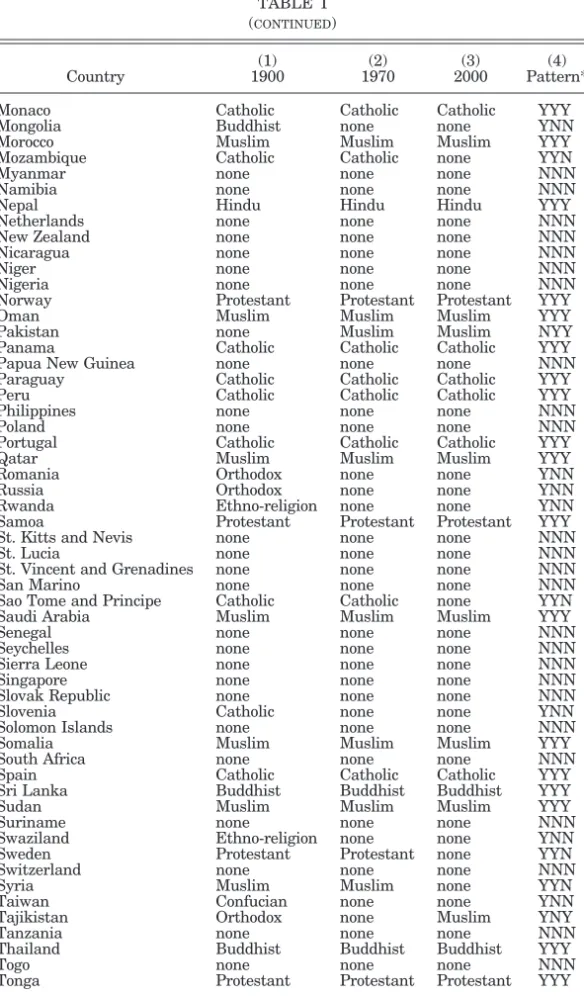
Table I shows the data on state religion in 1900, 1970, and 2000 for 188 countries. In terms of transitions, the 188 countries break down into seven groups. Group 1, 72 countries, maintained no form of state religion throughout, that is, in 1900, 1970, and 2000. Examples are Australia, Canada, France,4Germany,
Mex-ico, and the United States.5 Group 2, 58 countries, had a state
religion at all three dates: 1900, 1970, and 2000.6Each of these
countries maintained only one type of state religion at the three dates: 21 had Catholic state religions, 22 had Muslim, 9 had Protestant (including Anglican), 1 had Orthodox, 4 had Buddhist, and 1 had Hindu.
The remaining 58 countries had some kind of transition for state religion between 1900 and 2000. Among these, 12 countries had two transitions; therefore, our data set has 70 transitions overall. Group 3, 29 countries, had state religions in 1900, aban-doned state religion by 1970, and did not reinstitute state religion
3. The 189 countries in 1970 include East and West Germany as separate entities. Many of the 188 independent countries that existed in 2000 were not independent in 1970 and, even more so, in 1900. For countries that were not independent in 1970 or 1900, the designation of state religion pertains to the regime applying to the comparable region. Some of these regions were colonies— for example, in Africa—and others were parts of larger countries—for example, republics of the Soviet Union or Yugoslavia in 1970 or pieces of the Ottoman Empire in 1900.
4. The French Republic separated completely from the Catholic Church in 1905. However, under the Third Republic, which started in 1871, there was a gradual movement toward universal and secular education. Probably for this reason, Barrett labels France as not officially Catholic in 1900. We think it would have been better to classify France as having a Catholic state religion in 1900.
5. In the colonial period, the Anglican Church was the official religion of the largest number of colonies, notably in the South. The Congregational Church (related to Presbyterianism) dominated in New England, except for Rhode Island, which lacked an official religion. The Congregational Church was not disestab-lished until 1818 in Connecticut, 1819 in New Hampshire, and in two parts—in 1824 and 1833—in Massachusetts. The U. S. prohibition against establishment of an official religion, a part of the Bill of Rights, was not applied to state govern-ments until the extension of the equal-protection clause of the Fourteenth Amend-ment to state governAmend-ments starting in the late 1800s. This extension culminated in a Supreme Court decision in 1934. For discussions, see Norman [1968, Chap-ters 1 and 2], Finke and Stark [1992, chapter 3], and Olds [1994].
6. We have not investigated in detail whether lapses in state religion oc-curred in these countries at other dates in the twentieth century. Two cases are Afghanistan lacking a state religion from the Marxist coup in 1978 until the rise of the Taliban in the mid-1990s and Cambodia lacking a state religion from the introduction of Communism in the mid-1970s until 1989.
TABLE I
INTERNATIONALPATTERNS OFSTATERELIGION
Country
(1) 1900
(2) 1970
(3) 2000
(4) Pattern*
Afghanistan Muslim Muslim Muslim YYY
Albania Muslim none none YNN
Algeria Muslim Muslim Muslim YYY
Andorra Catholic Catholic Catholic YYY
Angola Catholic Catholic none YYN
Antigua and Barbuda none none none NNN
Argentina Catholic Catholic Catholic YYY
Armenia Orthodox none Orthodox YNY
Australia none none none NNN
Austria none none none NNN
Azerbaijan Muslim none Muslim YNY
Bahamas Protestant Protestant Protestant YYY
Bahrain Muslim Muslim Muslim YYY
Bangladesh none Muslim Muslim NYY
Barbados Protestant Protestant none YYN
Belarus Orthodox none Orthodox YNY
Belgium none none none NNN
Belize none none none NNN
Benin Ethno-religion none none YNN
Bhutan Buddhist Buddhist Buddhist YYY
Bolivia Catholic Catholic Catholic YYY
Bosnia and Herzegovina none none none NNN
Botswana Protestant none none YNN
Brazil Catholic none none YNN
Brunei Muslim Muslim Muslim YYY
Bulgaria none none Orthodox NNY
Burkina Faso Ethno-religion none none YNN
Burundi Ethno-religion none none YNN
Cambodia Buddhist Buddhist Buddhist YYY
Cameroon none none none NNN
Canada none none none NNN
Cape Verde Catholic Catholic none YYN
Central African Republic Ethno-religion none none YNN
Chad Ethno-religion none none YNN
Chile Catholic none none YNN
China Confucian none none YNN
Colombia Catholic Catholic Catholic YYY
Comoros none none none NNN
Congo (Brazzaville) none none none NNN
Congo (Kinshasa) Catholic none none YNN
Costa Rica Catholic Catholic Catholic YYY
Cote d’Ivoire none none none NNN
Croatia Catholic none Catholic YNY
Cuba Catholic none none YNN
Cyprus none none none NNN
Czech Republic none none none NNN
Denmark Protestant Protestant Protestant YYY
Djibouti none none none NNN
Dominica none none none NNN
Dominican Republic Catholic Catholic Catholic YYY
Ecuador none none none NNN
Egypt Muslim Muslim Muslim YYY
El Salvador Catholic Catholic Catholic YYY
Equatorial Guinea Catholic none none YNN
Eritrea Orthodox Orthodox none YYN
Ethiopia Orthodox Orthodox none YYN
Fiji none none none NNN
Finland Protestant Protestant Protestant YYY
France none none none NNN
Gabon none none none NNN
Gambia none none none NNN
Georgia Orthodox none Orthodox YNY
Germany none none none NNN
Ghana none none none NNN
Greece Orthodox Orthodox Orthodox YYY
Grenada none none none NNN
Guatemala Catholic Catholic Catholic YYY
Guinea none none none NNN
Guinea-Bissau Catholic Catholic none YYN
Guyana none none none NNN
Haiti Catholic Catholic Catholic YYY
Honduras Catholic Catholic Catholic YYY
Hungary none none none NNN
Iceland Protestant Protestant Protestant YYY
India none none none NNN
Indonesia Protestant none none YNN
Iran Muslim Muslim Muslim YYY
Iraq Muslim Muslim Muslim YYY
Ireland Catholic Catholic none YYN
Israel none Jewish Jewish NYY
Italy Catholic Catholic Catholic YYY
Jamaica none none none NNN
Japan Buddhist** none none YNN
Jordan Muslim Muslim Muslim YYY
Kazakhstan Orthodox none none YNN
Kenya none none none NNN
Kiribati none none none NNN
Korea (North) Confucian none none YNN
Korea (South) Confucian none none YNN
Kuwait Muslim Muslim Muslim YYY
Kyrgyz Republic Orthodox none Muslim YNY
Laos Buddhist Buddhist none YYN
Latvia Orthodox none none YNN
Lebanon Muslim none none YNN
Lesotho none none none NNN
Liberia Protestant Protestant Protestant YYY
Libya Muslim Muslim Muslim YYY
Liechtenstein Catholic Catholic Catholic YYY
Lithuania Catholic none none YNN
Luxembourg Catholic Catholic Catholic YYY
Macedonia Orthodox none Orthodox YNY
Madagascar none none none NNN
Malawi none none none NNN
Malaysia Muslim Muslim Muslim YYY
Maldive Islands Muslim Muslim Muslim YYY
Mali none none none NNN
Malta Catholic Catholic Catholic YYY
Marshall Islands none none none NNN
Mauritania Muslim Muslim Muslim YYY
Mauritius none none none NNN
Mexico none none none NNN
Micronesia none none none NNN
Moldova Orthodox none Orthodox YNY
TABLE I (CONTINUED)
Country
(1) 1900
(2) 1970
(3) 2000
(4) Pattern*
Monaco Catholic Catholic Catholic YYY
Mongolia Buddhist none none YNN
Morocco Muslim Muslim Muslim YYY
Mozambique Catholic Catholic none YYN
Myanmar none none none NNN
Namibia none none none NNN
Nepal Hindu Hindu Hindu YYY
Netherlands none none none NNN
New Zealand none none none NNN
Nicaragua none none none NNN
Niger none none none NNN
Nigeria none none none NNN
Norway Protestant Protestant Protestant YYY
Oman Muslim Muslim Muslim YYY
Pakistan none Muslim Muslim NYY
Panama Catholic Catholic Catholic YYY
Papua New Guinea none none none NNN
Paraguay Catholic Catholic Catholic YYY
Peru Catholic Catholic Catholic YYY
Philippines none none none NNN
Poland none none none NNN
Portugal Catholic Catholic Catholic YYY
Qatar Muslim Muslim Muslim YYY
Romania Orthodox none none YNN
Russia Orthodox none none YNN
Rwanda Ethno-religion none none YNN
Samoa Protestant Protestant Protestant YYY
St. Kitts and Nevis none none none NNN
St. Lucia none none none NNN
St. Vincent and Grenadines none none none NNN
San Marino none none none NNN
Sao Tome and Principe Catholic Catholic none YYN
Saudi Arabia Muslim Muslim Muslim YYY
Senegal none none none NNN
Seychelles none none none NNN
Sierra Leone none none none NNN
Singapore none none none NNN
Slovak Republic none none none NNN
Slovenia Catholic none none YNN
Solomon Islands none none none NNN
Somalia Muslim Muslim Muslim YYY
South Africa none none none NNN
Spain Catholic Catholic Catholic YYY
Sri Lanka Buddhist Buddhist Buddhist YYY
Sudan Muslim Muslim Muslim YYY
Suriname none none none NNN
Swaziland Ethno-religion none none YNN
Sweden Protestant Protestant none YYN
Switzerland none none none NNN
Syria Muslim Muslim none YYN
Taiwan Confucian none none YNN
Tajikistan Orthodox none Muslim YNY
Tanzania none none none NNN
Thailand Buddhist Buddhist Buddhist YYY
Togo none none none NNN
by 2000. Examples are Brazil and Chile (which dropped the Catholic state church), Turkey (Muslim), Indonesia (which dropped the Dutch Reformed Church imposed by the former colonial ruler), Russia (Orthodox), Japan (Shinto), and China and
Trinidad and Tobago none none none NNN
Tunisia Muslim Muslim Muslim YYY
Turkey Muslim none none YNN
Turkmenistan Orthodox none Muslim YNY
Uganda none none none NNN
Ukraine Orthodox none Orthodox YNY
United Arab Emirates Muslim Muslim Muslim YYY
United Kingdom Protestant Protestant Protestant YYY
United States none none none NNN
Uruguay none none none NNN
Uzbekistan Orthodox none Muslim YNY
Vanuatu none none Protestant NNY
Venezuela Catholic Catholic Catholic YYY
Vietnam none none none NNN
Yemen Muslim Muslim Muslim YYY
Yugoslavia (Serbia) none none none NNN
Zambia none none none NNN
Zimbabwe none none none NNN
Total observations 188 189† 188
No state religion total 77 116† 113
Buddhist total 7 5 4
Catholic total 35 27 22
Confucian total 4 0 0
Ethno-religion total 7 0 0
Hindu total 1 1 1
Jewish total 0 1 1
Muslim total 31 25 29
Orthodox total 13 3 8
Protestant total 13 11 10
Summary of transitions for 1900, 1970, 2000: Group 1 (no state religion throughout, NNN)⫽72 Group 2 (state religion throughout, YYY)⫽58 Group 3 (dropped state religion by 1970, YNN)⫽29
Group 4 (dropped state religion between 1970 and 2000, YYN)⫽12 Group 5 (dropped state religion by 1970, reinstated by 2000, YNY)⫽12 Group 6 (introduced state religion by 1970, NYY)⫽3
Group 7 (introduced state religion between 1970 and 2000, NNY)⫽2 * Y means some type of state religion and N means no state religion. ** Shinto.
† East and West Germany included separately, each with no state religion.
Data are from Barrett [1982, pp. 800 – 801] and Barrett, Kurian, and Johnson [2001, pp. 834 – 835], from which a number of typos were corrected. We added the information that Cambodia reinstated a Buddhist state religion in 1989, Sweden dropped its Lutheran state religion in 2000, and Bulgaria adopted an Orthodox state religion in 2001 (treated as the 2000 status in our table).
Some transitions that cannot be seen in the tabulations for 1900, 1970, 2000 are as follows. Afghanistan lacked a state religion from 1978 until the mid-1990s. Cambodia lacked a state religion from the mid-1970s until 1989. Bangladesh lacked a state religion from 1972 (the time of independence from Pakistan) until 1975. For the United Kingdom, England has Anglican, and Scotland has Presbyterian. The Anglican religion was disestablished in Ireland in 1869 and in Wales in 1919.
Barrett designations with which we disagree but nevertheless accepted are as follows. We would have classified Ireland as lacking a state religion in 1900 (when it was part of the United Kingdom). We would have classified France as having a Catholic state religion in 1900 (before the final break with the Catholic Church in 1905). We would have classified Guatemala as lacking a state religion in 2000 (following the new constitution in 1993 and de facto changes thereafter).
Korea (Confucianism). Group 4, 12 countries, had state religion in 1900 and abandoned state religion between 1970 and 2000. This group includes Ireland (which dropped Catholic7), Syria
(Mus-lim), and Sweden (Protestant).
Group 5, 12 countries, had a state religion in 1900, dropped the state religion by 1970, but then reinstated a state religion by 2000. These cases are all former republics of the Soviet Union or Yugoslavia. Four Asian countries that were previously parts of the Soviet Union had Orthodox state religions in 1900 (as parts of the Russian empire) but adopted Muslim state religions by 2000. Five other former Soviet republics, including Armenia and Ukraine, reinstated an Orthodox state religion by 2000. Croatia had a Catholic state religion in 1900 and 2000 but no state religion, as part of Yugoslavia, in 1970.
The final two groups had no state religion in 1900 but intro-duced one by 1970 (three cases) or 2000 (two cases). The three countries that adopted a state religion by 1970 were not indepen-dent entities in 1900: Bangladesh8 and Pakistan, which
insti-tuted a Muslim state religion, and Israel, which adopted a Jewish state religion. The two countries that adopted between 1970 and 2000 are Vanuatu, which introduced a Protestant state religion upon independence in 1979, and Bulgaria, which established the Orthodox Church (in 2001, rather than 2000).9
II. THEORY OF THECHOICE OF ASTATERELIGION
We start with an unregulated market for religion goods. Within this setting, the outcome will sometimes be a monopoly; that is, the unregulated market may be a natural monopoly. A critical element for natural monopoly is the presence of large fixed costs, such as those applicable to the creation and dissemi-nation of a set of religious beliefs. Relative to these fixed costs, the
7. Our classification follows Barrett’s designation of Ireland as having a Catholic state church in 1900 and 1970. However, the official status of the Catholic Church in Ireland was not established until after Irish independence in 1921. Moreover, the Anglican Church was disestablished in Ireland in 1869. Therefore, it would have been preferable to treat Ireland as lacking a state religion in 1900 and having one in 1970. A 1972 referendum eliminated the Catholic Church’s official status in Ireland.
8. Bangladesh lacked a state religion from the time of its independence from Pakistan in 1972 until the military coup of 1975.
9. Barrett classifies Bulgaria as not having an Orthodox state religion in 1900, when the country was subject to competing influences from the Russian and Ottoman empires.
marginal costs of membership and participation are likely to be small and would not tend to be increasing. Therefore, if people view alternative religions as close substitutes, a single type of religion might prevail in equilibrium. Within this setting, we can assess how changes in exogenous variables affect the likelihood of the monopoly outcome. We argue subsequently that analogous forces motivate a government to enforce a monopoly, that is, to establish a state religion.
II.A. Hotelling Model of Unregulated Competition in Religions An important constraint on the monopoly of religion goods is heterogeneity in individuals’ preferences. This diversity applies to religious doctrine and tradition, to degrees of strictness, and so on. We model this heterogeneity with Hotelling’s [1929] spatial model of variety, previously applied to religion denominations by Montgomery [2003].
Suppose that consumerihas religion preferencexi, arrayed
along a straight line, (0,x). We assume that each religion pro-vider can offer only a single variety. Therefore, a monopolist supplies only one type of religion (possibly changing over time), and the availability of multiple types requires more than one religion, that is, the absence of monopoly.
Assume that religion provider jis located atxj and charges
the price Pj for religion goods. Consumer i’s effective price for
goods purchased from firm j, P*ij, is increasing in the “distance,” 兩xi⫺ xj兩. We can represent this effective price by
(1) P*ij⫽Pj⫹f共兩xi⫺xj兩兲,
where f is an increasing function. Given the prices, Pj and
locations xj, consumer i buys from the provider who offers the
lowest effective price P*ij. The quantity bought is given from a downward-sloping demand curve (unlike in the standard Hotel-ling model, where consumers buy either zero or one unit of the good). We assume, only for simplicity, that each individual has the same form of demand function; that is, differences across individuals are captured fully by thexi. Given the locations of all
providers, each firm chooses its pricePjto maximize profit, given
the prices of the other firms (Bertrand competition). We assume that costs of provision,c, are constant and the same for all firms. At an earlier stage, the religion firms that have chosen to enter the market select their locationsxj. We assume that firms
given the positions of the otherxjand given the dependence of the
prices Pj, on x1. An additional firm enters the market if the
prospective present value of profit exceeds its fixed cost, assumed to be the same for all firms. We let Nˆ represent the number of firms that arises in equilibrium.
An important assumption in the model is religious tolerance, in the sense that individual utility depends only on the quantity and type of a person’s own religion good and not on the quantities and types of religion goods consumed by others. The model also neglects network externalities or other spillovers—such as rein-forcing beliefs—that cause adherents to a particular religion to benefit from the participation of other persons in the same type of religion. However, the structure of fixed costs with constant mar-ginal costs provides analogous reasons for economies of scale.
For present purposes, we are not interested in the full equi-librium of the Hotelling model. Rather, we are interested in factors that determine the probabilities of the three possible types of outcomes:
● Nˆ ⬎ 1, which represents diversity of religion,
● Nˆ ⫽ 1, which represents a monopoly religion, and
● Nˆ ⫽ 0, which represents nonreligion.
Our primary interest is in conditions that generate a monopoly religion provider,Nˆ ⫽1. However, it is worth stressing that this outcome is contending with alternatives on both sides, that is, Nˆ ⬎ 1 and Nˆ ⫽ 0.
The monopoly outcome arises when one producer makes profit but a second provider cannot profitably enter the market. It is straightforward that the monopoly equilibrium will be more likely to hold when the distribution of individual preferences,xi,
is more compressed. In the limiting case, where everyone has the same preferences, all customers want the same type of religion good. In general, for given fixed costs and forms of demand func-tions, more similarity in preferences makesNˆ ⫽1 more likely to hold.
Two other straightforward results are that Nˆ is higher the lower the fixed cost of being a religion provider and the greater the scale of the market (in the sense of the number of persons and the per capita demands for religion goods). Therefore, if we con-sider only the choice between Nˆ ⫽ 1 and Nˆ ⬎ 1, the monopoly outcome is more likely the higher fixed costs and the smaller the scale of demand. However, these conclusions are reversed if the
religion market contracts to the extent thatNˆ ⫽ 0 becomes the alternative to Nˆ ⫽ 1.
When a monopoly outcome prevails, Nˆ ⫽ 1, the provider’s chosen locationx1is central relative to the distribution of thexi.
In contrast, if the distribution of preferences is highly dispersed, if fixed costs are low, and if the scale of the market is large, the equilibrium features two or more providers with spacing between them.
II.B. Government
We consider in this section why the government might want the number of religion providers, N, to deviate from the free-market choiceNˆ. One reason is externalities in beliefs—an indi-vidual’s beliefs may be enhanced when other people hold similar views. These spillovers could motivate a benevolent government to support an official religion as a way of strengthening faith— and, thereby, making the typical person happier. Similar influ-ences might arise from network externalities, for example, com-munication benefits from citizens sharing a common institution, such as a designated religion.10
The government may also respond to religious intolerance, modeled as a dependence of individual utility on other persons’ religious practices and beliefs. Specifically, an individual may lose utility when other people practice different faiths. Viewed this way, religious intolerance is similar to externalities in be-liefs. Thus, intolerance of individuals would motivate the govern-ment—possibly still benevolent—to favor the majority religion by subsidizing its practices and by restricting religious expression of minorities. These subsidies and restrictions are hallmarks of a state religion.
Stark [2001, 2003] argues that religious intolerance is espe-cially powerful in the three principal monotheistic faiths—Jew-ish, Christian, and Muslim. Stark’s argument, motivated more by the Old Testament than the Enlightenment, is that these
reli-10. The literature on product variety, summarized in Mankiw and Whinston [1986], provides additional reasons why the unregulated outcome may not be socially optimal. The excess of price over marginal cost in these models (and in the Hotelling model) means that, for a given number of religion firms, the quantity of religion goods is inefficiently low. In addition, the number of firms,Nˆ, typically differs from the socially optimal number. The unregulated number tends to be too small because an entrant counts only part of the social surplus from expanded variety. However, an offsetting force is that an entrant counts as private reward the profit taken from incumbent firms, whereas a benevolent government ex-cludes this “business-stealing effect.”
gions regard their own faith as essential for salvation and are therefore likely to press for a state religion as a way to suppress “inappropriate” worship by others. According to Stark [2003, p. 32], “Those who believe there is only One True God are offended by worship directed toward other Gods.” Thus, his argument predicts that a state religion is more likely when the main reli-gion is monotheistic.
Aspects of constitutional and legal structure would influence the ability of the government to restrict religious expression of minorities. For example, the constitution or legal history might commit the government to maintaining civil liberties, including religious freedoms. These constraints inhibit differential treat-ment of majority and minority religions and, thereby, make state religion less likely or, at least, less meaningful. However, the empirical challenge is to isolate exogenous dimensions of legal structure that influence the probability of state religion. The favoring of civil liberties and the maintenance of religious free-doms would typically emerge simultaneously as parts of liberal regimes.
From a political standpoint, the government—not necessar-ily benevolent—might want to use organized religion as a coop-erative force for controlling the citizenry. This control might be facilitated by having a monopoly religion. Exogenous features of the political system, such as separation of powers between the executive and other branches, would affect the government’s abil-ity to collude with private groups, such as organized religion. Thus, on these grounds, more separation of powers makes state religion less likely.
Alternatively, organized religion may be a competing force that the government seeks to constrain. This competition typifies Communism, a regime in which antireligion is a central tenet. Communist countries, such as the Soviet Union, East Germany, and China, attempted to destroy organized religion partly on ideological grounds and partly as a way to weaken or eliminate organized competition with state power. In the Soviet Union and East Germany, the government promoted “scientific atheism” to reinforce opposition to standard religion.11Since we do not count
atheism as a religion, we think of Communist governments as attempting to enforce the outcomeN⫽0, that is, nonreligion. We
11. See Froese and Pfaff [2003] for a discussion of East Germany and Froese [2004] for an analysis of the Soviet Union.
therefore predict that the probability of state religion, N⫽ 1, is low under Communism.12Note, however, thatN ⫽ 1 is unlikely
not because Communist governments push the outcome toward religion diversity,N⬎ 1, but, rather, toward nonreligion,N⫽0. Our empirical analysis includes the presence of a Communist regime as an explanatory variable. In practice, the antireligion nature of Communist regimes is so powerful that our sample contains only one example of a Communist government with a state religion—Somalia with a Muslim state religion in 1970. We treat the presence of Communism as exogenous with respect to state religion. In particular, we do not allow for the possibility that the extent of religiosity—which influences the probability of state religion—affects the likelihood that a Communist regime would come to power. We also investigate whether Communism has an influence on state religion that persists after the end of the Communist regime.
In the previous section we described a number of exogenous variables that affectNˆ and, thereby, the likelihood of monopoly in an unregulated setting. A key point is that these variables influ-ence in a similar way the number of religion firms sought by the government. Suppose, for example, thatNˆ is high because indi-vidual religion preferences, xi, are highly dispersed or because
the fixed costs of religions are low or because the overall scale of demand is high. In these cases, the government will find it costly to enforce a monopoly religion, that is, to have a state religion. Thus, our previous predictions about effects on the probability of state religion still apply even in the presence of a government that may or may not be benevolent.
II.C. Empirical Implementation
We use the observed dispersion of religion adherence shares to get an empirical measure of the distribution of preferences over types of religion. Our enumeration of adherence in 1900, 1970, and 2000 comes from Barrett [1982] and Barrett, Kurian, and Johnson [2001]. We use an eleven-way breakdown: Catholic,
12. If we instead viewed Communism as its own religion, we would get that the probability of state religion under Communism is high. In our earlier research we found that the presence of state religion— defined to exclude Communism as a religion—raised customary religious beliefs, such as in an afterlife, which in turn enhanced economic growth. Communism does not work this way. That is, the beliefs supported by Communism are antithetical to an afterlife and are likely to detract from economic growth. For this reason, we think it advisable to stick with the usual classification of Communism as not being a religion.
Protestant, Orthodox, other Christian, Muslim, Jewish, Hindu, Buddhist, other Eastern religion, other religion, and nonreligion (which includes atheists).13One limitation of the Barrett data is
that they do not systematically break down Muslim adherence by type. We use other sources to get a rough breakdown in 2000 among Sunni, Shia, and other forms.14
The principal variable that we use is the square of the frac-tion of the populafrac-tion that adheres to the most popular religion. This variable, which we call the main-religion variable, can be interpreted as the probability that two randomly selected persons belong to a country’s most popular religion. The numbers that we get for the main-religion variable depend, to some extent, on the groupings used. If the data were available, we could think of starting from a much finer division than the eleven-way one we used and then attempt to assess the distances between the groups in the sense of the relevant cumulative pressure for having a state religion. We go a little bit in this direction by examining whether the Muslim population is best treated as a single group (as in our main analysis) or, instead, as three distinct subgroups. Similarly, we assess whether the Christian population is best viewed as four distinct subgroups (as in our main analysis) or, instead, as an amalgam of Catholic, Protestant, other Christian, and Orthodox.
The Hotelling model says that the greater the concentration of religion adherence the more likely that the unregulated market will have a monopoly religion, Nˆ ⫽ 1. Based on our earlier reasoning, this effect implies that a state religion,N⫽1, is more probable. We also allow for the endogeneity of religion concentra-tion, that is, for the possibility that state religion influences this concentration. We try to sort out the direction of causation by using religion concentration in 1900 as an instrument for concen-tration in 1970 and 2000.
Given the main-religion variable, we can also use the Hotel-ling model to assess the impact of the distribution of adherence to the remaining religions. When the adherence of this remaining
13. The Protestant category includes Anglican. The other Christian group comprises independent Christians, marginal Christians, such as Mormons and Jehovah’s Witnesses, and unaffiliated Christians. Buddhist includes Shinto. Hindu includes Jains and Sikhs.
14. The information comes from U. S. State DepartmentInternational Reli-gious Freedom Reportsfor 2001 and 2004, discussions in Barrett, Kurian, and Johnson [2001], Marshall [2000], andEncyclopedia Britannicaonline edition for 2004.
group is more concentrated, it is more likely that the market equilibrium would sustain a second religion; that is, state religion would belessprobable. For example, if the main religion has 50 percent of the population, state religion would be less likely if the remaining 50 percent were in one religion, rather than scattered among several types. Empirically, we assess this influence by including the square of the adherence share of the second most popular religion— called the second-religion variable. We should note that this specification departs from the common practice of using a Herfindahl index of, in this case, religion adherence shares. Our prediction is that the square of the main-religion adherence share has a positive effect on state-religion probability, whereas the square of the second-religion adherence share has a negative effect. The Herfindahl specification constrains the coef-ficients of these two variables (and of the square of other religion adherence shares) to be the same.
Consider the predictions for how state religion relates to the scale of the religion market. One straightforward determinant of market size is population. Higher population raises the scale of demand and tends, thereby, to increase the equilibrium number of religions, Nˆ, in the Hotelling model. Therefore, in the range where Nˆ ⫽ 0 is not a relevant alternative, the prediction is that higher population makes state religion less likely.
If we begin with a very small market, so thatNˆ ⫽0 applies, the conclusion is reversed. An increase in market size— caused, for example, by higher population—makes the monopoly out-come,Nˆ ⫽1, more probable. Thus, in this range, higher popula-tion makes state religion more likely.
Overall, the Hotelling model predicts a nonlinear relation-ship between population and state religion. For very small coun-tries, the relation is positive. However, once the population be-comes large enough to sustain at least one organized religion, the relation is negative. Since Nˆ ⫽ 0 is likely to be a relevant alternative only for very small countries, we anticipate that the effect of population on the probability of state religion would be negative in the main range of experience.
The positive relation between population and state religion for very small countries is analogous to the effect of market size on the propensity to regulate in the model developed by Mulligan and Shleifer [2005]. Their key assumption is that regulation entails fixed costs. We can apply this reasoning to religion if we think about the maintenance of a state religion as a form of
regulation. We then get that a lower scale of demand for religion goods— generated, for example, by a smaller population—makes it less likely that the government would find it worthwhile to administer a state religion. In other words, we can think of the outcomeNˆ ⫽ 0 in the Hotelling model not as literally no religion but as the absence of a formal structure in which the government maintains an official religion.
Another determinant of market size is per capita income, which we measure by real per capita GDP. The standard view is that richer countries are less likely to have state religions.15
However, the Hotelling model does not necessarily make this prediction. The key issue is whether an increase in per capita GDP raises or lowers the market demand for religion services. The secularization hypothesis predicts that economic develop-ment causes individuals to become less religious, and this view receives empirical support in international data; see, for example, Inglehart and Baker [2000] and Barro and McCleary [2006]. The principal finding is that increases in standard of living lead to small, but statistically significant, decreases in religious partici-pation and beliefs. Nevertheless, the effect on market demand is ambiguous because richer nations may spend less time on reli-gion but still spend more money on activities related to organized religion. Thus, the overall effect of an increase in per capita GDP on the equilibrium number of religion firms,Nˆ, is ambiguous in the Hotelling model. Consequently, per capita GDP has an am-biguous effect on the probability of state religion.
In the empirical analysis we treat population as exogenous with respect to state religion (thereby ignoring possible endoge-nous responses of migration and fertility). We allow for two-way causation between per capita GDP and state religion by using instrumental variables that predict per capita GDP and are ar-guably exogenous with respect to state religion. We use as instru-ments two geography measures—the absolute value of degrees latitude (which matters for climate and, thereby, for health and agriculture) and landlocked status (which matters for transpor-tation and trade).
With respect to political structure, we use information from Polity IV [Marshall and Jaggers 2003] on the overall polity index (the difference between “democracy” and “autocracy”) and on the
15. This idea—a part of the secularization hypothesis—appears in Weber [1930] and was extended in Wilson [1966], Berger [1967], and Chaves [1994].
extent of constraints on the chief executive. These variables may also be simultaneously determined with state religion. Therefore, we use as instruments measures of a country’s colonial heritage and legal origins.
III. EMPIRICALFINDINGS
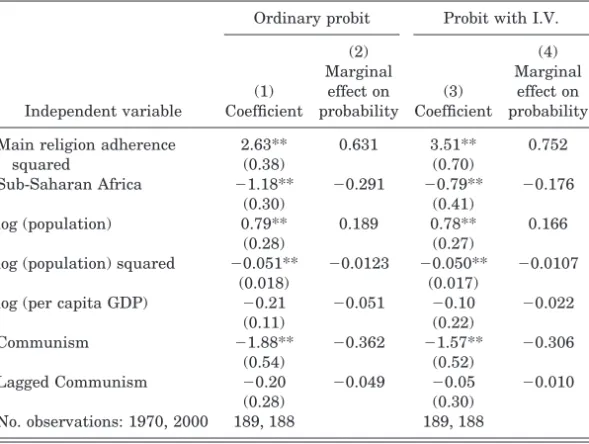
We focus on linear probability models for the presence of state religion in 1970 and 2000. A limitation of these linear specifications is that the fitted values for explaining state religion need not lie in the interval (0,1), as would be true for a probabil-ity. This problem can be handled by a binary-model specification, such as a probit form. The results from probit estimation are similar to those for the linear model. Since the linear models are more tractable, especially for instrumental estimation, we em-phasize these results.
III.A. Empirical Setup
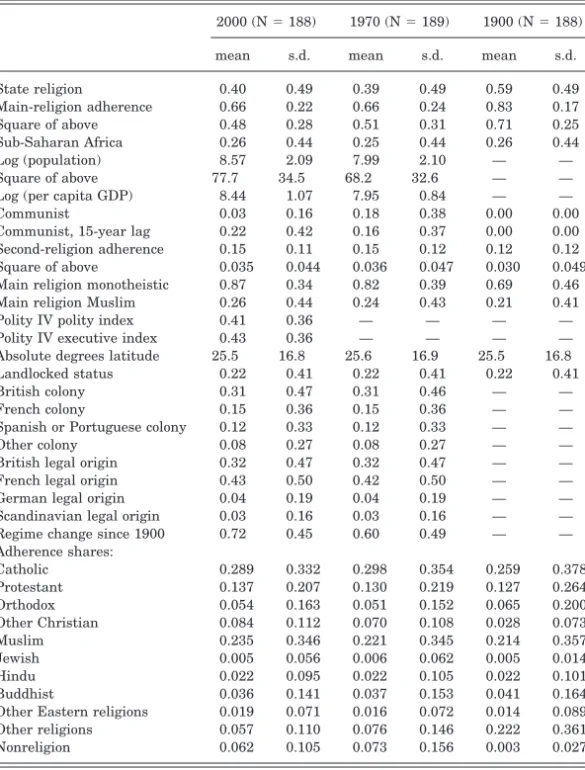
Table II shows means and standard deviations of the vari-ables used in the analysis. Table III gives estimates of linear probability models. The dependent variable is a (0,1) dummy for the presence of a state religion in 1970 or 2000. Thus, we inves-tigate only whether a state religion exists, not the form of state religion. The estimation treats the equations for state religion in 1970 and 2000 as a system, where the error terms for each country for the two years are allowed to be correlated. The method weighs countries the same, independently of size, geo-graphical proximity to other countries, and so on. The seemingly unrelated regression (SUR) systems neglect the potential endo-geneity of the right-hand-side variables. The three-stage least-squares (3SLS) systems allow for endogeneity of some of the explanatory variables. The sample for 2000 has 188 countries, and that for 1970 has 189 countries (with East and West Ger-many included separately).
One explanatory variable is the value in 1970 or 2000 of the main-religion variable (the square of the religion-adherence share of the most represented religion). The underlying data on religion adherence are subject to measurement error in all coun-tries. However, this problem is especially serious in sub-Saharan Africa. As an example, Barrett’s [1982, p. 527] discussion for Nigeria notes that lack of census information is a major problem. More significantly for our purposes, the Barrett classifications for
TABLE II
MEANS ANDSTANDARDDEVIATIONS OFVARIABLES(UNWEIGHTED AVERAGES ACROSS COUNTRIES)
2000 (N⫽188) 1970 (N⫽189) 1900 (N⫽188)
mean s.d. mean s.d. mean s.d.
State religion 0.40 0.49 0.39 0.49 0.59 0.49
Main-religion adherence 0.66 0.22 0.66 0.24 0.83 0.17
Square of above 0.48 0.28 0.51 0.31 0.71 0.25
Sub-Saharan Africa 0.26 0.44 0.25 0.44 0.26 0.44
Log (population) 8.57 2.09 7.99 2.10 — —
Square of above 77.7 34.5 68.2 32.6 — —
Log (per capita GDP) 8.44 1.07 7.95 0.84 — —
Communist 0.03 0.16 0.18 0.38 0.00 0.00
Communist, 15-year lag 0.22 0.42 0.16 0.37 0.00 0.00 Second-religion adherence 0.15 0.11 0.15 0.12 0.12 0.12 Square of above 0.035 0.044 0.036 0.047 0.030 0.049 Main religion monotheistic 0.87 0.34 0.82 0.39 0.69 0.46 Main religion Muslim 0.26 0.44 0.24 0.43 0.21 0.41
Polity IV polity index 0.41 0.36 — — — —
Polity IV executive index 0.43 0.36 — — — —
Absolute degrees latitude 25.5 16.8 25.6 16.9 25.5 16.8
Landlocked status 0.22 0.41 0.22 0.41 0.22 0.41
British colony 0.31 0.47 0.31 0.46 — —
French colony 0.15 0.36 0.15 0.36 — —
Spanish or Portuguese colony 0.12 0.33 0.12 0.33 — —
Other colony 0.08 0.27 0.08 0.27 — —
British legal origin 0.32 0.47 0.32 0.47 — —
French legal origin 0.43 0.50 0.42 0.50 — —
German legal origin 0.04 0.19 0.04 0.19 — —
Scandinavian legal origin 0.03 0.16 0.03 0.16 — —
Regime change since 1900 0.72 0.45 0.60 0.49 — —
Adherence shares:
Catholic 0.289 0.332 0.298 0.354 0.259 0.378
Protestant 0.137 0.207 0.130 0.219 0.127 0.264
Orthodox 0.054 0.163 0.051 0.152 0.065 0.200
Other Christian 0.084 0.112 0.070 0.108 0.028 0.073
Muslim 0.235 0.346 0.221 0.345 0.214 0.357
Jewish 0.005 0.056 0.006 0.062 0.005 0.014
Hindu 0.022 0.095 0.022 0.105 0.022 0.101
Buddhist 0.036 0.141 0.037 0.153 0.041 0.164
Other Eastern religions 0.019 0.071 0.016 0.072 0.014 0.089 Other religions 0.057 0.110 0.076 0.146 0.222 0.361
Nonreligion 0.062 0.105 0.073 0.156 0.003 0.027
The dummy variable for the presence of a state religion comes primarily from Barrett [1982] and Barrett, Kurian, and Johnson [2001]; see the text for discussion. Population numbers (in 1000s) are from World Bank, World Development Indicators.The main-religion variable is the share of the population that adheres to the most popular religion; the second-religion variable is the share of the second most popular religion. Main religion is monotheistic if a dummy variable for whether the most popular religion is Jewish, Christian, or Muslim. Main religion is Muslim if a dummy variable for whether the main religion is Muslim. Data on religion adherence are from Barrett, as above. GDP data (1996 dollars) are from Heston, Summers, and Aten [2002]. The dummy variable for a Communist regime is from Kornai [1992] and CIAWorld Fact Book;see the text. Polity IV data for 1965 are from Marshall and Jaggers [2003]. Data on latitude are from the web site: www.bcca.org/misc/qiblih/latlong_oc.html. Prior colonial status is from Barro [1997, Table 3.5]. Legal-origins variables are from La Porta et al. [1998]. The left-out category is socialist legal origin. The regime-change variable is a dummy variable for whether an independent country in 2000 had, since 1900, 1) achieved independence from a former colonial authority; 2) split off as an independent entity from a larger country; or 3) adopted or dropped a Communist regime.
sub-Saharan Africa seem to overclassify people as adhering to Christianity or Islam, as opposed to maintaining dual adherence with an indigenous faith.16 For this reason, the Barrett data
likely overstate the concentrations of religion adherence in 1970 and 2000. As an attempt to correct this problem, we include a dummy variable for sub-Saharan Africa. The three-stage least-squares estimates may also help to correct for measurement error. In some specifications, we add the second-religion variable (the square of the adherence share for a country’s second most popular religion).
Another explanatory variable is the presence of a Communist regime.17 We include contemporaneous and fifteen-year lags of
this variable (for 1970 and 1955 in the 1970 equation and for 2000 and 1985 in the 2000 equation).
To measure market size, we use the log of population. Since the Hotelling model implies a nonlinear relation between state religion and market size, we also include the square of the log of population.
We include the log of per capita GDP as an additional deter-minant of market size. However, as discussed before, the effect of per capita GDP on the demand for religion services is ambiguous. The data on GDP are the purchasing-power adjusted numbers from Heston, Summers, and Aten [2002]. Many countries lack these data—in our sample, 74 countries in 1970 and 40 in 2000. Moreover, the selection of which countries lack GDP data is not random—for example, only 5 of the 35 countries designated as
16. For unweighted averages of 48 sub-Saharan African countries that ex-isted in 2000, the Barrett data show that the fraction of the adhering population professing the Catholic religion rose from 0.06 in 1900 to 0.23 in 2000; the fraction Protestant, other Christian, or Orthodox rose from 0.04 to 0.28; the fraction Muslim increased from 0.20 to 0.30; and the fraction associated with indigenous and other religions fell from 0.69 to 0.16.
17. In 2000 we classified 5 of the 188 countries as having Communist re-gimes, based on the descriptions of governmental systems in CIA World Fact Book.The five are China, Cuba, Laos, North Korea, and Vietnam. In 1970 we used Kornai’s list [1992, Table 1.1] to classify 34 of 189 countries plus one-half of Vietnam as having Communist governments. Since our data for Vietnam are not separated into North and South, we entered the Communism dummy for Vietnam in 1970 as one-half, corresponding to the roughly equal breakdown of the popu-lation between North and South. Many of the Communist “countries” in 1970 were parts of larger states (republics of the Soviet Union and Yugoslavia) or were Eastern European countries that were heavily influenced by the Soviet Union. Also classified as Communist were China, Congo (Brazzaville), Cuba, Mongolia, North Korea, North Vietnam, and Somalia. South Yemen was also Communist in 1970, but our data for 1970 refer only to non-Communist North Yemen (roughly 80 percent of the combined population of Yemen). Our data for Communism in 1955 also come from Kornai’s list, and our data for Communism in 1985 come from
TABLE III
LINEARPROBABILITYMODELS FORSTATERELIGION IN1970AND2000 (COEFFICIENTS SHOWN WITH STANDARD ERRORS IN PARENTHESES)
(1) (2) (3) (4) (5) (6)
Estimation method SUR 3SLS SUR 3SLS SUR 3SLS
Main religion adherence squared
0.683** 1.007** 0.659** 1.173** 0.683** 1.087** (0.086) (0.165) (0.111) (0.272) (0.088) (0.174) Sub-Saharan Africa ⫺0.354** ⫺0.178* ⫺0.354** ⫺0.167 ⫺0.354** ⫺0.163 (0.072) (0.088) (0.072) (0.091) (0.072) (0.088) log (population) 0.187** 0.161* 0.186** 0.159* 0.187** 0.163* (0.064) (0.066) (0.064) (0.067) (0.064) (0.067) log (population)
squared
⫺0.0114** ⫺0.0098* ⫺0.0113** ⫺0.0095* ⫺0.0114** ⫺0.0101* (0.0040) (0.0041) (0.0040) (0.0042) (0.0040) (0.0042) log (per capita GDP) ⫺0.053* 0.015 ⫺0.055* 0.033 ⫺0.053* 0.031
(0.025) (0.036) (0.025) (0.040) (0.025) (0.037) Communism ⫺0.354** ⫺0.263** ⫺0.360** ⫺0.215* ⫺0.354** ⫺0.245**
(0.057) (0.071) (0.059) (0.092) (0.057) (0.072) Lagged Communism ⫺0.152* 0.005 ⫺0.156* 0.038 ⫺0.152* 0.023
(0.061) (0.073) (0.062) (0.086) (0.061) (0.074) Second religion
adherence squared
— — ⫺0.22 1.59 — —
(0.63) (1.69) Main religion is
monotheistic
— — — — ⫺0.001 ⫺0.157*
(0.063) (0.079) No. observations:
1970, 2000 189, 188 189, 188 189, 188 189, 188 189, 188 189, 188 R2
Communist in 1970 have data for 1970. Since the idea is to include an indicator of standard of living, rather than per capita GDP, per se, we used information on life expectancy at birth and other variables to construct proxies for the standard of living in
TABLE III (CONTINUED)
(7) (8) (9) (10) (11) (12)
Estimation method SUR 3SLS SUR 3SLS SUR 3SLS
Main religion adherence squared
0.631** 0.992** 0.667** 0.934** 0.650** 0.910** (0.090) (0.169) (0.087) (0.164) (0.086) (0.156) Sub-Saharan Africa ⫺0.359** ⫺0.181* ⫺0.351** ⫺0.183* ⫺0.355** ⫺0.188*
(0.072) (0.088) (0.072) (0.086) (0.071) (0.085) log (population) 0.176** 0.157* 0.225** 0.224* 0.215** 0.220* (0.064) (0.067) (0.082) (0.090) (0.082) (0.089) log (population)
squared
⫺0.0109** ⫺0.0096* ⫺0.0132** ⫺0.0129* ⫺0.0126** ⫺0.0127* (0.0039) (0.0041) (0.0047) (0.0051) (0.0047) (0.0050) log (per capita GDP) ⫺0.045 0.017 ⫺0.046 0.018 ⫺0.037 0.022
(0.025) (0.036) (0.026) (0.037) (0.025) (0.037) Communism ⫺0.357** ⫺0.264** ⫺0.352** ⫺0.268** ⫺0.354** ⫺0.270**
(0.056) (0.071) (0.056) (0.067) (0.056) (0.066) Lagged Communism ⫺0.151* 0.006 ⫺0.174** ⫺0.016 ⫺0.220** ⫺0.041 (0.061) (0.073) (0.062) (0.085) (0.065) (0.097) Main religion is
Muslim
0.115* 0.047 — — — —
(0.059) (0.072) Polity: constraints on
executive†
— — ⫺0.143 ⫺0.012 — —
(0.081) (0.166) Polity: overall polity
index†
— — — — ⫺0.258** ⫺0.068
(0.085) (0.166) No. observations:
1970, 2000 189, 188 189, 188 189, 188 189, 188 189, 188 189, 188 R2
: 1970, 2000 0.40, 0.38 0.37, 0.37 0.41, 0.38 0.39, 0.37 0.42, 0.39 0.40, 0.38
*p-valueⱕ0.05, **p-valueⱕ0.01.
† Observations with missing Polity data have the sample mean for the variable entered. A separate dummy variable (not shown) is included for these observations.
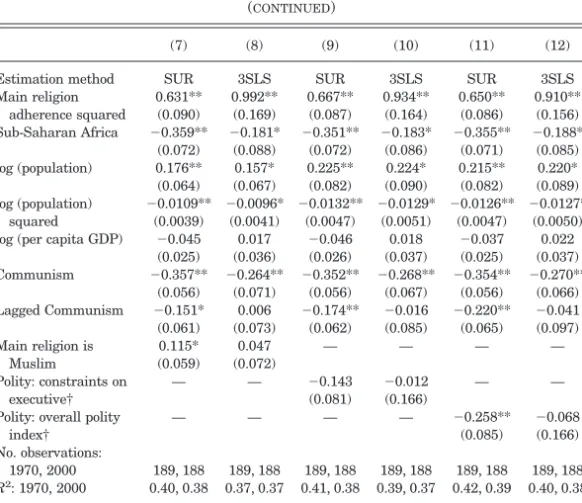
Constant terms are included but not shown. The dependent variable is a dummy for the presence of state religion in 1970 or 2000. The estimates weight each country equally. When the estimation method is denoted SUR, the equations are estimated using the seemingly unrelated technique, which allows for different error variances for the two periods and for correlation of the error terms over the periods for each country. When the estimation is denoted 3SLS, the equations are estimated using three-stage least-squares. The endogenous and instrumental variables are described below.
The following explanatory variables are for 1970 in the first equation and 2000 in the second equation: main and second religion squared, log of population, log of real per capita GDP, the dummy variable for a contemporaneous Communist regime, and the dummy variables for whether the main religion is monotheistic or Muslim. Lagged Communism is for 1955 in the 1970 equation and for 1985 in the 2000 equation. The Polity variables (from Polity IV, described in Marshall and Jaggers [2003]) are for 1965. These variables are measured on a (0,1) scale, with 0 denoting least constraints on the executive or least democratic. In column (2), the variables treated as endogenous are main-religion squared and log of per capita GDP. Instruments are main-religion squared in 1900, a dummy variable for landlocked status, and absolute degrees latitude. In column (4), second-religion squared is treated as endogenous, and second-religion squared in 1900 is added as an instrument. In columns (10) and (12), the Polity variables are treated as endogenous. The additional instruments are four dummy variables for legal origins (British, French, German, and Scandinavian) and four dummy variables for colonial history (former colony of Britain, France, Spain, or Portugal, and other rulers). The legal-origins variables are from La Porta et al. [1998].
countries that lack GDP data. Specifically, we use fitted values computed from regressions of the log of per capita GDP on the contemporaneous log of life expectancy at birth, the absolute value of degrees latitude, the dummy for landlocked status, and dummy variables for Communism. The R2 values for these
re-gressions are reasonably high— 0.70 in 1970 and 0.80 in 2000 — and the fitted values should serve adequately as proxies for the standard of living.18
From Polity IV [Marshall and Jaggers 2003] we used the indicator for constraints on the chief executive. The original scale from 1 to 7 was converted to 0 to 1, with 1 signifying the most constraints. We also used the overall polity index from Polity IV—the difference between the measures of democracy and au-tocracy. The original scale from⫺10 to⫹10 was converted to 0 to 1, with 1 signifying the most democracy or least autocracy. III.B. Linear Probability Models
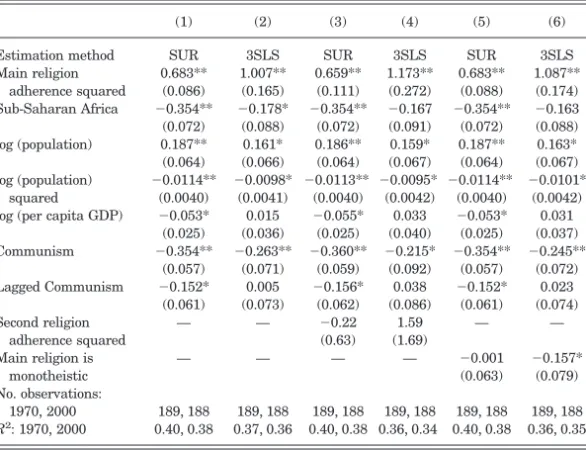
The baseline specification in Table III, columns (1) and (2), excludes political variables, except for Communism. For the SUR estimation in column (1), the main-religion variable has a statis-tically significant, positive coefficient. The point estimate of 0.68 means that a one-standard deviation increase in the square of the main-religion adherence share (by 0.28 in 2000, see Table II) raises the probability of state religion by 0.19. This result sup-ports the hypothesis that greater concentration of adherence in the main religion raises the probability of state religion. However, this interpretation assumes that the coefficient reveals the influ-ence from religion concentration to state religion, rather than the reverse. In the three-stage least-squares estimates, we treat the main-religion variable as endogenous.
The coefficient on the dummy variable for sub-Saharan Af-rica,⫺0.35 (s.e.⫽0.07), is significantly negative. Thus, for given concentration in the main religion, presence in sub-Saharan Af-rica is associated with a lower probability of state religion. As mentioned, our interpretation is that the main-religion variable, based on the reported religion adherence numbers, systemati-cally overstates the share of the main religion in sub-Saharan African countries.
18. Life expectancy has the most explanatory power in these regressions (positive). However, absolute degrees latitude is also important (positive), as is Communism in 1985 in the 2000 equation (negative).
For market size, the log of population has statistically sig-nificant effects on the probability of state religion. The effects are nonlinear in the way predicted by the Hotelling model: in Table III, column (1), the coefficient on the log of population is positive, 0.187 (s.e.⫽0.064) and that on the square is negative,⫺0.0114 (0.0040). These coefficients imply that, for very small countries, an increase in population raises the probability of state religion. However, when the population exceeds 3.6 million, the point estimates imply that an increase in population reduces the like-lihood of state religion. In 2000 the median population was 6.6 million, and 62 of the 188 countries had populations below 3.6 million. In 1970 the median was 4.2 million, with 88 of 189 below 3.6 million. Thus, a majority of countries—and a much larger majority of the world’s population—are in the range where higher population makes state religion less likely.
For the log of per capita GDP, the predicted effects on state religion were ambiguous because the impact of per capita GDP on the scale of the religion market was unclear. In Table III, column (1), the coefficient on the log of per capita GDP is significantly negative: ⫺0.053 (s.e. ⫽ 0.025). However, this result does not hold up in our instrumental estimation.
The contemporaneous presence of a Communist government has a statistically significant, negative effect, ⫺0.35 (s.e. ⫽ 0.06). Our sample has, in 1970, 34 of the 189 countries, plus one-half of Vietnam, classified Communist. In 2000, 5 of the 188 countries are designated Communist. As mentioned, the only one of these countries that had a state religion contemporaneously with Communism was Somalia in 1970.19
We also estimated lagged effects of Communism by entering a dummy variable for 1955 in the 1970 equation and for 1985 in the 2000 equation.20 The results show a significantly negative
coefficient,⫺0.15 (s.e. ⫽ 0.06), about half the magnitude of the contemporaneous effect. In our sample, the main distinctions between contemporaneous and lagged Communism come from the 28 countries in 2000 that were no longer Communist because of the collapses in the 1990s of the Soviet Union and Yugoslavia.
19. The autocrat Siad Barre, who came to power in Somalia in 1969, argued that his brand of socialism was consistent with Islam. Thus, initially, there were no changes in the official status of Islam. However, in the pursuit of “scientific socialism” in the 1970s, Siad Barre moved increasingly to weaken the political influence of religious leaders.
20. The 1985 value of the Communism dummy for unified Germany is set to 0.20, the population share of the eastern parts.
Thus, the estimated coefficient on the lagged Communism vari-ables suggests that the negative influence of Communism on state religion has about 50 percent persistence after ten years.21 The 3SLS estimates in Table III, column (2), treat the main-religion variable and the log of per capita GDP as endogenous. One instrument is a long lag of the main-religion variable—the value applying in 1900. We would prefer to use instruments related to the main-religion variable other than long lags but have not come up with any.22The instrument list also includes
the two geography measures mentioned before—the absolute value of degrees latitude and the dummy variable for landlocked status.
We can examine first-stage regressions to gauge the explana-tory power of the instruments for the endogenous variables. For the main-religion variables in 2000 and 1970, the R2 values for the first-stage equations are 0.4 – 0.5. The most important explana-tory variable in these regressions is the main-religion variable for 1900, which has significantly positive coefficients: 0.59 (s.e. ⫽ 0.07) in the 1970 equation and 0.52 (0.07) in the 2000 equation. The other important explanatory variable is the dummy variable for sub-Saharan Africa, which is significantly negative.
For the log of per capita GDP in 1970 and 2000, theR2values in the first-stage regressions are 0.5– 0.7. The significant vari-ables are the absolute value of degrees latitude (positive), the dummy for sub-Saharan Africa (negative), the dummy for land-locked status (negative), and the dummy for lagged Communism (negative).
Comparing columns (1) and (2) of Table III, one difference is that the point estimate of the coefficient on the main-religion
21. These results hold constant the adherence share of the main religion, but another channel for persisting influence of Communism on state religion involves religion adherence. Communism tends particularly to shift persons away from adherence to any religion and toward nonreligion. For example, Russia had an Orthodox state religion in 1900 when the adherence shares were 76 percent in the main religion—Orthodox—and 0 percent nonreligion. Under Communism, these numbers went by 1970 to 28 percent Orthodox and 52 percent nonreligion. Then, after the fall of Communism, the Orthodox share recovered by 2000 to 50 percent, and the nonreligion share fell to 33 percent. Thus, the effect of Communism on religion adherence, particularly nonreligion, seems to die out gradually and may not be permanent. We are presently studying the dynamic effects of Communism on religion adherence.
22. One possibility would be the composition of cumulated immigration. However, we lack the data to implement this idea.
variable is higher under 3SLS than under SUR.23This result may
be surprising because, if there were a positive reverse effect of state religion on adherence to the main religion, the SUR esti-mate would tend to be biased upward. The likely explanation is that the instrumentation corrects for measurement error, which is important in the data on religion adherence. This error tends to bias the SUR coefficient on the main-religion variable toward zero. This interpretation may also explain why the 3SLS results show a coefficient of smaller magnitude for the sub-Saharan African dummy. In the SUR estimation, the African dummy likely serves as a proxy (in a negative direction) for true religion concentration.
The coefficient on the log of per capita GDP was negative and marginally significant in the SUR results (Table III, column (1)) but is insignificantly positive in the 3SLS estimates (column (2)).24The likely explanation is that the coefficient of the GDP
variable in the SUR estimation is biased downward because of a negative effect of state religion on per capita GDP. If we enter the state-religion dummy variable for 1900 into the first-stage regres-sions for the log of per capita GDP, the coefficients are ⫺0.26 (s.e. ⫽ 0.09) in the 1970 equation and⫺0.14 (0.10) in the 2000 equation.
The coefficient of lagged Communism was significantly posi-tive in the SUR estimation (Table III, column (1)) but is essen-tially zero in the 3SLS results (column (2)). Note that current and lagged Communism are included in the instrument lists. There-fore, the different results reflect the interaction between lagged Communism and the instrumentation for the endogenous
vari-23. Our main-religion variable uses the concept that emerges naturally from the underlying theory—the share of adherents to the most popular religion in total population. Arguably, a less endogenous variable is the share of adherents to the most popular religion in the population that adheres to some religion, that is, after excluding the fraction designated as nonreligion. If we replace the main-religion variable in the SUR estimates (Table III, column (1)) by this alternative concept, we get a somewhat lower coefficient on the main-religion variable (0.607,
s.e.⫽0.085) and a slightly poorer fit (R2values of 0.38 in 1970 and 0.37 in 2000). A better procedure is to modify the three-stage least-squares estimation (Table III, column (2)) to retain the original main-religion variable but to replace the associated instrument with the main-religion variable for 1900 calculated from the share in the population that adheres to some religion. This procedure yields results that are very close to those reported in Table III, column (2).
24. One concern is that, over long periods, landlocked status is endogenous because it reflects changes in country borders. For example, Bolivia currently lacks access to the sea because it lost its coastline in a war with Chile in the late 1800s. Moreover, this military defeat might be related to Bolivia’s potential per capita GDP. The results change little if we drop the landlocked dummy variable from the instrument lists.