Orthogonal Bases and the QR Algorithm
by Peter J. Olver
University of Minnesota
1. Orthogonal Bases.
Throughout, we work in the Euclidean vector space V = Rn, the space of column vectors withnreal entries. As inner product, we will only use the dot productv·w=vTw and corresponding Euclidean norm kvk=√v·v.
Two vectorsv,w∈V are called orthogonal if their inner product vanishes: v·w= 0. In the case of vectors in Euclidean space, orthogonality under the dot product means that they meet at a right angle. A particularly important configuration is when V admits a basis consisting of mutually orthogonal elements.
Definition 1.1. A basisu1, . . . ,unofV is calledorthogonal ifui·uj = 0 for alli 6=j. The basis is called orthonormal if, in addition, each vector has unit length: kuik= 1, for all i= 1, . . . , n.
The simplest example of an orthonormal basis is the standard basis
e1 =
1 0 0 .. . 0 0
, e2 =
0 1 0 .. . 0 0
, . . . en =
0 0 0 .. . 0 1
.
Orthogonality follows because ei·ej = 0, for i 6=j, while keik= 1 implies normality. Since a basis cannot contain the zero vector, there is an easy way to convert an orthogonal basis to an orthonormal basis. Namely, we replace each basis vector with a unit vector pointing in the same direction.
Lemma 1.2. If v1, . . . ,vn is an orthogonal basis of a vector space V, then the normalized vectors ui =vi/kvik,i = 1, . . . , n, form an orthonormal basis.
Example 1.3. The vectors v1 =
12
−1
, v2 =
01
2
, v3 =
−52
1
,
are easily seen to form a basis ofR3. Moreover, they are mutually perpendicular,v
1·v2 = v1 ·v3 = v2·v3 = 0, and so form an orthogonal basis with respect to the standard dot
product on R3. When we divide each orthogonal basis vector by its length, the result is the orthonormal basis
u1=√1 6
12
−1
=
1 √ 6 2 √ 6 −√1
6
, u2= 1 √ 5
01
2
=
0 1 √ 5 2 √ 5
, u3= 1 √
30
−52
1
=
5 √
30 −√2
30 1 √
30
,
satisfying u1·u2 =u1·u3 =u2·u3 = 0 andku1k=ku2k=ku3k= 1. The appearance of square roots in the elements of an orthonormal basis is fairly typical.
A useful observation is that any orthogonal collection of nonzero vectors is automati-cally linearly independent.
Proposition 1.4. If v1, . . . ,vk ∈ V are nonzero, mutually orthogonal elements, so
vi 6=0 and vi·vj = 0 for all i6= j, then they are linearly independent.
Proof: Suppose
c1v1+ · · · +ckvk =0.
Let us take the inner product of this equation with any vi. Using linearity of the inner product and orthogonality, we compute
0 =c1v1+ · · · +ckvk·vi =c1v1·vi+ · · · +ckvk·vi =civi·vi =cikvik2.
Therefore, provided vi 6= 0, we conclude that the coefficient ci = 0. Since this holds for all i= 1, . . . , k, the linear independence of v1, . . . ,vk follows. Q.E.D.
As a direct corollary, we infer that any collection of nonzero orthogonal vectors forms a basis for its span.
Theorem 1.5. Suppose v1, . . . ,vn ∈V are nonzero, mutually orthogonal elements of an inner product space V. Then v1, . . . ,vn form an orthogonal basis for their span
W = span{v1, . . . ,vn} ⊂ V, which is therefore a subspace of dimension n= dimW. In particular, if dimV =n, then v1, . . . ,vn form a orthogonal basis for V.
Computations in Orthogonal Bases
What are the advantages of orthogonal and orthonormal bases? Once one has a basis of a vector space, a key issue is how to express other elements as linear combinations of the basis elements — that is, to find their coordinates in the prescribed basis. In general, this is not so easy, since it requires solving a system of linear equations. In high dimensional situations arising in applications, computing the solution may require a considerable, if not infeasible amount of time and effort.
However, if the basis is orthogonal, or, even better, orthonormal, then the change of basis computation requires almost no work. This is the crucial insight underlying the efficacy of both discrete and continuous Fourier analysis, least squares approximations and statistical analysis of large data sets, signal, image and video processing, and a multitude of other applications, both classical and modern.
Theorem 1.6. Let u1, . . . ,un be an orthonormal basis for an inner product space
V. Then one can write any element v∈V as a linear combination
v=c1u1+ · · · +cnun, (1.1)
in which its coordinates
ci =v·ui, i= 1, . . . , n, (1.2)
are explicitly given as inner products. Moreover, its norm
kvk=
q c2
1+ · · · +c2n =
v u u t
n
X
i= 1
v·ui2 (1.3)
is the square root of the sum of the squares of its orthonormal basis coordinates.
Proof: Let us compute the inner product of (1.1) with one of the basis vectors. Using the orthonormality conditions
ui·uj =
0 i
6
=j,
1 i =j, (1.4)
and bilinearity of the inner product, we find v·ui=
* n X
j= 1
cjuj; ui
+
= n
X
j= 1
cjuj·ui =cikuik2 =ci.
To prove formula (1.3), we similarly expand kvk2 =v·v=
n
X
i,j= 1
cicjui·uj = n
X
i= 1
c2i,
again making use of the orthonormality of the basis elements. Q.E.D.
Example 1.7. Let us rewrite the vector v= ( 1,1,1 )T in terms of the orthonormal basis
u1 =
1 √ 6 2 √ 6 −√1
6
, u2 =
0 1 √ 5 2 √ 5
, u3 =
5 √
30 −√2
30 1 √
30
,
constructed in Example 1.3. Computing the dot products v·u1 = √2
6, v·u2 = 3 √
5 , v·u3 = 4 √
30, we immediately conclude that
v= √2 6 u1+
3 √
5 u2+ 4 √
30 u3.
Needless to say, a direct computation based on solving the associated linear system is more tedious.
While passage from an orthogonal basis to its orthonormal version is elementary — one simply divides each basis element by its norm — we shall often find it more convenient to work directly with the unnormalized version. The next result provides the corresponding formula expressing a vector in terms of an orthogonal, but not necessarily orthonormal basis. The proof proceeds exactly as in the orthonormal case, and details are left to the reader.
Theorem 1.8. Ifv1, . . . ,vn form an orthogonal basis, then the corresponding coor-dinates of a vector
v=a1v1 + · · · +anvn are given by ai =
v·vi
kvik2 . (1.5)
In this case, its norm can be computed using the formula
kvk2 = n
X
i= 1
a2i kvik2 = n
X
i= 1
v·vi kvik
2
. (1.6)
Equation (1.5), along with its orthonormal simplification (1.2), is one of the most useful formulas we shall establish, and applications will appear repeatedly throughout the sequel.
Example 1.9. The wavelet basis
v1 =
1 1 1 1
, v2 =
1 1 −1 −1
, v3 =
1 −1 0 0
, v4 =
0 0 1 −1
, (1.7)
is an orthogonal basis of R4. The norms are
kv1k= 2, kv2k= 2, kv3k=√2, kv4k=√2.
Therefore, using (1.5), we can readily express any vector as a linear combination of the wavelet basis vectors. For example,
v=
4 −2 1 5
= 2v1− v2+ 3v3−2v4,
where the wavelet coordinates are computed directly by v·v1
kv1k2 = 8 4 = 2,
v·v2 kv2k2 =
−4
4 =−1,
v·v3 kv3k2 =
6 2 = 3
v·v4 kv4k2 =
−4
2 =−2. Finally, we note that
46 =kvk2 = 22kv1k2+ (−1)2kv2k2+ 32kv3k2+ (−2)2kv4k2 = 4·4 + 1·4 + 9·2 + 4·2,
2. The Gram–Schmidt Process.
Once we become convinced of the utility of orthogonal and orthonormal bases, a natu-ral question arises: How can we construct them? A practical algorithm was first discovered by Pierre–Simon Laplace in the eighteenth century. Today the algorithm is known as the
Gram–Schmidt process, after its rediscovery by the nineteenth century mathematicians Jorgen Gram and Erhard Schmidt. The Gram–Schmidt process is one of the premier algorithms of applied and computational linear algebra.
We assume that we already know some basis w1, . . . ,wn of V, where n = dimV. Our goal is to use this information to construct an orthogonal basis v1, . . . ,vn. We will construct the orthogonal basis elements one by one. Since initially we are not worrying about normality, there are no conditions on the first orthogonal basis element v1, and so there is no harm in choosing
v1 =w1.
Note thatv1 6=0, since w1 appears in the original basis. The second basis vector must be orthogonal to the first: v2 ·v1 = 0. Let us try to arrange this by subtracting a suitable multiple of v1, and set
v2 =w2−cv1,
where c is a scalar to be determined. The orthogonality condition 0 =v2·v1 =w2 ·v1−cv1·v1 =w2·v1 −ckv1k2 requires that c=w2·v1/kv1k2, and therefore
v2 =w2− w2·v1
kv1k2 v1. (2.1)
Linear independence of v1 =w1 and w2 ensures that v2 6=0. (Check!) Next, we construct
v3 =w3−c1v1−c2v2
by subtracting suitable multiples of the first two orthogonal basis elements from w3. We want v3 to be orthogonal to both v1 and v2. Since we already arranged that v1·v2 = 0, this requires
0 =v3·v1 =w3·v1−c1v1·v1, 0 =v3·v2 =w3·v2−c2v2·v2,
and hence
c1 = w3·v1
kv1k2 , c2 =
w3·v2 kv2k2 . Therefore, the next orthogonal basis vector is given by the formula
v3 =w3− w3·v1 kv1k2 v1−
w3·v2 kv2k2 v2.
Sincev1 andv2 are linear combinations ofw1 andw2, we must have v3 6=0, as otherwise this would imply that w1,w2,w3 are linearly dependent, and hence could not come from a basis.
Continuing in the same manner, suppose we have already constructed the mutually orthogonal vectors v1, . . . ,vk−1 as linear combinations of w1, . . . ,wk−1. The next or-thogonal basis element vk will be obtained from wk by subtracting off a suitable linear combination of the previous orthogonal basis elements:
vk=wk−c1v1− · · · −ck−1vk−1.
Since v1, . . . ,vk−1 are already orthogonal, the orthogonality constraint 0 =vk·vj =wk·vj −cjvj ·vj
requires
cj = wk·vj
kvjk2 for j = 1, . . . , k−1. (2.2)
In this fashion, we establish the general Gram–Schmidt formula
vk = wk − kX−1 j= 1
wk·vj
kvjk2 vj, k = 1, . . . , n. (2.3) The Gram–Schmidt process (2.3) defines an explicit, recursive procedure for construct-ing the orthogonal basis vectors v1, . . . ,vn. If we are actually after an orthonormal ba-sis u1, . . . ,un, we merely normalize the resulting orthogonal basis vectors, setting uk = vk/kvkk for each k = 1, . . . , n.
Example 2.1. The vectors w1=
11
−1
, w2 =
10
2
, w3 =
−22
3
, (2.4) are readily seen to form a basis† of R3. To construct an orthogonal basis (with respect to the standard dot product) using the Gram–Schmidt procedure, we begin by setting
v1 =w1 =
11
−1
.
The next basis vector is
v2 =w2− w2·v1 kv1k2 v1 =
10
2
− −1
3
11
−1
=
4 3 1 3 5 3
.
† This will, in fact, be a consequence of the successful completion of the Gram–Schmidt process
and does not need to be checked in advance. If the given vectors were not linearly independent, then eventually one of the Gram–Schmidt vectors would vanish, v
k = 0, and the process will
The last orthogonal basis vector is
v3 =w3− w3·v1 kv1k2 v1−
w3 ·v2 kv2k2 v2 =
2 −2 3 − −33
1 1 −1 − 147
3 4 3 1 3 5 3 = 1 −32 −12
.
The reader can easily validate the orthogonality of v1,v2,v3.
An orthonormal basis is obtained by dividing each vector by its length. Since kv1k=√3, kv2k=
r
14
3 , kv3k=
r
7 2 . we produce the corresponding orthonormal basis vectors
u1 =
1 √ 3 1 √ 3 −√1
3
, u2 =
4 √ 42 1 √ 42 5 √ 42
, u3 =
2 √ 14 −√3
14 −√1
14
. (2.5)
Modifications of the Gram–Schmidt Process
With the basic Gram–Schmidt algorithm now in hand, it is worth looking at a couple of reformulations that have both practical and theoretical advantages. The first can be used to directly construct the orthonormal basis vectors u1, . . . ,un from the basis w1, . . . ,wn. We begin by replacing each orthogonal basis vector in the basic Gram–Schmidt for-mula (2.3) by its normalized version uj = vj/kvjk. The original basis vectors can be expressed in terms of the orthonormal basis via a “triangular” system
w1 =r11u1,
w2 =r12u1+r22u2,
w3 =r13u1+r23u2+r33u3,
..
. ... ... . ..
wn =r1nu1+r2nu2+ · · · +rnnun.
(2.6)
The coefficients rij can, in fact, be computed directly from these formulae. Indeed, taking the inner product of the equation for wj with the orthonormal basis vector ui for i ≤ j, we find, in view of the orthonormality constraints (1.4),
wj·ui =r1ju1+ · · · +rjjuj ·ui =r1ju1·ui+ · · · +rjjun·ui=rij,
and hence
rij =wj ·ui. (2.7)
On the other hand, according to (1.3),
The pair of equations (2.7–8) can be rearranged to devise a recursive procedure to com-pute the orthonormal basis. At stage j, we assume that we have already constructed u1, . . . ,uj−1. We then compute†
rij =wj ·ui, for each i= 1, . . . , j−1. (2.9) We obtain the next orthonormal basis vector uj by computing
rjj =qkwjk2−r2
1j− · · · −rj2−1,j , uj =
wj −r1ju1− · · · −rj−1,juj−1
rjj
. (2.10) Running through the formulae (2.9–10) for j = 1, . . . , n leads to the same orthonormal basis u1, . . . ,un as the previous version of the Gram–Schmidt procedure.
Example 2.2. Let us apply the revised algorithm to the vectors w1=
11
−1
, w2 =
10
2
, w3 =
−22
3
,
of Example 2.1. To begin, we set
r11 =kw1k=√3, u1 = w1
r11 =
1 √ 3 1 √ 3 −√1
3
.
The next step is to compute
r12 =w2·u1 =−√1
3, r22 =
q
kw2k2−r2 12 =
r
14
3 , u2 =
w2−r12u1
r22 =
4 √
42 1 √
42 5 √
42
.
The final step yields
r13 =w3·u1 =−√3, r23 =w3·u2 =
r
21 2 ,
r33 =
q
kw3k2−r2
13−r223 =
r
7
2, u3 =
w3−r13u1−r23u2
r33 =
2 √
14 − √3
14 − √1
14
.
As advertised, the result is the same orthonormal basis vectors that we found in Exam-ple 2.1.
For hand computations, the original version (2.3) of the Gram–Schmidt process is slightly easier — even if one does ultimately want an orthonormal basis — since it avoids the square roots that are ubiquitous in the orthonormal version (2.9–10). On the other hand, for numerical implementation on a computer, the orthonormal version is a bit faster, as it involves fewer arithmetic operations.
However, in practical, large scale computations, both versions of the Gram–Schmidt process suffer from a serious flaw. They are subject to numerical instabilities, and so accu-mulating round-off errors may seriously corrupt the computations, leading to inaccurate, non-orthogonal vectors. Fortunately, there is a simple rearrangement of the calculation that obviates this difficulty and leads to the numerically robust algorithm that is most often used in practice. The idea is to treat the vectors simultaneously rather than sequen-tially, making full use of the orthonormal basis vectors as they arise. More specifically, the algorithm begins as before — we take u1 = w1/kw1k. We then subtract off the appropriate multiples of u1 from all of the remaining basis vectors so as to arrange their orthogonality tou1. This is accomplished by setting
w(2)k =wk−wk·u1u1 for k = 2, . . . , n.
The second orthonormal basis vector u2 = w(2)2 /kw(2)2 k is then obtained by normalizing. We next modify the remaining w(2)3 , . . . ,w(2)n to produce vectors
wk(3) =w(2)k −wk(2)·u2u2, k = 3, . . . , n,
that are orthogonal to both u1 and u2. Then u3 =w(3)3 /kw(3)3 k is the next orthonormal basis element, and the process continues. The full algorithm starts with the initial basis vectors wj =wj(1), j = 1, . . . , n, and then recursively computes
uj = w (j) j
kw(jj)k, w (j+1) k =w
(j) k −w
(j)
k ·ujuj,
j = 1, . . . , n,
k =j + 1, . . . , n. (2.11)
(In the final phase, when j = n, the second formula is no longer needed.) The result is a numerically stable computation of the same orthonormal basis vectors u1, . . . ,un.
Example 2.3. Let us apply the stable Gram–Schmidt process (2.11) to the basis vectors
w(1)1 =w1 =
22
−1
, w(1)2 =w2 =
04
−1
, w(1)3 =w3 =
12
−3
.
The first orthonormal basis vector isu1 = w (1) 1 kw(1)1 k =
2 3 2 3 −13
. Next, we compute
w(2)2 =w(1)2 −w2(1)·u1u1 =
−22
0
, w(2)3 =w3(1)−w(1)3 ·u1u1 =
−10
−2
.
The second orthonormal basis vector is u2 = w (2) 2 kw(2)2 k =
−√1 2 1 √ 2 0
. Finally,
w(3)3 =w(2)3 −w3(2)·u2u2 =
−12 −12 −2
, u3 = w (3) 3 kw(3)3 k =
−√62 −√62 −2√32
.
The resulting vectors u1,u2,u3 form the desired orthonormal basis.
3. Orthogonal Matrices.
Matrices whose columns form an orthonormal basis of Rn relative to the standard Euclidean dot product play a distinguished role. Such “orthogonal matrices” appear in a wide range of applications in geometry, physics, quantum mechanics, crystallography, partial differential equations, symmetry theory, and special functions. Rotational motions of bodies in three-dimensional space are described by orthogonal matrices, and hence they lie at the foundations of rigid body mechanics, including satellite and underwater vehicle motions, as well as three-dimensional computer graphics and animation. Furthermore, orthogonal matrices are an essential ingredient in one of the most important methods of numerical linear algebra: the Q R algorithm for computing eigenvalues of matrices.
Definition 3.1. A square matrix Q is called an orthogonal matrix if it satisfies
QTQ= I. (3.1)
The orthogonality condition implies that one can easily invert an orthogonal matrix:
Q−1 =QT. (3.2)
In fact, the two conditions are equivalent, and hence a matrix is orthogonal if and only if its inverse is equal to its transpose. The second important characterization of orthogonal matrices relates them directly to orthonormal bases.
Proposition 3.2. A matrix Q is orthogonal if and only if its columns form an orthonormal basis with respect to the Euclidean dot product on Rn.
Proof: Let u1, . . . ,un be the columns of Q. Then uT1, . . . ,uTn are the rows of the transposed matrixQT. The (i, j) entry of the product QTQ is given as the product of the
ithrow ofQT times thejth column ofQ. Thus, the orthogonality requirement (3.1) implies ui·uj =uT
i uj =
1, i=j,
0, i6=j, which are precisely the conditions (1.4) for u1, . . . ,un to
form an orthonormal basis. Q.E.D.
Warning: Technically, we should be referring to an “orthonormal” matrix, not an “orthogonal” matrix. But the terminology is so standard throughout mathematics that we have no choice but to adopt it here. There is no commonly accepted name for a matrix whose columns form an orthogonal but not orthonormal basis.
u1 u2
θ
u1
u2
θ
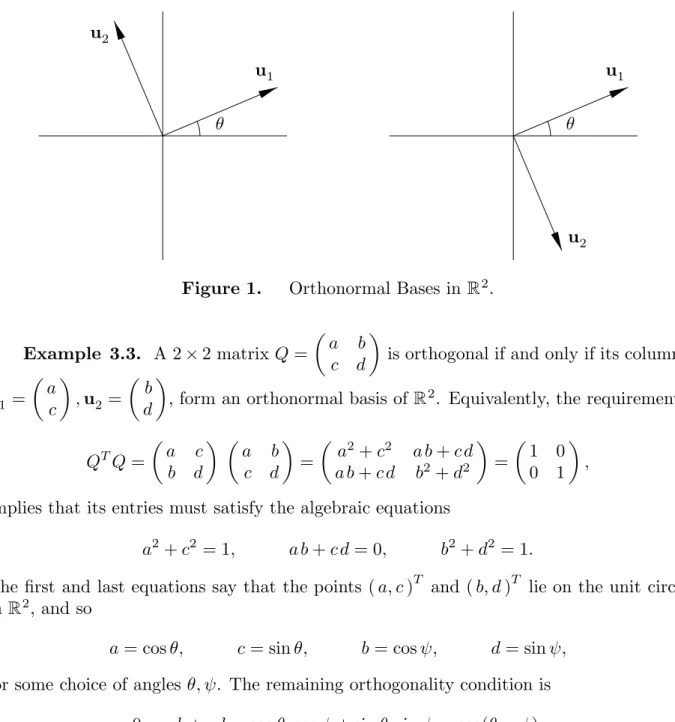
Figure 1. Orthonormal Bases in R2.
Example 3.3. A 2×2 matrix Q=
a b
c d
is orthogonal if and only if its columns u1=
a c
,u2 =
b d
, form an orthonormal basis of R2. Equivalently, the requirement
QTQ=
a c
b d
a b
c d
=
a2+c2 a b+c d a b+c d b2+d2
=
1 0 0 1
,
implies that its entries must satisfy the algebraic equations
a2+c2 = 1, a b+c d= 0, b2+d2 = 1.
The first and last equations say that the points (a, c)T and (b, d)T lie on the unit circle in R2, and so
a = cosθ, c= sinθ, b= cosψ, d = sinψ,
for some choice of angles θ, ψ. The remaining orthogonality condition is 0 =a b+c d= cosθ cosψ+ sinθ sinψ = cos(θ−ψ),
which implies that θ and ψ differ by a right angle: ψ =θ± 12π. The ± sign leads to two cases:
b=−sinθ, d= cosθ, or b= sinθ, d =−cosθ.
As a result, every 2×2 orthogonal matrix has one of two possible forms
cosθ −sinθ
sinθ cosθ
or
cosθ sinθ
sinθ −cosθ
, where 0 ≤θ <2π. (3.3) The corresponding orthonormal bases are illustrated in Figure 1. The former is a right handed basis, and can be obtained from the standard basis e1,e2 by a rotation through angle θ, while the latter has the opposite, reflected orientation.
Example 3.4. A 3×3 orthogonal matrixQ= (u1 u2 u3) is prescribed by 3 mutually perpendicular vectors of unit length inR3. For instance, the orthonormal basis constructed in (2.5) corresponds to the orthogonal matrix Q=
1 √ 3
4 √
42
2 √
14 1
√ 3
1 √
42 − 3 √
14 − √1
3 5 √
42 − 1 √
14
.
Lemma 3.5. An orthogonal matrix has determinant detQ=±1.
Proof: Taking the determinant of (3.1),
1 = det I = det(QTQ) = detQT detQ= (detQ)2,
which immediately proves the lemma. Q.E.D.
An orthogonal matrix is called proper or special if it has determinant + 1. Geomet-rically, the columns of a proper orthogonal matrix form a right handed basis of Rn. An
improper orthogonal matrix, with determinant−1, corresponds to a left handed basis that lives in a mirror image world.
Proposition 3.6. The product of two orthogonal matrices is also orthogonal.
Proof: If QT
1Q1 = I = QT2Q2, then (Q1Q2)T(Q1Q2) = QT2QT1Q1Q2 = QT2Q2 = I ,
and so the product matrixQ1Q2 is also orthogonal. Q.E.D.
This property says that the set of all orthogonal matrices forms a group. The orthog-onal group lies at the foundation of everyday Euclidean geometry, as well as rigid body mechanics, atomic structure and chemistry, computer graphics and animation, and many other areas.
4. Eigenvalues of Symmetric Matrices.
Symmetric matrices play an important role in a broad range of applications, and enjoy a number of important properties not shared by more general matrices. Not only are the eigenvalues of a symmetric matrix necessarily real, the eigenvectors always form an orthogonal basis. In fact, this is by far the most common way for orthogonal bases to appear — as the eigenvector bases of symmetric matrices. Let us state this important result, but defer its proof until the end of the section.
Theorem 4.1. Let A =AT be a real symmetric n
×nmatrix. Then
(a) All the eigenvalues of A are real.
(b) Eigenvectors corresponding to distinct eigenvalues are orthogonal.
(c) There is an orthonormal basis of Rn consisting of neigenvectors of A.
Example 4.2. Consider the symmetric matrix A =
−54 −45 22
2 2 −1
. A straight-forward computation produces its eigenvalues and eigenvectors:
λ1 = 9, λ2 = 3, λ3 =−3,
v1 =
−11
0
, v2 =
11
1
, v3 =
11
−2
.
As the reader can check, the eigenvectors form an orthogonal basis ofR3. An orthonormal basis is provided by the unit eigenvectors
u1 =
1 √ 2 − √1
2 0
, u2=
1 √ 3 1 √ 3 1 √ 3
, u3 =
1 √ 6 1 √ 6 − √2
6
.
Proof of Theorem 4.1: First, if A=AT is real, symmetric, then
(Av)·w=v·(Aw) for all v,w∈Cn, (4.1) where · indicates the Euclidean dot product when the vectors are real and, more generally, the Hermitian dot product v·w =vTw when they are complex.
To prove property (a), suppose λ is a complex eigenvalue with complex eigenvector v∈Cn. Consider the Hermitian dot product of the complex vectorsAv and v:
(Av)·v= (λv)·v=λkvk2.
On the other hand, by (4.1),
(Av)·v=v·(Av) =v·(λv) =vT λv=λkvk2.
Equating these two expressions, we deduce
λkvk2= λkvk2.
Since v 6= 0, as it is an eigenvector, we conclude that λ = λ, proving that the eigenvalue
λ is real.
To prove (b), suppose
Av=λv, Aw=µw,
where λ6=µ are distinct real eigenvalues. Then, again by (4.1),
λv·w= (Av)·w=v·(Aw) =v·(µw) =µv·w,
and hence
Since λ6=µ, this implies that v·w= 0 and hence the eigenvectors v,w are orthogonal. Finally, the proof of (c) is easy if all the eigenvalues ofA are distinct. Part (b) proves that the corresponding eigenvectors are orthogonal, and Proposition 1.4 proves that they form a basis. To obtain an orthonormal basis, we merely divide the eigenvectors by their lengths: uk =vk/kvkk, as in Lemma 1.2.
To prove (c) in general, we proceed by induction on the size n of the matrix A. To start, the case of a 1×1 matrix is trivial. (Why?) Next, supposeAhas sizen×n. We know that A has at least one eigenvalue, λ1, which is necessarily real. Let v1 be the associated eigenvector. Let
V⊥ ={w∈Rn | v
1·w= 0}
denote the orthogonal complement to the eigenspaceVλ1 — the set of all vectors orthogonal to the first eigenvector. Since dimV⊥ = n − 1, we can choose an orthonormal basis y1, . . . ,yn−1. Now, if w is any vector in V⊥, so is Aw, since, by (4.1),
v1·(Aw) = (Av1)·w=λ1v1 ·w = 0.
Thus, A defines a linear transformation onV⊥ represented by an (n−1)×(n−1) matrix with respect to the chosen orthonormal basis y1, . . . ,yn−1. It is not hard to prove that the representing matrix is symmetric, and so our induction hypothesis then implies that there is an orthonormal basis ofV⊥ consisting of eigenvectors u
2, . . . ,unof A. Appending the unit eigenvector u1 =v1/kv1k to this collection will complete the orthonormal basis
of Rn. Q.E.D.
The orthonormal eigenvector basis serves to diagonalize the symmetric matrix, result-ing in the so-calledspectral factorization formula.
Theorem 4.3. Let A be a real, symmetric matrix. Then there exists an orthogonal matrix Q such that
A =QΛQ−1 =QΛQT, (4.2)
whereΛ = diag (λ1, . . . , λn)is a real diagonal matrix. The eigenvalues of A appear on the
diagonal of Λ, while the columns of Q are the corresponding orthonormal eigenvectors.
Proof: Equation (4.2) can be rewritten as A Q= QΛ. The kth column of the latter matrix equation reads Avk = λkvk, where vk is the kth column of Q. But this is merely the condition that vk be an eigenvector of A with eigenvalue λk. Theorem 4.1 serves to
complete the proof. Q.E.D.
Remark: The term “spectrum” refers to the eigenvalues of a matrix or, more gener-ally, a linear operator. The terminology is motivated by physics. The spectral energy lines of atoms, molecules and nuclei are characterized as the eigenvalues of the governing quan-tum mechanical Schr¨odinger operator. The Spectral Theorem 4.3 is the finite-dimensional version for the decomposition of quantum mechanical linear operators into their spectral eigenstates.
Definition 4.4. An n×nsymmetric matrix Ais called positive definite if it satisfies the positivity condition
xTAx>0 for all 0 =6 x∈Rn. (4.3) Theorem 4.5. A symmetric matrix A =AT is positive definite if and only if all of
its eigenvalues are strictly positive.
Proof: First, if A is positive definite, and v 6= 0 is an eigenvector with (necessarily real) eigenvalue λ, then (4.3) implies
0<vTAv=vT(λv) =λkvk2, (4.4) which immediately proves that λ > 0. Conversely, suppose A has all positive eigenvalues. Let u1, . . . ,un be the orthonormal eigenvector basis of Rn guaranteed by Theorem 4.1, with Auj =λjuj. Then, writing
x=c1u1 + · · · +cnun, we find Ax=c1λ1u1+ · · · +cnλnun.
Therefore, using the orthonormality of the eigenvectors, for any x6=0, xTAx= (c1uT1 + · · · +cnu
T
n) (c1λ1u1+ · · · +cnλnun) =λ1c21+ · · · +λnc2n> 0 since only x=0 has c1 =· · ·=cn= 0. This proves that A is positive definite. Q.E.D.
5. The
Q RFactorization.
The Gram–Schmidt procedure for orthonormalizing bases of Rn can be reinterpreted as a matrix factorization. This is more subtle than the L U factorization that results from Gaussian Elimination, but is of comparable significance, and is used in a broad range of applications in mathematics, statistics, physics, engineering, and numerical analysis.
Letw1, . . . ,wnbe a basis ofRn, and letu
1, . . . ,un be the corresponding orthonormal basis that results from any one of the three implementations of the Gram–Schmidt process. We assemble both sets of column vectors to form nonsingular n×nmatrices
A = (w1 w2 . . . wn), Q= (u1 u2 . . . un).
Since the ui form an orthonormal basis, Qis an orthogonal matrix. Moreover, the Gram– Schmidt equations (2.6) can be recast into an equivalent matrix form:
A =Q R, where R=
r11 r12 . . . r1n 0 r22 . . . r2n
..
. ... . .. ... 0 0 . . . rnn
(5.1)
is an upper triangular matrix whose entries are the coefficients in (2.9–10). Since the Gram–Schmidt process works on any basis, the only requirement on the matrix A is that its columns form a basis of Rn, and hence A can be any nonsingular matrix. We have therefore established the celebrated Q R factorization of nonsingular matrices.
Q R Factorization of a Matrix A
start
for j = 1 to n
set rjj =
q a2
1j+ · · · +a2nj
if rjj = 0, stop; print “A has linearly dependent columns” else for i = 1 to n
set aij =aij/rjj next i
for k =j+ 1 to n
set rjk =a1ja1k+ · · · +anjank
for i= 1 to n
set aik=aik−aijrjk
next i next k next j end
Theorem 5.1. Any nonsingular matrixAcan be factored,A =Q R, into the product of an orthogonal matrix Qand an upper triangular matrix R. The factorization is unique if all the diagonal entries of R are assumed to be positive.
We will use the compacted termpositive upper triangular to refer to upper triangular matrices with positive entries along the diagonal.
Example 5.2. The columns of the matrixA =
1 11 0 −22 −1 2 3
are the same as the basis vectors considered in Example 2.2. The orthonormal basis (2.5) constructed using the Gram–Schmidt algorithm leads to the orthogonal and positive upper triangular matrices
Q=
1 √ 3
4 √
42
2 √
14 1
√ 3
1 √
42 − 3 √
14 − √1
3 5 √
42 − 1 √
14
, R=
√
3 −√1
3 −
√ 3 0 √√14
3 √
21 √
2
0 0 √√7
2
. (5.2)
The reader may wish to verify that, indeed, A=Q R.
While any of the three implementations of the Gram–Schmidt algorithm will produce theQ Rfactorization of a given matrixA= (w1 w2 . . . wn), the stable version, as encoded in equations (2.11), is the one to use in practical computations, as it is the least likely to fail
due to numerical artifacts produced by round-off errors. The accompanying pseudocode program reformulates the algorithm purely in terms of the matrix entriesaij of A. During the course of the algorithm, the entries of the matrix A are successively overwritten; the final result is the orthogonal matrixQ appearing in place of A. The entries rij of Rmust be stored separately.
Example 5.3. Let us factor the matrix
A=
2 1 0 0
1 2 1 0
0 1 2 1
0 0 1 2
using the numerically stable Q R algorithm. As in the program, we work directly on the matrix A, gradually changing it into orthogonal form. In the first loop, we set r11 = √5 to be the norm of the first column vector of A. We then normalize the first column
by dividing by r11; the resulting matrix is
2 √
5 1 0 0
1 √
5 2 1 0
0 1 2 1
0 0 1 2
. The next entries r12 =
4 √
5, r13 = 1 √
5, r14 = 0, are obtained by taking the dot products of the first column with the other three columns. For j = 1,2,3, we subtract r1j times the first column
from the jth column; the result
2 √ 5 − 3 5 − 2 5 0 1 √ 5 6
5 45 0
0 1 2 1
0 0 1 2
is a matrix whose first column is
normalized to have unit length, and whose second, third and fourth columns are orthogonal to it. In the next loop, we normalize the second column by dividing by its norm r22 =
q
14
5 , and so obtain the matrix
2 √ 5 − 3 √ 70 − 2 5 0 1 √ 5 6 √ 70 4 5 0
0 √5
70 2 1
0 0 1 2
. We then take dot products of
the second column with the remaining two columns to produce r23 = √16
70, r24 = 5 √
70. Subtracting these multiples of the second column from the third and fourth columns, we
obtain 2 √ 5 − 3 √ 70 2 7 143 1 √ 5 6 √ 70 − 4 7 − 3 7
0 √5
70 6 7 149
0 0 1 2
, which now has its first two columns orthonormalized,
by r33 = q157, and so 2 √ 5 − 3 √ 70 2 √ 105 3 14 1 √ 5 6 √ 70 − 4 √ 105 − 3 7
0 √5
70 6 √ 105 9 14
0 0 √7
105 2
. Finally, we subtract r34 = √20 105
times the third column from the fourth column. Dividing the resulting fourth column by its norm r44 =q56 results in the final formulas,
Q= 2 √ 5 − 3 √ 70 2 √ 105 − 1 √ 30 1 √ 5 6 √ 70 − 4 √ 105 2 √ 30
0 √5
70 6 √ 105 − 3 √ 30
0 0 √7
105 4 √ 30
, R=
√ 5 √4
5 1 √
5 0
0 √√14 5 16 √ 70 5 √ 70 0 0 √√15
7 20 √
105
0 0 0 √√5
6 ,
for the A =Q R factorization.
6. Numerical Calculation of Eigenvalues.
We are now ready to apply these results to the problem of numerically approximating eigenvalues of matrices. Before explaining theQ Ralgorithm, we first review the elementary
power method.
The Power Method
We assume, for simplicity, that A is a complete n×n matrix, meaning that it has an eigenvector basis† v
1, . . . ,vn, with corresponding eigenvalues λ1, . . . , λn. It is easy to see that the solution to the linear iterative system
v(k+1) =Av(k), v(0) =v, (6.1) is obtained by multiplying the initial vector v by the successive powers of the coefficient matrix: v(k) =Akv. If we write the initial vector in terms of the eigenvector basis
v=c1v1+ · · · +cnvn, (6.2) then the solution takes the explicit form
v(k) =Akv=c1λk1v1+ · · · +cnλ k
nvn. (6.3) Suppose further that A has a single dominant real eigenvalue, λ1, that is larger than all others in magnitude, so
|λ1|>|λj| for all j >1. (6.4)
† This is not a very severe restriction. Theorem 4.1 implies that all symmetric matrices are
complete. Moreover, perturbations caused by round off and/or numerical inaccuracies will almost inevitably make an incomplete matrix complete.
As its name implies, this eigenvalue will eventually dominate the iteration (6.3). Indeed, since
|λ1|k ≫ |λj|k for all j >1 and all k≫0,
the first term in the iterative formula (6.3) will eventually be much larger than the rest, and so, provided c1 6= 0,
v(k) ≈ c1λk
1v1 for k ≫0.
Therefore, the solution to the iterative system (6.1) will, almost always, end up being a multiple of the dominant eigenvector of the coefficient matrix.
To compute the corresponding eigenvalue, we note that the ith entry of the iterate v(k) is approximated by v(k)
i ≈ c1λk1v1,i, where v1,i is the ith entry of the eigenvector v1. Thus, as long asv1,i 6= 0, we can recover the dominant eigenvalue by taking a ratio between selected components of successive iterates:
λ1 ≈ v
(k) i
v(ik−1) , provided that v
(k−1)
i 6= 0. (6.5) Example 6.1. Consider the matrix A=
−−11 −42 −22
−3 9 7
. As you can check, its eigenvalues and eigenvectors are
λ1 = 3, v1 =
−11
3
, λ2 =−2, v2 =
01
−1
, λ3 = 1, v3 =
−11
−2
.
Repeatedly multiplying an initial vector v = ( 1,0,0 )T, say, by A results in the iterates v(k) = Akv listed in the accompanying table. The last column indicates the ratio λ(k) =
v(1k)/v1(k−1) between the first components of successive iterates. (One could equally well use the second or third components.) The ratios are converging to the dominant eigenvalue
λ1 = 3, while the vectors v(k) are converging to a very large multiple of the corresponding eigenvector v1 = ( 1,−1,3 )T.
Variants of the power method for finding other eigenvalues include theinverse power method based on iterating the inverse matrix A−1, with eigenvalues λ−1
1 , . . . , λ−n1 and the
shifted inverse power method, based on (A−µ I )−1, with eigenvalues (λk−µ)−1. The power method only produces the dominant (largest in magnitude) eigenvalue of a matrixA. The inverse power method can be used to find the smallest eigenvalue. Additional eigenvalues can be found by using the shifted inverse power method, or deflation. However, if we need to knowall the eigenvalues, such piecemeal methods are too time-consuming to be of much practical value.
The Q R Algorithm
The most popular scheme for simultaneously approximating all the eigenvalues of a matrixA is the remarkableQ Ralgorithm, first proposed in 1961 independently by Francis
and Kublanovskaya. The underlying idea is simple, but surprising. The first step is to factor the matrix
A=A1 =Q1R1
into a product of an orthogonal matrix Q1 and a positive (i.e., with all positive entries along the diagonal) upper triangular matrix R1. Next, multiply the two factors together
in the wrong order! The result is the new matrix
A2 =R1Q1.
We then repeat these two steps. Thus, we next factor
A2 =Q2R2
using the Gram–Schmidt process, and then multiply the factors in the reverse order to produce
A3 =R2Q2.
The complete algorithm can be written as
A =Q1R1, RkQk= Ak+1 =Qk+1Rk+1, k = 1,2,3, . . . , (6.6) where Qk, Rk come from the previous step, and the subsequent orthogonal matrix Qk+1
and positive upper triangular matrix Rk+1 are computed by using the numerically stable form of the Gram–Schmidt algorithm.
The astonishing fact is that, for many matrices A, the iterates Ak → V converge to an upper triangular matrix V whose diagonal entries are the eigenvalues ofA. Thus, after a sufficient number of iterations, say k⋆, the matrix A
k⋆ will have very small entries below
the diagonal, and one can read off a complete system of (approximate) eigenvalues along its diagonal. For each eigenvalue, the computation of the corresponding eigenvector can be done by solving the appropriate homogeneous linear system, or by applying the shifted inverse power method.
Example 6.2. Consider the matrix A =
2 1 2 3
. The initial Gram–Schmidt fac-torization A=Q1R1 yields
Q1 =
.7071 −.7071
.7071 .7071
, R1 =
2.8284 2.8284 0 1.4142
.
These are multiplied in the reverse order to give
A2 =R1Q1 =
4 0 1 1
.
We refactor A2 =Q2R2 via Gram–Schmidt, and then reverse multiply to produce
Q2 =
.9701 −.2425
.2425 .9701
, R2 =
4.1231 .2425 0 .9701
, A3=R2Q2 =
4.0588 −.7647
.2353 .9412
.
The next iteration yields
Q3 =
.9983 −.0579
.0579 .9983
, R3 =
4.0656 −.7090
0 .9839
, A4=R3Q3 =
4.0178 −.9431
.0569 .9822
.
Continuing in this manner, after 9 iterations we find, to four decimal places,
Q10 =
1 0 0 1
, R10 =
4 −1
0 1
, A11 =R10Q10 =
4 −1
0 1
.
The eigenvalues of A, namely 4 and 1, appear along the diagonal of A11. Additional iterations produce very little further change, although they can be used for increasing the accuracy of the computed eigenvalues.
If the original matrix A is symmetric, positive definite, and with distinct eigenvalues, then, in most situations (see below for the precise requirement), the iterates converge,
Ak → V = Λ, to a diagonal matrix containing the eigenvalues of A in decreasing order. Moreover, if, in this case, we recursively define
S1 =Q1, Sk =Sk−1Qk =Q1Q2 · · · Qk−1Qk, k >1, (6.7) thenSk →S have, as their limit, an orthogonal matrix whose columns are the orthonormal eigenvector basis of A.
Example 6.3. Consider the symmetric matrix A=
21 13 −01
0 −1 6
. The initial
A=Q1R1 factorization produces
S1 =Q1 =
..89444472 −..40828165 −..18263651 0 −.4082 .9129
, R1 =
2.2361 20 2..23614495 −−3..44722660
0 0 5.1121
,
and so
A2 =R1Q1 =
13..00000954 13..09543333 −2.08700 0 −2.0870 4.6667
.
We refactor A2 =Q2R2 and reverse multiply to produce
Q2 =
..93933430 −..27347488 −..20715672 0 −.6038 .7972
, S2 =S1Q2 =
..70017001 −..44002686 −..56236615 −.1400 −.8569 .4962
,
R2 =
3.1937 20 3..17234565 −−4..71583804
0 0 2.5364
, A3 =R2Q2 =
13..74511856 15..18562330 −1.53140 0 −1.5314 2.0219
.
Continuing in this manner, after 10 iterations we find
Q11 =
1..00000067 −1..00670000 .00010 0 −.0001 1.0000
, S11 =
..07533128 −−..56677679 −..82055591 −.9468 −.2987 .1194
,
R11 =
6.32290 3..06473582 −.00060
0 0 1.3187
, A12 =
6..32320224 3..02243581 −.00020 0 −.0002 1.3187
.
After 20 iterations, the process has completely settled down, and
Q21 =
10 0 01 0
0 0 1
, S21 =
..07103069 −−..56727702 −..82055590 −.9491 −.2915 .1194
,
R21 =
6.3234 .0001 0
0 3.3579 0
0 0 1.3187
, A22 =
6.3234 0 0
0 3.3579 0
0 0 1.3187
.
The eigenvalues of A appear along the diagonal of A22, while the columns of S21 are the corresponding orthonormal eigenvector basis, listed in the same order as the eigenvalues, both correct to 4 decimal places.
We will devote the remainder of this section to a justification of theQ R algorithm for a general class of symmetric matrices. We begin by assuming thatAis ann×nsymmetric, positive definite matrix, with distinct eigenvalues
λ1 > λ2 > · · · > λn >0. (6.8) According to the Spectral Theorem 4.3, the corresponding unit eigenvectors u1, . . . ,un form an orthonormal basis of Rn. After treating this case, the analysis will be extended to a broader class of symmetric matrices, having both positive and negative eigenvalues.
The secret is that theQ Ralgorithm is, in fact, a well-disguised adaptation of the more primitive power method. If we were to use the power method to capture all the eigenvectors and eigenvalues of A, the first thought might be to try to perform it simultaneously on a complete basis v1(0), . . . ,v(0)n of Rn instead of just one individual vector. The problem is that, for almost all vectors, the power iterates v(jk) = Akv(0)
j all tend to a multiple of the dominant eigenvector u1. Normalizing the vectors at each step is not any better, since then they merely converge to one of the two dominant unit eigenvectors ±u1. However, if, inspired by the form of the eigenvector basis, we orthonormalize the vectors at each step, then we effectively prevent them from all accumulating at the same dominant unit eigenvector, and so, with some luck, the resulting vectors will converge to the full system of eigenvectors. Since orthonormalizing a basis via the Gram–Schmidt process is equivalent to a Q R matrix factorization, the mechanics of the algorithm is not so surprising.
In detail, we start with any orthonormal basis, which, for simplicity, we take to be the standard basis vectors of Rn, and so u(0)
1 = e1, . . . ,u(0)n = en. At the kth stage of the algorithm, we set u(1k), . . . ,u(nk) to be the orthonormal vectors that result from
applying the Gram–Schmidt algorithm to the power vectors v(jk) = Ake
j. In matrix language, the vectors v(1k), . . . ,v(nk) are merely the columns of Ak, and the orthonormal basis u(1k), . . . ,un(k) are the columns of the orthogonal matrixSk in theQ R decomposition of the kth power of A, which we denote by
Ak =SkPk, (6.9)
where Pk is positive upper triangular. Note that, in view of (6.6)
A=Q1R1, A2 =Q1R1Q1R1 =Q1Q2R2R1, A3 =Q1R1Q1R1Q1R1 =Q1Q2R2Q2R2R1 =Q1Q2Q3R3R2R1,
and, in general,
Ak = Q
1Q2· · ·Qk−1Qk
RkRk−1· · ·R2R1. (6.10) The product of orthogonal matrices is also orthogonal. The product of positive upper triangular matrices is also positive upper triangular. Therefore, comparing (6.9, 10) and invoking the uniqueness of the Q R factorization, we conclude that
Sk=Q1Q2· · ·Qk−1Qk =Sk−1Qk, Pk =RkRk−1· · ·R2R1 =RkPk−1. (6.11) Let S = (u1 u2 . . . un) denote an orthogonal matrix whose columns are unit eigen-vectors of A. The Spectral Theorem 4.3 tells us that
A =SΛST, where Λ = diag (λ1, . . . , λn)
is the diagonal eigenvalue matrix. Substituting the spectral factorization into (6.9), we find
Ak =SΛkST =SkPk.
We now make one additional assumption on the matrix A by requiring that ST be a
regular matrix, meaning that we can factor ST = L U into a product of special lower and upper triangular matrices, or, equivalently, that Gaussian Elimination can be performed on the linear system STx=b without any row interchanges. Regularity holds generically, and is the analog of the condition that our initial vector in the power method includes a nonzero component of the dominant eigenvector. We can assume that, without loss of generality, the diagonal entries of the upper triangular matrix U — that is, the pivots of
ST — are all positive. Indeed, this can be arranged by multiplying each row of ST by the sign of its pivot — this amounts to possibly changing the signs of some of the unit eigenvectors ui, which is allowed since it does not affect their status as an orthonormal eigenvector basis.
Under these two assumptions,
Ak =SΛkL U =S
kPk, and hence SΛ
kL=S
kPkU−1. Multiplying on the right by Λ−k, we obtain
SΛkLΛ−k=SkTk, where Tk =PkU−1Λ−
is also a positive upper triangular matrix, since we are assuming that the eigenvalues, i.e., the diagonal entries of Λ, are all positive.
Now consider what happens as k → ∞. The entries of the lower triangular matrix
N = ΛkLΛ−k are
nij =
lij(λi/λj) k
, i > j, lii = 1, i=j,
0, i < j.
Since we are assuming λi < λj when i > j, we immediately deduce that ΛkLΛ−k
−→ I,
and hence
SkTk =SΛkLΛ−k
−→ S as k −→ ∞. (6.13)
We now appeal to the following lemma, whose proof will be given after we finish the justification of the Q Ralgorithm.
Lemma 6.4. Let S1, S2, . . . and S be orthogonal matrices and T1, T2, . . . positive upper triangular matrices. Then SkTk →S as k→ ∞ if and only ifSk →S andTk → I.
Therefore, as claimed, the orthogonal matrices Sk do converge to the orthogonal eigenvector matrix S. By (6.11),
Qk =Sk−−11Sk −→ I as k −→ ∞. (6.14)
Moreover, by (6.11–12),
Rk=PkPk−−11 = TkΛ k
U−1 Tk−1Λ
k−1U−1−1 =T
kΛTk−−11. Since both Tk and Tk−1 converge to the identity matrix, in the limit
Rk −→ Λ as k −→ ∞. (6.15)
Combining (6.14, 15), we deduce that the matrices appearing in theQ Ralgorithm converge to the diagonal eigenvalue matrix, as claimed:
Ak =QkRk −→ Λ as k −→ ∞. (6.16)
Note that the eigenvalues appear in decreasing order along the diagonal, which is a conse-quence of our regularity assumption on the transposed eigenvector matrix ST.
The last remaining item is a proof of Lemma 6.4. We write S = (u1 u2 . . . un),
Sk = (u(1k), . . . ,un(k)) in columnar form. Let t(ijk) denote the entries of the positive upper triangular matrix Tk. The first column of the limiting equation SkTk→S reads
t(11k)u(1k) −→ u1.
Since both u(1k) andu1 are unit vectors, and t(11k) >0,
The second column reads
t12(k)u(1k)+t22(k)u(2k) −→ u2.
Taking the inner product with u(1k) →u1 and using orthonormality, we deduce t(12k) → 0, and so t(22k)u(2k) → u2, which, by the previous reasoning, implies t(22k) →1 and u(2k) → u2. The proof is completed by working in order through the remaining columns, employing a similar argument at each step.
To modify the preceding proof for symmetric, but non-positive definite matrices, we introduce the diagonal orthogonal matrix
∆ = ∆−1 = diag (signλ1, . . . ,signλn), so that ∆ Λ = Λ ∆ = diag (|λ1|, . . . ,|λn|).
whose diagonal entries are the signs of the eigenvalues. (So in the positive definite case ∆ = I .) Set
e
Sk =Sk∆k, Tek = ∆kTk.
Thus, (6.13) can be rewritten as
e
SkTek =SkTk =SΛ k
LΛ−k −→ S as k −→ ∞.
Recalling (6.12), the diagonal entries of the upper triangular matrix Tek = ∆kT
k are seen to be strictly positive, and hence Lemma 6.4 implies
e
Sk −→ S, Tek −→ I, as k −→ ∞.
Therefore,
Qk =Sk−−11Sk = ∆k−1Se−1 k−1Sek∆
k
−→ ∆,
Rk =TkΛTk−−11 = ∆kTekΛTek−−11∆k−1 −→ ∆ Λ, as k−→ ∞. (6.17)
The convergence of the Q R matrices immediately follows:
Ak=QkRk −→ ∆2Λ = Λ as k −→ ∞.
Keep in mind that, in non-positive definite cases, the orthogonal matrices Sk no longer converge, since the nonzero entries in the columns corresponding to negative eigenvalues switch their signs back and forth ask increases; however, by eliminating the sign changes — which, in practice can be done by inspection — their modifications Sek = Sk∆k
→ S
will converge to the eigenvector matrix.
This completes the proof of the convergence of theQ R algorithm for a broad class of symmetric matrices.
Theorem 6.5. If A is symmetric, satisfies
|λ1|>|λ2|> · · · >|λn|>0, (6.18)
and its transposed eigenvector matrix ST is regular, then the matrices appearing in the
Q R algorithm applied to A converge to the diagonal eigenvalue matrix: Ak → Λ = diag (λ1, . . . , λn) as k → ∞.
v
u
Hv u⊥
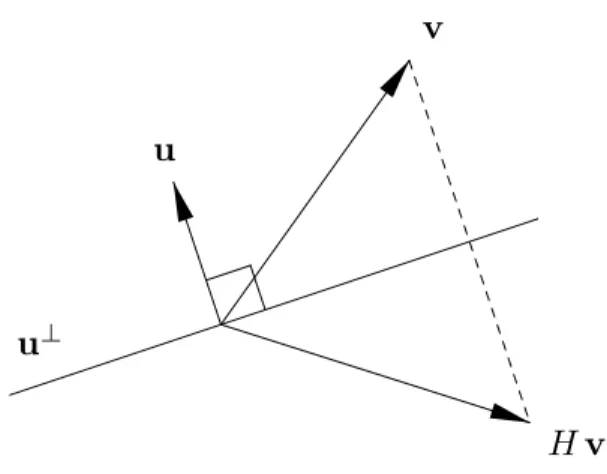
Figure 2. Elementary Reflection Matrix.
Tridiagonalization
In practical implementations, the directQ Ralgorithm often takes too long to provide reasonable approximations to the eigenvalues of large matrices. Fortunately, the algorithm can be made much more efficient by a simple preprocessing step. The key observation is that the Q R algorithm preserves the class of symmetric tridiagonal matrices, and, more-over, like Gaussian Elimination, is much faster when applied to this class of matrices. It turns out that, although diagonalizinjg a matrix is effectively the same as finding its eigenvectors, one can “tridiagonalize” the matrix by a sequence of fairly elementary matrix operations, based on the following class of matrices.
Consider the Householder or elementary reflection matrix
H = I −2u uT (6.19)
in whichuis a unit vector (in the Euclidean norm). The matrixH represents a reflection of vectors through the subspaceu⊥ ={v|v·u= 0}of vectors orthogonal tou, as illustrated in Figure 2. The matrix H is symmetric and orthogonal:
HT =H, H2 = I, H−1 =H. (6.20)
The proof is straightforward: symmetry is immediate, while
H HT =H2 = ( I −2u uT) ( I −2u uT) = I −4u uT + 4u(uTu)uT = I
since, by assumption, uTu = kuk2 = 1. By suitably forming the unit vector u, we can construct an elementary reflection matrix that interchanges any two vectors of the same length.
Lemma 6.6. Let v,w ∈Rn with kvk= kwk. Set u = (v−w)/kv−wk and let
H = I −2u uT be the corresponding elementary reflection matrix. Then Hv = w and