Steering User Behavior with Badges
∗Ashton Anderson
Daniel Huttenlocher
Jon Kleinberg
Jure Leskovec
Stanford University Cornell University Cornell University Stanford University
[email protected]
{dph, kleinber}@cs.cornell.edu
[email protected]
ABSTRACT
An increasingly common feature of online communities and social media sites is a mechanism for rewarding user achievements based on a system ofbadges. Badges are given to users for particular contributions to a site, such as performing a certain number of ac-tions of a given type. They have been employed in many domains, including news sites like the Huffington Post, educational sites like Khan Academy, and knowledge-creation sites like Wikipedia and Stack Overflow. At the most basic level, badges serve as a sum-mary of a user’s key accomplishments; however, experience with these sites also shows that users will put in non-trivial amounts of work to achieve particular badges, and as such, badges can act as powerful incentives. Thus far, however, the incentive structures created by badges have not been well understood, making it diffi-cult to deploy badges with an eye toward the incentives they are likely to create.
In this paper, we study how badges can influence and steer user behavior on a site—leading both to increased participation and to changes in the mix of activities a user pursues on the site. We intro-duce a formal model for reasoning about user behavior in the pres-ence of badges, and in particular for analyzing the ways in which badges can steer users to change their behavior. To evaluate the main predictions of our model, we study the use of badges and their effects on the widely used Stack Overflow question-answering site, and find evidence that their badges steer behavior in ways closely consistent with the predictions of our model. Finally, we inves-tigate the problem of how to optimally place badges in order to induce particular user behaviors. Several robust design principles emerge from our framework that could potentially aid in the design of incentives for a broad range of sites.
Categories and Subject Descriptors:J.4 [Social and Behavioral Sciences]: Economics.
General Terms:Algorithms, Economics, Theory.
Keywords:Badges, steering, badge placement problem.
1.
INTRODUCTION
Give me enough medals and I’ll win you any war. —Napoleon ∗This is an extended version of what appears in the conference pro-ceedings, the only difference being the inclusion of two appendices that spell out details we had to omit in the conference version due to space constraints.
Copyright is held by the International World Wide Web Conference Committee (IW3C2). IW3C2 reserves the right to provide a hyperlink to the author’s site if the Material is used in electronic media. WWW 2013, May 13–17, 2013, Rio de Janeiro, Brazil. ACM 978-1-4503-2035-1/13/05.
Designers of online communities and social media sites have in-creasingly been making use ofbadgesas a way to reward users for their achievements. Badges have been employed across a wide range of domains, from news sites like Huffington Post, where users are recognized for contributing valued comments and being well-connected; to education sites like Khan Academy, where users are awarded badges for watching instructional videos and correctly answering questions; to knowledge creation sites like Wikipedia and Stack Overflow, where users are awarded for their contribu-tions to the online community. The use of badges in these settings invokes a much longer history of badge use in off-line domains: for example, organizations like the Boy Scouts award (literal) badges for proficiency at particular tasks, and airlines award elite status for specific amounts of travel.
Badges play multiple roles in all these settings. First, they func-tion as a credentialing system, summarizing the skills and achieve-ments of the individuals who receive them. But they also work powerfully asincentives; experience across many domains shows that people will direct considerable amounts of effort in pursuit of a badge. It is this incentive function of badges, and particularly the ways these badge-based incentives can be used in online ap-plications, that is the focus of our work here—the ways in which badges can affect the extent and form of user participation in online communities and social media sites.
Badges as Incentives. The question of user participation and contribution in online domains is a broad topic that a number of active lines of research have contributed to, including social-psychological studies of user engagement [5, 6], incentives for ef-fort and high-quality contribution in social media [12], mechanisms for distributed online recruitment [2, 7, 13], and the design of con-tests to encourage crowdsourced effort [8]. Different systems have been used successfully in different settings.
Badges are in several respects simpler than some of these other incentive mechanisms, lacking the direct competition of auctions and leaderboards and the exchangeability of currency-like systems. Despite their simplicity, however, in practice many social sites have positioned badges as an important part of their incentive systems. Furthermore, they appear to induce complex user behaviors that are thus far not well understood. Understanding this complexity, and developing principles for reasoning about how to use badges most effectively, are key underlying motivations of the present research. Perhaps the most basic way badges can affect user behavior is by encouraging users to increase their overall level of participation. But much of the richness and complexity of badges comes from the fact that they are intrinsically based on a kind of multi-faceted way of thinking, in the following sense. A site will generally have many different types of activities that users can perform (the dif-ferent dimensions of possible contributions to the site), and by cre-ating badges that reward certain of these contributions at specific
levels, the site’s designers can attempt to “steer” a user’s activities toward particular forms of contribution. For example, a question-answering (Q&A) site may have a range of activities that include asking questions, answering questions, up-voting and down-voting questions and answers, and others. On a Q&A site where everyone wants to ask questions and few people want to answer them, intro-ducing a badge for users who have contributed a certain number of answers can steer the community toward contributing to this un-derrepresented action type. Badges for voting can similarly try to steer users toward providing enough feedback to maintain a useful quality signal on the content.
In summary, badges provide a rich language for expressing in-centives, but with little existing framework for reasoning about their effects. Our work addresses a set of questions that can help provide insight into badges and their use. In particular, a natural first question is: Do badges work? That is, can we find concrete ev-idence that badges increase site participation or steer users towards taking actions they might not have taken otherwise? If badges do have an effect on users, how can we model user behavior in the presence of badges? And to the extent that designers can indeed steer user behavior with badges, how should they define badges to achieve the outcomes they want?
Overview of Results
Our work is based on this set of questions, and comprises three different components. First, we develop a model for user behav-ior in the presence of badges on a site with multiple types of ac-tivities. Second, we evaluate our model on data from the popular question-answering site Stack Overflow, and show that the main qualitative predictions of the model match what we observe in the aggregate user behavior on the real site. Third, we consider how a site designer can use such a model to define badges with the goal of achieving a desired pattern of behavior.
Theoretical Model of User Behavior. Given the discussion of badges thus far, what are the basic ingredients we need in order to define a model of user behavior with badges? Intuitively, we would like to have a multi-dimensional space representing the pos-sible types of actions on the site; users have a preferred mixture of activities in this space, and introducing badges can induce them to shift their mixture in particular ways. Our model brings these features together in a natural way.
Since a key aspect of badges is the way in which different badges reward different activities, we model the site as havingndifferent action types; as in our example of a Q&A site above, the action types could correspond to asking a question, answering a ques-tion, voting on a question or answer, and others. Users perform actions, choosing from among these types; a user’s mix of actions over his lifetime can thus be thought of as defining a vector in an
n-dimensional space whoseith coordinate records the number of actions of typeithat he has taken.1Each badge is defined by spec-ifying how many actions of each type must be performed in order for it to be awarded; in this sense, each badge defines a “frontier” in the space that the user’s vector must cross in order for the badge to be awarded. We refer to this frontier as thebadge boundary.
In order to talk about the incentives that badges create, we also need a model of a user’s utility, which we represent in two com-ponents. First, each user has a preferred mix of actions on the site, corresponding to a distribution over the possible action types; in the absence of badges, he would simply perform actions according to this mixture by sampling from his distribution over possible action types. Sampling action types from a different distribution incurs a 1
Throughout this paper we use male pronouns to refer to users of a site and female pronouns to refer to site designers.
cost to the user, based on how far the distribution is from his pre-ferred one. Second, a badge confers utility once it is awarded, and so a user has an incentive to shift his distribution of activities some-what in order to achieve the badge more quickly, which trades off against the cost for deviating from the preferred distribution.
The user’s behavior is thus determined by the solution to an individual-level optimization problem, trading off the cost of shift-ing his activity distribution against the value of the badge. We will see that when this optimization is solved, the force of the incen-tives from badges clearly emerges naturally: the user’s distribution of actions is deflected in the direction of badges, and there is an “acceleration” effect in which this deflection becomes stronger as the user approaches a badge boundary.
Thus far the model captures how a badge can steer users toward certain types of actions. At a higher level, a badge can also increase the overall level of user participation on the site. While it may ini-tially seem that these are two different phenomena—participation level versus choice of actions on the site—we can unify them within the model by representing the user’s off-site activities via a single additional action type, corresponding to one extra dimension in the space of possible actions. We refer to this additional action type as thelife-action, since it corresponds to the sum total of the user’s tivities in his life off the site; the user’s preferred distribution of ac-tivities will include a probability associated with the life-action as well. With this extended framework, we can ask about the effect of a badge in two distinct respects: the extent to which it draws proba-bility mass away from the life-action, thus increasing participation on the site, and the extent to which is shifts probability mass be-tween different site actions, thus steering behavior within the site.
Empirical Evaluation.After developing the model, we investigate whether its qualitative predictions match the aggregate behavior we see in a large-scale setting that makes strong use of badges. To do this, we analyze the behavior of several million users on Stack Overflow, a large and very active question-answering site. On Stack Overflow, badges play a prominent role—they are displayed along-side a user’s name wherever he posts on the site, and they are dis-cussed extensively on Stack Overflow forums.
We find that the main qualitative predictions of the model match the behavior we observe on Stack Overflow in four key respects.
(i) If a certain level of activity of a particular type is rewarded by a badge, users will increase their activity of this type as they approach the level needed for the badge. This is the notion ofsteeringtoward a badge boundary mentioned above. (ii) Different badges produce different amounts of steering. (iii) The extent of steering depends on how close the user is to the
badge boundary—an “acceleration” effect in which a user steers particularly strongly toward a badge when they are close to achieving it.
(iv) Steering involves both shifts in the mixture of actions the user performs on the site, as well as in their overall level of participation on the site.
What we find promising about these results is that each of (i)-(iv) arises naturally as a prediction of our modeling framework, despite the fact that we did not “build in” any of them. Rather, the model generates these behaviors by simply positing users who act to maximize utility.
The Badge Placement Problem.Finally, having proposed a model of user behavior in the presence of badges and showing that its main predictions are consistent with empirical data, we return to the model and explore it from the site designer’s perspective. Suppose the site designer has a desired mixture of actionsq—over the full user population, she would like to see the action types performed
in the proportions represented by the distributionq. If the site de-signer has the ability to define a fixed number of badges, essentially “placing” each one as a frontier in the space of actions, how should she place the badges so that when users optimize their behavior, the overall mixture of activities is as close toqas possible?
We formalize and study thisbadge placement problem, analyz-ing the way in which the site designer’s solution varies with the properties of the underlying user population and with the desired outcome. From this analysis we can abstract a number of high-level design principles. First, the effectiveness of badges depends significantly on where they are placed, and the optimal location is often surprisingly hard to reach. It is more important to preserve a badge as an incentive over the course of the user’s career on the site, even if it is far away for much of that time, than have it be achieved too early. Second, if the site designer wants to use multi-ple badges to reward the same type of action (e.g.one for a medium level of contribution and another for a very high level), the model indicates that it is more useful to spread them out and assign them roughly equal value, rather than concentrating them close together and effectively produce a single badge of greater value. At a qual-itative level, these findings suggest the power of creating multiple smaller rewards, relatively far off to preserve their incentive effects over long periods of contributions.
Overall, these results are part of an effort to develop a principled, tractable way of reasoning about badges and their effects on user behavior, validated on evidence from large social sites, and provid-ing a framework for usprovid-ing badges proactively to design incentives that guide a user community toward a desired mix of behaviors.
2.
A MODEL OF USER BEHAVIOR
We begin with our theoretical model of user behavior in the presence of badges, following the principles outlined in Section 1. Overall, our goal is to keep the model set-up as simple as possible while still capturing the basic effect of badges as incentives.
2.1
Setting
To establish terminology, a designer controls a sitein which userstakeactionsof differenttypes. Although we talk about the model in terms of user behavior on a Web site, in keeping with our primary motivation, the model is formulated in terms general enough to provide connections back to the off-line examples from Section 1 as well. Moreover, even though we will describe the model from a single user perspective note that our model naturally allows for heterogeneous user populations.
Action types. If there arenpossible kinds of actions on the site, we declare the life-action, representing the user’s activities outside the site, to be an(n+ 1)staction type. The set of possible action types is then denotedA={A1, A2, . . . , An, An+1}, whereAn+1
is the life-action. For example, on a simple question-answering site of the type discussed in the introduction, we might haven = 4, withA1, A2, A3,andA4corresponding, respectively, to asking a
question, answering a question, voting on a question, and voting on an answer; and hereA5is the life-action.
User histories. A user’s history on the site will be represented abstractly as a sequence of choices of action types (e.g., on a Q&A site, the user first asked two questions, then answered a question, then voted on three answers, and so forth). In general, we will be interested in a user’s cumulative number of actions taken so far, and these can be represented by a singleaction vectora∈Rn+1whose ithcoordinateaiis simply equal to the number of actions of type
ithe user has taken over his history on the site (with coordinate
an+1 denoting the off-site life-action). We useei to denote the unit vector with a1in coordinateiand0elsewhere, so that when
a user with vectoraperforms an action of typei, the user’s new vector isa+ei.
Badges and their boundaries. We focus on badges that are awarded once the user has reached a certain level of cumulative contribution—so a badgebis associated with the subset of possible user action vectorsacorresponding to contributions that warrant the badge. This set of vectors is monotonic in the sense that if an action vectorawarrants the badge, and˜ais coordinate-wise at least as large asa(˜ai ≥ aifor alli), then˜aalso warrants the badge. Note that badges can only be awarded for on-site activities but not for the activity of the life-action. Thus, ifband˜bdiffer only in coordinaten+ 1(the life-action coordinate), thenbwarrants the badge if and only if˜bdoes.
We writeIb(a) for the indicator function specifying whether vector awarrants badgeb: Ib(a) = 1if awarrants the badge, and it is0otherwise. Often we will talk about a user reaching the badge boundaryfor a badgeb; the badge boundary is simply the set of vectors at which the badge may be first awarded. Concretely, the boundary is the set of vectorsasuch thatIb(a) = 1but for which there exists a unit vectoreisuch thatIb(a−ei) = 0.
For example, a common type of badge simply rewards a certain number of actions of a single fixed type (e.g., answering at least a certain total number of questions on a Q&A site); this would mean that for some choice of action typeiand a particular thresholdk, the badge is awarded to any user whose action vectorasatisfies
ai≥k. The badge boundary here would be the hyperplaneai=k.
Utilities and incentives.Finally, we describe a model of the utility a user derives from the site, so as to incorporate the idea that badges produce incentives and thus steer behavior. A user’s utility has two components: one from taking types of actions he naturally prefers, and one from receiving badges. The tension between these two components is what drives the behavior of the model.
To represent the user’s inherent utility from selecting actions, we want a model based on the idea that the user has a preferred mix-ture of activities (i.e., a preferred proportion in which to do things on and off the site). We therefore say that a user has a fixed “ideal” distributionpover action types—in the absence of any other incen-tives he samples frompin each step to determine his next action. Basing selection on sampling rather than a sequence of fixed de-terministic choices leads to a model whose global structure is very similar to what we would get from deterministic choice, but whose local structure nicely “smooths out” some of the artifacts that would arise at a local level from deterministic selection (for example strict round-robin alternation and parity effects).
In the presence of badges, a user may choose a different mixture of activities, but still has an interest in remaining close to his pre-ferred distributionp. We thus give the user the ability to choose any distributionxfrom which to sample the next action, and model the user’s goal of staying close to his preferred mixture by saying that he incurs a cost ofg(x,p)for choosing x, whereg(x,p) = 0
if and only ifx = p, and g(·) is monotonic in the sense that
g(˜x,p) ≥ g(x,p)ifx˜−pis coordinate-wise at least as large asx−p. Thus the higher the deviation of a user from his pre-ferred actions, the higher the cost. (In our analysis, we will use
g(x,p) =kx−pk22for concreteness.)
As we will see, a user may want to choose different distributions in different states, based on his action vector so far. We will usexa to denote the distribution chosen by the user when he is at action vectora. If there were no badges, the user would choosexa =p for everya, sincegis uniquely minimized for this choice ofxa.
Notice that in this scenario the preferred vectorpdoesn’t de-pend ona, and hence the user would act the same regardless of the sequence of actions he has taken so far. However our model
is very general, and can be easily generalized to incorporate richer user utilities that may depend extensively on the user’s state. Two examples include a user who: (a) wants to maintain the proportions in the vectorpglobally over his entire lifetime (that is, he wants to choose a distribution at a given vectorathat tries to bring him back toward a point where the proportion of action types performed so far is balanced according to the coordinates ofp), and (b) values badges differently depending on which other badges he has already received—this could be incorporated into the value functionV.
Next we consider the utility associated with badges. We useB
to denote the set of all badges on the site. A badgeb∈Bconfers a valueVbto a user in each step after he receives it. (Alternately, the value ofbcould be conferred entirely in a “lump-sum payment” in the step when the user receivesb; this would lead to a model that is formally equivalent, but expressing the value as being conferred in each step after the badge is received is an easier formalism to work with.) In keeping with the fact that badges produce genuine incentives on the site under consideration, we treat the notion of a badge’s value as a primitive in the model. The broader question of what a badge’s value means is an interesting issue that we return to in the discussion at the end of the paper.
In addition to the incentive to achieve a badge, we also want to capture the idea that it is better to receive a badge sooner rather than later. We do this by the standard approach of discounting the future: we say that a user has a fixed exogenous probabilityδ >0
that he permanently leaves the system after each action, and write
θ= 1−δfor the corresponding probability that he survives to per-form another step. The user ceases to receive utility once he leaves the system. In this way, under a plan that involves receiving a badge some distance into the future, the value of the badge is discounted by the probability that he survives long enough in the system to actually reach the badge.2 We emphasize that the parameterθ con-trols an exogenous process by which the user leaves the system, in the sense that it operates independently of the user’s choices. There is a separate endogenous way for the user to stop performing actions on the site, which is simply to choose a distributionxover actions that places a probability mass of1on the life-action.
Intuitively, at a current vectora, a user therefore needs to choose a distributionxso as to trade off between remaining close topand achieving badges more quickly. This is the trade-off that leads a user to steer toward a badge boundary.
A user’s policy. Let us suppose that a user has decided, for each possible action vectora, which distributionxaover next actions he will use should he find himself at vectora. We call this choice of distributionsX ={xa}the user’spolicy. We can write the utility the user in stateareceives from policyxa, as follows.
U(xa) = X
b∈B
Ib(a)Vb+θ n+1
X
i=1
xia·U(xa+ei)−g(xa,p) (1)
The first sum on the right-hand side is the user’s value from all the badges he holds at vectora. The second sum is the expected value arising from the vector the user reaches after sampling according to
xa: with probabilityxiathe user moves toa+ei, where he will use
distributionxa+eiand hence obtain utilityU(xa+ei). This second
sum is discounted byθ, since the user only reaches this next step with probabilityθ. The third term is the cost from the difference between the actual action distributionxaand the preferredp.
2
We focus on this basic form of discounting for simplicity; without much modification one can also formulate the model using more sophisticated types of discounting of the kind developed in the be-havioral economics literature [11], and the results in this case are qualitatively unchanged.
2.2
The User’s Optimization Problem
Having fully specified our setting, we can now ask how a user will behave under the model in the presence of a set of badgesB. Formally, we will assume that the user chooses a policyX={xa} to maximize his utilityU(x0)starting from the origin (i.e., before performing any actions). As with any model of this form, the un-derlying optimization problem is intended to represent an abstrac-tion of a real user’s decision-making, when he trades off the terms in Equation (1), balancing fidelity to his preferred distributionp
against the long-range prospect of obtaining badges.
We note that the user’s optimization problem can be cast as the optimum of a Markov decision process (MDP), but this observa-tion doesn’t directly help us since MDPs can be computaobserva-tionally expensive to solve even for instances with state sets and action sets of moderate size, and our model here produces instances with a countably infinite state set and a continuum of possible actions. In fact we will be able to develop an efficient algorithm, but it requires making use of the inherent structure of the problem as it arises from our model, rather than invoking a general class of results.
For most of the section, we will focus onthreshold badges, which reward a certain number of actions of a particular type. Con-cretely, a threshold badge can be described by a pair(k, i), specify-ing that a user is awarded the badge as soon as he has taken at least
kactions of typeAi(that is,Ib(a) = 1if and only ifai≥k). We say that a threshold badge described by(k, i)targetsdimensioni.
In developing the algorithm, we focus on threshold badges that target one or two dimensions; we will see that such badges illustrate the range of principal behaviors that we subsequently observe in the data as well. At the end of the section, we discuss the extension to general badges.
One targeted dimension
From Equation (1), we see that the user’s utility at an action vec-toradepends on his utility at each of the vectorsa+ei. We there-fore approach the problem using dynamic programming, with the vectorsaas thestatesof the dynamic program. For simplicity, we will consider the casen= 2, so there is one additional site action plus the life-action, but the algorithm trivially extends to largern.
If we want to set up the dynamic programming recurrence based on Equation (1), then we need to initialize it. We must do this care-fully, since each state depends on a state associated with a vector of larger norm. We handle this via the following two observations.
First, note that when the user takes hiskth
action of typeA1he
achieves the badge, and after this there is no further badge utility to be gained. Hence, for any stateathat is past the badge boundary, the utility fromxadepends entirely on the costg(xa,p), and so in the optimal policy we havexa=pfor all such states. Second, ifa and˜ahave the same coordinate in dimension1, then a sequence of actions starting atacrosses the badge boundary if and only if the same sequence starting at˜acrosses the badge boundary. Thus, we effectively have a one-dimensional problem, in which the value of coordinate1in the current vector is the only variable that matters.
The utility functionU(·)can therefore be expressed simply as a function ofa1, the number ofA1actions the user has taken.
Abus-ing notation slightly to writeU in terms of both vectors and the coordinate in this one targeted dimension, we have
U(a1) = θ
3
X
j=1
xja·U(xa+ej)−g(xa,p) = θ·[x1aU(xa+e1) +x
2
0 5 10 15 20 25 30
Number ofA1actions
0.0 0.2 0.4 0.6 0.8 1.0
Probability
A1 A2 A3
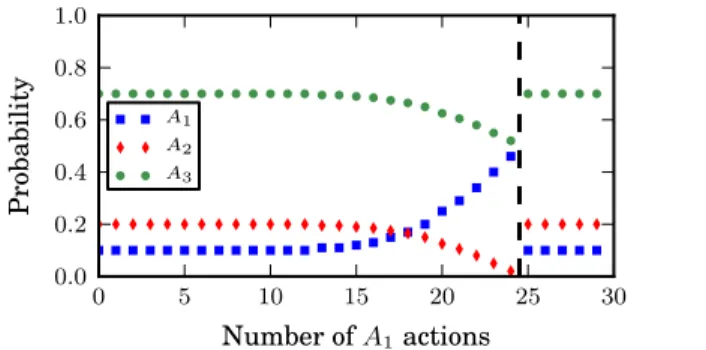
Figure 1: User receives the badge after completing 25A1
ac-tions. ActionsA1increase towards the badge boundary at the
expense of the other site actionA2 (shifting effort within the
site) as well as the life-actionA3(increase in site activity).
and then solving forU(a1) =U(xa)we have
U(a1) =θ·x
1
a·U(xa+e1)−g(xa,p)
1−θ(x2a+x3a)
Since we have already computedU(a1+ 1) =U(xa+e1), this
becomes an optimization problem in 3 variables: maximize
xa
θ·x1a·C−g(xa,p)
1−θ(x2
a+x3a)
subject to xja≥0, j= 1,2,3 and
3
X
j=1 xja= 1 where we’ve replacedU(xa+e1)withC. In the appendix of the
extended version of the paper we show how to solve this problem efficiently. For our purposes, the important point is that the optimal distribution in statea1 can be computed using the solution of the statea1+ 1. Since we knowxa = pfor all statesasuch that
a1 ≥k, we can use this to compute the optimalxafor allasuch thata1 =k−1, and recurse all the way back toa0, thus solving the user’s optimization problem in the one-dimensional case.
To illustrate the effects captured by our model, we compute the optimal policy on a simple illustrative instance. In this instance, we place one threshold badge on actionA1with boundary 25 (i.e.,
b = (25,1)). We then solve the user optimization problem de-fined above and plot the optimalxaas a function ofa1 (see Fig-ure 1). The user’s optimal mixing probability gets progressively more deflected away from his preferredpas he approaches the badge boundary. The user also increases his probability onA1
by offloading probability mass from both other action types: he is shifting his effort within the site (moving probability mass from the other site actionA2) and also increasing participation on the
site overall (moving probability mass from the life-actionA3).
Note that unifying participation and shifting site effort in this way does not necessarily make themequivalentin our framework. The deviation penalty functiong(xa,p)could be chosen to penal-ize deviating from user’s preference for the life-action more than deviating from his preferences for the various site actions.
Multiple badges.So far we considered a case where there is only one badge on the site. We now show that a similar algorithm can solve the user’s optimization problem when there are multiple badges that all target the same dimension.
Let B = {bj = (kj,1)} for j ∈ {1, . . . , m} be a set of m badges all on the same action A1, and assume that
k1 < k2 < . . . < kmwithout loss of generality. (Ifkj = kj0
for somej6=j0
, then we can consider these two badges as a sin-gle badge with value equal to the sum of their individual values.)
The fact that there are many badge boundaries does not affect the algorithm; the observation about the utility in all states with the same number ofA1 actions still holds, since all such states are
equidistant from all badge boundaries, and thus the optimization problem is the same in all of them. The problem thus becomes one-dimensional and solvable in the exact same way as before. The value of each state is “initialized” withP
b∈BIb(a)Vband again our dynamic programming base case is that in all statesaafter all the badge boundaries, the user will choosexa =p. Then the re-gion between the last and second-last badge boundaries is identical to the one-badge case we solved in the previous section and can be solved analogously. In general, the region between badgesj−1
andjis identical to the single badge case with a badge of value
Vbj+U(xkj)In this way, we recurse backwards through the set of
badges to solve the one-dimensional case with many badges.
Two targeted dimensions
Now we consider the case where different badges target different types of actions. We start withB ={b1 = (k1,1), b2= (k2,2)},
so there are two dimensions with one badge targeting each (again, letn= 2for convenience).
We begin by observing that only actions on targeted dimensions affect the optimization problem in any state, thus the utility val-ues in two states with the same number ofA1actions andA2
ac-tions are the same. Our problem, and corresponding dynamic pro-gramming table, is thus two-dimensional. The badge boundaries
a1=k1anda2=k2split the action space into four regions:
•R: a finite rectangle bounded by the origin and(k1−1, k2−1),
•H: an infinite horizontal strip with boundary points(k1,0)and
(k1, k2−1)extending rightward,
•V: an infinite vertical strip with boundary points(0, k2)and
(k1−1, k2)extending upward, and
•Q: a quadrant rooted at(k1, k2).
Similarly to before, past all the badge boundaries the user has no incentive to deviate fromp, soxa=pfor all states in quadrantQ (those witha1 ≥k1anda2≥k2).
QuadrantsHandV are then identical to the case of one thresh-old badge in one targeted dimension that we solved above.
Now we are left with the finite rectangleR, which we can di-rectly fill in in order of decreasing coordinate sum since the cells furthest from the origin depend on the value of states we already know from solving quadrantsQ,HandV. For every statea∈R:
U(xa) =θ n+1
X
j=1
xja·U(xa+ej)−g(xa,p)
Consider a stateain regionR that we process in order. We have already computedU(xa+e1)andU(xa+e2), so we can
fur-ther simplify:
U(xa) =
θ·(C1·x1a+C2·x2a)−g(xa,p)
1−θ·x3
a
whereCj = U(xa+ej)forj = 1,2are the constants we have
computed. This results in an optimization problem very similar to the one we had in the one-dimensional case:
maximize xa
θ·(C1·x1a+C2·x2a)−g(xa,p)
1−θ·x3
a
subject to xja≥0, j= 1,2,3 and
3
X
j=1 xja= 1
0 5 10 15 20
Number ofA1actions
0 2 4 6 8 10 12
Number
of
A2
actions
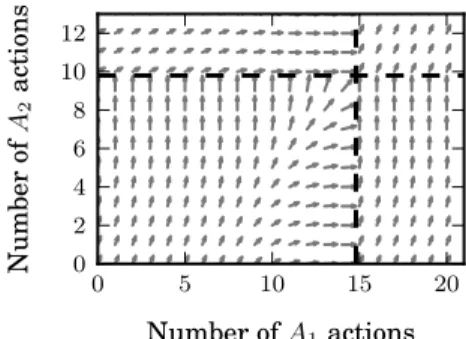
Figure 2: Two badges, each in one dimension. Arrows are pro-jections of the optimal 3-dimensional directions in each state. Arrow length corresponds to user participation on the site, and arrow direction corresponds to the distribution over the two site actions. Notice that towards the badge boundary arrows get longer (as the user increases site activity) as well as point in-creasingly towards the boundary (as the user shifts effort onto the activity warranting the badge).
Similarly to before, this optimization problem can be solved ef-ficiently. Whereas a naive, approximate solution to the problem requires solving a quadratic program for each possible discretized choice ofx3a, our method efficiently finds the exact solution via a reduction to a one-variable optimization problem (details in the ap-pendix of the extended version). This means we can use dynamic programming to fill inRmoving right-to-left and top-to-bottom, which solves the user optimization problem with two badges on different targeted dimensions. Figure 2 shows the optimal policy for an example two-dimensional problem. Again, the user both participates more on the site and steers toward badge boundaries.
This algorithm extends to the case when both targeted dimen-sions have multiple badges, just as in the one-dimensional case. The base caseQregion remains as before, the infinite strips H
andV become equivalent to the one-dimensional case with many badges, and the finite rectangleR is the same as before except we initialize each state with a differentP
bIb(a)Vb, depending on which badges have been won. This fully covers the two-dimensional case with any set of threshold badges.
General Monotone Badges. We’ve seen that interesting and in-tuitively natural behavior emerges even when we limit our atten-tion to threshold badges in one or two dimensions. We now briefly discuss the user’s optimization problem in the case of an arbitrary monotone badge. (We leave the proofs to the extended version.)
For a badgeb, letSbbe the set of action vectors that warrant the badge:Sb={a:Ib(a) = 1}. If we letm=n+ 1be the number of dimensions, thenSbis a subset ofNm, the set of allm-tuples
of natural numbers, and we say thatSbismonotoneif for any two vectorsa,˜a∈Nmsuch that˜a≥aanda∈S, we have˜a∈S. In
this notation,bis a monotone badge ifSbis monotone.
The first challenge in discussing an arbitrary monotone badgeb
is how to even specify it compactly—do the conditions required to obtainbnecessarily have a finite description? In fact they do, based on a result in combinatorics known asDickson’s Lemma. To formulate this result, we need one more definition: for a monotone setS ⊆ Nm, we say thata ∈ S is aminimal elementif for all
˜
a6= a, we have that˜a≤ aimplies˜a6∈ Sb. Dickson’s Lemma says the following: any monotone subset ofNmhas only finitely
many minimal elements.
This result implies that for any monotone badgeb, there is a finite set of vectorsc1,c2, . . . ,cksuch thatIb(a) = 1if and only if one of the vectorscisatisfiesci≤a.
Given this, we can solve the user’s optimization problem for badgebas follows. We first choose a natural numberwsuch that all coordinates of all vectorsciare upper-bounded byw, and letw be the vector inNmall of whose coordinates arew. The central
construction is to divide upNmby thinking ofwas the “origin,”
and looking at the2mregions defined by whether each coordinate is larger or smaller thanw. Specifically, let[m]denote the set of dimensions{1,2, . . . , m}; for a setσ⊆[m], letTσ ⊆Nmdenote
the set of vectorsa= (a1,a2, . . . ,am)such thatai ≤ wif and only ifi∈σ. Notice thatT[m]is a finite set, and all otherTσfor
σ6= [m]are infinite.
We solve for the optimal policy{xa}in each regionTσ induc-tively, in order of increasing cardinality ofσ. Whenσis the empty set, we know that alla ∈ Tσ satisfyxa = p. For generalTσ, we can prove the following key fact: Leta,˜a ∈ Tσ agree on all coordinates inσ, and letb∈Nm; thena+b∈Sbif and only if
˜
a+b∈ Sb. In other words, any action sequence starting froma leads to obtaining the badge if and only if the same action sequence starting from˜adoes. For suchaand˜a, it follows that we can set
xa=x˜ain the optimal policy.
As a result, it is enough to compute the optimal policy on the subsetT∗
σ ⊆Tσ in which all coordinates are bounded byw+ 1; every othera∈ Tσagrees with some˜a∈ Tσ∗on all coordinates inσ, and so its optimal policy can be determined from the optimal policies onTσ∗. SinceTσ∗is a finite set, we can then computexafor eacha∈T∗
σ using the standard recurrence for the optimal policy by considering vectorsain order of decreasing coordinate sum.
3.
EMPIRICAL EVALUATION
Having developed a model of user behavior in the presence of badges, we now investigate how the predictions of the model com-pare with the aggregate behavior of people on a popular web site. We analyze the question-answering (Q&A) site Stack Overflow, which makes extensive use of badges and was one of the first sites to use them on a large scale.
There are over 100 different badges on Stack Overflow, which vary greatly in how difficult they are to achieve. For instance, there are a number of badges for encouraging new users that nearly ev-eryone obtains, such as the “Editor” badge for contributing a first edit. In order to measure how user behavior changes in relation to the badge, we limit our attention to badges that both require sub-stantial effort to achieve and for which a user’s progress towards the badge can be readily determined. This latter restriction ex-cludes one-shot badges such as the “Great Question” badge, which rewards a single high-quality contribution.
Our particular focus is on threshold badges (those that are awarded once a user has taken a prespecified number of actions of certain types) because the action count provides a direct measure of progress towards the badge. There are four main action types on Stack Overflow: asking a question, answering a question, voting on a question and voting on an answer (abbreviated as Q, A, Q-vote and A-vote, respectively). The two badges that we consider here are the “Electorate” badge, awarded for taking at least 600 Q-votes and having at least one Q-vote for every four A-votes3, and the “Civic Duty” badge, awarded after voting 300 times (on questions or answers). Importantly, users can see exactly how many actions they’ve taken so far, and how many more they need to take in order to achieve these badges. In the language of our model, Electorate is a threshold badge and Civic Duty is an additive badge.
3In our data once user takes 600 Q-votes, they almost always sat-isfy the restriction on the ratio of Q- to A-votes, so we can think of the “Electorate” badge as being a threshold on 600 Q-votes.
Our analysis is made possible by the granular level of detail available in the activity traces on Stack Overflow4. Each individual action performed by a user is recorded and timestamped, which af-fords us the ability to directly observe the complete sequence of actions users take and measure their progress towards obtaining badges. We use Stack Overflow data from the site’s inception on July 31, 2008 to December 31, 2010.
Activity around the badge boundary. We first examine how users’ propensities to take different types of actions vary as they approach the badge boundary. We aim to analyze both how users shift their effort between actions on the site and change their overall level of site activity. For each user we bin the number of actions of each type by day. This way, changes in the relative number of var-ious types of actions per day indicate a user shifting his efforts on the site, and the daily sum over all actions measures his overall par-ticipation level (where an increase or decrease in parpar-ticipation can be interpreted as steering away from or towards the life-action).
For each badge, we take the complete set of users who ever achieved that badge and axis-align their activity profiles by letting “day 0” denote the day they receive the badge. To eliminate pos-sible population effects, we restrict the set of users to those who were active at least 60 days before and after they win the badge. Figure 3 shows user activity in the days surrounding the award-ing of the Electorate and Civic Duty badges. Notice how activ-ity on the targeted actions (Q-votes for Electorate, Q-votes and A-votes for Civic Duty) increases substantially before users achieve the badge, and then almost immediately returns to near-baseline levels. Also notice that most of the other site actions are not ad-versely affected—the rates of these actions remain relatively sta-ble over time. Since the four actions shown in the Figure are the main activities on the site, this means users increase their overall activity level on the site in the days leading up to achieving these badges. The one exception is the A-vote curve in the Electorate badge, which drops in the days leading up to the badge boundary. This is evidence that users are steering their behavior from A-votes to Q-votes during this time.
Turning towards the badge.Given that we do indeed see the sort of steering behavior predicted by our model, where user activity increases near a badge boundary (in these cases at the expense of the life-action), we now examinehowusers steer towards badge boundaries. One of the main qualitative predictions of our model is that users will “turn” towards badge boundaries, meaning they will deviate more from their preferred actions as they get closer to receiving a badge. We test this prediction by computing which ac-tions a user has taken over the course of his lifetime, and examining how actions change as a function of position in the action space.
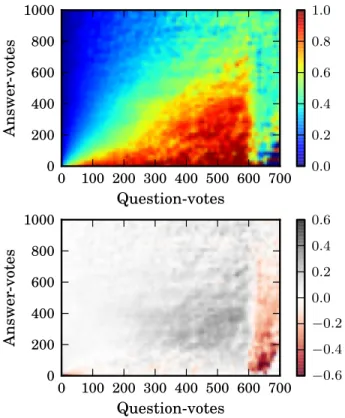
We proceed as follows. For every state in the action space, we compute the empirical distribution over site actions that users took in that state. For example, for all users who at one point during their lifetimes had contributed exactly 11 questions, 17 answers, 20 question-votes, and 11 answer-votes, we calculate the distribution over the next action they are going to take. The resulting distribu-tion represents the aggregate direcdistribu-tion users traveled at that point in the action space. The composition of these directions forms a vec-tor field like the one we modeled in Figure 2. Since this vecvec-tor field is 4-dimensional, we visualize its projection onto the question-vote and answer-vote dimensions in Figure 4 (top), where hotter colors represent higher likelihoods of the next action being a question-vote (and cooler colors represent higher likelihoods of the next action being an answer-vote).
4Stack Overflow generously gave us a complete trace of actions, but qualitatively similar results are derivable from the data that is publicly available on the Stack Overflow website.
−60 −40 −20 0 20 40 60
Number of days relative to badge win
0 2 4 6 8 10 12 14
Number
of
actions
per
day
Electorate
Qs As Q-votes A-votes
−60 −40 −20 0 20 40 60
Number of days relative to badge win
0 2 4 6 8 10
Number
of
actions
per
day
Civic Duty
Qs As Q-votes A-votes
Figure 3: Number of actions per day as a function of number of days relative the time of obtaining a badge. Notice steering in the sense of increased activity on actions targeted by the badge.
The first salient feature of the vector field is the gradient from hot to cold as the angle departing the origin varies between the two extremes. The fact that the color stays the same along a given direction starting from the origin is a validation of our modeling assumption that users have preferred distributions over the action types: one interpretation consistent with this gradient is that users tend to travel in the direction they have already traveled in.
To more clearly illustrate the “turning” effect, we normalize out the tendency of users to act as they have acted in the past by sub-tracting off the direction of each cell (so that each cell shows the difference between the empirical fraction of actions users chose and the fraction given by the position of the cell). In the resulting plot, Figure 4 (bottom), white indicates a direction matching the vec-tor corresponding to the position in action space, black indicates a higher probability of taking a question-vote, and red indicates a lower probability of taking a question-vote.
The dominant white color for smallxvalues shows that away from badge boundaries, users do not deviate much from the direc-tion they have already taken. For greaterxvalues, we clearly see that once users get near the Electorate badge boundary, they start performing more question votes (than we would expect given their position in the action space). Furthermore, this shifting towards question votes intensifies as they approach the boundary (the dark-est greys occur right before the boundary). As soon as users obtain the badge, they shift back away from question voting (doing this action less than we would expect given their position, as indicated by the red color). That the badge boundary naturally emerges from observing users’ directions in action space is a striking confirma-tion that badges influence user behavior and supports our multi-dimensional modeling framework. Additionally, the increase in in-tensity as we move along thexaxis agrees with our model’s qual-itative prediction that users are increasingly incentivized as they approach badge boundaries.
0 100 200 300 400 500 600 700
Question-votes
0 200 400 600 800 1000
Answer
-votes
0.0 0.2 0.4 0.6 0.8 1.0
0 100 200 300 400 500 600 700
Question-votes
0 200 400 600 800 1000
Answer
-votes
−0.6 −0.4 −0.2 0.0 0.2 0.4 0.6
Figure 4: Electorate badge. Given that user has taken x question-votes andyanswer-votes, what is the probability that next action will be a question vote. Top: Raw probability. Bot-tom: Relative change in probability of question-voting. Notice the effects of “turning” towards the badge boundary.
To summarize, the above experiments demonstrate that badges can steer user behavior in a manner consistent with our model. First, we observe user site activity increases as users approach the badge and thus site activity increases at the expense of the life-action. And second, we observe that users also shift their effort on the site towards actions that lead them to badges. To our knowl-edge, this is the first concrete evidence of users changing their be-havior in either of these two distinct ways in response to badges.
4.
THE BADGE PLACEMENT PROBLEM
Having seen that our model matches up well with real-world be-havior for threshold badges on Stack Overflow (badges that are awarded once a user has taken a specified number of actions of certain types) we now investigate how our model can help provide insights into the design of badges for online communities. In partic-ular, the site designer has the ability to decide on the conditions for obtaining badges; within our model we think of this as “placing” the badge boundaries within the space of action vectors. We are in-terested in addressing the following questions: (1) How much user steering do different badge placements provide? (2) How might site designer place badges to best achieve desired user behavior? (3) What is the space of user behaviors fixed badges can elicit?
We present our results organized around these three central ques-tions. First, we find that the effectiveness of a badge is generally maximized at an internal optimum that is surprisingly high, and we explore how the effectiveness varies with the setting. Second, the effectiveness of multiple badges working together is maximized when they are of equal value and are spaced roughly evenly apart. Finally, we explore the “feasible region” of user behaviors the
de-signer can elicit with a fixed set of badges and find it to be a highly complex and counterintuitive structure worthy of future study.
We arrived at these results by running experiments on our model developed in Section 2. By repeating the simulations using many different parameter settings, we found that the presented results all hold for a wide range of parameter values and thus illustrate broader principles of the badge placement problem. Moreover, we used the sameg(·)as before:g(x,p) =kx−pk22.
Throughout this section, we refer to the total fraction of actions on a targeted action (over the user’s lifetime) that results from a particular set of badge placements as theyieldof those badges. We also definegainto be the difference between the yield and the de-fault fraction of actions the user takes in the absence of any badges.
Optimal location and yield with one badge
We start our investigations with the case in which the site de-signer has a single badge at her disposal and wishes to maximize the yield on a single dimension, which we take to beA1 without
loss of generality. This setting, while simple, is of both conceptual and practical value, since the effects of placing a single badge are most easily seen when the badge is the only influence over user be-havior, and in practice it is often desirable for the designer to limit herself to a single badge.
Placing a badge of fixed prespecified value on a single dimension requires striking the right balance between two mutually compet-ing forces. First, if the badge is to have an effect on many actions, its threshold should be set high enough so that it takes many steps to achieve it. However, if its threshold is set too high, then even surviving long enough on the site to achieve the badge becomes a low-probability event and thus users will not be sufficiently in-centivized to steer strongly towards it. The solution to the badge placement problem is therefore in general an internal optimum be-tween these two goals.
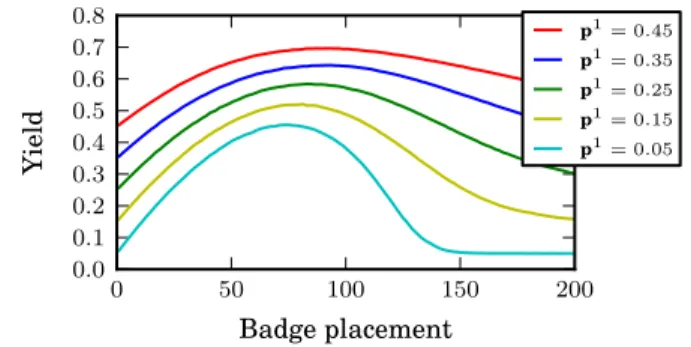
Figure 5 shows how the fraction of actions on the targeted di-mensionA1 (the yield) varies as a function of where the badge
of fixed value is placed. We plot this for various choices of
p = (x,0.5−x,0.5),x ∈ {0.05, . . . ,0.45}(while keeping all other parameters fixed). Notice that each curve has a unique inter-nal maximum. We can also see that the resulting fraction ofA1
actions is higher for larger values ofp1, which intuitively makes sense since the user is increasingly predisposed to takeA1actions.
More subtle, however, is that the optimal badge location also in-creases with p1: for p1 = 0.05it is A1 = 75, whereas for p1 = 0.45it isA1 = 90. Another interesting observation is that
this optimal location is surprisingly high: sinceθ = 0.99in this example,p1 = 0.05implies that the user would only take 5A1
actions in the absence of badges, yet the optimal badge location is far beyond this point, atA1= 75.
These results suggest interesting relationships between the model parameter settings and the amount of steering induced by the badge. For example, we just saw that the yield increases with
p1, and that the badge gets placed further away from the origin as
p1 increases. In Figure 6, we plot the yield at the optimal badge location as a function ofp1,Vb, and the user’s expected lifetime
1/(1−θ). We observe that the relationship follows a different functional form for each setting: the yield increases approximately linearly inp1 (but the gain decreases linearly), increases with di-minishing returns inVb, and surprisinglydecreasesin the expected lifetime of the user. The decreasing relationships are particularly interesting; they imply that the designer can steer users more on the actions they dislike (i.e., lowp1) than those they like, and that badges have stronger effects when users’ lifetimes are shorter.
0 50 100 150 200
Badge placement
0.0 0.1 0.2 0.3 0.4 0.5 0.6 0.7 0.8
Y
ield
p1= 0.45
p1= 0.35
p1= 0.25
p1= 0.15
p1= 0.05
Figure 5: The resulting fraction of actions on the targeted di-mension (hereA1) as a function of where the badge is placed.
The different curves show how the relationship varies as the user’s preferencespchange.
0.0 0.2 0.4 0.6 0.8
p1 0.0
0.2 0.4 0.6 0.8 1.0
Y
ield
Yield Gain
0 150 300 450 Badge amount 0.0
0.2 0.4 0.6 0.8 1.0
0 150 300 450 Expected lifetime 0.0
0.2 0.4 0.6 0.8 1.0
Figure 6: How optimal yield varies with setting parameters.
So far we have established that a single badge is optimally placed at an ideal middle ground (which is surprisingly high) and explored how the optimal yield depends on the setting. Now we investigate how one should place use multiple badges in concert with each other (i.e., target the same dimension). Exploring optimal place-ments for pairs of badges (rather than individual badges) uncovers two additional basic principles that we now discuss.
Optimal spacing.We find that yield on a single targeted dimension is maximized by two badges when they are spaced roughly evenly apart. In Figure 7, each point(x, y)represents placing the two badges atxandy A1actions, respectively, and the color indicates
the resulting yield (i.e., the cumulative activity on both targeted actions). More effective badge placements are colored red, while less effective placements are colored blue. Due to symmetry the plot is naturally mirrored below the diagonal.
The salient qualitative observation is that the optimal set of badge locations is off the main diagonal, indicating that it is better to place the two badges at distinct locations than to combine them into a single large badge at any single location.
In fact, this observation is consistent with the solution of the user’s optimization problem in Section 2.2 in the case of multi-ple badges on the same dimension, where we saw that the last badge exerts influence over not only the region after the second-last boundary, but also over the earlier regions as well. There, once we solved the user’s optimal direction for the last badge, solving the second-last badge region became equivalent to the one-badge case with a badge value equal to the second-last badge valueplus the expected utility from potentially winning the last badge.
We further note that in the optimal set of placements, badges are spaced approximately evenly apart. If the first badge is ata1=x, the second badge is ata1= 2x−for some small. The reason for theis that the second badge is placed a little closer to the origin than it would be placed in a one-badge problem starting ata1 =x
since it not only steers behavior fora1 ≥xbut also has a slight effect on the user fora1 < x.
0 100 200 300 400
Badge boundary 1 0
100 200 300 400
Badge
boundary
2
0.0 0.1 0.2 0.3 0.4
Figure 7: Yield as a function of where two badges are placed on the same targeted dimension. Every cell(x, y)corresponds to placing one badge ata1 =xactions and another ata1 =y actions, and the color of the cell indicates the resulting yield.
0 20 40 60 80 100 Vb1= 100−Vb2 0.70
0.75 0.80 0.85 0.90
Y
ield
Figure 8: How the optimal yield achievable with two badges depends on how a fixed amount of utility is split across the two badges. The more even the split, the higher the yield.
Yield is maximized with badges of equal value. In the previous case, the two badges targeted the same action but both had some fixed equal valuez. Now we allow the two badges to take dif-ferent values while their total value is held constant. Assume the first badge has valuexand the second2z−x. Now fixzand the question is: what is the optimal way to split the value of2zamong the two badges to gain maximum yield? Figure 8 plots the yield as a function ofx. Notice the effectiveness of the two badges is maximized when the badges have equal value(x=z). This result suggests that the designer should create badges in such a way that they have about equal value.
Targeting two dimensions
We just established how yield on one targeted dimension is max-imized by a single badge and when two badges are acting together. The yield of a set of badges was a natural objective function, since it expresses how much of the given action can be induced by the badge(s). With badges that can target different dimensions, there is a more complex set of trade-offs, since we need to decide how we want to balance increases in the volume of one site action with increases in another, when both are targeted by badges. More gen-erally, we ask: what is the set of all possible behaviors that can be induced using badges targeting multiple dimensions?
For simplicity we consider the scenario in which the designer has two threshold badges that she can place however she wants. She can put them both onA1, both onA2, or one on each action.
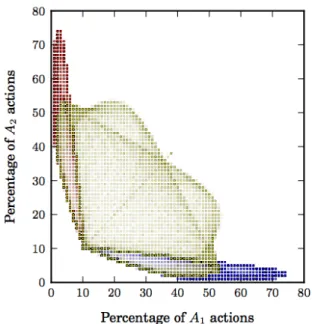
Figure 9 plots the all possible behaviors that can be induced using two threshold badges. The general contour of the plot is maintained across a wide range of model parameter settings. (For example, the contour grows as the user’s expected lifetime gets longer.)
The opacity of each(x, y)cell reflects how many distinct place-ments of two badges produce a yield ofxonA1 and a yield ofy
onA2. The dark outlines of the blue and red regions (where the
de-signer targets the same dimension with both badges) indicate that it’s easier (in the sense that there are more unique placements) to
Figure 9: The feasible region of what yields are achievable with two badges of fixed value (hereVb1 = Vb2 = 200and
p= (0.1,0.1,0.8)). A blue cell at(x, y)indicates that the de-signer can have both badges targetA1actions and elicitx%of
A1actions andy%ofA2 actions; red cells are similar but for
theA2dimension; and yellow cells indicate what is achievable
by putting one badge on each dimension. The cell opacity cor-responds to how many different pairs of badge locations elicit that particular yield.
elicit yield on the border than in the middle of these wing-shaped regions. If we consider the blue region as an example, the upper outline, near they = 10line, is dark because it corresponds to using one badge nearly optimally and essentially “discarding” the other one (by placing it so far from the origin that it doesn’t shape user behavior), whereas the lower dark outline (smoothly varying from(10%,10%)to(40%,2%)) corresponds to using both badges in concert. There are similar recurring “veins” in the gold region, indicating that some parameterized lines through the feasible re-gion are implemented by more badge placements than others.
The maximum yield on a single dimension naturally occurs when the designer places both badges on that dimension, and the mid-dle ground where both the yield is high on both dimensions oc-curs when she places one badge on each dimension. However, note that the feasible region is interestingly non-convex between these two cases. This means that designer cannot induce certain behav-iors regardless of how she places the badges. For example, the designer can elicit(5%,70%)yield using two badges onA2 and
(15%,50%)using one badge on each, but she cannot elicit the in-termediate(10%,60%)using any combination of two badges.
5.
RELATED WORK
As noted in the introduction, the use of badges is a growing trend in the design of online communities, social computing applications, and electronic commerce (e.g.see [19]), and researchers have be-gun to study the role that badges play in these sites. Antin and Churchill [1] present a conceptual organization for different types of badges, considering, among other things, the motivation they provide from a social-psychological viewpoint. Oktay et al. [18] use quasi-experimental designs to support causal claims in the con-text of badges. The use of badges can be viewed as part of the grow-ing phenomenon ofgamification[9], in which elements tradition-ally associated with computer games are used to motivate people in
other domains. Our work contributes to this literature by propos-ing a formal framework for reasonpropos-ing about the effects badges will have, which can potentially be used for the badge design in both current and new contexts.
Badges and badge-like recognitions have been proposed in off-line domains as well. There is a growing movement toward us-ing systems of badges in educational settus-ings; as one example, the Badges for Lifelong Learning Competition has made use of the Mozilla Open Badges project [10, 16] for this purpose. Thus far such initiatives in education have used badges primarily as a form of credentialing, but moving beyond this towards engaging and mo-tivating students is another key opportunity with badges in this set-ting. The advantages of badges in such contexts is a theme that has been advocated in earlier research in education as well [4].
Rewards for cumulative effort have been considered in several domains. For example, one can interpret customer loyalty pro-grams as containing badge-like incentives, such as the different status milestones in airline frequent flier programs, and research economics and marketing has studied the effect of such programs on customer behavior [14, 15]. In a different direction, Zhang et al. consider placing limited amounts of reward in a Markov decision process, as an instance of what they termenvironment design[20]. Finally, our work is related to the more general question of in-centives for contribution in social media. This is a very broad area, encompassing a number of approaches beyond just the use of badges for expressing incentives. As noted in the introduction, two methodologies that have been brought to bear on this question in the computing literature are (i) social-psychological perspec-tives on the notion of engagement and social motivators [5, 6, 17]; and (ii) algorithmic game-theoretic and economic approaches, in-cluding incentives for recruitment, contribution quality, and crowd-sourced effort [2, 7, 8, 12, 13].
6.
CONCLUSION
Badge systems are an increasingly widespread feature of online social media sites, and they can produce strong incentive effects on the users in these domains. Our work has proposed a method-ology for reasoning about these incentives, starting with a model of users who optimize their behavior given opportunities to receive badges. The main qualitative predictions of our model are borne out by an analysis of user behavior in the presence of badges on Stack Overflow, and we have seen how the model provides useful qualitative insights into the problem of placing badges to optimize their incentive effects.
We see a number of important directions in which further work could be pursued. First, the notion of a badge’svaluehas been taken as a primitive definition in this work, but as discussed earlier, it is interesting to think about the mechanisms by which badges ac-quire (non-monetary) value, and the extent to which a site designer can influence the value of a badge. More generally, our model sug-gests that in optimizing a system of badges, certain parameters— not just the badges’ values but also the structure of the possible actions, users’ preferences for these actions, and users’ expected lifetimes—all can play a potential role in the process. Develop-ing methods of estimatDevelop-ing these parameters for use in the design of badge systems is an interesting direction for further research.
Incentivizing users to increase their activity naturally brings up the question of how this affects the quality of their actions. For ex-ample, we find on Stack Overflow that users’ votes on questions are significantly more positive before they receive the Electorate badge than after it. Developing principled ways of incorporating action quality into models of user behavior in the presence of badges is an exciting direction for future work.
Acknowledgments.We thank Stack Overflow for providing their data and Hristo Spassimirov Paskov for help solving the optimization problems. This research is supported in part by a Google PhD Fellowship, a Simons Inves-tigator Award, a Google Research Grant, an ARO MURI grant, the Okawa Foundation, Boeing, Allyes, Intel, a Sloan Fellowship, a Microsoft Faculty Fellowship, and NSF grants 1149837, 0910664, CCF-0910940, IIS-1159679, IIS-1016909, CNS-1010921, and IIS-1016099.
7.
REFERENCES
[1] J. Antin and E. Churchill. Badges in social media: A social psychological perspective. InCHI Workshop on
Gamification, 2011.
[2] M. Babaioff, S. Dobzinski, S. Oren, and A. Zohar. On bitcoin and red balloons. InACM Conference on Electronic
Commerce, pages 56–73, 2012.
[3] T. Becker and V. Weispfenning.Gröbner Bases: A
Computational Approach to Commutative Algebra. Springer, 1993.
[4] J. H. Bishop. Incentives for learning: Why american high school students compare so poorly to their counterparts overseas. Technical Report CAHRS 89-09, Cornell University School of Industrial and Labor Relations, 1989. [5] M. Burke, C. Marlow, and T. M. Lento. Feed me: motivating
newcomer contribution in social network sites. InACM Conference on Human Factors in Computing Systems, pages 945–954, 2009.
[6] M. Burke and B. Settles. Plugged in to the community: social motivators in online goal-setting groups. In
International Conference on Communities and Technologies, pages 1–10, 2011.
[7] M. Cebrián, L. Coviello, A. Vattani, and P. Voulgaris. Finding red balloons with split contracts: robustness to individuals’ selfishness. InACM Symposium on Theory of Computing, pages 775–788, 2012.
[8] S. Chawla, J. D. Hartline, and B. Sivan. Optimal crowdsourcing contests. InACM-SIAM Symposium on Discrete Algorithms, pages 856–868, 2012.
[9] S. Deterding, M. Sicart, L. Nacke, K. O’Hara, and D. Dixon. Gamification: Using game-design elements in non-gaming contexts. InCHI Workshop on Gamification, 2011.
[10] Digital Media and Learning Competition. Badges for lifelong learning. http://dmlcompetition.net/competition/4/badges-competition-cfp.php.
[11] S. Frederick, G. Loewenstein, and T. O’Donoghue. Time discounting and time preference: A critical review.Journal of Economic Literature, 40(2):351–401, 2002.
[12] A. Ghosh and R. P. McAfee. Incentivizing high-quality user-generated content. InInternational World Wide Web Conference, pages 137–146, 2011.
[13] J. Kleinberg and P. Raghavan. Query incentive networks. In IEEE Symposium on Foundations of Computer Science, pages 132–141, 2005.
[14] P. K. Kopalle and S. A. Neslin. The economic viability of frequency reward programs in a strategic competitive environment.Review of Marketing Science, 1, 2003. [15] M. Lewis. The influence of loyalty programs and short-term
promotions on customer retention.Journal of Marketing Research, 41(3), 2004.
[16] Mozilla. Open badges. http://openbadges.org/en-US/. [17] H. L. O’Brien and E. G. Toms. What is user engagement? a
conceptual framework for defining user engagement with technology.Journal of the American Society for Information Science and Technology, 59(6):938–955, 2008.
[18] H. Oktay, B. Taylor, and D. Jensen. Causal discovery in social media using quasi-experimental designs. In Proceedings of the First Workshop on Social Media Analytics, pages 1–9. ACM, 2010.
[19] N. Singer. You’ve won a badge (and now we know all about you).New York Times, 4 February 2012.
[20] H. Zhang, D. C. Parkes, and Y. Chen. Policy teaching through reward function learning. InACM Conference on Electronic Commerce, pages 295–304. ACM, 2009.
APPENDIX
A.
GENERAL MONOTONE BADGES
At the end of Section 2.2, we briefly discussed the user’s opti-mization problem in the case of an arbitrary monotone badge. Here we give an extended argument with proofs showing that our algo-rithm extends to this general setting.
LetNmdenote the set of allm-dimensional vectors whose co-ordinates are natural numbers. We sayS⊆Nmismonotoneif for any two vectorsa,˜a∈Nmsuch that˜a≥aanda∈S, we have
˜
a∈S. A vectorais aminimal elementofSif (i)a∈S, and (ii) if˜a6=asatisfies˜a≤athen˜a6∈Sb.
We begin with a theorem from combinatorics known as Dick-son’s Lemma.
(1) (Dickson’s Lemma). LetS ⊆ Nmbe monotone. ThenShas only finitely many minimal elements.
It will also be useful to describe a particular method for finding a minimal element of a monotone setS ⊆Nmstarting from any
a∈S. The methods is as follows. Fix any permutationπon the dimensions{1,2, . . . , m}. Starting froma, we decrease the value ofa’s coordinate in dimensionπ(1)until the last point at which we still have a vector inS. Call the vector we reach at this point
a1 ∈ S. We then do the same starting froma1using dimension
π(2), ending at a vectora2 ∈S. We continue through allm di-mensions this way according toπ, ending with a vectoram ∈S; we denoteambyπ(a).
(2) For any monotoneS ⊆Nm, anya∈ S, and any permutationπ, the pointπ(a)is a minimal element of
S.
To prove (2), suppose by way of contradiction that π(a) is not minimal; this means that for some coordinate i, we have
π(a)−ei ∈ S, whereei denotes the unit vector in coordinate
i. Now, in the process that led fromatoπ(a), consider the vector
˜
aat the moment when we had finished working on dimensioni. We haveπ(a)≤˜a, and henceπ(a)−ei≤˜a−ei. Butπ(a)−ei∈S by assumption, and˜a−ei 6∈ S by the definition of the process, and this contradicts the monotonicity ofS.
Now we discuss badges. Consider a system where there arem
possible actions, and a user has a preferred distributionpover these actions. The user’s current state is a vectora ∈ Nm, the set of all m-tuples of natural numbers. (We can think ofm = n+ 1
for a system with n actions plus one life-action.) A badge b
has an associated indicator functionIb, whereIb(a) = 1if the badge has been earned at vectora, andIb(a) = 0otherwise. Let
Sb={a:Ib(a) = 1}; we say that the badgebismonotoneifSb is a monotone set.
We say that apoint-badgeis a badgebfor which there existsc
such thatIb(a) = 1if and only ifa≥c. We say that an∨-badge is a badge bthat is an “or” of a finite set of point-badges—that is, there existc1,c2, . . . ,cksuch thatIb(a) = 1if and only if
a≥cifor somei∈ {1,2, . . . , k}. In this case, we will say that