Acid-base Equilibria and Calculations
A Chem
1
Reference Text
Stephen K. Lower Simon Fraser University
Contents
1 Proton donor-acceptor equilibria 4
1.1 The ion product of water . . . . 4
1.2 Acid and base strengths . . . . 6
2 The fall of the proton 9 2.1 Proton sources and sinks . . . . 9
2.2 Leveling effect. . . . 9
2.3 Dissociation of weak acids . . . . 10
2.4 Titration . . . . 10
2.5 Strong bases. . . . 10
2.6 Proton free energy and pH. . . . 11
3 Quantitative treatment of acid-base equilibria 12 3.1 Strong acids and bases . . . . 12
3.2 Concentrated solutions of strong acids . . . . 13
3.3 Weak monoprotic acids . . . . 14
3.4 Pure acid in water . . . . 14
3.5 Weak bases . . . . 15
3.6 Carrying out acid-base calculations . . . . 16
Selecting the approximation. . . . . 16
Solving quadratic and higher-order polynomials . . . . 17
3.7 Calculations on mixtures of acids . . . . 18
3.8 Mixture of an acid and its conjugate base: buffers . . . . 19
3.9 Ionization fractions . . . . 21
3.10 Calculations involving mixtures of acids and bases . . . . 22
3.11 Zwitterions . . . . 25
3.12 Diprotic acids . . . . 26
Solution of an ampholyte salt . . . . 28
4 Acid-base titration 28 4.1 Titration curves. . . . 29
4.2 Observation of equivalence points . . . . 30
•CONTENTS
5 Acid- and base neutralizing capacity 34
6 Graphical treatment of acid-base problems 35
6.1 Log-C vs pH plots . . . . 35
Locating the lines on the graph . . . . 35
6.2 Estimating the pH on−logC vspH diagrams. . . . 37
pH of an acid in pure water . . . . 37
pH of a solution of the conjugate base . . . . 37
Titration curves. . . . 38
Polyprotic acids. . . . 38
7 Acid-base chemistry in physiology 40 7.1 Maintenance of acid-base balance . . . . 40
7.2 Disturbances of acid-base balance . . . . 40
8 Acid rain 41 9 The carbonate system 42 9.1 The geochemical carbon cycle . . . . 42
9.2 Carbon dioxide in the atmosphere . . . . 42
9.3 Dissolution of CO2 in water . . . . 43
9.4 Distribution of carbonate species in aqueous solutions . . . . 43
•CONTENTS
Acid-base reactions
, in which protons are exchanged between donor molecules (acids)
and acceptors (bases), form the basis of the most common kinds of equilibrium problems
which you will encounter in almost any application of chemistry.
This document provides a reasonably thorough treatment of aquatic-solution acid-base
equilibria. Although it has been used as the principal text for part of a university-level
General Chemistry course, it can also serve as a reference for teachers and advanced
students who seek a more comprehensive treatment of the subject than is likely to be
found in conventional textbooks.
As background, we will assume that you already have some understanding of the
following topics:
•
The Arrhenius concept of acids and bases
•
the Brønsted-Lowry concept, conjugate acids and bases
•
titration
•
definition of pH and the pH scale
•
strong
vs.
weak acids and bases
•1 Proton donor-acceptor equilibria
1 Proton donor-acceptor equilibria
In order to describe acid-base equilibria in the most general way, we will often represent an acid by the formula HA and its conjugate base as A−. The actual electric charges of the species will of course depend
on the particular nature of A, but the base will always have one more negative charge than the acid HA. This pair of species constitutes anacid-base systemwhose two members are related by the reaction
HA(aq) −"!− H+ + A− (1)
The most fundamental property of a given acid-base system is the extent of the above reaction. If the concentration of undissociated HA is negligible when the reaction is at equilibrium, the acid is said to bestrong. Only a very small number of acids fall into this category; most acids areweak.
There are two complications that immediately confront us when we attempt to treat acid-base equi-libria in a quantitative way:
1. Since protons cannot exist in solution as independent species, the tendency of an acid or a base to donate or accept a proton (as in Eq 1) cannot be measured for individual acid or base species separately; the best we can do is compare two different acid-base systems, and determine the extent to which the bases are able to compete against each other for the proton.
2. Water itself can act both as an acid and a base, and most of the practical applications of acid-base chemistry are those involving aqueous solutions. This means that whenever we are studing an aqueous solution of an acid HA, we must also contend with the conjugate acid and base of H2O. We can make use of (2) to help us out with (1) by using water as a reference standard for proton-donating and -accepting power. Thus the strength of an acid HA can be defined by the equilibrium
HA + H2O −→ H3O+ + A− Ka (2)
Similarly, the strength of the base A− is defined by
A− + H
2O −→ HA + OH− Kb (3)
Note carefully that reaction (3) isnotthe reverse of (2).
1.1
The ion product of water
In pure water, about one H2O molecule out of 109is “dissociated”: H2O −"!− H+ + OH− The actual reaction, of course, is the proton transfer
H2O + H2O −"!− H3O+ + OH− (4) for which the equilibrium constant
Kw= [H3O+][OH−] (5)
is known as theion productof water. The value ofKwat room temperature is 1.008×10⁻¹⁴. In pure water, the concentrations of H3O+ and OH− must of course be the same:
[H3O+] = [OH−] =
!
Kw≈10−7
•The ion product of water
As with any equilibrium constant, the value of Kw is affected by thetemperature(Kw undergoes a
10-fold increase between 0◦C and 60◦C), by the pressure(Kw is about doubled at 1000 atm), and
by the presence ofionic species in the solution. Because most practical calculations involvingKw
refer to ionic solutions rather than to pure water, the common practice of using 10−14 as if it were a universal constant is unwise; under the conditions commonly encountered in the laboratory, pKw
can vary from about 11 to almost 151. In seawater,K
w is 6.3×10⁻¹².
Notice that under conditions when Kw differs significantly from 1.0×10⁻¹⁴, the pH of a neutral
solution will not be 7.0. For example, at a pressure of 93 kbar and 527◦C,Kw= 10−3.05, the pH of pure water would be 1.5. Such conditions might conceivably apply to deposits of water in geological formations and in undersea vents.
Problem Example 1
At 60◦C, the ion product of water is 9.6E-14. What is the pH of a neutral solution at this
tempera-ture?
Solution: Under these conditions, [H+][OH−] = 9.6E–14. If the solution is neutral, [H+] = [OH−] =√9.6E–14, corresponding to pH = 6.5.
1See Stephen J. Hawkes: “pK
• Acid and base strengths
1.2
Acid and base strengths
The equilibrium constants that define the strengths of an acid and of a base are
Ka= [H3O
+][OH−]
[HA] (6)
and
Kb=[HA][OH
−]
[A−] (7)
How areKa andKb related? The answer can be found by adding Equations 2 and 3:
HA −"!− H+ + A− (8)
A− + H
2O −"!− HA + OH− (9)
H2O −"!− H+ + OH− (10)
Since the sum of the first two equations represents the dissociation of water (we are using H+ instead of H3O+ for simplicity), the equilibrium constant for the third reaction must be the product of the first two equilibrium constants:
KaKb=Kw (11)
Clearly, as the strength of a series of acids increases, the strengths of their conjugate bases will decrease, hence the inverse relation betweenKa andKb.
pK values You will recall that the pH scale serves as a convenient means of compressing a wide range of [H+] -values into a small range of numbers. Just as we defined the pH as the negative logarithm of the hydrogen ion concentration, we can define
pK=−logK
for any equilibrium constant. Acid and base strengths are very frequently expressed in terms of pKaand
pKb. From Eq 11 it should be apparent that
pKa+ pKb = pKw (= 14.0 at 25◦C)
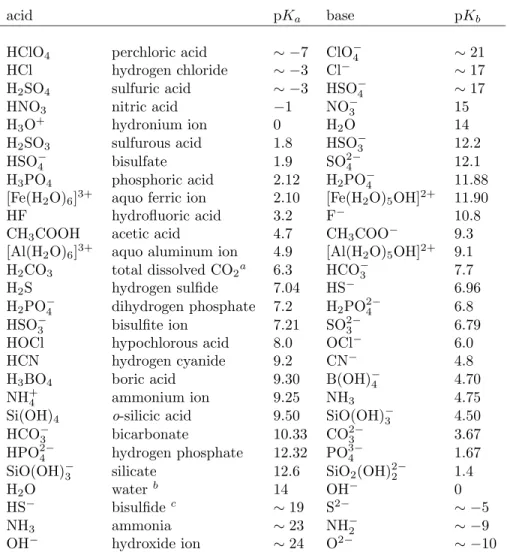
Table 1 on the next page gives the pKvalues for a number of commonly-encountered acid-base systems
which are listed in order of decreasing acid strength. Take a moment to locate the H3O+/H2O system in this table. Notice the value of pKa for the hydronium ion; its value of 0 corresponds toKa= 1. Any
acid whoseKa exceeds that of the hydronium ion is by definition a strong acid. You will also notice that
the pK’s of the strongest acids and bases are given only approximate values; this is because these species
are so strongly dissociated that the interactions between the resulting ions make it difficult to accurately define their concentrations in these solutions.
• Acid and base strengths
acid pKa base pKb
HClO4 perchloric acid ∼ −7 ClO−4 ∼21
HCl hydrogen chloride ∼ −3 Cl− ∼17
H2SO4 sulfuric acid ∼ −3 HSO−4 ∼17
HNO3 nitric acid −1 NO−3 15
H3O+ hydronium ion 0 H2O 14
H2SO3 sulfurous acid 1.8 HSO−3 12.2 HSO−
4 bisulfate 1.9 SO
2−
4 12.1
H3PO4 phosphoric acid 2.12 H2PO−4 11.88 [Fe(H2O)6]3+ aquo ferric ion 2.10 [Fe(H2O)5OH]2+ 11.90
HF hydrofluoric acid 3.2 F− 10.8
CH3COOH acetic acid 4.7 CH3COO− 9.3 [Al(H2O)6]3+ aquo aluminum ion 4.9 [Al(H2O)5OH]2+ 9.1 H2CO3 total dissolved CO2a 6.3 HCO−3 7.7
H2S hydrogen sulfide 7.04 HS− 6.96
H2PO−4 dihydrogen phosphate 7.2 H2PO24− 6.8 HSO−
3 bisulfite ion 7.21 SO
2−
3 6.79
HOCl hypochlorous acid 8.0 OCl− 6.0
HCN hydrogen cyanide 9.2 CN− 4.8
H3BO4 boric acid 9.30 B(OH)−4 4.70 NH+
4 ammonium ion 9.25 NH3 4.75
Si(OH)4 o-silicic acid 9.50 SiO(OH)−3 4.50 HCO−
3 bicarbonate 10.33 CO
2−
3 3.67
HPO2−
4 hydrogen phosphate 12.32 PO34− 1.67 SiO(OH)−
3 silicate 12.6 SiO2(OH)22− 1.4
H2O water b 14 OH− 0
HS− bisulfidec
∼19 S2− ∼ −5
NH3 ammonia ∼23 NH−2 ∼ −9
OH− hydroxide ion ∼24 O2− ∼ −10
aThe acid H
2CO3 is only a minority species in aqueous carbon dioxide solutions, which contain mainly CO2(aq).
The pKaof 6.3 that is commonly given is calculated on the basis of the total CO2in the solution. The true pKaof
H2CO3is about 3.5.
bIf water is acting as asolute, as it must if the acid strength of H
2O is being compared with that of other very
weak acids, then pKa≈16 should be used. SeeJ. Chem. Education1990: 67(5) 386-388.
cMany tables still give 14 as pK2for H
2S; this is now known to be incorrect.
• Acid and base strengths
• 2 The fall of the proton
2 The fall of the proton
An acid, being a proton donor, can onlyact as an acid if there is a suitable base present to accept the proton. What do we mean by “suitable” in this context? Simply that a base, in order to accept a proton, must provide a lower-free energy2 resting place for the proton than does the acid. Thus you can view an acid-base reaction as the “fall” of the proton from a higher free energy to a lower free energy.
2.1
Proton sources and sinks
Viewed in this way, an acid is a protonsource, a base is a protonsink. The tendency for a proton to move from source to sink depends on how far the proton can fall in energy, and this in turn depends on the energy difference between the source and the sink. This is entirely analogous to measuring the tendency of water to flow down from a high elevation to a lower one; this tendency (which is related to the amount of energy that can be extracted in the form of electricalworkif the water flows through a power station at the bottom of the dam) will be directly proportional to the difference in elevation (difference in potential energy) between the source (top of the dam) and the sink (bottom of the dam).
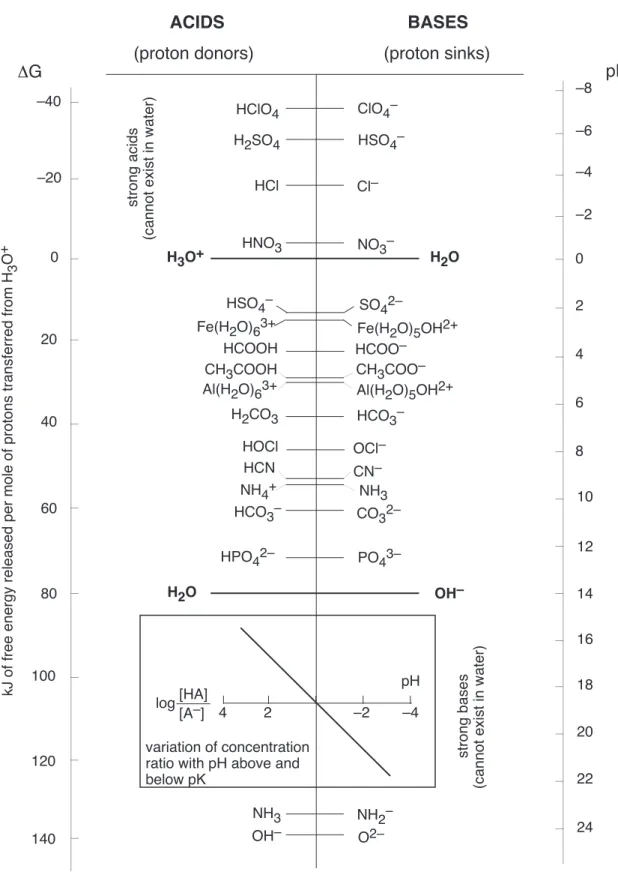
Now look at Table 2 on the following page and study it carefully. In the center columns of the diagram, you see a list of acids and their conjugate bases. These acid-base pairs are plotted on an energy scale which is shown at the left side of the diagram. This scale measures the free energy released when one mole of protons is transferred from a given acid to H2O. Thus if one mole of HCl is added to water, it dissociates completely and heat is released as the protons fall from the source (HCl) to the lower free energy that they possess in the H3O+ ions that are formed when the protons combine with H2O.
Any acid shown on the left side of the vertical line running down the center of the diagram can donate protons to any base (on the right side of the line) that appears below it. The greater the vertical separation, the greater will be the fall in free energy of the proton, and the more complete will be the proton transfer at equilibrium.
Notice the H3O+/H2O pair shown at zero kJ on the free energy scale. This zero value of free energy corresponds to the proton transfer process
H3O+ + H2O −→ H2O + H3O+
which is really no reaction at all, hence the zero fall in free energy of the proton. Since the proton is equally likely to attach itself to either of two identical H2O molecules, the equilibrium constant is unity. Now look at the acid/base pairs shown at the top of the table, above the H3O+-H2O line. All of these acids can act as proton sources to those sinks (bases) that appear below them. Since H2O is a suitable sink for these acids, all such acids will lose protons to H2O in aqueous solutions. These are therefore all
strongacids that are 100% dissociated in aqueous solution; this total dissociation reflects the very large equilibrium constants that are associated with any reaction that undergoes a fall in free energy of more than a few kilojoules per mole.
2.2
Leveling effect
Because H2O serves as a proton sink to any acid in which the proton free energy level is greater than zero, the strong acids such as HCl and H2SO4 cannot “exist” (as acids) in aqueous solution; they exist as their conjugate bases instead, and the only proton donor present will be H3O+. This is the basis of theleveling effect, which states thatthe strongest acid that can exist in aqueous solution isH3O+.
2You don’t know whatfree energyis? Don’t worry about it for the time being; just think of it as you would any other
form of potential energy: something that falls when chemical reactions take place. This topic will be covered later in the course.
•Dissociation of weak acids
Now consider a weak acid, such as HCN at about 40 kJ mol−1 on the scale. This positive free energy means that in order for a mole of HCN to dissociate (transfer its proton to H2O), the proton mustgain 40 kJ of free energy per mole. In the absence of a source of energy, the reaction will simply not go; HCN is dissociated only to a minute extent in water.
2.3
Dissociation of weak acids
Why is a weak acid such as HCN dissociated at all? The molecules in solution are continually being struck and bounced around by the thermal motions of neighboring molecules. Every once in a while, a series of fortuitous collisions will provide enough kinetic energy to a HCN molecule to knock off the proton, effectively boosting it to the level required to attach itself to water. This process is calledthermal excitation, and its probability falls off very rapidly as the distance (in kJ mol−1 ) that the proton must rise increases. The protons on a “stronger” weak acid such as HSO−
4 or CH3COOH will be thermally excited to the H3O+ level much more frequently than will the protons on HCN or HCO−3, hence the difference in the dissociation constants of these acids.
2.4
Titration
Although a weak acid such as HCN will not react with water to a significant extent, you are well aware that such an acid can still be titrated with strong base to yield a solution of NaCN at the equivalence point. To understand this process, find the H2O/OH− pair at about 80 kJ mol−1 on the free energy scale. Because the OH−ion can act as a proton sink to just about every acid shown on the diagram, the
addition of strong base in the form of NaOH solution allows the protons at any acid above this level to fall to the OH− level according to the reaction
H+ + OH− −→ H
2O
Titration, in other words, consists simply in introducing a low free energy sink that can drain off the protons from the acids initially present, converting them all into their conjugate base forms.
2.5
Strong bases
There are two other aspects of the H2O-H3O+ pair that have great chemical significance. First, its location at 80 kJ mol−1 tells us that for a H
2O molecule to transfer its proton to another H2O molecule (which then becomes a H3O+ion whose relative free energy is zero), a whopping 80 kJ/mol of free energy must be supplied by thermal excitation. This is so improbable that only one out of about 10 million H2O molecules will have its proton elevated to the H3O+ level at a given time; this corresponds to the small value of the ion product of water, about 10−14.
The other aspect of the H2O-OH− pair is that its location defines the hydroxide ion as the strongest base that can exist in water. On our diagram only two stronger bases (lower proton free energy sinks) are shown: the amide ion NH−
2, and the oxide ion O2−. What happens if you add a soluble oxide such as Na2O to water? Since O2−is a proton sink to H2O, it will react with the solvent, leaving OH−as the strongest base present:
Na2O + H2O −→ 2OH− + Na+
This again is the leveling effect; all bases stronger than OH− appear equally strong in water, simply
• Proton free energy and pH
2.6
Proton free energy and pH
The pH of a solution is more than a means of expressing its hydrogen ion concentration on a convenient logarithmic scale3. The pH as we commonly use it nowadays indicates theavailabilityof protons in the solution; that is, the ability of the solution to supply protons to a base such as H2O. This is the same as the hydrogen ion concentration[H+] only in rather dilute solutions; at ionic concentrations (whether of H+or other ions) greater than about 0.01M, electrostatic interactions between the ions cause the relation between the pH (as measured by direct independent means) and [H+] to break down. Thus we would
notexpect the pH of a 0.100M solution of HCl to be exactly 1.00.
On the right side of Figure Table 2 is a pH scale. At the pH value corresponding to a given acid-base pair, the acid and base forms will be present at equal concentrations. For example, if you dissolve some solid sodium sulfate in pure water and then adjust the pH to 2.0, about half of the SO−
42will be converted into HSO−
4. Similarly, a solution of Na2CO3in water will not contain a very large fraction of CO23−unless the pH is kept above 10.
Suppose we have a mixture of many different weak acid-base systems, such as exists in most biological fluids or natural waters, including the ocean. The available protons will fall to the lowest free energy levels possible, first filling the lowest-energy sink, then the next, and so on until there are no more proton-vacant bases below the highest proton-filled (acid) level. Some of the highest protonated species will donate protons to H2O through thermal excitation, giving rise to a concentration of H3O+ that will depend on the concentrations of the various species. The equilibrium pH of the solution is a measure of this H3O+ concentration, but this in turn reflects the relative free energy of protons required to keep the highest protonated species in its acid form; it is in this sense that pH is a direct measure of proton free energy.
In order to predict the actual pH of any given solution, we must of course know something about the nominal concentrations (Ca) of the various acid-base species, since this will strongly affect the distribution
of protons. Thus if one proton-vacant level is present at twice the concentration of another, it will cause twice as many acid species from a higher level to become deprotonated. In spite of this limitation, the proton free energy diagram provides a clear picture of the relationships between the various acid and base species in a complex solution.
3The concept of pH was suggested by the Swedish chemist Sørensen in 1909 as a means of compressing the wide range
of [H+] values encountered in aqueous solutions into a convenient range. The modern definition of pH replaces [H+] with
{H+}in which the curly brackets signify the effectiveconcentration of the hydrogen ion, which chemists refer to as the
hydrogen ionactivity:
•3 Quantitative treatment of acid-base equilibria
3 Quantitative treatment of acid-base equilibria
3.1
Strong acids and bases
The usual definition of a “strong” acid or base is one that is completely dissociated in aqueous solution. Hydrochloric acid is a common example of a strong acid. When HCl gas is dissolved in water, the resulting solution contains the ions H3O+, OH−, and Cl−, but except in very concentrated solutions, the concentration of HCl is negligible; for all practical purposes, molecules of “hydrochloric acid”, HCl, do not exist in dilute aqueous solutions.
In order to specify the concentrations of the three species present in an aqueous solution of HCl, we need three independent relations between them. These relations are obtained by observing that certain conditions must always be true in any solution of HCl. These are:
1. Thedissociation equilibrium of watermust always be satisfied:
[H3O+][OH−] =Kw (12)
2. For any acid-base system, one can write a mass balance equation that relates the concentrations of the various dissociation products of the substance to its “nominal concentration”, which we designate here as Ca. For a solution of HCl, this equation would be
[HCl] + [Cl−] =Ca
but since HCl is a strong acid, we can neglect the first term and write the trivial mass balance equation
[Cl−] =Ca (13)
3. In any ionic solution, the sum of the positive and negative electric charges must be zero; in other words, all solutions are electrically neutral. This is known as theelectroneutrality principle.
[H3O+] = [OH−] + [Cl−] (14) The next step is to combine these three equations into a single expression that relates the hydronium ion concentration toCa. This is best done by starting with an equation that relates several quantities,
such as Eq 14 , and substituting the terms that we want to eliminate. Thus we can get rid of the [Cl−]
term by substituting Eq 13 into Eq 14 :
[H3O+] = [OH−] +Ca (15)
A [OH−]-term can always be eliminated by use of Eq 12 :
[H3O+] =Ca+ Kw
[H3O+]
(16) This equation tells us that the hydronium ion concentration will be the same as the nominal concentration of a strong acid as long as the solution is not very dilute. As the acid concentration falls below about 10−6M, however, the second term predominates; [H
3O+]approaches √Kw, or 10−7M. The hydronium ion concentration can of course never fall below this value; no amount of dilution can make the solution alkaline!
Notice that Eq 16 is a quadratic equation; in regular polynomial form it would be [H3O+]
2
−Ca[H3O+]−Kw= 0 (17)
Most practical problems involving strong acids are concerned with more concentrated solutions in which the second term of Eq 16 can be dropped, yielding the simple relation H3O+= [A−].
• Concentrated solutions of strong acids
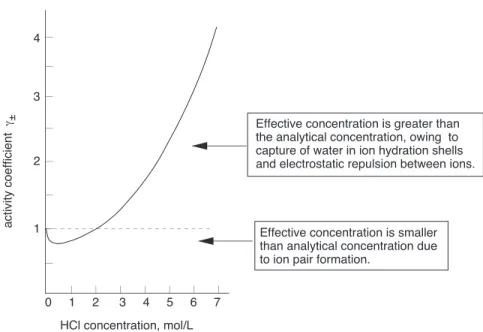
Figure 1: Mean ionic activity coefficient in HCl as a function of concentration
3.2
Concentrated solutions of strong acids
In more concentrated solutions, interactions between ions cause their “effective” concentrations, known as theiractivities, to deviate from their “analytical” concentrations.
Thus in a solution prepared by adding 0.5 mole of the very strong acid HClO4 to sufficient water to make the volume 1 litre, freezing-point depression measurements indicate that the concentrations of hydronium and perchlorate ions are only about 0.4M. This does not mean that the acid is only 80% dissociated; there is no evidence of HClO4molecules in the solution. What has happened is that about 20% of the H3O+ and ClO−4 ions have formed ion-pair complexes in which the oppositely-charged species are loosely bound by electrostatic forces. Similarly, in a 0.10Msolution of hydrochloric acid, the activity of H+ is 0.081, or only 81% of its concentration.
Activities are important because only these work properly in equilibrium calculations. Also, pH is defined as the negative logarithm of the hydrogen ion activity, not its concentration. The relation between the concentration of a species and its activity is expressed by theactivity coefficientγ:
a=γC (18)
As a solution becomes more dilute, γ approaches unity. At ionic concentrations below about 0.001M,
concentrations can generally be used in place of activities with negligible error.
At very high concentrations, activities can depart wildly from concentrations. This is a practical consideration when dealing with strong mineral acids which are available at concentrations of 10M or greater. In a 12Msolution of hydrochloric acid, for example, the mean ionic activity coefficient4 is 207. This means that under these conditions with [H+] = 12, the activity
{H+
} = 2500, corresponding to a
pH of about –3.4, instead of –1.1 as might be predicted if concentrations were being used.
These very high activity coefficients also explain another phenomenon: why you can detect the odor of HCl over a concentrated hydrochloric acid solution even though this acid is supposedly 100% dissociated.
4Activities of single ions cannot be determined, so activity coefficients in ionic solutions are always the average, ormean,
• Weak monoprotic acids
With such high effective concentrations, the “dissociated” ions come into such close contact that the term begins to lose its meaning; in effect, dissociation is no longer complete. Although the concentration of HCl(aq) is never very high, its own activity coefficient can be as great as 2000, which means that its
escaping tendency from the solution is extremely high, so that the presence of even a tiny amount is very noticeable.
3.3
Weak monoprotic acids
Most acids are weak; there are hundreds of thousands of them, whereas there are no more than a few dozen strong acids. We can treat weak acid solutions in exactly the same general way as we did for strong acids. The only difference is that we must now include the equilibrium expression for the acid. We will start with the simple case of the pure acid in water, and then go from there to the more general one in which strong cations are present. In this exposition, we will refer to “hydrogen ions” and [H+] for brevity, and will assume that the acid HA dissociates into H+ and its conjugate base A−.
3.4
Pure acid in water
In addition to the species H+, OH−, and A− which we had in the strong-acid case, we now have the
undissociated acid HA; four variables, four equations. 1. Equilibria. We now have two equilibrium relations:
[H+][OH−] =Kw (19)
[H+][A−]
[HA] =Ka (20)
2. Mass balance. The mass balance relation expresses the nominal concentration of the acid in terms of its two conjugate forms:
Ca = [HA] + [A−] (21)
3. Electroneutrality.
[H+] = [A−] + OH− (22)
We can use Eq 21 to get an expression for [HA], and this can be solved for [A−]; these are substituted
into Eq 20 to yield
Ka= [H
+]([H+]−[OH−])
Ca−([H+]
−[OH−]) (23)
This equation is cubic in [H+]when [OH−] is expressed as Kw/[H+]; in standard polynomial form it becomes
[H+]3+Ka[H+]2
−(Kw+CaKa)[H+])
−KwKa = 0 (24)
For most practical applications, we can make approximations that eliminate the need to solve a cubic equation.
1. Unless the acid is extremely weak or the solution is very dilute, the concentration of OH− can be
neglected in comparison to that of [H+]. If we assume that [OH−] ' [H+], then Eq 23 can be simplified to
Ka= [H +]2
Ca−[H+] (25)
which is a quadratic equation:
[H+]2+Ka[H+]
• Weak bases
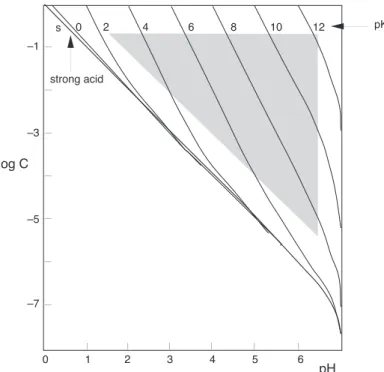
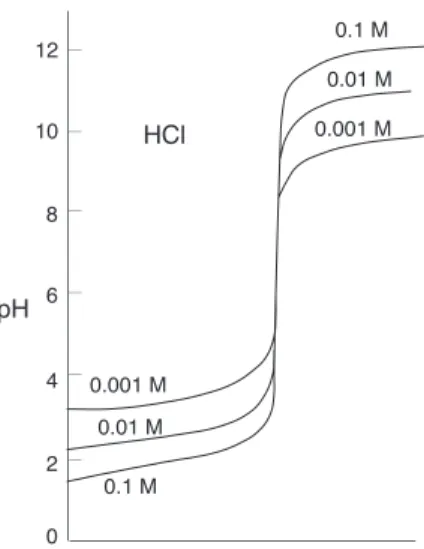
Figure 2: pH as a function of concentration for acids of various strengths
The shaded area indicates the range of acid strengths and concentrations for which the approximation Eq 28 is generally valid.
2. If the acid is fairly concentrated (usually more than 10−3M), a further simplification can frequently be achieved by making the assumption that [H+]
' Ca. This is justified when most of the acid
remains in its protonated form [HA], so that relatively little H+ is produced. In this event, Eq 25 reduces to
Ka= [H +]2
Ca (27)
or
[H+]≈(KaCa)12 (28)
3.5
Weak bases
The weak bases most commonly encountered are NH3, amines such as CH3NH2, and anions A− of weak acids. Using the latter as an example, we can write the base constant
Kb=[HA][OH−]
[A−]
For aCbM solution of NaA in water, the charge balance is
• Carrying out acid-base calculations
Replacing the [Na+] term by Cb and combining withKw and the mass balance Cb = [HA] + [A−], a
relation is obtained that is analogous to that of Eq 23 for weak acids:
Kb= [OH−]([OH−]−[H +])
Cb−([OH−]−[H+]) (29)
The approximations
Kb= [OH
−]2
Cb−[OH−] (30)
and
[OH−]≈(KbCb)12 (31)
can be derived in a similar manner.
3.6
Carrying out acid-base calculations
Acid-base calculations fall into two categories: those that are done as part of a course in which your aim is to obtain a good grade, and those done for real-world applications in which the goal is to obtain a useful answer with a minimum of effort. For the latter, there is almost never any need to do anything other than a graphical estimate as described in Section 6. Unless values of Kw and Ka’s that pertain
to the actual conditions of temperature and ionic strength are available, carrying out a calculation to a precicision of more than two significant figures while usingKw = 10−14 and the Kw values commonly seen in textbooks (which apply only to pure water, which is rarely the subject of our interest) is a waste of time.
Even so, the algebraic approach that is taught in most General Chemistry courses is important in two respects: the quantitative treatment required to derive the equations provides a clearer view of the equi-libria involved and serves as a model for the treatment of generalized equiequi-libria, and the approximations commonly applied to simplify the relations serve as good models of the kinds of judgements that must be made very commonly in applied mathematics. It is important to bear in mind, however, than the results are only as valid as the data, and the latter are almost never good enough to yield correct answers for any but extremely dilute solutions.
Selecting the approximation.
Eq 25 serves as the starting point for most practical calculations on solutions of weak monoprotic acids.
Don’t memorize this equation; you should be able toderiveit (as well as the analogous equation for weak bases) from the definition of the equilibrium constant. If you know that the system parameters fall into the shaded region of Fig. 2, then the approximation Eq 28 is usually satisfactory. However, if the acid is very dilute or very weak, the exact calculation Eq 23 will be required.
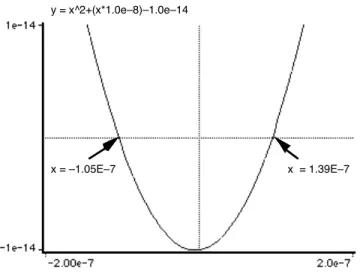
As an example, consider a 10−6Msolution of hypochlorous acid, pKa = 8.0. (HOCl is a decomposition product of chlorine in water and is largely responsible for its bactericidal properties.) In this case, the approximation Eq 23 leads to a quadratic equation whose non-negative root is 9.50E−8, clearly an absurd value for a solution of any acid, no matter how dilute or weak. Substitution into Eq 24 and plotting reveals a root at [H+] = 1.30E
−7.
For acids having pKas of 10 or greater, even solutions as concentrated as .001M will yield incorrect
pH values unless the exact calculation is used. The same is true of comparably weak bases, which are most commonly encountered in the form of anions which are conjugate to the stronger of the weak acids. Thus for a 0.0010M solution of Na2SO4 (and using Ka =.012 for HSO−4), Eq 30 predicts a pH of 6.46 (anacidic solution!), while Eq 29 yields the more reasonable value of 7.02.
• Carrying out acid-base calculations
Figure 3: Plot of Eq 26 for 10−6M HOCl
This was done with NumberCrunch, a widely-available free utility for the Macintosh computer. Sev-eral tries were required to set the limits of the axes so that both roots are revealed. The physically meaningful root is the one on the right, where the plot crosses the zero line atx= +1.39E−7.
Solving quadratic and higher-order polynomials
The roots of quadratic equations such as Eq 25 can of course be found by casting the equation into standard polynomial form and using the quadratic formula5. Deciding which of the roots corresponds to [H+] is almost never a problem, since you know it can’t be negative and for an acid solution must be within the range 10−7 toCa.
If Eq 28 gives a reasonable value of [H+], this can be substituted into the denominator of Eq 25 which then yields a revised version of Eq 28 to solve. Two or three iterations usually yield an unchanging value of [H+]. This procedure is easily carried out on a hand-held calculator. However, it is not foolproof; successive answers do not always converge, especially if the initial guess is too far off.
For dealing with cubic and higher-order equations (and even for quadratics in some cases), the most practical methods aretrial-and-error andplotting. The first of these involves making a series of guesses which are modified according to the value they give when substituted into the equation. If you have a plotting calculator or a computer equipped with a suitable utility, the easiest method of all is to simply plot the function within a suitable range ofx-values Fig. 3.
Computer utilities such as MathCad and Mathematica are especially convenient for solving equilibrium problems and for comparing the results obtained by approximate and exact solutions.
5If you do this on a computer or programmable calculator, it is better to avoid calculatingx= (−b)±!(b2−4ac)/2a
directly. The reason is that ifb2 # |4ac|, one of the roots will involve the subtraction of two terms of similar value; this
can lead to considerable error when carried out on hardware having finite precision. The recommended way is to calculate the quantity
Q=−(b+sgn(b)∗sqrt(b2−4ac))/2
from which the roots arex1=Q/aandx2=c/Q. See any textbook on numerical computing methods for more information
• Calculations on mixtures of acids
3.7
Calculations on mixtures of acids
Many practical problems relating to environmental and physiological chemistry involve solutions con-taining more than one acid. Several methods have been published for calculating the hydrogen ion concentration in solutions containing an arbitrary number of acids and bases6. These generally involve iterative calculations carried out by a computer.
In this section, we will restrict ourselves to a much simpler case of two acids, with a view toward showing the general method of approaching such problems by starting with charge- and mass-balance equations and making simplifying assumptions when justified.
In general, the hydrogen ions produced by the stronger acid will tend to suppress dissociation of the weaker one, and both will tend to suppress the dissociation of water, thus reducing the sources of H+ that must be dealt with.
Consider a mixture of two weak acids HX and HY; their respective nominal concentrations and equilibrium constants are denoted byCx,Cy,KxandKy. Starting with the charge balance expression
[H+] = [X−] + [Y−] + [OH−]
We use the equilibrium constants to replace the conjugate base concentrations with expressions of the form
[X−] =Kx[HX]
[H+] to yield
[H+] = [HX] Kx +
[HY]
Ky +Kw
Multiplying both sides by [H+] allows us to eliminate [OH−]:
[H+]2=Kx[HX] +Ky[HY]
If neither acid is very strong nor very dilute, we can replace equilibrium concentrations with nominal concentrations:
[H+]≈!CxKx+CyKy+Kw
For a solution containing 0.10 Macetic acid (Ka= 1.75E-5) and 0.20M phenol (Ka= 1.00E-10) this
yields a reasonable answer. But if 0.001M chloroacetic acid (Ka= .0014) is used in place of phenol, the
above expression becomes
[H+] =!1.40E-6 + 1.75E-8 + 10−14= 0.00118
which exceeds the concentration of the stronger acid; because the acetic acid makes a negligible contri-bution to [H+] here, the simple approximation given above is clearly invalid.
We now use the mass balance expression for the stronger acid [HX] + [X−] =Cx
to solve for [X−] which is combined with the expression for Kx to yield
[X−] =Cx−[H+][X−]
Kx
•Mixture of an acid and its conjugate base: buffers
Solving this for [X−] gives
[X−] = CxKx
Kx+ [H+]
The approximation for the weaker acetic acid (HY) is still valid, so we retain it in the subtituted elec-tronegativity expression:
[H+] = CxKx Kx+ [H+]+
CyKy
[H+] which is a cubic equation that can be solved by approximation.
3.8
Mixture of an acid and its conjugate base: buffers
If we add some sodium hydroxide to a solution of an acid, then an equivalent amount of the acid will be converted into its base form, resulting in a “partly neutralized” solution in which both the acid and its conjugate base are present in significant amounts. Solutions of this kind are far more common than those of a pure acid or a pure base, and it is very important that you have a thorough understanding of them.
For example, suppose that we have a solution containing 0.010 mole of acetic acid. To this we add 0.002 mole of sodium hydroxide, which consumes this same amount of acid and produces 0.002 mole of acetate ion. If the volume of the final solution is 100 ml, then the nominal acid and base concentrations are
Ca=
.010−.002 mol
.100 L =.080M and Cb=
.002
.100=.020M
Note that this solution would be indistinguishable from one prepared by combiningCa=.080 mole
of acetic acid withCb= 0.020 mole of sodium acetate and adjusting the volume to 100 ml.
The equilibrium expressions for such a solution are just the ones for the pure-acid case: Eq 19 and Eq 20 . The mass balance for the acid now contains the additional termCb; note that in the preceding
example, this sum will have the value 0.100 M:
[HA] + [A−] =Ca+Cb (32)
There is a new mass balance equation for the cation, but it is trivial:
[Na+] =Cb (33)
The charge balance equation must also include [Na+]:
[Na+] + [H+] = [OH−] + [A−] (34)
Substituting Eq 33 into the above expression yields an equation for [A−]:
[A−] =Cb+ [H+]
−[OH−] (35)
Inserting this into Eq 32 and solving for [HA],
[HA] =Ca−([H+]
−[OH−]) (36)
Finally we substitute these last two expressions into the equilibrium constant Eq 20 : [H+] =KaCa−[H+] + [OH−]
•Mixture of an acid and its conjugate base: buffers
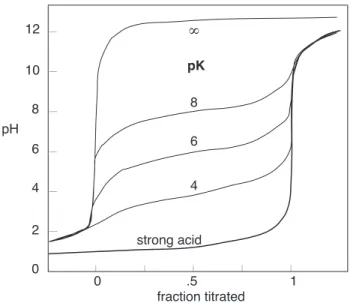
How dilute can a solution with [A−] =Cb be and still exhibit
use-ful buffering action? As you can see from these plots, the answer de-pends very much on the pKaof the
particular acid-base system. (The pKa values are indicated near the
top of the figure.) The lines marked strong base and strong acid corre-spond to the limiting cases of pKa=
±∞. The vertical part of each plot corresponds to the concentra-tion range in which the approxima-tion Eq 40 is valid.
Figure 4: Buffering action as a function of buffer concentration which is cubic in [H+] when [OH−] is replaced byKw/[H+]:
[H+]3+ (Cb+ 1)[H+]2
−(Kw+CaKa)[H+]
−Kw= 0 (38)
In almost all practical cases it is possible to make simplifying assumptions. Thus if the solution is known to be acidic or alkaline, then the [OH−] or [H+] terms in Eq 37 can be neglected. In acidic solutions, for example, Eq 37 becomes
[H+]
≈KaCa−[H +]
Cb+[H+] (39)
If the concentrations Ca andCb are sufficiently large, it may be possible to neglect the [H+] terms entirely, leading to the commonly-seen expression
[H+]
≈KaCaCb (40)
This relation is an extremely important one which you must know; it is sometimes referred to as the
Henderson-Hasselbalch equation7 .
Pitfalls of the Henderson-Hasselbalch equation The above equation will be found in virtually all textbooks and is widely used in practical calculations. What most books do not tell you is that Eq 40 is no more than an “approximation of an approximation” which can give incorrect and misleading results
7The first studies on buffer action were published by Lawrence Henderson (USA, 1908 and by Karl Hasselbalch (Denmark,
• Ionization fractions
when applied to situations in which the simplifying assumptions are not valid. Unless you know what you are doing, your starting point should normally be Eq 39 for solutions that are expected to be acidic, or an analogous relation which can easily be derived for alkaline solutions.
Problem Example 2
Calculate the pH of a solution prepared by adding 0.10 mole of NaOH to a solution containing 0.20 mole/litre of iodic acid, HIO3,Ka= 0.2.
Solution: Eq 40 predicts a hydrogen ion concentration of
[H+] =K
a
Ca
Cb
= 0.20.10 0.10= 0.2
or a pH of 0.70, but this is wrong. The problem is that HIO3 is a rather “strong” weak acid, so the value of [H+] will be comparable in magnitude to those ofCaandCbin Eq 39. Placing this equation
in standard polynomial form yields [H+]2
+ (Ca+Ka)[H+]−KaCa= 0 (41)
Solving this for [H+] using the values in the problem gives a hydrogen ion concentration of 0.056M
and a pH of 1.2; notice that these results are quite different from what Eq 40 would predict.
Be careful about confusing the two relations [H+] =Ka[HA]
[A−] and [H+]≈Ka
Ca Cb
The one on the left is simply a re-writing of the equilibrium constant expression, and is thereforealways true. Of course, without knowing the actual equilibrium values of [HA] and [A−], this relation is of little
direct use in pH calculations. The equation on the right isnever true, but will yield good results if the acid is sufficiently weak in relation to its concentration to keep the [H+] from being too high. Otherwise, the high [H+] will convert a significant fraction of the A− into the acid form HA, so that the ratio [HA]/[A−]
will differ fromCa/Cbin the above two equations. Consumption of H+by the base will also raise the pH above the value predicted by Eq 40 as we saw in the preceding problem example.
Finally, notice that Eq 40 can give absurd values of hydrogen ion concentration if one ofCa orCb is
extremely small.
Buffer solutions The important feature of Eq 37 or of its approximation Eq 40 is that they give the pH of the solution in terms of the nominal concentrationsof the conjugate acid and base; in most practical cases these values are known or can easily be calculated. Furthermore, ifCa andCb are quite large, any
reactions that tend to produce or withdraw H3O+ or OH− ions will have only a small effect on their
ratio, and thus on the pH of the solution. Such a solution is said to bebuffered.
One of the most important conjugate pairs involved in buffering is CO2/ HCO−3. These two species are largely responsible for maintaining the pH of the ocean and also of blood at a constant value. Many of the reactions that take place in organisms involve the uptake or release of hydrogen ions, and the media in which they occur must be buffered in order to keep the pH within the rather narrow bounds that the organism can tolerate.
3.9
Ionization fractions
It is important to be able to express the relative amounts of a conjugate acid-base system present in the protonated and deprotonated forms. The simple ratio [HA]/[A−] (or its inverse) is often used, but this
•Calculations involving mixtures of acids and bases
Figure 5: Ionization fraction diagram for a monoprotic acid.
suffers from the disadvantage of being indeterminate when the concentration in the denominator is zero. For many purposes it is more convenient to use theionization fractions
α0≡αHA=
[HA]
[HA] + [A−]; α1≡αA− =
[A−]
[HA] + [A−] (42)
The fractionα1 is also known as thedegree of dissociationof the acid. By making appropriate substitu-tions using the relation
[H+] =Ka[HA]
[A−] (43)
. we can express the ionization fractions as a function of the pH:
α0≡αHA=
[H+]
Ka+ [H+]; α1≡αA− = Ka
Ka+ [H+] (44)
In the plot of these two functions shown in Fig. 5, notice the crossing point where [HA] = [A−] when
[H+] =Ka. This corresponds to unit value of the quotient in Eq 43.
3.10
Calculations involving mixtures of acids and bases
Solutions containing significant concentrations of an acid and its conjugate base, or of a salt of a weak acid and a weak base, are encountered very frequently in many practical applications of chemistry and biochemistry. Exact calculations on such mixtures that take into account charge balance, all equilibria and all mass balances tend to be rather complicated and are almost never necessary. In most cases you can simplify the problem by identifying the major equilibrium species and neglecting minor ones. Doing so requires some chemical intuition which is best developed by carefully following examples of the kind presented in this section.
Problem Example 3
Calculate the pH of a solution containing 0.0100 mole of ammonium chloride and 0.0200 mole of ammonia in 100 ml of solution.
Solution:The equilibrium here is
•Calculations involving mixtures of acids and bases
For NH+
4,Ka= 10−9.3and thusKb= 10−(14−(−9.3))= 10−4.7:
[NH+
4][OH−]
[NH3]
= 10−4.7
The nominal concentrations of the acid and conjugate base are respectively Ca = 0.100M and
Cb= 0.200M. The mass balance expressions are
[NH+
4] + [NH3] =Ca+Cb= 0.30 and [Cl−] =Ca
and the charge balance is given by
[Cl−] + [OH−] = [H+] + [NH+
4]≈[NH+4]
in which the approximation shown above is justified by our knowledge that the solution will be weakly alkaline. The equilibrium concentrations of the conjugate species are then
[NH+
4] = 0.100 + [OH−] and [NH3] = 0.200−[OH−]
BecauseCaandCbare large compared to [OH−] (the solution is not expected to be strongly alkaline),
the [OH−] terms in the above expressions can be dropped and the equilibrium expression becomes
(0.100)[OH−]
0.200 = 2.0E–5 from which we find [OH−] = 4.0E–5, pOH = 4.4 and pH = 9.6.
Problem Example 4
What will be the change in the pH if 10 ml of 0.100MHCl is added to 100 ml of the above solution?
Solution: We can continue using the approximations for the concentrations of the conjugate species that we developed in the preceding example. Addition of the strong acid (1.0 mmol) converts this amount of NH3 into NH+4 and also increases the total volume of the solution. The values ofCb and
Ca are now
Cb=
(20 mmol−1 mmol)
110 ml = 0.173M ≈[NH3] and
Ca= (10 mmol + 1 mmol)
110 ml = 0.100M ≈[NH +
4]
Substituting these into the equilibrium constant expression yields [OH−] = [NH3]
[NH+
4]
Kb= 1.73×2.0×10−5= 3.46E–5
The new pOH is 4.5, so addition of the acid has changed the pH to 9.5, a decrease of only 0.1 pH unit.
Problem Example 5
Calculate the pH of a 0.01Msolution of ammonium chloride in pure water.
Solution: From the charge balance expression
[NH+
4] + [H+] = [OH−] + [Cl−]
we can drop the [OH−] term since we know that the solution will be weakly acidic. Using this
approximation and the mass balance on the conjugate species, we have [NH+4] = 0.01−[H+] and [NH
•Calculations involving mixtures of acids and bases
Substituting these into theKa expression for [NH+4], we obtain (compare with Eq 37) [H+] = [NH+4]
[NH3]
Ka= 0.01−[H
+]
[H+] ×5.0×10
−10
Can we drop the [H+] term in the numerator? Doing so yields [H+] =!0.01
×5×10−10= 2.2E–6
Because this value is small compared to 0.01, this approximation is acceptable and the pH is 5.6.
Comment: Because the concentrations were not extremely small, this turns out to be a typical buffer solution problem in which Eq 37 is simplified to Eq 40. However, instead of blindly substituting into the latter equation, we followed the much safer route of examining the effects of the various approximations as we made them. Only through this approach can you have any confidence that your result is a valid one.
A salt of a weak acid gives an alkaline solution, while that of a weak base yields an acidic solution. What happens if we dissolve a salt of a weak acid anda weak base in water? The following example is typical of a variety of problems that arise in applications as diverse as physiological chemistry and geochemistry:
Problem Example 6
Estimate the pH of a 0.0100M solution of ammonium formate in water. Formic acid, HCOOH, is the simplest organic acid and hasKa= 10−3.7= 1.76E–4. For NH4+,Ka= 10−9.3.
Solution: Three equilibria are possible here; the reaction of the ammonium and formate ions with water, and their reaction with each other:
NH+
4 + H2O −"!− NH3 + H3O+ K1= 10−9.3
HCOO− + H2O −"!− HCOOH + OH− K2= 10−14
10−3.7 = 10−10.3
NH+
4 + HCOO− −"!− NH3 + HCOOH K3
Inspection reveals that the last equation is the sum of the first two, plus the reaction H+ + OH− −→ 2 H2O K4 = 1/Kw
The value ofK3 is therefore
K3=
10−9.3
×10−10.3
Kw
= 10−5.6
A rigorous treatment of this system would require that we solve these equations simultaneously with the charge balance and the two mass balance equations. However, becauseK3 is several orders of magnitude greater thanK1orK2, we can greatly simplify things by neglecting the other equilibria and considering only the reaction between the ammonium and formate ions. Notice that the products of this reaction will tend to suppress the extent of the first two equilibria, reducing their importance even more than the relative values of the equilibrium constants would indicate.
From the stoichiometry of ammonium formate we can write
[NH+4] = [HCOO−] and [NH3] = [HCOOH]
Then
K3= [NH3][HCOOH] [NH+4][HCOO−]=
[HCOOH]2 [HCOO−]2 =
Kw
KaKb
• Zwitterions
From the formic acid dissociation equilibrium we have [HCOOH] [HCOO−] =
[H+]
Ka
Rewriting the expression forK3,
K3= [HCOOH] 2
[HCOO−]2 = [H+]2
Ka2
= Kw
KaKb
Which yields
[H+] =
"
KwKa
Kb
= 10−6.5
Comment: This problem involved two subproblems: finding a value forK3, and then finding a relation that joins this quantity to the hydrogen ion concentration. Since the dissociation of HCOOH is the most important one involving H+, this brings in K
a.
What is interesting about this last example is that the pH of the solution is apparently independent of the concentration of the salt. If Ka =Kb then this is always true and the solution will be neutral
(neglecting activity effects in solutions of high ionic strength). Otherwise, it is only an approximation that remains valid as long as the salt concentration is substantially larger than the magnitude of either equilibrium constant. Clearly, the pH of any solution must approach that of pure water as the solution becomes more dilute (Fig. 2).
3.11
Zwitterions
Amino acids, the building blocks of proteins, contain amino groups –NH2 that can accept protons, and carboxyl groups –COOH that can lose protons. Under certain conditions both of these events can occur, so that the resulting molecule becomes a “double ion” which goes by its German nameZwitterion. The simplest of the twenty amino acids that occur in proteins is glycine, H2N–CH2–COOH whose solutions are distributed between the acidic-, zwitterion-, and basic- species
+H
3NCH2COOH −"!− +H3NCH2COO− −"!− H2NCH2COO−
which we denote by the abbreviations H2Gly+(glycinium), HGly, and Gly− (glycinate) respectively. The two acidity constants are
K1= 10−2.35=
[H+][HGly] [H2Gly+]
, K2= 10−9.78=
[H+][Gly−]
[HGly] If glycine is dissolved in water, charge balance requires that
[H2Gly+] + [H+] = [Gly−] + [OH−]
Substituting the equilibrium constant expressions (including that for the autoprotolysis of water) into the above relation yields
[H+][HGly] K1
+ [H+] = K2[HGly] [H+] +
Kw
[H+] whose solution is
[H+] =
#
K2[HGly] +Kw [HGly]/K1+ 1
•Diprotic acids
Problem Example 7
Calculate the pH and the concentrations of the various species in a 0.100Msolution of glycine.
Solution:Substitution into the equation for [H+] developed above yields
[H+] =
"
10−9.78(0.10) + 10−14 0.1/10−2.35+ 1 = 10
−6.08
The concentrations of the acid and base forms can be found in the usual way: [H2Gly+] =
[H+](0.10) 10−2.35 = 10
−4.73
[Gly−] = 10
−9.78(0.10) [H+] = 10
−4.70
From these values it is apparent that the zwitterion is the only significant glycine species present in the solution.
3.12
Diprotic acids
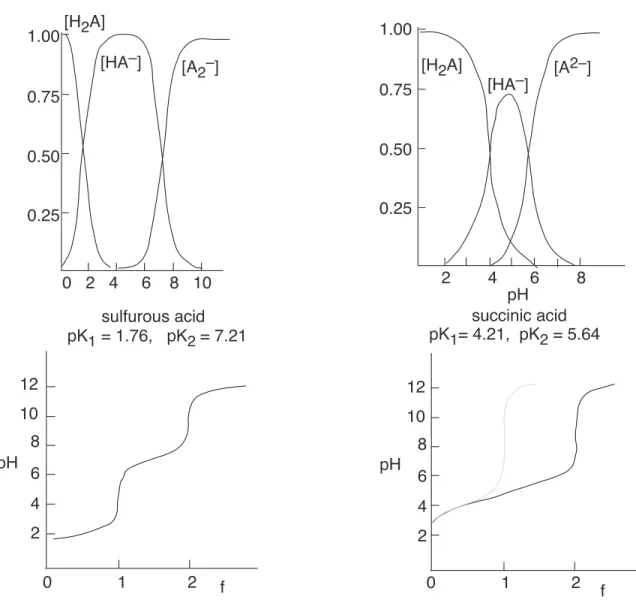
A diprotic acid such as H2SO4 can donate its protons in two steps, yielding first a monoprotonated species HSO−
4 and then the completely deprotonated form SO 2−
4 . Since there are five unknowns (the concentrations of the acid, of the two conjugate bases and of H3O+and OH−), we need five equations to define the relations between these quantities. These are
• Equilibria:
[H+][OH−] = K
w (45)
[H+][HA−]
[H2A]
=Ka1 (46)
[H+][A2−]
[HA−] =Ka2 (47)
• Material balance: When we start withCa moles per litre of the acid H2A, the concentrations of those species containing the species A must add up to the amount initially present.
Ca = [H2A] + [HA−] + [A2−] (48) The full equation (which we show only to impress you) is
K2= [H+]
$
[H+]
−[OH−]−2K2([H+]−[OH−]) [H+]
+2K2
%
Ca−
$
[H+]
−[OH−]−2K2([H+]−[OH−]) [H+]
+2K2
% (49)
which can be expressed as the quartic polynomial [H+]4+ [H+]3([A−] + K
1) = [H+]2(K1K2−Kw)−[H+]&K1([A−]K2+Kw)'−K1K2Kw= 0 (50) There are very few, if any practical situations in which this exact relation needs to be used. If the solution is at all acidic then [OH−] is negligible compared to [H+] and the first equation reduces to