Munich Personal RePEc Archive
A Game Theoretic Framework for
Competing/Cooperating Retailers under
price and advertising dependent demand
Dridi, Dhouha and Ben Youssef, Slim
29 March 2015
Online at
https://mpra.ub.uni-muenchen.de/63317/
1
A Game Theoretic Framework for Competing/Cooperating Retailers under
price and advertising dependent demand
Dhouha DRIDI1 and Slim BEN YOUSSEF2 Manouba University and ESC de Tunis
Campus Universitaire, 2010 La Manouba, TUNISIA.
March 2015
Abstract In this paper, we develop a game theoretic model for cooperative advertising in a supply chain consisting of a monopolistic manufacturer selling its product to the consumer only through competing duopolistic retailers. We consider a new form of the demand function which is an additive form. The demand is influenced by both retail price and advertising expenditures. To identify optimal advertising and pricing decisions, we discuss three possible games (two non cooperative games including Cournot and Stackelberg-Collusion, and one cooperative game) and then we compare the various decision variables and the profits for all cases and also with similar results of the existing literature to develop some important insights.
Keywords: game theory, supply chain, pricing, advertising, cooperative advertising, retail competition, retail cooperation, cooperation.
JEL Classifications: C7, M3
1.
Introduction
Cooperative advertising is one of the most important issues in marketing programs and plays a significant role in the analysis of supply chain relationships. It is defined as an interactive relationship and financial arrangement between the members of supply chain, in which the
manufacturer shares a part of the retailer’s advertising expenditures - commonly known as the
manufacture’s participation rate - to motivate immediate sales at the retail level. The supply chain members have different advertising objectives. The manufacturer invests in national advertising in order to build brand equity and to promote and lure the potential consumers
1
E-mail: [email protected] 2
2
choosing its product. Whereas, the retailer invests in local advertising in order to boost the local demand.
Reviewing the literature developed by several researchers, one can find that the most widely effective tool used to analyze the cooperative advertising is the game theory. The latter is a mathematical method for modeling strategic decision making between two or more players. Game theory is divided in two branches: non cooperative and cooperative. A game is non cooperative if each player makes decisions independently and only interest is to maximize its
own payoff irrespective of the other player’s profit. A game is cooperative if all players wish to be one person and making decisions together in order to optimize the total sum of the individual profit.
Additionally, the literature review focused on static models of cooperative advertising can be divided into two main parts. A literature deals with the classical supply chain consisting of one manufacturer – one retailer and a literature deals with the supply chain formed by multiple manufactures – multiple retailers.
For the first part, the work of Berger (1972) was the first paper modeling mathematically the cooperative advertising as discount on the wholesale price given by a manufacturer to retailer. The consumer demand is a concave function of the level of advertising. He concluded that using cooperative advertising can make higher profits and both the manufacturer and the retailer can be better off from it. Following this research, several authors have addressed this concept by different point of view (see,e. g., Berger (1973); Crimmins (1985); Roslow, Laskey, and Nicholls (1993);Berger and Magliozzi (1992); Dant and Berger (1996); kim and Staelin (1999); Xie & Ai (2005); Nagler (2006)…).
Huang and Li (2001) studied the vertical cooperative advertising issue under a non-linear demand function which depends both on the local and the national advertising expenditures. This work was the first that compares the different type of manufacturer-retailer interactions by game theory. The authors identified best Pareto efficient sharing schemes by taking
channel members’ risk attitudes into account. They observed that the manufacturer always prefers the Stackelberg game to the simultaneous move game whereas the preference of the retailer depends on the parameters of the model. See also Li et al. (2002), Huang et al. (2002) and Huang and Li (2005) for similar approaches but with slightly different demand functions.
Yue et al. (2006) investigated the coordination of cooperative advertising when the manufacturer provides a price deduction directly to consumers. Also, their approach focused on the problem of negative Huang and Li (2001) demand function under certain values of the decisions variables.
Szamerkovsky and Zhang (2009) developed a supply chain formed by one manufacturer one retailer where demand is influenced by both retail price and advertising and obtained Stackelberg manufacturer equilibrium.
3
equilibrium pricing and cooperative advertising policies. They determine a close-form optimal solution in both Stackelberg game and cooperative game and compare them. They conclude that the profit and advertising efforts are higher for all channel members and the retail price reduces under cooperation. They identify the feasible solutions to a bargaining problem where the channel members can determine how to divide the extra-profits generated by cooperation.
Xie and Neyret (2009) keep the multiplicatively separable form of the demand function of Xie and Wei (2009), but they adopted the advertising effect function that proposed by Huang and Li (2001). Then, they discussed pricing and cooperative advertising strategies by considering three non cooperative games (Nash, Stackelberg-manufacturer and Stackelberg-retailer) and one cooperative game. The results of this research do not differ from those found by Xie and Wei.
Further, SeyedEsfahani et al. (2011) coordinate pricing and cooperative advertising in one manufacturer-one retailer supply chain. In this paper, the authors introduce a slight modification in the linear price demand function which is assumed to have a relatively general form: they introduce a new parameter which yields convex , linear and concave curves.
Aust and Buscher (2012) expand the existing research which deals with simple supply chain consisting of one manufacturer and one retailer. The market demand is the multiplication of the retail price and advertising investment as the linear function proposed by Xie and Wei (2009). In addition, the authors derive the modified price demand function of SeyedEsfahani et al. (2011) by introduction a new decision variable (the retailer margin ). The authors apply four forms of retailer-manufacturer relationship on their model (the Nash, the Sackelberg-manufacturer, the Stackelberg-retailer and the cooperation) and conclude that the profit of the supply chain was the highest when the supply chain members cooperated. Also, this situation generates a lowest retail price and highest advertising expenditures.
For the second part, we focus on the literature dealing with competing members in upstream and/or downstream of the channel. Among all hitherto existing literature on advertising and pricing, a few studies considered a supply channel in which a one manufacturer sells a product through two competing retailers. In this context, Wang et al. (2011) consider a market demand that only depends on advertising investment. They establish four non cooperative games (Stackelberg - Cournot, Stackelberg - Collusion, Nash - Cournot and Nash – collusion) and a cooperative game to investigate the impact of various competitive behaviors on the cooperative advertising policies and on the profits of all participants. Zhang and Xie (2012) follow the similar approach and explore the impact of the retailer’s multiplicity on channel
members’ optimal decisions and on the total channel efficiency.
4
They propose a new and unusual evaluation of consumers’ surplus which positively depends not only on the price-demand function but also on the national advertising investment.
Recently, Aust and Buscher (2014) assumed that the consumer demand simultaneous influenced by both retail price and advertising efforts: the demand function was deduced from
the consumers’ utility function and is a multiplicative form as Xie and Wei (2009) model. The authors compare two different types of retailer behavior: retailers acting independently and retailers acting in collusion.
The work of Alirezai and KhoshAllah (2014) is closely related to that of Aust and Busher (2012). The authors consider pricing3 which splitting into wholesale price and retailer margin and cooperative advertising in two-stage supply chain and develop a monopolistic retailer and duopolistic retailers’ model. Each member plays the Nash, Manufacturer-Stackelberg and cooperative game. They failed to analytically solve the equation for the manufacturer’s wholesale price in the Manufacturer-Stackelberg case and the parametric equations in cooperation case. This requires the use of numerical example that illustrates the performance of the supply chain is improved under the cooperation.
Lastly, Karray and Amin (2014) evaluate the profitability of cooperative advertising in a channel with competing retailers. In this work, the authors proposed the retail price and the local advertising expenditures as decision variables of retailers and the coop participation rate and the wholesale price as decision variables of manufacturer. But, they ignored the national advertising expenditures (decision variable of manufacturer). They assumed a demand function that has been commonly used in the literature by McGuire and Staelin (1983), Choi (1991), Karray and Zaccour (2006) and Karray (2013). This demand function is positively influenced by his local advertising and negatively affected by the local advertising of his competitor. They developed two non-cooperative games (one is without cooperative advertising and another is with cooperative advertising) and a cooperative game and provided equilibrium solutions for each game.
For more comprehensive review of the literature on advertising in supply chain, one can be referred to the articles contributed by Aust and Busher (2014) and by Jorgensen and Zaccour (2013).
The main motivation of our research is to extend the existing research that considered a static model of cooperative advertising and pricing in one manufacturer – one retailer supply chain by assuming a supply chain with one manufacturer and two retailers which sell the
manufacturer’s products to final consumers. To our best knowledge, the researches that addressed to study pricing and cooperative advertising at the same time in one manufacturer – two retailers supply chain has not been well explored in literature. Furthermore, our paper proposes a new additive form of consumer’s demand function that takes into account the competitive behavior of the duopolistic retailers in terms of pricing strategies and advertising investments. The positive influence of both the own advertising efforts and the competing
retailer’s advertising makes our contribution unique because no studies related to this issue
3
5
have been done before. This paper investigates the effects of cooperative advertising programs in a supply chain where retailers compete or retailers collude or manufacturer and retailers cooperate. Also, it discusses the impact of the retailers’ interaction and cooperation
on the channel’s decision variables, the demand and the profits. Our model is analyzed under three different cases. In the first case, which is a Stackelberg – Cournot game, the manufacturer as a leader charges a wholesale price, invests in national advertising and offers participation rate. The two retailers as followers charge the retail prices and invest in local advertising (retail competition). The second case is a Stackelberg – Collusion game, the
manufacturer’s behavior remains unmodified, while the two retailers collude and work
together (retail coalition). In the third case, all supply chain members agree to make their decision together by maximizing the total profit which is the sum of the manufacture’s and
retailers’ profits.
This paper proceeds as follows: in section , we present the basic model and the assumptions required for our work, while in section ; three game models of one manufacturer – two retailers relationship are described. In section , we compare and discuss our results obtained. Finally, in section , we present the conclusions of our work, followed by a description of future researches.
2.
The basic model
In this paper, we consider a supply chain consisting of a monopolistic manufacturer selling its product to the consumer only through two duopolistic retailers. The manufacturer announces his wholesale price and each retailer decides on the retail price. In order to improve sales, the manufacturer invests in national advertising while the two retailers invest in local advertising. In addition to the national advertising investment and the wholesale price, the manufacturer agrees to share with the duopolistic retailers the same fraction of total local advertising
expenditures, which is the manufacturer’s co-op advertising reimbursement policy, to boost the local demand.
Unlike the existing research related to this issue that mainly focused on channel members’
advertising decisions and adopted a multiplicatively separable demand function, our paper presents a supply chain model with duopolistic retailers’ different competitive behaviors by adopting an additive form of demand function and taking pricing decisions into account. We assume the expected demand function, often called the sales response function, to be determined by the retail price, local advertising expenditures, and national advertising expenditures. As in Lal (1990) and in Wang et al. (2009), we assume that the demand depends
positively on own advertising investments and on rival’s advertising. So, we define the following demand function of retailer , as,
6
is a positive parameter that denotes the price competition level between retailers and should
not be higher than a retailer’s own price ( ).
( ) is the sale price charged by retailer to consumer;
is the local advertising expenditure of retailer ;
is the advertising competition effect;
is the manufacturer’s national advertising expenditures.
The demand function of each retailer decreases with the retailer’s own price and increases with the competing retailer’s price, with the own advertising and with the competing retailer’s advertising.
According to the notation explained above, the retailer i’s and the manufacturer’s profits are expressed as follows, respectively4:
So, the sum of the retailers’ profit and the total channel’s profit are determined respectively as follows:
is the manufacturer’s wholesale price ;
is the manufacturer's participation rate in retailers’ local advertising expenditures
.
The wholesale price and the participation rate are assumed to be equal for both retailers because of a legislation constraint by the Robinson–Patman act of 1936 (or Anti-Price Discrimination Act) that is a United States federal law that prohibits unjust discrimination. In addition, we want to treat them in the same manner5.
Without loss of generality, we normalize the to .
4
Wang et al. (2009) note that the advertising expenditures are quadratic as incremental investments in brand-specific service become increasingly costly and note also that assuming cost is equivalent to assuming diminishing returns to advertising effort in Eq. (1). It is the same for the national advertising.
5
7
3.
Three game models of one manufacturer- two retailers relationship
In this section, we discuss three game-theoretic models based on two non-cooperative games including Stackelberg-Cournot and Stackelberg-Collusion with one cooperative. In the Stackelberg game setting, the manufacturer acts as a leader by declaring the wholesale price, the level of national advertising investment and the participation rate of local advertising expenditures (first stage). Then, the duopolistic retailers behave like followers and make the decision about the retail prices and the level local advertising costs after the manufacturer’s revelation of co-op advertising policy (second stage). In the cooperative game setting, the members of the supply chain coordinate their decisions in order to optimize the overall profit of the supply chain.
In the next subsections, we will analyze the supply chain by game theoretic approach and will discuss how each member of the supply chain determines its sale price and advertising policy.
3.1. The Stackelberg - Cournot game
In this situation, we model the relationship between the manufacturer and the two retailers as a sequential (two stage) non-cooperative game where the manufacturer, as the leader, first specifies its strategy. The retailers, as the followers, then make decisions simultaneously and independently (they play a Nash game).
The solution of this game is called the Stackelberg equilibrium. In order to determine this
solution, we use a backward procedure that allows solving first the followers’ decision
problem to get the response functions (of the leader’s decisions) of retail prices and local advertising expenditures. We then find the optimal the manufacturer's optimal decision variables based on the best responses of the duopolistic retailers.
So, the decision problem of retailer is as follows:
To identify the best response functions, we will compute the first-order derivatives of the
retailers’ decision problem when the manufacturer’s decision variables are considered exogenousand then set them to zero. Therefore, we can obtain the results:
8
After knowing the retailers’ pricing strategy and advertising policy, the manufacturer chooses its proper wholesale price, national advertising level and local advertising participation rate. For this reason, we substitute equations and into to obtain the manufacturer profit function. Therefore, the manufacturer’s decision problem can be rewritten as shown below:
is a concave function of manufacturer’s decision variables, its reaction functions can be derived from the three first-order derivatives of Eq. .
Which are expressed as (after substitution):
Proposition : the Stackelberg-Cournot game previously described has the following unique equilibrium solution6:
6
9
All the decision variables depend on the level of both the competitor’s price and
competitor’s advertising . In the Stackelberg-Cournot game, the manufacturer invests more on advertising than the duopolistic retailers. Proposition 1 reveals that the manufacturer is disposed to share the cost of local advertising. Fig. illustrates the function of . We can easily perceive that the highest participation rate will be achieved for the maximum values of and . Also, if and , will be equal to . The shape of the curve shows that the price competition effect has more influence on the participation rate than the advertising competition effect.
3.2. The Stackelberg - Collusion game
10
two retailers decide to collude because they want to maximize the joint profit that is, the sum of their profits (see Eq. ). We hence have the following profit function:
To maximize this joint profit function, one can easily solve the retailers’ decision problem by equating the four first-order derivatives to zero and taking into account the exogeneity of the manufacturer's decision variables.
From the equations presented above, we have the optimal solutions of the retail price and the local advertising as shown:
The manufacturer, as a leader, knows the retailers’ reaction functions given in and before setting , , . So, the manufacturer’s profits function for any , and can be formulated by substituting and into as:
Solving
leads us to the following proposition:
11
Under the Stackelberg-collusion game, we observe that the manufacturer determines its
participation rate for the retailers’ local advertising costs independently of parameters and .
3.3.The cooperation game
The previous two subsections analyzed two non-cooperative game structures. We now focus on the cooperative game structure in which the monopolistic manufacturer and the two duopolistic retailers agree to cooperate and they make their decisions together to determine the retail price and the local/national advertising investment. The aim of this cooperation is to improve their profitability and to achieve the optimal pricing and advertising policies by maximizing the entire profit of the whole supply chain together (Eq ). That is:
We remark that the objective function does not depend on the wholesale price and the participation rate of local advertising. However, the individual profit of each supply chain member is dependent of these variables. To solve this optimization problem, we determine the first-order derivatives of by taking with respect to , and , respectively, and then equate them to zero as follows:
12
From , and , we derive the following proposition:
Proposition : The equilibrium solution of Cooperation game between a monopolistic manufacturer and duopolistic retailers is unique and is as follows:
Regardless from the interaction between the manufacturer and the retailers, the manufacturer, as a leader, spends more on advertising than the retailers (the followers).
4.
The results and discussion
In this section, we compare our results obtained and discuss them.
4.1. Comparison of results
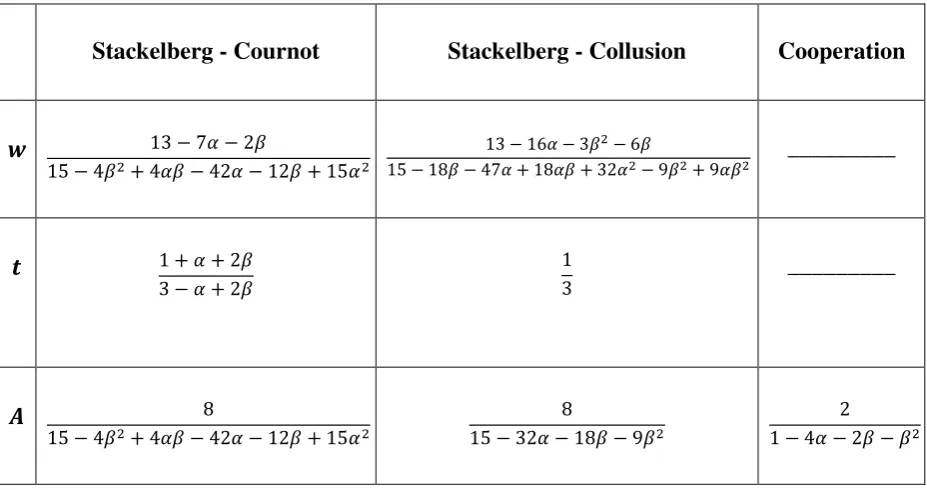
Before discussing the results, we summarize the equilibrium solutions obtained for each game in Table . Then, we compare between them.
Table : Optimal expressions in each game
Stackelberg - Cournot Stackelberg - Collusion Cooperation
_________
_________
[image:13.595.67.531.522.767.2]13
Due to the difficulty of comparison, we use the following figures. In the figures , , ,
and , we evaluate the effect of retailers' behavior on the manufacture’s and retailers’ decision variables by comparing the equilibrium solution of both the Stackelberg-Cournot game (retail competition) and the Stackelberg-Collusion game (retail cooperation). In the figures , and , we compare the equilibrium solutions of the three games in order to determine the impact of cooperation between all the supply chain members on the decisions variables. The areas shaded in red, blue and green shown in the schemas correspond, respectively, to the Stackelberg-Cournot game, the Stackelberg-Collusion game and the cooperation game. As shown in the appendix, the second order conditions require us to
choose the intervals of the competitor’s price ( ) and the competitor’s advertising ( ) to ensure that the solutions of each variable are maximums. For this reason, we consider that
15
Each figure of , , , and indicates the sets of the parameters , for which a retail competition leads to higher or lower decision variable than a retail cooperation.
For higher levels of the competitor’s advertising , the manufacturer increases
her/his wholesale price if the retailers work together whatever the level of the competitor’s
price . Also, it can be seen in the Fig. that the highest wholesale price occurs at the Stackelberg - Cournot whereas the lowest occurs at the Stackelberg – Collusion if the
level of competitor’s advertising is low and the level of competitor’s price is very
high . If and are very low . And if is too low and is low .
From Fig. , we notice that the manufacturer’s participation rate in retailers’ local advertising expenditures is higher in the retail competition than when the duopolistic retailers agree to act jointly in pricing and local advertising. This result is interesting and surprised us because it is different from that found by Wang et al. (2011). The latter found that the participation rate is higher, under certain condition, in the Stackelberg - Collusion. Otherwise they will be equal to zero. In addition, empirical studies of Dutta et al (1995) and Nagler (2006) reveal that the most common participation rate was anywhere between to and most manufacturers set the participation rate arbitrarily and without detailed analysis. However, we prove in this research that the manufacturer’s participation in the local advertising expenditures is between and .
We remind that the cooperation game is not included in the figures and because the optimal solutions of and are not determined in this situation.
Under the retail cooperation, Fig. indicates that the manufacturer invests more in advertising if the level of competitor’s advertising is higher than regardless of the level
16
If , the level of the competitor’s price determines for which a retail competition leads to higher or lower manufacturer’s advertising expenditures than a retail cooperation. For
example:
Fig. illustrates that the manufacture’s advertising expenditures increases when the supply chain members engage in a cooperative program.
When the duopolistic retailers compete, they advertise less than the level desired by the manufacturer (Fig. ). For this reason, the manufacturer provides a part of the retailers’ advertising costs between and to boost sales of their product at local level.
When the duopolistic retailers cooperate, the manufacturer sets the participation rate at
regardless of the level of both competitor’s price and competitor’s advertising which requires the two retailers to invest more in advertising.
Fig. shows that each retailer’s advertising is higher in the cooperation game than in the Stackelberg-Cournot game or in the Stackelberg-Colluson game.
As shown in Fig. , the retail cooperation leads to higher retail price if the degree of the
competitor’s advertising surpass (for any value of the competitor’s price), while, the retail competition yields the lowest price.
If the competitor’s advertising is less than , the highest retail price depends on the set of
the competitor’s price ( ). If located in the red area (respectively the blue area), the highest retail price arises from the competition behavior amongst the two retailers (respectively the cooperative behavior amongst the two retailers).
From Fig. , the highest retail price can be found in the cooperation. So, this result is very important because Ben Youssef and Dridi (2013) shown that the lowest retail price results from the cooperation
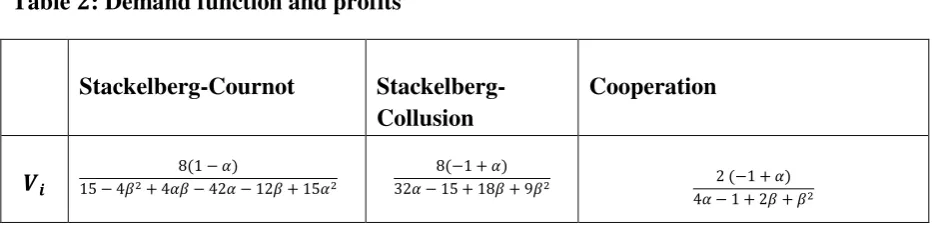
Next, we will determine the demand function, the profit of each supply chain member and the overall profit of the system of the three games in Table .
Table : Demand function and profits
Stackelberg-Cournot Stackelberg-Collusion
Cooperation
[image:17.595.65.532.651.764.2]
17
19
We will analyze the demands and the profit resulting for each channel member as well as the total profit. Fig. and Fig. illustrate that the highest demand of each channel member7 is received under collusion in retail markets if (for any value of ).
If the figures reveal two regions. For example,
As we mentioned earlier that the retail price increases under a Cooperation strategy, the
retailers’ demand does not decrease (Fig. ). So, an increase in retail price does not necessarily lead to a decrease in sales. This is largely explained by spending more money on national and local advertising. As visible from Fig. , the highest manufacturer’s demand results when the manufacturer and the two retailers cooperate.
Fig. and Fig. reveal that the manufacturer, as a leader, prefers that the duopolistic retailers collude and maximize their joint profit. However, the two retailers prefer acting simultaneously and separately because they gain more profits under this situation. For a very
high value of the competitor’s price and a very low valueof the competitor’s advertising, each
channel member gain more profits under the Stackelberg-Cournot game rather than under the Stackelberg-Collusion game. In contrast, for a very low value of the competitor’s price and a
very high value of the competitor’s advertising, each channel member receives higher profits
when the duopolistic retailers cooperate compared to the competing retailers’ situation.
Fig. and Fig. show our results for the total profit. In Fig. , the highest total profit of the supply chain results from the Stackelberg-Cournot game (Stackelberg-Collusion game) if the parameters set in the red area (the blue area). Fig. is consistent with the well-known result of the literature: for every set of the parameters and , the supply chain members
7
20
agree to take decisions together (to cooperate) in order to maximize the entire channel’s profit only if they cannot get any higher profits in any other strategies.
5.
Conclusions
The current paper extends the existing studies of cooperative advertising that mainly focus on supply chain with one manufacturer-one retailer by adding a competition between retailers. Furthermore, only few studies to date have developed a supply chain consisting of one manufacturer and two retailers and have not taken into account the pricing decisions directly. To fill this gap, our paper investigates the pricing policies and the advertising strategies for one manufacturer - two retailers supply chain and we assume that the demand function is an additive form which is influenced by both retail price and advertising expenditures. By means of game theory, we consider three different scenarios between the supply chain members: the manufacturer, as a leader, specifies its strategy. Then the two retailers, as the followers, make decisions simultaneously and independently; the manufacturer is still the leader, while the two retailers decide to cooperate in order to maximize the sum of their profits; all the channel members cooperate and make decisions together to improve their profitability by maximizing the total profit of the whole supply chain.
Based on the analysis of these relationships, we find the following insights: All the decision variables (except ) and the demand and the profits functions depend on the level of
both the competitor’s price and competitor’s advertising . The sets of these parameters ( and ) indicate for which a retail competition leads to higher or lower decision variables (the wholesale and retail prices and the manufacturer’s and retailer’s advertising expenditures) and demand than a retail cooperation. For a very higher value of (for a very low value of ) and a very low value of (a very high value of ), the highest variables are received when the two duopolistic retailers compete (the two duopolistic retailers cooperate). Additionally, the manufacturer, as a leader, prefers that the duopolistic retailers collude and maximize their joint profit. However, the two retailers prefer acting simultaneously and separately because they gain more profits under this situation. The
manufacturer’s participation rate in retailers’ local advertising expenditures is higher in the retail competition than when the duopolistic retailers agree to act jointly. In the contrast to previous studies which reveal that the most common participation rate is chosen arbitrarily and was anywhere between to , our research prove that the manufacturer’s participation in the local advertising expenditures does not exceed (between and
.). The cooperation between all the members of supply chain generated the highest wholesale and retail prices, the highest local and national advertising expenditures, the highest demand of each member and the highest total profits compared to the other scenarios. Our research demonstrates that despite the increase in retail price, but the demand rose. This situation is harmful to consumer and puts him in a worse position. While, the previous researches proved that the cooperation is characterized by a lowest retail price.
21
pursued. For example, our investigation on one manufacturer – two retailers supply chain can be extended to two manufacturers – two retailers. It will be interesting to adopt another form of demand function or adding another coordination instrument that may yield different results. Finally, we may continue our research by using a simultaneous move game (Nash - Cournot, Nash - Collusion), shifting the leading power from manufacturers to retailers or assuming collusion between a manufacturer and retailer.
Appendix
Proof of proposition 1.
The first partial derivatives of the profit function of each retailer are:
To proof the optimality of the solutions of retailer , we calculate the Hessian matrix:
The second order partial derivatives are as follows:
The first principal minor of is negative ( ).
The second principal minor of is:
is positive if
.
The principal minors have alternating algebraic signs, which means that the profit function of each retailer is concave at the solution , which is a local maximum.
The second order partial derivatives of formula with respect to , and are:
22
To proof the optimality of the solutions of manufacturer, we have the following Hessian matrix:
The first principal minor of is
and is negative.
The second principal minor of is
and is positive if
8.
The third principal minor of is
is negative if
9.
So, the manufacturer’s profit function is concave at the solution , which is a local maximum.
Proof of proposition 2.
The first partial derivatives of the joint retailers’ profit function are the
following expressions:
8
: is a function of when the second principal minor equate to zero. 9
23
After substitution and algebraic simplification, we obtain equation and equation .
To proof the optimality of the solutions of two retailers, we calculate the following Hessian matrix:
The first principal minor of is is negative.
The second principal minor of is and is positive for all .
The third principal minor of is and is negative if
10.
The fourth principal minor of is and is positive if
11.
So, the principal minors of have alternating algebraic signs at the solution . This means that is negative definite and the profit of both retailers is concave at this solution, which is a local maximum.
To proof the optimality of the solutions of manufacturer under the Stackelberg-Collusion game, we calculate the Hessian matrix as shown in proof of proposition and we found:
The first principal minor of is
is negative.
The second principal minor of is
and is
positive if 12.
10
: is a function of when the third principal minor equate to zero. 11
: is a function of when the fourth principal minor equate to zero. 12
24
The third principal minor of is
and is negative if
13.
So, the principal minors of have alternating algebraic signs at the solution . This means that is negative definite and the profit of manufacturer is concave at this solution, which is a local maximum.
Proof of proposition 3. To proof the optimality of the solutions of supply chain members, we
calculate the following Hessian matrix of the total channel’s profit:
The first principal minor of is is negative.
The second principal minor of is and is positive for all .
The third principal minor of is and is negative if
14.
The fourth principal minor of is and is positive if
15.
The fifth principal minor of is and
is negative if 16.
So, the principal minors of have alternating algebraic signs and the matrix is negative definite at the cooperative solution . This means that there exist a unique solution and is a local maximum.
References
13
: is a function of when the third principal minor equate to zero. 14
: is a function of when the third principal minor equate to zero. 15
: is a function of when the fourth principal minor equate to zero. 16
25
Aust, G., & Buscher, U. (2012). Vertical cooperative advertising and pricing decision a manufacturer-retailer supply chain: A game-theoretic approach. European journal of Operational Research, 223,473 - 482.
Aust, G., & Buscher, U. (2014). Vertical cooperative advertising in a retailer duopoly. Computers and Industrial Engineering, 72,247 - 254.
Alirezai, A., and KhoshAlhan, U., (2014). Coordination of pricing and co-op advertising models in supply chain: A game theoretic approach. International Journal of Industrial Engineering Computations, 23 - 40.
Ben Youssef, S., & Dridi, D. (2013). National advertising and cooperation in a manufacturer two retailers channel. International Review of Management and Marketing, 75-85.
Berger, P. (1972). Vertical cooperative advertising ventures. Journal of Marketing research 9 (3), 309 - 312.
Choi, S. (1991). Price Competition in a Channel Structure with a Common Retailer. Marketing Science 10 (4), 271–296.
Dant, R. P. & Berger, P. D. (1996). Modeling cooperative advertising decisions in franchising. Journal of the Operational Research Society, 1120 – 1136.
Dutta S., Bergen M., John G. and Rao A. (1995). Variations in the Contractual Terms of Cooperative advertising Contracts: An Empirical Investigation. Marketing Letters, 15-22.
Jorgensen S. and Zaccour G. (2013). A survey of game-theoretic models of cooperative advertising.
Huang, Z., & Li, S. X. (2001). Co-op advertising models in a manufacturer–retailer supply chain: A game theory approach. European Journal of Operational Research, 135(3), 527–544.
Karray, S. (2013). Periodicity of Pricing and Marketing Efforts in a Distribution Channel.” European Journal of Operational Research 228 (3), 635–647.
Karray, S. and Amin S. H. (2014). Cooperative advertising in a supply chain with retail
competition. International Journal of Production Research, DOI:
10.1080/00207543.2014.925602.
Karray, S., and G. Zaccour. (2006). Could Co-op Advertising Be a Manufacturer’s Counterstrategy to Store Brands? Journal of Business Research 59 (9), 1008–1015.
Kim, S. Y.& Staelin, R. (1999). Manufacturer allowances and retailer pass-through rates in a competitive environment. Management Science, 59 – 76.
26
McGuire, T., and R. Staelin. (1983). An Industry Equilibrium Analysis of Downstream Vertical Integration. Marketing Science 2 (2), 161–191.
Nagler, M.G. (2006). An exploratory analysis of the determinants of cooperative advertising participation rates. Marketing Letters, 91 – 102.
SeyedEsfahani, M.M., Biazaran, M., & Gharakhani, M. (2011). A game theoretic approach to coordinate pricing and vertical co-op advertising in manufacturer–retailer supply chains. European Journal of Operational Research, 263-273.
Szmerekovsky, J., & Zhang, J. (2009). Pricing and two-tier advertising with one manufacturer and one retailer. European Journal of Operational Research, 904-917.
Wang, S.D., Zhou, Y.W., Min, J., & Zhong, Y.G. (2011). Coordination of cooperative advertising models in a one-manufacturer two-retailer supply chain system. Computers & Industrial Engineering, 1053-1071.
Wang, Y., Bell, D. R. and Padmanabhan, V. (2009). Manufacturer-owned retail Stores. Marketin Letters, 20, 107-124.
Xie, J. & Ai, S. (2005). A note on “cooperative advertising, game theory and manufacturer -retailer supply chains”. The International Journal of Management Science, 501 – 504.
Xie, J., & Neyret A. (2009). Co-op advertising and pricing models in manufacturer retailer supply chains. Computers & Industrial Engineering, 1375–1385.
Xie, J. & Wei J. C. (2009). Coordinating advertising and pricing in a manufacturer–retailer channel. European Journal of Operational Research, 758-791.