412
Quality Assessment of Raw and Pasteurized Milk Using
Microbiological Parameters
Marioara Nicoleta Filimon
1, Aurica Breica Borozan
2, Despina Maria Bordean
3, Roxana
Popescu
4, Smaranda Rodica Gotia
5, Doina Verdes
4, Florica Morariu
6, Sebastian Treitli
11
West University of Timisoara, Faculty of Chemistry-Biology-Geography, Department of Biology, Pestalozzi, 16, 300115, Romania
2
Banat University of Agricultural Sciences and Veterinary Medicine from Timisoara, Departament of Horticulture, Aradului Street, 119, 300645, Romania
3
Banat University of Agricultural Sciences and Veterinary Medicine from Timisoara, Departament of Tehnology Agroalimentary Products, Aradului Street, 119, 300645, Romania
4
University of Medicine and Pharmacy “Victor Babes” Timisoara, Departament of Cellular and Molecular Biology, E. Murgu, 2, 300041, Timisoara, Romania
5
University of Medicine and Pharmacy “Victor Babes” Timisoara, Departament of Phisiology, E. Murgu, 2, 300041, Timisoara, Romania
6
Banat University of Agricultural Sciences and Veterinary Medicine from Timisoara, Faculty of Animal Science and Biotehnologies, Departament of Biotehnology, Aradului Street, 119, 300645, Romania
Abstract
The milk intended for human consumption must meet the terms of safety and human security. The purpose of this paper was to evaluate the raw milk quality from the food markets of Timisoara, in relation with pasteurized milk. The microbiological studies included the following assays: total number of germs (TNG) and coliform bacteria. From milk samples were made dilutions which later were distributed on the surface of the solid medium poured in Petri dishes. The incubation was carried out at 37º C for 48 h, after which it was determined the number of colony forming units. The obtained values for each sample were compared with the values in existing legislation noticing that the total number of germs is within normal values but towards the upper limit of normality, except the milk samples from Sacos village where UFC/ml exceed the maximum value admitted (300.000 UFC/ml milk). In coliform bacteria case is observed that in all analyzed milk samples the values obtained exceed the maximum values admitted (0.1 UFC/ml) indicating the existence of inappropriate sanitary and hygienic conditions of milking, transporting and marketing.
Keywords: milk, sanitary microbiological indicator,
1. Introduction
Milk is a commonly used food source. People use it for consumption and also in their diet [1]. 1Milk presents a series of physical, chemical and biological characteristics. It also has
*Marioara Nicoleta Filimon, Tel.: +40256592646,
Fax:+40256592622,E-mail: [email protected]
organoleptical characteristics: color, smell, taste, texture, freezing point, pH and density.
413 fermentation and pollution microflora. Milk may transmit certain diseases such as tuberculosis, anthrax, fever, brucellosis, salmonellosis, staphylococcus and streptococcus infections. It is therefore necessary to microbiologically test the milk and the dairy products [2, 3].
It is well known that the fresh milk contains some bacteria and somatic cells. These are the milk’s biological constituents. The numbers of these biological constituents change according to production conditions like the animal’s health and hygiene during milking, preserving and transporting the milk and the milk products [4, 5, 6]. These microorganisms have an important role in the alteration and contamination of milk and milk products [7]. Temperature control is essential to prevent milk alteration, because of the microbial growth [8]. The number of microorganisms vary according to the temperature (season) indicating that the total number of coliforms and E. coli significantly differ in summer and winter [9].
There have been several studies on raw milk quality and microbial composition of raw milk in rural areas [10, 11], milk and dairy products in urban areas [12]. Studies have shown that the microbiological quality of the product is mainly provided by the control of the product, directly from the source. Unfortunately, a growing number of pathogen agents are easily developing at refrigeration temperatures and in areas where milk is normally stored [11].
Milking techniques have been improved because of technology development. However, certain rural and peri-urban producers haven’t adopted new milking methods. Hand milking is still the most commonly used. Contamination with pathogen agents is considerably increased.
The present study contains data about milk sold in certain markets from Timisoara. We established the total number of germs and coliform bacteria, but also other parameters closely related to bacteria communities in milk.
2. Materials and methods
Milk samples have been purchased from the market place and hypermarket. Subsequently, samples have been processed in the laboratory. Dilutions have been performed on culture environment for seeding. For instance, 10-5
dilution in order to determine the total number of germs and coli form bacteria.
The total number of germs (TNG)
Culture environment used for seeding the samples has been the nutrient agar. The chemical composition of the environment consists of meat extract - l0 g, peptone - l0 g, NaCl - 5 g, agar - 20 g, distilled water - 000 ml l. As a technique used for sample seeding (in 2 repetitions) has been the inoculum’s dissemination technique.
The preceding technique has the following steps: placing the culture environment in Petri plates; seeding the environment with test samples (1 ml inoculum/Petri plate), inoculums dissemination with the help of an "L" shaped rod; removing excess; plate incubation the for 48 hours at 37° C [13].
Microorganism indicators and coliform bacteria Coliform bacteria (Escherichia sp., Enterobacter sp., Klebsiella sp.) are of great importance to food microbiology. These are some of the most important microbiological health indicators to highlight hygiene conditions at processing and handling the product. Certain cases reflect the compliance of various thermal treatments (pasteurization type) applied to food.
The culture environment used for sample seeding has been the gentian violet environment (Kessler medium). The technique used for sample seeding (in 2 repetitions) has been the “inoculums dissemination technique.” Plate incubation has been made during 48 hours, at 37° C [14].
Milk samples
The number of studied milk samples is 7, 8. Milk samples have been purchased from the market place in Timisoara. The milk comes from producers living in different areas near Timisoara. Milk samples purchased from the market come from the following places: Iecea Mare, Beracsau, Sacos, Topolovat, Belint and Hodos. Two milk samples are represented by pasteurized milk sold in a hypermarket. The purchased milk has been used for comparisons and to establish the compliance of transport and storage.
3. Results and discussion
414 total number of germs and coli form bacteria. For organoleptic and physical studies, raw or pasteurized milk has been used. No dilutions have
been performed.
Studied
organoleptic andphysical parameters have been the color, opacity,
odor, taste and pH. This way we can establish milk quality. We can also find out if something has been added to the milk in order to make it more commercial, but of a lower quality.
Table. 1. Organoleptic and physical parameters
Milk samples Colour Opacity Smell Taste pH
Iecea Mare White High Cattle Usual 6,558
Beracsau White Average Grass Usual 6,470
Sacos Yellowish Low Usual Usual 6,737
Topolovăt Yellowish Low Cattle Sour 6,469
Belint Yellowish Low Grass Sour 6,508
Hodos White Average Grass Usual 6,635
Pasteurization
milk 1 White Low Usual Usual 6,607
Pasteurization
milk 2 Yellowish Average Usual Usual 6,652
0 50000 100000 150000 200000 250000 300000 350000 400000 450000
1 2 3 4 5 6 7 8
Samples milk
UF
C
T
N
G
/ m
l m
il
k
UFC TNG/ml milk samples UFC TNG/ ml milk maxim values
Figure 1. Reporting the total number of germs to the allowed maximum value (1. Iecea Mare, 2. Beracsau, 3. Sacos,
4. Topolovat, 5. Belint, 6. Hodos, 7. Pasteurization milk 1, 8. Pasteurization milk 2)
0 0.1 0.2 0.3 0.4 0.5 0.6
1 2 3 4 5 6 7 8
Samples milk
CB
UF
C
/ m
l m
il
k
CB UFC/ ml milk samples CB UFC/ml milk maxim values
Figure 2. Reporting the coliform bacteria to the allowed maximum value (1. Iecea Mare, 2. Beracsau, 3. Sacos, 4.
415 Usually, the color of the milk is white. Any other shades found in milk samples indicate the existence of certain additives to increase the milk’s commercial quality. An intense yellowish color does not suggest a kind of milk with high fat content. On the contrary, it tells of milk with color additives, in order to produce a milk fake.
The bluish color points out fake milk. The reason is adding water or milk skimming, meaning to partly remove the cream from the milk. Milk opacity is another parameter which reveals possible milk fakes. If the milk leaves marks on the sides of the bowl, it means that the milk has been tampered. In case of fake milk, water is added, which will "wash the bowl sides." The sour taste of the milk denotes the existence of a large number of germs and a lower milk quality. This kind of milk is not fresh. Milk acidity may give an indication of its quality. Higher acidity demonstrates a large number of microorganisms, with an intense enzymatic activity. It has the role of decomposing the nutrients. Therefore, the result is a large number of metabolism products, which increases the acidity.
Coliform bacteria from milk and dairy products changes taste and texture. It also changes the milk quality. A large number of microorganisms in milk samples establishes and changes the pH, making it lower and more acid due to the intense metabolism.
Obtained values for the total number of germs (TNG) have been compared to values offered in specialized literature [15]. The usual limit of the total number of bacteria/ml raw milk is 300,000 UFC/ml milk (units forming colony/ml milk). Studying the obtained values, we got to the conclusion that the number of samples does not exceed the admitted maximum values. The only exception is milk sample number 3. The studied milk sample come from Sacos. A large number of microorganisms points out a milk of low quality, with a higher possibility of change.
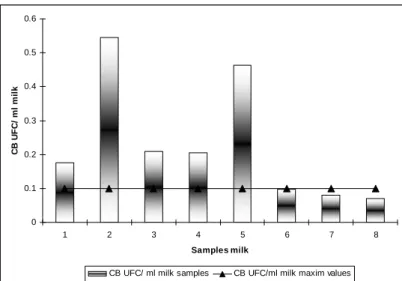
The presence of coliform bacteria in milk samples suggest inadequate milking conditions and storage. These poor conditions led to an external contamination of milk samples. Also, contaminated with coliform bacteria may come from a sick animal. After milking, certain tests have to be made [3].
The total number of germs, coliform bacteria and
E. coli, have been evidenced in large numbers,
overcoming the values denoted by specialized
literature. Results point out that the number of
coliforms and E. coli are rather different in
summer and winter. A significant number of E.
coli found in studied milk samples denotes fecal contamination which has been inevitable. The undetected cow diseases are likely to determine the cause of an alarming number of microbial agents. Traditional milking practices are contaminating the milk and reproducing the microorganisms [9].
The maximum admitted values of coli form bacteria/ml of milk is 0.1 UFC/ ml milk. As we compared obtained values to values presented in specialized literature, we established a large number of samples. Results exceed maximum values. Milk samples from Iecea Mare, Sacos and Topolovat are twice as much when compared to maximum values. Milk samples from Belint and Beracsau exceed maximum values.
Coliforms bacteria, especially represented by E. coli, are often found in raw milk samples. This bacterium is considered to have an important fecal contamination. Other bacteria act the same, like Yersinia enterocolitica, Listeria monocytogenes and many others. These types of bacteria can be destroyed by heat, such as boiling and pasteurization [16].
There are milk and dairy products considered sources of contamination for humans, leading to different disease. This is due to the fact that dairy products present pathogen agents such as
Campylobacter sp., E. coli, Salmonella sp. and
Staphylococcus aureus. Some of the food
infections are: typhoid fever, diphtheria and scarlet fever. These are most often transmitted through milk. The most severe diseases transmitted from animals to humans are tuberculosis and brucellosis [17, 18]. Determining the quality of raw milk sold in the markets is necessary because humans have to avoid contaminations with pathogen agents and the appearance of epidemic food. These studies are necessary because the households and micro farms are used to hand milking. This practice does not meet the sanitary standards of storage and transportation. This is the reason why milk is contaminated. It stimulates the proliferation of existing microorganisms.
416
The coliforms bacteria and E. coli in milk is
considered a threat of food poisoning in the entire localities and comunities [20, 21].
Microbiological analysis of milk for consumption has an important role in reducing the risk of food poisoning caused by pathogens in milk. Compliance with hygienic-sanitary milking, storage and transportation greatly reduces the ability of abnormal milk.
4. Conclusions
At milk samples purchased from markets and neighboring towns of Timisoara, the most
common methods of fake milk and milk quality reduction are the following: adding water, churning, addition of synthetic dyes, a fact translated into color, taste, smell and the milk’s opacity.
The total number of germs in studied milk samples is considered to be in accordance with the usual variations recorded in specialized literature on food safety.
The presence of coliform bacteria above the usual values recorded by specialized literature, in many studied milk samples point out improper sanitary conditions during milking and milk handling.
References
1. Grimaud, P., Sserunjogi, M., Wesuta, M., Grillet, N., Kato, M., Faye, B., Effects of season and agro-ecological zone on the microbial quality of raw milk along the various levels of the value chain in Uganda. Tropical Animal Health Production, 2009, 41, pp. 883-890.
2. Mişca, C.D., Microbiologia produselor
agroalimentare, Editura Solness, Timişoara, 2001
3. Darău, P.A., Igiena şi siguranţa produselor
alimentare de origine alimentară, Vasile Goldiş
University Press, Arad, 2008, pp. 207
4. Turner, G.V., Veary, C.M., Food Hygiene. In:
Manual. Onderstepoort: University of Pretoria, 1990, pp. 1-17
5. Oprean, L., Analiza microbiologică a produselor
alimentare, Editura Universităţii Lucian Blaga, Sibiu,
2002
6. Pop, C., Merceologia produselor alimentare, Editura
Tipo Moldova – Iaşi, 2004
7. Gilmour, A., Rowe, M.T., Microorganisms associated with milk. In: Robinson, RK. Ed. Dairy Microbiology. England: Appl. Sci. Pub. Ltd., 1981, pp. 35-128
8. Frazier, W.C., Westhoff, D.C., Food microbiology, McGraw-Hill Book Company, Singapore, 1988, pp. 287-299
9. Lues, J. F. R., De Beer, H., Jacoby, A., Jansen, K. E, Shale, K., Microbial quality of milk, produced by small scale farmers in a peri-urban area in South Africa, African Journal of Microbiology Research, 2010, 4(17), pp. 1823-1830
10. Prinsloo, N., Milking parlour hygiene inspection course, Agricultural Research Council: Animal Nutrition Products Institute, Irene, South Africa, 2001 11. Jansen, K.E., The microbiological composition of milk and associated milking practices amongst small scale farmers in the informal settlement of Monyakeng. Thesis (M. Tech: Environmental Health), Technikon Free State, Bloemfontein, 2003
12. Lues, J.F.R., Venter, P., Van der Westhuizen, H., Enumeration of potential microbiological hazards in milk from a marginal urban settlement in central South Africa. Food. Microbiol., 2003, 20, pp. 321-326
13. Drăgan-Bularda, M., Microbiologie generală
-Lucrări practice, Cluj-Napoca, 2000, pp. 221-222.
14. Dunca, S., Ailiesei, O., Nimitan, E., Stefan, M.,
Microbiologie aplicată, Demiurg Publishing House,
Iaşi, 2007, pp. 224-226
15. Monitorul oficial al României 268/1999 - Securitatea produselor alimentare
16. Bell, C., Kyriakides, A., E. coli; a practical
approach to the organism and its control in foods. London; Blackie Academic and Professional, 1998, pp. 1-193
17. Heuvelink, A.E., Bleumink, B., Biggelaar, F., Giffel, M.C., Beumer, R.R., Boer, E., Occurrence and
survival of verocytotoxin-producing Eschericia coli
O157 in raw cow’s milk in the Netherlands, J. Food Protection, 1998, 61(12), pp. 1597-1601
18. Ruegg, P., Salmonella, Listeria, E. coli and
Mycobacterium paratuberculosis in milk. Is there cause
for concern?, Available from World Wide Web: http/www.wisc.edu/dysci/uwex/milk/pubs/zoo.pdf, 1999.
19. Dovie, D.B.K., Shackleton, C.M., Witkowski, E.T.F., Valuation of communal area livestock benefits, rural livelihoods and related policy Iissues. Land Use Policy, 2006, 23, pp. 260-271
20. Effler, P., Isaäcson, M., Arntzen, L., Heenan, R., Canter, P., Barrett, T., Lee, L., Mambo, C., Levine, W., Zaida, A., Griffin, P.M., Factors contributing to the
emergence of Escherichia coli O157 in Africa, Emerg.
Infect. Dis., 2001, 7(5), pp. 812-819