Original Research Article
Evaluation of efficacy of intravenous magnesium sulphate versus
dexamethasone for prevention of postoperative sore throat in patients
undergoing lumbar spine surgery in prone position: a prospective
randomized double blind placebo controlled study
Shahnaz Ahmad Sheikh, Aabid Hussain Mir
,Abida Yousuf*, Imtiaz Ahmad Naqash
INTRODUCTION
Airway access is an important aspect during general anesthesia and period of unconsciousness. The laryngeal Mask airway (LMA) and endotracheal tube (ETT) are some of the methods with the ETT being the gold standard in the airway control. One of the most common complications of general anesthesia is sore throat
particularly after surgery in the prone position.1 The
reported incidence varies widely 0-22% in non-intubated patients and 6-100% in intubated patients.2 Although a
minor complication, postoperative sore throat contributes to postoperative morbidity and patient dissatisfaction. Postoperative sore throat is much more common when ETT is used for airway control in comparison with LMA or face mask.3
ABSTRACT
Background: Endotracheal intubation is associated with postoperative sore throat. The aim was to evaluate the efficacy of intravenous magnesium sulphate versus dexamethasone for prevention of postoperative sore throat in patients undergoing lumbar surgery in prone position.
Methods: 150 patients of ASA physical status I and II in the age group of 18 to 70 years were divided into three groups of 50 each. group I (magnesium sulphate) received intravenous magnesium sulphate 30 mg. kg-1 in a total of 50 ml of normal saline for 10 minutes after intubation, group II (dexamethasone group) received intravenous dexamethasone 8 mg in 50 mL normal saline for 10 minutes after intubation and group III (placebo group) received 50 ml of normal saline for 10 minutes after intubation. The incidence and severity of postoperative sore throat and hoarseness was assessed by an anesthesiologist unaware of the group allocation, on arrival in the post anesthesia care unit at 0 h, and at 1 h, 6 h, 12 h, and 24 h thereafter.
Results: Both incidence and severity of sore throat and incidence of hoarseness was more in placebo group than magnesium sulphate group and dexamethasone group and was statistically significant (p<0.05) and was comparable between magnesium sulphate and dexamethasone groups.
Conclusions: Endotracheal intubation is associated with sore throat and hoarseness of voice. Magnesium sulphate and dexamethasone given intravenously reduce the incidence and severity of sore throat and hoarseness associated with endotracheal intubation.
Keywords: Dexamethasone, Endotracheal intubation, Hoarseness, Magnesium sulphate, Sore throat Department of Anaesthesiology and Critical Care, SKIMS, Soura, Srinagar, J&K, India
Received: 07 March 2019
Accepted: 30 March 2019
*Correspondence:
Dr. Abida Yousuf,
E-mail: [email protected]
Copyright: © the author(s), publisher and licensee Medip Academy. This is an open-access article distributed under the terms of the Creative Commons Attribution Non-Commercial License, which permits unrestricted non-commercial use, distribution, and reproduction in any medium, provided the original work is properly cited.
The postoperative sore throat is attributed to the local irritation, inflammation and edema associated with airway instrumentation and due to reduction in the mucosal blood flow in tracheal mucosa leading to ischemic damage.4 Postoperative sore throat is attributed
to multiple perioperative conditions including local irritation and inflammation of airway, large size of tracheal tube, increased duration of surgery and prone position.5-8 In lumbar spinal surgery performed in the
prone position, the incidence and severity of
postoperative sore throat is expected to be high and of great magnitude as it mandates the use of wire reinforced tracheal tube having larger outer diameter requiring concomitant use of a rigid stylet and a position change that occurs twice in the perioperative period (at the beginning and at the end of surgery).
Numerous non-pharmacological and pharmacological measures have been used for attenuating postoperative sore throat with variable success. Among the non-pharmacological methods, smaller sized ETT, lubricating ETT with jelly, careful air way instrumentation,
intubation after complete relaxation, gentle
oropharyngeal suctioning, minimizing intra-cuff
pressures and extubation when the tracheal cuff is fully deflated have been reported to decrease the incidence of postoperative sore throat. Pharmacological measures including beclomethasone inhalation local steroid application over ETT, intravenous steroids, gargles of benzydamine hydrochloride or ketamine and aspirin have shown variable efficacy in preventing or minimizing postoperative sore throat. Various grades of sore throat in postoperative period are graded as9
• No sore throat at any time since the operation
• Minimal sore throat (less severe than a cold)
• Moderate sore throat (similar to that with a cold)
• Severe Sore throat (more severe than with a cold)
Magnesium, an N-methyl–D-aspartate (NMDA) receptor antagonist has potential advantage `to play a beneficial role in reducing postoperative sore throat through multiple mechanisms as well, such as anti-nociceptive and anti-inflammatory effects by inhibiting NMDA receptor mediated calcium influx.10 Indeed there are
evidences to suggest that magnesium can be used for reducing the incidence of postoperative sore throat.11,12
The effect of magnesium on postoperative sore throat, however, has really been compared with other agents shown to have efficacies in that regard, especially in patients undergoing lumbar spinal surgery in prone position who are at increased risk of developing postoperative sore throat.
In lumbar spinal surgery performed in the prone position, the incidence and severity of postoperative sore throat (POST) is expected to be high and of great magnitude as it mandates the use of wire-reinforced tracheal tube having larger outer diameter requiring concomitant use of
a rigid stylet, and two times of position change while being intubated.13 Thus, efforts to reduce the occurrence
of postoperative sore throat (POST) would be of high priority in this subset of patients while evidence is scarce in that regard. Numerous pharmacological and non-pharmacological approaches to prevent or minimize the incidence and severity of postoperative sore throat (POST) have been tried with conflicting results.14,15
Among them, dexamethasone possessing pluripotent action mechanisms has been proposed as a relatively well-proven preventive measure for postoperative sore throat (POST) although possible inherent complications such as gastric ulcer, infection and hyperglycemia limit its widespread use.16-18 Magnesium, an
N-methyl-D-aspartate (NMDA) receptor antagonist, has potential advantages to play a beneficial role in reducing postoperative sore throat (POST) through multiple mechanisms as well, such as anti-nociceptive and anti- inflammatory effects by inhibiting NMDA receptor-mediated calcium influx.19 Indeed, there are evidences to
suggest that magnesium can be used for reducing the incidence of postoperative sore throat (POST).20 The
effect of magnesium on postoperative sore throat (POST), however, has rarely been compared with other agents shown to have efficacies in that regard, especially in patients undergoing lumbar spinal surgery in the prone position who are at increased risk of developing postoperative sore throat (POST).
Dexamethasone is a highly selective glucocorticoid. Dexamethasone sodium phosphate injection has rapid onset but short duration of action. It is used for inflammatory and allergic conditions, shock and cerebral edema. It is also used for postoperative vomiting and pain
and for pediatric tonsillectomy. Antinociceptive
mechanism of corticosteroids is unknown.
Dexamethasone inhibits the synthesis of prostaglandins. It is primarily metabolized by hepatic microsomal enzymes.
The present placebo controlled study was conducted to determine the efficacy of intravenous magnesium sulphate for prevention of postoperative sore throat and compare it with intravenous dexamethasone.
METHODS
patients were premedicated with 0.5 mg of alprazolam orally on night before surgery. Patient was shifted to operating room on a trolley and intravenous line was
established. All mandatory monitors like
electrocardiography, non invasive blood pressure, and pulse oximetry were attached. Patients were divided into three groups of 50 each, group I (magnesium group) who received intravenous magnesium sulphate 30 mg.kg-1 in a total of 50 lL of normal saline for 10 minutes after intubation, group II (dexamethasone group) who received intravenous dexamethasone 8 mg in 50 ml normal saline for 10 minutes after intubation and group III (placebo group) who received 50 ml of normal saline for 10 minutes after intubation. The study drugs were prepared in syringes labeled ‘study drug’ and administered by the anesthesiologist not involved in the postoperative assessment and interview of the patient.
The anesthesia protocol was standardized for all the patients. All patients were premedicated with injection Pantoprazole 40 mg intravenously before induction. Anesthesia was induced with propofol 2 mg.kg-1 and fentanyl 2 μg.kg-1. Atracurium 0.5 mg.kg-1 body weight was used for neuromuscular blockade. Laryngoscopy was performed with size 3 or 4 Macintosh laryngoscope blade for insertion of 7.5 mm or 8.0 mm internal diameter flexometallic endotracheal tube with the help of gum elastic bougie. Application of cricoids pressure to aid tracheal intubation was recorded. The number of attempts for intubation was noted. The tracheal tube cuff was inflated until no air leakage could be heard with a peak airway pressure at 20 cm H2O and cuff pressure was maintained between 18 cm and 22 cm H2O using a handheld pressure gauge. Patient’s position was changed from supine to prone for surgery, and patient’s head positioned on the sponge face pillow without head rotation. Anesthesia was maintained with nitrous oxide in oxygen and isoflurane with incremental doses of atracurium as and when needed. All the patients received intravenous paracetamol one gram 30 minutes after tracheal intubation. Intraoperative monitoring included ECG, heart rate, pulse oximetry, capnography, and non-invasive blood pressure. In case of hypotension (mean arterial pressure less than 20% of pre-anesthetic value), 200ml of normal saline was given in 10 minutes. If hypotension persisted, ephedrine boluses of 6 mg or boluses of phenylephrine were administered.
After completion of surgery, neuromuscular block was reversed with injection glycopyrrolate 0.01 mg.kg-1 and injection neostigmine 0.05mg.kg-1 and extubated when
adequate spontaneous ventilation is established.
Oropharyngeal suction was performed under direct vision to avoid trauma to the tissues before extubation and to confirm that the clearance of secretions is complete. Cricoid compression, duration of tracheal intubation, duration of prone position, duration of anesthetic time, and incidence of cough during extubation was recorded. The incidence and severity of postoperative sore throat and hoarseness was assessed by an anesthesiologist
unaware of the group allocation, on arrival in the post anesthesia care unit at 0 h, and at 1 h, 6 h, 12 h, and 24 h thereafter. The severity of postoperative sore throat (POST), hoarseness and cough was graded on a four point scoring system (0-3) as follows:
Severity score
Sore throat
0-No sore throat at any time since the operation
1-Minimal sore throat (complains of sore throat only on asking)
2-Moderate sore throat (complains of sore throat on his/her own)
3-Severe sore throat (change of voice, associated with throat pain).
Hoarseness
0-No complaint of hoarseness
1-Minimal change in quality of speech (minimal hoarseness)
2-Moderate change in quality of speech (moderate hoarseness)
3-Gross change in the quality of speech (severe hoarseness).
Any complication associated with the use of magnesium sulfate and dexamethasone was also assessed.
Statistical analysis
The data thus obtained was entered into computer using Microsoft Excel. Data was analyzed using students’t-test, chi- square test and ANOVA. A p-value of < 0.05 was considered statistically significant.
RESULTS
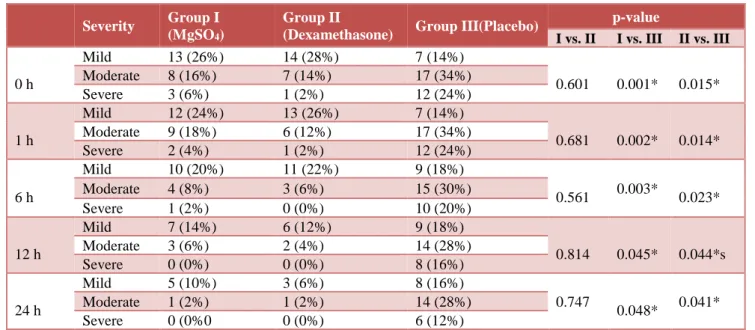
Thus, at all study stages, incidence of sore throat was less
in patients receiving magnesium sulphate or
dexamethasone than those receiving placebo. Also, patients who developed sore throat even after receiving magnesium sulphate or dexamethasone have a lesser
severity of sore throat than those receiving placebo. Both magnesium sulphate and dexamethasone were found to be equally effective in reducing the incidence and severity of sore throat.
Table 1: Comparison of patient characteristics in two groups.
Patient characteristics Group 1(n=50) Group II(n=50) Group III(n=50) P-value
Age(years) 45.6±12.25 47.9±14.56 44.8±13.54 0.513
Gender (M/F) 27/23 24/26 29/21 0.601
ASA-PS(I/II) 39/11 35/15 41/9 0.352
Value expressed as mean ± SD, ASA-PS: American society of anesthesiologist’s physical status, SD: standard deviation
Table 2: Incidence of sore throat in groups at different intervals of time.
Time Group I
(MgSO4)
Group II (Dexamethasone)
Group III (Placebo)
p-value
I vs. II I vs. III II vs. III
0 h 24 (48%) 22 (44%) 36 (72%) 0.688 0.014* 0.005*
1 h 23 (46%) 20 (40%) 36 (72%) 0.545 0.008* 0.001*
6 h 15 (30%) 14 (28%) 32 (64%) 0.826 <0.001* <0.001*
12 h 10 (20%) 8 (16%) 28 (56%) 0.603 <0.001* <0.001*
24 h 6 (12%) 4 (8%) 23 (46%) 0.739 <0.001* <0.001*
Value shown as number (percentage) in which sore throat is present, *=statistically significant
Table 3: Comparison of severity of sore throat in three groups at different study intervals.
Severity Group I
(MgSO4)
Group II
(Dexamethasone) Group III(Placebo)
p-value
I vs. II I vs. III II vs. III
0 h
Mild 13 (26%) 14 (28%) 7 (14%)
0.601 0.001* 0.015*
Moderate 8 (16%) 7 (14%) 17 (34%)
Severe 3 (6%) 1 (2%) 12 (24%)
1 h
Mild 12 (24%) 13 (26%) 7 (14%)
0.681 0.002* 0.014*
Moderate 9 (18%) 6 (12%) 17 (34%)
Severe 2 (4%) 1 (2%) 12 (24%)
6 h
Mild 10 (20%) 11 (22%) 9 (18%)
0.561 0.003*
0.023*
Moderate 4 (8%) 3 (6%) 15 (30%)
Severe 1 (2%) 0 (0%) 10 (20%)
12 h
Mild 7 (14%) 6 (12%) 9 (18%)
0.814 0.045* 0.044*s
Moderate 3 (6%) 2 (4%) 14 (28%)
Severe 0 (0%) 0 (0%) 8 (16%)
24 h
Mild 5 (10%) 3 (6%) 8 (16%)
0.747
0.048*
0.041*
Moderate 1 (2%) 1 (2%) 14 (28%)
Severe 0 (0%0 0 (0%) 6 (12%)
*-statistically significant, values shown as number (percentage)
Table 4: Incidence of hoarseness in groups at different intervals of time.
Group I(MgSO4)
Group
II(Dexamethasone)
Group III(Placebo)
p-value
I vs. II I vs. III II vs. III
0 h 26 (52%) 25 (50%) 38 (76%) 0.841 0.012* 0.007*
1 h 25 (50%) 23 (46%) 37 (74%) 0.689 0.013* 0.004*
6 h 23 (46%) 19 (38%) 35 (70%) 0.418 0.015* 0.002*
12 h 11 (22%) 9 (18%) 28 (56%) 0.617 <0.001* <0.001*
24 h 9 (18%) 5 (10%) 24 (48%) 0.249 0.001* <0.001*
Figure 1: Incidence of sore throat in different study groups.
Figure 2: Number of patients having mild sore throat at different study intervals in different groups.
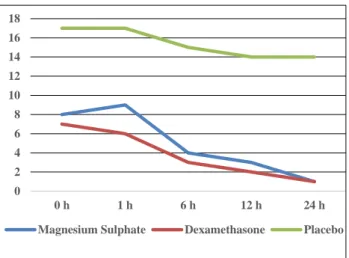
Figure 3: Number of patients having moderate sore throat at different study intervals in different groups.
Incidence of hoarseness at 0 hour post-extubation was less in patients receiving magnesium sulphate (52%) or dexamethasone (50%) than those receiving placebo (76%) and was statistically significant (p-values of 0.012 and 0.007), while it was comparable between patients receiving magnesium sulphate and dexamethasone (p value-0.841) (Table 4).
Similar results were seen at rest of study stages with incidence of hoarseness being higher in placebo group at all stages and comparable between magnesium sulphate and dexamethasone groups (Table 4 and Figure 5) The results suggest that both dexamethasone and magnesium sulphate are effective in reducing incidence of post-extubation hoarseness of voice.
Figure 4: Number of patients having severe sore throat at different study intervals in different groups.
Figure 5: Incidence of hoarseness of voice in different study groups
DISCUSSION
Postoperative sore throat (POST) is a common complication of general anesthesia and has been described as one of the most undesirable outcomes during the postoperative period, because it adversely affects the satisfaction and activities of the patients even after discharge from hospital.3,21,22 Typically, the incidence
rate of postoperative sore throat (POST) is as high as 30-100% of patients who are tracheally intubated.23-26
Various non-pharmacological and pharmacological
measures have been used for attenuating postoperative sore throat with variable success. In present study
prospective, randomized, double blind, placebo
controlled study the groups were comparable with respect to age, gender distribution and ASA status of patients (Table 1). Similar results were in studies done by Park JH
0 5 10 15 20 25 30 35 40
0 h 1 h 6 h 12 h 24 h
Magnesium suphate Dexamethasone Placebo
0 2 4 6 8 10 12 14 16
0 h 1 h 6 h 12 h 24 h
Magnesium Sulphate Dexamethasone Placebo
0 2 4 6 8 10 12 14 16 18
0 h 1 h 6 h 12 h 24 h
Magnesium Sulphate Dexamethasone Placebo
0 2 4 6 8 10 12 14
0 h 1 h 6 h 12 h 24 h
Magnesium Sulphate Dexamethasone Placebo
0 10 20 30 40
0 h 1 h 6 h 12 h 24 h
Magnesium Sulphate Dexamethasone
et al, Bagchi D et al, Park SH et al and Thomas S et al.27,28,16,17 Incidence and severity of sore throat in
placebo group was much more than magnesium sulphate group and dexamethasone group and was statistically significant at 0 h, 1 h, 2 h, 6 h, 12 h and 24 h. Between magnesium sulphate group and dexamethasone group comparison was statistically insignificant at all intervals of time. This shows magnesium sulphate 30mg.kg-1 and dexamethasone 8 mg are equally efficacious in reducing incidence and severity of postoperative sore throat and are superior to normal saline given as placebo.
Present study results correlate with the study done by Park JH et al, who concluded that prophylactic 30 mg.kg-1 magnesium sulphate followed by mg.kg-10 mg.kg-mg.kg-1. h-mg.kg-1 infusion till end of was surgery was comparable to 8 mg dexamethasone for prevention of postoperative sore throat in patients undergoing lumbar spine surgery in the prone position.27 Present study results are also in
concordance with the study conducted by Park SH et al.16
They conducted a prospective, randomized, double blind, placebo controlled study to evaluate the efficacy of dexamethasone for reducing the incidence and severity of postoperative sore throat and hoarseness. One hundred and sixty-six patients (aged 18-75years) were included in the study. They concluded that prophylactic use of 0.2mg/kg of dexamethasone significantly decreases the incidence and severity and hoarseness at 1hr and 24 hrs after extubation as compared to the placebo group. Present study results also correlate with studies by Bagchi D et al, who concluded that prophylactic intravenous dexamethasone in a dose of 0.2mg/kg can reduce the incidence of postoperative sore throat as compared to the placebo group.28 Present study findings are also similar to
study conducted by Thomas S et al, who in their randomized, double blind and placebo controlled study, they concluded that preoperative administration of dexamethasone 8mg intravenously reduces the incidence and severity of postoperative sore throat in patients receiving general anesthesia with endotracheal intubation as compared to the placebo group.17 Another
meta-analysis conducted by Sun L et al, suggested that intravenous dexamethasone reduces the risk and severity of postoperative sore throat from intubation at 24 hours.29
They suggested that effective dose of dexamethasone for prevention of POST to be 0.1mg/kg. Present study results also correlate with the study of Borazan H et al, in which they observed that preoperative administration of oral magnesium lozenges which contained 100mg of magnesium ion content per dose reduce both incidence as well as severity of postoperative sore throat at 0 hr, 2 hours, 4 hours and 24 hours.11 In their study the incidence
of sore throat was less as compared to Present study in the first three time intervals while as at 24 hrs after extubation it was approximately equal to our study, the reason may be that intravenous drug takes some time to act. Also, they used lozenges before intubation while as we have given the magnesium sulphate intravenously after intubation. Present study results are also in concordance with the study by Sane S et al, who
compared intravenous magnesium sulphate 40mg.kg-1 given after intubation with saline placebo for reducing incidence of postoperative sore throat in patients undergoing lumbar laminectomy and found that administration of intravenous magnesium sulphate after intubation is effective to reduce the incidence of postoperative sore throat.30 Present study found
hoarseness of voice was less in magnesium sulphate and dexamethasone as compared to placebo group. It was
comparable between magnesium sulphate and
dexamethasone groups. So, we found that magnesium sulphate 30mg.kg-1 and dexamethasone 8 mg are equally efficacious in reducing the incidence of hoarseness and are superior to normal saline used as placebo. Present study results are in concordance with the study conducted by Park JH et al, who found both dexamethasone and magnesium sulphate to be effective for prevention of post extubation hoarseness.16 Results also correlate with the
study conducted by Park SH et al who found that
prophylactic use of 0.2 mg/kg dexamethasone
significantly decreases the incidence of postoperative hoarseness at 1 and 24 hours after extubation.16 Lee SH et
al, also found that dexamethasone in a dose of 0.2 mg/kg decreased the incidence of hoarseness in patients undergoing prone position surgery.31 The placebo group
helped us to evaluate the efficacy of both the study drugs. Also, comparison between two drugs was statistically comparable and hence both the drugs can be safely administered for the prevention of postoperative sore throat and hoarseness. This study has several limitations. As the response for incidence and severity of sore throat as well as hoarseness was to be enquired from study patients so there was a chance of subjective bias. Also, we followed patients up to 24 hours only so we couldn’t assess the long term effects.
CONCLUSION
We concluded that endotracheal intubation is associated with postoperative sore throat and hoarseness of voice. Intravenous dexamethasone 8 mg and intravenous magnesium sulphate 30mg.kg-1 reduces the incidence and severity of postoperative sore throat compared to
placebo. Intravenous dexamethasone 8mg and
intravenous magnesium sulphate 30mg.kg-1 reduces the incidence of postoperative hoarseness compared to
placebo. However, magnesium sulphate and
dexamethasone are equally efficacious and comparable in reduction of incidence and severity of sore throat as well as hoarseness.
Funding: No funding sources Conflict of interest: None declared
Ethical approval: The study was approved by the Institutional Ethics Committee
REFERENCES
postoperative sore throat; A prospective, single blind study. Anesth Analg. 2006;103:1001-3.
2. Stock MC, Downs JB. Lubrication of tracheal tubes to prevent sore throat from intubation. Anesthesiology. 1982;57:418-20.
3. Higgins PP, Chung F, Mezei G. Postoperative sore throat after ambulatory surgery. Br J Anaesth. 2002;88:582-4. 4. Marais J, Prescott RJ. Throat pains and pharyngeal
packing: a controlled randomized double blind comparison between gauze and tampon. Clin Otolaryngol. 1993;18:426-9.
5. Ayoub CM, Ghobashy A, Koch ME, McGrimley L, Pascale V, Qadir S, et al. Wide spread application of topical steroids to decrease sore throat, hoarseness and cough after tracheal intubation. Anesth Anlag. 1998;87(3):714-6.
6. Stout DM, Bishop MJ, Dwersteg JF, Cullen BF. Correlation of endotracheal tube size with sore throat and hoarseness following General Anesthesia. Anesthesiology. 1987;67(3):419-21.
7. Biro P, Seifert B, Pasch T. Complaints of sore Throat after tracheal intubation; a prospective evaluation. Eur J Anesthesiology. 2005;22(4):307-11.
8. Koshy E, Curcin V, Bottle A, Sharland M, Saxena S. Sore throat consultations in general practice prior to tonsillectomy among eight hundred and sixty three children in England. ClinOtolaryngol. 2013;38(3):266-70. 9. Hari Kumar S, Saravanan D, Ranganathan S, Sumathi K.
Postoperative sore throat-incidence and contributory factors. J Pharm Biomed Sci. 2013;26(26):286-92. 10. Koinig H, Wallner T, Marhofer P, Andel H, Horauf K,
Mayer N. Magnesium sulfate reduces intra and postoperative analgesic requirements. Anesth Analg. 1998;87(1):206-10.
11. Borazan H, Kececioglu A, Okesli S, Otelcioglu S. Oral magnesium lozenges reduces postoperative sore throat: a randomized, prospective placebo controlled study. Anesthesiol. 2012;117(3):512-8.
12. Gupta SK, Tharwani S, Singh DK, Yadav G. Nebulized magnesium for prevention of postoperative sore throat. Br J Anaesth. 2012;108(1):168-9.
13. Dimitriou VK, Zogogiannis ID, Douma AK, Pentilas ND, Liotiri DG, Wachtel MS, et al. Comparison of standard polyvinyl chloride tracheal tubes and straight reinforced tracheal tubes for tracheal intubation through different sizes of the Airtraq laryngoscope in anesthetized and paralyzed patients: a randomized prospective study. Anesthesiology. 2009;111(6):1265-70.
14. Ayoub CM, Ghobashy A, Koch ME, McGrimley L, Pascale V, Qadir S, et al. Widespread application of topical steroids to decrease sore throat, hoarseness, and cough after tracheal intubation. Anesth Analg. 1998;87(3):714-6.
15. Hakim ME. Beclomethasone prevents postoperative sore throat. Acta Anaesthesiol Scand. 1993;37(3):250-2. 16. Park SH, Han SH, Do SH, Kim JW, Rhee KY, Kim JH.
Prophylactic dexamethasone decreases the incidence of sore throat and hoarseness after tracheal extubation with a double-lumen endobronchial tube. Anesth Analg. 2008;107(6):1814-8.
17. Thomas S, Beevi S. Dexamethasone reduces the severity of postoperative sore throat. Can J Anaesth. 2007;54(11):897-901.
18. Nicholson G, Burrin JM, Hall GM. Peri-operative steroid supplementation. Anaesthesia 1998;53(11):1091-104. 19. Koinig H, Wallner T, Marhofer P, Andel H, Horauf K,
Mayer N. Magnesium sulfate reduces intra and postoperative analgesic requirements. Anesth Analg. 1998;87(1):206-10.
20. Gupta SK, Tharwani S, Singh DK, Yadav G. Nebulized magnesium for prevention of postoperative sore throat. Br J Anaesth. 2012;108(1):168-9.
21. Macario A, Weinger M, Truong P, Lee M. Which clinical anesthesia outcomes are both common and important to avoid? The perspective of a panel of expert anesthesiologists. Anesth Analg 1999;88(5)1085-91. 22. Estebe JP, Dollo G, Le Corre P, Le Naoures A, Chevanne
F, Le Verge R, et al. Alkalinization of intra cuff lidocaine improves endotracheal tube-induced emergence phenomena. AnesthAnalg. 2002;94(1):227-30.
23. Combes X, Schauvliege F, Peyrouset O, Motamed C, Kirov K, Dhonneur G, et al. Intra cuff pressure and tracheal morbidity: influence of filling with saline during nitrous oxide anesthesia. Anesthesiol. 2001;95(5):1120-4. 24. Herlevsen P, Bredahl C, Hindsholm K, Kruhoffer PK.
Prophylactic laryngo-tracheal aerosolized lidocaine against postoperative sore throat. Acta Anaesthesiol Scand. 1992;36(6):505-7.
25. Wang JJ, Ho ST, Lee SC, Liu YC, Liu YH, Liao YC. The prophylactic effect of dexamethasone on postoperative nausea and vomiting in women undergoing thyroidectomy: a comparison of droperidol with saline. Anesth Analg. 1999;89(1):200-3.
26. Lee JH, Lee HK, Chun NH, So Y, Lim CY. The prophylactic effects of gabapentin on postoperative sore throat after thyroid surgery. Korean J Anesthesiol. 2013;64(2):138-42.
27. Park JH, Shim JK, Song JW, Jang J, Kim JH, Kwak YL. A randomized, double-blind, non-inferiority trial of magnesium sulphate versus dexamethasone for prevention of postoperative sore throat after lumbar spinal surgery in the prone position. Int J Med Sci. 2015;12(10):797-804. 28. Bagchi D, Mandal MC, Das S, Sahoo T, Basu SR, Sarkar
S. Efficacy of intravenous dexamethasone to reduce incidence of postoperative sore throat: A prospective randomized controlled trial. J Anaesthesiol Clin Pharmacol. 2012;28:477-80.
29. Sun L, Guo R, Sun L. Dexamethasone for preventing postoperative sore throat: a meta-analysis of randomized controlled trials. Ir J Med Sci. 2014;183(4):593-600. 30. Sane S, Mahoori AR, Valizade Hasanloei M, Karami N,
Dehghani E. The effect of intravenous magnesium sulfate on postoperative sore throat in patients undergoing lumbar laminectomy (Persian). J Anesth Pain. 2015;6(3):11-18. 31. Lee SH, Lee YC, Lee JH, Choi SR, Lee SC, Lee JH et al.
The prophylactic effect of dexamethasone on postoperative sore throat in prone position surgery. Korean J Anesthesiol. 2016 Jun;69(3):255.