Pollution Potential of General Dentistry Offices in Terms of Wastewater and
Solid Waste: A Case Study in the City of Arak, Iran
Ali Koolivand
*1, Mohammad Sadegh Rajaee
1, Mohammad Javad Ghanadzadeh
1, Reza Saeedi
2,3,
Fattolah Gholami Borojeni
41)Department of Environmental Health Engineering, Faculty of Health, Arak University of Medical Sciences, Arak, Iran 2) Workplace Health Promotion Research Center, Shahid Beheshti University of Medical Sciences, Tehran, Iran
3) Department of Health, Safety and Environment (HSE), School of Public Health and Safety, Shahid Beheshti University of Medical Sciences, Tehran, Iran
4) Department of Environmental Health Engineering, Faculty of Health, Mazandaran University of Medical Sciences, Sari, Iran *Author for Correspondence: [email protected]
Received: 23 Dec. 2017, Revised: 20 Apr. 2018, Accepted: 18 May 2018
ABSTRACT
Dental wastewater and solid waste are one of the most important sources of environmental pollution. The objective of the present study was to evaluate the quality of wastewater and solid waste produced in the general dentistry offices in the city of Arak, Iran. A total number of 30 samples of wastewater and 30 samples of solid waste were taken from 30 general dentistry offices. The samples of wastewater were analyzed for metals and other parameters such as BOD, COD, and TSS. The samples of solid wastes were manually separated into 66 components and 4 categories and then weighted. The mean concentrations of Zn, Cu, Hg, Fe, B, Ba, Sn, Ag, Pb, Al, Mn, Cr, and Co were 3950.09, 2578.59,
1247.28, 1060.21, 538.36, 493.21, 300.91, 156.56, 108.32, 107.37, 91.11, 66.00, and 6.48µg L-1, respectively. The
mean generation of dental solid waste in each general dentistry office was 670.22g day-1. Potential infectious waste,
domestic-type waste, chemical & pharmaceutical waste, and toxic waste constituted 51.52%, 35.30%, 11.11% and 2.07%, of the total waste generated, respectively. Due to the high levels of some metals in the samples, the wastewater should be treated before discharging into the public sewer.
Keywords:
Dental Wastewater; Dental Solid Waste; Potential Infectious Waste; Toxic Waste; ArakABBREVIATION
COD: Chemical Oxygen Demand
BOD: Chemical Oxygen Demand
TSS: Total Suspended Solids
ICP: Inductively Coupled Plasma
INTRODUCTION
Dentistry centers are one of the main sources of environmental pollution in terms of both dental wastewater and solid waste [1, 2]. Unfortunately, there is no specific attention to these centers in comparison with other generators of wastewater and solid waste, especially in developing countries. Management of dental wastewater and solid waste is a complicated issue and thus requires training, awareness, and financial supports [3, 4].
Dentistry offices produce a vast variety of waste components with different characteristics [5]. These components would be classified into various categories such as domestic-type waste, potential infectious waste, toxic waste, and chemical & pharmaceutical waste. Each category requires a specific approach for suitable collection, treatment and disposal [6, 7]. Domestic-type waste comprises
components such as paper, cardboard and plastic that do not pose a threat for human and animal health or the environment. This category can be collected and disposed of along with the municipal solid waste [8]. Potentially infectious wastes consist of discarded items exposing to blood and its derivatives. Infectious waste should be managed in a safe manner to avoid adverse effects on the environment and public health [9, 10].
environment, they can accumulate in the food chain and impose adverse health risks [15, 16]. Dental operations generate a heterogeneous waste mixture of liquids and particles with different sizes ranging from large visible particles to fine colloidal suspensions. During the dental procedures, fine parts of amalgam enter the wastewater stream. Thus, dental wastewater contains high levels of various metals especially mercury [17-19]. The uncontrolled discharge of dental wastewater into the sewer system from a large number of dentistry centers would increase the contents of mercury in the municipal wastewater treatment plants [20, 21]. Generally, high concentrations of mercury and other metals in wastewater are toxic to microorganisms present in wastewater treatment plants [21, 22]. Other sources of hazardous materials in dentistry centers include fixer solutions, unused film, and lead foil of film packet. Spent fixer solution and the undeveloped film must be treated as hazardous wastes because of the levels of silver. . The lead foil of film packet can leach and contaminate soil and groundwater [23].
The problem of dental wastewater and solid waste is still unsolved in Iran; mainly due to the absence of specific regulations on dentistry centers. In most areas of the country, dental solid waste and municipal solid waste are collected simultaneously and disposed of in uncontrolled landfills. On the other hand, dental wastewater is unlimitedly discharged into the sewers without any pre-treatments. Based on our knowledge, there is no study about dental wastewater in Iran. In other countries, most studies that dealt with metal pollution of dental wastewater have concentrated only on mercury. Therefore, the present study was performed to quantify the amount of various metals in the wastewater of some general dentistry offices in the city of Arak, Iran. In addition, other characteristics of dental wastewater such as COD, BOD, and TSS as well as management activities were investigated. The components, composition and generation rate of dental solid waste and associated management practices were also studied.
MATERIALS AND METHODS
Description of the study area
This study was performed at the general dentistry offices in the city of Arak, Iran, in 2015. Arak with a population of about 700000 is located in the center of Iran. Some primitive diagnosis and treatment activities are done in the general dentistry offices. They also prescribe medications such as antibiotics and any other drugs used in patient management.
Sampling and analysis of solid waste
A number of 30 general dentistry offices were randomly selected and then 3 samples of solid waste
were taken from each office at the end of successive working days. Sample collection was carried out at night as working time was over. The samples were separately transferred to the waste storage room and then manually separated into 66 components and 4 categories (Table 1). Each component was weighted using a laboratory-scale within 10 hours after the sampling.
Sampling and analysis of wastewater
Out of 30 general dentistry offices, 90 samples of wastewater were taken at the end of the successive working day. Glass- and plastic-wares used for sampling were soaked overnight in 10% nitric acid and then rinsed with distilled water before use. The wastewater discharged from the dentistry chairs was continuously collected in 10 L-capacity polyethylene plastic bottles. In order to preserve the samples, nitric acid solution (50% v/v) was added to the samples to maintain a solution pH below 2. Samples were then
refrigerated at 4°C until being analyzed. Metal contents
of the samples were analyzed two times with ICP after
digesting with a mixture of HCl and H2SO4. Other
characteristics of wastewater including COD, BOD, TSS, and pH were analyzed according to the standard
methods (methods 5220, 5210, 2540, and 4500-H+,
respectively) for the examination of water and wastewater [24]. All the standard solutions and chemicals were of high-purity prepared from Merck Company.
Surveying management activities
Management practices of solid waste and wastewater in the dentistry offices were investigated by means of
a structured questionnaire. The questionnaire
contained various questions about generation, reuse, recycle, collection, and disposal of the wastewater and
solid waste. Some questions also focused on the
presence of puncture-resistant containers in the offices and the personnel in charge of solid waste collection.
Furthermore, dentists were asked about the
management of the processing solutions and wastewater. On the other hand, interviews and observations were used to obtain detailed information about solid waste and wastewater management.
RESULTS AND DISCUSSION
Solid waste characteristic
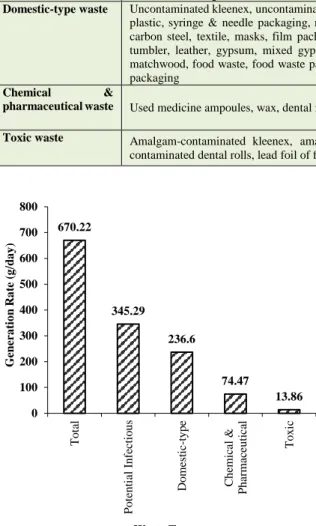
The generation rate of various categories of dental solid waste is presented in Fig. 1. As seen, the mean generation rate of dental solid waste in the general
dentistry offices was 670.22g day-1. As well, the mean
generation of potentially infectious waste, domestic-type waste, chemical & pharmaceutical waste, and toxic waste in each center were 345.29, 236.60, 74.47
Table 1: Classification of components of dental solid waste generated in the surveyed general dentistry offices
Waste categories Waste components
Potential infectious
waste
Blood & saliva-contaminated kleenex, blood & saliva-contaminated gauze, blood & saliva-contaminated cotton, blood & saliva contaminated dental rolls, nylon gloves, latex gloves, syringes, saliva ejectors, sharps & needles, extracted teeth, dental mirror, stitch string, stitch needle, surgical blades, absorbent paper points, gutta percha points, dental bridges, dental floss, tongue blade, dentistry pallet, brackets, poar air cover, polishing strip, matrix band, dental wedge
Domestic-type waste Uncontaminated kleenex, uncontaminated gauze, uncontaminated cotton, uncontaminated dental rolls, nylon &
plastic, syringe & needle packaging, nylon-coated paper, articulating paper, sand paper, paper & cardboard, carbon steel, textile, masks, film packet paper, film packet plastic, empty [used] amalgam capsules, plastic tumbler, leather, gypsum, mixed gypsum and gauze, paper banderole, brilliant banderole, sticking plaster, matchwood, food waste, food waste packaging, tea slag, filter tip, mixed soil and gypsum, medicine ampoule packaging
Chemical &
pharmaceutical waste Used medicine ampoules, wax, dental impression material, acrylic, calcium hydroxide.
Toxic waste Amalgam-contaminated kleenex, contaminated gauze, contaminated cotton,
amalgam-contaminated dental rolls, lead foil of film packet, amalgam particles.
Fig. 1: Generation rate of various categories of solid waste generated in the surveyed general dentistry offices
On the other hand, percentages of potentially infectious waste, domestic-type waste, chemical & pharmaceutical waste, and toxic waste were found to be 51.52%, 35.30%, 11.11% and 2.07%, respectively (Fig. 2). The results of the present study are in line with a similar study in Iran [25] reporting the percentages of domestic-type waste, potentially infectious waste, chemical & pharmaceutical waste, and toxic waste were 51.93%, 38.16%, 9.47%, and 0.44%, respectively. Different factors such as the type of dentistry centers, dental procedures and operations, and national regulations would affect the composition of dental solid waste. Other studies [26, 27] also reported that the majority of dental solid waste
comprises domestic-type waste and potentially infectious waste. Therefore, prevention of mixing the potentially infectious waste with the domestic-type is necessary to reduce the volume of infectious waste generated.
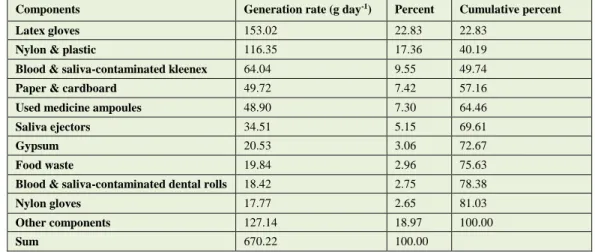
Table 2 shows the percentage of various components of dental solid waste. As presented, out of 66 components, only 10 components constituted more than 80% of the total solid waste generated. These components include latex gloves, nylon & plastic, blood & saliva-contaminated kleenex, paper & cardboard, used medicine ampoules, saliva ejectors, gypsum, food waste, blood & saliva-contaminated dental rolls, and nylon gloves. Thus, waste reduction and recycling programs should be concentrated on these components. These findings are in line with other studies reporting only a few components are responsible for generating the majority of dental solid waste [25, 27, 28].
Fig. 2: Percentages of various categories of solid waste generated in the surveyed general dentistry offices
Potential Infectious 51.52%
Domestic-type 35.30% Chemical
& Pharmace
utical 11.11%
Toxic 2.07% 670.22
345.29
236.6
74.47
13.86 0
100 200 300 400 500 600 700 800
To
ta
l
Po
te
n
ti
a
l
In
fe
c
ti
o
u
s
D
o
mest
ic
-t
y
p
e
C
h
emi
ca
l
&
P
h
ar
mac
eu
ti
ca
l
To
x
ic
Gener
a
ti
o
n
R
a
te
(
g
/d
a
y
)
On the other hand, 7 components including latex gloves, blood & saliva-contaminated kleenex, saliva ejectors, blood & saliva-contaminated dental rolls, nylon gloves, blood & saliva-contaminated gauze, and sharps & needles were responsible for more than 90% of the potentially infectious waste generated (Table 3). Thus, for the prevention of mixing the potentially infectious waste with the non-infectious waste, these main components should be considered first.
Our results also showed that per capita generation of dental solid waste in general dentistry offices was
66.71g day-1 per each patient. Two recent studies on
dental solid waste in Iran reported that per capita generation of dental solid waste in the general
dentistry offices were 31.56 [25] and 48.72 [27] g day
-1 per each patient. Comparison of the results of Iran
with other countries such as Greece with a per capita
of 513g day-1 per each patient [26] indicates that the
generation rate of dental solid waste in Iran is very low. These differences are due to this fact that the generation rate of dental solid waste depends on various factors such as economy, dental procedures and operations, and the type of materials used.
Table 2: Generation rate of various components of solid waste generated in the surveyed general dentistry offices
Cumulative percent Percent
Generation rate (g day-1)
Components
22.83 22.83
153.02
Latex gloves
40.19 17.36
116.35
Nylon & plastic
49.74 9.55
64.04
Blood & saliva-contaminated kleenex
57.16 7.42
49.72
Paper & cardboard
64.46 7.30
48.90
Used medicine ampoules
69.61 5.15
34.51
Saliva ejectors
72.67 3.06
20.53
Gypsum
75.63 2.96
19.84
Food waste
78.38 2.75
18.42
Blood & saliva-contaminated dental rolls
81.03 2.65
17.77
Nylon gloves
100.00 18.97
127.14
Other components
100.00 670.22
Sum
Table 3: Generation rate of various components of potentially infectious waste generated in the surveyed general dentistry offices
Cumulative percent Percent
Generation rate (g day-1)
Components
44.31 44.31
153.02
Latex gloves
62.86 18.55
64.04
Blood & saliva-contaminated kleenex
72.85 9.99
34.51
Saliva ejectors
78.19 5.34
18.42
Blood & saliva-contaminated dental rolls
83.34 5.15
17.77
Nylon gloves
87.68 4.35
15.01
Blood & saliva-contaminated gauze
91.38 3.70
12.77
Sharps & needles
93.28 1.90
6.57
Tongue blade
94.38 1.10
3.80
Blood & saliva-contaminated cotton
94.89 0.50
1.73
Extracted teethes
100.00 5.11
17.66
Other components
100.00 345.29
Sum
Wastewater characteristic
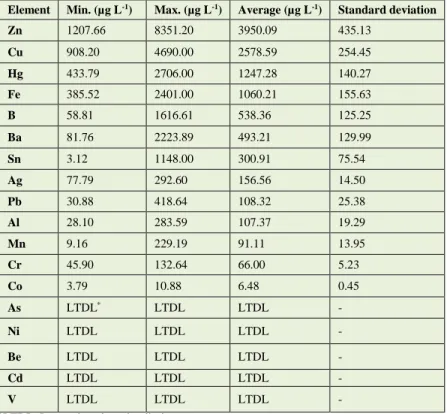
Collected samples were analyzed for elements including Hg, Ag, Sn, Cu, Zn, Cr, Mn, Fe, Co, Ni, Cd, Ba, Pb, Al, B, As, V, and Be. As presented in Table 4,
the samples contained high levels of Zn (3950.09µg L
-1), Cu (2578.59µg L-1), Hg (1247.28µg L-1) and Fe
(1060.21µg L-1). In addition, the contents of these
elements in the dental wastewater are actually higher because these levels represent only the soluble fraction of the metals such as Hg. The filter of dental chair units can trap much of the Hg contents of the wastewater as
solid amalgam. The residual vaporizes into the air, or deposit at the bottom of samples containers. The findings of the present research are in line with the results of other studies reporting high levels of metals in dental wastewater [18, 29]. Based on water quality in the city of Arak, the contribution of inlet water to the contents of the metal of the wastewater is negligible. Thus, the main source of Zn, Cu, Sn, Ag, and Hg is the dental amalgam since they are major
elements of amalgam. The materials used in various
elements. There are also large variations in metals concentrations among samples of various centers. This also may be attributed to different operations (e.g. placement or extraction of amalgam fillings,
placement of non-amalgam fillings, teeth extraction, scaling, and polishing) used in each dentistry office [18, 30].
Table 4: Elemental analysis of wastewater generated in the surveyed general dentistry offices (No. of samples = 90)
Element Min. (µg L-1) Max. (µg L-1) Average (µg L-1) Standard deviation
Zn 1207.66 8351.20 3950.09 435.13
Cu 908.20 4690.00 2578.59 254.45
Hg 433.79 2706.00 1247.28 140.27
Fe 385.52 2401.00 1060.21 155.63
B 58.81 1616.61 538.36 125.25
Ba 81.76 2223.89 493.21 129.99
Sn 3.12 1148.00 300.91 75.54
Ag 77.79 292.60 156.56 14.50
Pb 30.88 418.64 108.32 25.38
Al 28.10 283.59 107.37 19.29
Mn 9.16 229.19 91.11 13.95
Cr 45.90 132.64 66.00 5.23
Co 3.79 10.88 6.48 0.45
As LTDL* LTDL LTDL -
Ni LTDL LTDL LTDL -
Be LTDL LTDL LTDL -
Cd LTDL LTDL LTDL -
V LTDL LTDL LTDL -
*LTDL: Lower than detection limit
Table 5 shows some other characteristics of dental wastewater including COD, BOD, TSS and pH. As indicated, the quality of dental wastewater is similar to municipal wastewater in terms of these parameters.
For this reason, discharging the wastewater into the sewers does not pose any additional loads to the wastewater treatment plants.
Table 5: Characteristic of dental wastewater generated in the surveyed general dentistry offices (No. of samples = 90)
Parameters Unit Min. Max. Average Standard deviation
BOD mg L-1 141 237 155.73 10.11
COD mg L-1 430 570 451.67 30.86
TSS mg L-1 136 227 147.40 10.21
pH - 5.86 7.14 6.70 0.08
Management activities
Although the amount of dental solid waste is small in comparison with municipal solid waste, it is necessary to manage it properly. Our findings (Table 6) indicated that there was no effective activity for solid waste minimization, reuse, and recycling in the investigated dentistry centers. Furthermore, management of sharps, potential infectious and other hazardous dental wastes was not proper. These results are in accordance with other similar studies [1, 31] reporting these items were collected and disposed of along with the domestic-type
waste. The Indian study conducted by Sudhakar and Chandrashekar [28] showed that many dentistry centers (35.7%) disposed of their dental solid waste without segregation and disinfection into the municipal solid waste stream.
[32]. On the other hand, amalgam may enter the wastewater stream and increase the level of mercury in it. Due to the hazardous nature of mercury, it was globally regulated [33, 34]. In many countries, the maximum permissible value for discharging mercury into the publicly owned sewer system is below 50 µg
L-1 [18, 35]. Therefore, several measures such as
application of sealed small capsules, the use of
amalgam filters or separators, and suitable
management of amalgam and other Hg-containing wastes should be done by dentistry centers in order to reduce the release of mercury into the environment. The fixer that dentistry offices use to develop X-ray was directly discharged into the sewer due mainly to the lack of silver recovery units. Fixer solution should not be simply disposed of down to the sewer. Silver recovery unit should be used to recapture the silver and then the de-silvered fixer solution can be mixed with developer solution and water and discharge to the sewer. Additionally, spent developer can be diluted with water and then discharged into the sewer. Since the undeveloped films consist of high amounts of silver, it must be treated as a hazardous waste. Unused film should be recycled rather than being placed into the solid waste stream. Application of digital X-ray units would remove the need for fixer solutions and X-ray films. Developed film can be collected along with the regular solid waste as it contains little amount of silver. Lead foil packets and lead aprons should be collected as toxic wastes in a special marked container [23, 36].
Minimization, segregation, and recycling of dental waste should be done especially for hazardous waste. Application of less toxic or reusable materials and equipment instead of the disposable ones result in minimizing the generation of waste [37]. Prevention of mixing various categories of dental solid waste has a significant effect on the volume of dental hazardous waste generated. Potential infectious waste should be separated from other dental solid wastes and disposed of after sterilization process. Sharp items should be transferred to special thick wall containers and sterilized [38]. One of the reasons for improper management of health care waste is the lack of knowledge regarding waste management programs [39, 40]. Thus, it is suggested that a continuous educational program be considered for motivating the practice, knowledge, and awareness of the dentists regarding dental waste management.
Table 6: Wastewater and solid waste management conditions in the surveyed general dentistry offices
Results Management activities
100%
Implementing waste reduction
programs
100%
Implementing waste separation programs
100%
Implementing waste recycling
programs
100%
Application of silver recovery units
100%
Application of mercury recovery units
100%
Amalgam recycling
100%
Film packet recycling
100%
Fixer solution recycling
80% by safety box 20% by trash disposal
Method of sharps management
60% by oven 20% by autoclave 20% by chemical solutions
Method of equipment sterilization
CONCLUSIONS
The wastewater discharged from the surveyed dentistry offices contained high levels of some metals. Such wastewater should not be discharged to the municipal sewer without suitable pretreatment. Obviously, amalgam and other materials and tools used in dental operations were the sources of these metals in dental wastewater. On the other hand, the solid waste generated in the dentistry offices included various categories containing some infectious and hazardous components. Each category of dental solid waste should be collected and disposed of in accordance with their related criteria.
ETHICAL ISSUES
Ethical issues such as plagiarism have been observed by the authors.
COMFLICT OF INTEREST
The authors have no conflicts of interest to declare.
AUTHORS’ CONTRIBUTION
All authors collaborated equally.FUNDING/ SUPPORTING
Arak University of Medical Sciences supported and funded this research.
ACKNOWLEDGEMENTS
REFERENCES
[1] Abhishek K, Suryavanshi HN, Sam G, Chaithanya K, Punde P, Singh SS. Management of biomedical waste: An exploratory study. JIOH. 2015;7(9): 70-74. [2] Singh BP, Khan SA, Agrawal N, Siddharth R, Kumar L. Current biomedical waste management
practices and cross‐infection control procedures of
dentists in India. Int Dent J. 2012;62(3): 111-16. [3] Vieira CD, de Carvalho MAR, de Menezes Cussiol NA, Alvarez-Leite ME, dos Santos SG, da Fonseca
Gomes RM, et al. Count, identification and
antimicrobial susceptibility of bacteria recovered from dental solid waste in Brazil. Waste Manage. 2011;31(6): 1327-32.
[4] Koolivand A, Mahvi AH, Alipoor V, Azizi K, Binavapour M. Investigating composition and production rate of healthcare waste and associated management practices in Bandar Abbass, Iran. Waste Manage Res. 2012;30(6): 601-06.
[5] Mandalidis A, Topalidis A, Voudrias EA, Iosifidis N. Composition, production rate and characterization of Greek dental solid waste. Waste Manage. 2018;75: 124-30.
[6] Vieira CD, de Carvalho MAR, de Menezes Cussiol NA, Alvarez-Leite ME, dos Santos SG, da Fonseca
Gomes RM, et al. Composition analysis of dental solid
waste in Brazil. Waste Manage. 2009;29(4): 1388-91. [7] Al-Momani TD, Al-Zube LA, Al-Bataineh OM. Assessment of medical wastes management protocols in Jordanian healthcare institutions. Int J Environt Waste Manage. 2013;11(3): 323-34.
[8] Daou MH, Karam R, Khalil S, Mawla D. Current status of dental waste management in Lebanon. Environ Nanotechnol Monitor Manage. 2015;4: 1-5. [9] Damani N, Koolivand A, Sadat M, Mahvi AH, Mazloomi S. Hospital waste generation and management in some provinces of Iran. Toxicol Environ Chem. 2013;95(6): 962-69.
[10] Maamari O, Moujaes F, Keyrouz R, El-Obeid D,
Kosremelli Asmar M, Brandam C, et al. The creation
and monitoring of a network for solid healthcare waste management. Int J Environ Waste Managet. 2015;15(2): 130-47.
[11] Makkar M, Kaur KA. Management of wastes in dental offices-a review. J Adv Med Dent Sci Res. 2015;3(3): 65-68.
[12] Krishnappa P, Sreekantaiah P, Hiremath S, Thapsey H, Shivraj N, Murthy NS. Quantification of dental health care waste generated among private
dental practices in Bengaluru city. JIOH.
2015;7(6):84-87.
[13] Dalla Costa R, Cossich ES, Tavares CRG. Influence of the temperature, volume and type of solution in the mercury vaporization of dental amalgam residue. Sci Total Environ. 2008;407(1): 1-6.
[14] Al-Khatib IA, Darwish R. Assessment of waste amalgam management in dental clinics in Ramallah and al-Bireh cities in Palestine. Int J Environl Health Res. 2004;14(3): 179-83.
[15] Somerset V, Van der Horst C, Silwana B, Walters C, Iwuoha E. Biomonitoring and evaluation of metal concentrations in sediment and crab samples from the North-West province of South Africa. Water Air Soil Pollut. 2015;226(3): 1-25.
[16] Barbieri FL, Gardon J, Ruiz-Castell M, Paco V P,
Muckelbauer R, Casiot C, et al. Toxic trace elements
in maternal and cord blood and social determinants in a Bolivian mining city. Int J Environl Health Res. 2016; 26(2): 158-74.
[17] Keramati P, Hoodaji M, Tahmourespour A. Multi-metal resistance study of bacteria highly resistant to mercury isolated from dental clinic effluent. Afr J Microbiol Res. 2011;5: 831-7.
[18] Shraim A, Alsuhaimi A, Al-Thakafy JT. Dental clinics: a point pollution source, not only of mercury but also of other amalgam constituents. Chemosphere. 2011;84(8): 1133-39.
[19] Fard GH, Mehrnia MR. Investigation of mercury
removal by micro-algae dynamic membrane
bioreactor from simulated dental waste water. J Environ Chem Eng. 2017;5(1): 366-72.
[20] Carraro E, Bonetta S, Bertino C, Lorenzi E, Bonetta S, Gilli G. Hospital effluents management: Chemical, physical, microbiological risks and legislation in different countries. J Environ Manage. 2016;168: 185-99.
[21] Chung D, Choi HH, Yoo HY, Lee JY, Shin SK,
Park JM, et al. Mercury flows in a zinc smelting
facility in South Korea. J Mate Cycles Waste Manage. 2015;19: 46-54.
[22] Hara K, Kuroda M, Yabar H, Kimura M, Uwasu M. Historical development of wastewater and sewage sludge treatment technologies in Japan: An analysis of patent data from the past 50 years. Environ Develop. 2016; 19: 59-69.
[23] Brahmankar U. Hazardous waste from dental radiology. Int J Med Public Health. 2015;5(1): 123-24. [24] APHA. Standard methods for the examination of water and wastewater. American Public Health Association (APHA): Washington, DC, USA. 2005. [25] Koolivand A, Gholami-Borujeni F, Nourmoradi
H. Investigation on the characteristics and
management of dental waste in Urmia, Iran. J Mater Cycles Waste Manage. 2014;17: 553-59.
[26] Kizlary E, Iosifidis N, Voudrias E,
Panagiotakopoulos D. Composition and production rate of dental solid waste in Xanthi, Greece: variability among dentist groups. Waste Manage. 2005;25(6): 582-91.
dental solid waste and associated management practices in Hamadan, Iran. Waste Manage Res. 2011;30: 619-24.
[28] Sudhakar V, Chandrashekar J. Dental health care waste disposal among private dental practices in Bangalore City, India. Int Dent J. 2008;58(1):51-54. [29] Al-Kawas S, Abu-Yousef I, Kanan S, El-Kishawi
M, Siddique A, Abdo N, et al. Analysis of mercury in
wastewater of some dental clinics in United Arab Emirates. J Int Environ Applic Sci. 2008;3(1): 21-28. [30] Nicolae A, Ames H, Quiñonez C. Dental amalgam and urinary mercury concentrations: a descriptive study. BMC Oral Health. 2013;13(1): 44-66.
[31] Muhamedagic B, Muhamedagic L, Masic I. Dental office waste: Public health and ecological risk. Materia Socio-Medica. 2009;21(1): 35-38.
[32] Lan R, Tzortzis S, Desfosses Y, Signoli M, Tardivo D. Study of remains and dental wastes of a First World War German rest camp. Trop Dent J. 2014;37(148): 13-24.
[33] Takaoka M. Mercury and mercury-containing waste management in Japan. J Mater Cycles Waste Manage. 2015;17(4): 665-72.
[34] Sahu R, Saxena P, Johnson S, Mathur H, Agarwal H. Mercury pollution in the Sonbhadra district of Uttar Pradesh, India, and its health impacts. Toxicol Environ Chem. 2014;96(8): 1272-83.
[35] Sundseth K, Pacyna JM, Pacyna EG, Panasiuk D. Substance flow analysis of mercury affecting water quality in the European Union. Water Air Soil Pollut. 2012;223(1): 429-42.
[36] Narayan KJ, Srinivas P, Suresh S, Kamalsha S, Rao MS. Oral health care waste disposal methods and practices among private dentists in a coastal city of Andhra Pradesh, India. Editorial Board. 2015;4(5): 46. [37] Dwivedy M, Mittal R. Willingness of residents to participate in e-waste recycling in India. Environ Develop. 2013;6: 48-68.
[38] Mahmoudi N, Sepandi M, Mohammadi A, Masoumbeigi H. Epidemiological aspects of needle stick injuries among nurses in a military hospital. IJHSE. 2015;2(4): 374-79.
[39] Bangennavar BF, Gupta A, Khullar S, Sukla N, Das A, Atram P. Biomedical waste disposal: practice, knowledge, and awareness among dentists in india. JIOH. 2015;7(11): 53-56.