Article
Why the Tsirelson Bound?
Bub’s Question and Fuchs’ Desideratum
W.M. Stuckey1* , Michael Silberstein2,3, Timothy McDevitt4and Ian Kohler1
1 Department of Physics, Elizabethtown College, Elizabethtown, PA 17022, USA 2 Department of Philosophy, Elizabethtown College, Elizabethtown, PA 17022, USA 3 Department of Philosophy, University of Maryland, College Park, MD 20742, USA
4 Department of Mathematical Sciences, Elizabethtown College, Elizabethtown, PA 17022, USA
1
2
3
4
5
6
7
8
9
10
11
12
13
* Correspondence:[email protected]
Abstract: ToanswerWheeler’squestion“Whythequantum?” viaquantuminformationtheory accordingtoBub,onemustexplainbothwhytheworldisquantumratherthanclassicalandwhy theworldisquantumratherthansuperquantum,i.e.,“WhytheTsirelsonbound?”Weshowthat thequantumcorrelationsandquantumstatescorrespondingtotheBellbasisstates,whichuniquely producetheTsirelsonboundfortheClauser-Horne-Shimony-Holtquantity,canbederivedfrom conservationpernopreferredreferenceframe(NPRF).Areferenceframeinthiscontextisdefinedby ameasurementconfiguration,justaswiththelightpostulateofspecialrelativity.Wethereforeargue thattheTsirelsonboundisultimatelybasedonNPRFjustasthepostulatesofspecialrelativity.This constraint-based/principleanswertoBub’squestionaddressesFuchs’desideratumthatwe“takethe structureofquantumtheoryandchangeitfromthisveryovertmathematicalspeak...intosomething like[specialrelativity].”Thus,theanswertoBub’squestionperFuchs’desideratumis,“theTsirelson boundobtainsduetoconservationperNPRF.”
Keywords: Tsirelson bound; Bell-CHSH inequality; superquantum correlations; quantum informationtheory
14
1. Introduction 15
Wheeler’s opening statement in his 1986 paper, “How Come the Quantum?” holds as true today 16
as it did then [1] 17
The necessity of the quantum in the construction of existence: out of what deeper requirement 18
does it arise? Behind it all is surely an idea so simple, so beautiful, so compelling that when – 19
in a decade, a century, or a millennium – we grasp it, we will all say to each other, how could 20
it have been otherwise? How could we have been so stupid for so long? 21
The problem is, as Hardy points out, “The standard axioms of [quantum theory] are rather ad hoc. 22
Where does this structure come from?”[2]. Concerning quantum mechanics, Fuchs writes [3, p. 285] 23
Compare that to one of our other great physical theories, special relativity. One could make 24
the statement of it in terms of some very crisp and clear physical principles: The speed of 25
light is constant in all inertial frames, and the laws of physics are the same in all inertial 26
frames. And it struck me that if we couldn’t take the structure of quantum theory and 27
change it from this very overt mathematical speak – something that didn’t look to have 28
much physical content at all, in a way that anyone could identify with some kind of physical 29
principle – if we couldn’t turn that into something like this, then the debate would go on 30
forever and ever. And it seemed like a worthwhile exercise to try to reduce the mathematical 31
structure of quantum mechanics to some crisp physical statements. 32
Special relativity is a principle theory, i.e., its postulates are constraints, so quantum information 33
theory (QIT) seeks “thereconstructionof quantum theory” via a constraint-based/principle approach 34
[4] in answering Wheeler’s “Really Big Question,” “Why the quantum?” [5,6]. Indeed, QIT has 35
produced several different sets of axioms, postulates, and “physical requirements” in terms of quantum 36
information (five noted by Fuchs, for example [3]) which all reproduce quantum theory. Bub has 37
successfully recast Wheeler’s question as, “why is the world quantum and not classical, and why is it 38
quantum rather than superquantum, i.e., why the Tsirelson bound for quantum correlations?” [7–9]. 39
That is, classical correlations produce a Clauser-Horne-Shimony-Holt (CHSH) quantity [10] 40
between 2 and 2 (the Bell inequality [11]), quantum correlations produce a CHSH quantity between 41
2p2 and 2p2 (the Tsirelson bound [12]), and superquantum correlations produce a maximum CHSH 42
quantity of 4 (the Popescu-Rohrlich (PR) correlations [13]). Classical and quantum correlations exist 43
in Nature, but superquantum correlations have not been observed. All three correlations satisfy 44
relativistic causality (the no-signaling condition [14]), so “Why the quantum?” meaning “Why the 45
quantum correlations?” means answering Bub’s question, “Why the Tsirelson bound?” 46
An interesting information-theoretic derivation of the Tsirelson bound has been produced via 47
“information causality” [15], so it would seem QIT is making great strides in both reconstructing 48
quantum theory and recasting and answering Wheeler’s question. Bub writes, “It’s a significant sea 49
change in the foundations of physics that information-theoretic principles of this sort are investigated 50
as possible constraints on physical processes” [9, p. 183]. 51
Despite all the success of QIT, the community does not find any of the reconstructions compelling. 52
Cuffaro, for example, argues that information causality needs to be justified in some physical sense 53
[16]. And, as Hardy states, “When I started on this, what I wanted to see was two or so obvious, 54
compelling axioms that would give you quantum theory and which no one would argue with” [17]. 55
Fuchs quotes Wheeler, “If one really understood the central point and its necessity in the construction 56
of the world, one ought to state it in one clear, simple sentence” [3, p. 302]. Asked if he had such a 57
sentence, Fuchs responded, “No, that’s my big failure at this point” [3, p. 302]. 58
Herein, we propose a constraint-based answer to QIT’s version of “Why the quantum?” that we 59
can state in “one clear, simple sentence” 60
The Tsirelson bound obtains because of conservation per no preferred reference frame. 61
Assuming the reader is willing to suspend their anthropocentric bias against constraint-based 62
explanation [18,19], Section 2 shows how the phenomona described by two Bell basis 63
states, the spin singlet state ⇣p1
2(|+1 1i | 1+1i)
⌘
and the ‘Mermin photon state’ 64
⇣ 1
p2(|+1+1i+| 1 1i)⌘, satisfy conservation of angular momentum [20] per no preferred 65
reference frame (NPRF). The term “reference frame” has many meanings in physics related to 66
microscopic and macroscopic phenomena, Galilean versus Lorentz transformations, relatively moving 67
observers, etc. Here, a measurement configuration constitutes a reference frame, as with the light 68
postulate of special relativity. This constraint, conservation per NPRF, reproduces the quantum 69
correlation function for the Bell-basis-states phenomena whence the Tsirelson bound. We then show 70
how the quantum states themselves follow from this constraint and NPRF proper. Thus, violations 71
of the Bell inequality up to the Tsirelson bound follow from quantum correlations obtained from 72
the conservation of angular momentum per NPRF1. It is then easy to generalize this constraint to 73
conservation per NPRF for phenomena described by any of the Bell basis states. Since the quantum 74
correlations and quantum states associated with the Bell-basis-states phenomena both follow from the 75
constraint and NPRF, and the Bell basis states uniquely establish the Tsirelson bound [12,22,23], the 76
Tsirelson bound is ultimately grounded in NPRF, just as special relativity. 77
Finally, using the Popescu-Rohrlich (PR) correlations, we show how superquantum correlations 78
that satisfy the no-signaling condition and exceed the Tsirelson bound can violate conservation per 79
NPRF. Thus, this result shows explicitly how the quantum correlations responsible for the Tsirelson 80
bound satisfy conservation per NPRF while both classical and superquantum correlations can violate 81
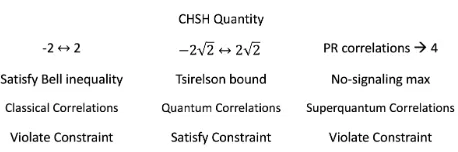
this constraint (Figure1). 82
Figure 1.Summary of the result. The “constraint” is conservation per no preferred reference frame.
Our explanation of the Tsirelson bound does not require a map from 3N-dimensional Hilbert 83
space to some ‘causal influence’ in spacetime, e.g., a dynamical interpretationa laBohmian mechanics, 84
and it does not require hidden variables, e.g., [24]. That is, the +1/–1 outcomes (dropping factors 85
of ¯h/2) for the spin singlet or ‘Mermin photon’ states [25] and the angle between Stern-Gerlach (SG) 86
magnets or polarizers are all that appear in the quantum correlations uniquely producing the Tsirelson 87
bound and they are all that is required for our constraint-based explanation. 88
Thus, we see explicitly in this result how quantum mechanics conforms statistically to a 89
conservation principle without need of a ‘causal influence’ or hidden variables acting on a trial-by-trial 90
basis to account for that conservation. There are many attempts to add such classical mechanisms, but 91
they are superfluous as far as the physics is concerned. The light postulate of special relativity is a 92
good analogy for our proposed constraint. 93
In special relativity, Alice is moving at velocityVarelative to a light source and measures the 94
speed of light from that source to bec. Bob is moving at velocityVbrelative to that same light source 95
and measures the speed of light from that source to bec. Here “reference frame” refers to the relative 96
motion of the observer and source which then defines a specific measurement of a specific quantity in 97
the context of all its alternatives. NPRF in this context thus means all measurements produce the same 98
outcomec. As a consequence of this constraint and NPRF proper (giving the relativity postulate of 99
special relativity), special relativity is a constraint-based/principle theory. 100
In quantum mechanics, Alice orients her SG magnet atarelative to a source of spin entangled 101
particles and measures +1 or –1 (h¯
2). Bob orients his SG magnet atbrelative to that same source of spin 102
entangled particles and measures +1 or –1 (¯h
2). Here “reference frame” refers to the relative orientation 103
of the SG magnets and source which then defines a specific measurement of a specific quantity in the 104
context of all its alternatives. NPRF in this context means all measurements produce the same outcome 105
+1 or –1 (¯h2). As a consequence of this constraint, we can only conserve angular momentum on average 106
between different reference frames, i.e., it cannot be conserved on a trial-by-trial basis unless the SG 107
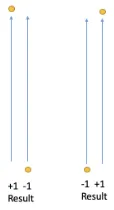
magnets or polarizers are co-aligned (Figure2). As we will show, this constraint plus NPRF proper 108
(givingP+ =P +) then produce the quantum state, i.e., probability for each possible measurement 109
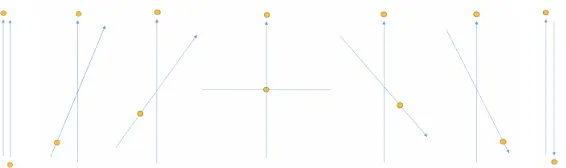
outcome. This is quite unlike classical physics (Figures3&4), in fact it is what uniquely distinguishes 110
the quantum joint distribution from its classical counterpart [26]. Thus, NPRF here leads to quantum 111
outcomes (+1/–1 only) and ‘average-only’ conservation (Figure5), a constraint-based/principle answer 112
The Tsirelson bound obtains because of conservation per no preferred reference frame. 114
Figure 2.Outcomes (yellow dots) in the same reference frame, i.e., outcomes for the same measurement (blue arrows represent SG magnet orientations), for the spin singlet state explicitly conserve angular momentum.
We do acknowledge that our explanation of the Tsirelson bound lies outside the QIT enterprise 115
devoted to explaining quantum probability theory via information-theoretic principles over all possible 116
probability structures [2,3,27]. In the parlance of metaphysics, we have not ruled out some “possible 117
world” in which superquantum correlations exist, we have only ruled them out on empirical grounds 118
for our world in accord with physics. However, the result is not without relevance for QIT. From an 119
information-theoretic perspective, what is actually being conserved in this fashion is the fundamental 120
unit of binary information, e.g., on-off(ness) or on-on(ness) or yes-no(ness), etc. 121
Figure 3. A spatiotemporal ensemble of 16 experimental trials for the spin singlet state. Angular momentum is not conserved in any given trial, because there are two different measurements being made, i.e., outcomes are in two different reference frames, but it is conserved on average for all 16 trials. It is impossible for angular momentum to be conserved explicitly in each trial since the measurement outcomes are binary (quantum) with values of +1 (up) or –1 (down)⇣¯h2⌘per no preferred reference frame. The conservation principle at work here assumes Alice and Bob’s measured values of angular momentum are not mere components of some hidden angular momentum, e.g., oppositely orientedSA
andSBso that Alice and Bob’s +1/–1 results are always components of those hiddenSAandSBwith
variable magnitudes. That is, the measured values of angular momentumarethe angular momenta contributing to this conservation principle.
This is not conservation of informationa lainformation causality, our constraint does not deal with 122
signals sent between Alice and Bob, but with the spatiotemporal correlations in their measurement 123
settings and results. Accordingly, we concur with the QIT approach to view quantum mechanics 124
in terms of spacetime constraints on par with a principle theory like special relativity (Figure5), 125
rather than dynamical laws or processes. Therefore, we feel this constraint-based explanation of 126
the Tsirelson bound does contribute to the desideratum of QIT. Again, we emphasize that this is 127
a constraint-based explanation of the Tsirelson bound per physics, so it cannot satisfy any grander 128
Figure 4. Reading from left to right, as Bob rotates his SG magnets relative to Alice’s SG magnets for her +1 outcome, the average value of his outcome varies from –1 (totally down, arrow bottom) to 0 to +1 (totally up, arrow tip). This obtains per conservation of angular momentum on average in accord with no preferred reference frame. Bob can say exactly the same about Alice’s outcomes as she rotates her SG magnets relative to his SG magnets for his +1 outcome. That is, their outcomes can only satisfy conservation of angular momentum on average, because they only measure +1/–1 ⇣
¯
h
2 ⌘
, never a fractional result. Thus, just as with the light postulate of special relativity, we see that no preferred reference frame requires quantum (+1/–1) outcomes for all measurements and that leads to a constraint-based/principle answer to Bub’s question.
2. The Tsirelson Bound from a Conservation Principle 130
We assume at this point the reader is prepared to consider a constraint-based/principleexplanation 131
[18,19] of the phenomena responsible for the Tsirelson bound. We will present the physics that is 132
germane to our argument though much of it is doubtless familiar to the reader. The deeper point is 133
to look at the physics via constraints (Figures3&4), so as to remove the mystery of entanglement 134
created by dynamical bias (Section3). While the following analysis itself does not require it, we 135
urge the reader to take seriously the possibility that quantum entanglement is explained not by some 136
dynamical/causal process in Hilbert space or spacetime, but by constraints on events in spacetimea la 137
a principle theory. 138
We start with a specific case, viz., conservation of angular momentum per NPRF, before 139
generalizing that to conservation per NPRF. More specifically, we consider the spin singlet state (total 140
anti-correlation) and the ‘Mermin state’ [25] for photons (total correlation) since they are examples 141
of two Bell basis states with obvious physical meaning. After our presentation of this transparent 142
conservation principle, we will show how it and NPRF proper give the quantum states. We can then 143
show how conservation of angular momentum per NPRF generalizes to conservation per NPRF for 144
Bell-basis-states phenomena. 145
In principle, the creation of an entangled state due to conservation of angular momentum is 146
not difficult to imagine, e.g., the dissociation of a spin-zero diatomic molecule [28] or the decay of 147
a neutral pi meson into an electron-positron pair [29]. In reality, creating a spin singlet state or the 148
Mermin photon state in a controlled experimental situation is nontrivial [30,31], i.e., the preparation 149
fragment of the circuit would contain many operations and wires, so we will suppress the preparation 150
into a spatially localized region which we will call “the source” per convention (Hardy calls this an 151
“equivalence class of preparations” [27]). The spin singlet state (total angular momentum equals zero 152
[32, p. 29-30]) isp1
2(|udi |dui)whereu/dmeans the outcome is displaced upwards/downwards 153
relative to the north-south pole alignment of the SG magnets. This state obtains due to conservation 154
of angular momentum at the source as represented by momentum exchange in the spatial plane 155
orthogonal to the source collimation (binary information is “up or down” transverse). 156
The Mermin state for photons (a Bell basis state in the triplet space with total angular momentum 157
of 1 [32, p. 29-30]) isp1
2(|VVi+|HHi)whereV(“vertical”) means the there is an outcome (photon 158
detection) behind one of the co-aligned polarizers andH(“horizontal”) means there is no outcome 159
behind one of the co-aligned polarizers. This state obtains due to conservation of angular momentum 160
Figure 5.Comparing special relativity with quantum mechanics according to no preferred reference frame. Because Alice and Bob both measure the same speed of lightcregardless of their relative motion, Alice(Bob) may claim that Bob’s(Alice’s) length and time measurements are erroneous and need to be corrected (length contraction and time dilation). Likewise, because Alice and Bob both measure the same values for angular momentum +1/–1⇣¯h
2 ⌘
regardless of their relative SG magnet orientation, Alice(Bob) may claim that Bob’s(Alice’s) individual +1/–1 values are erroneous and need to be corrected (averaged). It is possible that Alice and Bob’s outcomes are equally valid, i.e., neither need to be corrected, per no preferred reference frame. In special relativity, the apparently inconsistent results can be reconciled via relativity of simultaneity. In quantum mechanics, the apparently inconsistent results can be reconciled via ‘average-only’ conservation. It is also possible that Alice(Bob) is actually correct and Bob’s(Alice’s) outcomes need to be corrected, or that some other frame is actually preferred and both Alice and Bob need to correct their outcomes or understand them in the context of that preferred frame. In special relativity, we can do that using an empirically unverifiable ether. In quantum mechanics, we can do that using empirically unverifiable hidden variables (Figure3).
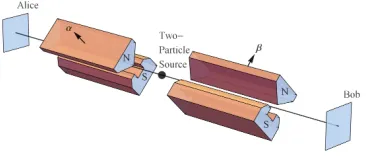
Figure 6. Alice and Bob making spin measurements with their Stern-Gerlach (SG) magnets and detectors.
is “yes or no” longitudinal). At this point we will focus the discussion on the spin singlet state for total 162
anti-correlation, since everything said of that state can be easily transferred to the Mermin photon 163
state. 164
We wire the preparation to a pair of transformations then wire those to a pair of results, i.e., we orient the emission directions of the source towards SG magnets and detectors (Figure6). The circuits of QIT represent a series of operations in space and time (Figure7) in accord with our attempt to explain the spatiotemporal ensemble of spatiotemporal experimental trials for the spin singlet and Mermin photon states (Figure3). In this way we move the discussion from time-evolved state vectors in 3N-dimensional Hilbert space to the computation of probabilities for circuits in spacetime using the Feynman path integral. We can obtain the following probability amplitudes for the various correlated outcomes of the circuits associated with our spin singlet state using the path integral method [33,34]
Aud= Adu= 1 2p2
⇣
Figure 7.“It is always possible to provide a complete foliation for a circuit” [27, p. 20]. Reproduced with permission from the author.
Auu= Add= 2p12 ⇣
eia eib⌘ (2)
whereaandbare the SG magnet orientation angles in space (Figure6). The corresponding probabilities are then
Pud=|Aud|2=|Adu|2=Pdu= 12cos2 ✓
a b 2
◆
(3)
and
Puu=|Auu|2=|Add|2=Pdd= 12sin2 ✓
a b 2
◆
(4)
Eqs. (3) & (4) constitute the “quantum state” for the spin singlet state. We will derive these from our constraint and NPRF proper below. Likewise, the probabilities for the Mermin photon state are
PVV =PHH= 12cos2(a b) (5)
and
PVH=PHV = 12sin2(a b) (6)
Eqs. (5) & (6) constitute the quantum state for the Mermin photon state. We will also derive these 165
from our constraint and NPRF proper below. Each probability for a particular circuit is spacetime in 166
that it is the probability for a source emission event with its corresponding orientations of the two SG 167
magnets (aandb) and two outcomes (uu,dd,ud, ordu), as represented by each trial in Figure3. Let us 168
investigate what Alice and Bob discover about this preparation in the various spatiotemporal classical 169
contexts of their transformations and results. 170
Alice’s detector responds up and down with equal frequency regardless of the orientationaof her 171
SG magnet, i.e., she obtains the same outcome regardless of her measurement per NPRF. Bob observes 172
the same regarding his SG magnet orientationb. Thus, the source is rotationally invariant in the spatial 173
plane orthogonal to the source collimation in this spacetime context per NPRF. When Bob and Alice 174
compare their outcomes, they find that their outcomes are perfectly anti-correlated (udandduwith 175
equal frequency) whena b=0, i.e., when making the same measurement. This is consistent with
176
conservation of angular momentum per classical mechanics between the pair of detection events (this 177
fact defines the state). The degree of that anti-correlation diminishes asa b!p
2 until it is equal to 178
the degree of correlation (uuanddd) when their SG magnets are at right angles to each other. In other 179
words, whenever the SG magnets are orthogonal to each other anti-correlated and correlated outcomes 180
occur with equal frequency, i.e., conservation of angular momentum in one direction is independent 181
of the angular momentum changes in any orthogonal direction. Thus, we would not expect to see 182
more correlation or more anti-correlation based on conservation of angular momentum for transverse 183
results in the spatial plane orthogonal to the source collimation when the SG magnets are orthogonal 184
obtains in a purely statistical sense, since we can no longer have explicit cancellation of Alice and Bob’s 186
measured values (Figure4). 187
As we continue to increase the anglea bbeyondp2 the anti-correlations continue to diminish 188
until we have totally correlated outcomes when the SG magnets are anti-aligned. This is also consistent 189
with conservation of angular momentum, since the totally correlated results when the SG magnets are 190
anti-aligned represent momentum exchanges in opposite directions in the spatial plane orthogonal to 191
the source collimation just as when the SG magnets are aligned, it is now simply the case that what 192
Alice calls up, Bob calls down and vice-versa. 193
The counterpart for the Mermin photon state is simply that angular momentum conservation 194
is evidenced byVVorHHoutcomes for co-aligned polarizers (again, this fact defines the state), i.e., 195
when making the same measurement. When the polarizers are at right angles you have only VH 196
and HV outcomes, which is still totally consistent with conservation of angular momentum as ‘notH’ 197
impliesVand vice-versa [31]. In other words, a polarizer does not have a ‘north-south’ distinction 198
(longitudinal rather than transverse momentum exchange). In particular, having rotated either or both 199
polarizers bypone should obtain preciselyVVorHHoutcomes again. 200
One might then ask (rhetorically for this audience) whether or not it is possible to explain the conservation of angular momentum per NPRF for this spin singlet circuit using classical probability theory. Of course, that would be a hidden variable theory amenable to counterfactual definiteness (Mermin’s “instruction sets” [25,35]) on a trial-by-trial basis. This possibility is explored using correlations where the probability of outcomesiand jfor settingsaand bis writtenp(i,j | a,b)
[16]. We start with the fact that Alice’s outcomes are not influenced by Bob’s settings and vice-versa
p(A|a,b) =p(A|a,b0) p(A|a0,b) =p(A|a0,b0) p(B|a,b) =p(B|a0,b) p(B|a,b0) =p(B|a0,b0)
(7)
This is the no-signaling condition alluded to earlier. Next, we write the average of outcomesi·jfor settingsaandbas
ha,bi=
Â
(i·j)·p(i,j|a,b) (8) and construct the Clauser-Horne-Shimony-Holt (CHSH) quantityha,bi+ha,b0i+ha0,bi ha0,b0i (9) If one attempted to instantiate the momentum exchanges of the spin singlet circuit using instruction sets/counterfactual definiteness/hidden variables per classical probability theory in accord with no-signaling, Eq. (9) would give a value between 2 and –2 (CHSH version of Bell’s inequality [11]). However, Eqs. (3) and (4) per quantum mechanics put into Eqs. (8) and (9) give
cos(a b) cos(a b0) cos(a0 b) +cos(a0 b0) (10)
Choosinga = p/4, a0 = p/4,b = 0, andb0 = p/2 minimizes Eq. (10) at 2p2 (the Tsirelson
201
bound). 202
Everything said here concerning angular momentum conservation per anti-correlated outcomes of the spin singlet state applies for angular momentum conservation per correlated outcomes of the Mermin photon state, which gives
for Eq. (9). Usinga=p/8,a0= p/8,b=0, andb0=p/4 maximizes Eq. (11) at 2p2 (the Tsirelson 203
bound). Experiments show that the quantum results can be achieved (violating the Bell inequality), 204
ruling out an explanation of these correlated momentum exchanges via classical probability theory. We 205
now derive these quantum correlations using the conservation of angular momentum [20] per NPRF. 206
Using that result and NPRF proper, we will then be able to derive the quantum states and generalize 207
the constraint to conservation per NPRF. 208
It is easy to see how this follows by starting with total angular momentum of zero for binary 209
(quantum) outcomes2+1 and –1. Alice and Bob both measure +1 and –1 results with equal frequency 210
for any SG magnet angle (NPRF) and when their angles are equal they obtain totally anti-correlated 211
outcomes giving total angular momentum of zero (this is a defining factor). Now divide Alice’s results 212
into two subsets of +1 and –1, each occurringN/2 times when the total number of measurements 213
isN(the argument is symmetric with respect to Bob, obviously). Contrary to classical mechanics, 214
conservation of angular momentum per NPRF does not allow us to make a definitive prediction about 215
a particular outcome at Bob’s location based on a particular corresponding outcome at Alice’s location 216
when Bob’s SG magnet is rotated byqrelative to Alice’s, because Bob only ever measures +1 or –1 per 217
NPRF, i.e., no fractions3(Figure3). 218
By definition, the correlation function for theseNpairs of results is 219
ha,bi= (+1)A( 1)B+ (+1)A(+1)B+ ( 1)A( 1)B+...
N (12)
Now organize the numerator into two equal subsets, the first is that of all Alice’s +1 results(+1)Aand 220
the second is that of all Alice’s –1 results( 1)A 221
ha,bi= (+1)A(ÂBA+) + ( 1)A(ÂBA-)
N (13)
whereÂBA+ is the sum of all of Bob’s results corresponding to Alice’s result(+1)AandÂBA- is 222
the sum of all of Bob’s results corresponding to Alice’s result( 1)A. Again, we could just as well 223
have used Bob’s results(+1)Band( 1)Band obtained averages over Alice’s results instead, since the 224
situation is symmetric (NPRF). Now, rewrite Eq. (13) as 225
ha,bi= 12(+1)ABA+ +12( 1)ABA (14) with the overline denoting average. In order to obtain the quantum correlation function we need some 226
principle that specifiesBA+andBA and we are proposing that principle is our particular form of 227
conservation. Here is how one might argue for the principle using classical reasoning applied to the 228
quantum exchange of momentum. 229
The projection of the angular momentum vector of Alice’s particle~SA= +1ˆaalong ˆbis~SA·bˆ=
+cosqwhere againqis the angle between the unit vectors ˆaand ˆb. From Alice’s perspective, when Bob makes the same measurement, i.e.,b=a, he finds the angular momentum vector of his particle
is~SB = 1ˆa, so that~SA+~SB = ~STotal = 0. When he does not make the same measurement, he should obtain a fraction of the length of~SB, i.e.,~SB·bˆ = 1ˆa·bˆ = cosq(this also follows from counterfactual spin measurements on the single-particle state [36]). Of course per NPRF, Bob only ever obtains +1 or –1, so we posit that Bob willaveragethe required cosq(Figures3&4), which means
BA+ = cosq (15)
2 This argument is for the spin singlet state and, again, we are suppressing the factor of ¯h/2. “Binary” entails “quantum” so we will stop qualifying it as such.
Likewise, for Alice’s( 1)Aresults we have
BA =cosq (16)
Putting these into Eq. (14) we obtain
ha,bi= 12(+1)A( cosq) +12( 1)A(cosq) = cosq (17)
which is precisely the correlation function given by quantum mechanics. This derivation of the 230
quantum correlation function is independent of the formalism of quantum mechanics, instead it 231
follows from a compelling and simple physical principle, the conservation of angular momentum per 232
NPRF. Now let us use this result and derive the corresponding quantum state, i.e., Eqs. (3) & (4). 233
We need to findPuu,Pdd,Pud, andPduso we need four independent conditions. Normalization gives
Puu+Pud+Pdu+Pdd=1 (18)
and our correlation function
ha,bi= (+1)A(+1)BPuu+ (+1)A( 1)BPud+ ( 1)A(+1)BPdu+ ( 1)A( 1)BPdd (19) along with our constraint represented by Eqs. (14–16) give
Puu Pud= 12cosq (20)
and
Pdu Pdd= 12cosq (21)
Finally, NPRF givesPud=Pdu, sincePudis Alice’s up results paired with Bob’s down results andPduis 234
Bob’s up results paired with Alice’s down results. Solving these four equations forPuu,Pdd,Pud, and 235
Pdugives precisely Eqs. (3) & (4). 236
Notice that since the angle between SG magnets a b is twice the angle between Hilbert 237
space measurement bases, this result easily generalizes to conservation per NPRF of whatever the 238
measurement outcomes represent when unlike outcomes entail conservation. All one need do is 239
letq ! 2qin the above analysis, understanding thatq now represents the angle between Hilbert 240
space measurement bases. The origin of the more general conservation principle is transparent in 241
the next example where the angle between polarizersa bequals the angle between Hilbert space 242
measurement bases. 243
For the Mermin photon state, conservation of angular momentum is established by pass (designated by +1) and no pass (designated by –1) results through a polarizer. When the polarizers are co-aligned Alice and Bob get the same results, half pass and half no pass. Thus, conservation of angular momentum is established by the intensity of the electromagnetic radiation applied to binary outcomes for various polarizer orientations. Again, grouping Alice’s results into +1 and –1 outcomes we see that she would expect[cos2q sin2q]atqfor her +1 results and[sin2q cos2q]for her –1 results. Since Bob measures the same thing as Alice for conservation of angular momentum, we posit that those are Bob’s averages when his polarizer deviates from Alice’s byq. Therefore, the correlationha,bi of results for conservation of angular momentum per Eq. (14) is
1
2(+1)A(cos2q sin2q) + 1
2( 1)A(sin2q cos2q) =cos 2q (22) which is precisely the correlation function given by quantum mechanics. Now let us use this result 244
As before, we need to findPVV,PHH,PVH, andPHV so we need four independent conditions. Normalization andPVH=PHVare the same as for the spin singlet case. The correlation function
ha,bi= (+1)A(+1)BPVV+ (+1)A( 1)BPVH+ ( 1)A(+1)BPHV+ ( 1)A( 1)BPHH (23) along with our constraint represented by Eq. (22) give
PVV PVH = 12(sin2q cos2q) (24)
and
PHV PHH= 12(sin2q cos2q) (25)
Solving these four equations forPVV,PHH,PVH, andPHVgives precisely Eqs. (5) & (6). 246
Notice that since the angle between polarizersa bequals the angle between Hilbert space 247
measurement bases, this result immediately generalizes to conservation per NPRF of whatever 248
the outcomes represent when like outcomes entail conservation. [We will expand on the general 249
conservation principle below.] Consequently, the CHSH quantity that obtains using correlations 250
derived by demanding strict (each measurement pair) conservation for like settings (same reference 251
frame, defining the entangled state) and average conservation for unlike settings (different reference 252
frames) is exactly that of quantum mechanics. That explains the Tsirelson bound per conservation 253
of binary information over a spatiotemporal ensemble, i.e., conservation per NPRF. Accordingly, 254
expecting the Bell inequality to be satisfied per classical probability theory means selectively 255
abandoning the conservation principle proposed here. 256
We can now show how superquantum correlations in accord with the no-signaling condition that can exceed the Tsirelson bound, violate our spacetime symmetry group constraint. We already know that superquantum correlations must violate this constraint, since the constraint yields quantum correlations and superquantum correlations exceed quantum correlations. This merely serves as an example for clarity. The Popescu-Rohrlich (PR) correlations [13]
p(1, 1|a,b) =p( 1, 1|a,b) = 1
2 p(1, 1|a,b0) =p( 1, 1|a,b0) = 1
2 p(1, 1|a0,b) =p( 1, 1|a0,b) = 1 2 p(1, 1|a0,b0) = p( 1, 1|a0,b0) = 1
2
(26)
produce a value of 4 for Eq. (9), the largest of any no-signaling possibilities. In order to explicitly relate 257
quantum and superquantum correlations, we bring Eq. (26) to bear on our spin singlet and Mermin 258
photon states. Again, we will focus the discussion on the spin singlet state and allude to the obvious 259
manner by which the analysis carries over to the Mermin photon state. 260
The last PR correlation certainly makes sense ifa0=b0, i.e., the total anti-correlation implying 261
conservation of angular momentum, so let us start there. The third PR correlation makes sense for 262
b=p+b0, where we have conservation of angular momentum with Bob having flipped his coordinate 263
directions. Likewise, then, the second PR correlation makes sense fora = p+a0, where we have 264
conservation of angular momentum with Alice having flipped her coordinate directions. All of this 265
is perfectly self-consistent with our constraint, sincea0andb0are arbitrary per rotational invariance 266
in the spatial plane orthogonal to the source collimation. But now, the first PR correlation is totally 267
at odds with conservation of angular momentum. Both Alice and Bob simply flip their coordinate 268
directions, so we should be right back to the fourth PR correlation witha0 !aandb0!b. Instead, 269
momentum) rather than total anti-correlation per conservation of angular momentum, which violates 271
every other observation. In other words, the set of PR observations violates conservation of angular 272
momentum in a maximal sense. To obtain the corresponding argument for angular momentum 273
conservation per the correlated outcomes of the Mermin photon state, simply start with the first PR 274
correlation and show the last PR correlation maximally violates angular momentum conservation. 275
To show the spectrum on which superquantum correlations violate our constraint in this context, replace the first PR correlation with
p(1, 1|a,b) =C p( 1, 1|a,b) =D p(1, 1|a,b) =E
p( 1, 1|a,b) =F
(27)
The no-signaling condition Eq. (7) in conjunction with the second and third PR correlations gives 276
C=DandE=F. That in conjunction with normalizationC+D+E+F=1 and p(anti-correlation) 277
+ p(correlation) = 1 means total anti-correlation is the conservation of angular momentum per the 278
quantum case while total correlation is the max violation of conservation of angular momentum per 279
the PR case. Thus, we have a spectrum of superquantum correlations all violating conservation of 280
angular momentum. The take-home message is that if the correlation is stronger than that of quantum 281
mechanics, it violates conservation of angular momentum per NPRF. 282
Using Eq. (27) with the second, third, and fourth PR correlations we obtain a CHSH quantity of
3+C+D E F (28)
As we pointed out above, the PR correlations Eq. (26) haveC =D =1/2 andE=F =0 giving a
283
CHSH quantity of 4. And, the angular-momentum-conserving quantum correlations areC=D=0 284
andE= F = 1/2 giving a CHSH quantity of 2. Thus in this case, the superquantum correlations 285
violate conservation of angular momentum when the quantum correlation is below the Tsirelson 286
bound. 287
This conclusion also follows from the Mermin photon state by replacing the last PR correlation in analogous fashion, again withq=p. We leta!a0andb!b0in Eq. (27) to replace the fourth PR correlation and the CHSH quantity becomes
3 C D+E+F (29)
Now the max violation of conservation of angular momentum occurs forE = F = 1/2 (PR case) 288
and total conservation of angular momentum occurs forC= D=1/2 (quantum case). Again, the 289
quantum correlation gives a CHSH quantity of 2 for this case, satisfying the Bell inequality. Thus, 290
again, the superquantum correlations violate conservation of angular momentum when the quantum 291
correlation is below the Tsirelson bound. What is important to see is that correlations stronger than 292
those of quantum mechanics violate conservation of angular momentum. Since we have not observed 293
such violations of conservation of angular momentum (CHSH quantity in excess of the the quantum 294
This spin singlet and Mermin photon state analysis generalizes to any measurement associated with any of the four Bell basis states
1 p
2(|+1 1i | 1+1i) 1
p
2(|+1 1i+| 1+1i) 1
p
2(|+1+1i+| 1 1i) 1
p
2(|+1+1i | 1 1i)
(30)
The eigenvalues for any 2⇥2 Hermitian matrix can be written +1 and –1, so whatever Alice and 296
Bob are measuring it gives outcomes of +1 or –1 (NPRF). All the states are rotationally invariant in 297
Hilbert space, so whatever the various measurement settings represent, Bob and Alice always measure 298
unlike results in like settings for the first two states (“unlike states”) and like results for like settings 299
for the last two states (“like states”) as required for explicit conservation of binary information, e.g., 300
on-on(ness) or on-off(ness) or yes-no(ness), when Alice and Bob make the same measurement (general 301
form of our defining factor). Further, Bob and Alice measure +1 and –1 with equal frequency regardless 302
of their settings (NPRF), so Alice’s results can be split into two equal sets of +1 and –1 outcomes. For 303
her +1 results, conservation dictates Bob’s outcomes will average[cos2q sin2q]for the two like states 304
and[sin2q cos2q]for the two unlike states whereqis now the angle between eigenbases in Hilbert 305
space representing whatever the relative difference in settings means in spacetime. For Alice’s –1 306
results, the two equations are flipped, so we have correlations of±cos 2qfor like and unlike states, 307
respectively, which give the Tsirelson bound. Of course, Bob can make the same claim about Alice’s 308
outcomes satisfying conservation on average with his +1 and –1 outcomes. 309
For the spin singlet case,qbetween bases in Hilbert space is half the anglea bbetween the SG 310
magnets while the angle between the polarizersa bin the Mermin photon case is equal to the angleq 311
between bases in Hilbert space. Thus, the derivations of the quantum correlations and quantum states 312
using our constraint and NPRF proper for the spin singlet and Mermin photon cases immediately 313
generalize to any Bell basis state analysis in Hilbert space. Consequently, our constraint in a very 314
general sense is conservation per NPRF. 315
Classical correlations violate the constraint by not reaching the upper limit of the quantum 316
correlations (Tsirelson bound) as usual, and superquantum correlations violate the constraint by 317
exceeding the quantum correlations. Specifically, the probability of measuring unlike results for the 318
unlike states is cos2qand the probability of measuring like results is sin2q(generalized spin singlet 319
case). Similarly, the probability of measuring like results for the like states is cos2qand the probability 320
of measuring unlike results is sin2q(generalized Mermin photon case). 321
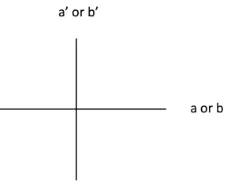
Start with the unlike states. The last PR correlation says thata0andb0must be parallel (cos2q=1, 322
Figure8). The third PR correlation saysa0andbmust be perpendicular (sin2q=1, Figure8). And, the 323
second PR correlation saysaandb0must be perpendicular (sin2q=1, Figure8). Thus, these three PR 324
correlations in total saya0/b0is perpendicular toa/b(Figure8). So, we need the first PR correlation 325
to sayaandbare parallel, but of course it says thataandbmust also be perpendicular (sin2q=1). 326
Therefore, the PR correlations violate our constraint in a maximal fashion for the unlike states. 327
Now for the like states. The last PR correlation says thata0andb0must be perpendicular (sin2q=1, 328
Figure9). The third PR correlation saysa0andbmust be parallel (cos2q=1, Figure9). And, the second 329
PR correlation saysaandb0must be parallel (cos2q=1, Figure9). Thus, these three PR correlations in 330
total saya0/bis perpendicular toa/b0(Figure9). So, we need the first PR correlation to sayaandb 331
are perpendicular, but of course it saysaandbmust also be parallel (cos2q =1). Therefore, the PR 332
Figure 8.Relative eigenbases configuration for the unlike states of Eq. (30) satisfying the last three PR correlations.
Figure 9.Relative eigenbases configuration for the like states of Eq. (30) satisfying the last three PR correlations.
Again, replacing the first PR correlation with Eq. (27) and using the no-signaling condition Eq. (7) 334
in conjunction with the second and third PR correlations givesC=DandE=F. The CHSH quantity 335
is 3+C+D E Ffor both the unlike and like states. We just showed that for both like and unlike 336
states we needC=D=0 andE=F=1/2 to satisfy conservation per NPRF, but the PR correlations 337
are just the opposite,C=D=1/2 andE=F=0. This shows how superquantum correlations violate 338
our constraint in a very general sense. 339
3. Discussion 340
Given the widely recognized fundamental importance of conservation principles following from 341
the spacetime symmetry group, this spin singlet state and Mermin photon state analysis suggests 342
that our constraint-based approach provides a “motivated principle” requested by Cuffaro [16]. And, 343
just as the light postulate of special relativity is in accord with NPRF, the Bell basis states producing 344
the Tsirelson bound are also in accord with NPRF. Alice and Bob each measure +1 and –1 with equal 345
frequency for all measurement settings, they confirm conservation in all trials where their measurement 346
settings (reference frames) are the same, and Alice(Bob) can argue that Bob(Alice) averages less than 1 347
to satisfy conservation in her(his) choice of measurement setting when the settings (reference frames) 348
are not the same (Figures3&4). 349
Thus, our constraint-based/principle answer to Bub’s question, “Why the Tsirelson bound?” [7–9], 350
the QIT counterpart to Wheeler’s “Really Big Question”, “Why the quantum?”, can be summed up in 351
“one clear, simple sentence” 352
The Tsirelson bound obtains because of conservation per NPRF. 353
in accord with Fuchs’ desideratum (Figure5). 354
The bottom line is that a compelling constraint (who would argue with conservation per NPRF?) 355
answers “Why the Tsirelson bound?” without a corresponding ‘dynamical/causal influence’ or 356
explanation as fundamental, the lack of a compelling, consensus dynamical interpretation is not a 358
problem. This is just one of many mysteries in physics created by dynamical thinking and resolved by 359
constraint-based thinking [19]. 360
Since the Tsirelson bound follows more generally from the mathematical form of any Bell basis 361
state, regardless of what that state represents physically, one could argue that the Tsirelson bound 362
results more generally or more fundamentally from a conservation of binary information. That is, 363
from an information-theoretic perspective, the Tsirelson bound results from a frame independent 364
conservation of on-on(ness) or on-off(ness) or yes-no(ness), etc. However, this conservation of binary 365
information is not information exchanged from Alice(Bob) to Bob(Alice) as in information causality, 366
but information distributed among both Alice and Bob via a spatiotemporal ensemble. Nonetheless, 367
the constraint-based approach certainly negates the need for dynamical interpretation, which is a QIT 368
desideratum. 369
One of the many motivations for the QIT approach is the suspicion that realism about the 370
formal machinery of ordinary textbook quantum mechanics is not warranted. For example, the 371
measurement problem is driven by taking seriously the unitary evolution of quantum states in Hilbert 372
space. Likewise quantum entanglement is thought to require nonlocal causal influences, inexplicable 373
non-separability/wholism, backwards causation, etc., precisely because it is assumed there must be 374
some dynamical or causal explanation of some sort. However, as we have shown herein, without 375
invoking mere instrumentalism or deflationary tactics, one can explain quantum entanglement and 376
the Tsirelson bound without any of that dynamical baggage and without realism about Hilbert space. 377
And just as the QIT community hypothesized, the explanation is a constraint-based/principle one. 378
Therefore, we believe our constraint-based answer to “Why the Tsirelson bound?” not only 379
justifies the spirit of the QIT constraint-based approach, but provides a physical model of the quantum 380
in spacetime per the interpretation-project (Figures2,3, &4), albeit not a dynamical model. As things 381
stand now, there is no obvious connection between the interpretation-project and the QIT-project 382
[38]. In this regard, keep in mind that the postulates of special relativity are about the physical world 383
in spacetime, so in keeping with this analogy, QIT must eventually make such correspondence to 384
reach their lofty goals and escape the clever, but inherent instrumentalism of ordinary quantum. Our 385
explanation of the Tsirelson bound precisely addresses the need for QIT to make correspondence with 386
phenomena in spacetime. 387
The resistance to Einstein’s light postulate was immense because he posited something as 388
axiomatic that most people wanted to have explained. We understand the resistance to our constraint, 389
conservation per NPRF, will be at least as fierce even though it satisfies QIT’s stated desideratum, 390
i.e., they wanted to answer “Why the Tsireslon bound?” per postulates like those of special relativity. 391
So ironically, some in QIT may not be satisfied with our constraint-based/principle explanation of 392
the Tsirelson bound precisely because it posits conservation per NPRF without further explanation; 393
they desire some ‘extra-physical’ explanation for this constraint, e.g., information causality. In the 394
parlance of metaphysics, the complaint is that we have not ruled out some “possible world” in which 395
superquantum correlations exist, we have only ruled them out on empirical grounds for our world. 396
On this way of thinking, superquantum correlations can only be ruled out via mathematical or logical 397
necessity from some extra-physics basis. 398
Herein, we have answered Bub’s question within the purview of physics in precise analogy with 399
the light postulate of special relativity in accord with Fuchs’ desideratum, i.e., the Tsirelson bound 400
ultimately obtains because of conservation in accord with no preferred reference frame. Accordingly, 401
there is nothing mysterious about the physics we have discovered so far, it points unambiguously to 402
a physical reality governed fundamentally by constraints. Just as the QIT community suspected, 403
mysteries in quantum mechanics arise solely from the misplaced dynamical expectations of its 404
practitioners. Once we recognize the power of constraints to dispel the mysteries of physics, “we will 405
all say to each other, how could it have been otherwise? How could we have been so stupid for so 406
Author Contributions: conceptualization, W.S. and M.S.; software, T.M.; formal analysis, all authors; 408
writing–original draft preparation, W.S.; writing–review and editing, all authors; visualization, T.M.; supervision, 409
W.S. and M.S. 410
Funding:This research received no external funding. 411
Conflicts of Interest:The authors declare no conflict of interest. 412
References 413
1. Wheeler, J. How Come the Quantum? New Techniques and Ideas in Quantum Measurement Theory1986, 414
480, 304–316.https://nyaspubs.onlinelibrary.wiley.com/doi/abs/10.1111/j.1749-6632.1986.tb12434.x. 415
2. Hardy, L. Reconstructing Quantum Theory. InQuantum Theory: Informational Foundations and Foils; 416
Chiribella, G.; Spekkens, R., Eds.; Springer: Dordrecht, 2016; pp. 223–248.https://arxiv.org/abs/1303. 417
1538. 418
3. Fuchs, C.; Stacey, B. Some Negative Remarks on Operational Approaches to Quantum Theory. InQuantum 419
Theory: Informational Foundations and Foils; Chiribella, G.; Spekkens, R., Eds.; Springer: Dordrecht, 2016; pp. 420
283–305. 421
4. Chiribella, G.; Spekkens, R. Introduction. InQuantum Theory: Informational Foundations and Foils; Chiribella, 422
G.; Spekkens, R., Eds.; Springer: Dordrecht, 2016; pp. 1–18. 423
5. Wheeler, J.A. Information, Physics, Quantum: The Search for Links. InProceedings III International 424
Symposium on Foundations of Quantum Mechanics; et al., S.i.K., Ed.; 1989; pp. 354–358. 425
6. Barrow, J.D.; Davies, P.C.W.; Charles L. Harper, J., Eds. Science and Ultimate Reality: Quantum Theory, 426
Cosmology, and Complexity; Cambridge university Press: New York, 2004. 427
7. Bub, J. Why the Quantum? Studies in History and Philosophy of Modern Physics2004, 35B, 241–266. 428
https://arxiv.org/abs/quant-ph/0402149. 429
8. Bub, J. Why the Tsirelson bound? InThe Probable and the Improbable: The Meaning and Role of Probability in 430
Physics; Hemmo, M.; Ben-Menahem, Y., Eds.; Springer: Dordrecht, 2012; pp. 167–185.https://arxiv.org/ 431
abs/1208.3744. 432
9. Bub, J.Bananaworld: Quantum Mechanics for Primates; Oxford University Press: Oxford, UK, 2016. 433
10. Clauser, J.F.; Horne, M.A.; Shimony, A.; Holt, R.A. Proposed Experiment to Test Local Hidden-Variable 434
Theories. Phys. Rev. Lett. 1969,23, 880–884. https://link.aps.org/doi/10.1103/PhysRevLett.23.880, 435
doi:10.1103/PhysRevLett.23.880. 436
11. Bell, J. On the Einstein-Podolsky-Rosen paradox.Physics1964,1, 195–200. 437
12. Cirel’son, B. Quantum Generalizations of Bell’s Inequality.Letters in Mathematical Physics1980,4, 93–100. 438
https://www.tau.ac.il/~tsirel/download/qbell80.pdf. 439
13. Popescu, S.; Rohrlich, D. Quantum nonlocality as an axiom. Foundations of Physics1994,24, 379–385. 440
https://arxiv.org/abs/quant-ph/9508009v1. 441
14. Buhrman, H.; Massar, S. Causality and Tsirelson’s bounds. Phys. Rev. A2005,72, 052103. https: 442
//link.aps.org/doi/10.1103/PhysRevA.72.052103, doi:10.1103/PhysRevA.72.052103. 443
15. Pawlowski, M.; Paterek, T.; Kaszlikowski, D.; Scarani, V.; Winter, A.; Zukowski, M. Information Causality 444
as a Physical Principle.Nature2009,461, 1101–1104. https://arxiv.org/abs/0905.2292. 445
16. Cuffaro, M.E. Information Causality, the Tsirelson Bound, and the ‘Being-Thus’ of Things. http://philsci-446
archive.pitt.edu/14027/1/tbound.pdf. 447
17. Ball, P. Physicists want to rebuild quantum theory from scratch.Wired2017. https://www.wired.com/ 448
story/physicists-want-to-rebuild-quantum-theory-from-scratch/amp. 449
18. Silberstein, M.; Stuckey, W. Quantum Mechanics and the Consistency of Conscious Experience, 2019. 450
https://arxiv.org/abs/1901.10825. 451
19. Silberstein, M.; Stuckey, W.; McDevitt, T.Beyond the Dynamical Universe: Unifying Block Universe Physics and 452
Time as Experienced; Oxford University Press: Oxford, UK, 2018. 453
20. Unnikrishnan, C.S. Correlation functions, Bell’s inequalities and the fundamental conservation laws. 454
Europhysics Letters2005,69, 489–495. 455
21. Cabello, A. Violating Bell’s inequality beyond Cirel’son’s bound.Physical Review Letters2002,88, 060403. 456
https://arxiv.org/abs/quant-ph/0108084. 457
23. Khalfin, L.A.; Tsirelson, B.S. Quantum/Classical Correspondence in the Light of Bell’s Inequalities. 459
Foundations of Physics1992,22, 879–948.https://www.tau.ac.il/~tsirel/download/quantcl.ps. 460
24. Ghirardi, G.; Romano, R. Arbitrary violation of the Tsirelson bound. Phys. Rev. A2012,86, 022116. 461
https://link.aps.org/doi/10.1103/PhysRevA.86.022116, doi:10.1103/PhysRevA.86.022116. 462
25. Mermin, N. Quantum mysteries refined.American Journal of Physics1994,62, 880–887. 463
26. Garg, A.; Mermin, N. Bell Inequalities with a Range of Violation that Does Not Diminish as the Spin 464
Becomes Arbitrarily Large.Phys. Rev. Lett.1982,49, 901–904. 465
27. Hardy, L. Reformulating and Reconstructing Quantum Theory, 2011.https://arxiv.org/abs/1104.2066. 466
28. Bohm, D.Quantum Theory; Prentice-Hall: New Jersey, USA, 1952. 467
29. La Rosa, A. Introduction to Quantum Mechanics, Lecture 12, Quantum Entanglement.https://www.pdx. 468
edu/nanogroup/sites/www.pdx.edu.nanogroup/files/QUANTUMENTANGLEMENT_18.pdf. 469
30. Hensen, B. Experimental loophole-free violation of a Bell inequality using entangled electron spins 470
separated by 1.3 km, 2015.https://arxiv.org/pdf/1508.05949.pdf. 471
31. Dehlinger, D.; Mitchell, M. Entangled photons, nonlocality, and Bell inequalities in the undergraduate 472
laboratory.American Journal of Physics2002,70, 903–910. 473
32. Renes, J. Quantum Information Theory, 2015. http://edu.itp.phys.ethz.ch/hs15/QIT/renes_lecture_ 474
notes14.pdf. 475
33. Sinha, S.; Sorkin, R. A Sum-over-histories Account of an EPR(B) Experiment.Foundations of Physics Letters 476
1991,4, 303–335. 477
34. Wharton, K.; Miller, D.; Price, H. Action duality: a constructive principle for quantum foundations. 478
Symmetry2011,3, 524–540. 479
35. Mermin, N. Bringing home the atomic world: Quantum mysteries for anybody.American Journal of Physics 480
1981,49, 940–943. 481
36. Boughn, S. Making Sense of Bell’s Theorem and Quantum Nonlocality, 2017.https://arxiv.org/abs/1703. 482
11003. 483
37. Poh, H.S.; Joshi, S.K.; Cerè, A.; Cabello, A.; Kurtsiefer, C. Approaching Tsirelson’s Bound in a Photon Pair 484
Experiment.Phys. Rev. Lett.2015,115, 180408.https://link.aps.org/doi/10.1103/PhysRevLett.115.180408, 485
doi:10.1103/PhysRevLett.115.180408. 486
38. Timpson, C.G.Quantum Information Theory & the Foundations of Quantum Mechanics; Oxford University 487