Thienchai Ngamthipwatthana, M.D.*, Yanisa Kiattisirichai, M.Sc.*, Tikumporn Hosiri, M.D.*, Vichai Manussirivithaya, M.D.**
*Department of Psychiatry, Faculty of Medicine Siriraj Hospital, Mahidol University, Bangkok 10700, **Somdech Phra Pinklao Hospital, Naval Medical Department, Bangkok 10600, Thailand.
The Effect of Group Cognitive Behavioral Play
Therapy Program on Self-Control among Late
Childhood in Foster Care
Correspondence to: Tikumporn Hosiri E-mail: [email protected]
Received 30 May 2018 Revised 25 October 2018 Accepted 1 November 2018 doi:10.14456/smj.2018.82
ABSTRACT
Objective: To develop and evaluate the effectiveness of group cognitive behavioral play therapy program on
self-control in foster care for late childhood.
Methods: The program was developed by researchers and validated by 3 experts, and consisted of one individual
session and 14 group sessions. Twelve boys with age 8-10 years at Mahamek Home for Boys attended the 40-50 minutes group session twice a week for 7 consecutive weeks. The effectiveness of the program was evaluated pre and post- intervention by using Self-Control Skill in 5 Situational Test and externalizing domains in Thai Youth Checklist (TYC). Descriptive statistics, Wilcoxon Signed Ranks Test, and qualitative analysis were used in data analysis.
Results: The participants were 12 boys with age 8-10 years at Mahamek Home for Boys. They were studying primary education
in public school and were fostered because of poverty, abandonment, and abuse. Comparison of changes between pre and post-intervention scores revealed increment in mean score of Self-Control Skill in 5 Situational Tests with p-value at 0.267, related to decrement in mean score of overall externalizing behavior problems in TYC with p-value at 0.086. Examined score in sub-domains of TYC found statistical decrease in aggression with p-value at 0.028 (p. <.05) as well as decrease in delinquency and impulsivity with p-value at 0.257 and 0.146, but found slightly increased immaturity domain with p-value at 0.892.
Conclusion: The program was effective in reducing aggressive behavior and had a tendency to improve self-control
skill among 8-10 years old children in a foster care. However, the effectiveness of the program in long-term needs to be further investigated.
Keywords: Self-control; group cognitive behavioral play therapy; late-childhood; foster child (Siriraj Med J 2018;70:
507-513)
INTRODUCTION
Self-control is an ability to regulate emotions, thought and able to inhibit inappropriate behavior with any situation. It relates with academic achievement, social skill and can predict future success. The one with less self-control skill will be easily distracted, impulsive, unable to wait and have difficulty to deal with frustration. This leads to poor academic performance and social problems
such as violence, delinquency or drugs addiction in adolescent.1,2
Self-control is cumulative behavior which can be promoted by learning process. The first place to learn is family. Children learn to regulate and manage emotion from parents by observing parent’s behavior, imitating and maintaining it from reinforcement.3,4 Prior studies
family tends to lack self-control skill and has tendencies to become delinquent child.3 According to Piaget, who
mentioned that development of self-control behavior should be developed by their own experience? The more behavior feedback he gets, the more chance he has learned. Besides cumulative behavior, self-control involves with cognitive development. They must be able to understand the consequence of action and outcome and be able to remember what behavior leads to reward or punishment and make decision by their own experiences.
Cognitive behavior play therapy or CBPT was developed by Knell in 1998. She applied play technique with cognitive behavior therapy by using toys and play as a medium to child’s thought and reflect child’s behavior. In this technique, a child learns the connection of emotions, thought and behavior, by applying learn CBT techniques such as labelling feelings, coping skill via play. Learning through play is fun, understandable and concrete. Moreover, playing with others is an opportunity for a child to learn about the consequence of his own action from other members’ response or from a therapist who provides feedbacks and modelling. After a child receives direct or indirect feedbacks which are not matched with his prior belief, he tends to re-evaluate his action and alter behavior to be more appropriate.6-8 However, conventional leaning
in primary school age children may have limitation due to cognitive development level
All the mentioned above points that if children who are at risk for externalizing behavior problems, have a chance to learn new appropriate behavior through CBPT their self-control skill may be improved. However most of prior interventions were conducted in normal population. We still need to explore the appropriateness of using this type of intervention in the specific populations, which have many different characteristics like severity and complexity of mental health problems.9 Therefore, the
objective of this study was to develop and evaluate the effectiveness of group cognitive behavior play therapy program with expectation of increment in self-control skill and decrement in externalizing behavior problems among foster children.
MATERIALS AND METHODS
This study was designed as quasi-experimental research, one group pre-test-post-test design for evaluating the effectiveness of the program on self-control among late childhood in foster care. This study was conducted with the approval of the Siriraj Institutional Review Board (SIRB), Faculty of Medicine Siriraj Hospital, Mahidol University (Si 606/2017) with the following procedure.
Participant
Participants in this study were 12 boys with age from 8-10 years old at Mahamek Home for boys. This number was according to Marvin E. Shaw (1971) who explained that a group should have at least 10 members but not exceed 13 people, for thorough participation in the activity.10 Mahamek Home for boys is a foster home
for 6-18 years old boys with poverty, abandonment, or abuse. This home provide shelter, food, basic education in public school, medical care, and recreation activities. Thus, it is suitable to examine the effectiveness of the psychological intervention program.
Inclusion criteria
1. Age from 8-10 years old through studying period 2. Had higher score in externalizing domain of Thai Youth Checklist than the population in Mahamek Home for Boys’ average score
3. Was not currently receiving other intervention. 4. Willing to join the study.
Exclusion criteria
1. Subject has intellectual disability, which was accessed from their profile.
2. Subject has other serious mental or physical disorder which would affect learning from the program.
Withdrawal criteria (Subjects were allowed to withdraw
from the study in any period)
1. Participated in program less than 80%.
Instruments
Instruments which were used in this study were divided into 2 parts which were intervention instrument and data collection instruments.
Intervention instrument
Group cognitive behavioral play therapy program
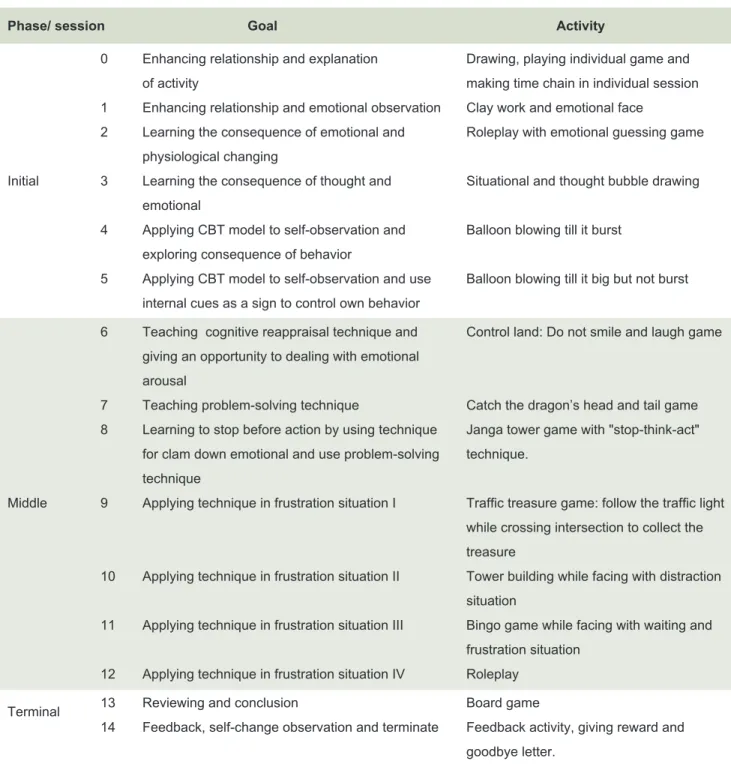
The program was developed by researchers and validated by 3 experts based on theory and techniques from cognitive behavior play therapy, group play therapy, and self-control development (program activities were displayed in Table 1). The program emphasised on learning and practicing in emotional and thought awareness, problem-solving skill and reinforcement of desired behavior by using token economy technique. Feedback in each session and homework assignment were used to evaluate participants understanding of the program.
TABLE 1. The program activities.
Phase/ session Goal Activity
0 Enhancing relationship and explanation Drawing, playing individual game and of activity making time chain in individual session 1 Enhancing relationship and emotional observation Clay work and emotional face
2 Learning the consequence of emotional and Roleplay with emotional guessing game physiological changing
Initial 3 Learning the consequence of thought and Situational and thought bubble drawing emotional
4 Applying CBT model to self-observation and Balloon blowing till it burst exploring consequence of behavior
5 Applying CBT model to self-observation and use Balloon blowing till it big but not burst internal cues as a sign to control own behavior
6 Teaching cognitive reappraisal technique and Control land: Do not smile and laugh game giving an opportunity to dealing with emotional
arousal
7 Teaching problem-solving technique Catch the dragon’s head and tail game 8 Learning to stop before action by using technique Janga tower game with "stop-think-act"
for clam down emotional and use problem-solving technique. technique
Middle 9 Applying technique in frustration situation I Traffic treasure game: follow the traffic light while crossing intersection to collect the
treasure
10 Applying technique in frustration situation II Tower building while facing with distraction
situation
11 Applying technique in frustration situation III Bingo game while facing with waiting and frustration situation
12 Applying technique in frustration situation IV Roleplay Terminal 13 Reviewing and conclusion Board game
14 Feedback, self-change observation and terminate Feedback activity, giving reward and goodbye letter.
1. The initial phase aimed to enhance a relationship between group members, provide basic concepts about CBT model, and help the participants to understand how to observe their own emotions, thought and behavior through play activities and guidance. This phase consisted of one individual session and group sessions from the first to fifth.
2. The middle phase consisted of 2 sub-phases. The objective was to teach self-control techniques and facilitate participants to use these techniques in play activities. The second objective was to practice techniques and receive
feedbacks form therapist and other members. This phase consisted of the activities in sixth to eleventh sessions.
3. Terminal phase was aimed to summarize, provide feedback about program and discuss the changes of themselves and other members. This phase also provided time for farewell and termination of the program. It consisted of the 13th-14th sessions.
Data collecting instruments and analysis
Part 1: demographic data consisted of age and
Descriptive statistics was used to analyze demographic data in mean and percentage.
Part 2: self-control behavior consisted of Self-Control
Skill in 5 Situations Test and Thai Youth Checklist. Data were collected in pre and post intervention 7 weeks apart.
Self-Control Skill in 5 Situational Test was developed
by the authors and content validated by 3 experts. It was based on concepts and theories of self-control, and cognitive development. This test consisted of 5 open ended questions asking about tendencies of behavior that may manifest if participants are in these 5 situations. For instance, if you plan to have lunch at your favorite store, but it has a very long queue, what will you do? Score 1 if the answer reflects to responsibility, perform behavior that along with moral and social norm, able to inhibit inappropriate behavior, refuse temptation which may lead to negative impact. Score 0 if the answer is opposite from above. Data were collected from participants. For participants who could not read, they were facilitated by research assistants. Wilcoxon Signed Ranks Test and qualitative analysis were used in data analysis.
Thai Youth checklist (TYC) is a screening for
observational behavioral problems in children age 6-17 years old, and classify behavior problems in 2 domains, internalizing and externalizing problems. TYC has 2 forms; observing behavior by parents at home and teachers at school, both must be the one who has high interaction with a child for direct observation. It was translated to
Thai by Suwannalert S et al; 1989, and test-retest and inter-interviewer reliability were 0.81 and 0.91.11 The
externalizing behavioral problems in boys age 6-11 years old: parent version was used in this study. This domain consists of four sub-domains; aggressive, impulsivity, delinquency, and immaturity. Data were collected from 4 caretakers who have 8-12 boys in care. Each caretaker was assigned to observe and report behavior of 2-5 children according to the number of participations in care. The data was analyzed by using Wilcoxon Signed Ranks Test.
RESULTS
Demographic data
Participants were 12 boys, age 8-10 years old in Mahamek Home for Boys, who had scored from TYC higher than the average score of this population. Two participants were excluded because they participated less than 80 % and 1 participant was excluded because the researcher was unable to collected data of post- intervention. Therefore, the number of participants in this study was 9. The participants were 4 boys with 8 years old, 4 boys with 9 years old and 1 with 10 years old. All participants study in public school, one boy in grade one, five in grade two and three in grade three. They came to foster care because of poverty, abandonment and had been abused. General information of the participants was displayed in Table 2.
TABLE 2. General information of the participants.
ID Age Shelter Number of participations Noted
1 10 A 9/14 Excluded
2 10 A 9/14 Excluded
3 9 B 13/14
4 9 B 12/14
5 10 B 12/14
6 8 B 12/14
7 8 C 12/14 Excluded
8 8 C 14/14
9 8 C 13/14
10 8 D 13/14
11 9 D 13/14
The effect of group cognitive behavior play therapy on self-control
Self-control skill in 5 situational tests The result
from Table 3 showed increasing of mean score in post-intervention, with non-statistical significance (Z = - 1.134; p-value = 0.257) However, there were some interesting changes in participants’ answers for instance; if your friend dislikes your drawing in group work and erases it, what will you do? The answer in pre-intervention such as “punch him” “damn him” changed to “tell a teacher” “tell a friend to stop erasing and draw again” Nonetheless, there were answers which implied lack of self-control skill like, “Ask a friend who is in the queue to buy for me” “pay money for jump the queue” for the situation like if you plan to have lunch at your favorite store, but it has a very long queue, what will you do?
Thai Youth Checklist Comparison of changes
between pre and post-intervention found the mean score of overall externalizing behavior problems was decreased with non-statistically significant level (Z = - 1.719; p = 0.086). Examination of the mean score of subdomains found decreases in aggression, impulsivity, and delinquency (Z= -2.203; p = 0 .028 / Z= -1,452; p = 0.146 / Z = -1.132; p = 0.257), but only aggression was statistically changed. However, the score of immaturity subdomain was increased. (Z = .136; p = 0.892), as displayed in Table 4.
DISCUSSION
The results show that this program is effective in decreasing aggressive behavior (p. <.05). It also has a trend to improve self-control skill and reduce externalizing behavior problems. The positive result, especially in aggressive domain, is congruent with previous studies which found that group cognitive behavior therapy is effective in reducing aggressive behavior and externalizing behavior in primary and secondary school students5,12
and in street girls.13 All these congruent results may
conclude that group cognitive behavior therapy is also effective treatment in enhancing self-control skill and reducing externalizing behavior problems in special populations like this one.
There are studies which found that perception bias of anger and sadness, ability in coping with anger, and inappropriate expression of sadness relate with externalizing behavior problems14-16. It is the same with
the participants’ behavior. We found that they got angry easily even from slight mistake or by accident and always immediately reacted with aggressive behavior such as, destroying things or get into fight. It is interesting that they did the same behavior when they might be unsatisfied, for instance, not been chosen to do extra activity. However, when they were asked about their feeling, none of them mentioned sadness, most of them reported anger. Therefore, decreasing of externalizing
TABLE 3. Comparing the mean score of self-control skill in 5 situations test.
Time Mean S.D. Za P-value
Pre 4.11 1.364
Post 4.67 .707 -1.134 .257
TABLE 4. Comparing of mean score of TYC.
Domain Time Mean S.D. Za P-value
Immaturity Pre 4.56 2.40
Post 4. 67 2.39 .136 .892
Delinquency Pre 4.33 2.55
Post 3.33 2.73 -1.132 .257
Impulsive Pre 7.11 3.37
Post 6.22 2.05 -1.452 .146
Aggressive Pre 17.22 4.73
Post 11.89 6.15 -2.203 .028*
Total Pre 29.78 9.65
behavior problems might be because their emotional awareness and coping skill were improved. As shown in the answer of participants from activities, worksheet, and interviewing for instance; “I used to be a bad temper person, but now I learned how to manage it, especially when I get in fight with my friends”, “I always say a bad word to people around me when I felt angry in the past but I seldom do it now. Instead of saying bad word I count 1-10, think of other thing to calm myself down”.
Only significant improvement in aggression domain may be due to participants’ behavior. We found that they felt angry more often than other emotion and always manifested with aggressive behavior in group sessions. Therefore, participants had more chance to learn the consequences of aggressive behavior by direct or indirect reinforcement from the program. This could lead to cognitive and behavior adaptation by accommodation process which would occur when new experiences conflicts with existing belief.17
Examination of the answer of the participants from Self-Control Skill in 5 Situations Test revealed that most of the answers from the post intervention changed to become more appropriate. This reflected that changes in cognition occurred. However, behavioral change needs more time to practice and acquire experience in various situations. Therefore, practicing only in 14 group sessions without assistance from caretaker to generate learned skill or techniques in daily life situations might not be enough for behavior changing.
Age could be another factor which affected the result. From the behavior observation and worksheet, we found that participants with age 10 years old perform better in cognitive reappraisal and problem-solving technique than those younger. This could be effect of children’s cognitive development, which develops by age. This finding is congruent with the study of DeCicco, et al (2014) who found that effectiveness of cognitive reappraisal techniques is increased by age18 and the prior
meta-analysis supports that CBT has more effectiveness when applied with older children.19
However, it does not mean that younger participants are not able to learn from these two techniques. Prior studies found that 8-year-olds could understand the connection of cognitive reappraisal and emotion adaptation.20-21 As
with this study, we found younger participants understood and applied techniques better if they received intimate advice, modelling or more thinking time. Therefore, if they get more guidance or the duration of the program was extended, their behavior may be improved.
A relaxation technique, was found to be effective in
reducing aggressive behavior among elementary students with emotional or behavioral disorders.22 In this study
we found most of the participants understood, did well in practicing, but had some limitations in applying to some frustrated situations. This could be the effect of inadequate practicing, because this technique may not be able to apply in daily life effectively unless they have already become familiar with it. Hence, extending the duration of the program may increase the program’s effectiveness.
Another factor that may enhance the program effectiveness is including caretaker in the program. There are evidences from studies which found that including parents in a program can enhance effectiveness in reducing externalizing behavior problems of children. Parents can facilitate children to use learned techniques in daily life and reinforce trained behavior which supports, generalises and maintains desired behaviors.23-24 There are studies
which found that relative foster care is superior to non-relative foster care, because of pre-existing emotional and social connection and quality of interaction with foster parents can predict externalizing behavior problems.24
However, including foster parents in the program may have limitation in practice because foster parents may have limited time to participate in the program.24 Therefore,
incorporating foster parents into the program should be investigated more in further study.
Considering about observers may be the factor which lead to different outcome. According to previous meta-analysis study which found that parents tend to report larger improvement in externalizing symptom than teacher. This because parents and teachers may differ in level of intimacy and concern.5 For this study,
the responder was foster parents who have 8-12 children under care. This number may be too large for close interaction with each participant. This may affect to behavior observation, particularly in minor detail such as crying or blathering. However, aggression is easy to notice or receive complaint, which might not be affected from this limitation.
quantitative evaluation. From this consequence, it is possible that different outcomes might be due to the limitations of the assessment.
Finally, generalization of this study is limited. This study was investigated with 8-10 years boys in foster care in one group design without booster session. Thus, we could not compare the program effectiveness with external factors or other populations as well as the long-time effectiveness which still needs to be further investigated.
CONCLUSION
The program was effective in reducing aggressive behavior and had a trend to improve self-control skill among 8-10 year old children in foster care. However, this program needs to be developed. Including foster parents into the program, review new assessment, and investigation in controlled experiment with booster session design are recommended for further research.
ACKNOWLEDGMENTS
This study was supported by Siriraj Graduate Scholarship, Faculty of Medicine Siriraj Hospital, Mahidol University. The authors would like to thank. Assist. Prof. Sirinadda Panyapas M.D., Assist. Prof. Wanlop Atsariyasing. M.D., Ms.Panida Yomaboot for validating the research instruments, Department of Children and Youth Ministry of Social Development and Human Security for allowing the authors to collect data in Mahamek Home for Boys, and also thanks to officers in Mahamek Home for Boys who facilitated in data collection process.
REFERENCES
1. Tangney JP, Baumeister RF, Boone AL. High Self-control Predicts Good Adjustment, Less Pathology, Better Grades, and Interpersonal Success. J Pers. 2004;72(2):271-324.
2. Swanson J, Casarjian BE. Using Games to Improve Self-Control Problems in Children. In: Schaefer C, Reid SE, editors. Game Play Therapeutic use of Children Games. New York: John Wiley & Sons, Inc.; 2001. p. 316-27.
3. Bronson MB. Self-regulation in early childhood: nature and nurture. New York: The Guilford Press; 2000. p.11-30.
4. Kendall PC, Braswell L. Cognitive-Behavioral Self-Control Therapy for Children: A Components Analysis. J Consult Clin Psychol. 1982;50:672-89.
5. Battagliese G, Caccetta M, Luppino OI, Baglioni C, Cardi V, Mancini F, et al. Cognitive-behavioral therapy for externalizing disorder: A meta-analysis of treatment effectiveness. Behav Res Ther. 2015;75:60-71.
6. Knell SM. Cognitive Behavior Play Therapy Theory and Applications. In: Drewes AA, editor. Blending Play Therapy with Cognitive Behavioral Therapy. New Jersey: John Wiley & Sons, Inc.; 2009. p. 117-33.
7. Knell SM, Dasari M. CBPT: Implementing and Integrating CBPT into Clinical Pratice. In: Athena A D, editor. Blending
Play Therapy with Cognitive Behavioral Therapy. New Jersey: John Wiley & Sons. Inc.; 2009. p. 321-52.
8. Cavett AM. Cognitive-behavior play therapy. In: Crenshaw DA, Stewart Al, editors. Play Therapy a comprehensive guide to theory and practice. New York: The Guilford Press; 2015. p. 83-97.
9. Hambrick EP, Oppenheim-Weller S, N’zi MA. Mental health interventions for children in foster care: A Systematic review. Child Youth Serv Rev. 2016;70:65-77.
10. Shaw ME. Group dynamic: the psychology of small group behaviors. New York: McGraw-Hill Book Company; 1971. p. 335-362.
11. Suwannalert S, Chaiyasit W. Manual for the Thai youth checklist (TYC). 3rd ed. Nonthaburi: Department of Mental Health, Ministry of Public Health; 1997.
12. Lochman JE, Boxmeyer C, Powell N. The Role of Play within Cognitive Behavioral Therapy for Aggressive Children. In: Athena AD, editor. Blending Play Therapy with Cognitive Behavioral Therapy Evidence-Based and other Effective Treatements and Techniques. New Jersey: John Wiley & Sons, Inc; 2009. p. 179-97.
13. Ghodousi N, Sajedi F, Mirzaie H, Rezasoltani P. the effectiveness of cognitive-behavioral play therapy on externalizing behavior problems among street and working children. IRJ. 2017;15(4):359-66.
14. Martin SE, Boekamp JR, McConville DW, Wheeler EE. Anger and Sadness Percption in Clinically Referred Preschool: Emotion Process and Externalizing Behavior Symptoms. Child Psychiatry Hum Dev. 2010;41:30-46.
15. Zeman J, Shipman K, Suveg C. Anger and Sadness Regulation: Predictions to Internalizing and Externalzing Symptoms in Children. J Clin Child Adolesc Psychol. 2002;31(3):393-8.
16. Fine SE, Trentacosta CJ, Lzard CE, Mostow AJ, Campbell JL. Anger Perception, Caregivers’ use of physical discipline, and aggression in children at risk. Soc Dev. 2004;13(2):213-28.
17. Charlesworth R. Understanding Child Development For Adults Who Work with Young Children.New York: Thomson Learning, 2004. p. 33-97
18. DeCicco JM, O’Toole LJ, Dennis TA. Cognitive Reappraisal in Children: An ERP Study Using the Late Positive Potential. Dev Neuropsychol. 2014;39(7):497-515.
19. Sukhodolsky DG, Kassinove H, Gorman BS. Cognitive-behavioral Therapy for anger in children and adolescents: a meta-analysis. Aggress Violent Behav. 2004;9(3):247-69.
20. Flavell J, Flavell E, Green F. Development of children’s understanding of connections between thinking and feeling. Psycho Sci. 2001;12(5):430-32.
21. Pons F, Harris PL, Rosnay MD. Emotion comprehension between 3 and 11 years: Developmental periods and hierarchical organization. Eur J Dev Psychol. 2004;1(2):127-52.
22. Lopata C, College C. Progresive Muscle Relaxation and Aggression Among Elementary Students with Emotional or Behavioral Disorders. BD. 2003;28(2):162-72.
23. Lochman JE, Wells KC. The Coping Power Program for Preadolescent Aggressive Boys and Their Parents: Outcome Effects at the 1-Year Follow-Up. J Consult Clin Psychol. 2004;72(4):571-8.