A Natural Language Architecture
Adesina Simon Sodiya
Computer Science Department, University of Agriculture, Abeokuta, Ogun State, Nigeria
Natural languages are the latest generation of program-ming languages, which require processing real human natural expressions. Over the years, several groups or researchers have been trying to develop widely ac-cepted natural languages based on Artificial Intelligence
(AI). But, no true natural language has been developed. The goal of this work is to design a natural language preprocessing architecture that identifies and accepts pro-gramming instructions or sentences in their natural forms and generates equivalent codes in the base high-level language. The new programming language platform, called H++, translates and processes real human nat-ural expressions. Using Visual Basic 6.0 as the basic high-level programming language, the implementation resulted in an interactive and easy to use natural language platform.
Keywords: programming language, natural language, artificial intelligence(AI), instructions.
1. Introduction
A high-level programming language is a pro-gramming language that is user-friendly, to some extent platform-independent, and abstract from low-level computer processor operations(Bunch and Hellemans, 2004). It is therefore evident that a user-friendly programming language must be easy to use. High-level programming lan-guages were designed to be easy to use by making them closer to human language than to the machines languages. But, most high-level programming languages still require cod-ing, though these codes are close to human ex-pressions.
Coding in most programming languages re-quires writing lines of instructions, even for a very simple problem. The object-oriented pro-gramming languages have been developed to also, among other benefits, reduce the lines of codes. However, in most programming lan-guages, the simplest problem definition would require a minimum of 4 to 5 lines of codes. A
huge programming task at times requires good programming skills. In some cases, program-ming in high-level programprogram-ming language is complex and less interesting because of the re-quirement for core knowledge of the language syntax. This is why there is much interest in the design and processing of natural language. Nat-ural Language Processing (NLP)requires ana-lyzing, understanding and generating languages that human beings use naturally, so that even-tually you will be able to address the computer as if you were addressing another person. The goal of NLP is not easy to reach as it requires detailed syntax and semantic analysis and rep-resentations.
The objective of this work is to design a natu-ral language platform that brings programming in high-level languages much closer to human languages. It is geared towards given natural language instructions to computer systems. The idea is to remove or reduce the jargons of cod-ing so as to make programmcod-ing an easy task for skilled or less skilled programmers or comput-ing professionals. The new programmcomput-ing plat-form is called H++ (pronounced Hplusplus), which means a higher high-level programming language. H++is a unique programming envi-ronment that will make the act of programming faster, easier and friendlier.
2. Related Work
The third and fourth generation languages are generally less technical, less flexible, slower and more user-friendly than the previous ones
need for proper understanding of the language, even before simple program can be written and, besides, some instructions used are not really English-like.
The Fifth Generation Language(5GLs), which is also called “natural language”, requires com-puter responding directly to spoken or writ-ten instructions or commands(Williams et al., 1999). Natural language evolved in order to bring programming much closer to human be-ings. Over the years, researchers have been working on designing appropriate natural lan-guages.
Knowledge representation and translation were the initial focus of NLP with researchers ex-ploring tasks ranging from responding to com-mands and answering questions in a micro-world(Winograd, 1972)to responding to data-base queries(Woods, 1977)and understanding short stories(Schank & Abelson, 1977; Char-niak & Wilks, 1976). Jelinek (1998) applied statistical method in speech recognition and this has motivated the application of similar meth-ods to almost all areas of natural language pro-cessing. Statistical methods have now been ap-plied in machine translation, information ex-traction, syntactic analysis and word disam-biguation(Manning & Schutze, 1999). Some recent works were on empirical semantic role analysis(Fillmore et al., 2000; Gildea & Juraf-sky, 2002). Tang & Mooney(2000)presented an approach to learn non-deterministic parsers. This area still needs to be explored in order to identify alternative approaches to learning se-mantic parsers.
Further investigation revealed a focus on learn-ing to parse natural language into semantic log-ical forms, speciflog-ically mapping natural lan-guage sentences into programming expressions
(Tang & Mooney, 2000; Tang, 2003). Some natural language projects are currently handled by European Chapter of the Association for Computational Linguistics and Microsoft Nat-ural Language Processing Group (MNLPG). Some of the projects by MNLPG are Para-phrase, MindNet, Machine Translation and Cor-pus(http://research.microsoft.com/nlp/). Most of these projects are based on application on artificial intelligence to natural language de-sign.
Unfortunately, there have been limited works on learning to map complete sentences to
program-ming codes or semantic representation. How-ever, detailed semantic analysis might be dif-ficult for complex systems. In order to avoid this problem, it is important to think of how to build robust systems for simpler tasks, which is a major interest of this work.
3. Design of H++
As it was mentioned earlier, H++is designed to introduce a natural language platform that is truly high in abstraction and natural. The design procedure of H++is described here.
3.1. Significant Considerations
The goal of the work is to design and build a programming platform that will accept, ana-lyze, understand, and translate very high-level instructions (languages that humans use natu-rally). The idea is to bring programming to a level of addressing computer as if we were addressing another person. Some specific con-siderations are:
a. to provide a programming platform that is very easy to use, even for non core program-mers.
b. to provide fast access to computing function-alities without thorough coding.
c. to make programming with very few lines of code really possible. For example, writing a program to display “This is H++” 10 times in C++gives
int main()
{ for int i=1, <=10, i++) cout << ‘‘This is H++’’; }
Using a 4GL like Dbase, we have
I=1 K=10
Do while I<=10
@K,10 say ‘‘This is H++’’ K=K+1
The first program is 4 lines and the second program is 7 lines. One of the major inter-ests in H++ is to solve problems like this, using just one line of instruction.
For example,
Display ‘‘This is H++’’ 10 times
d. to provide a higher level of interaction be-tween the user and computer.
3.2. H++ Architecture
TheH++architecture is 3-level and is shown in Figure 1 below.
Fig. 1.H++Architecture.
This architecture is built on a high-level lan-guage which is used to convert and compile natural expressions. Real natural languages are accepted at the first level and are translated to high-level language equivalents. Then, the base high-level language will process the translated natural expressions through the normal compi-lation process.
3.2.1. Program Execution Process
The program execution process(simply known as compiling process) is described in Figure 2 below.
Each program may contain one or more sen-tences or instruction lines, all separated with full stops (.). Each sentence is (then) stored
Fig. 2.Program execution process in H++.
in an array. There is a loop to process all the sentences in the whole program.
a. Processing of Sentences
When a sentence is read into an array, it is bro-ken down into words. In this case, a word can be either a verb(reserved word or statement)or an identifier. Words are recognized with blank spaces, which are used between words as sepa-rators. The words recognized are also stored in a different array.
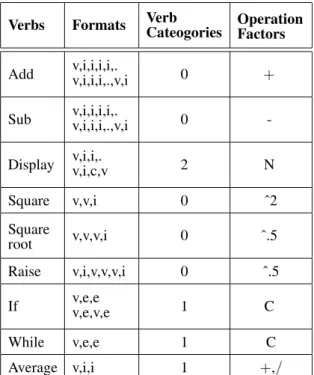
There is a table (the verb table) that stores all the verbs in H++. The first word in every sen-tence is compared with the series of verb stored in the table. If there is a match, H++checks
Verbs Formats VerbCateogories OperationFactors
Add v,i,i,i,i,.v,i,i,i,.,v,i 0 +
Sub v,i,i,i,i,.v,i,i,i,.,v,i 0
-Display v,i,i,.v,i,c,v 2 N
Square v,v,i 0 ˆ2
Square
root v,v,v,i 0 ˆ.5
Raise v,i,v,v,v,i 0 ˆ.5
If v,e,ev,e,v,e 1 C
While v,e,e 1 C
Average v,i,i 1 +,/
the format for that word. It simply identifies the first verb in an instruction or sentence and validates the format in the format or parsing ta-ble. Table 1 shows the structure of some of the parsing methods used in H++. The table is big enough to accommodate up to 51 verbs.
The verb column represents all the verbs in H++. The format column represents the spe-cific format for the verbs. H++verbs are cate-gorized into 3 types. The third column denotes the verb category. Also, there are some opera-tors attached to each H++verb. Letters v,i,c,e in the format specification represent verb, iden-tifier, constant and expression respectively. The dot(.) after i means that it can allow more iden-tifiers.
If a given format is found, the system(then) ex-ecutes the sentence by generating codes in VB. In executing a sentence, all identifiers and verbs in the front of the verb are used to generate the VB codes. There is a function for each verb in H++that actually converts H++sentences to VB codes.
For example, Add A,B to C
b. H++ Function Architecture
The sentences in H++are divided into 3 cate-gories viz;
i. Expression sentences: These sentences are known as arithmetic sentences and have as-sociated arithmetic operators. These sen-tences are categorized as ‘0’(See Table 1). Examples are the sentences that start with Add, Sub, Ave and so on.
ii. Statement sentences: These have no asso-ciated arithmetic sentences and are used for special and direct operations. This category is represented by “2”. Examples are Display, Extract, Search and so on.
iii Condition sentences: These are condition sentences and are categorized as “1”. Ex-amples include While, If, and so on.
— If the sentence category(sent cate) =0, then the variables/identifiers within the sentence and operation factors (See Table 1) for the category are used to form arithmetic expres-sions. The general form of expressions in this category is Result=var1 θ var2 θ var3
θ. . .θ varn
Whereθ represents the associated operation factor. For example, Add A,B to C would
give
Result=A+B+C C=Result
(Notes: - Result of the last arithmetic oper-ation in H++ is always kept in a variable called RESULT.
The variables in H++ program are read as var1, var2, var3 and so on.)
— If the sentence category(sent cate) =1, then the condition statements are used directly be-cause they are used in H++. So, in this case, there is no serious translation from H++to VB.
— If the sentence category(sent cate) =2, then the function for the verb is called. There are different functions for verbs in this category. For example, the functions Display and Ex-tract have functions display()and extract()
respectively. These functions now generate codes based on this verb.
3.2.2. Other Design Issues
a. Variables and Identifiers
The beauty of the design is in that it allows various forms and lengths of identifiers. For example, “Victor Sodiya” can be taken to be an identifier in H++. The simple way this is done is that any combination of characters before the next verb is found and taken as identifier. How-ever, if two or more separate names are used as a name, any of these separate names can be the verb.
Therefore, H++ will accept identifier names like
Father’s Name Is this your house? And so on.
This enables identifiers to be formed in most natural way.
b. Rules in H++
i All H++ sentences/instructions must be terminated with a full stop e.g. Find the ad-dition of a and b.
iii All H++ sentences/instructions must start with a verb which describes the action or task to be performed e.g. solve the area of a rectangle=length x breadth.
iv All H++ sentences/instructions can only consist of simple and related sentences and not compound or complex sentences. H++
can allow a sentence like add 10 and 20 and divide the result by 2. It cannot allow an in-struction like add 10 and 20 and add 40 and 50.
c. Error handling
The system flags syntax errors when the rules are not obeyed or when the usage format does not exist and returns back to the instruction line.
d. Ambiguity handling
A grammar that has more than one parse tree generating a given string of tokens is said to be ambiguous(Ahoo and Ullman 1988). The architecture of H++is simple and straightfor-ward. As it was stated earlier, all sentences must start with a verb. Table 1 shows that each verb has a separate method of parsing or format specification and translation procedure. There are even different functions to handle different verbs. Since the key aspect of H++sentences is the verb and there are no two verbs with the same name, then it is not possible to have ambi-guity. Consequently, increasing the size of the vocabulary will only result in introducing more functions to handle the added verbs.
e. Handling of complex expressions
Complex expressions can be handled by break-ing down the expressions into smaller units as it is done in the convectional programming. In H++, there could be interaction between the previous and the next expression. As mentioned earlier, the result of the previous operation is kept in a variable called RESULT. RESULT can then be used as a variable in the next expression, making it possible not to use verbose sentences to compute complex sentences.
4. H++ Interface
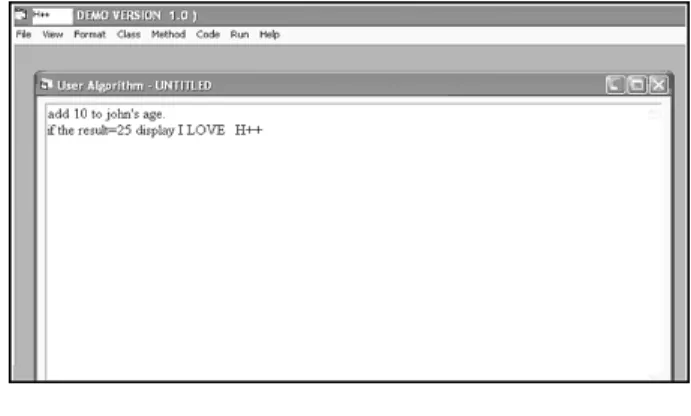
As it has been mentioned, H++ was imple-mented on Visual Basic 6.0. H++ opening menu has 8 options and several sub-options viz:-File, View, Format, Class, Method, Code, Run,
Help. This is shown in Figure 2. Details of usage of H++ are available in H++ manual
(Sodiya and Ojeanelo, 2005).
Fig. 3.H++Interface.
5. Some H++ Statements
The usages of some H++ statements are de-scribed below:
a. Add/Sum
i. Add var1, var2[,var3] [and var4]
ii. Add var1 to var2
In both cases, the result would be kept in a variable called result or answer. Sum can be used in place of Add
b. Subtract/Minus
i. Subtract var1, var2[,var3] [and var4]
ii. Subtract var1 from var2
Minus can be used in place of Substract
c. Average
i. Find the average of var1, var2[,var3] [and var4]
ii. Find the average of x numbers Where x stands for any integer
d. Accept/Input
Accept var1, var2[,var3] [and var4]
e. Display/print
Display var1, var2[,var3] [and var4]
f. Solve/Find/Calculate/perform
Solve formular
g. Divide
Divide var1 by var2
f. Multiply
Multiply var1 by var2
g. Initialize
Initialize var1=var2
h. Store result/Answer
Store result/answer as var1
Where result is the result from an arithmetic calculation
i. Square/Square root
i. Square of var1 ii. Square root of var1
iii. Find the Square/Square root of var1
j. Raise
Raise var1 to power of var2
k. Increase/Decrease
Increase var1 by var2
l. Join
Join var1, var2[,var3] [and var4] m. Go to/move to
Go to line number
Where line number is an integer number in front of any executable statement
The Go to and Move to are used in the same way
n. If/Should
If<condition1> <action1>
If<condition1>then<action1>
Where condition1 and action1 is an arith-metic operation
Also multiple condition and action must be enclosed in braces
Should can be used to replace If.
o. While/Until
While<condition1> <action1> p. Extract Right/Left
i. Extract num1 from the left/right of var2 Extract a letter from the left/right of var2 Where var1 is an integer
ii. Extract blank spaces right/left
Extract blank spaces from the left/right of var1
q. Convert
Convert var1 to lower case/upper case/small letter/capital letter
r. Pause
Pause for var1 seconds/minutes/hours
s. Stop/End
End(program execution)
Stop[any word(s)to describe your action]
t. Draw
i. Draw line ab [with/using, colour type colour]
ii. Draw diagonal ab[with/using, colour type colour]
where ab represents two points in your program and colour type represents any colour such as red, pink etc.
iii. Draw triangle abc[with/using colour type colour]
iv. Draw rectangle parallel gram abacd [ us-ing/with colour type colour]
u. Move Shape/Object
i. Move shape/object abcd var1 times Where abacd represents the coordinate enclosing the object
Var1 is an integer which represents the distance to which the object moves. ii. Move shape/object abacd to the left/right/
up/down at var1 km/hr var2 times Where Var1 and var2 are integers
v. Separate
Separate sentence into words/letters
We have just given about one third of the total statements or verb accepted by H++.
5.1. Examples of H++ instructions
i. Solve simple interest=(principal rate of time of deposit)/100
ii. Multiply principal, rate and time of de-posit.
iii. Divide the result by 100
iv. Store the result as simple interest v. Display “I love H++” 10 times. vi. Find the square of R
vii. Raise R to the power of 2 multiply the result by PI
viii. Perform the addition of 2 numbers twice ix. Accept first name and last name
xi. Join first name and last name
xii. Extract a letter from the left of surname xiii. Initialize level=100
xiv. Increase result by 30
xv. While the number<10 increase number by 1
xvi. Display the number of repetition 10 times xvii. Pause for 10 seconds
6. Future Work
H++ can only perform operation that starts with a verb. The design can be improved fur-ther so that it will allow sentences that do not necessarily start with a verb. Though, this is an enormous task as it will definitely result in huge number of rules to handle language ambiguity. I also recommend research on mapping natural language sentences into detailed semantic and logical forms for complex systems. We hope to improve this work so as to design a natural language the world is looking forward to see.
7. Conclusion
Designing a programming language is almost the same as designing a natural language. Un-derstanding a language means, among other things, knowing what concepts a word or sen-tence stands for and how to link those concepts together in a meaningful way. This goal of de-signing H++ was not easy to reach and the process of really putting it into shape is still on-going. We have been able to present an ar-chitecture that provides a shift from the present form of semi-English-like expressions to real English-like expressions. That is, we have in-troduced a more natural language – H++. This language is very easy to use and learn and it can be used by non core programmers for simple analysis and coding. H++ideas and concepts will be useful for researchers in natural language design and processing.
References
[1] A. V. AHOO ANDJ. D. ULLMAN, Principles of Com-piler Construction, Addison-Wesley Series In Com-puter Science and Information Processing, World Student Series Edition.
[2] B. BUNCH ANDA. HELLEMANS,(2004).History of Science and Technology, Published by Houghton Mifflin Company.
[3] E. CHARNIAK, (1972). Towards a Model of Chil-dren’s Story Comprehension, Technical Report TR266, Artificial Intelligence Laboratory, Mas-sachusetts Institute of Technology.
[4] E. CHARNIAK AND Y. WILKS, (1976). Computa-tional Semantics, Amsterdam: North-Holland.
[5] C. J. FILLMORE, F. C. BAKER ANDH. SATO,(2000). The FrameNet Database and Software Tools, In
Proceedings of the Third International Conference on Language Resources and Evaluation (LREC), pp. 1157–1160.
[6] D. GILDEA ANDD. JURAFSKY,(2002). Automated Labeling of Semantic Roles, Computational Lin-guistics28(3), pp. 245–288.
[7] F. JELINEK, (1998)Statistical Methods for Speech Recognition, Cambridge, MA: MIT Press.
[8] C. D. MANNING ANDH. SCHUTZE,(1999). Founda-tions of Statistical Natural Language Processing. Cambridge, MA: MIT Press.
[9] R. C. SCHANK ANDR. P. ABELSON,(1977).Scripts, Plans, Goals and Understanding: An Inquiry into Human Knowledge Structures, Hillsdale, NJ: Lawrence Erlbaum and Associates.
[10] A. S. SODIYA ANDV. OJEANELO,(2005).H++ Us-age Manual, Version 1.0, Vol. 1, 2005.
[11] L. R. TANG, (2003), Integrating Top-down and
Bottom-up Approaches in Inductive Logic Program-ming: Application in Natural Language Processing and Relational Data Mining, Ph.D. Dissertation, Department of Computer Sciences, University of Texas, Austin, TX.
[12] L. R. TANG AND R. J. MOONEY, (2000). Auto-mated Construction of Database Interfaces: In-tegrating Statistical and Relational Learning for Semantic Parsing, InProceedings of the Joint SIG-DAT Conference on Empirical Methods in Natural Language Proceeding and Very Large Corpora (EMNLP/VLC-2000), pp. 133–141.
[13] B. K. WILLIAMS, S. C. SAWYER ANDS. E. HUTCHIN -SON, (1999). Using Information Technology: A
Practical Introduction to Computers & Communica-tions, Third Edition, published by Irwin/ McGraw-Hill, pp. 507–544.
[14] T. WINOGRAD,(1972).Understading Natural
Lan-guage, Orlando, FL: Academics Press.
[15] W. A. WOODS, (1977). Lunar Rocks in Natural English: Explorations in Natural Language Ques-tion Answering, In Zampoli, A., ed., Linguistic Structures Processing, New York: Elsevier North-Holland.
Received:October, 2005
Revised:March, 2006
Accepted: March, 2006
Contact address:
Adesina Simon Sodiya Computer Science Department University of Agriculture Abeokuta, Ogun State Nigeria e-mail:[email protected]
DR. ADESINAS. SODIYAis a lecturer in Computer Science, University