An Extended TOPSIS Method for Multiple Attribute Group Decision
Making Based on Generalized Interval-valued Trapezoidal Fuzzy
Numbers
Peide Liu
Shandong Economic University, Information Management School Jinan Shandong 250014, China
E-mail:[email protected]
Keywords:interval-valued fuzzy number, relative closeness coefficient, multiple attribute group decision making
Received:May 29, 2009
An Extended TOPSIS Method deals with multiple attribute group decision making problems in which the attribute values and weights take the form of the generalized interval-valued trapezoidal fuzzy numbers (GIVTFN). First, some properties are defined, such as the concept and the relational calculation rules of GIVTFN, the distance and its characteristics of GIVTFN, and the method which can transform the linguistic terms into GIVTFN. Second, the normalization method of GIVTFN is illustrated, and an extended TOPSIS method based on the GIVTFN is presented in detail. The order of the alternatives is ranked based on the relative closeness coefficient of TOPSIS. Finally, an illustrate example is given to show the effectiveness of this method and this decision making steps.
Povzetek: Z izboljšano metodo TOPSIS so dosegli boljše rezultate pri odločanju z mnogoterimi atributi.
1
Introduction
Multiple attribute decision making (MADM) is an important part of modern decision science. It has been extensively applied to various areas, such as society, economics, management, military and engineering technology. For example, the investment decision-making, project evaluation, the economic evaluation, the personnel evaluation etc. Since the object things are fuzzy, uncertainty and human thinking is ambiguous, the majority of the multi-attribute decision-making is uncertain and ambiguous, which is called the fuzzy multiple attribute decision-making (FMADM). Since Bellmanhe and Zadeh [1] initially proposed the basic model of fuzzy decision making based on the theory of fuzzy mathematics, FMADM has been receiving more and more attentions. Many achievements have been made on FMADM problems [2-5,7-21].
TOPSIS (Technique for Order Preference by Similarity to Ideal Solution) is proposed by Hwang and Yoon [6], and it is a popular approach to MCDM problems. The basic principle is that the chosen alternative should have the shortest distance from the positive ideal solution and the farthest distance from the negative ideal solution. In the TOPSIS, the performance ratings and the weights of the criteria are given as crisp values. In many cases, crisp data are inadequate to model real life situations. Jahanshahloo et al [7] extends the TOPSIS method to the fuzzy decision making situations by considering interval numbers and defining crisp Euclidean distance between two interval numbers. Wang and Elhag[8] proposes a fuzzy TOPSIS method based on alpha level sets and presents a nonlinear programming
(NLP) solution procedure by considering triangular fuzzy numbers. Liu and Zeng [9] proposes a new TOPSIS method to deal with the fuzzy multiple attribute group decision making problem based on the expected value operator of the trapezoidal fuzzy number when the fuzzy decision matrixes and the weights of the decision attributes and decision makers are all given by the trapezoidal fuzzy number. Tsaur et al. [10] convert the fuzzy MCDM problem into a crisp one via centroid defuzzification and then solve the non-fuzzy MCDM problem by the TOPSIS method. Chu and Lin [11] changed the fuzzy MCDM problem into a crisp one. Differing from the others, they first derive the membership functions of all the weighted ratings in a weighted normalized decision matrix and then convert them to crisp values by defuzzifying and then use TOPSIS method to solve this problem.
the interval-valued triangular fuzzy numbers. Wei and Chen[18]proposed similarity measures between the generalized interval-valued trapezoidal fuzzy numbers (GIVTFN) for risk analysis. This paper proposed an extended TOPSIS Method to solve the multiple attribute group decision making problems of which the attribute weights and values are given with the form of GIVTFN.
In this paper we develop an extended TOPSIS method for multiple attribute group decision making based on the generalized interval-valued trapezoidal fuzzy numbers by defining the distance of GIVTFN. The remaining of this study is organized as follows. In the next section, we will briefly introduce the basic concept and the operation rules of the GIVTFN, and define the distance of GIVTFN. Section 3 describes the extended TOPSIS method to solve the multiple attribute group decision making problems by using GIVTFN. Section 4 gives a numerical example to explain validity of the decision-making steps and the method. The study is concluded in Section 5.
2
The basic concept of the
interval-valued trapezoidal fuzzy numbers
2.1
The generalized trapezoidal fuzzy
numbers
(1) The concept of the generalized trapezoidal fuzzy numbers
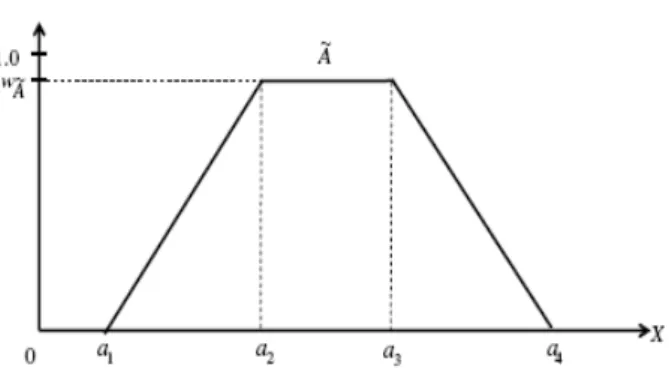
Definition 1 [19]: The generalized trapezoidal fuzzy
numbers can be defined as a vector
1 2 3 4
( ,
,
,
;
A)
A
a a a a w
(as shown in Fig1), and the membership functiona x R
( ) :
[0,1]
is defined as follows:1
1 2 2 1
2 3 4
3 4
3 4
1 4
,
( ,
)
,
(
,
)
( )
,
( ,
)
0,
(
,
)
(
, )
AA
A
x a
w
x
a a
a
a
w
x
a a
a x
x a
w
x
a a
a
a
x
a
a
(1)
where
a
1
a
2
a
3
a
4andw
A
[0,1]
.The elements of the generalized trapezoidal fuzzy numbers
x R
are real numbers, and its membership functiona x
( )
is the regularly and continuous convex function, showing the membership degree to the fuzzysets. If
1
a
1
a
2
a
3
a
4
1
, thenA
is called the normalized trapezoidal fuzzy number. Especially, if1
Aw
, thenA
is called the trapezoidal fuzzynumber
( ,
a a a a
1 2,
3,
4)
; ifa
1
a
2
a
3
a
4, thenA
is reduced to a triangular fuzzy number.If
a
1
a
2
a
3
a
4 , thenA
is reduced to a real number.
Figure 1: The generalized trapezoidal fuzzy number
A
.(2) The operation of the generalized trapezoidal fuzzy number
Suppose that
1 2 3 4
( ,
,
,
;
a)
a
a a a a w
,b
( ,
b b b b w
1 2, ,
3 4;
b)
are the generalized trapezoidal fuzzy numbers, then the operational rules of the generalized trapezoidal fuzzy number are shown as follows:[20](i) 1 2 3 4 1 2 3 4
1 1 2 2 3 3 4 4
( , , , ;
)
( , , , ;
)
(
,
,
,
;min(
,
))
a b
a b
a b
a a a a w
b b b b w
a b a b a b a
b
w w
(2)
(ii) 1 2 3 4 1 2 3 4
1 4 2 3 3 2 4 1
( ,
, , ;
) ( , , , ;
)
(
,
,
,
;min(
,
))
a b
a b
a b
a a a a w
b b b b w
a b a
b a b a
b
w w
(3)
(iii)
( , , , ;
1 2 3 4)
( , , , ;
1 2 3 4)
( , , , ;min(
,
))
a b
a b
a b
a a a a w
b b b b w
a b c d
w w
(4)
where
1 1 1 4 4 1 4 4
min(
,
,
,
)
a
a b a b a
b a
b
,2 2 2 3 3 2 3 3
min(
,
,
,
)
b
a
b a
b a
b a
b
2 2 2 3 3 2 3 3
max(
,
,
,
)
c
a
b a
b a
b a
b
,1 1 1 4 4 1 4 4
max(
,
,
,
)
d
a b a b a
b a
b
If
a a a a b b b b
1,
2,
3,
4, ,
1 2,
3,
4 are the positive numbers, then1 1 2 2 3 3 4 4
(
,
,
,
;min(
a,
b))
a b
a b a b a b a b
w w
(iv) 1 2 3 4 1 2 3 4
1 4 2 3 3 2 4 1
/
( ,
, ,
;
) / ( , , , ;
)
( /
,
/ ,
/
,
/ ;min(
,
))
a b
a b
a b
a a a a w
b b b b w
a b a b a b a b
w w
(5)
(3) The center of the gravity (COG) point of the generalized trapezoidal fuzzy numbers
and suppose that the COG point of the generalized
trapezoidal fuzzy numbers
1 2 3 4
( ,
,
,
;
a)
a
a a a a w
is(
x y
a,
a)
, then [21]:3 2 4 1
1 4
1 4
2 3 1 4
2
6
2
(
) (
) (
)
2
a a aa a a
a
a
a a
w
a
a
if a
a
y
w
if a
a
y
a
a
a a
w
y
x
w
(6)2.2
The interval-valued trapezoidal fuzzy
numbers
(1)The interval-valued trapezoidal fuzzy numbers [18]
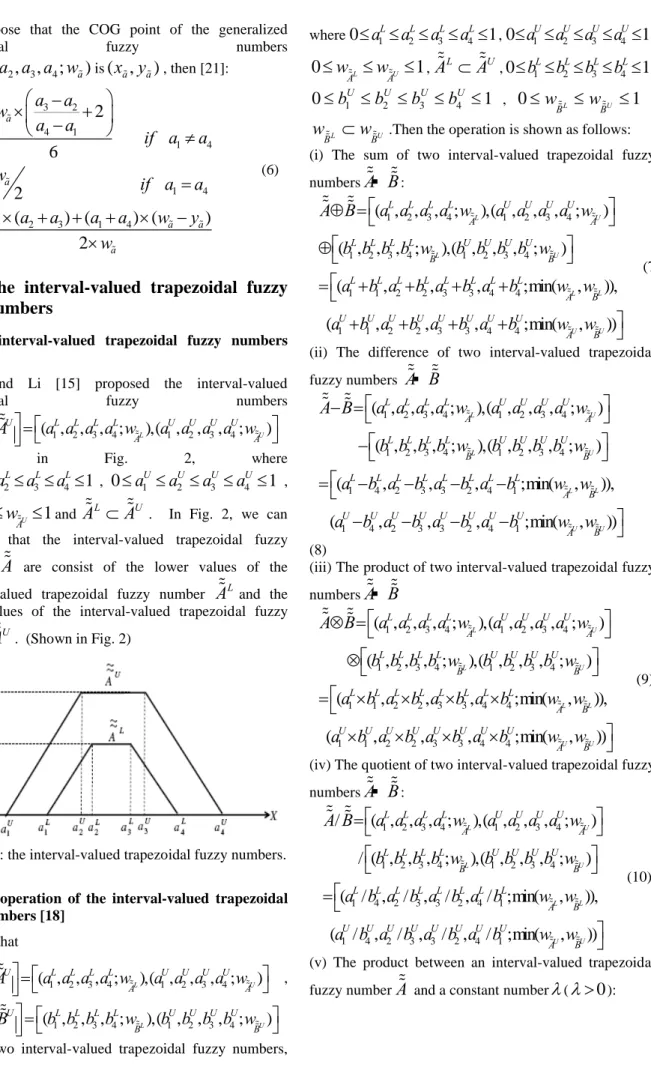
Wang and Li [15] proposed the interval-valued
trapezoidal fuzzy numbers
1 2 3 4 1 2 3 4
,
( , , , ;
L),( ,
,
,
;
U)
L U L L L L U U U U
A A
A
A A
a a a a w
a a a a w
shown in Fig. 2, where
1 2 3 4
0
a
La
La
La
L1
,0
a
1U
a
2U
a
U3
a
U4
1
,0
w
AL
w
AU
1
andL U
A
A
. In Fig. 2, we canconclude that the interval-valued trapezoidal fuzzy
numbers
A
are consist of the lower values of the interval-valued trapezoidal fuzzy numberA
Land the upper values of the interval-valued trapezoidal fuzzynumber
A
U. (Shown in Fig. 2)Figure 2: the interval-valued trapezoidal fuzzy numbers.
(2) The operation of the interval-valued trapezoidal fuzzy numbers [18]
Suppose that
1 2 3 4 1 2 3 4
,
( , , , ;
L),( ,
,
,
;
U)
L U L L L L U U U U
A A
A A A
a a a a w
a a a a w
,1 2 3 4 1 2 3 4
,
( , , , ;
L),( ,
,
,
;
U)
L U L L L L U U U U
B B
B
B B
b b b b w
b b b b w
are the two interval-valued trapezoidal fuzzy numbers,
where
0
a
1La
2La
3La
4L1
,0
a
1Ua
2Ua
3Ua
4U1
,0
L U1
A A
w
w
,A
L
A
U,0
1 2 3 41
L L L L
b
b
b
b
,1 2 3 4
0
b
U
b
U
b
U
b
U
1
,0
w
BL
w
BU
1
,L U
B B
w
w
.Then the operation is shown as follows: (i) The sum of two interval-valued trapezoidal fuzzynumbers
A B
,
:1 2 3 4 1 2 3 4
1 2 3 4 1 2 3 4
1 1 2 2 3 3 4 4
1 1 2 2 3 3 4 4
( , , , ;
),( ,
,
,
;
)
( , , , ;
),( ,
, , ;
)
(
,
,
,
;min(
,
)),
(
,
,
,
;
L U
L U
L L L L L L U U U U
A A
L L L L U U U U
B B
L L L L L L L L
B A U U U U U U U U
A B
a a a a w
a a a a w
b b b b w
b b b b w
a b a b a b a b
w w
a b a b a b a b
min(
w w
AU,
BU))
(7)(ii) The difference of two interval-valued trapezoidal
fuzzy numbers
A B
,
1 2 3 4 1 2 3 4
1 2 3 4 1 2 3 4
1 4 2 3 3 2 4 1
1 4 2 3 3
( , , , ;
),( ,
,
,
;
)
( , , , ;
),( , , , ;
)
(
,
,
,
;min(
,
)),
(
,
,
L U
L U
L L L L L L U U U U
A A
L L L L U U U U
B B
L L L L L L L L
B A U U U U U
A B
a a a a w
a a a a w
b b b b w
b b b b w
a b a b a b a b
w w
a b a b a
2
,
4 1;min(
U,
U))
U U UB A
b a b
w w
(8)(iii) The product of two interval-valued trapezoidal fuzzy
numbers
A B
,
1 2 3 4 1 2 3 4
1 2 3 4 1 2 3 4
1 1 2 2 3 3 4 4
1 1 2 2 3 3
( , , , ;
),( ,
,
,
;
)
( , , , ;
),( , , , ;
)
(
,
,
,
;min(
,
)),
(
,
,
,
L U
L U
L L L L L L U U U U
A A
L L L L U U U U
B B
L L L L L L L L
B A U U U U U U
A B
a a a a w
a a a a w
b b b b w
b b b b w
a b a b a b a b
w w
a b a b a b
4 4
;min(
U,
U))
U UB A
a b
w w
(9)
(iv) The quotient of two interval-valued trapezoidal fuzzy
numbers
A B
,
:1 2 3 4 1 2 3 4
1 2 3 4 1 2 3 4 1 4 2 3 3 2 4 1
1 4 2 3 3 2
/
( , , , ;
),( , , , ;
)
/ ( , , , ;
),( , , , ;
)
( / ,
/ ,
/ ,
/ ;min(
,
)),
(
/
,
/
,
/
L U
L U
L L L L L L U U U U
A A
L L L L U U U U
B B
L L L L L L L L
B A U U U U U
A B
a a a a w
a a a a w
b b b b w
b b b b w
a b a b a b a b
w w
a b a b a b
4 1,
/ ;min(
U,
U))
U U UB A
a b
w w
(10)
(v) The product between an interval-valued trapezoidal
1 2 3 4 1 2 3 4
1 2 3 4 1 2 3 4
( , , , ;
),( , , , ;
)
(
,
,
,
;
),(
,
,
,
;
)
L U
L U
L L L L U U U U
A A
L L L L U U U U
A A
A
a a a a w
a a a a w
a a a a w
a a a a w
(11)
2.3
The distance of the interval-valued
trapezoidal fuzzy numbers
Suppose that
1 2 3 4 1 2 3 4
,
( , , , ;
L),( ,
,
,
;
U)
L U L L L L U U U U
A A
A A A
a a a a w
a a a a w
,1 2 3 4 1 2 3 4
,
( , , , ;
L),( ,
,
,
;
U)
L U L L L L U U U U
B B
B
B B
b b b b w
b b b b w
are any two generalized trapezoidal fuzzy numbers, then the distance of two interval-valued trapezoidal fuzzy
numbers(
A
andB
) is calculated as follows:(1)Utilize the formula (6) to calculate the coordinate of
the COG point
L,
L
A A
x
y
,
U,
U
A Ax y
,
x
BL,
y
BL
,
x
BU,
y
BU
which belongs to the generalized trapezoidal fuzzy
numbers
A A B B
L,
U,
L,
Urespectively.(2) The distance of two interval-valued trapezoidal fuzzy numbers is:
2 2 2 2
(
) (
) (
) (
)
( , )
4
L L U U
L B L B U B U B
A A A A
y
y
x
x
y
y
x
x
d AB
(12)
where
d A B
( , )
satisfies the following properties: (i) ifA
andB
are the normalized interval-valued trapezoidal fuzzy numbers, then0
d A B
( , ) 1
(ii)
A B
d A B
( , )
0
(iii)d A B
( , )
d B A
( , )
(iv)
d A C
( , )
d C B
( , )
d A B
( , )
Obviously, the properties (i) and (iii) are satisfied.
For the properties (ii), if
A B
, then( , )
0
d A B
. Ifd A B
( , )
0
, then the COG ofA
isequal to
B
’s, so we approximately believe thatA B
.For properties (iv): In order to simplify the expression in distance formula, we suppose that
1 L
,
2 BL,
3 LA C
x
x
x
, 1 L,
2 BL,
3 LA C
y
y
y
, 1 U,
2 BU,
3 UA C
x
x
x
, 1 U,
2 BU,
3 UA C
y
y
y
.
2 2 2
2
( , )
( , )
( , )
( , )
( , )
( , )
( , )
( , )
( , )
0
d A B
d B C
d A C
d A B
d B C
d A C
d A B
d B C
d A C
2 2 2 2 2 2 2 2
1 2 1 2 1 2 1 2 2 3 2 3 2 3 2 3
2 2 2 2 2 2 2 2
1 2 1 2 1 2 1 2 2 3 2 3 2 3 2 3
2 2 2 2
1 3 1 3 1 3 1 3
(
)
(
)
(
)
(
)
(
)
(
)
(
)
(
)
2 (
)
(
)
(
)
(
)
(
)
(
)
(
)
(
)
(
)
(
)
(
)
(
)
0
Suppose that
2 2 2 2 2 2 2 2
1 2 1 2 1 2 1 2 2 3 2 3 2 3 2 3
2 2 2 2
1 3 1 3 1 3 1 3
(
)
(
)
(
)
(
)
(
)
(
)
(
)
(
)
(
)
(
)
(
)
(
)
dA
2 2 2 2 2 2 2 2
1 2 1 2 1 2 1 2 2 3 2 3 2 3 2 3
2 (
)
(
)
(
)
(
)
(
)
(
)
(
)
(
)
dB
2 2 2 2 2 2 2 2
1 2 1 2 1 2 1 2 2 3 2 3 2 3 2 3
2 2 2 2
1 3 1 3 1 3 1 3
1 2 3 2 1 2 3 2 1 2 3 2 1 2 3 2
(
)
(
)
(
)
(
)
(
)
(
)
(
)
(
)
(
)
(
)
(
)
(
)
2(
)(
) 2(
)(
) 2(
)(
) 2(
)(
)
dA
2 2 2 2 2 2 2 2
1 2 1 2 1 2 1 2 2 3 2 3 2 3 2 3
2 2
1 2 2 3 1 2 2 3 1 2 2 3 1 2 2 3 1 2 2 3 1 2 2 3
2
(
)
(
)
(
)
(
)
(
)
(
)
(
)
(
)
2 (
)(
) (
)(
)
(
)(
) (
)(
)
2 (
)(
) (
)(
dB
dC
where
1 2 2 3 1 2 2 3 1 2 2 3 1 2 2 3 1 2 2 3 1 2 2 3 1 2 2 3 1 2 2 3
2[(
)(
)(
)(
)
(
)(
)(
)(
)
(
)(
)(
)(
)
(
)(
)(
)(
)]
dC
22
0
( , )
( , )
( , )
0
( , )
( , )
( , )
dA dB
d A B
d B C
d A C
d A B
d B C
d A C
2.4
Utilize the interval-valued trapezoidal
fuzzy numbers to represent the
linguistic terms
In the real decision making process, it is difficult to adopt the form of generalized interval-valued trapezoidal
fuzzy numbers to give the attribute values and weights directly by the decision makers. So we usually adopt the form of linguistic terms. Wei and Chen [18] utilizes the interval-valued trapezoidal fuzzy numbers to represent the 9-member linguistic terms. (shown in Table 1)
Table 1: A 9-member interval linguistic term set.
linguistic terms linguistic terms generalized interval-valued trapezoidal (the attribute values) (weights) fuzzy numbers
Absolutely-poor(AP) Absolutely-low(AL) [(0.00,0.00,0.00,0.00;0.8), (0.00,0.00,0.00,0.00;1.0)] Very-poor(VP) Very-low (VL) [(0.00,0.00,0.02,0.07;0.8), (0.00,0.00,0.02,0.07;1.0)] poor (P) low (L) [(0.04,0.10,0.18,0.23;0.8), (0.04,0.10,0.18,0.23;1.0)] Medium-poor(MP) Medium-low(ML) [(0.17,0.22,0.36,0.42;0.8), (0.17,0.22,0.36,0.42;1.0)] Medium (F) Medium (M) [(0.32,0.41,0.58,0.65;0.8), (0.32,0.41,0.58,0.65;1.0)] Medium-good(MG) Medium-high(MH) [(0.58,0.63,0.80,0.86;0.8), (0.58,0.63,0.80,0.86;1.0)] good(G) high(H) [(0.72,0.78,0.92,0.97;0.8), (0.72,0.78,0.92,0.97;1.0)] Very-good(VG) very-high (VH) [(0.93,0.98,1.00,1.00;0.8), (0.93,0.98,1.00,1.00;1.0)] Absolutely-good(AG) Absolutely-high (AH) [(1.00,1.00,1.00,1.00;0.8), (1.00,1.00,1.00,1.00;1.0)]
3
Group decision making method
3.1
The description of the decision making
problems
Let
E
e e
1,
2,
,
e
q
be the set of decision makers in the group decision making, andA
A A
1,
2,
,
A
m
be the set of alternatives, andC
C C
1,
2,
,
C
n
be the set of attributes. Suppose that1 2 3 4 1 2 3 4
(
L,
L,
L,
L;
L),(
U,
U,
U,
U;
U)
ijk ijk ijk ijk ijk ijk ijk ijk ijk ijk ijka
a a
a a
w
a a
a a
w
is the attribute value given by the decision maker
e
k, wherea
~
~
ijk is an interval-valued trapezoidal fuzzy number for the alternativeA
i with respect to theattribute
C
j ,and
1 2 3 4 1 2 3 4
(
L,
L,
L,
L;
L),(
U,
U,
U,
U;
U)
kj kj kj kj kj kj kj kj kj kj kj
is the attribute weight given by the decision maker
e
k, where
~
~
kj is also an interval-valued trapezoidal fuzzy number. Let
( ,
1 2,
,
q)
be the weight vector of decision makers, where
k is a real number,and
1
1
qk k
. Then we use the attribute weights, the decision makers’ weights, and the attribute values to rank the order of the alternatives.3.2
Normalize
the
decision-making
information
we need normalize the decision-making information, in order to eliminate the impact of different physical dimension to the decision-making result. Consider that there are generally benefit attributes (
I
1 ) and cost attributes (I
2). The normalizing method is shown as follows:For benefit attributes, where jk
(
Uijk4)
im
max a
.1 2 3 4 1 2 3 4 1 2 3 4 1 2 3 4
(
,
,
,
;
),(
,
,
,
;
)
(
,
,
,
;
),(
,
,
,
;
)
L L L L L U U U U U
ijk ijk ijk ijk ijk ijk ijk ijk ijk ijk ijk
L L L L U U U U
ijk ijk ijk ijk L ijk ijk ijk ijk U
ijk ijk
jk jk jk jk jk jk jk jk
x
x x
x x w
x x
x x w
a
a
a
a
a
a
a
a
w
w
m m m m
m m m m
(13)
For cost attributes, where jk
min(
ijkL1)
i1 2 3 4 1 2 3 4
1 2 3 4 1 2 3 4
(
,
,
,
;
),(
,
,
,
;
)
(
,
,
,
;
),(
,
,
,
;
)
L L L L L U U U U U
ijk ijk ijk ijk ijk ijk ijk ijk ijk ijk ijk
jk jk jk jk L jk jk jk jk U
ijk ijk
L L L L U U U U
ijk ijk ijk ijk ijk ijk ijk ijk
x
x x x x w
x x x x w
n
n
n
n
n
n
n
n
w
w
a
a
a
a
a
a
a
a
(14)3.3
Combine the evaluation information of
each decision maker
We can get the collective attribute values and weights, according to the different projects’ attribute values and weights which were given by different experts under different attribute.
The combining steps are shown as follows:
1 2 3 4 1 2 3 4
1 2 3 4 1 2 3 4
1 1 1 2 1 1
(
,
,
,
;
), (
,
,
,
;
)
(
,
,
,
;
), (
,
,
,
;
)
,
,
L L L L L U U U U U
ij ij ij ij ij ij ij ij ij ij ij
q q
L L L L L U U U U U
k ijk k ijk ijk ijk ijk ijk ijk ijk ijk ijk ijk
k k
q q
L L
k ijk k ijk k
k k
x
x x
x
x
w
x x
x
x
w
x
x
x
x
x
w
x
x
x
x
w
x
x
3 4 1 11 2 3 4
1 1 1 1
,
; min(
) ,
,
,
,
; min(
)
q q
L L L
ijk k ijk k ijk
k k
q q q q
U U U U U
k ijk k ijk k ijk k ijk k ijk
k k k k
x
x
w
x
x
x
x
w
(15)
1 2 3 4 1 2 3 4
1 2 3 4 1 2 3 4
1 1
1 2 3 4
1 1 1 1
(
,
,
,
;
), (
,
,
,
;
)
(
,
,
,
;
), (
,
,
,
;
)
,
,
,
L L L L L U U U U U
j j j j j j j j j j j
q q
L L L L L U U U U U
k kj k kj kj kj kj kj kj kj kj kj kj
k k
q q q q
L L L L
k kj k kj k kj k kj
k k k k
1
2
3
4
1 1 1 1
; min(
) ,
,
,
,
; min(
)
L kj k
q q q q
U U U U U
k kj k kj k kj k kj k kj
k k k k
(16)3.4
Construct the weighted matrix
Let
V
v
ij m n
be the weighted matrix, then:1 2 3 4 1 2 3 4
1 1 2 2 3 3 4 4
1 1 2 2 3 3 4 4
(
,
,
,
;
), (
,
,
,
;
)
(
,
,
,
; min(
,
)),
(
,
,
,
; min(
,
))
L L L L L U U U U U
ij ij ij ij ij ij ij ij ij ij ij ij j
L L L L L L L L L L
ij j ij j ij j ij j ij j
U U U U U U U U U U
ij j ij j ij j ij j ij j
v
v
v
v
v
v
v
v
v
x
x
x
x
x
w
x
x
x
x
w
(17)3.5
The extended TOPSIS decision making
method
(1) Determine the positive ideal solution and the negative ideal solution of the evaluation objects
Suppose that the positive ideal solution and the negative
ideal solution are
1
,
1j n j n
V
v
V
v
, then :1 2 3 4 1 2 3 4
1 2 3 4
1 2 3 4
(
,
,
,
;
), (
,
,
,
;
)
(max (
), max (
), max (
), max (
); max (
)),
(max (
), max (
), max (
), max (
); max (
))
L L L L L U U U U U
j j j j j j j j j j j
L L L L L
ij ij ij ij ij
i i i i i
U U U U U
ij ij ij ij ij
i i i i i
v
v
v
v
v
v
v
v
v
v
v
v
v
v
v
v
v
1 2 3 4 1 2 3 4
1 2 3 4
1 2 3 4
(
,
,
,
;
), (
,
,
,
;
)
(m in (
), min (
), min (
), min (
); min (
)),
(m in (
), min (
), min (
), min (
); min (
))
L L L L L U U U U U
j j j j j j j j j j j
L L L L L
ij ij ij ij ij
i i i i i
U U U U U
ij ij ij ij ij
i i i i i
v
v
v
v
v
v
v
v
v
v
v
v
v
v
v
v
v
(19)
(2) Calculate the weighted matrix and the COG of each attributes with respect to the positive ideal solution and the negative ideal solution
Based on the formula (6), we can calculate the
COG
4 5
( , )
y x
v of each element in the weighted matrixand the barycentric
coordinates
5
( , )
y x
V
and5
( , )
y x
V
of eachelement with respect to the positive ideal solution and the negative ideal solution.
(3) Calculate the weighted distance between each
project
A
iand the ideal solutionV
and negative ideal solutionV
:2 1
(
,
)
ni j ij
j
d
d v v
(20)2 1
(
,
)
ni j ij
j
d
d v v
(21)where
i
1
,
2
m
,
j
1
,
2
,
n
.(4) Calculate the relative closeness coefficient
C
i:i i
i i
d
C
d
d
(22)(5) Rank the alternatives
We rank each alternative, based on therelative closeness coefficient. The bigger the relative closeness coefficient is, the better the alternative is, vice versa.
4
Illustrative example
Suppose that a Telecommunication Company intends to choose a manager for R&D department from four volunteers named A1, A2, A3 and A4. The decision making committee assesses the four concerned volunteers based on five attributes: (1) the proficiency in identifying research areas (C1), (2) the proficiency in administration (C2), (3) the personality (C3), (4) the past experience (C4) and (5) the self-confidence (C5). The number of the committee members is three, labeled as DM1, DM2 and DM3, respectively, and the weight
vector of the decision makers is
1 1 1
, ,
3 3 3
. Eachdecision maker utilizes the linguistic terms to assess the importance of each attribute, and the evaluation information of four volunteers is shown in Tables2, 3, 4 and 5, respectively [17].
Table 2: The attribute weights given by three DMs.
1
c
c
2c
3c
4c
5 DM1 VH H H VH M DM2 VH H MH H MH DM3 VH MH MH VH MTable 3: The evaluation information given by DM1.
1
c
c
2c
3c
4c
51
a
VG VG VG VG VG2
a
G VG VG VG MG3
a
VG MG G G G4
a
G F F G MGTable 4: The evaluation information given by DM2.
1
c
c
2c
3c
4c
51
a
G MG G G VG2
a
G VG VG VG MG3
a
G G MG VG G4
a
VG F MG F GTable 5: The evaluation information given by DM3.
1
c
c
2c
3c
4c
51
a
MG F G VG VG2
a
MG MG G MG G3
a
VG VG VG VG MG4
a
MG VG MG VG FThe decision making steps are shown as follows:
[ ( 0 . 9 3 , 0 . 9 8 , 1 . 0 0 , 1 . 0 0 ; 0 . 8 ) , ( 0 . 9 3 , 0 . 9 8 , 1 . 0 0 , 1 . 0 0 ; 1 . 0 ) ] , [ ( 0 . 9 3 , 0 . 9 8 , 1 . 0 0 , 1 . 0 0 ; 0 . 8 ) , ( 0 . 9 3 , 0 . 9 8 , 1 . 0 0 , 1 . 0 0 ; 1 . 0 ) ] , [ ( 0 . 9 3 , 0 . 9 8 , 1 . 0 0 , 1 . 0 0 ; 0 . 8 ) , ( 0 . 9 3 , 0 . 9 8 , 1 . 0 0 , 1 . 0 0 ; 1 . 0 ) ] , [ ( 0 . 7 2 , 0 . 7 8 , 0 . 9 2 , 0 . 9 7 ; 0 . 8 ) , ( 0 . 7 2
, 0 . 7 8 , 0 . 9 2 , 0 . 9 7 ; 1 . 0 ) ] , [ ( 0 . 7 2 , 0 . 7 8 , 0 . 9 2 , 0 . 9 7 ; 0 . 8 ) , ( 0 . 7 2 , 0 . 7 8 , 0 . 9 2 , 0 . 9 7 ; 1 . 0 ) ] , [ ( 0 . 5 8 , 0 . 6 3 , 0 . 8 0 , 0 . 8 6 ; 0 . 8 ) , ( 0 . 5 8 , 0 . 6 3 , 0 . 8 0 , 0 . 8 6 ; 1 . 0 ) ] , [ ( 0 . 7 2 , 0 . 7 8 , 0 . 9 2 , 0 . 9 7 ; 0 . 8 ) , ( 0 . 7 2 , 0 . 7 8 , 0 . 9 2 , 0 . 9 7 ; 1 . 0 ) ] , [ ( 0 . 5 8 , 0 . 6 3 , 0 . 8 0 , 0 . 8 6 ; 0 . 8 ) , ( 0 . 5 8 , 0 . 6 3 , 0 . 8 0 , 0 . 8 6 ; 1 . 0 ) ] , [ ( 0 . 5 8 , 0 . 6 3 , 0 . 8 0 , 0 . 8 6 ; 0 . 8 ) , ( 0 . 5 8 , 0 . 6 3 , 0 . 8 0 , 0 . 8 6 ; 1 . 0 ) ] , [ ( 0 . 9 3 , 0 . 9 8 , 1 . 0 0 , 1 . 0 0 ; 0 . 8 ) , ( 0 . 9 3 , 0 . 9 8 , 1 . 0 0 , 1 . 0 0 ; 1 . 0 ) ] , [ ( 0 . 7 2 , 0 . 7 8 , 0 . 9 2 , 0 . 9 7 ; 0 . 8 ) , ( 0 . 7 2 , 0 . 7 8 , 0 . 9 2 , 0 . 9 7 ; 1 . 0 ) ] , [ ( 0 . 9 3 , 0 . 9 8 , 1 . 0 0 , 1 . 0 0 ; 0 . 8 ) , ( 0 . 9 3 , 0 . 9 8 , 1 . 0 0 , 1 . 0 0 ; 1 . 0 ) ] , [ ( 0 . 3 2 , 0 . 4 1 , 0 . 5 8 , 0 . 6 5 ; 0 . 8 ) , ( 0 . 3 2 , 0 . 4 1 , 0 . 5 8 , 0 . 6 5 ; 1 . 0 ) ] [ ( 0 . 5 8 , 0 . 6 3 , 0 . 8 0 , 0 . 8 6 ; 0 . 8 ) , ( 0 . 5 8 , 0 . 6 3 , 0 . 8 0 , 0 . 8 6 ; 1 . 0 ) ] [ ( 0 . 3 2 , 0 . 4 1 , 0 . 5 8 , 0 . 6 5 ; 0 . 8 ) , ( 0
. 3 2 , 0 . 4 1 , 0 . 5 8 , 0 . 6 5 ; 1 . 0 ) ]
[ ( 0 . 9 3 , 0 . 9 8 , 1 . 0 0 , 1 . 0 0 ; 0 . 8 ) , ( 0 . 9 3 , 0 . 9 8 , 1 . 0 0 , 1 . 0 0 ; 1 . 0 0 ) ] , [ ( 0 . 7 2 , 0 . 7 8 , 0 . 9 2 , 0 . 9 7 ; 0 . 8 ) , ( 0 . 7 2 , 0 . 7 8 , 0 . 9 2 , 0 . 9 7 ; 1 . 0 0 ) ] , [ ( 0 . 9 3 , 0 . 9 8 , 1 . 0 0 , 1 . 0 0 ; 0 . 8 ) , ( 0 . 9 3 , 0 . 9 8 , 1 . 0 0 , 1 . 0 0 ; 1 . 0 0 ) ] , [ ( 0 . 7 2 , 0 . 7 8 , 0 . 9 2 , 0 . 9 7 ; 0 . 8 ) , ( 0 . 7 2 , 0 . 7 8 , 0 . 9 2 , 0 . 9 7 ; 1 . 0 0 ) ] , [ ( 0 . 9 3 , 0 . 9 8 , 1 . 0 0 , 1 . 0 0 ; 0 . 8 ) , ( 0 . 9 3 , 0 . 9 8 , 1 . 0 0 , 1 . 0 0 ; 1 . 0 0 ) ] , [ ( 0 . 9 3 , 0 . 9 8 , 1 . 0 0 , 1 . 0 0 ; 0 . 8 ) , ( 0 . 9 3 , 0 . 9 8 , 1 . 0 0 , 1 . 0 0 ; 1 . 0 0 ) ] , [ ( 0 . 5 8 , 0 . 6 3 , 0 . 8 0 , 0 . 8 6 ; 0 . 8 ) , ( 0 . 5 8 , 0 . 6 3 , 0 . 8 0 , 0 . 8 6 ; 1 . 0 0 ) ] , [ ( 0 . 3
2 , 0 . 4 1 , 0 . 5 8 , 0 . 6 5 ; 0 . 8 ) , ( 0 . 3 2 , 0 . 4 1 , 0 . 5 8 , 0 . 6 5 ; 1 . 0 0 ) ] , [ ( 0 . 9 3 , 0 . 9 8 , 1 . 0 0 , 1 . 0 0 ; 0 . 8 ) , ( 0 . 9 3 , 0 . 9 8 , 1 . 0 0 , 1 . 0 0 ; 1 . 0 0 ) ] , [ ( 0 . 9 3 , 0 . 9 8 , 1 . 0 0 , 1 . 0 0 ; 0 . 8 ) , ( 0 . 9 3 , 0 . 9 8 , 1 . 0 0 , 1 . 0 0 ; 1 . 0 0 ) ] , [ ( 0 . 7 2 , 0 . 7 8 , 0 . 9 2 , 0 . 9 7 ; 0 . 8 ) , ( 0 . 7 2 , 0 . 7 8 , 0 . 9 2 , 0 . 9 7 ; 1 . 0 0 ) ] , [ ( 0 . 3 2 , 0 . 4 1 , 0 . 5 8 , 0 . 6 5 ; 0 . 8 ) , ( 0 . 3 2 , 0 . 4 1 , 0 . 5 8 , 0 . 6 5 ; 1 . 0 0 ) ] , [ ( 0 . 9 3 , 0 . 9 8 , 1 . 0 0 , 1 . 0 0 ; 0 . 8 ) , ( 0 . 9 3 , 0 . 9 8 , 1 . 0 0 , 1 . 0 0 ; 1 . 0 0 ) ] , [ ( 0 . 9 3 , 0 . 9 8 , 1 . 0 0 , 1 . 0 0 ; 0 . 8 ) , ( 0 . 9 3 , 0 . 9 8 , 1 . 0 0 , 1 . 0 0 ; 1 . 0 0 ) ] , [ ( 0 . 7 2 , 0 . 7 8 , 0 . 9 2 , 0 . 9 7 ; 0 . 8 ) , ( 0 . 7 2 , 0 . 7 8 , 0 . 9 2 , 0 . 9 7 ; 1 . 0 0 ) ] , [ ( 0 . 7 2 , 0 . 7 8 , 0 . 9 2 , 0 . 9 7 ; 0 . 8 ) , ( 0 . 7 2 , 0 . 7 8 , 0 . 9 2 , 0 . 9 7 ; 1 . 0 0 ) ] ,
[ ( 0 . 9 3 , 0 . 9 8 , 1 . 0 0 , 1 . 0 0 ; 0 . 8 ) , ( 0 . 9 3 , 0 . 9 8 , 1 . 0 0 , 1 . 0 0 , 1 . 0 ) ] [ ( 0 . 5 8 , 0 . 6 3 , 0 . 8 0 , 0 . 8 6 ; 0 . 8 ) , ( 0 . 5 8 , 0 . 6 3 , 0 . 8 0 , 0 . 8 6 ,
1 . 0 ) ]
[ ( 0 . 7 2 , 0 . 7 8 , 0 . 9 2 , 0 . 9 7 ; 0 . 8 ) , ( 0 . 7 2 , 0 . 7 8 , 0 . 9 2 , 0 . 9 7 , 1 . 0 ) ] [ ( 0 . 5 8 , 0 . 6 3 , 0 . 8 0 , 0 . 8 6 ; 0 . 8 ) , ( 0 . 5 8 , 0 . 6 3 , 0 . 8 0 , 0 . 8 6 , 1 . 0 ) ]
[ ( 0 . 7 2 , 0 . 7 8 , 0 . 9 2 , 0 . 9 7 ; 0 . 8 ) , ( 0 . 7 2 , 0 . 7 8 , 0 . 9 2 , 0 . 9 7 ; 1 . 0 0 ) ] , [ ( 0 . 7 2 , 0 . 7 8 , 0 . 9 2 , 0 . 9 7 ; 0 . 8 ) , ( 0 . 7 2 , 0 . 7 8 , 0 . 9 2 , 0 . 9 7 ; 1 . 0 0 ) ] , [ ( 0 . 7 2 , 0 . 7 8 , 0 . 9 2 , 0 . 9 7 ; 0 . 8 ) , ( 0 . 7 2 , 0 . 7 8 , 0 . 9 2 , 0 . 9 7 ; 1 . 0 0 ) ] , [ ( 0 . 9 3 , 0 . 9 8 , 1 . 0 0 , 1 . 0 0 ; 0 . 8 ) , ( 0 . 9 3 , 0 . 9 8 , 1 . 0 0 , 1 . 0 0 ; 1 . 0 0 ) ] , [ ( 0 . 5 8 , 0 . 6 3 , 0 . 8 0 , 0 . 8 6 ; 0 . 8 ) , ( 0 . 5 8 , 0 . 6 3 , 0 . 8 0 , 0 . 8 6 ; 1 . 0 0 ) ] , [ ( 0 . 9 3 , 0 . 9 8 , 1 . 0 0 , 1 . 0 0 ; 0 . 8 ) , ( 0 . 9 3 , 0 . 9 8 , 1 . 0 0 , 1 . 0 0 ; 1 . 0 0 ) ] , [ ( 0 . 7 2 , 0 . 7 8 , 0 . 9 2 , 0 . 9 7 ; 0 . 8 ) , ( 0 . 7 2 , 0 . 7 8 , 0 . 9 2 , 0 . 9 7 ; 1 . 0 0 ) ] , [ ( 0 . 3
2 , 0 . 4 1 , 0 . 5 8 , 0 . 6 5 ; 0 . 8 ) , ( 0 . 3 2 , 0 . 4 1 , 0 . 5 8 , 0 . 6 5 ; 1 . 0 0 ) ] , [ ( 0 . 7 2 , 0 . 7 8 , 0 . 9 2 , 0 . 9 7 ; 0 . 8 ) , ( 0 . 7 2 , 0 . 7 8 , 0 . 9 2 , 0 . 9 7 ; 1 . 0 0 ) ] , [ ( 0 . 9 3 , 0 . 9 8 , 1 . 0 0 , 1 . 0 0 ; 0 . 8 ) , ( 0 . 9 3 , 0 . 9 8 , 1 . 0 0 , 1 . 0 0 ; 1 . 0 0 ) ] , [ ( 0 . 5 8 , 0 . 6 3 , 0 . 8 0 , 0 . 8 6 ; 0 . 8 ) , ( 0 . 5 8 , 0 . 6 3 , 0 . 8 0 , 0 . 8 6 ; 1 . 0 0 ) ] , [ ( 0 . 5 8 , 0 . 6 3 , 0 . 8 0 , 0 . 8 6 ; 0 . 8 ) , ( 0 . 5 8 , 0 . 6 3 , 0 . 8 0 , 0 . 8 6 ; 1 . 0 0 ) ] , [ ( 0 . 7 2 , 0 . 7 8 , 0 . 9 2 , 0 . 9 7 ; 0 . 8 ) , ( 0 . 7 2 , 0 . 7 8 , 0 . 9 2 , 0 . 9 7 ; 1 . 0 0 ) ] , [ ( 0 . 9 3 , 0 . 9 8 , 1 . 0 0 , 1 . 0 0 ; 0 . 8 ) , ( 0 . 9 3 , 0 . 9 8 , 1 . 0 0 , 1 . 0 0 ; 1 . 0 0 ) ] , [ ( 0 . 9 3 , 0 . 9 8 , 1 . 0 0 , 1 . 0 0 ; 0 . 8 ) , ( 0 . 9 3 , 0 . 9 8 , 1 . 0 0 , 1 . 0 0 ; 1 . 0 0 ) ] , [ ( 0 . 3 2 , 0 . 4 1 , 0 . 5 8 , 0 . 6 5 ; 0 . 8 ) , ( 0 . 3 2 , 0 . 4 1 , 0 . 5 8 , 0 . 6 5 ; 1 . 0 0 ) ] ,
[ ( 0 . 9 3 , 0 . 9 8 , 1 . 0 0 , 1 . 0 0 ; 0 . 8 ) , ( 0 . 9 3 , 0 . 9 8 , 1 . 0 0 , 1 . 0 0 , 1 . 0 ) ] [ ( 0 . 5 8 , 0 . 6 3 , 0 . 8 0 , 0 . 8 6 ; 0 . 8 ) , ( 0 . 5 8 , 0 . 6 3 , 0 . 8 0 , 0 . 8 6 ,
1 . 0 ) ]
[ ( 0 . 7 2 , 0 . 7 8 , 0 . 9 2 , 0 . 9 7 ; 0 . 8 ) , ( 0 . 7 2 , 0 . 7 8 , 0 . 9 2 , 0 . 9 7 , 1 . 0 ) ] [ ( 0 . 7 2 , 0 . 7 8 , 0 . 9 2 , 0 . 9 7 ; 0 . 8 ) , ( 0 . 7 2 , 0 . 7 8 , 0 . 9 2 , 0 . 9 7 , 1 . 0 ) ]
3 5
k j
1 4 5
ij
a
2 4 5
ij
a