111
Impact of Wheat Non-Starch Polysaccharides on the
Intestinal Wall and Microflora in Broilers
Lavinia Stef
1, Gabi Dumitrescu
1, Dan Drinceanu
1, Ducu Stef
1, C
ă
lin Julean
1,
Nicolae Corcionivoschi
2, Cosmin Pandur, Ioana Sgura
11Banat's University of Agricultural Sciences and Veterinary Medicine,
300645, Calea Aradului, 119, Timişoara - România
2The Children’s Research Centre, Our Lady’s Hospital for Sick Children, University College DublinCrumlin Road
Dublin 12, Republic of Ireland
Abstract
Some cereals like barley, oat, and wheat contain significant quantities of non-starch polysaccharides (NSP). The main problems generated by NSPs are related to their viscous nature, to the physiological and morphological effects on the digestive tract and to their interaction with the intestinal flora. The objective of this experiment was to assess the impact exerted by wheat non-starch polysaccharides (NSP) on the intestinal flora and wall in broilers. The experiment was carried out during 6 weeks. We created two experimental groups: the experimental group EG1 fed on forage without wheat in its structure, and the experimental group EG2 fed on combined forage including 40% wheat. At 6 weeks old, after broiler killing, we sampled the intestinal wall and determined lactic bacteria and coliforms. Wheat incorporation in a proportion of 40 % in the combined forage determines the increase of NSP content with 1.84 percentage points; the number of lactic bacteria decreases insignificantly in EG2, fed on forage including wheat. In the experimental variant EG2, the mean height of the jejunal mucosa vilosity was bigger (684.6μ) than in the variant EG1 (403.9 μ), and these were coated with a slightly-hypertrophic epithelium (32.4 μ); on some of the areas, the capillaries were ectasied and we could notice hemorrhagic regions.
Keywords: broilers intestinal microflora, intestinal wall, non starch polysaccharides,
1. Introduction
Non-starch polysaccharides (NSP) are composed of chemical compounds with different physical and chemical properties (cellulose, arabinoxylans, beta glucans and pectic polysaccharides with manans and gallactans). The antinutritional effects on monogastrics are different and in many cases extreme. Some cereals like barley, oat, wheat, contain significant quantities of NSP. 1The main NSP-generated problems are related to their viscous nature, to the physiological and morphological effects on the digestive tract and to their interaction with the intestinal microflora. Arabinoxylans are the main NSP in wheat and give rise to highly viscous conditions in the small
* Lavinia Stef, 0722351672, 0256277110,
112 lumen [7]. Increased viscosity is associated with lower apparent metabolisable energy [2] as well as nutrient absorption and incidence of wet and sticky droppings [7]. Supplementation of broiler diets with appropriate enzymes, capable of degrading the xylan backbone of the AX has been shown to improve the nutritive value of wheat- [8], triticale [9] and rye-based diets [5,6]; for broilers. The improvement of performance has been suggested to be due to the lowered viscosity. However, the mode of the NSPs degrading enzyme action is not completely understood [6,11]. The composition of the diet affects the gastrointestinal microflora in broiler chickens. In particular, the presence of viscous polysaccharides has been shown to increase the intestinal microbial activity associated with poor broiler growth performance [14,16, 17, 21]. An increased microbial bile acid deconjugation, which leads to impaired lipid digestion, has been suggested to be partly responsible for poor broiler performance. Feed enzymes can reduce the bacterial activity in the ileum by reducing the amount of nutrients available for microbial fermentation [5,18].
2. Materials and methods
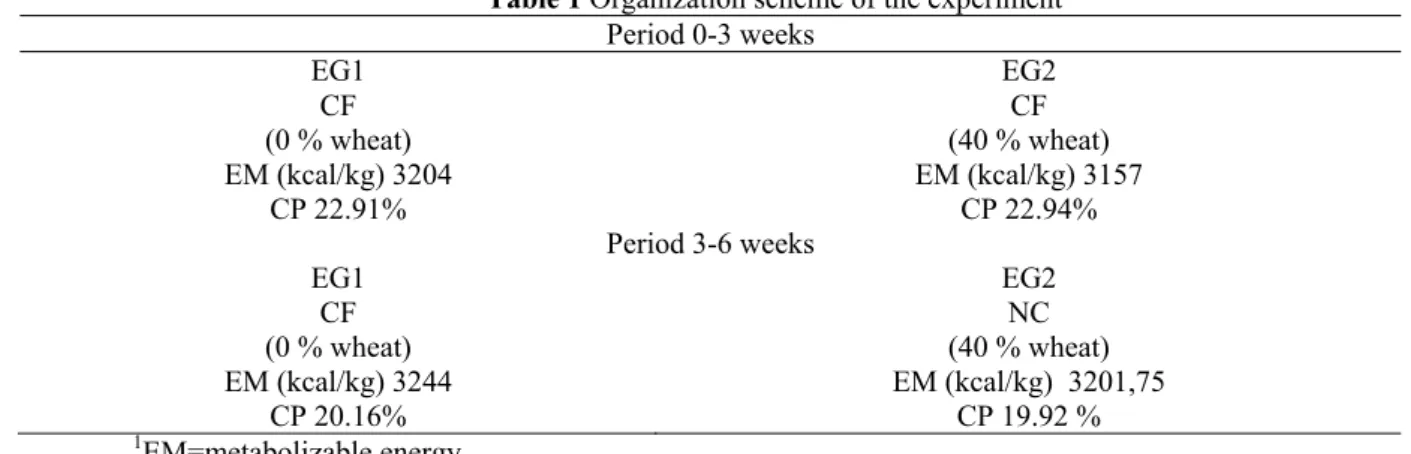
The experiment was performed on 60 chickens, distributed in two experimental variants. The chickens were fed as follows: during the first growth period, namely from eclosion to 3 weeks, the combined forage supplied 3157-3204 kcal metabolisable energy (EM) and a crude protein content of 22.91-22.94 %. In the second growth period, from 3 to 6 weeks, the combined forage supplied 3201.75-3244 kcal EM and 19.92-20.16 % CP. The experimental organization scheme and the nutritional characteristics of the forage mixtures used in this experiment are presented in table 1. To determine the nutritional value of the combined forage and the non-starch polysaccharide content, we used the standardized specific methods in concordance with the WEENDE scheme; the analyses were carried out in laboratories at the Department of Animal Nutrition and Alimentation, Faculty of Animal Sciences and Biotechnologies Timişoara and University College Dublin. To establish lactic bacteria and coliforms, the research material was inoculated in nutritional broth and then maintained in thermostat, at 37° C, for 24 hours. Then we determined the total germ number, with the help of Petri dish- cultures, making serial dilutions for
each of the bacteria genera studied. Of each dilution, we performed inoculations on Petri dishes; the solid medium (agar), melted and chilled at 45°C, was then poured on these, by welding for a uniform medium distribution. The prepared Petri dishes, adequately marked for each dilution, were maintained at room temperature for medium solidification, and then introduced in the thermostat, at 37°C, for 24 hours. Germ number determination was performed by counting the developed colonies, considering that each germ generates one colony. The number of colonies determined on the Petri dish was then multiplied with the dilution titre, obtaining the number of germs per dilution. To determine the morphophysiological changes induced by the various NSP sources on the epithelial tissue, we sampled 1-2 cm2 of duodenum, respectively jejunum from each chicken. The histological examination of the intestinal wall was carried out in concordance with the steps of sampling, washing, inclusion, sectioning and staining with haematoxylin-eosin, respectively trichromic Mallory staining. The testing of the difference significance between groups, regarding the production indices, was performed with the help of the Mann-Whitney-Wilcoxon test, and with the Minitab 14 software and the Duncan’s test as well.
3. Results and discussion
113 1.17 percentage points bigger than in EG1, during the period from 0 to 3 weeks, and of 1.19
percentage points bigger, during the period from 3 to 6 weeks.
Table 1 Organization scheme of the experiment Period 0-3 weeks
EG1 EG2 CF
(0 % wheat) EM (kcal/kg) 3204
CP 22.91%
CF (40 % wheat) EM (kcal/kg) 3157
CP 22.94% Period 3-6 weeks
EG1 EG2 CF
(0 % wheat) EM (kcal/kg) 3244
CP 20.16%
NC (40 % wheat) EM (kcal/kg) 3201,75
CP 19.92 %
1EM=metabolizable energy,
2CP= crude proteine
Table 2 Combined forages content in non-starch polysaccharides (NSP) Growth
period Specification NSPs
1
(%) differences Percentage NSPi
2
(%) Percentage differences NSPt
3
(%) Percentage differences Arabino- xylans differences Percentage
0% wheat 0.788 - 9.46 - 10.248 - 4.16 -
Period 0-3 weeks
40 % wheat 1.693 0.905 9.506 0.046 11.199 0.951 5.33 1.17
0 % wheat 0.865 - 9.55 - 10.415 - 4.37 -
Period 3-6 weeks
40 % wheat 1.8487 0.9837 9.5383 -0.117 11.387 0.972 5.56 1.19
1soluble non-starch polysaccharides
2 insoluble non-starch polysaccharides
3total non-starch polysaccharides
Table 3 Evolution of the number of Lactobacillus and coliform bacteria in the Broiler chickens from the experimental variants
EG1 EG2
Lactic bacteria Coliforms Lactic bacteria Coliforms
4.81x10⁸ 9.65x10⁵ 1.75x10⁸ 1.24x10⁵
The caecum is the most important fermentative segment in chicken gastric-intestinal tract, where the undigested carbohydrates may ferment with the help of the flora present here, being decomposed into organic acids and gas [11]. Fibre utilization in chicken diet influences chicken growth performances, and also the fermentation within caecum, causing even caecal hypertrophy [12]. [13] showed that a fibre-rich diet generated a 25%-increase of caecum size in turkeys, for example. In the experiment performed by Jozefiak, the poultry fed rye-based diet comprising high levels of soluble arabinoxylas had the biggest
114 forage including wheat, from 4.81 * 108 to 1.75 *
108 . Regarding coliform number, they decrease
from 9.65 * 105 in EG1 to 1.24 * 105 in EG2.
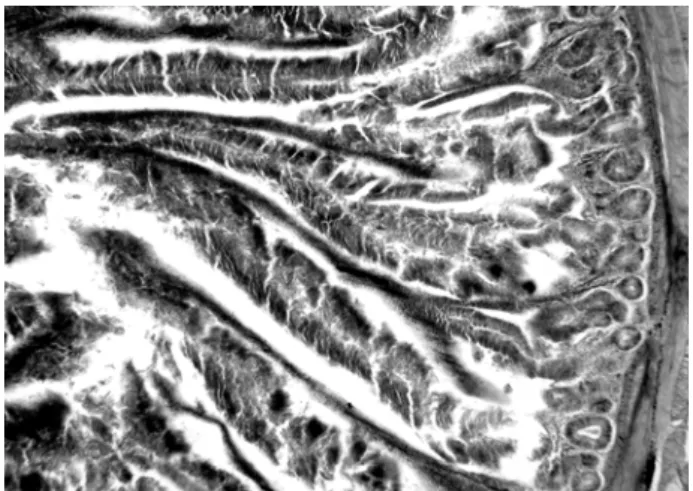
Intestinal viscosity enhancement may slow down the digestive passage, causing dramatic changes in the intestinal microbial balance by reducing oxygen pressure within the small intestine and by providing a stabile environment where the fermentative microflora may be constant (Wagner and Thomas, 1978). This determines intestinal microflora multiplication and consequently the increase of volatile fatty acids (AGV) and lactic acid production and the decrease of pH value (Hume et al., 1992; Ricke et al., 1982). Under normal conditions, the caecum represents the headquarters of the most processes of fermentation of the carbohydrate residual fragments from broilers’ gastric-intestinal tract (Jozefiak et al., 2004). The mechanism glucanase enhances caecal fermentation with is unknown (Choct et al., 1999). Possibly low-molecular weight glucids have entered the caecum because of the reduced digestive viscosity, and rapidly fermented. Also, caecum filling and emptying may be enhanced by enzyme ability of stopping the digestive viscosity at caecum enter (Choct et al., 1999). In a study, F. Gao, 2007 did not find out any significant difference between the control group and the group fed supplemented enzymes in terms of coliform bacteria and lactobacilli within the caecal content, in the case of 21-day old chickens. This result is concordant with the results achieved by Engberg et al. (2004), who drew the conclusion that there are minor changes in the caecal content of lactobacilli and coliform bacteria. In the case of the individuals from the experimental group 1 (EG1), the microscopic sections in duodenum and jejunum reveal the organization of this segment’s wall in four superposed coatings: mucous, submucous, muscle and serous. The mucous presents villosities with the mean height of about 1905.3 μ, slightly widen at the base (fig. 1) and coated with a high mono-layered epithelium, with the mean height of 26.6μ, endowed with ribbed plateau. The inter-glandular areas are reduced, occupied with lax conjunctival tissue consisted of collagen fibres, fibroblasts, mono- and polymorph nuclear leukocytes and sanguine capillaries. Several infiltrative cells may be observed within the glandular (fig. 2) and villositar inter-epithelial regions, and also on the epithelium surface. The conjunctival tissue within the submucous coating comprises numerous
vascular packages, and the muscle coating, consisted of two superposed layers of smooth muscle fibres, internally circular and externally longitudinal, has a mean width of about 174.3 μ. At jejunum mucous level, villosities range in size, but their mean height is 403.9 μ. The intestinal glands, with wide lumen, come from the base of villosities (fig. 2.); their epithelium is passed through by infiltrative cells, which can be observed in the glandular lumen, too. The lax conjunctival tissue within the villositar and interglandular corion (lamina propria) structure is reduced, it integrates the slightly ectasied capillary and lymphatic network. The mean width of the muscle coating, at this level, is about 150.0 μ.
Figure 1 Experimental group (EG1) - section through duodenum, overview
(100x; Mallory trichromic staining)
Figure. 2. Experimental group (EG1)– section through duodenum - intestinal glands and interglandular corion with infiltrated and sanguine
capillary
115 In the case of the individuals within the experimental group EG2, the duodenal mucosa presents villosities with a mean height of about 1090.8 μ, slightly branched (fig. 3), coated with a slightly hypertrophic epithelium, predominantly consisted of absorbent prismatic cells, with a mean height of about 32.6μ. Among the absorbent cells, there are a reduced number of caliciform cells, which are more numerous at glandular epithelium level, and migrating leukocytes as well. The periglandular regions are reduced, occupied by lax conjunctival tissue, the support for a hardly-visible capillary network and of an abundant leukocytary infiltrate. There is, in the villositar corion, a strong leukocytary infiltrate, and the capillary network becomes slightly hypertrophic; however the very well developed structural element of the villositar corion is represented by the smooth muscle fascicle or the Brüke’s muscle (fig. 3). The muscularis has a mean width of about 132.1 μ.
Figure. 3. Duodenum EG2 – intestinal villosity with slightly branched aspect
(400x; Mallory trichromic staining)
Jejunal mucous’ villosities, in the case of the individuals within the experimental group EG2, present a widen aspect, with coated, short lateral branches, like the ones in duodenum, with a slightly hypertrophic epithelium. Mean cell height is about 32.4 μ. Mean vilosity height is about 684.6μ. The interglandular corion structure includes the conjunctival stroma rich in collagen fibres and dispersed fascicles of smooth muscle fibres. Also, the periglandular and submucous capillary network is slightly hypertrophic. In some regions, capillaries are ectasied and we could notice hemorrhagic areas (fig. 4). The villositar
lamina propria is abundant in leukocytary infiltrate and Brüke’s muscle fascicle.
Figure. 4 Jejunum EG2 - ectasied capillary and hemorrhagic areas in the mucosa corion
(400x; trichromic Mallory staining)
The analysis of the histomorphometric data proves that, in the case of the experimental variant EG2, the mean height of the jejunum mucous villosities is bigger (684.6μ) than in the group EG1 (403.9 μ) and these are coated with a slightly hypertrophic epithelium (32.4 μ). Also, in the case of EG2, the periglandular and submucous capillary network is slightly hypertrophic; in some regions, capillaries are ectasied and we may notice hemorrhagic areas. The villositar corion is abundant in leukocytary infiltrate and Brüke’s muscle fascicle, and we could notice a few caliciform cells and very many infiltrative cells in the structure of the glandular epithelium.
4. Conclusions
As a conclusion, we may say that wheat incorporation in the combined forage structure in a proportion of 40 % determines some changes. In these terms, the NSPs content increases; the
116 slightly hypertrophic; in some regions, capillaries are ectasied and we may notice hemorrhagic areas.
Acknowledgements
This work was supported by CNCSIS –UEFISCSU, project number 1115 PNII – IDEI, code 895/2008
References
1 Gao, F., Jinag Y., Zhou G.,H., Han Z.K., The effect of xylanase supplementation on growth, digestion, circulating hormone and metabolite levels, immunity and gut microflora in cockerels fed on wheat based diets, 2007, British Poultry Science vol. 48, nr. 4, pp 480-488
2 Austin, S.,Wiseman, C., Chesson, J., Influence of non-starch polysaccharides structure on the metabolisable energy of U.K. wheat fed poultry. 1999. J. Cereal Sci. 29, 77–88.
3 Steenfeldt, S., 2001. The dietary effect of different wheat cultivars for broiler chickens. Br. Poult. Sci. 42, 595–609
4 Boros, D., Tolerance of broiler chickens to dietary rye soluble arabinoxylans. 1998, Anim. Feed Sci. Technol. 7, 323–331.
5 Silva, S.S.P., Smithard, R.R., Effect of enzyme supplementation of a rye-based diet on xylanase activity in the small intestine of broilers, on intestinal crypt proliferation and nutrient digestibility and growth performanceof the birds. 2002, Br. Poult. Sci. 43, 274– 282.
6 L´azaro, R., Garcia, M., Medel, P., Mateos, G.G., Influence of enzymes on performance and digestive parameters of broilers fed rye-based diets. 2003, Poult. Sci. 82, 132–140
7 Smits, C.H.M., Annison, G., Non-starch plant polysaccharides in broiler nutrition-towards a physiologically valid approach to their determination. 1996, World’s Poult. Sci. 52, 203–221
8 Steenfeldt, S., M¨ullertz, A., Fris Jensen, J., Enzyme supplementation of wheat-based diets for broilers. 1.Effect on growth performance and intestinal viscosity. 1998, Anim. Feed Sci. Technol. 75, 27–43. 9 Jamroz, D., Wiliczkiewicz, A., Skorupi´nska, J., Fermentation and apparent digestion of the structural carbohydrates in chicks, ducks and geese fed triticale mixtures supplemented with enzymes. 1998, J. Anim. Physiol. Anim. Nutr. (Berl.) 79, 1–17.
10 Jamroz, D., Wiliczkiewicz, A., Skorupi´nska, J., Orda, J., V¨olker, L., The effect of increased Roxazyme
G supplement in the broiler fed with triticale rich mixtures. 1996, Arch. Gefl¨ugel. 60, 165–173.
11 Jozefiak, D., Rutkowski, A., Martin, S.A., Carbohydrate fermentation in the avian cecca review. (2004b). Anim. Feed Sci. Tecnnol. 113, 1-15
12 Redig, P., The avian caeca: obligate combustion chambers or facultative afterburners? The conditioning influence of diet. 1989, J. E*p. Zool. 3 (Suppl.), 66-69 13 Duke, G.E., Ecclestone, E., Kirkwood, S., Louis, C.F., Bedbury, H.P., Cellulose digestion by domestic turkeys fed low or high fibre diets. 1984, J.Nutr. 114,95-1(12) 14 Wagner, D.D., Thomas, O.P., Influence of diets containing rye or pectin on the intestinal flora of chicks, 1978, Poult. Sci. 57, 971–975.
15 Choct, M., Hughes, R.J., Wang, J., Bedford, M.R., Morgan, A.J., Annison, G., Increased small intestinal fermentation is partly responsible for the anti-nutritive activity of non-starch polysaccharides in chickens, 1996, Br. Poult. Sci. 37, 609–621.
16 Langhout, D.J., Schutte, J.B., Van Leeuwen, P., Wiebenga, J., Tamminga, S., Effect of high- and lowmethylated citrus pectin on the activity of the ileal microflora and morphology of the small intestinal wall of broiler chicks. 1999, Br. Poult. Sci. 40, 340–347. 17 H¨ubner, K., Vahjen, W., Simon, O., Bacterial responses to different dietary cereal type and xylanase supplementation in the intestine of broiler chicken. 2002, Arch. Anim. Nutr. 56, 167–187.
18 Bedford, M.R., Apajalahti, J., Microbial interactions in response to Exogenous enzyme utilization. 2001, In: Bedford, M.R., Partrige, G.G. (Eds.), Enzymes in Farm Animal nutrition. CABI Publishing, pp. 299–314. 19 Hume, M.F., Kubena, L.F., Beier, R.C., Hinton, A., Carrier, D.E., Deloach, J.R., Fermentation of lactose in broiler chicks by cecal anaerobes. 1992, Poult. Sci. 71, 1464-1470
20 Ricke, S.C., Vander Har, P.J., Fahey Jr., G.C., Berger, L.L., Influence of dietary fibers on performance and fermentation characteristics of gut contents from growing chicks. 1982, Poult. Sci. 61, 1335-1343
21 Choct, M., Hughes, R. J., Bedford M. R., - Effects of a xylanase on individual bird variation , starch digestion throughout the ontestine, and ileal and caecal volatile fatty acid production in chickens fed wheat. 1999,. British Poultry Science, 40, pg 419-422