Comprehensive E-Research Process Framework and Effects of Electronic Scientific Databases on Its Adoption
V. Khatibi, M. Sc. G. A. Montazer, Ph.D. Tarbiat Modares University, Iran Tarbiat Modares University, Iran Corresponding Author: [email protected] Email: [email protected]
Abstract
Today, the scientific communications are developed and expanded on the internet and the famous World Wide Web service, and the popularity of the electronic scientific databases (ESDs) such as ScienceDirect, Google Scholar, and Scopus is an evidence of this claim. In addition to providing scientific contents, the ESDs offer researchers diverse scientific web services such as scientific communications and collaborations. In accordance with the electronic developments such as ESDs and their scientific web services, the scholars’ research process is evolved so as the birth of the electronic research (e-Research) process makes scholars initiate their research, drive it, and reach its determined goals electronically. In this paper, we focus on the ESDs’ scientific web services role in the research process. After presenting a classification for the scientific web services, a comprehensive framework for the e-Research process is proposed. Also, the effects of the scientific web services on adoption of the e-Research process are studied. For this purpose, an appropriate questionnaire was prepared and delivered to the graduate students in the Engineering and Management disciplines of Tarbiat Modares and Amirkabir universities, located in Tehran, to assess the scientific web services’ usages in their research processes development. After analysis of the acquired data, the findings showed that the scientific web services of information storage and sharing, searching, and communications are the most popular and useful web services in the scientific community, and therefore, have great effects on the adoption of the e-Research process so that the more convenient and desirable these services are, the more popular they get.
Keywords: E-Science, E-Research Process, Electronic Scientific Database, Scientific Web Service.
Introduction
authorized persons to validate their correctness, whereas in the rationalistic mode we rely mainly on sagacity to reason for our propositions. Also, mystical mode focuses on intuitive perceptions which provide humans with intuitions about propositions. The last mode, the scientific method, is considered as the most popular way to acquire knowledge in human society so far, so as humans can formulate, examine, test and verify their hypotheses in various disciplines (Krige and Pestre, 1997). Whatever the aims of their works, scientists use the same underlying steps to organize their researches (Trefil, 2001): (1) they make detailed observations about objects or processes, either as they occur in nature or as they take place during experiments; (2) they collect and analyze the information observed and (3) they formulate a hypothesis that explains the behavior of the phenomena observed.
On the other hand, the recent applications of information and communication technologies (ICTs) have a strong and social impact on the society and daily life. One of the aspects of society that has been transforming is the way of learning and teaching (Parikh and Verma, 2002). In the recent years, we have seen exponential growth of electronic learning (e-Learning) such as internet-based learning through World Wide Web services. In a simple definition, e-Learning is defined as the use of information and communication technologies to design, deliver, select, administer and extend learning (Hamdi, 2007). Important features of this form of learning are the separation of learner and teacher, and taking place anywhere, at any time and at any pace. Thus, e-Learning can take place at people’s work or at home, at the time available (Kabassi and Virvou, 2004). The other perspectives of using e-Learning can be generalized as follows: an opportunity for overcoming the limitations of traditional learning such as large distance, time, budget or busy program; equal opportunities for getting education no matter where you live, how old you are, what your health and social status is; better quality and a variety of lecture materials; new consortia of educational institutions where a lot of specialists work in collaboration, use shared resources and students get freedom to receive knowledge, skills and experience from other universities (Georgieva, Todorov and Smrikarov, 2003).
and Management disciplines of Tarbiat Modares and Amirkabir universities, located in Tehran, to assess the scientific web services’ usages in their research processes development. The obtained data of the scientific web services’ questionnaire are organized in spreadsheet software, and then analyzed by statistics software.
This paper is organized as follows: After discussing the e-Research in Section 2, we represent the findings of the electronic scientific databases study in Section 3. We propose an e-Research process framework in Section 4 which is comprised of fully electronic steps. In the last Section, the scientific web services’ effects on the adoption of the e-Research process are analyzed.
E-Science and E-Research
The relatively new field of electronic science (e-Science) provides a real opportunity to transform regular science by enabling students, teachers and research scientists to engage together in authentic scientific enquiry, collaboration and learning (Underwood, Smith, Luckin and Fitzpatrick, 2008; Schroeder, 2008). The UK National e-Science Centre asserts that e-Science will change the dynamic of the way science is undertaken describing the rapidly evolving field as being about global collaborations in science and developing the next generation of infrastructure that will enable these (NeSC, 2007). E-Science is about both new ways of doing science and technologies that allow this. Researchers in education have seen the potential for e-Science to also support new ways of learning and have explored these in several projects. For a review of e-Science in education, see (Woodgate and Fraser, 2005) who offers the following definition for the e-Science: ‘‘The use of ICT in education, to enable local and remote communication and collaboration on scientific topics and with scientific data’’. This definition rightly places the emphasis on the learning activities to be supported while deliberately avoiding mention of specific ‘new technologies’ to enable them. This contrasts with the wider definition of e-Science which, while still focusing on the activity to be supported, clearly points to the need for new infrastructure to enable this; an infrastructure that enables flexible, secure, coordinated resource sharing among dynamic collections of individuals, institutions and resources (NeSC, 2007).
to support communication between remote participants around scientific enquiry activities, e.g., between learners in different schools (Pea, Gomez, Edelson, Fishman, Gordin and O’Neil, 1997; Smith, Luckin, Fitzpatrick, Avramides and Underwood, 2005), between learners in school and out on field trips (Kravcik, Kaibel, Specht and Terrenghi, 2004) and between learners, teachers and remote science experts (Underwood et al., 2008). It is often claimed that such collaborations can lead to improved learner attitudes towards science and understanding of real science and scientists (Beare, 2007; Scherz and Oren, 2006).
On the other hand, another novel field in the Science has been developed, called e-Research, based on the information and communication technologies application in the research process (Anderson and Kanuka, 2003; Meyer and Schroeder, 2009). The term ‘e-Research’ encapsulates research activities that use a spectrum of advanced ICT capabilities and embraces new research methodologies emerging from increasing access to (Sargent, 2006):
broadband communications networks, research instruments and facilities, sensor networks, data repositories with their associated data standards and management tools, and high performance computing resources;
software and infrastructure services that enable a trust and sharing relationship to be established between researchers and the wide variety of data repositories, computers, systems and networks on which they depend; and
application and discipline-specific tools such as graphics intensive visualization, simulation software, and interaction tools that provide the human interface allowing researchers to interact with each other and with their instruments, computational facilities and data resources.
E-Research capabilities serve to advance and augment, rather than replace traditional research methodologies. There is a growing dependence on the following e-Research capabilities to (Sargent, 2006):
discover knowledge, whether held in digital or physical forms;
access data as well as the software services that are being made available to manipulate or analyze this data;
synthesize, curate and disseminate new knowledge efficiently; and
Facilitate interactivity and research collaboration, allowing researchers to work seamlessly from desk-to-desk within and between organizations.
The main factors that enable researchers to increase their use of ICT are:
their awareness of the full potential of ICT to enhance their research;
the availability of an interconnected fabric of underlying shared service resources that facilitate access to diverse data sets, collaboration and interoperability, regardless of the discipline of the researcher or computer platform being used;
the skills and abilities of the researchers themselves to make full use of the ICT services and facilities at their disposal.
The amount and range of benefits from greater use of e-Research methodologies will vary between researchers and disciplines, according to their needs, awareness and skills, and the availability of the necessary support, expertise and physical resources.
The ESDs have great effects on the e-Research process, so as the scholars can initiate their research, drive it, and reach its determined goals by using the ESDs’ scientific web services. Also, both of novice and experienced researchers can use e-Research process to enhance their research programs. It encompasses how the information technology such as internet changes, evolves, improves and yet often complicates the research process. In fact, e-Research is targeted toward completion and updating the regular research process to yield researchers most benefits of information and communication technologies. E-Research encompasses the normal research process which is augmented with benefits from internet tools in fields such as gathering both qualitative and quantitative data and then analyzing and disseminating results (Anderson and Kanuka, 2003).
Electronic Scientific Databases and Their Web Services
Electronic scientific databases, similar to digital libraries, are advanced academic repositories that offer scientific information through appropriate contents and services (Chowdhury and Chowdhury, 2003; Moreira, Goncalves, Laender and Fox, 2009; Buckland, 2008). In this way, two approaches are observed: one on the access and retrieval of digital content, and the other on collection, organization and service aspects of digital resources or artifacts that cannot be represented or distributed in printed formats (Xie, 2006). As a key pillar of the e-Research process, electronic scientific databases play a critical role in achievement of this developed research process. Today, internet and its most famous service, the World Wide Web, have great potentiality for establishing the ESDs and in this way are the most popular platform for implementing ESDs. To examine the various ESDs on internet and their scientific web services, we studied 42 ESDs as follows:
Science (E-LIS), Excerpta Medica Database (EMBASE), HighWire, Institute of Electrical and Electronic Engineers (IEEE) digital library, IngentaConnect, JSTOR (Journal Storage), National Bureau of Economical Research (NBER), Ovid, ProQuest, PubMed, Research Papers in Economics (RePEc), ScienceDirect, Sens Public, Social Sciences Research Network (SSRN), Wiley InterScience, Emerald, SpringerLink, GoogleScholar, HubMed, King Medical Library Engine (KMLE) Medical Dictionary, Libra, LivRe, Scirus, CiteULike, RefWorks, 2Collab and EndNote Web. In the next pace, the ESDs’ scientific web services are studied and then classified into 10 categories which are as follows:
scientific communications:
o e-Mail
o news groups and forums
o Weblogs
o virtual social networks
scientific information storage and sharing; scientific e-Publishing:
o scientific e-Journals and e-Zines
o e-Theses and e-Dissertations
o e-Encyclopedias, e-Dictionaries and e-Maps scientific searching:
o scientific search engines
scientific multimedia and Webcasting:
o texts, pictures, audios, videos, graphics, animations and interactives
o e-Conferences and Webinars scientific collaborations:
o e-Workspaces in scientific projects
o scientific discussions in chat rooms
o scientific funding opportunities
o scientists and researchers introduction
o scientific call for papers (CFPs) collective intelligence:
o online encyclopedias with user-generated content scientific indexing:
o indexing the papers of various journals
o indexing the journals in various disciplines scientific citation analysis:
o assessment of the papers citation
o determination of the most cited researchers and universities online scientific reference libraries:
scientific Web applications:
o grid computing
o decision support and expert systems on the web
Scientific communications category is very similar to regular communications, but performed by the electronic channels, e.g. email, weblogs and virtual social networks. Essentially, some of the electronic services are substituting the regular physical ones. For instance, the regular communication mechanisms such as physical letter posting are vanished and instead, the new ways of electronic communications are substituted. Scientific information storage and sharing category is the electronic publishing of the scientific information, called the scientific e-Publishing too. Scientific searching is represented in the special search engines such as Scirus5, which are designed to index, search and represent the scientific information only. Scientific multimedia and Webcasting service is using the audio, video, animation and other multimedia features to participate in the scientific events such as teleconferences or Webinars. Scientific collaborations category is the usage of ICT in forming a new shape of scientific workspace between scientists and researchers to conduct their research processes. Collective intelligence is a relatively new field in which information is generated by the users, e.g. Wikipedia6, so as users can extend their knowledge by using this intelligence and also contribute to improve the others intelligence. Scientific indexing service attends the indexing of the papers in various journals or the journals in various disciplines. Scientific citation analysis service has the role of the papers’ citation assessment, and in this way, can determine the most cited researchers and universities. Online scientific reference libraries are providing a new way for researchers to manage their scientific references on the web. Scientific web applications are special software programs on the web which facilitate the scientific affairs of researchers in various disciplines by providing customized services.
Among the mentioned categories, five categories of scientific information storage and sharing (e-Publishing), scientific indexing, scientific citation analysis, scientific searching and online reference libraries are primal, and are observed frequently in the ESDs. According to these categories, the 42 studied ESDs are classified as follows:
Scientific indexing: CiteSeer, Directory of Open Access Journals (DOAJ), Institute of Engineering and Technology/ Information Service for Physics, Electronics, and Computing (IET/INSPEC), Library and Information Sciences Abstracts (LISA), National Administration of Space and Aeronautics/ Astrophysics Data System (NASA/ADS), Open Access Journals Gateway (Open J-Gate), Stanford Public Information Retrieval System (SPIRS), and The Collection of Computer Science Bibliographies.
Scientific information storage and sharing (e-Publishing): Association of Computing Machinery (ACM) digital library, arXiv, AtyponLink, Blackwell Synergy, Cambridge Scientific Abstracts (CSA), E-prints in Library and Information Science (E-LIS), Excerpta Medica Database (EMBASE), HighWire, Institute of Electrical and Electronic Engineers (IEEE) digital library, Emerald, SpringerLink, IngentaConnect, JSTOR (Journal Storage), National Bureau of Economical Research (NBER), Ovid, ProQuest, PubMed, Research Papers in Economics (RePEc), ScienceDirect, Sens Public, Social Sciences Research Network (SSRN) and Wiley InterScience.
Scientific search engines: GoogleScholar, HubMed, King Medical Library Engine (KMLE) Medical Dictionary, Libra, LivRe and Scirus.
Online scientific reference libraries: CiteULike, RefWorks, 2Collab and EndNote Web.
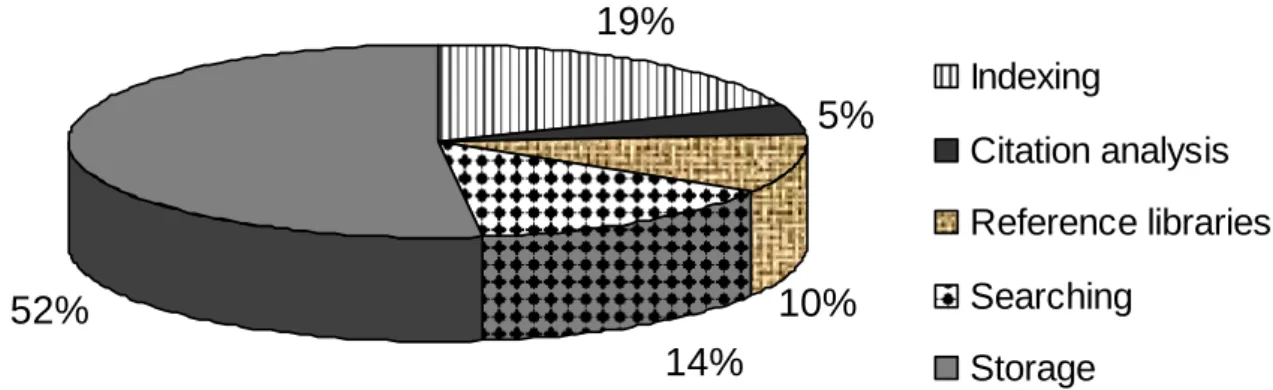
Most of the studied ESDs are in the scientific information storage and sharing category, whereas the least quantity of ESDs belongs to the online scientific reference libraries category. Figure 1 exhibits the quantity status of the studied ESDs based on their scientific web services. Induction of this result to the whole ESDs on the web indicates that most of the scientific web services belong to scientific e-Publishing, and then to the scientific indexing, searching, citation analysis and online reference libraries categories, sequentially. It should be noted that some of the ESDs such as citation analysis databases are very rare, but their tasks are very special in contrast to others.
5% 19%
52%
14%
10%
Indexing
Citation analysis Reference libraries Searching
Storage
Figure 1. Quantity status of the studied ESDs based on their scientific web services
E-Research Process Framework
a. Determination of general research topic and its target (Initial parameters)
The first step in the e-Research process framework is determination of general research topic which includes the research main target and its initial parameters.
b. Exact determination of research title
After deciding on the research topic, we enter the next pace which is the exact determination of the research title. At this step, we encounter one of the main services in the e-Research process called “scientific searching” which provides scholars with information of conference proceedings, journal papers, theses documents and even patent specifications, so as scholars can find the most suitable and appropriate contents related to their research topic. In addition to general purpose search engines such as Google7 and Yahoo8, some scientific search engines like Scirus and GoogleScholar9 are proposed specifically in this regard. Also, the searching service is included in almost all the ESDs such as ScienceDirect10, SpringerLink11, Scopus12 and ProQuest13.
The electronic encyclopedias can be used as the complementary general references in almost all the scientific disciplines, so as scholars can reach to huge pools of information provided by famous encyclopedias such as Britannica14 and Encarta15 to augment their research contents. These websites usually need subscription fees to represent their full versions to interested scholars. Also, electronic versions of the dictionaries are provided online, so as scholars can gain access to famous dictionaries such as Oxford16 and Webster17 to know the meanings of the words and phrases electronically. Also, special websites such as AcronymFinder18 help scholars know the abbreviations and acronyms in different disciplines.
After selection of the main research topic, scholars need to narrow down it to be a suitable research topic. In this regard, they should know all the related keywords to their research topic. The thesaurus search of the ESDs such as Scopus and ProQuest is a useful web service in this regard which assists scholars to find the related keywords to their research topic. Another method for this purpose is to browse indices in ESDs such as NASA/ADS19 which classify the research topics in a hierarchical mode. In this way, scholars can find the appropriate topics and keywords in each branch of a scientific discipline. Another useful web service in the ESDs is citation review and analysis. This service is one of the special services implemented via digital technologies in ESDs such as Scopus and CrossRef20 because without using theses technologies it is very difficult and in some cases impossible to gather all the citations to the scientific peer-reviewed contents.
c. Assurance of plagiarism avoidance
d. Literature study
In the next step, the researchers should study the literature carefully, so as searching and studying all the scientific documents regarding their exact research title or keywords are their main tasks in this step. For this purpose, researchers can use various web services including general e-Databases, discipline-specific e-Databases, citations and patents searching, abstract journals, open access journals, scientific search engines, and general e-Resources such as e-Books, e-Maps, e-Theses, etc.
e. Finding key researchers
Finding the key researchers in specific scientific domains is another web service embedded in some ESDs such as Scopus and Cambridge Scientific Abstracts (CSA)22. In this way, scholars can identify the most active researchers in their domain of research so as scholars can study their publications and also communicate with them electronically to
resolve their problems or even collaborate with them to conduct joint research projects.
f. Obtaining financial aids (grants and funds)
Usually, the scholars need sponsors to support their researches. In this regard, appropriate Web services are implemented in some ESDs such as ProQuest’s community of science (COS)23 to provide scholars with the financial opportunities, available grants and even fellowship opportunities. In this way, scholars can find and exploit the best occasions to support their researches. Also, participating in the scientific research groups is one of the regular issues in the science globe from long ago. The cyberspace also provides another novel medium to join other researchers in a specific domain via electronic communications, so as they can define, drive and finish their research with the collaboration of each other electronically. Some ESDs such as ACM’s special interest groups (SIGs)24 and IEEE’s sections25 provide such opportunities for scholars to participate in the research and scientific affairs.
g. Research problem solution and its examination
datasets via sponsors or donators for free or with usage fees.
h. Research findings writing
After proposing the research solution and its examination, we should write the research findings. For this reason, we can use online reference libraries to manage our scientific references on the Web. Gathering the citation information of the research references according to the journal or conference styles is one of the time-consuming and drudging tasks in the research process. Some ESDs such as RefWorks27 and CiteULike28 can assist in this regard so that after extracting the citation information of the selected references electronically, they adapt them according to the journal styles or reference library software such as EndNote29 and BibTex30 formats. Also, we can use the journals or conferences paper templates, e.g. the EndNote journal or conference templates to represent our solution in the scientific community.
i. Finding publications (call for papers)
Finding the appropriate and respective conferences, congresses, symposiums, colloquiums, and workshops to the research interests of the scholars is one of their tasks to collaborate and present the findings of their research in the scientific community and also get informed of the new advancements taken place in their domain of study. Some websites such as WikiCFP31, Conferencealerts32 and Allconferences33 provide dedicated services in this regard. Also, the call for papers (CFPs) of the peer-reviewed journals and their special issues are also included in some of the ESDs.
j. Reporting research results
After proposing a solution for the studied problem, it is necessary to report the research findings to the scientific community. For this purpose, the virginity and validity of the research should be investigated that is handled through peer-review process. Authors usually submit their research papers to conferences and journals to be reviewed for publication. In this stage, ESDs can assist the scholars in several ways. Almost all the conferences and journals have their dedicated websites through which they receive manuscripts and then dispatch them to their reviewers. After finalizing the review process, they send the reviewers’ comments and final decisions to the authors. The whole process is taken place electronically. As a famous instance of this Web service, we can mention Elsevier editorial service (EES)34 which is developed for almost all the journals in the publisher Elsevier35 so that it handles all the above mentioned process electronically. The other ways to represent the research results include magazines, workshops, patent registration, etc.
k. Electronic presentation
ScienceDirect. Besides, teleconferences, Webinars or virtual workshops are known as the novel presentation methods, so as authors participate or present their papers electronically via appropriate tools such as webcams and fast network connections.
One of the key protection mechanisms for the intellectual property is patents. The scholars can register the novel systems, products, algorithms or even ideas as patents, so as they will be recognized as the legal owners of them. Some offices are responsible for the reviewing and registering the patents among which United States patent and trademark office (USPTO)36, European patent office (EPO)37 and Japan patent office (JPO)38 offices are the most famous ones. Also, scholars can search the patent specifications in aforementioned websites in addition to Scopus patents39 and Google patents40.
l. Usage analysis
The next step is the usage analysis of the research findings reports such as papers or patents. The patent usages or paper citations are represented in some ESDs such as Scopus which can be used to recognize the hottest research topics and applications and also are considered as the main criteria in assessment of the scientists and universities.
m. Finalizing the research process with its documentation and proposing novel research
problems in following
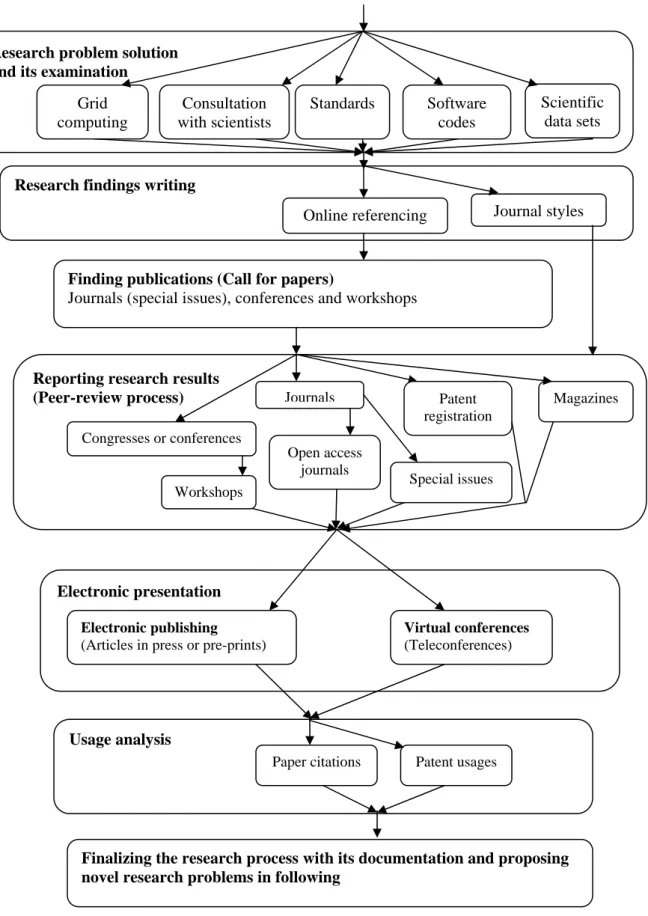
Figure 2. E-Research process framework Literature study
Determination of general research topic and its target (initial parameters)
Exact determination of research title
Determination of research keywords Online
dictionaries
Online encyclopedias E-Databases
E-Thesauruses Browse indices
Assurance of plagiarism avoidance
Discipline-specific e-databases General
e-databases
Citations and patents search
Abstract journals
Scientific search engines
E-Resources (e-Books, e-Maps,
E-Theses, ...)
Open access journals
Finding key researchers
Defining joint research projects
Searching researchers
Registration in scientific groups
Figure 2. E-Research process framework (Cont’d)
Analysis of Scientific Web Services’ Effects in Adoption of the E-Research Process
To invest effectively in the scientific web services, we need to know the importance and Research problem solution
and its examination
Research findings writing
Journal styles Online referencing
Reporting research results (Peer-review process)
Congresses or conferences
Journals
Special issues
Magazines Finding publications (Call for papers)
Journals (special issues), conferences and workshops
Open access journals
Patent registration
Usage analysis
Paper citations Patent usages
Finalizing the research process with its documentation and proposing novel research problems in following
Workshops
Scientific data sets Consultation
with scientists
Standards Software codes Grid
computing
Electronic presentation
Virtual conferences (Teleconferences) Electronic publishing
applicability of these services in the scientific community (Lopez-Fernandez and Rodriguez-Illera, 2009; Xie, 2008). In this way, we can determine the investment priorities, so as the most popular services need to obtain more funds. After that, the adoption and development of the e-Research process in the scientific community will be facilitated and also substituted to the regular research process in the future.
To evaluate the importance, applicability and effects of the scientific web services in adoption of the e-Research process, we prepared a questionnaire to measure the effect degrees of various scientific web services in the scientific community, and in this way, their ranking is also determined. In this questionnaire, we asked the audience to represent their opinions about the scientific web services’ importance, applicability and effect degrees in their research processes through the 1-10 rating scale. For this purpose, we selected 176 graduate students in Engineering and Management disciplines of Tarbiat Modares and Amirkabir universities, located in Tehran, as the audience of the questionnaire, so as they were asked to determine the importance degrees of the scientific web services in the development of their researches. After gathering the answer sheets of the questionnaires and organizing them in Microsoft Excel’s spreadsheet, we used Cronbach’s alpha test to check the internal consistency of the acquired data, so as 0.827 was obtained for their reliability analysis by the standard package for social sciences (SPSS) software. The descriptive statistics of the acquired data have been shown in Table 1. Also, Figure 3 exhibits the relative comparison of the scientific web services’ score averages.
Table 1
The Scientific Web Services’ Descriptive Statistics
Scientific Web service score Min. Max. Average Standard
deviation Variance
Scientific communications 6 10 6.89 1.75 3.08
Scientific information storage
and sharing (E-publishing) 8 10 9.32 1.87 3.49
Scientific searching 6 10 8.58 1.46 2.12
Scientific multimedia and
Webcasting 4 10 6.41 1.89 3.6
Scientific collaborations 5 10 7.54 1.61 2.58
Collective intelligence 4 9 6.5 1.78 3.2
Scientific information indexing 5 10 6.27 2.19 4.82
Scientific citation analysis 6 10 6.04 2.29 5.1
Online scientific reference
libraries 4 9 6.08 2.18 4.78
Figure 3. Scientific web services’ score averages comparison
In the next pace, we applied a ranking method to the acquired data to determine the scientific Web services’ ranking. For this purpose, we selected the Friedman’s ranking algorithm and used SPSS software to apply this algorithm to the scientific web services data. After running SPSS with selection of Friedman test in non-parametric tests on the scientific Web services’ data, the following results were acquired, as shown in Table 2.
Table 2
The Scientific Web Services Ranking Scores Based on the Friedman’s Algorithm Scientific Web service Score Rank
Scientific information storage and sharing (E-publishing) 9.27 1
Scientific searching 8.23 2
Scientific communications 5.82 3
Scientific collaborations 5.5 4
Scientific citation analysis 4.91 5
Collective intelligence 4.86 6
Scientific multimedia and Webcasting 4.68 7
Scientific information indexing 4.5 8
Online scientific reference libraries 3.77 9
Scientific Web applications 3.45 10
0 1 2 3 4 5 6 7 8 9 10
Rank score
Stor age
an
d sh arin g Sear chin g Com mun icat ions Colla bora tions Cita tion an alys is Colle ctiv
e in telli genc e Mul tim edia Inde xing Refe renc
e lib rari es Web ap plic atio ns
Scientific web services
Figure 4. Scientific web services ranking comparison based on the Friedman’s test
a. Research findings analysis
Based on the ranking results analysis, the most popular scientific web service is the scientific storage and sharing service whose effect degree average, in a 1-10 scoring system, is 9.32. The scientific searching and communications web services obtained the second and the third positions in the ranking, respectively. Therefore, it is obvious that the scientific storage and sharing, searching and communications web services, as the most popular services in the scientific community, have great effects on adoption of the e-Research process and hence should be flourished to come up with the new needs of the researchers and for this reason are the appropriate places to invest on. Therefore, the desirability of these services has great effects on the scientific community to adopt the e-Research process easily; the more convenient these services are the more popular they get.
On the other hand, some of the scientific web services are thoroughly new, and they did not exist beforehand such as the collective intelligence. But the low score of this service shows that this relatively new field needs more extensive partnership of scientists to be a scientific standard reference for researchers. Improvement in the information quality analysis, verification and assurance methods is the primal way in this regard. Also, the scientific web applications have not represented their real capabilities in the development of the research processes yet, so as one of the open research areas in the e-Research process is the proposition of the appropriate Web applications to assist in resolution of the research problems of various disciplines. The most crucial point in the e-Research process is the research problem solution step which is not fully electronic, and still needs more enhancements to integrate the various scientific affairs concerning the research problem solution. But at present, some research projects are using the ICT capabilities to drive their research processes, e.g. the grid computing service is a popular method to integrate all the computation capacities to perform massive calculations in the least time period, so as represented in the particle acceleration experiments’ calculations in European Organization for Nuclear Research (CERN).
Conclusion
Development in the scientific communications on internet and its famous web service caused the popularity of the electronic scientific databases such as ScienceDirect and Scopus. The ESDs provide scholars with scientific contents, besides diverse scientific web services comprised of several types including scientific communications and collaborations. Therefore, the scholars’ research process is evolved accordingly based on the ESDs and their web services called the electronic research (e-Research) process. In this paper, we proposed a comprehensive framework for the e-Research process comprised of thirteen steps which are undergone electronically. The research findings analysis showed the scientific web services of information storage and sharing, searching, and communications are the most popular and applicable services, and in this way, have great effects on the adoption of the e-Research process in the scientific community; the more convenient these services are the more popular they get. Also, the research findings showed probably some physical research services such as physical conferences and workshops will be durable in the future.
Endnotes
1. Faulkus Telescope Project; http://faulkus-telescope.com/. 2. Climate Prediction Project; http://www.climateprediction.net/.
3. Folding@home distributed computing project; http://folding.stanford.edu/.
http://www.nhm.ac.uk/woodlice/.
5. Scirus scientific search engine; http://www.scirus.com/.
6. User-generated content encyclopedia; http://www.wikipedia.org/. 7. Google general search engine; http://www.google.com/.
8. Yahoo general search engine; http://www.yahoo.com/. 9. Google’s scientific search engine; http://scholar.google.com/.
10. Publisher Elsevier’s online scientific repository; http://www.sciencedirect.com/. 11. Publisher Springer’s online scientific repository; http://www.springerlink.com/. 12. Publisher Elsevier’s scientific citation database; http://www.scopus.com/. 13. Proquest online scientific database; http://www.umi.com/pqdauto.
14. Encyclopedia Britannica’s online version; http://www.britannica.com/. 15. Encyclopedia Encarta’s online version; http://encarta.msn.com/.
16. Oxford dictionary’s online version; http://www.oxfordlanguagedictionaries.com/. 17. Webster dictionary’s online version; http://www.merriam-webster.com/.
18. Acronyms and abbreviations database AcronymFinder; http://www.acronymfinder. com/.
19. National aeronautics and space administration/Astrophysics Data System; http://www. suo-nasaads.com/.
20. Online citation database CrossRef using digital object identifier (DOI); http://www. crossref.org/.
21. Plagiarism detection database PlagiarismDetect ; http://www.plagiarismdetect.com/. 22. Cambridge scientific abstracts database, subset of Proquest database; http://www.
csa.com/.
23. ProQuest’s community of science database; http://www.cos.com/.
24. Association of computing machinery’s special interest groups; http://www.acm.org/. 25. Institute of electrical and electronic engineers’ sections; http://www.ieee.org/. 26. Machine learning repository of UCI university; http://archive.ics.uci.edu/ml/. 27. Online reference library website; http://www.refworks.com/.
28. Online manipulation of scientific references library; http://www.citeulike.org/. 29. EndNote reference library management software; http://www.endnote.com/. 30. BibTex reference library software; http://www.bibtex.org/.
31. Wiki call for papers; http://www.wikicfp.com/.
32. Alerts of conferences website; http://www.conferencealerts.com/.
33. Conferences lists in difference scientific disciplines; http://www.allconferences.com/. 34. Publisher Elsevier’s online editorial service; http://ees.elsevier.com/.
38. Japan patent office; http://www.jpo.go.jp/. 39. Scopus patents; http://www.scopus.com/.
40. Google patents; http://www.google.com/patents/.
References
Anderson, T. & Kanuka, H. (2003). E-research: Methods, strategies and issues. Boston: Pearson Education.
Beare, R. (2007). Investigation into the potential of investigative projects involving powerful robotic telescopes to inspire interest in science. International Journal of Science Education, 29 (3), 279–306.
Buckland, M. K. (2008). Reference library service in the digital environment. Library & Information Science Research, 30, 81-85.
Burbidge, M. & Grout, I. (2006). Evolution of a remote access facility for a PLL measurement course. Paper presented at the 2nd IEEE international conference on
e-Science and grid computing. Amsterdam, The Netherlands, December 4-6.
Chowdhury, G. G. & Chowdhury, S. (2003). Introduction to digital libraries. London: Facet Publication.
Georgieva, G., Todorov, G. & Smrikarov, A. (2003). A model of a Virtual University: Some problems during its development. Paper presented at the 4th ACM international
conference on computer systems and technologies: E-Learning. Rousse, Bulgaria, June 19-20.
Hamdi, M. S. (2007). MASACAD: A multi-agent approach to information customization for the purpose of academic advising of students. Applied Soft Computing, 7, 746–771. Kabassi, K. & Virvou, M. (2004). Personalised adult e-training on computer use based on
multiple attribute decision making. Interacting with Computers, 16, 115–132.
Kravcik, M., Kaibel, A., Specht, M. & Terrenghi, L. (2004). Mobile collector for field trips. Educational technology and society, 7 (2), 25-33.
Krige, J. & Pestre, D. (1997). Science in the twentieth century. Newark: Harwood Academic.
Lopez-Fernandez, O. & Rodriguez-Illera, J. L. (2009). Investigating university students’ adaptation to a digital learner course portfolio. Computers & Education, 52, 608-616. Meyer, E. T. & Schroeder, R. (2009). Untangling the web of e-research: Towards a
sociology of online knowledge. Journal of Informetrics, 3 (3), 246-260.
Monahan, T., Mcardle, G. & Bertolotto, M. (2008). Virtual reality for collaborative e-learning. Computers & Education, 50, 1339–1353.
Moreira, B. L., Goncalves, M. A., Laender, A. H. F. & Fox, E. A. (2009). Automatic evaluation of digital libraries with 5SQual. Journal of Informetrics, 3, 102-123.
Reinhold.
Nesc (2007). National e-Science Centre; Definition of e-Science. Retrieved on 10 January, 2010 from <http://www.nesc.ac.uk/nesc/define.html>.
Parikh, M. & Verma, S. (2002). Utilizing internet technologies to support learning: An empirical analysis. International Journal of Information Management, 22, 27–46. Pea, R., Gomez, L., Edelson, D., Fishman, B., Gordin, D. & O’neil, D. (1997). Science
education as a driver of cyberspace technology development. In COHEN, K. C. (Ed.) Internet links for science education: Student–scientist partnerships. Plenum: New York.
Sargent, M. (2006). An Australian e-research strategy and implementation framework. Canberra, Australia: E-research coordinating committee.
Scherz, Z. & Oren, M. (2006). How to change students’ images of science and technology. Science Education, 90, 965–985.
Schroeder, R. (2008). E-sciences as research technologies: Reconfiguring disciplines, globalizing knowledge. Social Science Information, 47 (2), 131-157.
Smith, H., Luckin, R., Fitzpatrick, G., Avramides, K. & Underwood, J. (2005). Technology at work to mediate collaborative scientific enquiry in the field. Paper presented at the
12th International Conference on Artificial Intelligence in Education (AIED 2005). Amsterdam, Netherlands, July 18-22.
Trefil, J. (2001). The encyclopedia of science and technology. London: Routledge.
Underwood, J., Smith, H., Luckin, R. & Fitzpatrick, G. (2008). E-Science in the classroom – Towards viability. Computers & Education, 50, 535–546.
Woodgate, D. & Fraser, D. S. (2005). E-Science and education 2005: A review; Joint Information Systems Committee (JISC). Retrieved on 10 January, 2010 from <http://www.jisc.ac.uk/uploaded_documents/ACF2B4.pdf>.
Xie, H. I. (2006). Evaluation of digital libraries: Criteria and problems from users' perspectives. Library & Information Science Research, 28, 433-452.