Exploring Critical Determinants in Deploying Mobile Commerce Technology
Saad G. Yaseen Suleiman Zayed
Al-Zaytoonah University of Jordan Arab Academy for Banking and
Financial Science, Jordan
Abstract
Problem statement: The research's problem lies in the fact that deploying m-commerce technology in Jordan represent the first serious trail to understand and explore the critical determinants that affect deploying mobile commerce technology. Approach: This research applied TAM model using the following variables: Perceived trust, perceived usefulness, perceived ease of use, social and cultural values and economic issues to explore determinants. Results: The result of the distributed 210 questionnaires to mobile commerce users in Amman Stock Exchange (Brokers and Investors) and 179 were returned correct and studied, reveal that perceived trust, perceived usefulness, perceived ease of use, social and cultural values have significant association with intention to deploy mobile commerce technology while economical issue is not significant. Conclusion: The results of the research indicate that TAM have capability in exploring critical determinants that affecting the intention to deploy mobile commerce technology in Jordanian marketplace, therefore, further studies are recommended to explore the critical determinants of deploying mobile commerce technology in other economic sectors.
Keyword: Technology Acceptance Models, Mobile Commerce Information and Communication Technology
Introduction
Deploying mobile commerce technology is a very difficult issue, because m-commerce
services are increasingly large and enhancing enterprises' abilities to offer mobile
commerce services anytime and anywhere. However, studies on the use and adoption of
mobile services indicate that traditional acceptance models need to be extended and
modified when applied to mobile commerce technology. The need for exploring critical
determinants that actually affect deploying mobile commerce is essential due to explosive
growth and penetration of mobile devices worldwide in general and in Jordan in particular
due to technological advances, regulatory changes and market demand, which prompted the
willingness of the innovators and the organizations to deploy m-commerce. The
Jordan represents the first serious trial to understand and explore the critical determinants
that affect deploying mobile commerce technology and to understand the social
phenomenon accompanied to the spread of mobile commerce.
This study aims to present an in-depth study of M-commerce adoption, analyzing the
variables which influence the decision maker's to determine the influence of relations with
the characteristics of mobile device and the applications that can be obtained and to identify
key drivers of future M-commerce intention in Amman Stock Exchange.
Background and related research
The Technology Acceptance Model (TAM) can be traced back to the doctoral
dissertation of Davis in 1989. Davis et al. (Davis 1989, Davis et al, 1989) looked at user
acceptance of computer technology by comparing two models those of TAM and
TRA(Ajzen, and, Fishbein, 1980) (Ajzen, 1991) TAM is tailored to IS context and was
designed to predict IT acceptance and usage. TAM is based on the theory of reasoned
action and theory of planned behavior Ajzen (Ajzen, 1991). Chau and Hu.(2002)
decomposed perceived usefulness into two parts-perceived near term usefulness and
perceived long term usefulness and he found that perceived near term usefulness had the
most significant relation with the intention to use a technology, followed by perceived long
term usefulness variable. In adoption research, the technology acceptance model focuses on
the attitudinal explanations of intention to use a specific technology or service. Davis et all
(Davis ,1989) According to this model, both perceived usefulness and ease of use influence
the attitude of individuals towards the use of technoloogy, while attitude and perceived
usefulness of the technology predict the individual’s behavior to use the technology. This
model has been widely used over the past decade as a means of predicting user’s intention to
use new technologies. There TAM could be useful in predicting user’s intention to adopt new
services and applications. Numerous empirical studies have provided support for the
proposition that perceived usefulness is the primary predictor of information technology
usage[(Davis, Bagozzi and Warshaw, 1989), (Davis F, R Bagozzi and Warshaw, 1989),
(Davis , Bagozzi and ,Warshaw, 1992), ( Gefen, Karahanna and Straub 2003), ( Wang.
Shun, Wang .Min. Lin. Hsin and Tang, 2003) (Igbaria et al, 1997), (Gefen and Straub,
2003), ( O’Cass and Fenench (Shih, 2004) argue that TAM is appropriate for research areas
in electronic commerce applications since electronic commerce is based on computer
technology. As scholars indicate that M-commerce is an extension of e-commerce, it is thus
justifiable to extend TAM to examine consumer intention to adopt behavior. Unifying the
various models of IT acceptance was completed by[(Chau & Hu. 2002), (Davis ,2001)] and
wherein they integrated the elements of eight prominent models. The UTAUT aims to
explain user intentions to use an IS and subsequent usage behavior. The theory holds that four
conditions) are direct determinants of usage intention and behavior(Venkatesh and Speier,
1999). Gender, age, experience and voluntariness of use are posited to mediate the impact of
the four key constructs on usage intention and behavior(Venkatesh and Speier, 1999).
Moreover, Prior studies have extended TAM with new constructs such as perceived
playfulness, perceived enjoyment and others. It is also widely recognized that subjective
norms and perceived behavioral control are important for understanding and predicting
intentions and behavior in specific contexts[(Chan , Cheung and Ming, 2004) ,( Chismar and
Patton, 2003),( Klopping, Inge and McKinney, 2004),( Luarn and Lin Hsin, 2004),( Triandis.
Kagitcibasi and Yoon, 1980),( Venkatesh .M.Morris, Davis and Davis, 2003) (Malhotra et
al., 1996)]. Based on the literature discussed and relations hypothesized between different
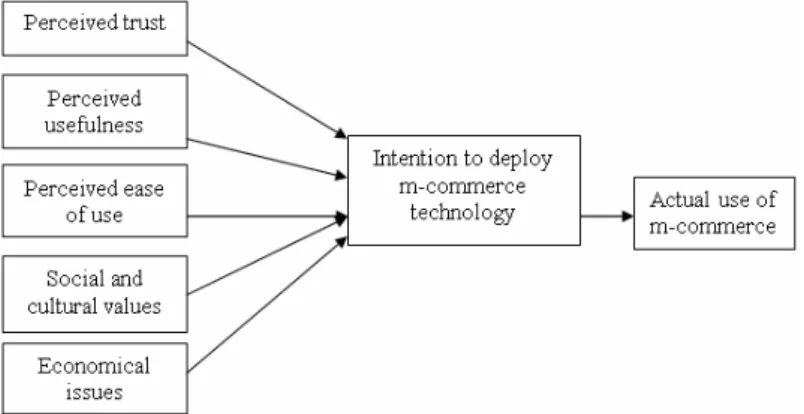
variables, we constructed a research model shown in Fig. 1, this model is used to test how
people and organizations deal with new technology, accept, resist or reject and potentially
influence an individual and organizational adoption decision regarding mobile commerce,
because mobile commerce technology is considered the new wave of IT. An extended
version of the technology acceptance model was employed to determine factors such as trust,
perceived usefulness, perceived ease of use, social and cultural values, economic issues that
influence a decision maker intention to adopt this type of technology in doing business.
Perceived trust
Trust is considered as a key factor for succeeding in doing e-commerce and
m-commerce, trust is major enabler of mobile device transactions because of a natural human
need to believe in the social surrounding of the virtual environment Perceived Usefulness:
"The degree to which a person believes that using a particular system would enhance his or
her job performance, by ubiquity, convenience localization, personalization, device
optimization"( Davis et al., 1989).
Figure 1. The proposed model. Source: Prepared by the researchers
Perceived ease of use
physical and mental effort"( Davis et al., 1989), freedom from difficulty and effort
Social and cultural trends
Social factors are defined as “an individual’s internalization of the reference group’s
subjective culture and specific interpersonal agreements that the individual has made with
others, in specific social situations”(Venkatesh V. and M. G. Morris, 2000). Thus, social
factors try to capture the congruency between social norms and individual beliefs and how
the human part of an individual’s environment affects one in performing a specific
behavior. Social factors are defined as “an individual’s internalization of the reference
group’s subjective culture and specific interpersonal agreements that the individual has
made with others, in specific social situations”( Venkatesh and Morris, 2000).
Economic issues
Economics is the social science that studies "mankind in the everyday business of life".
Intention
Intention is an indication of a person's readiness to perform a given behavior and it is
considered to be the immediate antecedent of behavior.
Hypothesis
To accomplish the objectives of this research, the following hypothesis will be tested:
H1: Perceived Trust have direct significant effect on m-commerce users' intention to deploy m-commerce technology.
H2: Perceived Usefulness have direct significant effect on m-commerce users' intention to deploy m-commerce technology.
H3: Perceived ease of use has significant effect on m-commerce users' intention to deploy m-commerce technology.
H4: Social and cultural values have direct significant effect on the m-commerce users' intention to deploy m-commerce technology.
Materials and Methods
In this study brokers and mobile commerce technology users from Amman stock
exchange are chosen to conduct study.
Reliability
The results of reliability show that Alpha Cronbach’s was 0.7098 for trust variable,
0.663 for usefulness variable, 0.703 for ease of use, 0.7636 for social and cultural values,
values of Alpha Cronbach’s for each variable were higher than 0.6, which is the acceptable
value for such research(Venkatesh andMorris, 2000 )
Model validity
In this study, summative scale technique was used to merge several sub factors into a
single factor by calculating average scale of each factor (Heck , 2004). Factor Analysis was
used applying Varimax procedure and Eigen value more than one. When the loading factor
is more than 0.40(Heck M., 2004), then the paragraph is valid to measure the variable.
Eigen value determines the accepted factors, Kaiser-Meyer-Olkin (KMO) measured the
fitness of using factor analysis for this data. The value of KMO was more than 0.50
reflecting the fitness of factor analysis for this data, KMO measure provides a means to
asses the extent to which the variables of the model belong together. Loading factor and
explained variance were used to measure the validity of each construct as shown in Table 1.
The respondents were closed in their predominantly positive intention toward using mobile
commerce technology and actual use.
Table 1
Construct validity of research variables
Variable Loading factor
Explained variance
KMO Eigen value Cronbach’s Alpha
Trust 0.880
0.863 0.606 0.279
49.086 0.597 1.963 0.7100
Usefulness 0.736 0.799 0.747 0.512
50.023 0.671 2.001 0.6630
Ease of Use 0.747 0.760 0.727 0.682
53.273 0.616 2.131 0.7030
Social and cultural issues
0.772 0.871 0.801 0.614
59.334 0.737 2.373 0.7636
Economical issues
0.839 0.899 0.871 0.893 0.355
Variable Loading Explained KMO Eigen value Cronbach’s
factor variance Alpha
Intentions 0.841 0.816 0.830 0.783
66.908 0.794 2.676 0.8340
Actual use 0.792 0.813 0.812 0.763 0.640
58.748 0.770 2.937 0.8180
Results
To accomplish the objectives of this study, hypotheses should be tested to find out the
relationship between variables. These tests as follow:
First hypothesis:
H1: Trust will have direct significant effect on m-commerce users' intention to deploy m-commerce technology.
The testing result of the analysis is as follow:
Y = 1.963+0.420X
(t = 5.854 with significance = 0.001) (t = 1.96 tabulated)
R2 = 0.113
F = 22.50 (F = 2.34 tabulated)
Where:
Y = Intention to deploy m-commerce technology
X = Trust of using m-commerce technology
Perceived trust explained 11.3% of the effect on the user's intention of deploying
mobiles commerce technology. The Trust effect on the user's intention to deploy mobile
commerce was significant with probability 0.001 (<0.05).
Second hypothesis
H2: Perceived usefulness has significant effect on the intention of mobile commerce user's to deploy m-commerce technology.
The testing result of the analysis is as follow:
Y= 1.804 +0.471 X
R2 = 0.162
F = 34.72 (F = 2.34 tabulated)
Where:
Y = Intention to deploy m-commerce technology
X =Perceived usefulness to deploy m-commerce technology
Perceived usefulness explained 16.2% of the effect on the user’s intention of deploying
mobile commerce technology. The effect of usefulness is significant with values 0.001.
This means that perceived usefulness has considerable effect on user’s intention of
deploying m-commerce.
Third hypothesis
H3: Perceived ease of use has a significant effect on the m-commerce users' intention to deploy m-commerce technology. The testing result is as follows:
Y = 2.007+0.413 X
(t = 5.296 with significance = 0.001) (t = 1.96 tabulated)
R2 = 0.137
F = 28.05 (F = 2.34 tabulated)
Where:
Y = Intention to deploy m-commerce technology
X = Perceived ease of use to deploy m-commerce technology
The increase of perceive ease of use by one unit will improve the intention of deploying
mobile commerce technology by 0.413. This means that there is a positive relationship
between perceive ease of use on the user's intention to deploy mobile commerce. This
relation is highly significant with probability value equal 0.001; ease of use explains 13.7%
of the user's intention to deploy mobile commerce technology.
Fourth hypothesis:
H4: Social and cultural values have significant effect on the m-commerce users' intention to deploy m-commerce technology.
The testing result is as follows:
Y = 2.460+0.301 X
(t = 2.697 with significance = 0.008) (t = 1.96 tabulated)
R2 = 0.039
F = 7.271 (F =2.34 tabulated)
Where:
Y= Intention to deploy m-commerce technology
mobile commerce technology
Perceive social and cultural values have the lowest effect on the user’s intention of
deploying mobile commerce technology. This is resulted of the low perceive of the social
and cultural values. The increase of perceive of social and cultural values will affect the
intention of deploying mobile commerce technology significantly (p<0.01), despite the low
explanation of this variable for the intention of deploying mobile commerce.
Fifth hypothesis:
H5: Economical issues have a significant effect on commerce intention to deploy m-commerce technology. The testing result is as follows:
Y= 3.298+0.069 X
(t = 0.782 with significance = 0.435) (t = 1.96 tabulated)
R2= 0.003
F = 0.612 (F = 2.34 tabulated)
Where:
Y = Intention to deploy m-commerce technology
X = Perceived economical issues on the user’s intention to deploy m-commerce
technology
The economical issues do not affect the user's intention of deploying mobile commerce
because brokers and investors did not find that deploying of mobile commerce technology
is related to economical issues.
Sixth hypothesis:
H6: Intention to deploy m-commerce technology has a significant effect on the actual use of m-commerce users.
The testing result is as follows:
Y = 2. 044+0.409 X
(t = 6. 091 with significance = 0.001) (t = 1.96 tabulated)
R2 = 0.173
F = 37.105 (F = 2.34 tabulated)
Where:
Y = Actual use of m-commerce technology
X = Intention to deploy m-commerce technology
User’s intention to deploy mobile commerce technology affects positively the actual
use of mobile commerce. This effect is positive and significant (p<0.001). The change in
the user’s intention explains 17.73% of the change in the actual use of mobile commerce.
Discussion
In most cases, mobile commerce technology users' adoption was much slower than
originally anticipated, this trend is often attributed to technological limitations, security
issues and significant economic investments associated with implementing mobile
commerce technology (Deans, 2002. Despite those issues that must be overcome, the main
reason for the lack of mobile commerce users adoption stems from the fact that current
mobile applications fail to deliver a sufficiently compelling value proposition to corporate
decision makers(Igbaria , 1993). The results of this study found that brokers and investors
are not completely satisfied with the benefits achieved by deploying mobile commerce
which similar to Deans (2002)and Heck (Igbaria , 1993) results.
The results of the first hypothesis show that perceived of trust has no significant effect
on mobile commerce users' intention to deploy mobile commerce technology. The results
of the second hypothesis when applying multiple regression show that perceived usefulness
has positive relationship with the user’s intention to deploy mobile commerce technology,
The results of our research is consistent with many previous studies that focused on the
acceptance and use of new technology and have provided support for the proposition that
perceived usefulness is considered as one of the primary predictor of mobile commerce
technology usage[ (Davis Bagozzi and Warshaw, 1992),( Gefen D., Karahanna and Straub
2003),( Wang Shun, Wang Min, Lin Hsin and Tang, 2003) (Igbaria et al., 1997; Gefen
and Straub, 1997, 2003)]. The results of the third hypothesis testing show that perceived
ease of use has a more powerful and consistent predictor than perceived usefulness towards
user’s intention to deploy mobile commerce technology. The results of our study is
consistent with many previous studies that focused on the acceptance and use of new
technology and the result of their studies demonstrated that perceived ease of use has a
positive correlation with behavioral intention[(Davis , Bagozzi and Warshaw, 1989),( Davis
1989, Davis et al, 1989),( Gefen , Karahanna , and Straub ,2003)( Wang . Shun, at .al,
2003)], A possible explanation of these findings is that the stability of the legislative
environment for economic issues, in addition to the interest rate, the cost of transaction and
the income of the mobile commerce users affects their planning to deploy m-commerce
technology in Jordanian environment. The results of the sixth hypothesis show that user's
intention to deploy mobile commerce technology in Jordanian market place has positive
relationship with the actual use of mobile commerce. These results are consistent with
many previous studies that focused on the acceptance and use of new technology
[(Compeau. and Higgins, 1995),( Venkatesh V. and F. Davis, 2000)]
Conclusion
The current research represents one of the first empirical efforts for eliciting, analyzing,
usefulness, perceived ease of use, social and cultural values and economical issues) on the
user's intention of deploying mobile commerce technology on the Jordanian marketplace,
by incorporating variables from technology acceptance/adoption models. The finding of
this study are supportive of the fact that more usefulness and more of ease of use of mobile
commerce technology are more likely affect the user's intention of mobile commerce
technology adoption. This indicates that mobile commerce is perceived to be high in
instrumentality leading higher acceptance/adoption rate. The result in coincide of other
studies and the link between those two determinants in agreement with the prior study
[(Davis. Bagozzi and Warshaw, 1989), (Davis, Bagozzi and Warshaw, 1989)]
References
Ajzen I., 1991. The theory of planned behavior. Organizational Behavior and Human
Decision Processes, 50, 179-211.
Ajzen I. and M. Fishbein, 1980. Understanding Attitudes and Predicting Social Behavior.
NJ: Prentice-Hall.
Chan S., Cheung and L.T. Ming, 2004. Understanding internet banking Adoption and use
behavior: A Hong Kong perspective. Journal of Global Information Management
Chau P.Y.K. & Hu. P.J.,2002. Examining a model of information technology acceptance
by. individual professionals: An exploratory study, Management Information Systems,
18(4), 191-2295.
Chismar W.G. and S.W. Patton, 2003. Does the extended technology acceptance model
apply to physicians? Proceeding of the 36th Hawaii International Conference on
System Sciences, Hawaii.
Compeau D.R. and C.A. Higgins, 1995b. Computer self-efficacy: Development of a
measure and initial test. MIS Q., 19: 189-211.
Davis F.D., R.P. Bagozzi and P.R. Warshaw, 1989. user acceptance of computer
technology: A comparison of two theoretical models. Manage. Sci., 35: 982-1002.
Davis 1989, Davis et al., 1989. Perceived usefulness, Perceived ease of use, and user
acceptance of information technology. Quart. 13, 319-339.
Davis F.D., R.P. Bagozzi and Warshaw, 1989. User acceptance of computer technology: A
comparison of two theoretical models. Manage. Sci., 35: 982-1002.
Davis F.D. 1989. Perceived usefulness, perceived ease of use and user acceptance of
information technology. MIS Q., 13: 318-340.
Davis F.D., R.P. Bagozzi and P.R. Warshaw, 1992. Extrinsic and intrinsic motivation o use
computers in the workplace. J. Applied Soc. Psychol., 22: 1111-1132.
Davis G.B., 2001. Anytime/anyplace computing and the future of the knowledge work.
Commun. ACM., 45: 67-73.
at the Eighth Americas Conference on Information Systems -14. Gefen D., E.
Karahanna and D.W. Straub, 2003. Trust and TAM in online shopping: An integrate
model. MIS Q., 27: 51-90.
Gefen D., Karahanna E., and Straub D., 2003. Trust and TAM in online shopping: An
integrate model. MIS Quarterly, 27(1), 51-90.
Heck M., 2004. Mobilizing the Enterprise. InfoWorld, 26, 24-26. Junglas, I. A., & Watson,
R. T. (2003). U-Commerce: A Conceptual Extension of E- and M-Commerce. Paper
presented at the International Conference on Information Systems, Seattle, WA.
Igbaria M., 1993. User acceptance of microcomputer technology: An empirical test. Omega
Int. J. Manage. Sci., 21: 73-90.
Igbaria, M., Zinatelli, N., Cragg, P., & Cavaye, A.L.M., 1997. “Personal Computing
acceptance factors in small firms: a structural equation model”, MIS Quarterly, 21,
279-305.
Ikart E.M., 2005. Executive information systems and the top level officer’s Roles: An
exploratory study of user behavior Model and lessons learnt. Aust. J. Inform. Syst., 13:
78-100.
Klopping M., Inge and McKinney, 2004. Extending the technology acceptance model and
task technology fit model to consumer e-commerce. Inform. Technol. Learn. Perform.
J., 22: 35-48.
Leung C., Y. Chan and C. Chan, 2003. Analysis of mobile-commerce market in Hong.
ICEC. Pittsburgh, PA, ACM 1-58113-788-5/03/09.
Luarn P. and Lin H. Hsin, 2004. Towards an understanding of the behavioral intention to
use mobile banking. Comput. Hum. Behav., 1-19.
O’Cass, A. and T. Fenench, 2003. Web retailing adoption: Exploring the nature of internet
users Webretailing behavior. J. Retail. Consum. Serv., 10: 81-94.
Sekaran, U., 1992. Research Methods for Business: A Skill Building Approach. 2nd Edn.,
John Wiley and Sons, Inc.
Shih, P.H., 2004. An empirical study of predicting user acceptance of e-shopping on web.
Internet Manage., 41: 351-568.
Thompson Venkatesh V. and F.D. Davis, 2000. A theoretical extension of the technology
acceptance model: Four longitudinal field studies. Manage. Sci., 45: 186-204.
Triandis C. Kagitcibasi and G. Yoon, 1980. Individualism and Collectivism: Theory,
Method and Applications. Thousand Oaks, CA., Sage.
Venkatesh V., M.Morris, G. Davis and F. Davis, 2003. User acceptance of information
technology: towards a unified view. MIS Q., 27: 425-477.
Venkatesh and Dvis, 1996. A model of the antecedents of perceived ease of use
development and test. Dec. Sci., 27: 451-481.
behavioral control, computer anxiety and enjoyment into the technology acceptance
model. Inform. Syst. Res., 11: 342-365.
Venkatesh V. and F. Davis, 2000. A theoretical extension of the technology acceptance
model: Four longitudinal field studies. Manage. Sci., 46: 186-204.
Venkatesh V. and M. G. Morris, 2000. Why don't men ever stop to ask for directions?
Gender, Social influence and their role in technology acceptance and usage behavior.
MIS Q., 24: 115-139.
Venkatesh V. and C. Speier, 1999. Computer Technology training in the workplace: A
longitudinal investigation of the effect of the mood. Org. Behav. Hum. Dec. Process.,
79: 1-28.
Venkatesh V., M. G. Morris and P.L. Ackerman, 2000. A longitudinal field investigation of
gender differences in individual technology adoption decision making processes. Org.
Behav. Hum. Dec. Process., 83: 33-60.
Wang Y. Shun, Wang Y. Min, Lin H. Hsin and I.T. Tang, 2003. Determinants of user
acceptance of internet banking: An empirical study. Int. J. Serv. Ind. Manage., 14: