Alternative Fuels Infrastructure Grant
Programme
Summary of projects supported.
1. Introduction
The DfT’s Alternative Fuels Infrastructure Grant Programme (AFIGP) is a grant intervention programme aimed at overcoming one of the market failures inhibiting the acceleration of the deployment of low carbon vehicles needed to meet national road transport decarbonisation targets and local air quality targets. The market failure is concerned with the interdependence of the availability of fuelling infrastructure and of alternatively-fuelled vehicles. Private investment in fuelling infrastructure is inhibited by the absence of a critical mass of vehicles in use, whereas the investment in vehicle availability is inhibited by the absence of an appropriate fuelling network. Thus the AFIGP was introduced by the DfT in 2005 as part of a suite of national policy interventions dealing in parallel with technology, fleet deployment, consumer awareness and infrastructure development.
The programme’s second campaign was managed by Cenex on behalf of the DfT and ran from mid-2009 to the end of March 2011. Three calls for proposals were run during this campaign with submission cut off dates of 30th September 2009, 9th December 2009 and 31st March 2010. A further call was advertised for 30th July 2010 but was withdrawn due to budget cuts. The scope encompassed recharging infrastructure for electricity, methane gas (including natural gas, biomethane and blends thereof) and hydrogen (including hydrogen/methane blends). Eligibility requirements for grant funding of up to 50% of project costs included:
Identification of vehicles/users of the installations
Reasonable third party access to other vehicle users
In the case of permanent installations, continuing provision of refuelling capability for 3 years.
2. Summaries of projects supported
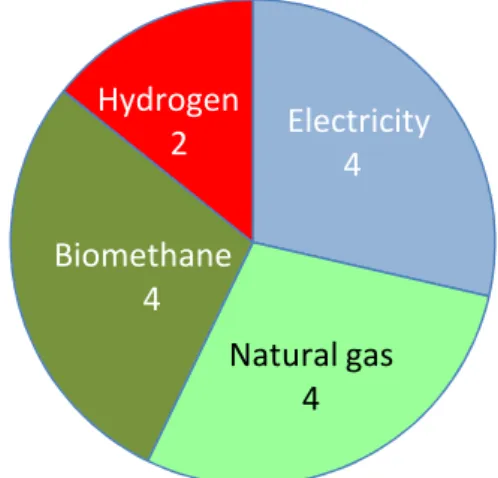
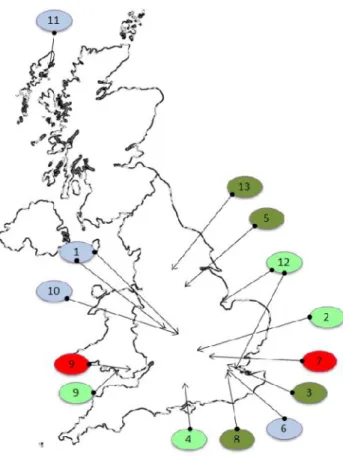
The table in the annex lists the grant recipients and alternative fuel categories of the 13 projects supported in the three calls of this campaign. A further four grant offer letters were issued but not taken up by the applicants. The original scope of some of the projects supported was reduced, generally because of difficulties in meeting the programme’s time constraints.These projects covered a range of alternative fuel categories, as indicated by Figure 1, and encompassed a broad regional coverage, as illustrated by Figure 2 which uses the same colour code for fuel type.
Figure 1 Coverage of fuel types
The installations served a wide range of vehicle categories including HGVs, trucks, RCVs, buses, minibuses, vans and cars.
Electricity
4
Natural gas
4
Biomethane
4
Hydrogen
2
Figure 2 Regional coverage of installations
Projects supported from the first call 1. Grant recipient: E.ON
Grant: £68,358 for electric vehicle charging points in two city centres
E.ON installed 36 Elektrobay 13A single phase charging points in clusters of three units at twelve car park and on-street sites in Birmingham and Coventry city centres. The project delivers the public component of the electric vehicle charging infrastructure required for the ‘CABLED’ project that has been funded by the Technology Strategy Board under its Ultra Low Carbon Vehicle Demonstrator programme (ULCVD). Initially there are 100 vehicles using the posts as part of the ‘CABLED’ trial. Electric vehicle (EV) and plug-in hybrid electric vehicle (PHEV) users who are not part of the trial can also access the posts using a Radio Frequency Identification Tag. The installation project generated learning and best practice on planning, legal and cost issues related to the installation of charging points in
public spaces and the learning from operational experience will continue to be generated within the ‘CABLED’ trial. 2. Grant recipient: Gasfill (in collaboration with Mercedes Benz)
Grant: £16,019 for a temporary CNG fuelling station at a van demonstrator fleet base
Gasfill have installed two of their refuelling units at the Mercedes Benz UK headquarters in Milton Keynes. The units are connected to the gas network and by using two Gasfill 2000 units together; it is possible to fast fill the vehicles. The benefit of this system is that it can be installed on a temporary basis and allows experience to be gained with compressed natural gas (CNG) vehicles before a decision is made to install a permanent CNG station. Mercedes Benz run ten Sprinter demonstrator vans fuelled by natural gas and plan to also operate a natural gas powered minibus. The project led to a better understanding of the practicalities and costs associated with grid connection and Mercedes Benz aim to establish a package solution to encourage the installation of further filling sites.
3. Grant recipient: Gasrec (in collaboration with London Borough of Camden)
Grant: £17,888 for a liquid/compressed biomethane gas refuelling station at a council site
The London Borough of Camden has identified biomethane as the most suitable fuel to allow them to reduce their transport emissions to meet their air quality targets particularly for PM10 and NOx. This project was to install the first publicly accessible compressed biomethane gas refuelling station in London. It comprised a skid based liquid biomethane to compressed biomethane refuelling unit supplied by Gas Container Services. The gas is supplied by Gasrec from a landfill site in Surrey. Having previously trialled CNG vehicles Camden Council are now operating fifteen of their panel vans on CNG. There is already significant interest from a number of local transport operators and John Lewis and Waitrose are already using the facility. 4. Grant recipient: Howard Tenens Associates
Grant: £130,000 for a liquid/compressed natural gas (LCNG) fuelling station at its Andover haulage depot
Having already trialled a temporary unit, this independent haulier installed a permanent LCNG fuelling station as part of its strategy to reduce CO2emissions from its fleet by
progressing through dedicated CNG or dual fuel propulsion through to biomethane. The station, comprising a cryogenic tank, vaporiser, compressor, dispenser and associated valves and pipe-work, was a mobile/temporary design aimed at supporting 10-20 vehicles. This gave it the potential to be subsequently moved to another site, not connected to the grid, whilst the learning from trials involving eleven of the company’s Mercedes Benz Astros HGVs will enable a permanent station to be scaled appropriately for use by other local users. The experience of this trial gave the company the confidence to successfully apply to the AFIGP’s third call for grant support for grid-connected CNG stations at two other depots.
5. Grant recipient: Sheffield City Council (in collaboration with Chesterfield Biogas, Volkswagen & Mercedes Benz) Grant: £9,500 for a temporary biomethane fuelling station on a council-owned site
Sheffield City Council undertook this biomethane fuel project to demonstrate the viability of low emission vehicle technology, the environmental benefits and the cost savings available to vehicle operators. Whilst directly contributing to local air quality and noise emission targets, the project would also provide a stimulus to anaerobic digestion and biomethane production in the region. Chesterfield Biogas provided the fuelling infrastructure comprising the gas dispenser, gas storage rig and the biomethane itself all on a lease basis. The six month trial involved seven Volkswagen Caddy vans, two Mercedes Sprinter vans and a Sprinter minibus, most of which were used by the Council’s Park Rangers Service. The results of the trial gave valuable input to the planning of a network of permanent CNG filling station and the decision by Veolia to install a LCNG station and purchase ten CNG vehicles.
A report for Sheffield City Council on the associated fleet trial is available on the Cenex web site.
6. Grant recipient: Transport for London
Grant: £40,716 for on road EV charging points in London boroughs
21 single phase 13 amp charging points have been installed across London in the boroughs of Camden, Greenwich,
Hackney and Westminster. The charging posts are supplied by 365 Energy Group, Elektromotive and Infracharge. The charging points feed into the larger roll out of charging points across London as part of OLEV’s Plugged in Places programme to create networks of charging points within regions across the UK. These charging points help meet the Mayor of London’s “Electric Vehicle Delivery Plan for London” (2009) and EV users can access them by paying an annual registration fee. This project generated valuable learning particularly on how best to coordinate planning approvals and interactions with Distribution Network Operators.
Projects supported from the second call
7. Grant recipient: Air Products (in collaboration with Millbrook Proving Ground and Transport for London) Grant: £157,435 for a re-locatable hydrogen refuelling unit A critical mass of refuelling stations is needed in order to attract interest in hydrogen vehicles. A relocatable filling station is an effective tool in this transition and can help lower the high capital costs associated with the early development of hydrogen refuelling infrastructure. A refuelling unit, capable of refuelling vehicles with hydrogen at 350 bar has been installed at Millbrook Proving Ground and will be upgraded under a separate initiative to allow refuelling at 700 bar. The facility enables Millbrook to refuel vehicles during testing and also provides hydrogen refuelling for other parties in the region. In the longer term this re-locatable unit may be moved to other sites where refuelling is needed. As a result of this project, Air Products believe they now have a good business model for the roll out of this system elsewhere in the UK.
8. Grant recipient: Chesterfield Biogas (In collaboration with London Borough of Greenwich Council)
Grant: £102,500 for a temporary biomethane refuelling facility on a council site
A temporary refuelling facility, with the ability to dispense, measure and record compressed biomethane, has been installed at a Greenwich Council site. The refuelling station is being leased by Chesterfield Biogas to Greenwich for the duration of a trial involving a range of vehicles including two refuse vehicles and eight Sprinter vans. Greenwich is an Olympic borough and the vehicles and refuelling infrastructure are being utilised to evaluate the viability of
natural gas vehicles for the 2012 Olympic Games. If the trial is successful, Greenwich Council may consider a permanent facility with biomethane supplied from a nearby 40,000 tonne per annum anaerobic digestion plant.
9. Grant recipient: University of Glamorgan
Grant: £77,389 for hydrogen and natural gas refuelling facilities on campus sites
The University of Glamorgan installed a hydrogen refuelling facility at its Glyntaff main campus. The refuelling facility is capable of filling a 3.5kg vehicle storage capacity in five minutes with hydrogen up to 350 bar. This was developed and installed in collaboration with Air Products, based on their S100 dispenser, and configured to allow future upgrading to 700 bar. At its Baglan Hydrogen Centre, the University has installed a facility to allow two banks of 200 bar cylinders to be filled with locally-produced renewable hydrogen for export to other hydrogen filling stations. Also at Baglan, the existing 300 bar refuelling facility has been upgraded to include mains natural gas connection, a biomethane cylinder import connection and a hydrogen feed and control system to allow NG/H2 blends of up to 40 vol. % hydrogen to be dispensed. This project forms part of the University’s investment plan to create a renewable hydrogen production and refuelling facility and has played a catalytic role in the establishment of other hydrogen facility investments, notably along the M4 corridor.
Projects supported from the third call 10. Grant recipient: Coventry City Council
Grant: £75,762 for electricity charging points in a Park & Ride car park and associated bus depot
A quick charging point and 6 standard charging posts have been installed at the War Memorial Park and Ride facility in the South of Coventry. The charging posts not only support the 48,000 daily commuters to Coventry city centre but also help Coventry to meet its carbon reduction targets. These charging posts dovetail with the ongoing Coventry and Birmingham ‘CABLED’ ULCVD project as well as the electric car grants offered by the UK government. The project brought together a range of public and private sector stakeholders and the learning experiences would be of benefit to planning of similar schemes for other cities.
11. Grant recipient: Galson Estate Trust (In collaboration with Community Energy Scotland)
Grant: £2,840 for a charging post at a community centre A “POD Point” electric vehicle charging post has been installed at a community centre on the Hebridean island of Lewis. The charging post is located adjacent to a wind turbine which offers the enhanced benefit of operating electric vehicles with near zero emissions. The installation is a standard single phase post with two sockets so that more than one vehicle can be charged at the same time. Initially, an electric minibus is to be used to transport tourists around the estate and also to support youth groups and community needs. The local council are now interested in procuring an electric van and they have expressed an interest in recharging at this site. The next step would be for the community to install a network of charging points across the island. 12. Grant recipient: Howard Tenens
Grant: £332,300 for grid-connected CNG stations at two haulage depots
The hauliers Howard Tenens installed grid-connected CNG stations at their South Ockendon and Boston depots to service their dual fuel (diesel and natural gas) HGV vehicles. The launch of the UK Government’s Renewable Heat Incentive scheme due in April 2011 should encourage the injection of biomethane into the national gas grid at which point Howard Tenens can switch gas supply agreements to bio-methane and realise the next step change improvement in reducing the environmental impact of their operations. There has been significant interest from third parties, including major retailers, hauliers and a local council, to use the refuelling stations. The experience gained from their interaction with the gas utility supplier is likely to shape the planning and implementation of future projects as they roll out similar grid connected refuelling stations at their other sites in England.
13. Grant recipient: Leeds City Council (in association with Gasrec)
Grant: £75,500 for a compressed gas biomethane refuelling station
Having previously leased a temporary gas refuelling station as part of their trial of dual fuel and dedicated compressed biomethane refuse vehicles, Leeds City Council installed a
compressed gas biomethane filling station to continue the demonstration without incurring the high costs of leasing a station. The specification was to dispense at least 36,000kg per year through a fast fill dispenser and flow meter in order to satisfy the significant interest from potential public and private sector users in the locality. The Council worked with Gasrec to source biomethane (Chive Fuels Ltd) and the gas refuelling station (Gas Container Services). This project highlighted the importance of careful planning in the design stage in order to correctly size a gas refuelling station.
3. Further information
The above projects generated valuable learning both in terms of the process of installing the fuelling installations and of their use in support of vehicle trials. In all cases, there has been a high level of interest from third parties to refuel at the above sites. These organisations can benefit from low carbon
refuelling without the initial capital outlay of installing their own station and at the same time, trial alternative fuels to assess suitability for their own vehicle operations. Therefore the benefits of the AFIGP programme are felt far wider than just the intended grant recipients.
Cenex is undertaking an analysis of the lessons learned from the installation phases of these projects and this will be reported separately in the form of case studies.
At the time of drafting this report many of the projects had only just completed the installations and were about to start the vehicle trials. Some of these trials will be incorporated into wider trial programmes such as DfT’s Plugged in Places or the TSB’s Ultra Low Carbon Vehicle Demonstration. Cenex plans to advise where trial information can be obtained.
Annex: Summary table of projects supported
ID
Grant recipient
Fuel
Call
Description
1 E.ON Engineering Electricity 1 On street and car park charging points in two city centres 2 Gasfill Natural gas 1 Temporary CNG unit on a van demonstrator fleet base 3 Gasrec Biomethane 1 Liquid/compressed biomethane station on a council site 4 Howard Tenens Natural gas 1 Liquid/compressed NG refuelling station at a haulage depot 5 Sheffield City Council Biomethane 1 Temporary compressed biomethane station on a council site 6 Transport for London Electricity 1 Public charging points in four London boroughs
7 Air Products Hydrogen 2 350 bar re-locatable hydrogen refuelling station. 8 Chesterfield Biogas Biomethane 2 Temporary compressed biomethane refuelling trailer. 9 University of Glamorgan Hydrogen &Natural Gas 2 Hydrogen and NG refuelling facilities on two campus sites 10 Coventry City Council Electricity 3 Charging points in a Park & Ride car park and bus depot 11 Galson Estate Trust Electricity 3 Charging post at an island community centre.
Howard Tenens Natural gas 3 Grid-connected CNG refuelling stations at two haulage depots 13 Leeds City Council Biomethane 3 Compressed biomethane semi-permanent refuelling station.