© 2001 John Wiley & Sons 1
Section 9.5
Electric Motors
Electric motors spin the parts of many household machines. Sometimes this rotary motion is obvious, as in a fan or mixer, but often it’s disguised, as in the agitator of a washing machine or the window opener of an automobile. Motors come in a variety of shapes and sizes, each appropriate to its task. No matter how much torque or power a motor must provide, you can probably find one that’s suitable. Some motors operate from direct cur-rent and can be used with batteries while others require alternating curcur-rent. There are even motors that work on either type of current.
In this section, we’ll examine the basic mechanisms of electric motors. We’ll look at what makes a motor turn and how motors differ from one another. As we do, we’ll revisit many of the relationships between electricity and magnetism that we’ve been studying since Chapter 8.
Questions to Think About: How can magnetic forces cause something to spin? If mag-netic forces cause motors to spin, why can’t a motor be built exclusively from permanent magnets? What determines which way a motor turns? Why are some motors safe for use with flammable chemicals while others are not?
Experiments to Do: Take a look at several different electric motors. You’ll find motors in a cassette tape recorder, a room fan, a kitchen mixer, and in the starter of a car. Motors in the cassette recorder and the automobile starter both run on DC power, but one consumes far more electric power and provides far more mechanical power than the other. What aspects of a starter motor allow it to handle so much power?
Motors in the fan and the mixer both run on AC power, but their internal structures are quite different. The fan motor starts slowly and gradually picks up speed while the mixer motor rotates at almost full speed only moments after you turn it on. How do the
Brush connection Bearing Shaft Cooling fan Armature Commutator Bearing
initial torques provided by those two motors compare? What do you think determines how fast these two motors turn?
What Spins an Electric Motor
The rotor of an electric motor needs a torque to start it spinning. This torque is normally produced by magnetic forces, exerted between magnetic poles on the rotor and those on the motor’s stationary shell. Attractive or repulsive forces pull or push on the outside of the rotor, producing torques that make the rotor spin faster and faster until friction or the objects attached to it reduce its net torque to zero. After that point, the rotor turns at a steady angular velocity.
Both the rotor and the motor’s fixed shell are magnetic. The forces between these magnets are what produce the torques. But while permanent magnets are often used in electric motors, at least some of a motor’s magnets must be electro-magnets. That’s because the motor can only keep turning if some of its magnetic poles change or move as the rotor spins. That way, while the rotor turns to bring opposite magnetic poles as close together as possible, the poles keep changing or moving so that the rotor finds itself perpetually chasing the optimum arrange-ment of poles.
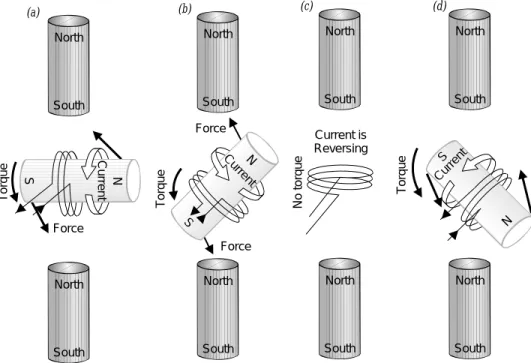
A simple motor is shown in Fig. 9.5.1. In this device, the rotor is a wire coil with current flowing through it. Since electric currents create magnetic fields, the coil is magnetic. Its magnetic field is similar to that of a permanent magnet, with its north and south poles shown in the figure.
The coil starts off in Fig. 9.5.1a with its magnetic poles arranged horizon-tally. Since opposite poles attract, the coil experiences a torque that acts to spin the coil counterclockwise. The coil undergoes angular acceleration and begins to rotate counterclockwise (Fig. 9.5.1b). The torque continues until the coil’s poles reach the opposite poles of the stationary magnets. There is then no torque on the rotor because the magnetic forces act directly toward or away from the axis of rotation. The rotor is in a stable equilibrium.
But just as the opposite poles reach one another, the current in the coil re-verses directions (Fig. 9.5.1c). Now the coil’s magnetic poles are close to like poles
Current N S CurrentN S Current N S (a) (b) (c) (d) North South North South North South North South North South North South North South North South Current is Reversing Force Force Torque Force Torque No torque Torque
Fig. 9.5.1 - A simple motor consists of a coil rotating between two per-manent magnets. (a) The coil’s magnetic poles are attracted toward opposite poles of the stationary magnets. (b) The coil turns to bring the opposite poles as close to one another as possible, but just as it arrives (c) the current passing through it reverses directions. (d) The coil’s magnetic poles also reverse and it continues turning.
of the stationary magnets and like poles repel one another. The rotor is suddenly in the worst possible orientation and must turn upside down to be optimally ori-ented again. Because it already has angular momentum, the coil continues its counterclockwise rotation and once again experiences a counterclockwise torque from the magnets.
But even when the coil has turned completely upside down, its travels aren’t over. The current in the coil reverses again and the coil is obliged to con-tinue its counterclockwise rotation. Since the coil’s current reverses every time it completes half a turn, the coil never stops. It keeps experiencing counterclock-wise torques and spins forever.
The rotor’s endless pursuit of the optimal orientation is reminiscent of Sisy-phus’s efforts in Greek mythology. Sisyphus was condemned to spend eternity rolling a heavy stone up a hill, only to have it roll to the bottom every time he reached the top. This same endless pursuit appears in electric motors, although the way in which it’s achieved varies from motor to motor. In what follows, we’ll examine how this effect is implemented in several different types of motors.
CHECK YOUR UNDERSTANDING #1: Like a Rolling Stone
Why can’t you build an electric motor entirely out of permanent magnets?
DC Motors
Powering an electric motor with a battery isn’t easy. The battery’s direct current is fine for electromagnets, but because there’s nothing that naturally changes with time, the poles of the electromagnets stay the same forever. Since a motor needs magnetic poles that change periodically, something must reverse the cur-rent flow through the electromagnets at the proper moments.
In most DC electric motors, the rotor is an electromagnet that turns within a shell of stationary permanent magnets (Fig. 9.5.2). To make the electromagnet stronger, the rotor’s coil contains an iron core that’s magnetized when current flows through the coil. The rotor will spin as long as this current reverses each time its magnetic poles reach the opposite poles of the stationary magnets.
The most common way to produce these reversals is with a commutator. In its simplest form, a commutator has two curved plates that are fixed to the rotor and connected to opposite ends of the wire coil (Fig. 9.5.3). Electric current flows into the rotor through a conducting brush that touches one of these plates and leaves the rotor through a second brush that touches the other plate. As the rotor turns, each brush makes contact first with one plate and then with the other. Each time the rotor turns half of a turn, the plates the two brushes touch are inter-changed and with this swapping of connections comes a reversal in the direction of current flow around the coil. The DC motor spins forever.
But the DC motor depicted in Fig. 9.5.3 has problems. First, there’s nothing to determine which way the motor should turn when it starts, so it starts ran-domly in either direction. Second, because there are times when a brush touches either both commutator plates at once or neither of them, the motor will some-times not start at all.
To start reliably, the motor must make sure that its brushes always send current through the rotor and that there are no short circuits through the commu-tator itself. In most DC motors, this requirement is met by having several coils in the rotor, each with its own pair of commutator plates. As the rotor turns, the brushes supply current to one coil after another. The rotor is constructed so that each of its coils receives power only when it’s in the proper orientation to experi-ence a strong torque in the desired direction. Since the brushes are wide enough
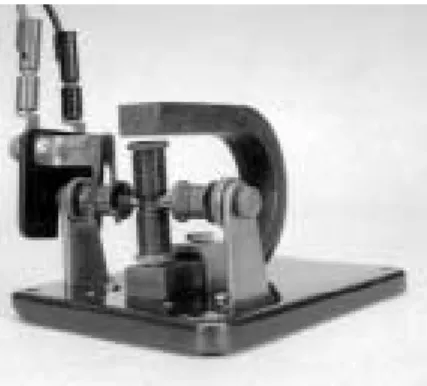
Fig. 9.5.2 - Current flows into and out of the rotor of this DC motor through the metal brushes on the left. These brushes touch the rotor’s commutator so that current in the rotor’s coil reverses every half turn.
Torque Coil Core Current South + Brush Current – Brush Current Current Battery N S N S + –
Fig. 9.5.3 - A commutator on the rotor of a DC motor connects its coil to the source of electric power. The commutator turns with the rotor and reverses the direction of cur-rent flow in the coil once every half turn of the rotor. Just as the rotor’s north pole reaches the south pole to its left, the current in the coil re-verses and so do the rotor’s poles.
that they always supply current to at least one coil but not so wide that they di-rectly connect the brushes to one another, the rotor will always start spinning when it’s turned on.
The rotor of a DC motor turns at a speed that’s proportional to the voltage drop through its coils. Those coils have little electric resistance and allow a large current to flow while the rotor is at rest. But once the rotor is turning, the chang-ing magnetic fields around the spinnchang-ing rotor cause it to experience electric fields. These electric fields oppose the flow of current through the rotor, extract-ing energy from that current and lowerextract-ing its voltage. Eventually the rotor reaches an angular velocity at which the voltage supplied to its coils matches the induced voltage drop caused by these dynamic electric fields. The rotor then spins stably at this angular velocity. However, if you slow the rotor’s rotation by making it do work on something, the voltage drop through the rotor will no longer match the induced voltage drop and the remaining voltage drop will have to occur because of electric resistance—more current will have to flow through the rotor. In general, loading the rotor has little effect on its angular velocity but causes it to draw more current from its power source. To change the rotor’s angu-lar velocity, you must change the voltage drop through its coils.
While the direction in which the rotor turns depends on the motor’s asym-metry, it also depends on the direction in which current flows through the entire motor. If you reverse that current, the rotor will begin turning backward. Its elec-tromagnets will still turn on and off as before, but now the magnetic forces be-tween the rotor and the stationary permanent magnets will be reversed. Instead of being attractive, they will be repulsive or vice versa. The torque on the rotor will be reversed, too, and the motor will spin backward. So to make a toy train move backward, you simply reverse the direction of current flow through its DC motor.
DC electric motors of this sort are used in a wide variety of battery-operated devices, from toy cars to electric screwdrivers. Unfortunately, their brushes experience mechanical wear as their rotors turn and eventually wear out and must be replaced. Furthermore, the brushes produce mechanical interrup-tions in the flow of current and these interrupinterrup-tions often create sparks. Motors with brushes are unsuitable for some environments because their sparking can ignite flammable gases. Sparking also produces radio waves so that an automo-bile’s DC motors often interfere with its radio reception.
CHECK YOUR UNDERSTANDING #2: Energy Shortage
As the batteries in a toy car run out of energy, the car slows down. Explain.
Universal Motors
Before looking at true AC electric motors, let’s look at an intermediate type of motor called a universal motor. This motor can run on either DC or AC electric power. A true DC motor can’t tolerate AC power because its rotational direction will reverse with every half cycle of the power line and it will simply vibrate in place. A true AC motor can’t tolerate DC power because, as we’ll soon see, it de-pends on the power line’s reversing current to keep the rotor moving.
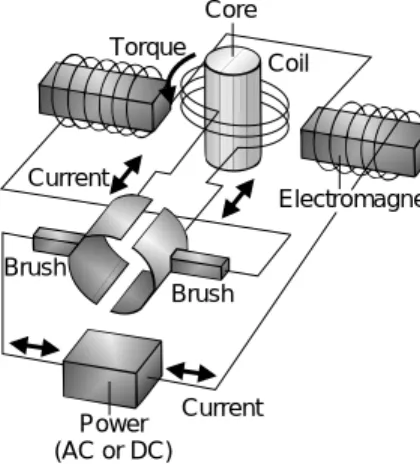
However, if you replace the permanent magnets of a DC motor with elec-tromagnets and connect these elecelec-tromagnets in the same circuit as the commuta-tor and rocommuta-tor, you will have a universal mocommuta-tor (Fig. 9.5.4). This mocommuta-tor will spin properly when powered by either direct or alternating current.
If you connect DC power to a universal motor, the stationary electromag-nets will behave as if they were permanent magelectromag-nets and the universal motor will
Torque Coil Electromagnet Core Brush Current Brush Current Power (AC or DC)
Fig. 9.5.4 - Because the stationary magnets of a universal motor are actually electromagnets, the motor doesn’t notice changes in the direc-tion of current flow from the power source—every pole in the entire motor reverses, leaving the forces between those poles unaffected. The universal motor works equally well on DC or AC electric power.
operate just like a DC motor. The only difference is that the universal motor will not reverse directions when you reverse the current passing through it. It will continue turning in the same direction because reversing the current through the rotor also reverses the current through the electromagnets. Since the universal motor contains no permanent magnets, every pole in the entire motor changes from north to south or from south to north. Because all the poles change, the mo-tor’s behavior does not. It keeps turning in the same direction. If you really want to reverse the motor’s rotational direction, you must rewire the stationary elec-tromagnets to reverse their poles.
Since the universal motor always turns in the same direction, regardless of which way current flows through it, it works just fine with AC electric power. There are moments during the current reversals when the rotor experiences no torque, but the average torque is still high and the rotor spins as though it were connected to DC electric power. Like a DC motor, the voltage drop through the coils of its rotor governs its speed.
Universal motors are commonly used in kitchen mixers (Fig. 9.5.5), blend-ers, and vacuum cleaners. While these motors are cheap and reliable, their graph-ite brushes eventually wear out and must be replaced. To repair a motor with a worn brush, you simply remove what’s left of the old brush and replace it with a new one from the hardware store. Some appliances even provide access ports through which you can replace the brushes without disassembling the motor.
CHECK YOUR UNDERSTANDING #3: Doing the Twist
A vacuum cleaner is advertised as having a “powerful, 8 amp motor.” What are those 8 amps of current doing?
Synchronous AC Motors
Some motors are designed to operate exclusively on alternating current. One such motor is shown in Fig. 9.5.6. This motor is essentially identical to the genera-tor from the previous section because generagenera-tors and mogenera-tors are closely related. A generator uses work to produce electric energy while a motor uses electric en-ergy to produce work.
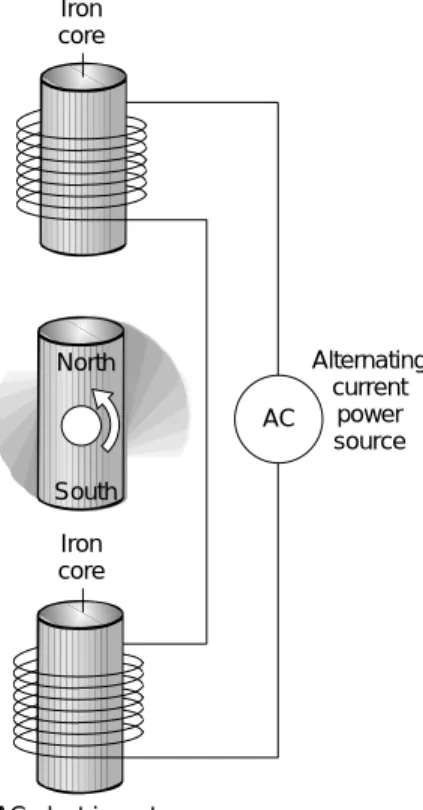
The rotor in Fig. 9.5.6 is a permanent magnet that spins between two sta-tionary electromagnets. Because the electromagnets are powered by alternating current, their poles reverse with every current reversal. The rotor spins as its north pole is pulled first toward the upper electromagnet and then toward the lower electromagnet. Each time the rotor’s north pole is about to reach the south pole of a stationary electromagnet, the current reverses and that south pole be-comes a north pole. The rotor turns endlessly, completing one turn for each cycle of the AC current. Because its rotation is perfectly synchronized with the current reversals, this motor is called a synchronous AC electric motor.
Synchronous AC motors advance the hands in some electric clocks. These motors follow the cycles of the power line exactly and thus keep excellent time. However, synchronous motors are hard to start because their rotors must be spinning rapidly before they can follow the reversals of the electromagnets. Be-cause they must be brought up to speed by other motor techniques, synchronous AC motors are only used when a steady rotational speed is essential.
However, synchronous motors illustrate an important point about motors and generators: they’re essentially the same devices. If you connect a synchro-nous AC motor to the power line and let it turn, it will draw energy out of the electric circuit and provide work. But if you connect that same motor to a light bulb and turn its rotor by hand, it will generate electricity and light the bulb.
Fig. 9.5.5 - The top of this kitchen mixer contains a universal motor, which turns the mixing blade through a series of gears. The mo-tor’s graphite brushes can be ser-viced through black plastic ports, one of which is visible near the cen-ter of mixer. The speed switch con-trols the current to the motor.
Iron core Alternating current power source North South AC electric motor Iron core AC
Fig. 9.5.6 - A synchronous AC mo-tor uses electromagnets to turn a magnetic rotor. Each time the cur-rent reverses, so do the poles of the electromagnets. This motor turns once per cycle of the AC current.
When the motor is acting as a generator, the turning magnetic rotor is in-ducing current in the coils of the electromagnets. But when the motor is acting as a motor, the turning magnetic rotor still affects the currents in the coils. In gen-eral, the currents in the electromagnets affect the motion of the rotor and the mo-tion of the rotor affects the currents in the electromagnets. Whether the motor acts as a generator or a motor depends on which way energy is transferred.
The motor acts as a generator if you exert a torque on the rotor in the direc-tion it’s turning. You are then doing work on the rotor and this work ends up as electric energy. The motor acts as a motor if you exert a torque on the rotor oppo-site the direction it’s turning. It’s then doing work on you and this work is ob-tained from electric energy. Although some energy is wasted as thermal energy, it’s always conserved. Thus the more work the motor does, the more electric en-ergy it consumes. Similarly, the more work you do on the motor, the more elec-tric energy it produces.
A motor’s coils become hot when large currents flow through them. Whether a motor is consuming or producing electric power, it will overheat and burn out if it’s required to handle too much current. Failures of this type occur in overloaded motors and in power plant generators during periods of exception-ally high electric power usage. Circuit breakers are often used to stop the current flow before it can cause damage.
AC synchronous motors aren’t the only motors that can generate electricity. Most other motors will generate electricity when something does work on them. For example, a DC motor will generate direct current when you spin its rotor. In fact, a car’s alternator is essentially a DC motor that’s turned by the car’s engine and powers the car’s electric system. One exception to this rule is the universal motor, which contains no permanent magnets and thus can’t begin to generate electricity.
CHECK YOUR UNDERSTANDING #4: Easy Come, Easy Go
A wind-turbine generator turns its magnetic rotor at a steady pace and pumps AC electric current through the power lines. When the wind dies, the turbine keeps turning anyway. Why?
Induction AC Motors
Some alternating current motors have rotors that are neither permanent magnets nor conventional electromagnets. These rotors are made of non-magnetic metals such as aluminum and have no electric connections. But their electric isolation doesn’t keep these rotors from becoming magnetic. When an aluminum rotor is exposed to changing magnetic fields, currents begin to flow through it and these induced currents make the rotor magnetic.
Motors that use induction to create magnetism in their rotors are called in-duction motors. Inin-duction motors are probably the most common type of AC motor, appearing in everything from household fans to industrial pumps to ca-ble-lift elevators. They provide lots of torque, start easily, and are inexpensive.
An induction motor works by moving a magnetic field around the rotor. The stationary shell surrounding the rotor contains a sophisticated electromagnet called a stator. While the stator doesn’t move, the field it produces does. Through a clever use of various electromagnetic devices, the stator is able to create mag-netic poles that move in a circle and travel around and around the rotor. In Fig. 9.5.7, the stator’s north pole travels counterclockwise around the rotor. Since the pole’s motion is based on current reversals of the AC power line, the north
(a) South North Stator Rotor (b) South North (c) South North
Fig. 9.5.7 - The magnetic poles pro-duced by the stator of an induction motor circle around the rotor. Their moving magnetic fields induce cur-rents in the metal rotor and it be-comes magnetic, too. The rotor spins in order to keep up with the circling magnetic poles.
pole usually travels once around the rotor for every full cycle of the current. A south pole also circles the rotor on the opposite side.
These moving magnetic poles pull the rotor along with them. They induce magnetic poles in the rotor and the rotor experiences magnetic torques. The rotor begins to spin, rotating faster and faster until it’s turning almost as rapidly as the moving magnetic poles of the stator.
We saw a similar effect with electrodynamically levitated trains. When you slide a strong magnet across a metal surface, magnetic drag forces tend to reduce the magnet’s velocity relative to the metal surface. The metal surface acts to slow the magnet down while the magnet acts to speed the metal surface up.
In the induction motor shown in Fig. 9.5.8, the role of the moving magnet is played by the stator’s circling magnetic poles. Even though no object is moving, the rotor perceives the circling magnetic poles as magnets that are traveling around it. The role of the metal surface is played by the rotor, which responds magnetically to the circling poles. The rotor acts to slow down the circling mag-netic poles while the circling magmag-netic poles act to speed the rotor up. The stator is fixed and can’t turn, but the rotor is free to spin. And so it does.
The rotor turns faster and faster until its surface moves right along with the circling magnetic poles. At that point, the magnetic poles no longer move relative to the rotor’s surface, so they don’t induce any currents in it. In actual use, the rotor never quite reaches this top speed. It lags a little behind so that it continues to experience a small magnetic torque. This torque keeps it rotating against the slowing effects of friction or whatever devices the motor is turning. As with any motor, there are induced voltage drops in the stator’s electromagnets that nor-mally match the voltage drop through those coils. However, if you slow the rotor by making it do work, the induced voltage drop decreases and more current flows through the stator’s coils. It then draws more power from its power source. The more work the motor does each second, the more power it consumes from the electric company.
The rotor’s direction of rotation is determined by the way in which the sta-tor’s magnetic poles circle. Most household induction motors make these poles circle with the help of a capacitor, a device we’ll examine in the next chapter. To make the motor turn backward, the capacitor must be reconnected so that the magnetic poles circle backward. Since there are no electric connections to the ro-tor, it needs no brushes and requires little maintenance. Induction motors nor-mally turn for years before failing. When they finally break, it’s usually because their bearings wear out or because the overloaded motor’s stator coils overheat and burn up.
CHECK YOUR UNDERSTANDING #5: Low, Medium, and High
The induction motor in an electric fan often has three different rotational speeds. What changes to determine those different speeds?
Stepping Motors
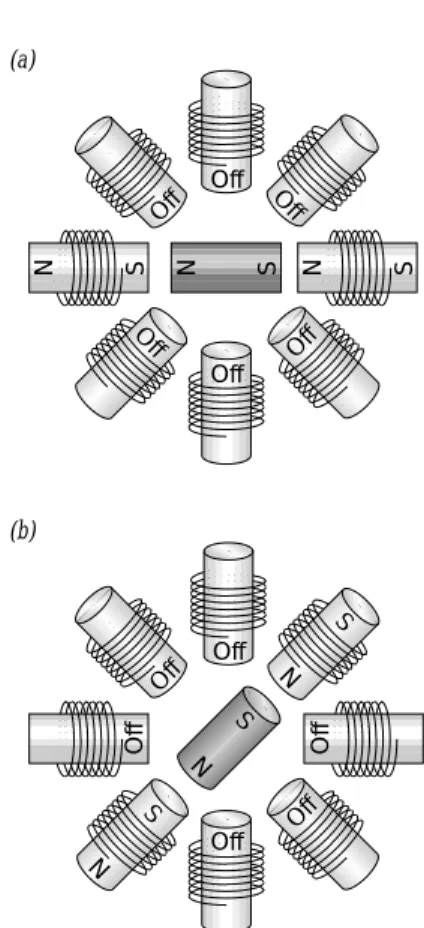
Many computerized devices use special motors that control the angles of their rotors. Instead of turning continuously, these rotors turn in discrete steps, so the motors are called stepping motors. The rotor of a stepping motor is a permanent magnet that’s attracted sequentially to the poles of several stationary electromag-nets (Fig. 9.5.9). These electromagelectromag-nets are turned on and off in a carefully con-trolled pattern so that the rotor’s magnetic poles move from one electromagnet to the next. The rotor is attracted so strongly by the nearby electromagnets that it
Fig. 9.5.8 - This 1 horsepower (750 W) induction motor is used in industrial and commercial equip-ment. The projection on top con-tains a capacitor that helps produce the rotating magnetic field the mo-tor needs to spin its romo-tor.
(a) (b) N S N S N S N S Off Off N S Off Off Off Off Off Off Off Off Off Off N S
Fig. 9.5.9 - In a stepping motor, the permanent magnet rotor is at-tracted first to one pair of electro-magnet poles and then to another. The rotor moves in discrete steps, pausing at each orientation until a computer activates a different set of electromagnet coils.
snaps almost instantly from one pole to the next as the computer shifts the flow of currents through the electromagnets.
The speed with which the rotor can step from pole to pole is determined mostly by the rotor’s moment-of-inertia. The smaller its moment-of-inertia, the more rapidly the rotor can respond to magnetic torques and the more steps it can make each second. Thus small stepping motors can respond more quickly than larger ones. Stepping motors are used in floppy disk drives, pen plotters, and numerically controlled machine tools.
CHECK YOUR UNDERSTANDING #6: Red Light, Green Light
After it makes a step from one pole to the next, the rotor oscillates back and forth briefly about the new pole. Why?