Just a Few Seeds More:
Value of Network Information for Diffusion
∗
Mohammad Akbarpour
†Suraj Malladi
‡Amin Saberi
§First Draft: September 2017
This Draft: June 2018
Abstract
Identifying the optimal set of individuals to first receive information (‘seeds’) in a social network is a widely-studied question in many settings, such as the diffusion of information, microfinance programs, and new technologies. Numerous studies have proposed various network-centrality based heuristics to choose seeds in a way that is likely to boost diffusion. Here we show that, for some frequently studied diffusion processes, randomly seedings+x individuals can prompt a larger cascade than optimally targeting the bestsindividuals, for a small x. We prove our results for large classes of random networks, but also show that they hold in simulations over several real-world networks. This suggests that the returns to collecting and analyzing network information to identify the optimal seeds may not be economi-cally significant. Given these findings, practitioners interested in communicating a message to a large number of people may wish to compare the cost of network-based targeting to that of slightly expanding initial outreach.
Keywords: Diffusion, seeding, social networks, targeting, word-of-mouth
JEL classification codes: D85, D83, O12, Z13
∗This paper has been previously distributed with the title “Diffusion, Seeding, and the Value of Network Information.” We thank Daron Acemoglu, Nava Ashraf, Stephane Bonhomme, Jeremy Bulow, Arun Chandrasekhar, Zoe Cullen, Darrell Duffie, Pascaline Dupas, Matthew Elliot, Ben Golub, Sanjeev Goyal, Matthew Jackson, Emir Kamenica, Alireza Khatami, Jon Kleinberg, Scott Kominers, Shengwu Li, Yucheng Liang, Greg MacNamara, Mihai Manea, Ilya Morozov, Michael Ostrovsky, Peter Reiss, Evan Sadler, Andy Skrzypacz, Alex Teytelboym, Christopher Tonetti, Carlos Varjao, as well as several other seminar participants, for valuable comments. We thank Jing Cai for helping us navigate their dataset. We also thank Maxime Rivet for coding some of the simulations reported here.
†Stanford Graduate School of Business.
‡Stanford Graduate School of Business.
1
Introduction
How to identify individuals who are the best ‘seeds’ for maximizing the spread of infor-mation in a social network is a widely studied policy question in settings such as the diffusion of brand awareness for products (Richardson and Domingos, 2002), the propa-gation of microfinance programs (Banerjee et al., 2013), and the adoption of agricultural technologies in developing economies (Beaman et al.,2015). Since this problem is known to be computationally complex (Kempe et al., 2003), a large body of theoretical and empirical studies introduce heuristics such as ‘degree centrality,’ ‘eigenvector-centrality,’ ‘diffusion-centrality,’ and the ‘k-shell’ index as proxies for ranking candidate individuals to target1. While such heuristic approximations are computationally feasible, implement-ing them requires knowledge of the network structure, which can be extremely costly to acquire in field settings2. This is part of the motivation for studies such as Banerjee et al. (2014) or Breza et al. (2017), which develop methods for identifying central nodes or approximating the network structure without conducting a thorough census. Here, our goal is not to identify the central individuals, but instead to quantify the value of doing so. We are interested in questions such as: When is it important to target central individuals? What is the value of having access to the network information? And how does this value compare with the cost of seeding?
The main contribution of this paper is to recast the benefit of following a network-guided seeding heuristic in terms of the additional seeds required for a heuristic that ignores the network structure to perform just as well. For a widely studied model of information diffusion in networks, we show that seeding a slightly larger number of in-dividuals randomly can prompt a larger cascade than seeding by optimizing over the network structure. We also show such results hold in simulations on some real-world net-work data and some alternative models of diffusion studied in the development economics literature. One can interpret our result as an upper bound on the value of network infor-mation and analysis for a policymaker attempting to spread inforinfor-mation through word-of-mouth. This suggests that slightly expanding initial outreach may be more economical than network-guided targeting.
In our model, we consider a population ofn individuals (or nodes) who are connected to each other through a social network. Individuals are either informed or uninformed about some product. The information percolates in the network according to a variant of the ubiquitous Susceptible-Infected-Recovered (SIR) diffusion model. In this model, all individuals (nodes) other than a small group (seeds) selected by the policymaker are initially uninformed. Once informed at time t, a node has one chance to speak to
1This problem has been studied in sociology, economics, marketing, computer science, medical
sci-ences, physics, etc. See section section1.1for some references.
2Breza et al. (2017) estimate that conducting network surveys in 120 Indian villages would cost
each of its uninformed neighbors. This information sharing is successful with probability
c independently for each neighbor, in which case the corresponding neighbors become informed by time t+ 1. This cascade of information continues until no new individual has the opportunity to become informed.
To quantify the value of network information in a policy-relevant way, we consider the following thought experiment: Suppose in one setting, we have access to full network data and unlimited computational power to optimally pick s individuals as initial seeds. In the second setting, we ignore the network and simply pick s+xinitial seeds uniformly at random. For what value ofxwill random seeding inform as many agents, in expectation, as the optimal seeding?3
In fact, we compare random seeding to a ‘better than optimal’ strategy, in the follow-ing sense. Suppose, in addition to the network structure, the policymaker has a perfect forecast of who would successfully share information with whom. She then picks the best s individuals to seed, equipped with this information. Comparing this ‘omniscient’ seeding with random seeding provides a generous upper bound for the value of network information, because for all realizations, the omniscient strategy will perform at least as well as the optimum, which itself performs better than computationally feasible heuristics. Our main result shows that for a wide range of parameters, the random seeding strategy withs+x seeds asymptotically performs as well as the omniscient strategy with
sseeds, wherexis vanishingly small relative to the size of the network. This result shows that, when the network is not too sparse or the communication probability is not too low, a policymaker interested in informing the greatest number of people should compare the cost of identifying the optimal seeds with the cost of seeding a few extra individuals. When these conditions fail and a sizable fraction of the population is not given the information, it is challenging to theoretically compare random and omniscient seedings. But in exactly this state of the world, we prove that even under the omniscient seeding, the fraction of informed population is vanishingly small compared to the total population. Moreover, our simulations show that even when the sufficiency conditions fail, except for a narrow range of parameters, extra seeds required by random to compete with the omniscient seeding is again small. This suggests that before considering network-based targeting strategies, a policymaker who believes that random seeding with a few additional agents is not a good strategy should first reconsider the efficacy of a word-of-mouth campaign.
We initially establish our result for ‘sparse’ Erd˝os-R´enyi random graphs. Such graphs, however, do not admit highly central agents and have low ‘clustering’ coefficients. Indeed, all nodes in such networks areex ante identical, so one may wonder whether the result is
3This thought experiment is analogous to the famous comparison of auctions and negotiations in
Bulow and Klemperer(1994), and its generalization inHartline and Roughgarden(2009). These results address how many additional bidders have to participate in a second-price auction, which requires no information on bidder valuations to implement, to generate as much revenue as an optimal auction with
(a) Optimal seeding (b) Random seeding (c) Random seeding with additional seeds
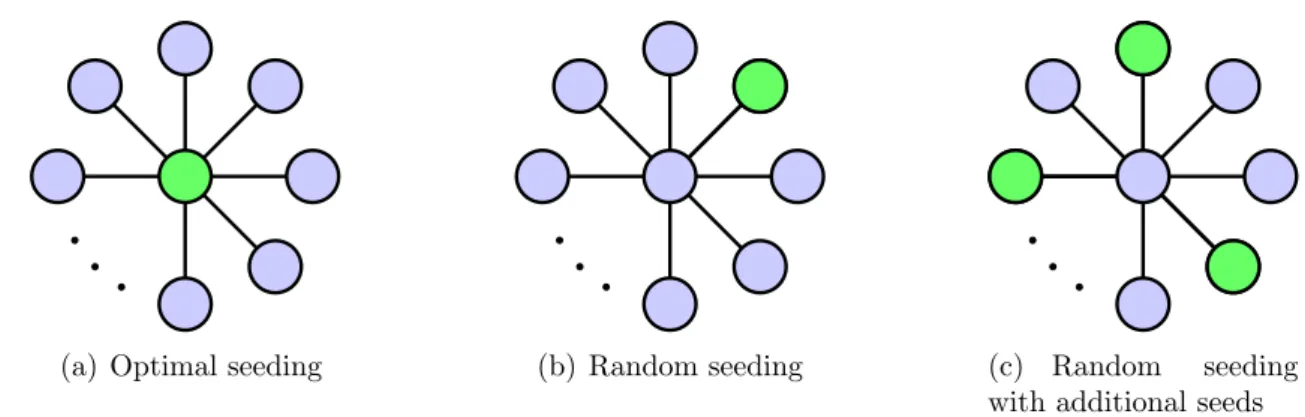
Figure 1: A simple intuition for the main result: Consider a star network withnleaves, for some largen. Suppose an informed node passes information along to each of its neighbors independently with probability 0.5. 1(a): With a single seed, diffusion is maximized by picking the central node and in expectation n2 of nodes will be informed. 1(b): Random seeding with a single seed will pick a non-central node with high probability. This means that half the time, diffusion ends immediately, and half the time, the central node becomes informed by the randomly chosen seed. Expected diffusion is approximately n4, far below what optimal seeding achieves. 1(c): Now consider a scenario with 1 < x n seeds. Random seeding will again pickx non-central nodes with high probability. However, the probability that a central seed is informed is 1−(12)x, so expected diffusion is nearly
n
2(1−( 1 2)
x), which quickly converges to n
2 asx grows. For instance, random seeding with
5 additional seeds performs better than 97% of optimal seeding.
an artifact of the Erd˝os-R´enyi structure. We therefore state similar results for a model of networks with power-law degree distributions and a generalized version of Erd˝os-R´enyi graphs with high clustering. One may believe that informing one of the few highly central nodes in a power-law network can be very important. But the key here is that random seeding is likely to seed some of the connections of those highly central agents, precisely because such individuals have many connections. Therefore, central individuals will become informed through their neighbors. Figure 1 explains this intuition.
Our next result concerns the speed of diffusion. When considering the spread of a new technology through imitation, policymakers may also be concerned with the rate of adoption, rather than just the eventual reach. Indeed, insofar as imitation of neighbors’ technology is a driving force of local economic growth, the speed of diffusion may be a primary concern (Alvarez et al., 2013; Perla and Tonetti, 2014). This is plausible, for instance, in agrarian village economies of the kind studied inBeaman et al.(2015), where the goal is to increase the influence of efficient agricultural technologies. Our second result considers a more general variant of the diffusion model in which the diffusion process ends after T ≥ 1 periods, for graphs with n agents without very high number of connections (in a sense that we make precise). We then prove that after any number of periods, a random seeding strategy with a proportional increase ofo(log(n)) in the number of seeds performs, asymptotically, better than the omniscient strategy withs seeds.
findings hold for finite, real-world networks. We study the Indian village household net-works of Banerjee et al. (2013), the Chinese village rice farmer networks of Cai et al.
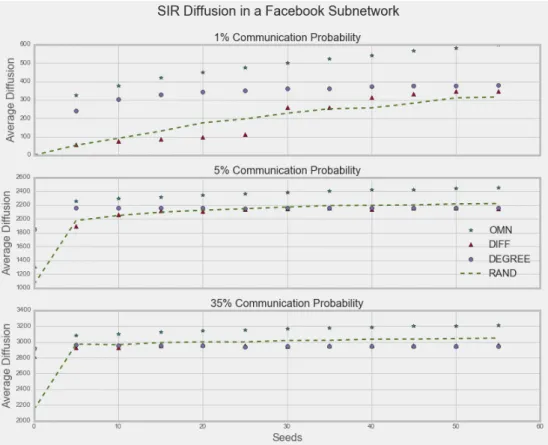
(2015), and a small subnetwork of Facebook using data fromLeskovec and Krevl(2014). We verify that random seeding competes well in the extent and speed of diffusion with both typically proposed and omniscient targeting strategies. For instance, in the Face-book subnetwork with nearly 4000 nodes, if each node speaks to her neighbors with probability 5%, random seeding with 10 seeds prompts a larger cascade than “diffusion-central” seeding with 11 seeds. Our simulations also show that the extra seeds required by random to beat network-guided heuristics in speed of diffusion is smaller than the theoretical o(log(n)) multiplicative bound.
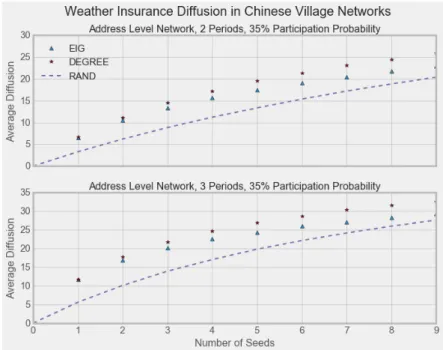
We go on to explore the robustness of our results to the specification of the diffusion model. The diffusion model considered so far is a workhorse model in the literature that studies information diffusion. We show that similar results hold for some of the more complex models estimated in the development economics literature. For example, for a version of the model of diffusion studied and estimated in Banerjee et al.(2013), random seeding with 11 seeds performs nearly as well as central seeding with 10. For the farmer social networks inCai et al.(2015) and only in two periods4, as another example, random seeding with 6 seeds performs nearly as well as central seeding with 5. It will be also clear from our proofs that similar results hold for the game-theoretic model of diffusion studied in Sadler (2018), where agents choose to adopt a product or not. Moreover, the model we studied exhibits undirected relationships and communication. This assumption may be questioned in some settings. Advice-giving, for example, is an inherently directed relationship where the involved parties are not necessarily equals. We then prove that our results hold in a model of random directed relationships and communication.
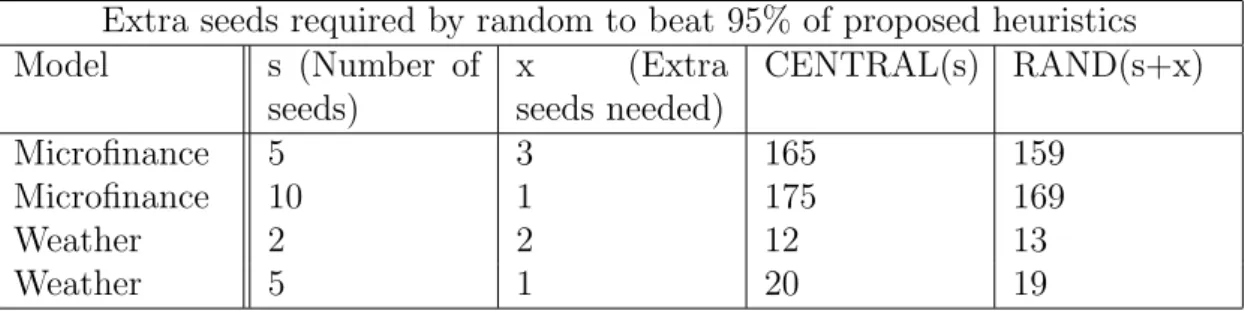
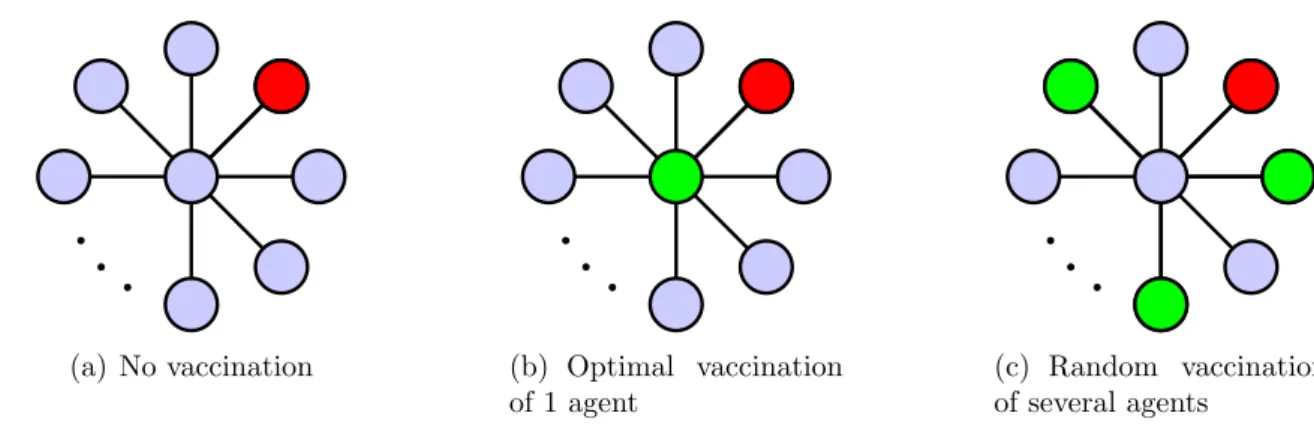
We close by stating a caveat: Network targeting might be essential in contexts different than ours. For instance, in a threshold model of diffusion where an agent is informed only if sufficiently many of his neighbors are informed, random seeding (even with a few additional seeds) performs poorly. Moreover, if the objective is tominimize diffusion by “vaccinating” individuals, targeting central nodes can be necessary. (Figure 6 illustrates this.) Therefore, our main finding should not be seen as an unambiguous advocacy for the superiority of expanded outreach to network targeting. Instead, the project of this paper is to identify practically relevant settings under which collecting and analyzing network data is not cost-effective. Whether network data is valuable for the problem in hand is, of course, context-dependent. That said, regardless of the diffusion model, ‘extra number of seeds required for a agnostic seeding to compete with a prescribed network-based heuristic’ is a statistic that can provide useful and easily interpretable information about the economic value of the results of a study beyond statistical significance. Table1
shows that this statistic forBanerjee et al. (2013) andCai et al. (2015) is smaller than 3.
1.1
Related Literature
How to identify a group of individuals within a social network who are most likely to adopt an idea or technology, or spread these things to others, are old questions in sociology.
Lazarsfeld et al. (1948) is one of the firsts who discussed this, and the idea that certain individuals accelerate the spread of ideas or technologies by adopting these themselves gained popularity since.
The threshold model of collective behavior and word-of-mouth was introduced in
Granovetter (1978). Domingos and Richardson (2001) is one of the firsts to introduce the influence maximization problem in the context of viral marketing. The independent cascade model was introduced inGoldenberg et al.(2001). Prominent among the next set of papers isKempe et al. (2003), which considers two common diffusion models and asks how difficult it is to generally solve for the optimal size k set of initial targets when the objective is maximum contagion. They show that computing the optimal set is NP-hard. The influence maximization spawned a large literature developing algorithms for in-fluence maximization over networks in a wide rang of disciplines. To see such examples in computer science and operations, see Chen et al. (2009); Goyal et al. (2011); Asad-pour and Nazerzadeh (2015);Chen et al. (2016);Wilder et al.(2017), in health-care, see
Rice (2010); Rice et al. (2012);Kim et al. (2015); Yadav et al. (2016), in marketing, see
Leskovec et al.(2007);Watts and Dodds (2007), and in the physics literature, seeKitsak et al. (2010); Chen et al. (2012). For more references, see a survey by Liu-Thompkins
(2012). Unlike these papers, we formally quantify the value of network information as the extra seeds required by random seeing to beat the optimum, and identify conditions under which careful seeding may or may not matter. Our formulation of the value of seeding raises a policy-relevant comparison for researchers and practitioners.
In the development economics literature, Duflo and Saez (2003); Conley and Udry
(2010); Dupas (2014) all point out to the importance of social networks as a means of learning in development economics.
Three development economics papers are particularly related to our paper: Baner-jee et al. (2013) is one of the first papers to introduce the question of careful seeding to effectively harness such social learning. One of the main findings of this paper is that eigenvector-centrality and diffusion-centrality (a measure introduced by the authors, which captures something between degree and eigenvector centrality) of initial seeds is strongly correlated with total participation into the microfinance program, while degree centrality is not. Beaman et al. (2015) study technological adoption by farmers as they vary seeding rules over 200 independent village-networks in Malawi in an experimental setting. Their result suggest a ‘threshold’ kind of diffusion, although across different seeding strategies, they find very little diffusion beyond the initial seeds. In the instances where some non-seed nodes adopt, it is more likely to happen under network-guided
seed-ing. This observation is in line with our theoretical result that if diffusion is vanishingly small, then network-based targeting can beat random seeding. Cai et al.(2015) also con-duct a randomized experiment in which they seed certain individuals in Chinese village with information about a weather insurance program and observe take-up rates among their neighbors within a village social network.
Banerjee et al.(2013),Beaman et al.(2015) andCai et al.(2015) all find that the effect of choosing central nodes on the size of diffusion is statistically significant. In contrast, the present paper asks when the magnitudes of the effects identified in those papers are
economically significant enough to justify network targeting. Keeping fixed the number of seeds, central seeding strategies may compare favorably to random seeding. But this viewpoint ascribes too much value to having precise network information, in light of the alternative option of expanded outreach.
Banerjee et al. (2014) suggests that for a diffusion process in which nodes know the originator of information, asking individuals who they think are the biggest gossips is enough to identify diffusion central individuals. Our result, on the other hand, elucidates when it is important to target central individuals in the first place. Moreover, keeping the same diffusion process as in Banerjee et al. (2014), our comparison between omniscient and random seeding holds for any information structure.
In one of their results, Jackson and Storms(2017) study a heuristic for optimal seed-ing in a model of diffusion with threshold behavior. Buildseed-ing on our intuition about the threshold model, they show that random seeding requires many extra seeds to beat network-guided heuristics in that context.
A relatively recent theoretical literature in economics have also studied the optimal seeding under various diffusion processes the conditions for achieving widespread con-tagion, as well as competition in diffusion (Morris (2000); Galeotti and Goyal (2009);
Young (2009); Goyal et al. (2014); Bloch et al. (2014); Lim et al. (2015); Mobius et al.
(2015); Sadler (2018); Galeotti et al. (2017); Banerjee et al. (2018)). Meanwhile, other papers describe game theoretic foundations for the traditional measures of centrality (e.g.,
Ballester et al. (2006);Bloch et al. (2016)) or role of influential nodes (e.g., Galeotti and Goyal(2010)).
Organization of the paper. We introduce our network diffusion model in section2. In section3, we present our benchmark theoretical result for Erd˝os-R´enyi graphs. Section 4
generalizes the benchmark result to power-law networks, as well as several real-world networks. In section 5, we study generalizations and limitations of the results with respect to the diffusion model. We extend the objective function to speed of diffusion in section 6. Main ideas behind the proofs are presented in section 7. Section 8 discusses some aspects of the model and results. Section 9concludes.
2
Model
There are n ≥ 3 individuals and we will refer to them as agents or nodes, with labels
i∈N ={1,2,· · · , n}. Agents are connected in a social network represented by a simple graph G = (N, E), where E is the set of unordered pairs of agents and {i, j} ∈ E if agent i and agent j are linked or are neighbors. A node’s degree in G is the number of its neighbors.
Diffusion process. Time passes in discrete periodst={0,1,2, . . .}. An agent is either
informed or uninformed. Once an agent becomes informed, it remains informed forever after. Initially, a subsetA0 ∈N of individuals are informed. Once informed at timet, an
agent has one chance to speak to each of its uninformed neighbors. We focus on the case that an informed individual has only one chance to speak to her neighbors, but this can be easily generalized to multiple (bounded) chances. This information sharing is successful with probability c independently for each neighbor, in which case the corresponding neighbors become informed by timet+ 1. Diffusion continues until no new individual has the opportunity to become informed. Later in the paper, we will consider cases where all communication ceases after some T ≥ 1 periods. The case where T is finite is called a
bounded diffusion process. Otherwise the diffusion process is called unbounded.
There is an alternative contrived but useful way to think about the unbounded diffu-sion: Suppose at timet, there is a coin flip for each link of the social networkG, and with probability c that link is maintained in the network. Let us call this new constructed network, which is clearly a function of the original network, a communication network
and denote it byK(G)⊆G. The communication network is a way to think about the set of all pairs of agents who will speak to each other, once one of them becomes informed.
The diffusion process considered here is one in which communication is undirected. In particular, the event that node i talks to j if informed is coupled with the event that
j talks to i if informed. Moving from undirected communication settings to directed communication requires addressing some technical issues. We postpone the discussion of this case to the section 5.2, where we show that results can be extended to settings with directed communication.5
Seeding strategies. A seeding strategy takes as input a network and a number of initial seeds s ≤ n and outputs a (random) set of s initial seeds to be informed at time t = 0. Formally, let Un be the set of all node-labeled networks on n nodes and let
[n] ={1,2, . . . , n}. A seeding strategy is a set-valued (random) functionf :Un×[n]→2N,
with the property that |f(G, s)|=s.
We say seeding strategy f is feasible if for all networks G = (N, E) ∈ Un and
s ≤ |N| = n, f(G, s) and K(G) are independent. The communication network en-codes the information of who would speak to whom, which is of course not available to a policymaker a priori. A seeding strategy that does not satisfy this property uses the re-alization of this information in determining the choice of seeds, and is therefore infeasible to implement. While in practice a policymaker with no knowledge beyond the network structure can only use feasible seeding strategies, infeasible strategies can be useful as theoretical benchmarks. Let F be the space of feasible seeding strategies for graphs on
n nodes.
Network formation model. A model of network formation is a probability distribu-tion Pn over the set of all networks Un. Let Gn be a (random) graph drawn from the
distribution Pn. Going forward, we will consider specific distributionsPn. We will drop
n from the notations when it is clear from the context. As will be clear shortly, in stating our theoretical results, we are interested in limit behavior of the networks as n → ∞.
To start, we consider an Erd˝os-R´enyi network formation process on a set of agentsN. In an Erd˝os-R´enyi random network, there is a link between a pair of agents (i, j) ∈ N2
with probabilityp, independently of other agents and links. We use the notationER(n, p) to denote an Erd˝os-Renyi network on n nodes in which each link exists with probability
p.
Erd˝os-R´enyi structure is the simplest and most widely used network model for which we state our results. We then generalize the main result to broader classes of models that resemble features of real-world networks.
Goal. LetAt(G, s, f)⊆N denote the (random) set of informed nodes at time 1 ≤t≤
T, as a function of the networkG, number of seeds s, and the seeding strategy f. Let h(G, s, f) ≡ E[|AT(G, s, f)|] be the expected number of informed agents at the
end of the process. Here the expectation is taken over the diffusion process. LetH(f, s)≡ EG∼Pn[h(G, s, f)]. The function H measures the performance of a seeding strategy by
taking the strategy and number of seeds as inputs and producing the expected total number of informed agents as output, for a given network formation process. The goal of the planner is to choose a seeding strategy f to maximize H(f, s).
Relevant seeding strategies. We denote the optimal seeding strategy by OPT. For a fixed network, this strategy picks the set ofsseeds that maximizes the expected diffusion, with an arbitrary selection when there are multiple optimal candidates:
OPT(s)∈argmax
f∈F
H(f, s).
instead, policymakers resort to heuristics such as seeding the s most central individuals in the network, according to various measures of centrality. We will introduce them in the empirical section of the paper.
We define two seeding strategies as theoretical benchmarks. Let RAND(s) be the strategy which picks s nodes uniformly at random in G. This strategy ignores all the information about the network structure.
On the other end, we analyze the omnicient seeding strategy, denoted by OMN(s), which for every realization of the communication network pickssinitial seeds to maximize diffusion. Notice that this strategy is infeasible by construction because it knows who is going to speak to whom, and it performs better than any feasible strategy for any realization of the diffusion and network formation processes. In particular, for any initial number of seeds k:
H(OMN, s)≥H(OPT, s)≥H(RAND, s)
3
Benchmark Result: Erd˝
os-R´
enyi Networks
To quantify the value of learning the network and identifying the optimal seeds, we would ideally like to compare the performances of OPT and RAND. Recall that OPT exploits the full knowledge of the structure of the network and solves a computationally hard optimization problem, while RAND ignores any information about the network. Therefore, the difference between these two can be interpreted as the value of network information and analysis. As noted earlier, however, computing OPT is an NP-hard problem. Instead, we measure the difference between the performances of OMN and RAND. Since for any realization of the diffusion process, OMN performs better than OPT, comparing RAND and OMN gives a generous upper bound on the value of network information and analysis.
To operationalize the difference between these two seeding strategies for the policy-maker, we pose the following question: how many additional seeds are required in random seeding to compete with the omniscient strategy? Our first theorem, stated below, shows that in Erd˝os-R´enyi networks, when diffusion is effective, this number is small. The results stated in this section will be for the unbounded diffusion process. The proofs make use of results from percolation theory and are relegated to the appendix. The ideas behind the proofs are presented in section 7.
To simplify the statement of our theoretical results, we define the following notation: We say that a function f(n) asymptotically weakly dominates g(n) if limn→∞|fg((nn))| ≥1.
We also sayf is ofo(g), ω(g), and O(g) if and only if this limit is zero, infinity, and any finite constant respectively. For example, any divergent increasing function of n is ω(1). We refer to ω(1) as asuper-constant.
Theorem 1. Consider an Erd˝os-R´enyi network on n nodes with average degree d. Let c be the probability that an informed node speaks to a given neighbor and let s =o(log(nn)). If cd > 1, then for any super-constant x(n),
lim n→∞ H(RAND, s+x(n)) H(OMN, s) ≥1. If cd≤1, then lim n→∞ H(OMN, s) n = 0.
This result states that if cd > 1, which means that each person on average talks to at least one of their friends, then random seeding with super-constant extra seeds (asymptotically) performs better than the omniscient seeding. On the other hand, when
cd ≤ 1, the fraction of informed nodes even under the omniscient seeding strategy goes to zero as n → ∞.
We point out that while a super-constantω(1) grows withn, such ‘limit results’ should not be read literally. The key lesson here is how quickly random takes over the optimum. Asymptotic results help us to theoretically study complex networks in a tractable way. Importantly, the number of additional seeds needed by random to be competitive with omniscient can be made to be asymptotically small compared to the number of seeds; that is, x/s can quickly go to zero. In fact, even for finite networks, random requires only a few additional seeds. For instance, consider an Erd˝os-R´enyi random network on 1000 nodes in which each informed node passes along the information to 1.5 neighbors on average (so cd= 1.5). Simulations show that randomly seeding 7 nodes achieves within 95% of omnisciently seeding 5 nodes. If nodes pass along information to 2 neighbors on average, then even 20 omnisciently selected nodes do no more than 5% better than 23 randomly selected nodes (with differences being even more negligible for fewer seeds).
Remark 1. While x(n)∈ω(1) additional seeds are needed for random seeding to asymp-totically dominate omniscient seeding, only a finite number of additional seeds, h()∈N, are needed for random seeding to come within a ratio of 1− of omnisicnet6.
The restriction on the size of s = o(log(nn)) precludes, for example, the case when a constant fraction of the seeds in a network are targeted. Indeed, the motivation for using word-of-mouth as a vehicle for diffusion is that few initial seeds are needed to reach a large population, so this restriction is natural. But this is not to say that random seeding is not comparable to practically implementable seeding strategies when more seeds are used. To the contrary, intuition and simulations suggest that flooding many individuals with information makes careful selection of initial seeds less valuable. However, the
performance of implementable strategies eventually flattens out due to redundancy in seeding choices, while the omniscient strategy delicately avoids seeding the same cluster twice, and so the omniscient ceases to be a useful theoretical benchmark for comparison. In fact, simulations of section4.2confirm that similar bounds will go through for relatively small networks and all values of s.
4
Generalized Networks
In this section, we will show that our main result holds for a variety of theoretical network models and real-world network structures.
Some real-world networks are characterized by degree distributions with fat tails, in the sense that they exhibit few nodes that have significantly greater degrees than others. For example,Barabasi and Albert(1999) describe a variety of social networks, such as the network of linked web pages or collaborating actors, exhibiting a power-law like degree distribution on its right tail. They also have a high degree of clustering (neighbors of neighbors tend to be neighbors themselves). Erd˝os-R´enyi networks fail to capture either of these properties. Here we will show that Theorem 1 can be extended to more general network models that exhibits power-law degree distribution. In the appendix B.1, we show that the result can be extended to a model of network with clustering. Last but not the least, we will show that our results hold for a variety of real-world networks with non-random structure and clustering, including Indian village network of Banerjee et al.
(2013) and a subnetwork of Facebook.
4.1
Power-law Chung-Lu networks
We will now consider network formation models that allow for more general degree dis-tributions. In particular, “Chung-Lu” networks (Chung and Lu,2002) or inhomogeneous random graph models are generalizations of Erd˝os-R´enyi that support power-law.
Definition 1 (Chung-Lu network). Fix a sequence w = (w1, . . . , wn) ∈ Rn+. A
Chung-Lu(undirected) network on n nodes, CL(n,w), is generated by including each edge {i, j}
independently with probability pij = min( wiwj
P
kwk,1).
For any node i, the expected degree is equal to P
j wiwj P kwk = wi P jwj P kwk = wi, which
means that the sequence of weightsw= (w1, . . . , wn) doubles as the sequence of expected
node degrees as well. Therefore, in order to capture the power-law degree distribution, we consider a parametric power-law functional form for the weights. In particular, we assume that for all i,
We call a Chung-Lu network with such a weight sequence a power-law Chung-Lu network onnnodes with minimal expected degreedand scale parameterb. The parameter
bdetermines the thickness of the tail, and asbgrows, the tail becomes thinner and thinner. The more permissive definition of power-law requires that the mass of the cumulative distribution function lying to the right of some large enough k is proportional to k−τ. Our model satisfies this condition forb =τ+ 1. Moreover, when the weight distribution follows a power law, the degree distribution of the corresponding random graph follows a power-law tail Van Der Hofstad (2016). Barabasi and Albert (1999) estimates the scale parameter for the tails of different real-world network degree distributions and find this lies in the (1,2] interval for many of their examples.
Theorem 2. Consider a power-law Chung-Lu network on n nodes with scale parameter b and minimal expected degree d . Let c be the probability that an informed node speaks to a given neighbor and let s = o(log(nn)). If either (1) b ∈ (0,2] or (2) b > 2 and cd >(b−1)(b−2), then for any super-constant x(n),
lim n→∞ H(RAND, s+x(n)) H(OMN, s) ≥1. If b > 2 and cd≤(b−1)(b−2), then lim n→∞ H(OMN, s) n = 0.
A power-law network can have nodes with extremely high degrees. The optimal seeding strategies can pick those nodes as seeds, whereas the random seeding strategy (even with a few additional seeds) will most likely never picks those nodes. Perhaps surprisingly, it is in the case where the tail of the degree distribution is sufficiently thick that no further assumptions on communication probability are needed to ensure the result of the theorem. This raises the question of how random seeding can compete in this case. The intuition, as depicted in Figure 1, is that random seeding is likely to pick one of the neighbors of the highly connected nodes. Hence, highly connected nodes are likely to become informed through their connections.
4.2
Real-world networks
So far, we have provided bounds on the value of seeding for two important theoretical classes of networks. We can consider other theoretical network models, but at the end no network model can match all moments of the real-world networks. Therefore, here we offer a (network formation) model-free perspective on the results of section 3 in an economically relevant context. We simulate the diffusion model studied here on the microfinance network data inBanerjee et al. (2013) as well as a subnetwork of Facebook,
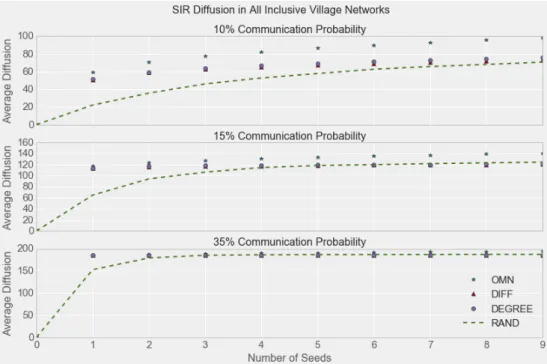
Figure 2: The average diffusion achieved by the various seeding strategies (omniscient, random, degree, diffusion) across ‘all inclusive networks’ in the village network data, for various levels of communication probabilities.
and compare the performance of various seeding strategies.
The networks in Banerjee et al. (2013) have households as nodes, with edges repre-senting some sort of relationship. For example, in one network, the edges represent that members of the incident households go to temple, mosque or church together. In another network, the edges represent the fact that members of one household have borrowed or loaned money to those in the other or frequently give or take advice from the other, and so on. While some of these relationships are directed, the graph will be taken to be undirected. For information diffusion, it is not unreasonable to think that any sort of contact creates an opportunity to speak about the topic at hand.
Simulations in Figure 2 compare average performance of random, degree-central, diffusion-central7, and omniscient seeding strategies on ‘all inclusive’ village networks, which includes an edge between two households whenever either party indicated some contact with the other group of any form. Results are included for different parameters of our diffusion process, which indicate the probability that two connected nodes commu-nicate information to each other given that one of them is informed. Running the same simulations for sparser networks (e.g., the kerosene and rice lending networks within the
7Degree centrality is simply a ranking of nodes from those with the most neighbors to those with
the least. Diffusion centrality for each node in a graph with adjacency matrixg, diffusion probabilityq, and T periods of communication is given byDC(g, q, T) = [PT
t=1(qg)
t]·1(Banerjee et al., 2013). At
T = 1, this measure ranks nodes simply by degree, and asT → ∞, depending on whether qis larger or smaller than the inverse of the largest eigenvalue ofg, the vector of diffusion centralities converges to a ranking proportional to Katz-Bonacich or eigenvector centrality respectively (these can be taken as the definitions of the latter measures).
Figure 3: A comparison of the various seeding strategies on a Facebook subnetwork with approximately 4000 nodes, for different communication probabilities. The random seeding strategy competes well with OMN and other seeding strategies, when the com-munication probability is not too small. And when the number of seeds is not too small, it beats degree and diffusion central seeding strategies.
same Indian villages) does not qualitatively change the results.
Next, we replicate the comparison between diffusion strategies on a Facebook subnet-work in Figure 3 to show that the patterns observed for the Indian village data roughly bear out here as well. In comparison to the village data, the degree distribution for this network exhibits a fatter right tail.
5
Alternative Diffusion Models
So far, our theoretical results focused on the undirected SIR model of diffusion, which is used to study processes such as diffusion of information and ideas, rumors, or infectious diseases. We focused on the SIR model since this is a workhorse model, studied and estimated in several economic environments. We will now discuss alternative diffusion models under which our results will (or will not) hold.
5.1
Models from development economics
The diffusion models used inBanerjee et al.(2013) andCai et al.(2015) are more complex, but still share the feature of the SIR model that an agent’s neighbors are “substitutes”, in the sense that having one informed neighbor ensures with sufficiently high probability that an agent will be subsequently informed. For instance, inBanerjee et al.(2013), once an agent gets informed, she may or may not participate in the microfinance program, and participants inform their neighbors with higher probability than non-participants. Cai et al. (2015), on the other hand, consider a linear probability model, where the chance that an agent gets informed is proportional to the number of its informed neighbors.
Our basic insight goes through for all diffusion models discussed above. To show this, we will consider the diffusion models and the social network data of Banerjee et al.
(2013) andCai et al.(2015) and compare centrality-guided and random seeding strategies. Simulations reported in appendixE(for the Microfinance model) and appendixF(for the weather insurance model) show that the number of additional seeds required for random to compete with centrality-guided heuristics is small.
When the diffusion process is such that neighbors are “complements”, say when sev-eral of an agent’s neighbors have to adopt a technology before he does the same, our results may fail to hold. For instance, in the threshold type models of diffusion, agents will only adopt a behavior if at least a certain number (or fraction) of their neighbors adopt, so there are complementaries in the inputs of propagation. Beaman et al. (2015) study technological adoption by farmers as they vary seeding rules in village-networks in Malawi in an experimental setting. Their result suggest a threshold-type diffusion pro-cess, although they observe little diffusion. Since random seeding is unlikely to inform multiple neighbors of the same node, if thresholds are uniformly high across all agents, random seeding will fail to prompt any diffusion. This intuition has been subsequently formalized in Jackson and Storms (2017). Typically, these models assume a uniform threshold across agents. But if thresholds are heterogeneous and sufficiently many agents have a threshold of 1, then results similar to our main theorems may continue to hold.
5.2
Directed communication
The models considered so far exhibit undirected relationships and communications. In particular, the event that node i talks to j if informed is coupled with the event that j
talks to i if informed. The assumption of undirected relationships and communication may both be called into question. Indeed, it frequently happens in surveys that one individual names another as a close friend, without the other declaring in kind. In addition, even if relationships are undirected, it is not a foregone conclusion that just because one agent would have informed a friend of some information, that the reverse would have occurred had the latter party learned of the information first.
We will now consider a model of directed networks similar to Erd˝os-Renyi. D(n, p) is a random directed network on n nodes in which directed edge (i, j) is drawn with probability pn. In this setting, OMN observes a realization of the directed communication network and chooses the best nodes to seed using this information.
Theorem 3. Consider an random directed network, D(n, p). Letcbe the probability that an informed node speaks to a given neighbor and let s=o( n
log(n)). If cp >1, then for any
super-constant x(n), lim n→∞ H(RAND, s+x(n)) H(OMN, s) ≥1. If cp ≤1, then lim n→∞ H(OMN, s) n = 0.
5.3
Game-theoretic models
The model of diffusion we study here, as well as those studied in Banerjee et al. (2013),
Cai et al.(2015) andBeaman et al.(2015), are all “mechanical” models, in the sense that agents do not optimize any specific objective function. In our model, for instance, once an agent is informed, it will inform each one of its friends with some probability. In principle, one could micro-found this behavior. Doing so is not the focus of this paper. Instead, we will simply note here the implications for seeding in the game-theoretic diffusion model introduced inSadler (2018). There, agents get informed, update their beliefs about their network position in a Bayesian fashion, and can choose to adopt a product. From the proof strategies of our paper, it is straightforward to see that our results hold in this context, since that paper (like ours) exploits the percolation results that if the diffusion process reaches a positive fraction of the population, there will be a giant component of informed individuals.
6
Speed of Diffusion
We will now discuss conditions under which a “similar” result can be extended to bounded diffusion processes, where all communication ceases after a fixed number of rounds. This result, then, shows that random seeding competes with omniscient seeding period by period, which can be interpreted as a statement on the relative speeds of diffusion in the unbounded case. This addresses the economically salient concern that while both seeding strategies eventually reach the same level of diffusion, network information allows policymakers to significantly accelerate the speed with which the information spreads. As an example, policymakers may be concerned with how quickly farmers adopt a new technology, so that the developing economies may grow at faster rates. Indeed, diffusion
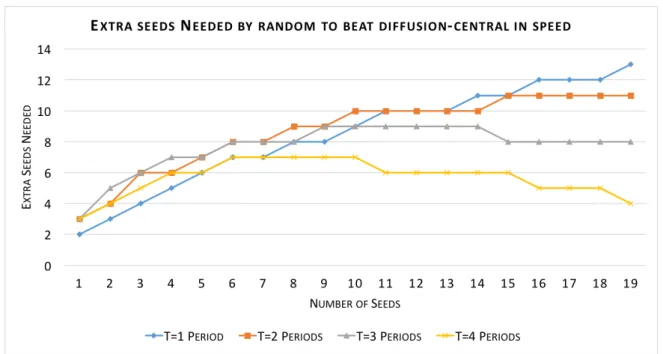
Figure 4: Average number of extra seeds required by random to outperform diffusion-centrality seeding in Indian village networks (in of speed of diffusion). If objective is diffusion in the first T=1 or T=2 periods, then extra seeds required is relatively high (still less than 15), but once total outreach in the first T=3, T=4 or more periods is the objective, less than 9 extra seeds is enough.
of technologies through imitation is a primary concern for the growth rate in a local economy (Perla and Tonetti,2014), for instance in agrarian village economies of the kind studied in Beaman et al. (2015), where the policy-makers wish to expand the influence of modern, more efficient agricultural technologies.
Our main result in this section shows that for Erd˝os-R´enyi networks, with o(log(n)) times additional seeds, random seeding competes with the omniscient seeding even in the speed of diffusion.
Theorem 4. Consider an Erd˝os-R´enyi network on n nodes with average degree d and a bounded diffusion process that ends in T ≥1 periods and let s be a non-negative integer. Then, H(RAND, o(log(n))s)≥H(OMN, s) for n sufficiently large.
In appendix B.2 we prove a generalized version of this theorem for a network model with clustering.
When the objective function is the speed of diffusion, our theoretical bounds are weaker: As opposed to ω(1) additional seeds for a broad class of network models, we provide o(log(n)) multiplicative bound for Erd˝os-R´enyi networks. This is because when it comes to bounded diffusion processes, it is easy to identify theoretical cases in which careful seeding is important. For instance, in a star network, when diffusion process ends afterT = 1 period, seeding the central node is essential for obtaining any diffusion.
6.1
Speed of diffusion in microfinance setting
We now compare speed of diffusion under random and diffusion-central seeding using the microfinance model of diffusion and Indian village networks. Figure 4 depicts the extra number of seeds needed for random to beat diffusion-central seeding in microfinance setting. When the diffusion ends in T = 1 orT = 2, periods, the extra number of seeds required for random to catchup is between 3 to 13, depending on the number of seeds. WhenT = 3 andT = 4, the extra number of seeds needed for random is always less than 9 and 7, respectively.
7
Proof Ideas
In this section, we discuss some ideas behind our theoretical results. Rigorous proofs are presented in the appendix. Readers not interested in these techniques may skip this section. The exposition uses standard graph-theoretic terminology that can be found in standard references, e.g., Jackson(2010).
Theorem 1. Recall that the communication network K(G) ⊆ G is a way to think about the set of all pairs of agents who will speak to each other, once one of them becomes informed. We can consider the connected components of this communication network to better understand the behavior of random and omniscient seeding strategies. Note that in the SIR model, a node becomes informed if and only if one of the nodes in its connected components in K is seeded. This implies that an omniscient seeding strategy with s seeds would simply seed one node in each of the s largest connected components ofK. On the other hand, for each seed, the probability that the random strategy informs a given component is proportional to the component’s size. This gives us a method of computing the expected diffusion for each of strategies, once we are given the distribution of component sizes for a communication network.
When n is sufficiently large and cd > 1, by the standard phase transition result for Erd˝os-R´enyi random graphs, there exists a component in the communication network which contains a constant fraction of the total population. The remaining components, on the other hand, are vanishingly small (O(log(n))) in population size. So as long as the random seeding strategy informs the nodes in the large component, which it can with high probability once it is given a sufficiently large budget of seeds, omniscient seeding cannot do much better.
When cd <1, then even the largest component isO(log(n)) in size, so the omniscient seeding strategy witho(logn(n)) seeds can only inform a vanishingly small (o(n)/n) fraction of the population.
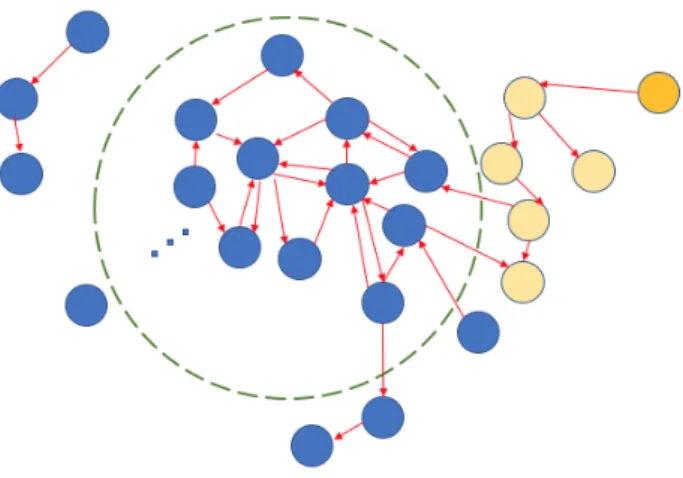
Figure 5: Above is an example communication network when communication is directed. The outgoing edges represent the nodes that a given node would inform if given informa-tion. The nodes within the dotted dashed circle represent the strongly connected giant component. The orange nodes, if informed, disseminate information to the SGC. In this example, OMN might choose to seed the dark orange node, given a single seed (and there could be many such useful entry points, though only one set of orange nodes is pictured above). In the proof of Theorem 3, we show that the size of the set of any cluster of orange nodes is o(log(n)) so that OMN cannot significantly outperform RAND.
Theorem 2. The arguments are analogous and similar phase transition theorems hold for Chung-Lu graphs for some range of parameters (Van Der Hofstad (2016)). For our results, we need to extend these theorems over a range of parameters where standard techniques do not apply (see Appendix Cfor details).
Theorem 3. The idea of using the communication network applies also to the case of directed networks with directed communication. However, the nodes that ultimately become informed are those for which a directed path exists from a seed. The analog of the giant component is the uniquestrongly connected giant component (SGC), which the random seeding strategy reliably hits.
The trouble in this case, however, is that a seed which ultimately informs the SGC may not be a member of this component at all (see Figure 5). Consider such a node and the length of the shortest path leading from this node into the SGC. If the path length is long, an omniscient strategy would go choose this node as an entry point into informing the nodes in the SGC. But a random seeding strategy with any number of seeds would not hit such a node, other than through sheer luck. Results inKarp (1990) indicate that such paths are o(√n) in length, which is too generous of an upper bound for our results to hold. We establish that these paths are in fact o(log(n)) in length, and can therefore be safely ignored.
Theorem 4. We need to show that the extent of diffusion that happens in T periods from any node must be o(log(n)) for large n. This is equivalent to bounding the size of a T−neighborhood of a random graph: with probability approaching 1, only o(log(n)) nodes are reachable in T steps from any given node. As described in the appendix, this bound straightforwardly extends to a model of graphs with clustering inspired by
Jackson and Rogers (2007), where friend of friends and friend of friend of friends (etc.) are likely to be one’s direct neighbors as well. In this sense, clustering does not change the performance comparison between omniscient and random seeding in speed of diffusion.
8
Discussion
8.1
A policy-relevant statistic
Our results suggest a way to measure the operational value of a seeding heuristic for researchers looking at the benefits of network based targeting in settings beyond ours. In particular, consider a general network setting, where the goal of a research study is to identify optimal nodes of a network for maximizing diffusion, for a given diffusion model. This could be the diffusion model studied in this paper or generalizations thereof, or any other diffusion model of interest. Suppose the researchers identify a specific seeding heuristic to perform well. These researchers can report the following statistic as a policy-relevant quantity: How many extra seeds are needed for the random seeding strategy to be within z% of their proposed strategy, for a small z?
For example, for the diffusion model of Banerjee et al. (2013) and with s= 10 initial seeds, random seeding with 1 extra seed is within 95% of the seeding based on their proposed strategy (diffusion centrality), and for the weather insurance setting of Cai et al. (2015) with s = 5, random seeding with 1 additional seed performs within 95% of their prescribed strategy (eigenvector centrality).8 Additional numbers are reported in Table 1.
8.2
The virtue of randomness
While simulations presented in this section are aligned with our theoretical findings, they also shed light on an important point: When the number of available seeds is not too small, random seeding can perform better than centrality-guided seeding heuristics. The intuition here is that centrality-guided seeding heuristics pick redundant agents, who are likely to be part of the connected core of the network. Seeding those individuals has
8For microfinance diffusion, for instance, we measure the expected diffusion of seedings top
degree-central agents, seeds+xagents randomly, and measure the expected diffusion forx≥0 up to the point that we find somexfor which the latter performs within a desired range of the former. Python code for computing such measures can be found on the authors’ websites.
Extra seeds required by random to beat 95% of proposed heuristics Model s (Number of seeds) x (Extra seeds needed) CENTRAL(s) RAND(s+x) Microfinance 5 3 165 159 Microfinance 10 1 175 169 Weather 2 2 12 13 Weather 5 1 20 19
Table 1: Calculating the statistic of extra seeds required by random to beat a network-guided heuristic for the Microfinance network of Banerjee et al. (2013) and the weather insurance network of Cai et al. (2015).
a decreasing marginal value. As the number of seeds increases, seeding an additional individual in the big component becomes less valuable than seeding individuals in the small components (that are disconnected from the big component). Random seeding, on the other hand, performs better because it is more likely to seed individuals in the small components as well.
8.3
Value of network targeting in vaccination
We will now show that network information can be highly valuable when a policymaker wishes tohalt the spread of some diffusion. This is a relevant point for the diffusion of fake news (or an infections), where a policy-maker wants to inform individuals that the news is fake (or to vaccinate them) so that they stop spreading it. To fix ideas, suppose some random individual is infected with a disease, and the diffusion process is the diffusion model studied in this paper. A policymaker seeks to ‘vaccinate’ a group of individuals to
minimize the extent of the diffusion. It is known that it is important to pick the optimal individuals for vaccination (Bollob´as and Riordan, 2004; Drakopoulos et al., 2016). In fact, we conjecture that the number of additional individuals that we need in order for random vaccination to beat the optimum can be as large as a constant fraction of all agents. In a star network, for instance, vaccinating the central agent would fully stop the diffusion, while random needs to vaccinate most agents to be likely to stop the diffusion. (For a concrete example, see Figure 6.) Therefore, while we show that in accelerating diffusion, network information can be of low value, in ‘vaccinating’ individuals to hinder the diffusion, network information can be highly valuable.
8.4
On Asymptotics
One may question the relevance of the asymptotic results in this section to small networks, such as those in village network studies. As we have already pointed out, whileω(1) and
(a) No vaccination (b) Optimal vaccination of 1 agent
(c) Random vaccination of several agents
Figure 6: Unlike in diffusion maximization, random strategy with a few additional indi-viduals can perform poorly when the goal is to ‘vaccinate’ indiindi-viduals to halt the diffusion. Consider a star network withnleaves, for some largen. Suppose some random individual gets infected with some disease (the red node), and any infected node infects its neigh-bors with probability c = 0.5. The goal is to vaccinate a single individual to minimize diffusion. 6(a): Without vaccination, the central node will be infected with probability 0.5, and thus n4 of agents get infected in expectation. 6(b): Optimal vaccination picks the central node, which stops the diffusion completely. 6(c): Randomly vaccinatingx=o(n) individuals will not pick the central node with high probability. Thus, the central node will be infected with probability 0.5, and nearly (n−4x) of agents will be infected in expec-tation.
quickly additional seeds help random take over the optimum. Precisely at which point these limit results kick in (e.g., for what value of n, random with log(n) additional seeds beats omniscient?) is a question we answer through simulations.
Moreover, while there are several ways of expressing our theorems for large graphs, we have attempted to state the results in a manner most reflective of the relevant trade-offs in small networks. For example, the statement of Theorem 4 can be strengthened and combined with Theorem 5 to say that for large enough graphs, RAND with s+log(n) seeds (as opposed to o(log(n))s seeds) has the same eventual diffusion and speed of diffusion9 as an omniscient seeding strategy with s seeds, since s+log(n)
o(log(n))s will eventually
be greater than one. However, this result will only emerge in exponentially large graphs, so stating a theorem in this manner is not practically relevant. The number of additional seeds needed for a random strategy to be competitive in terms of speed will turn out to grow multiplicatively in s, but as our results suggest, this multiple may be small in theory, and yet smaller in simulations.
On the other hand, one may measure the success of a seeding strategy by how small is the fraction of uninformed individuals to the population of the network. In this case, the relevant measure of value of network information is the ratio of the ‘loss’ of omniscient seeding to that of random seeding with ω(1) additional seeds. It is readily seen that
9Recall this means that for a fixedt, in a large enough network, the amount of diffusion that OMN
achieves with s seeds in t rounds of communication will be no more than what RAND achieves in t
this ratio converges to 1 in the size of the graph for any of the models studied above. Importantly, this does not depend on the communication probability being sufficiently large, as do the earlier theorems. In particular, when random seeding with additional seeds informs a vanishing fraction of individuals in the network, omniscient will do no better.
9
Concluding Remarks
Our theoretical bounds for omniscient seeding provide generous bounds for any practical network-based seeding strategy. We assumed that the omniscient strategy ‘knows who communicates with whom’ a priori. We also assumed that there are no network mea-surement errors and that individuals report their relationships truthfully. In practice, of course, policymakers do not have access to the true communication network. Moreover, we described the value of network information as the difference in diffusion between op-timum and random seeding. But even with full network data, there is still an NP-hard problem to be solved to execute the optimum seeding algorithm. Studying the optimum as opposed to the omniscient or analyzing various seeding strategies when networks are imperfectly observed remain open questions.
It would be remiss not to restate that our results should not be read as an un-qualified endorsement for expanding outreach as opposed to network targeting. To the contrary, our analysis suggests that network targeting could be valuable under several circumstances. Nevertheless, the current paper shows that the economic value of net-work information is necessarily context-dependent. In particular, we show that there are practically plausible conditions under which network position of seeds is not a first-order concern. Whether those conditions are satisfied in a specific context is an inherently em-pirical question. Much remains to be done to quantify the value of network information in other environments.
References
Alvarez, F. E., Buera, F. J., and Lucas Jr, R. E. (2013). Idea flows, economic growth, and trade. Technical report, National Bureau of Economic Research.
Asadpour, A. and Nazerzadeh, H. (2015). Maximizing stochastic monotone submodular functions. Management Science, 62(8):2374–2391.
Ballester, C., Calv´o-Armengol, A., and Zenou, Y. (2006). Who’s who in networks. wanted: The key player. Econometrica, 74(5):1403–1417.
Banerjee, A., Chandrasekhar, A. G., Duflo, E., and Jackson, M. O. (2013). The diffusion of microfinance. Science, 341(6144):1236498.
Banerjee, A., Chandrasekhar, A. G., Duflo, E., and Jackson, M. O. (2014). Gossip: Identifying central individuals in a social network. Technical report, National Bureau of Economic Research.
Banerjee, A. V., Breza, E., Chandrasekhar, A. G., and Golub, B. (2018). When less is more: Experimental evidence on information delivery during india’s demonetization. Barabasi, A. and Albert, R. (1999). Emergence of scaling in random networks. Science,
286(5439):509.
Beaman, L., BenYishay, A., Magruder, J., and Mobarak, A. M. (2015). Can network theory based targeting increase technology adoption. Unpublished Manuscript.
Bloch, F., Demange, G., and Kranton, R. (2014). Rumors and social networks. Bloch, F., Jackson, M. O., and Tebaldi, P. (2016). Centrality measures in networks. Bollob´as, B. and Riordan, O. (2004). Robustness and vulnerability of scale-free random
graphs. Internet Mathematics, 1(1):1–35.
Breza, E., Chandrasekhar, A. G., McCormick, T. H., and Pan, M. (2017). Using ag-gregated relational data to feasibly identify network structure without network data.
arXiv preprint arXiv:1703.04157.
Bulow, J. and Klemperer, P. (1994). Auctions vs. negotiations. Technical report, National Bureau of Economic Research.
Cai, J., De Janvry, A., and Sadoulet, E. (2015). Social networks and the decision to insure. American Economic Journal: Applied Economics, 7(2):81–108.
Chen, D., L¨u, L., Shang, M.-S., Zhang, Y.-C., and Zhou, T. (2012). Identifying influential nodes in complex networks. Physica a: Statistical mechanics and its applications, 391(4):1777–1787.
Chen, W., Lin, T., Tan, Z., Zhao, M., and Zhou, X. (2016). Robust influence maximiza-tion. arXiv preprint arXiv:1601.06551.
Chen, W., Wang, Y., and Yang, S. (2009). Efficient influence maximization in social net-works. InProceedings of the 15th ACM SIGKDD international conference on Knowl-edge discovery and data mining, pages 199–208. ACM.
Chung, F. and Lu, L. (2002). Connected components in random graphs with given expected degree sequences. Annals of combinatorics, 6(2):125–145.
Conley, T. and Udry, C. (2010). Learning about a new technology: Pineapple in Ghana.
The American Economic Review, 100(1):35–69.
Domingos, P. and Richardson, M. (2001). Mining the network value of customers. In
Proceedings of the seventh ACM SIGKDD international conference on Knowledge dis-covery and data mining, pages 57–66. ACM.
Drakopoulos, K., Ozdaglar, A., and Tsitsiklis, J. N. (2016). When is a network epidemic hard to eliminate? Mathematics of Operations Research, 42(1):1–14.
Duflo, E. and Saez, E. (2003). The role of information and social interactions in retirement plan decisions: Evidence from a randomized experiment. The Quarterly journal of economics, 118(3):815–842.
Dupas, P. (2014). Short-run subsidies and long-run adoption of new health products: Evidence from a field experiment. Econometrica, 82(1):197–228.
Galeotti, A., Golub, B., and Goyal, S. (2017). Targeting interventions in networks. arXiv preprint arXiv:1710.06026.
Galeotti, A. and Goyal, S. (2009). Influencing the influencers: a theory of strategic diffusion. The RAND Journal of Economics, 40(3):509–532.
Galeotti, A. and Goyal, S. (2010). The law of the few. American Economic Review, 100(4):1468–92.
Goldenberg, J., Libai, B., and Muller, E. (2001). Talk of the network: A complex systems look at the underlying process of word-of-mouth. Marketing letters, 12(3):211–223. Goyal, A., Bonchi, F., and Lakshmanan, L. V. (2011). A data-based approach to social
influence maximization. Proceedings of the VLDB Endowment, 5(1):73–84.
Goyal, S., Heidari, H., and Kearns, M. (2014). Competitive contagion in networks.Games and Economic Behavior.
Granovetter, M. (1978). Threshold models of collective behavior. American journal of sociology, 83(6):1420–1443.
Hartline, J. D. and Roughgarden, T. (2009). Simple versus optimal mechanisms. In
Proceedings of the 10th ACM conference on Electronic commerce, pages 225–234. ACM. Jackson, M. O. (2010). Social and economic networks. Princeton university press. Jackson, M. O. and Rogers, B. W. (2007). Meeting strangers and friends of friends: How
random are social networks? The American economic review, 97(3):890–915.
Jackson, M. O. and Storms, E. C. (2017). Behavioral communities and the atomic struc-ture of networks. Available at SSRN: https://ssrn.com/abstract=3049748.
Karp, R. M. (1990). The transitive closure of a random digraph. Random Structures & Algorithms, 1(1):73–93.
Kempe, D., Kleinberg, J., and Tardos, ´E. (2003). Maximizing the spread of influence through a social network. In Proceedings of the ninth ACM SIGKDD international conference on Knowledge discovery and data mining, pages 137–146. ACM.
Kim, D. A., Hwong, A. R., Stafford, D., Hughes, D. A., O’Malley, A. J., Fowler, J. H., and Christakis, N. A. (2015). Social network targeting to maximise population behaviour change: a cluster randomised controlled trial. The Lancet, 386(9989):145–153.
Kitsak, M., Gallos, L. K., Havlin, S., Liljeros, F., Muchnik, L., Stanley, H. E., and Makse, H. A. (2010). Identification of influential spreaders in complex networks.arXiv preprint arXiv:1001.5285.
Lazarsfeld, P. F., Berelson, B., and Gaudet, H. (1948). The peoples choice: how the voter makes up his mind in a presidential campaign.
Leskovec, J., Adamic, L. A., and Huberman, B. A. (2007). The dynamics of viral mar-keting. ACM Transactions on the Web (TWEB), 1(1):5.
Leskovec, J. and Krevl, A. (2014). SNAP Datasets: Stanford large network dataset collection. http://snap.stanford.edu/data.
Lim, Y., Ozdaglar, A., and Teytelboym, A. (2015). A simple model of cascades in networks. Technical report, mimeo.
Liu-Thompkins, Y. (2012). Seeding viral content. Journal of Advertising Research, 52(4):465–478.
Mobius, M., Phan, T., and Szeidl, A. (2015). Treasure hunt: Social learning in the field. Technical report, National Bureau of Economic Research.
Morris, S. (2000). Contagion. Review of Economic Studies, 67 (1):57–78.
Perla, J. and Tonetti, C. (2014). Equilibrium imitation and growth. Journal of Political Economy, 122(1):52–76.
Rice, E. (2010). The positive role of social networks and social networking technol-ogy in the condom-using behaviors of homeless young people. Public health reports, 125(4):588–595.
Rice, E., Tulbert, E., Cederbaum, J., Barman Adhikari, A., and Milburn, N. G. (2012). Mobilizing homeless youth for hiv prevention: a social network analysis of the accept-ability of a face-to-face and online social networking intervention. Health education research, 27(2):226–236.
Richardson, M. and Domingos, P. (2002). Mining knowledge-sharing sites for viral mar-keting. InProceedings of the eighth ACM SIGKDD international conference on Knowl-edge discovery and data mining, pages 61–70. ACM.
Sadler, E. D. (2018). Diffusion games. Working paper.
Van Der Hofstad, R. (2016). Random graphs and complex networks.
Watts, D. J. and Dodds, P. S. (2007). Influentials, networks, and public opinion formation.
Journal of consumer research, 34(4):441–458.
Wilder, B., Yadav, A., Immorlica, N., Rice, E., and Tambe, M. (2017). Uncharted but not uninfluenced: Influence maximization with an uncertain network. In Proceedings of AAMAS, 2017, pages 1305–1313.
Yadav, A., Chan, H., Xin Jiang, A., Xu, H., Rice, E., and Tambe, M. (2016). Using social networks to aid homeless shelters: Dynamic influence maximization under uncertainty. In Proceedings of AAMAS 2016, pages 740–748.
Young, H. P. (2009). Innovation diffusion in heterogeneous populations: Contagion, social influence, and social learning. American Economic Review.
A
Proof of Theorem 1
In this appendix, we prove Theorem1.
Let us start with a lemma on the performance of RAND and OMN on the communi-cation graphK(G) for an arbitrary G. We will be using this lemma multiple times:
Lemma 1. Let K=K(G) denote the communication graph of a given graph G. Denote by CC the number of connected components of K, and Ci the size of the i’th largest
component in K. Then, h(G, s, OM N) =E[ min{s,CC} X i=1 Ci] (2) and h(G, s, RAN D) = E[ cc X i=1 Ci(1−(1− Ci n) s )] (3)
Proof. The proof immediately follows the observation that in the SIR model a node becomes informed, if and only if one of the nodes in its connected components in K is seeded. In order to see equation (2), note that OMN maximizes the spread of the diffusion by informing one agent from each of the largest s connected components. Equation (3) captures the fact that the random policy hits a component with probability proportional to its size.
Proof of Theorem 1. If cd > 1, by the standard phase transition result for Erd˝os-R´enyi random graphs Van Der Hofstad (2016), there exists an α ∈ (0,1] such that with high probability C1 ≥ αn and Ci ∈ O(log(n)) for all 2 ≤ i ≤ CC. By the above lemma,
h(G, s,OMN)≤αn+sC2 =αn+o(n), where the last equality uses the assumption that
s=o(n/logn).
On the other hand, the probability that a node in the largest component is randomly seeded is at least (1− (1− α)ω(1)+k) which goes to 1 as n goes to infinity, implying
that h(G, s+ω(1),RAND) is at least αn. Therefore, H(RAND, ω(1) +s)/H(OMN, s)≥
αn/(αn+o(n)), which is equal to 1 in the limit if ω(1) is o(n) (the interesting case) and weakly greater otherwise.
When cd < 1, then even C1 ∈ O(log(n)), so H(OMN, s) ∈ log(n)o(logn(n)) = o(n),
which shows the second part of the theorem.
B
Clustering and Speed of Diffusion
This appendix shows that the main insight goes through for a model of networks with clustering (Theorem 5). We will subsequently prove Theorem4.