Classification of materials
METALS AND
NON-FERROUS METALS
Common engineering materials are normally classified as metals and nonmetals.
Metals may conveniently be divided into ferrous and non-ferrous metals. Important non-ferrous metals for the present purpose are:
(i) cast iron
(ii) wrought iron (iii)steel.
Some of the important non-ferrous metals used in engineering
design are:
(a)Light metal group such as aluminum and its alloys, magnesium and manganese alloys.
(b)Copper based alloys .
FE R R O U S MATERIALS
Castiron-It is an alloy of iron, carbon and silicon and it is hard and brittle. Carbon content may be within 1.7% to 3% and carbon may be present as free carbon (graphite) or iron carbide Fe3C.
In general the types of cast iron are (a)Grey cast iron
(b)White cast iron (c)Malleable cast iron
(d)Spheroidal or nodular cast iron (e)Austenitic cast iron
FE R R O U S MATERIALS
Castiron-It is an alloy of iron, carbon and silicon and it is hard and brittle. Carbon content may be within 1.7% to 3% and carbon may be present as free carbon (graphite) or iron carbide Fe3C.
In general the types of cast iron are (a)Grey cast iron
(b)White cast iron (c)Malleable cast iron
(d)Spheroidal or nodular cast iron (e)Austenitic cast iron
GREY CAST IRON
Grey cast iron Carbon content is 3 to 3.5%. Carbon here is mainly in the form of graphite. This type of cast iron is inexpensive and has high compressive strength. It has low tensile strength and low ductility. Graphite is an excellent solid lubricant and this makes it easily machinable but brittle. Some examples of this type of cast iron are FG20, FG35 or FG35Si15. The numbers indicate ultimate tensile strength in MPa and 15 indicates 0.15% silicon.
GREY CAST IRON
Applications:
Due to lubricating action it is very suitable for parts where sliding action is desired. They are machine tool bodies, automotive cylinder
blocks, heads, housings, fly-wheels, pipes and pipe fittings and agricultural implements.
AUSTENITIC CAST IRON
Depending on the form of graphite present this cast iron can be classified broadly under two headings: Austenitic flake graphite iron, Austenitic spheroidal or nodular graphite iron
.These are alloy cast irons and they contain small percentages of silicon, manganese, sulphur, phosphorus etc. They may be produced by adding alloying elements viz. nickel, chromium, molybdenum, copper and manganese in sufficient quantities. These elements give more strength and improved properties. They are used for making automobile parts such as cylinders, pistons, piston rings, brake drums etc.
WHITE CAST IRON
White cast iron
- Carbon content is 1.75
to
2.3%.In these cast irons carbon is present in the
form of iron carbide (Fe
3C)
which is hard and brittle. White cast iron has
high tensile strength and low
compressive
strength. The presence of iron carbide increases
hardness and
makes it difficult to machine.
Consequently these cast irons are
abrasion
resistant.
WHITE CAST IRON
Applications:
Due to wear resisting characteristics it is used for car wheels, rolls for crushing grains and jaw crusher plates.
ABRASION RESISTANT CAST IRON
These are alloy cast iron and the alloying
elements render abrasion resistance. A typical
designation is ABR33 Ni4 Cr2 which indicates
a tensile strength in kg/mm
2with 4% nickel and
MALLEABLE CAST IRON
Malleable cast iron- These are white cast irons rendered malleable by annealing. These are tougher than grey cast iron and they can be twisted or bent without fracture. They have excellent machining properties and are inexpensive. Depending on the method of processing they may be designated as black heart BM32, BM30 or white heart WM42, WM35 etc.
MALLEABLE CAST IRON
Applications:
Malleable cast iron is used for making parts where forging is expensive such as hubs for wagon wheels, brake supports.
SPHEROIDAL OR NODULAR GRAPHITE CAST
IRON
In these cast irons graphite is present in the form of spheres or nodules. This type of cast iron is formed by adding small amounts of magnesium (0.1 to 0.8%) to the molten grey iron. The addition of magnesium causes the graphite to take form of nodules or spheroids instead of normal angular flakes. They have high tensile strength and good elongation properties. They are designated as, for example, SG50/7, SG80/2 etc where the first number gives the tensile strength in MPa and the second number indicates percentage elongation.
SPHEROIDAL OR NODULAR GRAPHITE CAST
IRON
Applications:
Nodular cast iron is generally used for casting requires shock and impact resistance along with good machinability, such as hydraulic cylinders,
cylinder heads rolls for
rolling mills and cast centrifugally
WROUGHT IRON
This is a very pure iron where the iron content is of the order of 99.5%. It is produced by re- melting pig iron and some small amount of silicon, sulphur, or phosphorus may be present. It is tough, malleable and ductile and can easily be forged or welded. It cannot however take sudden shock.
Applications- Chains, crane hooks, railway couplings and such other components may be made of this iron.
STE E L
This is by far the most important engineering material and there is an enormous variety of steel to meet the wide variety of engineering requirements. Steel is basically an alloy of iron and carbon in which the
carbon content can be less than 1.7% and carbon is present in the form of iron carbide to impart hardness and strength.
Two main categories of steel are
(a)Plain carbon steel (b)Alloy steel.
PLAIN CARBON STEEL
The properties of plain carbon steel depend mainly on the carbon percentages and other alloying elements are not usually present in more than 0.5 to 1% such as 0.5% Si or 1% Mn etc. There is a large variety of plane carbon steel and they are designated as C01, C14, C45 and C70 and so on where the number indicates the carbon percentage.
Following categorization of these steels is sometimes made for convenience:
Dead mild steel- up to 0.15% C
Low carbon steel or mild steel- 0.15 to 0.46% C Medium carbon steel- 0.45 to 0.8% C.
LOW CARBON STEEL-(MILD STEELS (OR) SOFT
STEELS)-No alloying element other than carbon is present in low carbon steel. It has carbon content of 0.15% to 0.45%. However there may small magnitude of P, S, Si and Mn. They are present as impurities as it is difficult to remove them in the process of smelting. Because of low carbon percentage it cannot undergo heat treatment process. Its hardness cannot be increased by conventional heat treatment method. The hardness number is about 150BHN. It has lower tensile strength and malleable.
Applications-Screws, bolts, nuts, washers, wire fences, automobile body sheet, plates, wires, building bars, grills, beams, angles, channels etc.
MEDIUM CARBON STEEL-
(MACHINERY
STEELS)
The carbon content of medium carbon steel is 0.45% to 0.8%.Medium carbon steels has higher tensile strength and hardness than low carbon steels. The hardness number is about 300BHN. Medium carbon steels responds slightly to heat treatment process and hence its hardness can be further increased if required for a particular application. They also have better machining qualities. Generally they are hot worked.
Applications-Hooks, wire ropes, shafts, connecting rods, spindles, rail axles, gears, turbine bucket wheels, steering arms and other machine components which require medium strength.
HIGH CARBON STEEL
It has carbon content of 0.8% to 1.7%.High carbon steels has higher tensile strength and hardness than medium carbon steels. The hardness number is about 500BHN. High carbon steels responds readily to heat treatment process and hence its hardness can be further increased to desired values. They have good wear resistance. Generally they are hot worked.
Applications-They are used for making hand tools such as wrenches, chisels, punches and rail wheels, files, cutting tools like drills, wood working tools and rails, rods for reinforced concrete, forging dies, knives, drawing dies, saws etc.
Element Effect
Aluminum Ferrite hardener
Graphite former Deoxidizer
Chromium Mild ferrite hardener
Moderate effect on hardenability Graphite former Resists corrosion
Resists abrasion
Cobalt High effect on ferrite as a hardener High red hardness
Molybdenum Strong effect on hardenability
Strong carbide former High red hardness Increases abrasion resistance
Nickel Ferrite strengthener
Increases toughness of the hypoeutectoid steel With chromium, retains austenite
Graphite former Copper Austenite stabilizer
Improves resistance to corrosion Silicon Ferrite hardener
Increases magnetic properties in steel Phosphorus Ferrite hardener
Alloying elements have significant effect on the iron-iron carbide equilibrium diagram. The addition of some of these alloying elements will widen the temperature range through which austenite (g -iron) is stable while other elements will constrict the temperature range. What this means is that some elements will raise and some elements will lower the critical tempearture of steel.
Manganese, cobalt, and nickel increase the temperature
range through which austenite is stable. This also means that the lower critical temperature of steel will be lowered by these alloying elements. Other alloying elements that lower the critical temperature of steel are carbon, copper and
zinc. The alloying elements that are used to reduce the critical temperature are highly soluble in the gamma iron (austenite). Figure shows the effect of manganese on the critical temperature of steel.
Alloys such as aluminum, chromiuim,
molybdenum, phosphorus, silicon, tungsten tend to form solid solutions with alpha iron (ferrite). This constricts the temperature
region through which gamma iron (austenite) is stable. As shown in the figure in the next slide, chromium at different percentages constricts the critical temperature range which results in a marked reduction of the region where austenite is stable.
The elements shown in the previous Figure have the greatest solubility in ferrite and
also influence the hardenability of iron when in the presence of carbon. With a slight
increase in the carbon content, they respond markedly to heat treating, because carbon acts as a ferrite strengthener. As indicated in Figure, Phosphorus will improve the hardness of the ferrite significantly by adding only a very small percentage of Phosphorus, while Chromium will not strengthen the ferrite that well even at very high percentage of Chromium addition to the steel
The Figure shows the effect of furnace
cooling vs. air cooling on the tensile strength of steel for three different percentages of
carbon in the presence of chromium. As this figure indicates, furnace cooling has very little effect on the tensile strength of the
material. The addition of chromium does not change the tensile strength properties when the steel is cooled in the furnace. If the
same steels are air cooled at the same rate, the slope of the curves increases significantly which means that a slight increase in the
chromium content increases the strength drastically when air cooling is applied.
In low/medium alloy steels, with total alloying content up to about 5%, the alloy content is governed largely by the
hardenability and tempering requirements, although solid solution hardening and carbide formation may also be
important.
Some of these aspects have already been discussed, the main conclusions being that Mn and Cr increase
hardenability and generally retard softening and tempering. Ni strengthens the ferrite and improves hardenability and toughness; copper behaves similarly but also retards
tempering;
Co strengthens ferrite and retards softening on tempering; Si retards and reduces the volume change to martensite.
Both Mo and V retard tempering and provide secondary hardening.
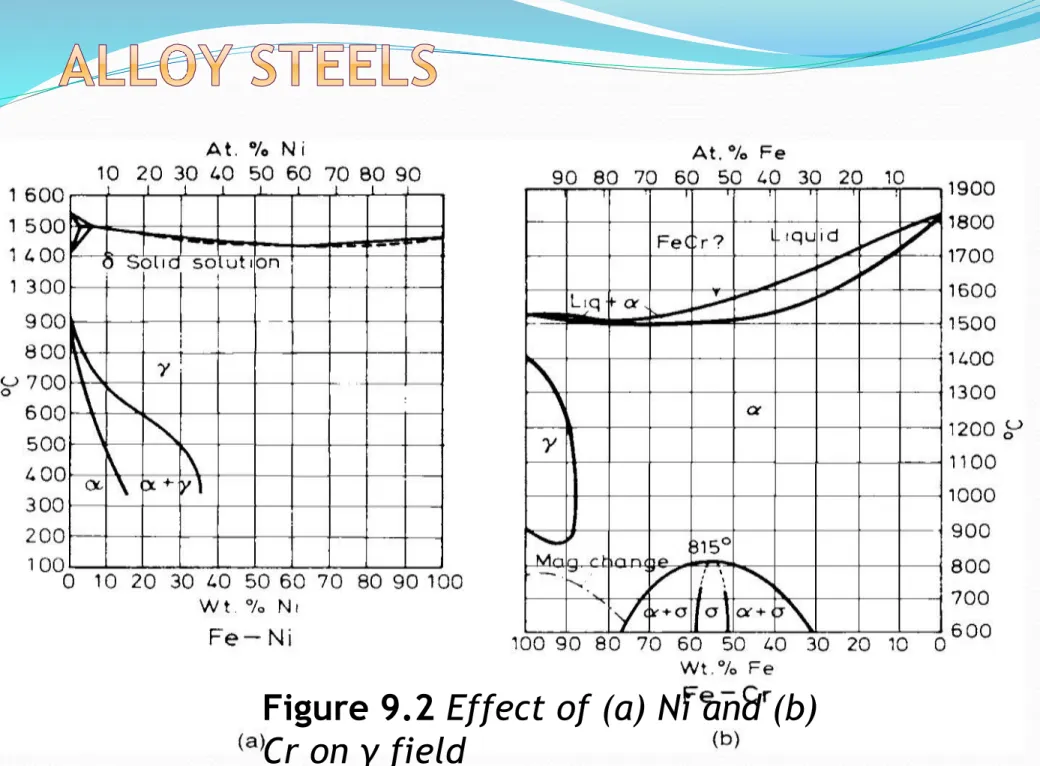
Figure 9.2 Effect of (a) Ni and (b)
In larger amounts, alloying elements either open
up the austenite phase field, as shown in Figure
9.2a, or close the γ field (Figure 9.2b).
‘Full’ metals with atoms like hard spheres (e.g.
Mn, Co, Ni) favour close packed structures and
open the γ field, whereas the
stable bcc
transition metals (e.g. Ti, V, Cr, Mo) close the
field and form what is called a γ loop.
The development of austenitic steels, an
important class of ferrous alloys, is dependent on
the opening of the γ phase field.
The most common element added to iron to
achieve this effect is Ni.
Interstitial C and N, which most ferrous alloys
contain, also expand the γ field because there
are larger interstices in the fcc than the bcc
structure.
The steel is water quenched to produce
austenite. The fcc structure has good fracture
resistance and, having a low stacking fault
energy, work-hardens very rapidly.
During the abrasion and work-hardening the
hardening is further intensified by a partial strain
transformation of the austenite to martensite;
this principle is used also in the sheet-forming of
stainless steels.
To make the austenitic steels resistant to oxidation and corrosion (see Chapter 12) the element Cr is usually added in concentrations greater than 12%.
Chromium closes the γ field, however, and with very
low carbon contents single-phase austenite cannot be produced with the stainless (>12%) composition. These alloys form the stainless (ferritic) irons and are easily fabricated for use as furnace
components.
Increasing the carbon content expands the γ loop
and in the medium-carbon range Cr contents with
good stainless qualities (≈15–18%) can be quench hardened for cutlery purposes where martensite is required to give a hard, sharp cutting edge
The combination of both Cr and Ni (i.e. 18/8)
produces the metastable austenitic stainless steel
which is used in chemical plant construction,
kitchenware and surgical instruments because of
its ductility, toughness and cold-working
properties.
Metastable austenitic steels have good
press-forming properties because the strain induced
transformation to martensite provides an
additional strengthening mechanism to
work-hardening, and moreover counteracts any drawing
instability by forming martensite in the
High-strength transformable stainless steels with good weldability to allow fabrication of aircraft and engine
components have been developed from the 0.05–0.1% C, 12% Cr, stainless steels by secondary hardening addition (1.5–2% Mo; 0.3–
0.5% V).
Small additions of Ni or Mn (2%) are also added to counteract the ferrite-forming elements Mo and V to make the steel fully
austenitic at the high temperatures. Air quenching to give α
followed by tempering at 650°C to precipitate Mo2C produces a steel with high yield strength (0.75 GN/m2), high TS (1.03
GN/m2) and good elongation and impact properties.
Even higher strengths can be achieved with stainless (12–16% Cr; 0.05% C) steels which although austenitic at room temperature (5% Ni, 2% Mn) transform on cooling to -78°C. The steel is easily fabricated at room temperature, cooled to control the
transformation and finally tempered at 650–700°C to precipitate Mo2C.
Plain carbon steels, if used for cutting tools, lack certain characteristics necessary for high-speed production, such as red hardness and hot -strength
toughness. The effect of alloying elements in steel is of great advantage and yields tool steels that overcome many of the shortcomings of the plain carbon steels. Tool steels are defined as "carbon or alloy steels
capable of being hardened and tempered". Many alloy steels would fit this loose definition. Tool steels usually contain significantly more alloying elements than alloy steels. However, the real factor that discriminates tool steels from carbon or alloy steels is the manufacturing practice.
Many types of tool steels are available. One reason for so many types of tool steels is evolutionary
development over a period of 80 years. The second reason is the wide range of needs that they serve.
Tool steel is generally used in a heat-treated state. With a carbon content between 0.7% and 1.5%, tool steels are manufactured under carefully controlled conditions to produce the required quality. The
manganese content is often kept low to minimize the possibility of cracking during water quenching.
However, proper heat treating of these steels is
important for adequate performance, and there are
many suppliers who provide tooling blanks intended for oil quenching.
Tool steels are made to a number of grades for
different applications. The higher carbon grades are typically used for such applications as stamping dies, metal cutting tools, etc.
Tool steels are also used for special applications like injection molding because the resistance to abrasion is an important criterion for a mold that will be used to produce hundreds of thousands of parts.
Tool steels have properties that permit their use as tools for cutting and shaping metals and other
materials both hot and cold. There are six major categories one of which contains grades intended for special purposes. A prefix letter is used in the alloy identification system to show use category, and the specific alloy in a particular category is identified by one or two digits. For example:
S1 = Shock resistant tool steel D2 = Cold-work tool steel
H11 = Hot work tool steel M42 = High-speed tool steel
Tool Steel Type Prefix Specific Types Cold Work W = Water Hardening
O = Oil Hardening A = Medium alloy Air Hardening
D = High Carbon, High Chromium
W1, W2, W5 O1, O2, O6, O7
A2, A4, A6, A7, A8, A9, A10, A11 D2, D3, D4, D5, D7
Shock Resisting S S1, S2, S4, S5, S6, S7
Hot Work H H10-H19 Chromium types
H20-H39 Tungsten types H40-H59 Molybdenum types
High Speed M
T
Molybdenum types (M1, M2, M3-1, M3-2, M4, M6, M7, M10, M33, M34, M36, M41, M42, M46, M50
Tungsten types (T1, T4, T5, T6, T8, T15)
Mold Steels P P6, P20, P21
Special Purpose
Composition and physical properties vary significantly (some tool steels have compositions that fit into the
composition ranges of carbon and alloy steels, but most tool steels have alloy concentrations that are
significantly higher than the carbon and alloy steels), One important factor that should be kept in mind is that the alloy additions do not improve corrosion resistance even though some grades have as much
chromium as stainless steels. The reason for this is that alloy elements are usually combined with carbon to
form carbides.
The most significant metallurgical difference between tool steels and the other steels is their microstructure. A fully hardened carbon steel or alloy steel would have only martensite as the predominant phase. Most tool steels have a hardened structure of martensite and alloy carbides.
Require special heat treatment processes , Higher cost than alloy steels,
Better hardenability than most carbon and alloy steels,
High heat resistance Easier to heat treat,
More difficult to machine than carbon and alloy steels
Most tool steels are sold as hot-finished shapes such as rounds and bars,
Cold-finished sheets are not available because it is difficult to cold roll or cold finish these materials.
Cold work tool steels are used for
➢ gages
➢ Blanking
➢ drawing and piercing dies ➢ shears
➢ forming and banding rolls ➢ lathe centers
➢ mandrels ➢ broaches ➢ reamers ➢ taps
➢ threading dies ➢ plastic molds ➢ knurling tools.
Water Hardening Tool Steels
(W series)
Oil Hardening Tool Steels (O-Series) Medium Alloy Air Hardening Steels (A-series)
High Carbon High Chromium Steels
(D-series) Essentially these are
carbon steels with 0.60 to 1.10 %
carbon.
Lowest cost tool steels.
Soft core(for
toughness) with hard shallow layer (for wear resistance). Use of w-series steels is declining.
0.90 to 1.45 % Carbon with Mn, Si, W, Mo, Cr. They contain graphite in the hardened
structure along with martensite. (Graphite acts as a lubricator and also makes machining easier. Tungsten forms
tungsten carbide which improves the abrasion resistance and edge retention in cutting devices.
5 to 10 % alloying
elements (Mn, Si, W, Mo, Cr, V, Ni) to improve the
hardenability, wear resistance, toughness.
All D-series contain 12% Cr and over 1.5 % C.
Air or oil quench. Low distortion, high abrasion resistance.
There are about 12 hot-worked tool steels.
They are categorized by major alloying
elements into three subgroups.
Chromium types
Tungsten types
Molybdenum types
These steels are used in extrusion dies, forging
dies, die casting, hot shear blades, plastic
molds, punches and dies for piercing shells, hot
press, etc.
These steels have 0.45 to 0.55 % carbon. The alloys, silicon, and nickel are ferrite
strengtheners. Chromium increases wear
resistance and hardenability. The S-series of tool steels were originally developed for chisel-type applications, but the number of alloys in this category has evolved to include steels with a broad range of tool applications. This class of steels has a very good shock resistant qualities with excellent toughness.
They are used in form tools, chisels, punches, cutting blades, springs, trimming, and swaging dies, concrete and rock drills, bolt cutters.
The L-type steels are low alloy steels with about 1 % Cr that makes them a good low cost substitute for cold work steels. The F-type steels are high in
carbon tungsten. They have high wear resistance, good toughness, and medium hardenability. The L-type steels are used in gages, broaches, drills, taps, threading dies, ball and roller bearings, clutch
plates, knurls, files. The F-type steels are used as finish machining tools.They have good wear
resistance and will maintain a sharp cutting edge.
They may be used in dies, cutting tools, form tools, knives, etc.
The requirement for structural steels to be
welded satisfactorily has led to steels with lower
C (<0.1%) content.
Unfortunately, lowering the C content
reduces the strength and this has to be
compensated for by refining the grain size.
This is difficult to achieve with plain C-steels
rolled in the austenite range but the addition of
small amounts of strong carbide-forming
elements (e.g. <0.1% Nb) causes the austenite
boundaries to be pinned by second-phase
particles and fine
grain sizes (<10µm) to be
produced by controlled rolling
Nitrides and carbonitrides as well as carbides,
predominantly fcc and mutually soluble in each other, may feature as suitable grain refiners in HSLA steels; examples include AlN, Nb(CN), V(CN), (NbV)CN, TiC and Ti(CN).
The solubility of these particles in the austenite
decreases in the order VC, TiC, NbC while the nitrides, with generally lower solubility, decrease in solubility in the order VN, AlN, TiN and NbN.
Because of the low solubility of NbC, Nb is perhaps the most effective grain size controller.
However, Al, V and Ti are effective in high-nitrogen steels, Al because it forms only a nitride, V and Ti by forming V(CN) and Ti(CN) which are less soluble in austenite than either VC or TiC.
The major strengthening mechanism in HSLA steels
is grain refinement but the required strength level
is obtained usually by additional precipitation
strengthening in the ferrite.
Figure 9.3 shows a stress
–
strain curve from a
typical HSLA steel.
Solid-solution strengthening of the ferrite is also
possible.
Phosphorus is normally regarded as deleterious due
to grain boundary segregation, but it is a powerful
strengthener, second only to carbon
Figure 9.3 Stress–strain curves for plain carbon, HSLA and dual-phase steels.
Microalloyed steel, or High Strength Low Alloy (is a type of alloy steel that contains small amounts of
alloying elements. These are mild steels with carbon 0.03 to 0.15%, manganese around 1.5% and less than 0.1% of niobium, vanadium, titanium, aluminium,
molybdenum, zirconium, boron, and rare-earth metals which have been given controlled rolling,
controlled cooling to obtain ultra-fine ferrite grains of size below 5 micro-meter to attain yield strengths of 290 to 550 Mpa, and tensile strengths of 415 to
700 Mpa with a ductile/brittle transition temperature at -70oC.
Alloying elements are also selected to influence
transformation temperatures so that the transformation of austenite to ferrite and pearlite occurs at a lower
temperature during air cooling. This lowering of the transformation temperature produces a finer-grain transformation product, which is a major source of strengthening.
At the low carbon levels typical of HSLA steels, elements such as silicon, copper, nickel, and phosphorus are
particularly effective for producing fine pearlite.
Element such as, manganese and chromium, which are present in both the cementite and ferrite, also
strengthen the ferrite by solid-solution strengthening in proportion to the amount, dissolved in the ferrite.
➢ Nitrogen additions to high-strength steels containing
vanadium are limited to 0.005% and have become
commercially important because such additions enhance precipitation hardening. The precipitation of vanadium nitride in vanadium-nitrogen steels also improves grain
refinement because it has a lower solubility in austenite than vanadium carbide.
➢ Manganese is the principal strengthening element in plain
carbon high-strength structural steels. It functions mainly as a mild solid-solution strengthener in ferrite, but it also
provides a marked decrease in the austenite-to-ferrite transformation temperature. In addition, manganese can enhance the precipitation strengthening of vanadium steels and. to a lesser extent, niobium steels.
➢ Copper in levels in excess of 0.50% also increases the
strength of both low- and medium-carbon steels by virtue of ferrite strengthening, which is accompanied by only slight decreases in ductility.
➢ One of the most important applications of silicon is its
use as a deoxidizer in molten steel. Silicon has a
strengthening effect in low-alloy structural steels. In larger amounts, it increases resistance to scaling at
elevated temperatures. Silicon has a significant effect on yield strength enhancement by solid-solution
strengthening and is widely used in HSLA steels for riveted or bolted structures.
➢ The atmospheric-corrosion resistance of steel is increased
appreciably by the addition of phosphorus, and when small
amounts of copper are present in the steel, the effect of the phosphorus is greatly enhanced. When both phosphorus and copper are present, there is a greater beneficial effect on corrosion resistance than the sum of the effects of the individual elements.
➢ Molybdenum in hot-rolled HSLA steels is used primarily to
improve hardenability when transformation products other than ferrite-pearlite are desired. Molybdenum (0.15 to
0.30%) in microalloyed steels also increases the solubility of niobium in austenite, thereby enhancing the precipitation of NbC (N) in the ferrite. This increases the precipitation-strengthening effect of NbC (N).
➢ Aluminum is widely used as a deoxidizer and was the first
element used to control austenite grain growth during
reheating. During controlled rolling, niobium and titanium are more effective grain refiners than aluminum.
➢ Vanadium strengthens HSLA steels by both precipitation
hardening the ferrite and refining the ferrite grain size. The precipitation of vanadium carbonitride in ferrite can develop a significant increase in strength that depends not only on the rolling process used, but also on the base
composition. Carbon contents above 0.13 to 0.15% and manganese content of 1% or more enhances the
precipitation hardening, particularly when the nitrogen content is at least 0.01%.
➢ Chromium is often, added with copper to obtain improved
atmospheric-corrosion resistance.
➢ Nickel is often added to copper-bearing steels to minimize
➢ Titanium is unique among common alloying elements in
that it provides both precipitation strengthening and sulfide shape control. Small amounts of titanium (<0.025%) are also useful in limiting austenite grain growth. However, it is
useful only in fully killed steels because of its strong
deoxidizing effects; the versatility of titanium is limited because variations in oxygen, nitrogen, and sulfur affect the contribution of titanium as carbide strengthened.
➢ Zirconium can also be added to killed HSLA steels to
improve inclusion characteristics, particularly in the case of sulfide inclusions, for which changes in inclusion shape
improve ductility in transverse bending.
➢ Boron has no effect on the strength of normal hot-rolled
steel but can considerably improve hardenability when
transformation products such as acicular ferrite are desired in low-carbon hot-rolled plate.
➢ Treatment with calcium is preferred for sulfide inclusion
▪ These steels lie, in terms of performance and cost,
between carbon steel and low alloy steel.
▪ Weldability is good, and can even be improved
by reducing carbon content while maintaining strength.
▪ Fatigue life and wear resistance are superior to
similar heat treated steels.
▪ The disadvantages are that ductility and toughness
are not as good as quenched and tempered (Q&T) steels.
The ferrite in HSLA steels is typically strengthened by grain refinement, precipitation hardening, and, to a lesser extent, solid-solution strengthening.
Grain refinement is the most desirable
strengthening mechanism because it improves not only strength but also toughness.
The main factors responsible for increased strength in HSLA steels are:
1. Fine ferritic grain size 2.Precipitation hardening
The very fine ferritic grain sizes in HSLA steels are possible by the control of austenitic grain size by the precipitation of carbonitrides during hot rolling as the temperature of the steel falls. These fine
precipitate particles hinder the growth of austenitic grains, and at still lower temperatures of rolling,
the particles inhibit even the recrystallization of the deformed austenitic grains.
To accomplish this, the fine precipitation of carbonitrides should take place in the critical rolling range of 1300oC to 925oC, when the
recrystallization of austenite could occur, and that the volume of the precipitates
formed should be large. It is thus essential that these carbonitrides have sufficient solid solubility at the highest austenitising or
soaking temperature and that the solid
solubility should decrease fast with the fall of temperature in this critical range.
Complete dissolution of carbonitride precipitates occurs at 1140°C in a temperature interval between 1100 – 1200°C, the above Illustrations showing dissolution of NbC, TiC and Vn
precipitates can be seen in Figure 1 where individual isotherms show dissolubility of precipitates for different carbon content in HSLA steels
Figure 1: Dissolubility of precipitates NbC, TiC and Vn according
It is essential to use high soaking temperatures to dissolve as much of the elements Nb, Ti, V, so that these could precipitate (as
carbonitrides) later during rolling when the temp continuously drops.
TiN is the most stable of precipitates and its
presence restricts the grain growth of austenite at the soaking temperature, and during the dynamic recrystallization of austenite during hot rolling at high temperature. While TiN restricts grain growth to some extent, the main refinement is achieved during hot rolling from 1300oC to 925oC as the temperature progressively falls and fine
carbonitrides are precipitated from austenite. Nb is the most effective element in modifying the
recrystallization behavior of austenite during hot rolling as niobium carbides and carbonitrides
precipitate during hot rolling of austenite and hence is the most important micro-alloying element.
The hot-rolling process has gradually become a much more closely controlled operation, and
controlled rolling is now being increasingly applied to microalloyed steels with compositions carefully chosen to provide optimum mechanical properties at room temperature.
Controlled rolling is a procedure whereby the various stages of rolling are temperature
controlled, with the amount of reduction in each pass predetermined and the finishing temperature precisely defined. This processing is widely used to obtain reliable mechanical properties in steels for pipelines, bridges, offshore platforms, and many other engineering applications.
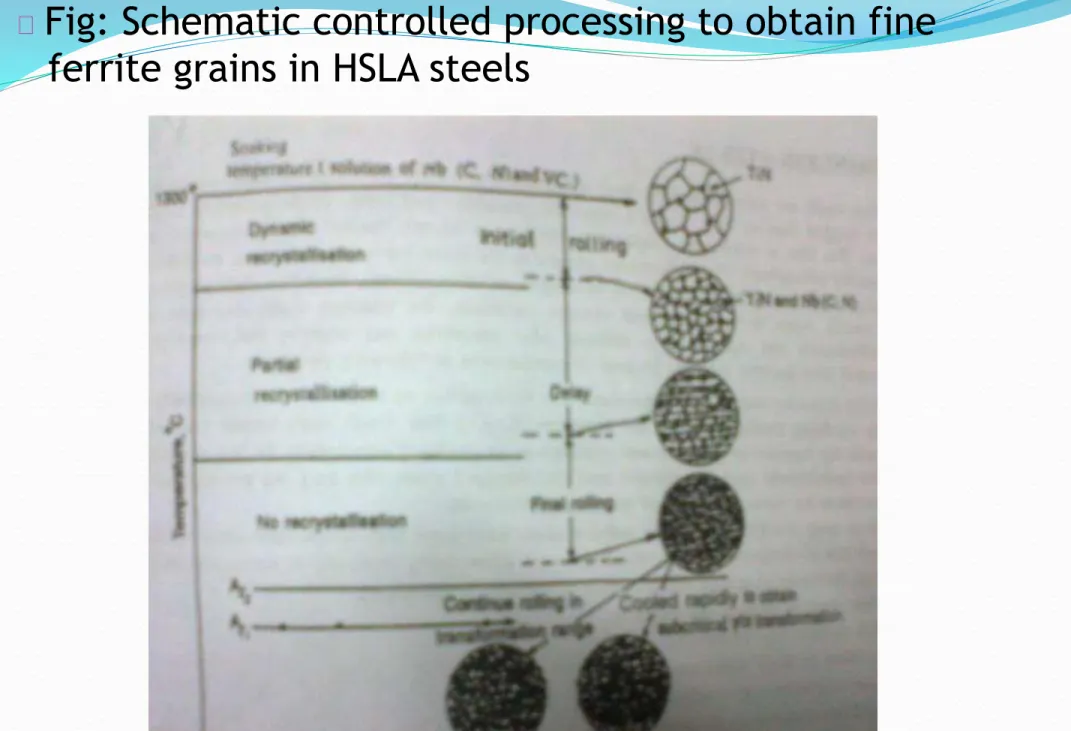
The use of controlled rolling has resulted in improved combinations of strength and toughness and further reductions in the carbon content of microalloyed HSLA steels. Controlled hot rolling of low carbon low alloy high strength steels is done to obtain ultra fine and uniform grains of ferrite and precipitation hardening. The figure below illustrates the grain size of austenite at different stages of hot rolling.
High temperature soaking is required to dissolve as much of alloying elements as possible. When austenite is
rolled at relatively high temperatures, it dynamically recrystallizes and the grain growth occurs. Heavy
deformation and low finishing temperature is required in the austenitic region, below about 925oC so that
austenite is unable to recrystallize.
The finishing temperature is very important. Normally all the deformation is done when the steel is austenitic and the nature of transformation is changed by
increasing the cooling rate using water sprays following rolling. The sub-critical transformation produces still
finer ferritic grains. Mechanical properties are improved and the sharp yield point is invariably suppressed.
Fig: Schematic controlled processing to obtain fine ferrite grains in HSLA steels
Precipitation hardening also contributes to the increased strength of HSLA steels. The
precipitates present or formed at high
temperatures during controlled rolling cause little strengthening as they are large sized,
widely spaced, and as most of them are present at the grain boundaries controlling the grain
growth.
The precipitate strengthening occurs by those particles that form:
In austenite at low temperature
At the gamma/alpha interface during transformation
The main contribution to precipitation
strengthening is due to the precipitation of carbides of Nb, Ti, and V which occurs during the transformation of austenite to ferrite
progressively at interphase boundaries called
interphase precipitation. It occurs on a very fine scale during the temperatures between 850oC and 650oC. Because of high solubility in
austenite, vanadium carbide and nitride
precipitate at interphase boundaries and in
ferrite, with Ti and Nb in the decreasing order, are most effective in increasing the strength by precipitation.
HSLA can be found in these applications:
Bridges
Suspension Components Building Structures
Vehicles/Transportation Tubular Components
Heavy Equipment Rails
In recent years an improved strength
–
ductility
relationship has been found for low carbon,
low-alloy steels rapidly cooled from an annealing
temperature at which the steel consisted of a
mixture of ferrite and austenite.
Such steels have a microstructure containing
principally low-carbon, fine-grained ferrite
intermixed with islands of fine martensite and are
known as dual phase steels.
Typical properties of this group of steels would
be a TS of 620 MN m
-2, a 0.2% offset flow stress of
380 MNm
-2and a 3% offset flow stress of 480 MN
The implications of the improvement in mechanical
properties are evident from an examination of the nominal stress–strain curves.
The dual-phase steel exhibits no yield discontinuity but work-hardens rapidly so as to be just as strong as the
conventional HSLA steel when both have been deformed by about 5%.
In contrast to ferrite–pearlite steels, the work-hardening rate of dual-phase steel increases as the strength increases.
The absence of discontinuous yielding in dual-phase steels is an advantage during cold-pressing operations and this feature combined with the way in which they sustain work hardening to high strains makes them attractive
The dual phase is produced by annealing in the
(α+γ) region followed by cooling at a rate which
ensures that the γ phase transforms to martensite,
although some retained austenite is also usually
present leading to a mixed martensite
–
austenite
(M
–
A) constituent.
To allow air-cooling after annealing, microalloying
elements are added to low-carbon
–
manganese
–
silicon steel, particularly vanadium or molybdenum
and chromium.
Vanadium in solid solution in the austenite increases the hardenability but the enhanced hardenability is due mainly to the presence of fine carbonitride precipitates which are unlikely to dissolve in either the austenite or the ferrite at the temperatures employed and thus inhibit the movement of the austenite/ferrite interface during the post-anneal cooling.
The martensite structure found in dual-phase steels is characteristic of plate martensite having internal
microtwins.
The retained austenite can transform to martensite during straining thereby contributing to the increased strength and work-hardening.
Low yield strength
Low yield to tensile strength ratio (yield strength/ tensile strength = 0.5)
High initial strain hardening rates Good uniform elongation
A high strain rate sensitivity (the faster it is crushed the more energy it absorbs)
Good fatigue resistance
Due to these properties DPS is often used for automotive body panels, wheels, and bumpers