Emerged Middle East Respiratory Syndrome Coronavirus
Yaoqing Chen,aKanagalaghatta R. Rajashankar,bYang Yang,aSudhakar S. Agnihothram,cChang Liu,aYi-Lun Lin,aRalph S. Baric,c Fang Lia
Department of Pharmacology, University of Minnesota Medical School, Minneapolis, Minnesota, USAa
; Department of Chemistry and Chemical Biology, Cornell University, NE-CAT, Advanced Photon Source, Argonne, Illinois, USAb
; Department of Epidemiology, University of North Carolina, Chapel Hill, North Carolina, USAc
The newly emerged Middle East respiratory syndrome coronavirus (MERS-CoV) has infected at least 77 people, with a fatality
rate of more than 50%. Alarmingly, the virus demonstrates the capability of human-to-human transmission, raising the
possibil-ity of global spread and endangering world health and economy. Here we have identified the receptor-binding domain (RBD)
from the MERS-CoV spike protein and determined its crystal structure. This study also presents a structural comparison of
MERS-CoV RBD with other coronavirus RBDs, successfully positioning MERS-CoV on the landscape of coronavirus evolution
and providing insights into receptor binding by MERS-CoV. Furthermore, we found that MERS-CoV RBD functions as an
effec-tive entry inhibitor of MERS-CoV. The identified MERS-CoV RBD may also serve as a potential candidate for MERS-CoV
sub-unit vaccines. Overall, this study enhances our understanding of the evolution of coronavirus RBDs, provides insights into
re-ceptor recognition by MERS-CoV, and may help control the transmission of MERS-CoV in humans.
S
ince the summer of 2012, a novel coronavirus, Middle East
respiratory syndrome coronavirus (MERS-CoV), has emerged
from the Middle East and spread to parts of Europe. MERS-CoV
infection often leads to acute pneumonia and renal failure, and the
human fatality rate is more than 50% (
1
,
2
). To date, MERS-CoV
has infected at least 77 people and was able to be transmitted from
human to human. The genomic sequence of MERS-CoV is closely
related to the sequences of certain bat coronaviruses (
3–5
), raising
concerns over persistent bat-to-human cross-species
transmis-sion of the virus. The clinical signs and epidemic patterns of
MERS-CoV are reminiscent of the severe acute respiratory
syn-drome coronavirus (SARS-CoV), the etiological agent of the
worldwide SARS epidemic in 2002-2003 that infected more than
8,000 people with a
⬃
10% fatality rate (
6
,
7
). MERS-CoV poses a
significant threat to global health and economy.
Coronaviruses are enveloped and positive-stranded RNA viruses
and can be divided into three major genera,
␣
,

, and
␥
(
8
). They
mainly cause respiratory, gastrointestinal, and central nervous system
diseases in mammals and birds. Coronaviruses recognize a variety of
host receptors. Human NL63 respiratory coronavirus (HCoV-NL63)
from
␣-genus and SARS-CoV from
-genus both recognize
angio-tensin-converting enzyme 2 (ACE2) as their host receptor (
9
,
10
).
Porcine respiratory coronavirus (PRCV) and some other
coronavi-ruses from
␣-genus recognize aminopeptidase N (APN) (
11
,
12
).
Mouse hepatitis coronavirus (MHV) from

-genus recognizes
carci-noembryonic antigen-related cell adhesion molecule 1 (CEACAM1)
(
13
,
14
), although certain MHV strains also recognize heparan sulfate
(
15
,
16
). Some coronaviruses from each of the three genera recognize
sugars (
17–20
). MERS-CoV belongs to the
-genus and uses human
dipeptidyl peptidase 4 (DPP4) as its host receptor (
21
). Receptor
rec-ognition is a major determinant of coronavirus host range and
tro-pism.
An envelope-anchored trimeric spike protein is responsible for
coronavirus entry into host cells via binding to the host receptor
and subsequently fusing viral and host membranes (
22
). The spike
protein consists of a receptor-binding S1 subunit and a membrane
fusion S2 subunit. The S1 subunit contains two independent
do-mains, an N-terminal domain (NTD) and a C-domain, both of
which can potentially function as receptor-binding domains
(RBD) (
Fig. 1A
) (
23
). Specifically, coronavirus S1 C-domains can
function as ACE2-, APN-, or heparan sulfate-binding RBDs,
whereas S1 NTDs can function as CEACAM1- or sugar-binding
RBDs. To date, crystal structures have been determined for a
number of coronavirus RBDs by themselves or in complex with
their host receptors, revealing how coronaviruses have evolved to
recognize host receptors and thereby traffic between different
spe-cies (
24–28
). It is not known which one of MERS-CoV S1 domains
is the DPP4-binding RBD or how the tertiary structure of
MERS-CoV RBD fits into the landscape of coronavirus evolution.
Here we have identified the MERS-CoV S1 C-domain as the
RBD, characterized its interaction with human DPP4, and
deter-mined its crystal structure. This study provides structural insights
into the evolution and receptor recognition of MERS-CoV. The
identified MERS-CoV RBD also has therapeutic implications.
MATERIALS AND METHODS
Protein preparation and crystallization.The MERS-CoV S1 C-domain (residues 367 to 588) was expressed and purified as previously described for the SARS-CoV C-domain (24,29,30). Briefly, the MERS-CoV C-do-main containing an N-terminal honeybee melittin signal peptide and a C-terminal His6tag was expressed in insect cells using the Bac-to-Bac expression system (Invitrogen), secreted into cell culture medium, and subsequently purified on a nickel-nitrilotriacetic acid (Ni-NTA) affinity column and a Superdex 200 gel filtration column (GE Healthcare). The protein was concentrated to 10 mg/ml and stored in buffer containing 20 mM Tris (pH 7.4) and 200 mM NaCl. Crystallization of the MERS-CoV
Received28 June 2013 Accepted22 July 2013
Published ahead of print31 July 2013
Address correspondence to Fang Li, [email protected].
Y.C., K.R.R., and Y.Y. contributed equally to this work.
Copyright © 2013, American Society for Microbiology. All Rights Reserved.
C-domain was set up using the sitting drop vapor diffusion method, with 2l protein solution added to 2l reservoir buffer containing 27% (vol/ vol) polyethylene glycol (PEG) 3350, 0.2 M MgCl2, and 0.1 M bis-Tris (pH 7.0) at 20°C. After 2 weeks, crystals of the MERS-CoV C-domain were harvested in buffer containing 25% (vol/vol) ethylene glycol, 27% (vol/ vol) PEG 3350, 0.2 M MgCl2, and 0.1 M bis-Tris (pH 7.0) and flash-frozen in liquid nitrogen. Heavy-atom derivatives of MERS-CoV C-domain crystals were prepared by soaking crystals for 15 min in buffer containing 1 M NaI, 25% (vol/vol) ethylene glycol, 27% (vol/vol) PEG 3350, 0.2 M MgCl2, and 0.1 M bis-Tris (pH 7.0).
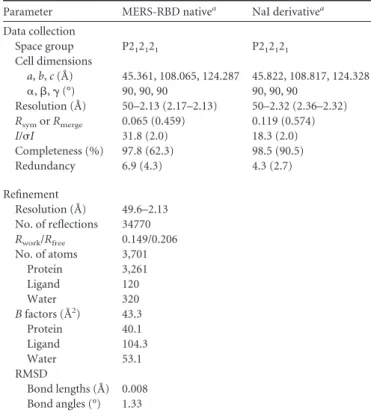
Data collection and structure determination.Data were collected at the Advanced Photon Source beamline 24-ID-C at 1.0716 Å for native crystals and 1.4586 Å for iodine-derivatized crystals. The crystal structure was determined using SIRAS (single isomorphous replacement with anomalous signal). X-ray diffraction data were processed using HKL2000 (31). Sixteen iodine sites were identified with the program HYSS (32) followed by phase refinement and solvent flattening with RESOLVE (33). The model was built and refined with Refmac (34) at 2.13 Å to a finalRwork andRfreeof 14.9% and 20.6%, respectively. In the final model of the MERS-CoV C-domain, 98% of residues are in the favored regions of the Ramachandran plot, and 0% of residues are in the disallowed regions.
MERS-CoV infection assay.Vero cells were incubated with different concentrations of recombinant MERS-CoV C-domain in minimum es-sential medium (GIBCO) for 1 h at 37°C. Medium containing the protein was removed, and the cells were infected with MERS-CoV at a multiplicity of infection (MOI) of 0.01 for 1 h at 37°C. Unbound viruses were washed with 1⫻phosphate-buffered saline (PBS), and the medium with MERS-CoV C-domain was added back to the cells. Supernatant was sampled at various time points, and the virus replication was determined by plaque assays on Vero cells as described previously (35).
Pseudotyped-virus infection assay.Pseudotyped-virus infection was carried out using murine leukemia viruses (MLVs) expressing -galacto-sidase and pseudotyped with MERS-CoV spike protein as described pre-viously (36). Briefly, to prepare pseudotyped viruses, HEK293T cells were cotransfected with spike protein-encoding plasmid pcDNA3.1(⫹), p3240, expressing murine leukemia virusgagandpolgenes, and a murine leukemia virus-galactosidase-transducing vector, pBAG. At 48 h post-transfection, virus supernatants were harvested and concentrated 20 times using Amicon Ultra-4 centrifugal filter units (Millipore) with
100-kDa molecular mass cutoff. HEK293T cells transiently expressing human DPP4 in pcDNA3.1(⫹) were inoculated in 96-well plates by adding 10l of concentrated viral supernatant to 100l Dulbecco’s modified Eagle medium (DMEM) per well. To examine the inhibition of MERS-CoV C-domain on infection, HEK293T cells transiently expressing human DPP4 were infected by pseudotyped virus in the presence of 20g/ml MERS-CoV C-domain or bovine serum albumin (BSA). Infection effi-ciency was quantified 48 h postinfection by measuring-galactosidase activity. As a negative control, HEK293T cells were transfected with empty pcDNA3.1(⫹) plasmid, instead of a DPP4 insertion-containing plasmid. As another control, MLVs pseudotyped with vesicular stomatitis virus glycoprotein (VSV-G) were used to infect HEK293T cells transiently ex-pressing human DPP4, in both the absence and presence of 20g/ml MERS-CoV C-domain protein or BSA.
DPP4 pulldown assay.HEK293T cells were transfected with either empty pcDNA3.1(⫹) vector or pcDNA3.1(⫹) vector containing the hu-man DPP4 gene. At 48 h posttransfection, cells were harvested and lysed in PBS with 300 mM NaCl and 0.25% SDS. Cell lysate was mixed with MERS-CoV C-domain. The protein complex was then precipitated with Ni-NTA agarose (Thermo Scientific). DPP4 and MERS-CoV C-domain contain a C-terminal hemagglutinin (HA) tag and His6tag, respectively, and were detected by anti-HA and anti-His6antibodies (Santa Cruz Bio-technology), respectively.
Protein structure accession number.Coordinates and structure fac-tors have been submitted to the PDB, accession number4L3N.
RESULTS AND DISCUSSION
Identification and functional characterization of MERS-CoV
RBD.
We designed a construct of the MERS-CoV S1 C-domain
(residues 367 to 588), based on the sequence alignment of
MERS-CoV and SARS-MERS-CoV S1 subunits (
Fig. 2A
). Although the two S1
subunits have low sequence similarity, sequence alignment was
guided by conserved cysteines. Based on its crystal structure,
SARS-CoV C-domain contains eight essential cysteines that form
four disulfide bonds (
24
). Our designed MERS-CoV C-domain
also contains eight cysteines, seven of which are conserved
be-tween SARS-CoV and MERS-CoV (
Fig. 2A
). The MERS-CoV
C-domain was expressed and purified using the protocol that we
used for the SARS-CoV C-domain (
24
,
29
,
30
). The protein was a
monomer in solution, based on the gel filtration chromatography
profile.
We characterized the interactions between the recombinant
MERS-CoV C-domain and human DPP4 on human cell surfaces,
using three alternative approaches. First, the recombinant
MERS-CoV C-domain inhibits MERS-MERS-CoV infection of permissive
mon-key cells (
Fig. 3A
). The inhibition efficiency increased with the
concentration of MERS-CoV C-domain. At a 13
M
concentra-tion, the MERS-CoV C-domain completely inhibits MERS-CoV
infection. Second, the recombinant MERS-CoV C-domain
inhib-its the infection of MERS-CoV spike-pseudotyped retroviruses,
but not VSV-G-pseudotyped retroviruses, in cells that express
hu-man DPP4 (
Fig. 3B
). Finally, the MERS-CoV C-domain pulled
down human DPP4 from cells that express human DPP4 (
Fig.
3C
). These results all suggest that the recombinant MERS-CoV
C-domain interacts directly with cell surface human DPP4 and
competes with virus surface MERS-CoV spike protein for the
binding site on human DPP4. Therefore, we conclude that the
MERS-CoV S1 C-domain is the RBD that binds human DPP4.
Crystal structure of MERS-CoV RBD.
Having identified the
MERS-CoV RBD, we further determined its crystal structure (
Fig.
1B
and
C
). The MERS-CoV RBD was crystallized in space group
P2
12
12
1, with 2 molecules per asymmetric unit. The structure was
determined using an iodine derivative obtained by a short
cryo-soak (
37
) and refined at a 2.13-Å resolution (
Table 1
). The two
copies of MERS-CoV RBD occupying the same asymmetric unit
have a small buried interface (⬃500 Å
2), consistent with the
ob-servation during protein purification that the MERS-CoV RBD is
a monomer in solution.
The crystal structure of the MERS-CoV RBD contains a core
structure and an accessory subdomain (
Fig. 1C
). The core
struc-ture is a five-stranded antiparallel

-sheet with several short
␣
-he-lices. The accessory subdomain lies on one edge of the core
struc-ture and consists of a four-stranded antiparallel

-sheet. The eight
cysteines in the RBD form four disulfide bonds (
Fig. 2B
). Three of
the disulfide bonds stabilize the core structure by connecting
cys-teine 383 to 407, 425 to 478, and 437 to 585; the remaining
disul-fide bond strengthens the accessory subdomain by connecting
cysteine 503 to 526. The RBD also contains 2 glycans that are
N-linked to Asn410 in the core structure and Asn487 in the
acces-sory subdomain, respectively (
Fig. 2B
). We were able to trace all of
the RBD residues (except for the N-terminal 12 residues) with an
average B factor of 40.1 Å
2. Overall, the MERS-CoV RBD has a
well-folded tertiary structure that is stabilized by disulfide bonds
and glycans.
Comparisons of MERS-CoV and SARS-CoV S1 C-domains.
The C-domains of

-genus MERS-CoV and SARS-CoV (both
function as RBDs) have similar tertiary structures, despite their
low amino acid sequence similarity. The Z score between the two
RBDs is 11.9, as calculated by the protein folding Dali server (
38
).
Like the MERS-CoV RBD, the SARS-CoV RBD contains a core
structure and an accessory subdomain (
Fig. 2C
). The two core
structures are highly similar, both consisting of a five-stranded
antiparallel
-sheet. The three disulfide bonds that strengthen the
core structure are all conserved between the two RBDs. On the
other hand, the accessory subdomains of the two RBDs are
mark-edly different. The accessory subdomain of the SARS-CoV RBD
mainly consists of loops, with a short two-stranded antiparallel

-sheet in the middle of the accessory subdomain. In contrast, the
same region in the MERS-CoV RBD mainly consists of a
four-stranded antiparallel

-sheet. The disulfide bond that stabilizes
the accessory subdomain of MERS-CoV RBD is arranged
differ-ently in SARS-CoV RBD. Overall, the similar core structures of the
two RBDs suggest that the two RBDs share an evolutionary origin
and their different accessory subdomains resulted from divergent
evolution.
The accessory subdomain of

-coronavirus S1 C-domains has
been shown to be a hypervariable region that
-coronaviruses
often use for receptor recognition. This region in SARS-CoV
C-domain binds its receptor, ACE2, and thus has been named the
receptor-binding motif (RBM) (
24
). The same region in MHV
often contains long insertions or deletions, depending on the
MHV strain. In certain MHV strains, a six-amino-acid insertion
in this region allows the C-domain to recognize heparan sulfate
(
15
,
16
). We propose that the accessory subdomain of MERS-CoV
C-domain also functions as RBM by binding to DPP4 and that
MERS-CoV and SARS-CoV have diverged in their RBMs to
rec-ognize different receptors (
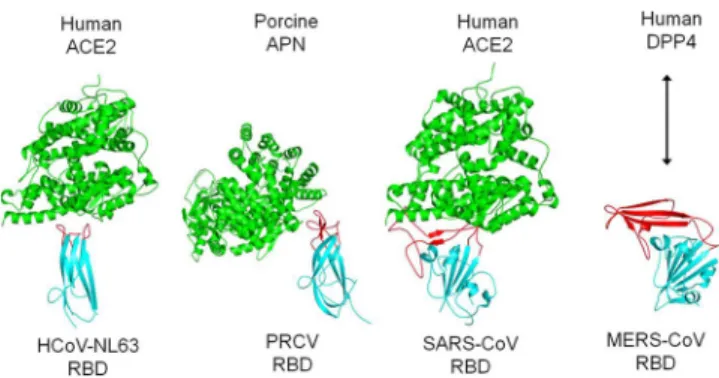
Fig. 4
).
Why is the accessory subdomain in

-coronavirus C-domain
hypervariable and often involved in receptor binding? The reason
is probably related to its location on the trimeric spike protein. As
TABLE 1Data collection and refinement statistics
Parameter MERS-RBD nativea NaI derivativea
Data collection
Space group P212121 P212121
Cell dimensions
a,b,c(Å) 45.361, 108.065, 124.287 45.822, 108.817, 124.328
␣,,␥(°) 90, 90, 90 90, 90, 90
Resolution (Å) 50–2.13 (2.17–2.13) 50–2.32 (2.36–2.32)
RsymorRmerge 0.065 (0.459) 0.119 (0.574)
I/I 31.8 (2.0) 18.3 (2.0)
Completeness (%) 97.8 (62.3) 98.5 (90.5)
Redundancy 6.9 (4.3) 4.3 (2.7)
Refinement
Resolution (Å) 49.6–2.13 No. of reflections 34770 Rwork/Rfree 0.149/0.206
No. of atoms 3,701
Protein 3,261
Ligand 120
Water 320
Bfactors (Å2) 43.3
Protein 40.1
Ligand 104.3
Water 53.1
RMSD
Bond lengths (Å) 0.008 Bond angles (°) 1.33
aValues in parentheses are for the highest-resolution shell.
FIG 3Interactions between the MERS-CoV S1 C-domain and human DPP4. (A) Dose-dependent inhibition of MERS-CoV infection by the MERS-CoV C-domain. Vero cells were treated with increasing concentrations of the MERS-CoV C-domain prior to infection. Virus titers were determined by plaque assay and are shown as PFU/ml. (B) Inhibition of MERS-CoV spike-pseudotyped retrovirus infection by MERS-CoV C-domain. MERS-CoV spike-pseudotyped MLV and VSV-G-pseudotyped MLV were mixed with the MERS-CoV C-domain and BSA, respectively. HEK293T cells transiently ex-pressing human DPP4 were infected with different amount of pseudotyped virus alone or its mixture with proteins. At 48 h postinfection, cells were lysed and-galactosidase activities were measured. The-galactosidase activity of cell lysate infected with 10l pseudotyped virus alone was taken as 100%. Values are means and standard errors of the means (SEM). (C) Pulldown of cell surface DPP4 by MERS-CoV C-domain. 293T cells were transfected with either empty vector or vector containing DPP4-HA gene. At 48 h posttrans-fection, cells were harvested and lysed. Cell lysate was mixed with the MERS-CoV C-domain containing a C-terminal His6tag. The C-domain/DPP4
we have shown previously using electron microscopy, the S1
C-domain is located on the membrane-distal tip of the trimeric spike
protein, with the accessory subdomain sitting on the very tip (
39
).
Hence, the accessory subdomain is the most exposed and
protrud-ing region on the whole spike protein, which has two results. First,
this region is exposed to the host immune system and thus evolves
at an increased pace to evade the host immune pressure. Second,
this region is easily accessible to potential host receptors.
Conse-quently,
-coronaviruses can take advantage of the increased
evo-lution rate in this region to screen for and, if circumstances allow,
switch to new receptors.
Structural comparisons of MERS-CoV and
␣
-coronavirus S1
C-domains.
The C-domains of
-genus MERS-CoV and
␣-genus
HCoV-NL63 and PCRV (all function as RBDs) have different
pri-mary, secondary, and tertiary structures. Both HCoV-NL63 and
PCRV RBDs contain a

-sandwich core structure consisting of
two
-sheet layers that stack together through hydrophobic
inter-actions, which is significantly different from the core structure of
MERS-CoV RBD that consists of a single

-sheet layer (
Fig. 5
).
The Z scores between MERS-CoV and HCoV-NL63 RBDs and
between MERS-CoV and PRCV RBDs are both less than zero,
suggesting no obvious similarity in their tertiary structures.
Fur-thermore, the proposed DPP4-binding RBM in MERS-CoV RBD
is also different from the ACE2-binding RBM in HCoV-NL63 and
the APN-binding RBM in PRCV (
Fig. 4
and
5
). The proposed
RBM in MERS-CoV RBD and the RBM in SARS-CoV RBD are
both single long and continuous subdomains, while the RBMs in
HCoV-NL63 and PRCV RBDs both consist of three short and
discontinuous loops. Despite their different tertiary structures,
these C-domains of
␣
- and

-coronaviruses are located in the
same region of their S1 subunits, suggesting that they are
evolu-tionarily related.
A closer inspection of these coronavirus C-domains reveals
that the MERS-CoV RBD has a structural topology (connectivity
of secondary structural elements) related to those of
␣-coronavi-ruses, consistent with what we showed previously with the
SARS-CoV RBD (
23
). Although one of the
-sheet layers in the RBD
core structure of
␣-coronaviruses has become
␣-helices in

-coronaviruses, all of the secondary structural elements in these
C-domains are connected in the same order (
Fig. 5
). These results
suggest that MERS-CoV and
␣
-coronavirus C-domains share an
evolutionary origin but have diverged dramatically to assume
ter-tiary structures with a similarity that is barely recognizable. The
evolutionary relationship between MERS-CoV and
␣
-coronavi-rus C-domains may also be explained by the location of the
C-do-main on the tip of the trimeric spike protein and hence an
in-creased evolution rate of this domain.
Position of MERS-CoV S1 C-domains on landscape of
coro-navirus evolution.
Here we summarize possible evolutionary
re-FIG 4Comparison of receptor-binding mechanisms of coronavirus S1 C-do-mains. These C-domains include HCoV-NL63 RBD complexed with human ACE2 (PDB 3KBH), PRCV RBD complexed with porcine APN (4F5C), and SARS-CoV RBD complexed with human ACE2 (2AJF). The arrow represents interaction between the MERS-CoV RBD and human DPP4. RBMs and core structures of coronavirus C-domains are in red and cyan, respectively, and receptors are in green.
lationships between MERS-CoV and other coronavirus
C-do-mains (
Fig. 6
). All coronavirus C-domains likely share an
evolutionary origin because of their related structural topology.
They have diverged into the
-sandwich core structure in
␣-coro-naviruses and the

-sheet core structure in

-coronaviruses. The
three RBM loops in
␣-coronaviruses further diverged into
ACE2-binding RBMs in HCoV-NL63 and APN-binding RBMs
in PRCV. The RBM subdomain in
-coronaviruses diverged into
ACE2-binding RBM in SARS-CoV, heparan sulfate-binding RBM
in some strains of MHV, and DPP4-binding RBM in MERS-CoV.
Therefore, this study has successfully positioned MERS-CoV RBD
on the landscape of coronavirus evolution and, during this
pro-cess, has also advanced our understanding of the evolution and
receptor recognition of coronaviruses.
Therapeutic implications.
MERS-CoV RBD has therapeutic
implications. As we have shown in this study, MERS-CoV RBD
functions as an effective inhibitor of MERS-CoV entry (
Fig. 3A
).
In addition, MERS-CoV RBD is also a potential candidate for
MERS-CoV subunit vaccines. Previous studies have shown that
SARS-CoV RBD can elicit robust host immune responses against
SARS-CoV infections (
40
,
41
). Likewise, the MERS-CoV RBD
identified in this study has a well-folded structure and interacts
strongly with human DPP4, making it a potential vaccine
candi-date. The determined structure of MERS-CoV RBD provides a
platform for structure-based design of effective MERS-CoV
vac-cines. For example, to help focus the antigenicity of the proposed
RBM region, new glycosylation sites may be introduced to the
surface of the core structure. In addition, to further stabilize
the RBD structure, new disulfide bonds can be introduced into
the RBD and some flexible loops can be modified. In sum, by
identifying the MERS-CoV RBD and determining its crystal
struc-ture, this study may be used to control the transmission of
MERS-CoV in humans.
ADDENDUM
During the submission and review of the present study, two other
studies independently mapped the MERS-CoV RBD fragments
(residues 358 to 588 and 377 to 662), both of which are similar to
the one identified in the present study (residues 367 to 588) (
42
,
43
). These studies also showed that the RBD efficiently elicits
neu-tralizing antibodies, confirming that the crystal structure of
MERS-CoV can be useful in structure-based vaccine design.
In addition, two other studies independently determined the
crystal structure of MERS-CoV RBD (residues 367 to 606)
com-plexed with human DPP4 (
44
,
45
). These studies delineated the
molecular interactions between the MERS-CoV RBD and its
re-ceptor and confirmed that the accessory subdomain in the
CoV RBD is the DPP4-binding RBM. The structures of the
MERS-CoV RBD as determined in these studies are a good match with the
structure reported in the present study (e.g., MERS-CoV RBD in
PDB 4KR0 can be superimposed onto the current structure with a
root mean square deviation [RMSD] of 0.82 Å). Although these
recently published studies are in general agreement with the
pres-ent study, this study is unique in that it focuses on (i) the evolution
of MERS-CoV and other coronavirus RBDs and (ii) the
therapeu-tic implications of MERS-CoV RBD. Both of these issues are
crit-ical for understanding and controlling MERS-CoV.
ACKNOWLEDGMENTS
We thank Lang Chen for assistance and discussion.
This work was supported by NIH grant R01AI089728 (to F. Li), by NIH grants R01AI085524 and 1U19AI100625 (to R. S. Baric), and by NIH grant 8P41GM103403-10 (to the Northeastern Collaborative Access Team beamlines at the Advanced Photon Source). Use of the Advanced Photon Source was supported by the U.S. DOE under contract DE-AC02-06CH11357. Computer resources were provided by the Basic Sciences Computing Laboratory of the University of Minnesota Supercomputing Institute.
REFERENCES
1.de Groot RJ, Baker SC, Baric RS, Brown CS, Drosten C, Enjuanes L, Fouchier RA, Galiano M, Gorbalenya AE, Memish Z, Perlman S, Poon LL, Snijder EJ, Stephens GM, Woo PC, Zaki AM, Zambon M, ZJ.2013. Middle East respiratory syndrome coronavirus (MERS-CoV); announce-ment of the Coronavirus Study Group. J. Virol.87:7790 –7792. 2.Zaki AM, van Boheemen S, Bestebroer TM, Osterhaus A, Fouchier
RAM.2012. Isolation of a novel coronavirus from a man with pneumonia in Saudi Arabia. N. Engl. J. Med.367:1814 –1820.
3.Annan A, Baldwin HJ, Corman VM, Klose SM, Owusu M, Nkrumah EE, Badu EK, Anti P, Agbenyega O, Meyer B, Oppong S, Sarkodie YA, Kalko EK, Lina PH, Godlevska EV, Reusken C, Seebens A, Gloza-Rausch F, Vallo P, Tschapka M, Drosten C, Drexler JF.2013. Human betacoronavirus 2c EMC/2012-related viruses in bats, Ghana and Europe. Emerg. Infect. Dis.19:456 – 459.
4.Holmes KV, Dominguez SR. 2013. The new age of virus discovery: genomic analysis of a novel human betacoronavirus isolated from a fatal case of pneumonia. mBio4:e00548 –12. doi:10.1128/mBio.00548-12. 5.Lau SK, Li KS, Tsang AK, Lam CS, Ahmed S, Chen H, Chan KH, Woo
PC, Yuen KY.2013. Genetic characterization of betacoronavirus lineage C viruses in bats reveals marked sequence divergence in the spike protein of Pipistrellus bat coronavirus HKU5 in Japanese pipistrelle: implications for the origin of the novel Middle East respiratory syndrome coronavirus. J. Virol.87:8638 – 8650.
6.Ksiazek TG, Erdman D, Goldsmith CS, Zaki SR, Peret T, Emery S, Tong SX, Urbani C, Comer JA, Lim W, Rollin PE, Dowell SF, Ling AE, Humphrey CD, Shieh WJ, Guarner J, Paddock CD, Rota P, Fields B, DeRisi J, Yang JY, Cox N, Hughes JM, LeDuc JW, Bellini WJ, Anderson LJ.2003. A novel coronavirus associated with severe acute respiratory syndrome. N. Engl. J. Med.348:1953–1966.
7.Peiris JSM, Lai ST, Poon LLM, Guan Y, Yam LYC, Lim W, Nicholls J, Yee WKS, Yan WW, Cheung MT, Cheng VCC, Chan KH, Tsang DNC, Yung RWH, Ng TK, Yuen KY.2003. Coronavirus as a possible cause of severe acute respiratory syndrome. Lancet361:1319 –1325.
8.Perlman S, Netland J.2009. Coronaviruses post-SARS: update on repli-cation and pathogenesis. Nat. Rev. Microbiol.7:439 – 450.
9.Hofmann H, Pyrc K, van der Hoek L, Geier M, Berkhout B, Pohlmann FIG 6Proposed evolution of the structures and functions of coronavirus S1
S.2005. Human coronavirus NL63 employs the severe acute respiratory syndrome coronavirus receptor for cellular entry. Proc. Natl. Acad. Sci. U. S. A.102:7988 –7993.
10. Li WH, Moore MJ, Vasilieva N, Sui JH, Wong SK, Berne MA, So-masundaran M, Sullivan JL, Luzuriaga K, Greenough TC, Choe H, Farzan M.2003. Angiotensin-converting enzyme 2 is a functional recep-tor for the SARS coronavirus. Nature426:450 – 454.
11. Delmas B, Gelfi J, Lharidon R, Vogel LK, Sjostrom H, Noren O, Laude H.1992. Aminopeptidase-N is a major receptor for the enteropathogenic coronavirus TGEV. Nature357:417– 420.
12. Yeager CL, Ashmun RA, Williams RK, Cardellichio CB, Shapiro LH, Look AT, Holmes KV.1992. Human aminopeptidase-N is a receptor for human coronavirus-229E. Nature357:420 – 422.
13. Dveksler GS, Pensiero MN, Cardellichio CB, Williams RK, Jiang GS, Holmes KV, Dieffenbach CW.1991. Cloning of the mouse hepatitis virus (MHV) receptor: expression in human and hamster cell lines confers sus-ceptibility to MHV. J. Virol.65:6881– 6891.
14. Williams RK, Jiang GS, Holmes KV.1991. Receptor for mouse hepatitis virus is a member of the carcinoembryonic antigen family of glycopro-teins. Proc. Natl. Acad. Sci. U. S. A.88:5533–5536.
15. Watanabe R, Matsuyama S, Taguchi F. 2006. Receptor-independent infection of murine coronavirus: Analysis by spinoculation. J. Virol.80: 4901– 4908.
16. Watanabe R, Sawicki SG, Taguchi F.2007. Heparan sulfate is a binding molecule but not a receptor for CEACAM1-independent infection of mu-rine coronavirus. Virology366:16 –22.
17. Cavanagh D, Davis PJ.1986. Coronavirus IBV—removal of spike glyco-polypeptide-S1 by urea abolishes infectivity and hemagglutination but not attachment to cells. J. Gen. Virol.67:1443–1448.
18. Schultze B, Cavanagh D, Herrler G.1992. Neuraminidase treatment of avian infectious-bronchitis coronavirus reveals a hemagglutinating activ-ity that is dependent on sialic acid-containing receptors on erythrocytes. Virology189:792–794.
19. Schultze B, Gross HJ, Brossmer R, Herrler G.1991. The S-protein of bovine coronavirus is a hemagglutinin recognizing 9-O-acetylated sialic acid as a receptor determinant. J. Virol.65:6232– 6237.
20. Schwegmann-Wessels C, Herrler G.2006. Sialic acids as receptor deter-minants for coronaviruses. Glycoconj. J.23:51–58.
21. Raj VS, Mou HH, Smits SL, Dekkers DHW, Muller MA, Dijkman R, Muth D, Demmers JAA, Zaki A, Fouchier RAM, Thiel V, Drosten C, Rottier PJM, Osterhaus A, Bosch BJ, Haagmans BL.2013. Dipeptidyl peptidase 4 is a functional receptor for the emerging human coronavirus-EMC. Nature495:251–254.
22. Bosch BJ, van der Zee R, de Haan CAM, Rottier PJM. 2003. The coronavirus spike protein is a class I virus fusion protein: structural and functional characterization of the fusion core complex. J. Virol.77:8801– 8811.
23. Li F.2012. Evidence for a common evolutionary origin of coronavirus spike protein receptor-binding subunits. J. Virol.86:2856 –2858. 24. Li F, Li WH, Farzan M, Harrison SC.2005. Structure of SARS
corona-virus spike receptor-binding domain complexed with receptor. Science 309:1864 –1868.
25. Peng GQ, Sun DW, Rajashankar KR, Qian ZH, Holmes KV, Li F.2011. Crystal structure of mouse coronavirus receptor-binding domain com-plexed with its murine receptor. Proc. Natl. Acad. Sci. U. S. A.108:10696 – 10701.
26. Peng GQ, Xu LQ, Lin YL, Chen L, Pasquarella JR, Holmes KV, Li F. 2012. Crystal structure of bovine coronavirus spike protein lectin domain. J. Biol. Chem.287:41931– 41938.
27. Reguera J, Santiago C, Mudgal G, Ordoño D, Enjuanes L, Casasnovas JM.2012. Structural bases of coronavirus attachment to host aminopep-tidase N and its inhibition by neutralizing antibodies. PLoS Pathog. 8:e1002859. doi:10.1371/journal.ppat.1002859.
28. Wu KL, Li WK, Peng GQ, Li F.2009. Crystal structure of NL63
respi-ratory coronavirus receptor-binding domain complexed with its human receptor. Proc. Natl. Acad. Sci. U. S. A.106:19970 –19974.
29. Li F.2008. Structural analysis of major species barriers between humans and palm civets for severe acute respiratory syndrome coronavirus infec-tions. J. Virol.82:6984 – 6991.
30. Wu KL, Peng GQ, Wilken M, Geraghty RJ, Li F.2012. Mechanisms of host receptor adaptation by severe acute respiratory syndrome coronavi-rus. J. Biol. Chem.287:8904 – 8911.
31. Otwinowski Z, Minor W.1997. Processing of X-ray diffraction data collected in oscillation mode. Methods Enzymol.276:307–326. 32. Grosse-Kunstleve RW, Adams PD.2003. Substructure search procedures
for macromolecular structures. Acta Crystallogr. D Biol. Crystallogr.59: 1966 –1973.
33. Terwilliger TC.2000. Maximum-likelihood density modification. Acta Crystallogr. D Biol. Crystallogr.56:965–972.
34. Murshudov GN, Vagin AA, Lebedev A, Wilson KS, Dodson EJ.1999. Efficient anisotropic refinement of macromolecular structures using FFT. Acta Crystallogr. D Biol. Crystallogr.55:247–255.
35. Josset L, Menachery VD, Gralinski LE, Agnihothram S, Sova P, Carter VS, Yount BL, Graham RL, Baric RS, Katze MG.2013. Cell host re-sponse to infection with novel human coronavirus EMC predicts potential antivirals and important differences with SARS coronavirus. mBio 4:e00165–13. doi:10.1128/mBio.00165-13.
36. Wu K, Chen L, Peng G, Zhou W, Pennell CA, Mansky LM, Geraghty RJ, Li F.2011. A virus-binding hot spot on human angiotensin-converting enzyme 2 is critical for binding of two different coronaviruses. J. Virol. 85:5331–5337.
37. Dauter Z, Dauter M, Rajashankar KR.2000. Novel approach to phasing proteins: derivatization by short cryo-soaking with halides. Acta Crystal-logr. D Biol. CrystalCrystal-logr.56:232–237.
38. Holm L, Sander C.1998. Touring protein fold space with Dali/FSSP. Nucleic Acids Res.26:316 –319.
39. Li F, Berardi M, Li WH, Farzan M, Dormitzer PR, Harrison SC.2006. Conformational states of the severe acute respiratory syndrome coronavi-rus spike protein ectodomain. J. Virol.80:6794 – 6800.
40. He YX, Lu H, Siddiqui P, Zhou YS, Jiang SB.2005. Receptor-binding domain of severe acute respiratory syndrome coronavirus spike protein contains multiple conformation-dependent epitopes that induce highly potent neutralizing antibodies. J. Immunol.174:4908 – 4915.
41. He YX, Zhou YS, Wu H, Luo BJ, Chen JM, Li WB, Jiang SB.2004. Identification of immunodominant sites on the spike protein of severe acute respiratory syndrome (SARS) coronavirus: implication for develop-ing SARS diagnostics and vaccines. J. Immunol.173:4050 – 4057. 42. Du L, Zhao G, Kou Z, Ma C, Sun S, Poon VK, Lu L, Wang L, Debnath
AK, Zheng BJ, Zhou Y, Jiang S.2013. Identification of receptor-binding domain in S protein of the novel human coronavirus MERS-CoV as an essential target for vaccine development. J. Virol. [Epub ahead of print.] doi:10.1128/JVI.01048-13.
43. Mou H, Raj VS, van Kuppeveld FJ, Rottier PJ, Haagmans BL, Bosch BJ. 2013. The receptor binding domain of the new MERS coronavirus maps to a 231-residue region in the spike protein that efficiently elicits neutralizing antibodies. J. Virol. [Epub ahead of print.] doi:10.1128/JVI.01277-13. 44. Lu G, Hu Y, Wang Q, Qi J, Gao F, Li Y, Zhang Y, Zhang W, Yuan Y,
Bao J, Zhang B, Shi Y, Yan J, Gao GF.2013. Molecular basis of binding between novel human coronavirus MERS-CoV and its receptor CD26. Nature [Epub ahead of print.] doi:10.1038/nature12328.
45. Wang N, Shi X, Jiang L, Zhang S, Wang D, Tong P, Guo D, Fu L, Cui Y, Liu X, Arledge KC, Chen YH, Zhang L, Wang X.2013. Structure of MERS-CoV spike receptor-binding domain complexed with human re-ceptor DPP4. Cell Res. [Epub ahead of print.] doi:10.1038/cr.2013.92. 46. Prabakaran P, Gan JH, Feng Y, Zhu ZY, Choudhry V, Xiao XD, Ji XH,