PROMISING PRACTICES FOR WORKFORCE HOUSING: IMPLICATIONS FOR COLLEGES AND UNIVERSITIES
Emily Arnold
An honors thesis submitted to the faculty of the Kenan-Flagler Business School at the University of North Carolina at Chapel Hill
Chapel Hill 2020
ABSTRACT Emily Arnold
Promising Practices for Workforce Housing: Implications for Colleges and Universities
TABLE OF CONTENTS
ABSTRACT………ii
LIST OF TABLES………...v
LIST OF FIGURES………...…...vi
Chapter I. INTRODUCTION………...………1
A. Overview of Housing Markets………....3
B. Research Context……….……….………...4
C. Impact for Employees….………....6
D. Research Question……….………….7
E. Research Significance……….7
F. Takeaways………..……….8
II. LITERATURE REVIEW……….………...9
A. Great Recession ………...………..9
B. Wage Stagnation.………..10
C. Student Debt Crisis…..……….11
D. Exclusionary Zoning……….………....12
E. Gentrification……….13
F. Government Action………...15
III. METHODOLOGY……….……….………..17
B. Measurement……….19
C. Limitations………20
IV. FINDINGS……….21
A. General Initiatives……….21
B. Promising Practices………...24
1. Defined Plans……….24
2. Inclusionary Zoning………...26
3. Transparency………..27
4. Developer Support……….29
5. Joint Ventures………30
6. Community Involvement………...32
7. Renovation and Adaptive Reuse………33
8. Accessibility………..35
V. SUMMARY,CONLUSION, AND RECOMMENDATIONS………...37
A. Action Strategies..……….38
B. Potential Barriers………..44
C. Suggestions for Future Research………..45
VI. APPENDIX………46
A. IRB Approval……….…...47
B. Interview Questions………...49
C. Survey Questions………...51
LIST OF TABLES
Table 1 Description of Interviewees……….………..17
LIST OF FIGURES
Figure 1 Number of affordable units per state………...1
Figure 2 Description of topic breakdown………...3
Figure 3 Photo of UoC site………...23
Figure 4 Photo of JHU site………...24
Figure 5 Photo of BoA site………...31
Figure 6 Photo of Bridge site………...34
Figure 7 IRB approval………..48
I. OVERVIEW
America is facing an affordable housing crisis. The crisis is evident in all sized metropolitan areas, micropolitan and rural communities, and in university towns like Chapel Hill. Across the nation, a diverse demographic, including older, homeless, disabled, extremely low income, and working poor individuals, is affected by the crisis. Housing is considered affordable when it costs less each month than 30% of household monthly income (McCarthy, 2019). According to the National Low-Income Housing Coalition, no county in any state has modest two-bedroom apartments available to workers earning minimum wage (McCarthy, 2019).
The affordability problem has other implications for the millions of Americans struggling to make housing payments. Two in five adults would not be able to come up with $400 if faced with an emergency right now; one in five adults are unable to pay the current month’s bills in full (Lowery, 2020). Young adults face rising health coverage costs, student debt, and childcare, preventing them from saving enough money each month to ensure future financial stability. Millions of young Americans are being priced out of cities they grew up in (Florida, 2015). If the housing affordability issue persists, young adults may never be able to afford a home and a family using the government’s standards of affordability.
As Figure 2 shows, a diverse array of institutional actors, including federal, state,
and local governments, community development corporations and other nonprofits
organizations, and a host of private sector entities, are trying to address the housing
affordability crisis. To create affordable housing for the diverse demographics who need
it, these institutional actors are leveraging a diverse portfolio of government dollars,
private capital, and philanthropic resources. Figure 2 does not include all possible
organizations or types of affordable housing and cannot replicate the complex system of
relationships involved in affordable housing projects, but provides a general conceptual
Figure 2 The second tier of the figure outlines different types of affordable housing, or who a particular housing project could be designed for. The third-tier outlines groups that may work on housing projects. Funding mechanisms that can be used by any organization are listed at the bottom of the figure. This research looks specifically at workforce housing. Under workforce housing, it looks at the efforts made by universities and companies.
A. Overview of Housing Market
Developers will not invest in an area if the market rate for housing does not cover the costs of development. In order to make this housing more affordable, lending
institutions and government programs provide assistance. For example, several banks offer lower interest rates on mortgages for first-time homebuyers (Bank of America). The Department of Housing and Urban Development provides housing vouchers for those earning below 50% of area median income [AMI] (Cartier, 2018). These vouchers help homeowners purchase homes in areas with high market rates by covering the difference between the actual price and what homeowners can afford. The government also
incentivizes developers to create housing for those earning below 80% AMI through low-income housing tax credits, which reduce development costs (Cartier, 2018). Developers can take advantage of these tax cuts as long as the properties remain affordable long-term.
B. Research Context
protect public health and safety as well as educate our youth. These individuals do not qualify for government housing subsidies.
Workforce housing units are often Class B and C1 multifamily properties. Exact income limits for workforce housing programs are different in each city. Since rents increased more than wages in the decade since the last recession, demand for workforce housing remains strong. Nationally, the current supply of workforce housing has a vacancy rate lower than 5% (CRBE, 2018). There are at least three major barriers to increasing the supply of workforce housing.
The first is the paucity of older properties that are safe enough to rehabilitate (CBRE, 2019). The second is the possibility or risk of upgrading older housing to a level or price point that it is no longer affordable for the missing middle. The third is most workforce housing properties, irrespectively of whether they are recently renovated or newly constructed, cannot quickly turn profits while staying true to workforce housing prices. Because of the lack of return on investment, many investors shy away from Class B and C properties where they cannot raise rents (Obando, 2019). Given the growing demand from the missing middle, clearly innovative approaches are required to increase the workforce housing supply.
In regards to universities, workforce housing refers to housing meeting the above qualifications provided for staff members. Since the salaries of janitorial staff, cooks, and other staff often do not match the cost of living in the communities surrounding
universities, they may need housing assistance.
C. Impact for Employers and Employees
Organizations that offer housing benefits for their employees see several reasons for doing so. Housing benefits are often intended to help employees live closer to their workplaces and to reduce the financial burden of homeownership. However, these assistance programs tend to have a positive impact on both the employees and the employers.
Reduced commutes can improve overall health in employees. According to a study conducted in 2011, commuting time can adversely affect heart health (Allen, Barlow, Hoehner, & Schootman, 2012). Long commutes lead to higher levels of stress from traffic congestion and the length of time spent sitting in stalled traffic. The study found that commutes longer than 10 miles could lead to elevated blood pressure and increase the commuters’ risks of becoming obese (Allen, Barlow, Hoehner, &
Schootman, 2012). By living within a 10-mile radius to their workplaces, employees will see improvements in their long-term health and face fewer challenges as they age.
Many employers are turning to housing assistance programs in order to retain talented employees and reduce hiring costs associated with replacing employees who leave. In 2017, a study of major employers found that 87% of participants want to
improve employee retention (Harlem, 2018). These employers reported replacement costs of up to 150% of the employees’ annual salaries. Employees who receive housing
assistance are more loyal to their employees and work harder for the company (Harlem, 2018). Organizations who want to retain more employees in the future could do so by providing housing benefits.
D. Research Question
Colleges and universities employ a large support staff who face housing affordability issues. They include, among others, custodial staff and food service
workers, mail clerks, bus drivers, and administrative support personnel, whose salaries do not match the cost of living in the communities near the universities that employ them. Recognizing the challenge that this poses for higher education institutions, especially those in rapidly grow cities and towns with escalating housing costs, this research seeks to answer the following question: Are there “promising practices” in the affordable housing space that colleges and universities can deploy to create workforce housing for their employees who need it?
E. Research Significance
The housing affordability crisis is affecting the ability of both public and private
sector employers, including higher education institutions, to recruit and retain workers
today. In response, employers, especially those in markets that are experiencing rapid
and competitive in our increasing global economy. Due to the escalating cost of both
single- and multi-family accommodations in Chapel Hill, for example, some university
workers—custodial and other support staff among others--are commuting up to 50 miles
one-way daily to perform jobs that do not pay them enough to live in Chapel Hill or
closer to the University.
Moreover, in 2019, the town only approved the construction of 78 new affordable
units and managed to preserve 147 units of existing affordable housing (Town of Chapel
Hill, 2019). Altogether, the town has a total of 1,155 affordable units, which is not nearly
enough to house the estimated 10,000 permanent Chapel Hill residents with below
poverty level earnings, let alone to accommodate the “missing middle” who work at
UNC-Chapel Hill but cannot afford to live in the city.
F. Takeaways
II. LITERATURE REVIEW
Only 30 out of every 100 low-income families are able to find affordable housing in the U.S. The working poor in particular struggle to find housing as they do not qualify for government assistance due their employment status. Six demand drivers for
workforce housing are highlighted below. A. Great Recession
While the job market managed to recover after the 2008 crash and evolve, the
housing market has not. Even those with jobs cannot always afford to live in the areas
they work. Longer commutes are now considered a normal part of working in a city.
Living in the city itself would be too expensive for the average lower income worker.
Workforce housing often is seen as a solution to pricey housing, but the lack of housing
market recovery creates a shortage of housing that the low-wage workforce or missing
middle can afford (Parlow, 2015). Although the crash of 2008 was over a decade ago, the
housing market’s slow recovery has prompted a new conversation about the importance
of workforce housing.
Because of the slow pace of recovery after the recession, poverty levels in some
areas remain at recession-era levels. People living below the poverty line often are forced
to stay in low-income neighborhoods due to lack of affordable alternatives (Holmes &
Kneebone, 2016). When poor people have no choice but to stay in deteriorating
Concentrated poverty disproportionately affects people of color, making it even harder
for residents of poor neighborhoods to leave.
The Great Recession has other lingering effects. For example, families with
school-age children often are constrained to neighborhoods and school districts with
inadequate resources to ensure their children a high quality education (Dastrup & Ellen,
2012). Due to the collapse of the housing market, these families also may be saddled
with damaged credit scores, which exacerbate a cycle of poverty they cannot escape
without help.
B. Wage stagnation
Wage stagnation existed long before the recession. When wages stagnate, families have to spend more on basic necessities (Wisman, 2013) and therefore find it difficult to build wealth, a situation that locks them in their current socioeconomic class. Moreover, since they no longer have extra money needed to cover unexpected costs, they are forced to take on additional debt when emergencies arise.
Wage stagnation affects almost everyone, seemingly only sparing the country’s top earners. Financial deregulation allowed the salaries of the top 1% and even the top 10% to increase at a faster rate (Mishel, 2015). These large salary gaps siphon more economic power from those on the bottom rung of the wealth ladder. Because they hold less economic and political power, their needs for housing have gone under-addressed. C. Student Debt Crisis
The student loan crisis is another contributor to the high demand for workforce housing. Students graduate with college degrees and may have a job that pays well, but are burdened by student debt that they cannot easily repay. The student loan debt total is currently higher than car loans and credit debt (Johnson, 2019). The high cost of a college education already excludes many from degrees and the student loan crisis makes
obtaining a degree seem impossible to those who do not have large amounts of money saved. Graduating students cannot afford to live near their workplaces and continue to pressure the workforce housing market.
Over 70% of recent college graduates have seen declining pay increases,
decreasing their ability to live near their workplaces (Mishel, 2015). Many are forced to live with multiple roommates and are still cost-burdened. While STEM2 graduates are some of the most sought-after employees, their wage increases are still not keeping up with the rate of inflation (Mishel, 2015). Because of these wage problems, college debt is an issue that refuses to shrink.
While mortgage interest rates are the lowest they have been in over a decade, people under the age of 35 are not buying homes. College graduates with existing student
debt usually do not qualify for mortgage financing (Rose, 2016). Student debt is usually not a short-term problem, as some debt takes over a decade to repay. In the second America Home Survey, half of the participants that reported having student debt named that debt as a major barrier between them and homeownership (Rose, 2016). Student debt continues to decrease the number of adults able to purchase homes.
Increases in student debt relief increase homeownership among young adults. While student debt may be on the rise, access to student debt relief may open doors for those who want to own homes. In some states, the costs of mortgages are decreasing, making homeownership a possibility for some debt-burdened residents. For example, Ohio had one of the highest average affordable down payments compared to the average of student debts in Ohio (Passy, 2019). Adequate debt relief for these students could allow them to own homes in the near future.
D. Exclusionary zoning
Exclusionary zoning also has exacerbated the housing affordability crisis. Exclusionary zoning occurs when cities use zoning codes to prevent more affordable forms of housing to be built in wealthier neighborhoods (Reeves, 2017). By preventing lower income individuals from occupying space in wealthier neighborhoods, city officials take away opportunities for lower-income individuals to gain access to better resources and safer communities. Reeves (2017) characterized exclusionary zoning as “opportunity hoarding” where wealthy residents prevent the construction of affordable housing in their neighborhood due to the perceived effect on their property values as well as the
and affordable housing more generally--is called NIMBYism, which stands for Not In My Backyard.
Exclusionary zoning has been around for over 100 years. These laws replaced general nuisance laws and allowed the government to control what could and could not be built in certain areas (Erickson, 2012). Zoning separated business districts from
residential districts. However, cities eventually turned to these laws as a way to segregate neighborhoods and force out unwanted residents. While zoning codes have adapted, some original codes still stand, harming the production of affordable housing.
Affordable housing, and by extension workforce housing, works well when multifamily units can be constructed. However, most city zoning codes prevent these types of units in middle- and upper-class neighborhoods. These units cannot exist when codes mandate density maximums and minimum lot sizes (Rigsby, 2016). By shutting out multifamily housing, governments successfully keep all of a city’s poor residents in specific areas and keeping those people from escaping poverty.
E. Gentrification
Gentrification is yet another driver of the demand for workforce housing. This is
a process where wealthier—and most often white—individuals purchase deteriorating
properties in older downtown area neighborhoods, which are typically occupied by
people of color, and engage in wholesale rehabilitation of the property and demand
improved services from the City (National Geographic Society, 2019). As the “gentry”
move in and upgrade these neighborhoods, long-term residents are forced out due to
rising property values and a higher cost of living. Displaced residents are often forced to
also may destroy valued social networks as well as increase both the length and cost of
their daily journey to work.
Gentrification erases long-standing cultures in affected neighborhoods.
Immigrants occupy some neighborhoods at risk of gentrification, and when they are
displaced, the diverse cultural fabric of these neighborhoods disappear (Capps, 2019).
During periods when gentrification is in full swing, cultural clashes can turn old residents
against new residents. However, neighborhoods are constantly changing and
gentrification occasionally may be conflated with other shifts in neighborhood
composition (Capps, 2019). Community members must be aware of the signs of certain
changes in order to identify gentrification.
One example of gentrification in action and the adverse effects it has on the
culture of neighborhoods is the Harlem neighborhood of New York. As of 2008,
traditional food, music, and clothing were disappearing from the streets as new Harlem
residents opted for healthier food and new styles (Gørrild, Obialo & Venema, 2008).
While at first glance the phenomenon is harmless considering consumer preferences are
fickle, these new preferences were ushered in by non-traditional Harlem residents. These
new residents came to revitalize Harlem and take advantage of the new high-rise
apartment buildings recently approved by the city. Long-time Harlem residents worried
that Harlem would soon become an extension of the East Side of Manhattan instead of a
unique community (Gørrild, Obialo & Venema, 2008). While the crime rate dropped and
the median income rose, Harlem lost several of the staples it once had as the capital of
F. Government Action
For decades, the federal government approved policies that segregated American
neighborhoods and prevented people of color from obtaining mortgages. Back in the
1930s, the Federal Housing Administration [FHA] discriminated against black families
by refusing to insure mortgages for properties in or near predominately black
neighborhoods (Gross, 2017). The organization justified its actions by claiming that the
presence of black families in or near white neighborhoods lowered property values. The
practice would later be known as redlining, as maps of housing were color-coded based
on who lived in certain neighborhoods (Gross, 2017). Any neighborhoods where black
families lived were colored red and considered too risky to insure. The FHA went as far
to state that different racial groups should not be allowed to live in the same
neighborhood in its manual. In 1968, the Fair Housing Act passed and redlining was
determined to be illegal (Gross, 2017). However, the practice remains undone, as
affordability issues and racial discrimination persist.
The federal government now focuses all housing efforts through the U.S.
Department of Housing and Urban Development [HUD]. In 2018, the New York Times
reported that HUD, under the leadership of Secretary Ben Carson, was not doing enough
to curb the growing housing affordability problem. In fact, Carson planned to triple rents
for over 700,000 low-income renters (Thrush, 2018). While Carson’s goal was to
motivate people to find ways to earn enough money to cover the difference between their
old and new rents, local officials saw the increase as an additional burden on local
housing programs. Housing authorities and HUD leaders continue to disagree on the role
programs are not strong enough on their own, but Carson believes federal aid should be
temporary and less common to encourage more work from local groups.
While government intervention may not be enough, the National Low-Income
Housing Coalition [NLIHC] provided a few recommendations for the federal government
in 2019. NLIHC felt these recommendations were necessary; according to a recent survey
conducted by NLIHC, 76% of voters are more likely to vote in 2020 for a presidential
candidate who has a plan for affordable housing relief. Given that current funds are not
enough, the federal government should expand the budget for HUD’s grant programs
(Yentel, 2019). NLIHC also wants to see more protection for renters in the future.
III. METHODOLOGY
A three-pronged research strategy was employed in this study. Each strategy was
designed to gather qualitative insights into promising practices employed to create
workforce housing. The IRB approval for the research instruments used in this study
appears in Appendix A.
A. Data Collection
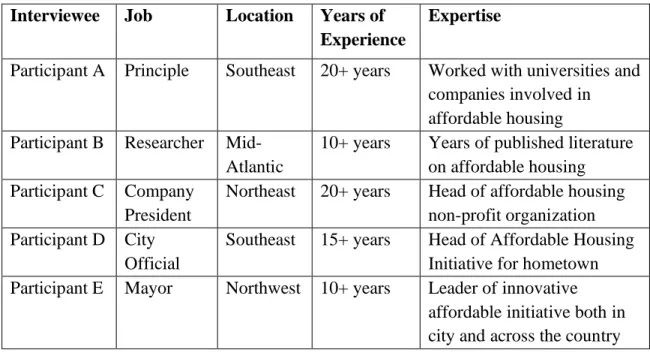
Interviews were conducted with three affordable housing experts who were selected based on their published work, expertise in workforce housing development, and experience with community partnerships. The protocol used in these interviews, which contains the specific questions posed to each of these key informants, appears in
Appendix B. Their expertise is summarized in Table 1. Table 1 Description of Interviewees
Interviewee Job Location Years of Experience
Expertise
Participant A Principle Southeast 20+ years Worked with universities and companies involved in affordable housing Participant B Researcher
Mid-Atlantic
10+ years Years of published literature on affordable housing Participant C Company
President
Northeast 20+ years Head of affordable housing non-profit organization Participant D City
Official
Southeast 15+ years Head of Affordable Housing Initiative for hometown Participant E Mayor Northwest 10+ years Leader of innovative
Based on existing research and key informant interviews, case studies of four organizations—two private universities and two financial institutions—that have successfully built workforce housing also were undertaken. Johns Hopkins University and the University of Chicago were the two private higher education institutions and Bank of America and the Bridge Investment Group were the two financial institutions.
John Hopkins University made a strong case study because it has been a long-time participant in conversations regarding affordable housing in Baltimore (Broadwater, 2018). Currently, the university and the medical center are working together to create cleaner, more affordable housing in East Baltimore. The City aims to revitalize the area while ensuring that the current residents can continue to live there in the future
(Broadwater, 2018). John Hopkins has the benefit of being a private university, meaning that it can invest money as well as time in projects.
The University of Chicago made a strong case study because it is Tier I higher education institution located in a city with a history of affordable housing disasters. Not only does the university work on projects in surrounding neighborhoods, it also provides subsidized housing for university employees (Office of Civic Engagement, 2015;
Mordfin, 2016). Chicago is an expensive place to live, which means that many university employees cannot live close to where they work. As a private school, the University of Chicago, not unlike Johns Hopkins, can make larger financial investments in workforce housing projects.
locations in both large cities and small towns throughout the country. Across its vast geographic footprint, employees and customers alike struggle to afford housing, and Bank of America set out to help them (Bank of America, 2019). In so doing, the
company also recognized the potential return on its investment in workforce housing. The company invests in housing by providing funding and other resources to housing tenants. In some cases, the company also participates in the development process, working with partner institutions to create housing plans and construct the housing.
Similar to Bank of America, the Bridge Investment Group—a real estate fund manager—made a good case study because of its numerous office locations, its expertise in residential real estate, and its pledge to invest $619 million in workforce housing projects near its offices (Ruterman, 2019). The company has offices in cities such as Los Angeles, New York, and Seattle where the cost of living is high and there is a severe shortage of affordable housing for both public and private sector workers (Ruterman, 2019). And not unlike Bank of America, Bridge Investment Group expects a large return on its investment in workforce housing.
Finally, in order to gain additional insights into promising practices, telephone surveys were conducted with other private universities as well as financial services firms who have engaged in workforce housing development. In total, 30 organizations
participated in the telephone survey. The protocol used in the telephone surveys appears in Appendix C. A summary of the survey responses appears in Appendix D.
B. Measurements
information gathered via the four case studies and surveys of other experts in this space was conducted. For the purpose of this study, revealed strategies or responses to one or more of the previously identified demand drivers for workforce housing were evaluated as potential “promising” practices for colleges and universities interested in building this type of housing in the years ahead. The case studies also highlighted the current efforts of organizations involved in workforce housing that did not fall under any of the promising practices. These actions are worthy of notice as they provide a strong foundation for recommended actions for the future.
C. Limitations
IV. FINDINGS
The findings of this study are organized in two separate but inter-related categories. The first is comprised of general observations about the involvement of colleges and universities in workforce housing and affordable housing more generally. The second section highlights the promising practices culled for the research on
institutional practices in both university setting and the private sector.
Current university initiatives are important because they can serve as the foundation on which a portfolio of “promising practices” can be built. This research— the survey responses and the case studies in particular—suggests that many colleges and universities are engaged in applied housing research and community outreach, but few have actually developed workforce housing.
Several schools provide clear directives on housing affordability issues and on
how both students and faculty can become involved in affordable housing work. Some
make housing a part of their mission by offering specific classes and programs for
students interested in facilitating community improvements through housing. Others
focus on housing research and securing grants for specific housing projects. And still
others embrace interdisciplinary approaches to housing, which allows students with
differing interests to participate in community improvement initiatives.
The University of Chicago, for example, has four different departments and
Law School offers one class and several seminars that are dedicated to helping evicted
low-income tenants. The Harris School of Public Policy offers workshops and holds
events dedicated to housing improvement. The School of Social Service Administration
also holds workshops on housing issues. And the University’s Kreisman Initiative for
Housing Law and Policy brings together interested students from a wide range of
departments to engage in affordable housing work in Chicago. All of these programs and
initiatives aim to serve the needs of the city while teaching students skills they will need
to solve pressing housing problems in the future.
Few colleges and universities have engaged in housing development for their
employees. However, some have provided vacant school property and survey responses
show that others have helped acquire city owned property for the construction of new
housing units. In addition, several schools have contributed to their community through
revitalization efforts, choosing one or more buildings to repurpose.
Among the universities that have engaged in housing development, few have targeted their “missing middle” employees for affordable residential accommodations. The University of Chicago, for example, provides housing stipends for full-time
professors and housing assistance for a few hourly workers, depending on how long those
employees have been with the school. Most low-wage workers (e.g., kitchen,
housekeeping, and security staff) are all hired by a partnering company, which relieves
the University of any responsibility for their well-being. As a consequence of the
University’s focus on affordable housing for faculty, reportedly there has been an
surrounding the University campus as full-time faculty have moved in and renovated
houses (Figure 3).
Figure 3 Children in Chicago’s Woodlawn neighborhood pass newly renovated homes. Source: Chaskin, Joseph, Khare, 2014.
While the University of Chicago has narrowly focused on faculty housing, Johns
Hopkins University has concentrated its efforts more broadly on revitalizing
neighborhoods, educating children, and helping university employees purchase homes in
East Baltimore where it is located. JHU currently has two main initiatives in Baltimore.
In East Baltimore, the school is helping to revitalize neighborhoods and educate the
children. For example, the university partnered with other key community stakeholders to
build the Henderson-Hopkins K-8 School, the first new school in East Baltimore in over
20 years. Along with housing for its employees, Johns Hopkins also invested in retail and
jobs are now available in the neighborhood as Johns Hopkins continues to invest in
additional retail and office space. And most notably, given the thrust of this research,
Johns Hopkins also helped university employees purchase homes in the neighborhood
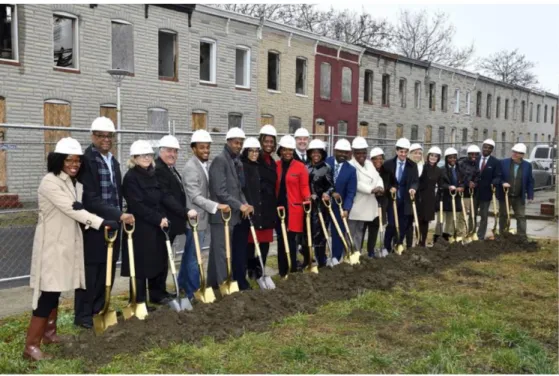
(see Figure 4).
Figure 4 Students and faculty break ground for new apartments as part of the East Baltimore Development Initiative. Source: provided by Office of the President B. Promising Practices
Eight promising practices were identified in this research. Each of these practices is described below. Where possible, specific examples from the case studies are presented as supporting evidence of the veracity of the practices.
Promising Practice #1: Defined Plans.
clearly articulated and outlined in discrete steps so there is no room for misconceptions or errors. Known costs and other financial aspects of the project and a timeline should be included.
By creating a plan, project leaders ensure that the steps of the production process are clear to all parties involved in the project. Discussions about the plan will also clear up any misconceptions or errors. As one key informant noted, the plan should serve as a measure of accountability; if one party fails to deliver on its part of the plan without reason, the/ other parties will know. These steps will ensure that all parties are able to help create housing with minimal frustration or hesitation. Finally, plans often break down massive projects into a series of approachable steps. While workforce housing development may seem daunting to even the most experienced parties, these steps ensure that all parties are able to help create housing with minimal frustration or hesitation.
Bank of America uses documented and defined plans when approaching workforce housing, and has seen great success with them. The company is able to use plans to justify the development of housing to shareholders, and the clarity of the plans allows shareholders to contribute thoughtful feedback to the company. Plans also help Bank of America stay on budget and avoid overspending when problems arise. While the plans cannot control external events, Bank of America’s plans provide a straightforward timeline to follow that can be adjusted with relative ease when needed. The plans will serve as guidance for future teams working on workforce or affordable housing projects. Project plans are a key piece of the company’s success with housing development. Several schools surveyed responded that they already had documented plans for
actions with their communities and stay organized while carrying out numerous
initiatives. Plans are adjusted as new departments and student groups get involved. Each plan includes a timeline and planned financial contributions from the school.
Promising Practice #2: Inclusionary Zoning.
One key informant cited exclusionary zoning laws as the number one obstacle to affordable housing production. Exclusionary codes restrict density and impose other regulatory barriers that make it difficult to build workforce housing—or any affordable housing for that matter. Inclusionary zoning laws remove the barriers inherent in exclusionary zone codes. They allow flexible density maximums and bend other regulations so that various types and sizes of multiple family housing are possible in areas formerly zoned for single-family housing units only. With inclusionary zoning, the production of affordable units increases and mixed income areas emerge. Communities with inclusionary zoning practices also tend to be more diverse—racially and ethnically as well as socioeconomically. Inclusionary zoning codes reflect YIMBYism, which stands for Yes In My Backyard, the antithesis of NIMBYism—Not in My Backyard.
By advocating for inclusionary zoning codes, organizations demonstrate their dedication to working with city officials. Many current codes prevent dozens of housing projects every year. With inclusionary zoning, production of affordable units increases and mixed income areas emerge. Communities with inclusionary zoning practices also tend to be more diverse and see greater economic participation from those on the lower end of the wealth spectrum.
of diverse backgrounds. These projects can also support more tenants, as more units per acre are allowed. Flexible zoning codes also means that Bridge’s properties are
profitable, making the company more likely to continue to invest in those communities in the future. Bridge is very knowledgeable about zoning codes and looks for inclusionary codes when choosing where to invest. Interest from companies like Bridge has drawn other businesses to those communities as well.
Very few universities have widespread knowledge of local zoning codes. While certain departments know a lot about local zoning, others learn just enough about these codes to stay in housing conversations and come up with realistic housing solutions. Promising Practice #3: Transparency.
University-sponsored projects can potentially harm community members if the
interests and wishes of community members are not taken into account. For this reason, it
is imperative to demonstrate at the outset of any proposed initiative how the community
will benefit and not be exploited or adversely affected. Community members are not
subjects to study, but real people who may need a helping hand. Given this risk,
transparency becomes even more important, especially for community members who
may be suspicious of the University’s intentions.
projects as well as benefits they hope the projects bring to the communities in question. Finally, a transparent party informs the community about what will happen after the project is completed.
Transparency helps remove doubts around workforce housing and increases the likelihood that community members will approve of housing being built in their
neighborhood. One key informant stressed the importance of transparency by calling it the difference between a NIMBY community and a YIMBY community. Being
transparent with community members allows them to feel more connected to the projects and included in the decision making process, even if they do not actually get votes. While sensitive information about potential residents should not be shared with communities, informing communities about the people who may soon join them helps ease the transition for project inhabitants. No inhabitant wants to feel unwelcome, and organizations can help prevent that by being transparent at all times.
Several company survey respondents noted that they worked with community members to keep everyone informed of both progress and setbacks during projects. They noted further that all project financial information was published and could be accessed online. In addition, survey respondents noted that they went to great lengths to ensure that all project stakeholders were in agreement about next steps as projects moved forward. That is, they worked to keep community members informed of any changes in project design, timelines, and costs.
Both Johns Hopkins University and the University of Chicago consider
project ideas and activities with community members. They see transparency as a way to build trust, minimize community opposition, and break through institutional barriers. Promising Practice #4: Developer Support.
If not the most important, developers are one of the key actors in the workforce housing development process. They create design plans, estimate financial needs, and often present projects to city officials. A developer’s role in a project starts long before
construction begins. While not every developer knows every zoning code by heart, they
often understand these codes better than other project participants. Developer support
should be mobilized as early as possible in the project timeline.
While developers may not know much about organizations’ specific needs, they
know a lot about how to legally maximize housing unit density on limited land area.
Organizations without housing development knowledge need developer support to gain
that knowledge. Support is also a two-way street. Outside developers may find it difficult
to gain community approval without the assistance of larger local organizations, who
tend to be major players in their communities. Organizational support can also be
beneficial to developers presenting plans to city officials and bolster developers’
reputations among city officials. Key informants in this research agreed that developer
support is the most important part of workforce housing projects.
Bridge Investment Group ensures that it has a developer as a partner in every
project, and will not start a new project without developer support. Developers provide
Bridge Investment Group with realistic estimates of project costs and the time each
project needs for completion. In return, Bridge helps developers put together plans for
different goals than developers do for each project, it finds ways to align its goals with
the developers’ goals. Because Bridge has solid support from developers, its projects are
rarely behind schedule or over budget. In fact, many projects come in under budget as the
partners work to keep costs low.
When asked about developer relations, about half of the university survey
respondents indicated they looked for developer support early on in their projects. All
schools work with developers during their projects, but some said they try to keep a
healthy distance between themselves and the developers—in all likelihood to maintain
the appearance of objectivity and fairness.
Promising Practice #5: Joint Ventures.
Joint ventures redistribute the stress of workforce housing development among
multiple parties. With joint ventures, all project partners share the risks and the rewards
of the project. Each party has an agreed-upon contribution to the project, although each
contribution may not be equal. Joint ventures may be between any two or more entities
working on housing, but should involve either a non-profit housing organization, a
developer, or a government organization familiar with housing development. Joint
ventures are typically between unrelated organizations so that each party brings
something unique to the partnership.
These partnerships aim to reduce risk in workforce housing development. Partners
are also able to pool their resources to provide more funding, tools, and support for the
community. Multiple respondents indicated that in their experience, partnerships resulted
compared to one another, there are general principles that can be replicated across
different projects and partnerships.
Bank of America has joint ventures with several types of organizations. In San
Francisco, the company partnered with local housing non-profits and the City itself to
redevelop former public housing. In Los Angeles, it pursued the same strategy in
renovating apartments in the Jordan Downs Development (Figure 5). While Bank of
America contributed more financial resources than others involved, all organizations took
on an equal amount of risk during development. Each organization in the partnership had
a different strength, making the venture more successful. The joint venture enabled the
organizations to offer more to residents of the new housing than one of the organizations
alone could offer to them.
Figure 5 Newly constructed apartments in the Jordan Downs development, renovated by Bank of America. The project was completed through a joint venture with the City of Los Angeles as well as numerous local non-profit organizations. Source: Ogilvie, 2019
bring new ideas to the table. While not every project is done through a joint venture, the vast majority of university-supported affordable housing projects are.
Promising Practice #6: Community Involvement
While community involvement is a broad concept, it is a crucial one in workforce
housing development. Community involvement means informing the current community
residents of construction plans and allowing them to provide feedback. The residents
would also be able to give feedback during the construction process. Residents may also
be the ones to request more affordable housing in their neighborhoods. In these cases,
residents see a need and feel that affordable housing is the best way to address that need.
While not all community involvement will propel projects forward, constructive
involvement is still valuable as it provides developers and partners with new ideas.
Community involvement can reduce the presence of NIMBYism. When
community residents feel their concerns are going unnoticed, they can erect barriers in an
effort to prevent progress. These conversations should work both ways, and organizations
should try to educate the community members about the project and help them look past
stereotypes. Support from the community may also help sway city officials who are
unsure about the benefits a project could provide. However, organizations should be
careful not to delegate too much power to the community, as doing so may slow down
the project and prevent any work from being done.
Several survey respondents indicated that they looked for community support
before beginning work on their projects. The additional support helped remove some
opinions emerged. Supportive communities also tended to be more receptive of the new
residents when they moved in. Overall, the community support helped new residents feel
included upon moving in and reduced the stigma that comes with workforce housing.
Johns Hopkins University had the full support of the community when beginning
the redevelopment process on Baltimore’s East Side. After years of neglect, the
community needed to be heard. The University listened, and proceeded with the
redevelopment efforts by leveraging feedback from the community.
Promising Practice #7: Renovation and Adaptive Reuse
In some instances, renovating and adaptive reuse of existing properties may be a
more viable—and profitable—pathway than attempting to build new workforce housing.
This strategy may involve renovating and transforming an obsolete commercial structure
into housing units. It may also involve renovating existing housing units so they are more
inhabitable by redesigning floor plans, repainting, repairing old wiring and piping, and
other structural improvements. By repurposing existing buildings, organizations often can
save time and money. However, the effectiveness of this strategy as a solution to the
workforce housing crisis is limited by the number of older buildings that are eligible for
redevelopment. Moreover, in some cases, organizations may find it more beneficial or
cost-effective to level an older structure and reuse the land for workforce or mixed
income housing.
Renovation and adaptive reuse of existing properties also is a great way to reduce
urban sprawl. By repurposing existing buildings, organizations save money and time on
leveling new land as well reducing the size of cities. In some cases, organizations may
revitalization can transform entire neighborhoods without increasing their size through
the redevelopment of just one building.
Bridge Investment Group’s strategy for workforce housing development is carried
out exclusively through renovation and adaptive reuse of existing properties. The
company purchases vacant or rundown apartment buildings and renovates them for future
use. In some cases, the company has even taken old industrial or retail space and created
apartments out of the existing structure. The company likes to revitalize spaces instead of
building new ones because revitalization takes less time, is generally less expensive, and
the project approval process is generally easier.
Figure 6 An exterior view of the Midpointe Apartments, one of Bridge Investment Group’s workforce housing projects. The building was renovated by Bridge. Source: Bridge Investment Group, 2019
Several universities have chosen to renovate older buildings or repurpose vacant
neighborhood and attention to residents that needed additional assistance. The success of
the project also encouraged the University to get involved in similar ways in other
neighborhoods.
Promising Practice #8: Accessibility
Accessibility is one of the most overlooked factors in affordable housing
development. Typically, accessible properties3 are located close to public transportation
and employment centers, which allow residents a shorter journey to work. Grocery
stores, pharmacies, and other amenities are usually close by. Selling potential residents
on the idea of gaining greater financial independence as result of spending less on
transportation, developers of accessible properties generally try to avoid parking
mandates and therefore may offer few parking spaces in their developments. They also
may offer few amenities if reasonable options are located nearby. In such instances,
residents may be hurt by the higher cost of food and other necessities.
Very few key informants in this study created accessible housing. These units
were often too expensive to build. The few properties that did aim for accessibility tried
to build close to bus stops farther from the center of the city, but even these were pricey.
Survey respondents reported that developers often fought against having affordable units
near public transit systems because the units could rent for a much higher price.
Affordable properties with access to public transit therefore are typically far from
employment centers, meaning residents still have to spend hours a day traveling to and
from work. While some survey respondents noted that their states or localities required
certain amenities to be within walking distance of such properties, only a limited number
of the units in such developments were “affordable.”
Several universities also cited difficulties with incorporating accessibility into
plans for their projects. Many relied solely on redeveloping existing properties. However,
some schools did take advantage of vacant land near their campuses as a way of creating
V. SUMMARY, CONCLUSIONS, AND RECOMMENDATIONS Through key informant interviews and surveys of experts in affordable housing
and case studies of both university- and private sector-initiated workforce housing
projects, eight promising practices were identified that other colleges and universities
interested in developing workforce housing for their “missing middle” employees might
consider. They are labeled “promising” as opposed to “best” practices due to the
limitations of the data relied on in the study.
While valuable insights were gained from university-based case studies and key
informants, most universities prioritize affordable housing in general over workforce
housing for their missing middle employees. That is, they tend to place an emphasis on
housing full time faculty as opposed to lower income employees. In fact, some colleges
and universities outsource low-wage jobs and therefore have no responsibility for
providing those employees with any benefit beyond a paycheck.
Johns Hopkins University was the exception. It adopted a whole community approach in
its efforts to rebuild East Baltimore. In so doing, it embraced many of the promising
practices highlighted in this research. Johns Hopkins engaged the resident of East
Baltimore and a diverse set of stakeholders, including local government officials,
developers and philanthropy, in the redevelopment process, which included the adaptive
reuse of existing properties as well as the construction of new housing for some of its
employees. Both Bank of America and the Bridge Investment Group embraced similar
In the years ahead, colleges and universities need to focus attention on creating
workforce housing for their support staff who are responsible for day-to-day operations. Without these employees, higher education institution will not be able to operate in an effective and cost-efficient way.
A. Action Strategies
For colleges and universities that might be interested in developing workforce
housing, several recommendations emanate from this research. Some recommendations
come directly from the promising practices while others are more general
recommendations.
First, interested colleges and universities should have a clear plan for providing housing assistance to employees. The plans should outline planned location of the housing, design parameters, funding sourcing, and a development construction strategy and timeline so project stays on budget and is able to secure the required funding to complete the project.
Occupancy plans should be as specific and detailed as possible. Plans should include a process for determining which employees are eligible for assistance, and should prioritize employees who currently commute long distances every day over those who already live closer to the school.
housing for employees close by. Workforce housing projects will likely need higher density maximums than other buildings in the area and institutions with free transit systems also could benefit from reduced parking mandates. For example, Chapel Hill’s bus system is free, so any university employee who might gain access to workforce housing that might be built may not need a car and therefore could live without on-site parking spots.
Universities need to be prepared to produce research and information on the benefits of inclusionary zoning. University opinions often carry a lot of weight in their communities, and they should take advantage of their position to lobby for change in zoning laws. Inclusionary zoning not only helps universities provide housing for lower income employees, but allows local developers to build more affordable housing for city residents as well. These zoning laws may not need to be permanent, but could be flexible and allowed only for developers creating a certain number of affordable units.
Third, colleges and universities should have a process for openly sharing information about their proposed workforce housing project with their employee and members of the broader community. If projects fall behind or lack funding for
completion, the universities should not shy away from releasing that information. In fact, hiding it may create a rift between the university and the community and cause
employees to look elsewhere for work. Employees must be able to trust their university to deliver on its promises.
the status of the project; and routine communication with donors and major stakeholders keep them abreast of project developments.
Fourth, colleges and universities need to look for developer support for projects before they start. Local developers are the most knowledgeable about zoning laws, the costs of construction, and reasonable timelines for this type of project. University-developer partnerships are mutually beneficial relationships, as University-developers may need the support of universities to get their plans approved by city officials in a timely manner. Creating workforce housing can be difficult, so universities need to look for developers with a lot of experience with affordable housing.
A developer should be engaged well before project plans are finalized. The developer should be an integral part of the planning process. With insights into a
project’s potential impact on employees and the community, the developer can be helpful in securing donor support for the proposed project. In addition, working with the right developer will aid in controlling project costs while creating as many affordable units as possible given the size and location of the housing development site. When looking for developers to work with, universities should choose local developers who are trusted by community members and city leaders.
be willing to help. Creating a joint venture will relieve some of the financial pressure and allow the project to have a greater impact.
When looking for partners, universities should consider several types of organizations and strive to forge strategic alliances with whose missions align with project goals. For example, a university struggling to find community support could look for assistance from a local interest group or a church. A university struggling with the construction aspects of the project could look for assistance from a housing non-profit. A university struggling to work around zoning codes could look for assistance from real estate groups and construction companies familiar with zoning. A strong partnership is one where all partners can contribute and feel valued.
Sixth, workforce housing projects will not be successful if there is major
opposition to university employees to taking up resident in the community. While
listening to all opinions from community members may be difficult, universities should
not underestimate the importance of hearing them. Community members should be
included in all stages of projects, and universities should be sharing information about the
projects with community members.
Universities should provide community members with a way to voice their
opinions or concerns. They may create a special website or phone line where individuals
can register their concerns. Universities should also educate community members on the
intentions of the project, as some might question the universities right to encroach on
their territory. Having community support can mitigate a host of issues that can arise with
Seventh, colleges and universities should look for local properties that lend
themselves to renovation and adaptive reuse as workforce housing. Oftentimes
neighborhoods near universities contain vacant houses, shops, or offices that can be
repurposed. Transforming such properties into workforce housing can potentially raise
property values in the community and create a safe and more welcoming environment for
the new occupants and members of the broader community more generally. Such projects
also have the potential to drive up property values, which can in turn lead to the
economic dislocation of nearby residents and the influx of affluent newcomers—a
process defined earlier as gentrification.
While the university must be careful not to displace current members of the
communities, they should not shy away from renovation and adaptive reuse projects.
When done properly, renovation and adaptive reuse projects allow universities to boost
economic mobility while also providing must needed affordable housing in the
community.
Finally, colleges and universities should prioritize accessibility when choosing
locations for workforce housing projects. To the maximum extent possible, project
locations should be close to transit systems, grocery stores, pharmacies, and other
amenities. Residents need to be close to these amenities to save time and in some cases
money instead of having a vehicle. While some of these amenities may have higher
prices for products than those located further from the university, the time saved is likely
more valuable to the employees.
close to several stops. Universities should take advantage of their position when looking
for housing for employees. An ideal location would be at most a ten-minute walk from a
transit stop and within a ten-minute walking distance from shops and restaurants.
In addition to the foregoing promising practices for workforce housing
development, there are other, more generalized practices in the affordable housing space
that colleges and universities looking to provide housing assistance to their employees.
They include the following.
Universities could embrace the traditional model of housing assistance that many
corporations use to provide housing for their employees. These programs utilize housing
vouchers similar to those provided by the federal government. Vouchers can have
different values depending on the targeted neighborhoods and the positions of the
employees requesting the vouchers. Employees usually agree to work for the organization
for a specified amount of time in order to obtain the voucher. Several universities have
these programs in place for full-time faculty already and could easily expand them to
include lower-income employees. However, these vouchers do not help increase the
housing supply or address the overall housing shortage.
Universities could also choose to focus on properties they already own. Several
universities own vacant land or unused buildings that could be transformed into
workforce housing for employees. This method ensures that essential employees are close
to the school and reduces the number of regulatory barriers faced. While it involves the
same procedures as renovation and adaptive reuse, the buildings are not part of the
the vacant land and empty buildings could also serve as additional dorm space for
students, which many universities need.
Finally, one key informant urges colleges and universities to look beyond typical
solutions to workforce housing. Local governments and non-profit organizations often
follow traditional processes to develop workforce and affordable housing; universities
can use their resources to find new and creative ways to address the housing shortage
while still providing housing to lower-income employees. Other organizations may not
have the research tools and knowledge necessary to find these new solutions.
B. Potential Barriers
While the future of housing partnerships is bright, the workforce housing industry does face some barriers. Government regulation is a major barrier. Public universities operate under fairly strict state laws, so they may not be able to contribute the resources required to make projects successful. They may need to find different and creative ways to engage in housing development for their employees.
Time constraints are another barrier. Universities are accustomed to long-term projects. However, the time and resources required to complete a workforce housing project far exceed the typical large scale university initiative. It is critically important to understand both the time and resource commitments required to successfully execute a workforce housing project.
sources of cash, this means they will have to appeal to their alumni and other potential donors for support for their workforce housing initiative.
C. Suggestions for Further Research
This research suggests several topics that were beyond the study’s scope but need further exploration. Some universities work closely with their affiliated healthcare systems and some do not. In the future, researchers should look into how the universities and their affiliated medical centers can work together to build or produce workforce housing.
Another topic worthy of further research involves the monetary impact of
affordable housing investments. Future researchers should perform a thorough analysis of the impact of these new affordable properties on neighborhood median household income and median housing value. Researchers also should look at how these properties may affect the long-term employability of residents and whether the effect has an impact on the neighborhood as a whole.
Finally, Bridge Investment Group, one of the case study companies in this study, claims to have a nearly perfect formula for creating successful workforce housing projects. Researchers should look further into Bridge’s funding model. If Bridge’s projects do tend to have better outcomes than those of other companies or housing
I asked the following questions in preliminary interviews. Each interviewee had 10+ years of experience with affordable housing development. Interviewees will remain anonymous, and had the choice of whether or not to participate in an interview.
Interview Questions:
1. Please describe your experience with affordable housing.
2. What characteristics or actions make affordable housing projects successful? 3. What characteristics or actions do not make affordable housing projects
successful?
4. Are you familiar with workforce housing development in particular? 5. How can universities contribute to workforce housing development?
6. What do you recommend for any groups looking to get involved in workforce housing development?
I conducted 30 telephone surveys using the questions below. Each survey
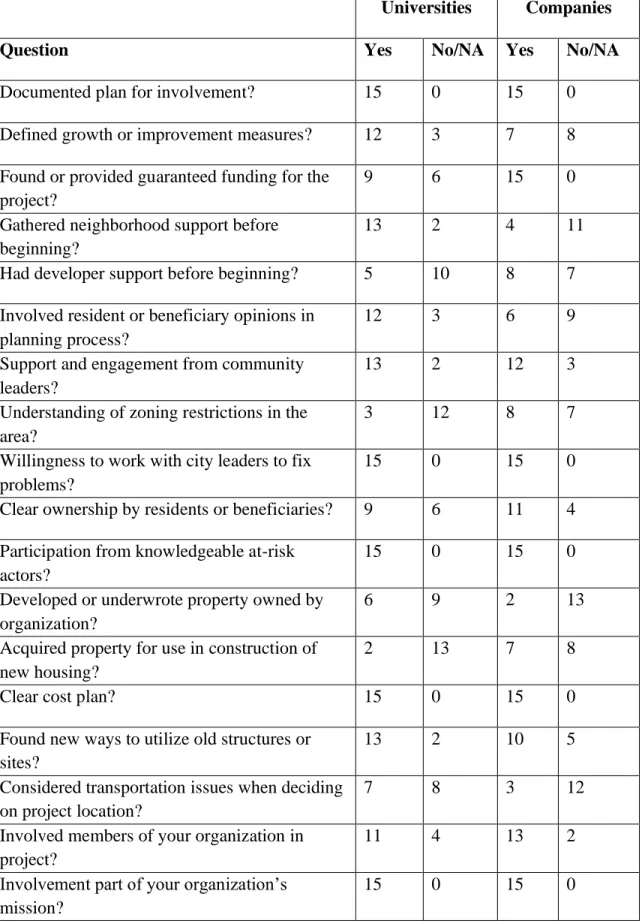
Table 2 Survey Responses
Universities Companies
Question Yes No/NA Yes No/NA
Documented plan for involvement? 15 0 15 0
Defined growth or improvement measures? 12 3 7 8 Found or provided guaranteed funding for the
project?
9 6 15 0
Gathered neighborhood support before beginning?
13 2 4 11
Had developer support before beginning? 5 10 8 7 Involved resident or beneficiary opinions in
planning process?
12 3 6 9
Support and engagement from community leaders?
13 2 12 3
Understanding of zoning restrictions in the area?
3 12 8 7
Willingness to work with city leaders to fix problems?
15 0 15 0
Clear ownership by residents or beneficiaries? 9 6 11 4 Participation from knowledgeable at-risk
actors?
15 0 15 0
Developed or underwrote property owned by organization?
6 9 2 13
Acquired property for use in construction of new housing?
2 13 7 8
Clear cost plan? 15 0 15 0
Found new ways to utilize old structures or sites?
13 2 10 5
Considered transportation issues when deciding on project location?
7 8 3 12
Heard and considered concerns from skeptical parties?
11 4 10 5
Worked in mixed income areas? 12 3 15 0
Transparent about motivation, progress, and outcome of involvement?
15 0 15 0
Clearly defined target residents or beneficiaries?
15 0 15 0
Took time to understand implications of involvement?
REFERENCES
Allen, P., Barlow, C., Hoehner, C., Schootman, M. (2012). Commuting Distance,
Cardiorespiratory Fitness, and Metabolic Risk. American Journal of Preventative Medicine, 42(6), 571-578. doi: 10.1016/j.amepre.2012.02.020
Allison, K., Harding, A. (2017). Employee Financial Wellness Survey. Retrieved from PricewaterhouseCoopers website: https://www.pwc.com/us/en/private-company-services/publications/assets/pwc-2017-employee-wellness-survey.pdf
Aurand, A., Emmanuel, D., Yentel, D., Errico, E., & Pang, M. (2018). The Gap: A Shortage of Affordable Homes. Retrieved from the National Low-Income Housing Coalition website: https://reports.nlihc.org/sites/default/files/gap/ Bank of America. (2019). Breaking New Ground: The Fight for Affordable Housing.
Retrieved from Bank of America website: https://about.bankofamerica.com/en-us/who-we-are.html
Bank of America. (2019). Community Homeownership Commitment. Retrieved from: https://www.bankofamerica.com/mortgage/affordable-housing-programs/
Bank of America. (2019). The Low-Income Housing Challenge. Retrieved from the Bank of America website: https://www.bofaml.com/en-us/content/low-income-housing-challenge.html
Bonds, J. M., Burnett, A., Sissman, E. (2018). Community Finance in East Baltimore: A Study of Phase One Redevelopment and Financing. Community Practice Papers, The Federal Reserve Bank of Richmond. Retrieved from:
https://www.richmondfed.org//media/richmondfedorg/publications/community_d evelopment/practice_papers/2018/practice_papers_2018-3.pdf
Bridge Investment Group [Bridge]. (2019). Workforce and Affordable Housing. Retrieved from: https://www.bridgeig.com/workforce-affordable-housing/ Broadwater, L. (2018). City housing officials to seek up to $100M subsidy for East
Baltimore development plan. Retrieved from Baltimore Sun website: