Giving
the
Genes
a
Shuf
fl
e:
Using
Natural
Variation
to
Understand
Host
Genetic
Contributions
to
Viral
Infections
Sarah
R.
Leist
1,*
,@and
Ralph
S.
Baric
1,2,3The laboratory mouse has proved an invaluable model to identify host factors that regulate the progression and outcome of virus-induced disease. The paradigm is to use single-gene knockouts in inbred mouse strains or genetic mapping studies using biparental mouse populations. However, genetic varia-tion among these mouse strains is limited compared with the diversity seen in human populations. To address this disconnect, a multiparental mouse popu-lation has been developed to specifically dissect the multigenetic regulation of complex disease traits. The Collaborative Cross (CC) population of recombi-nant inbred mouse strains is a well-suited systems-genetics tool to identify susceptibility alleles that control viral and microbial infection outcomes and immune responses and to test the promise of personalized medicine.
Viral Disease Is a Complex Trait
Viral infections pose a major threat to human and animal health, causing significant morbidity and mortality every year. During the past decades, the emergence of several highly pathogenic zoonotic viruses has demonstrated the fragility of the species barrier in protecting human and farm animal populations from pathogens that exist in the animal kingdom. While basic virological research offers the possibility to detect viral strains that are ‘poised’for emergence and identify mutations that might promote pathogen emergence, accurate prognoses are confounded by our inability to predict disease severity and viru-lence. Importantly, viruses with identical genome sequences do not always cause the same set of clinical manifestations in humans. Moreover, the complex interplay between envi-ronmental, viral, and host genetic factors drives differences in interindividual disease progression, severity, and outcome. These factors change over the course of a lifetime and some, like individual health status, comorbidities, and environmental factors[1,2], are difficult if not impossible to control. However, perhaps one of the most important key players in the fragile balance of microbial pathogenesis centers around host genetic susceptibility alleles that dramatically influence the course of disease in different individuals. In humans, a growing number of genetic factors like entry receptors, receptor-modifying enzymes, and innate and adaptive immune-related proteins that regulate influenza virus, norovirus, rotavirus, respiratory syncytial virus (RSV), HIV, hepatitis B and C viruses, herpes virus, and other acute and chronic virus disease outcomes have been identified (Table 1; more detailed list in[3]).
Accordingly, research on host genetics is a promising tool for understanding susceptibility and virulence patterns in human populations and refining pandemic-preparedness efforts. Further-more, the discovery of innovative prophylactic or diagnostic and therapeutic treatment options
Highlights
Viral infections are complex traits that are influenced by viral and environ-mental as well as host factors.
Complete knockouts of genes are rare in humans whereas natural variation at the nucleotide level is abundant. Thus, successful translation from mice to humans is more likely working with natural variation in mouse populations.
The Collaborative Cross is a mouse genetic reference population that is well suited to be utilized to identify net-works of host genetics key players that influence complex traits such as viral infections.
Indefinitely reproducible mouse strains with fully sequenced genomes offer the chance for wide collaborations across pathogens. Additionally, it offers the ability to identify cross-pathogen susceptibility or resistance alleles.
1
Department of Epidemiology, University of North Carolina at Chapel Hill, Chapel Hill, NC, USA
2
Department of Microbiology and Immunology, University of North Carolina at Chapel Hill, Chapel Hill, NC, USA
3
https://sph.unc.edu/adv_profi le/ralph-s-baric-phd/
@
Twitter:@Baric_Lab
Glossary
Causal gene variant:the genetic variant that influences a certain trait and explains most of the identified genotype–phenotype association. Clustered regularly interspaced short palindromic repeats (CRISPR)/CRISPR-associated protein 9 (Cas9):used to introduce mutations at specific genomic locations (higher cleavage efficiency and versatility).
Diallel:a defined set of parental strains is bred in every possible combination of mating pairs. F2 cross:parental strains are crossed to obtain an F1 (firstfilial) generation whose offspring is defined as F2 (secondfilial) generation. Forward genetics:unbiased approaches utilizing natural variation in the mouse species for which no prior knowledge of the causative gene is needed.
Geneflow:introduction of new genetic material from one population to another population, enhancing the overall genetic diversity.
Gene of major effect:causal gene of a certain trait (e.g., Mendelian traits, monogenic diseases). Genetic blind spots:genome regions with extremely low or no genetic diversity, causing difficulties in studies of natural populations and complex traits.
Genetic mapping:approach in which molecular markers are used to identify the location of one gene or the distances between genes. Genome-wide association study (GWAS):study that seeks tofind significant correlations between genetic variants and particular traits. Mouse genetic reference populations:a collection of mice withfixed and known genetic architecture.
Natural variation:random DNA mutations that are caused by mistakes during replication. Quantitative trait locus (QTL): chromosomal region (locus) of variable size that is associated with a certain phenotype (quantitative trait). Recombination breakpoint: Genomic locations where chromosomes break before they reattach.
Reverse genetics:comprises techniques of for the introduction of wanted mutations into the mouse
Table 1. Genes with Significant Associations with Viral Disease in Humans
Pathogen Phenotype Causal gene Refs
Dengue virus (DENV) DENV shock syndrome MICB,PLCE1 [73]
Epstein–Barr virus (EBV) EBNA-1 IgG titer HLA-DRB1,HLA-DQB1 [74]
Hepatitis B virus (HBV) Chronic infection HLA-DPA1,HLA-DPB1 [75]
Persistence INST10 [76]
Hepatitis C virus (HCV) Spontaneous clearance IL28B [77]
Development of hepatocellular carcinoma TLL1 [78]
Progression to hepatocellular carcinoma DEPDC5 [79]
HIV-1 Viral load HLA-B,HLA-C [80]
Viral load control HCP5 [81]
Influenza A virus (IAV) Reduced restriction of viral replication IFITM3 [82]
Increased incidence and increased risk of viral pneumonia
TNF [83]
Norwalk virus (NoV) Resistance FUT2 [84]
Respiratory syncytial virus (RSV) Bronchiolitis SFPA/D [85,86]
West Nile virus (WNV) Resistance CCR5 [87]
forviraldiseasethatcanbeleveragedacrossdifferenthostgeneticsusceptibilitypatternscan leadtoimprovedpersonalizedmedicine.
Inthisreviewwediscusshistoricandnewplatformstrategiesdesignedtounraveltheinterplay between the complex host and viral genetic determinants that regulate disease severity. Moreover,we discussrecent developments in the field of complex genetics designed to resolvequantitative traitloci (QTLs)(see Glossary) andrapidly identifysinglecandidate genesandallelesthatregulatemicrobialpathogenesis.
TheLaboratory Mousein ViralDiseaseResearch
genome. For this hypothesis-driven approach, prior knowledge about the gene of interest is essential. Signature gene:a gene or a set of genes that occurs as a result of a specific biological process. Transcription activator-like effector nucleases (TALENs): Transcription activator-like effector nucleases are used to introduce mutations at specific genomic locations (higher precision). Genetic Manipulation of the Mouse Genome
Using the mouse as a model organism offers two distinct types of genetic approaches:reverse and forward genetic studies. The most commonly used application in reverse genetic approaches involves the specific ablation of a single gene, either by deleting parts of or the entire gene or by replacing coding exons. Gene trapping by comparison offers the possibility to insert reporter genes into the gene of interest, disrupting its function. Both techniques require the DNA construct of choice to be transfected into mouse embryonic stem cells (mESCs), injection of screened mESC clones into a blastocyst, and transfer of this blastocyst into the uterus of the host animal. Most recently, innovative techniques liketranscription activator-like effector nucleases (TALENs)[5]andclustered regularly interspaced short palin-dromic repeats (CRISPR)/CRISPR-associated protein 9 (Cas9)[6]are accelerating the process of targeted genome editing, including the introduction of susceptibility alleles that improve virus replication and pathogenesis in the mouse[7].
Genetically engineered mouse strains have represented the gold standard to investigate the role of specific host genes in regulating disease and immune outcomes following virus infections (e.g.[8,9]). Furthermore, genetically modified strains can be used[10]to understand human monogenic diseases like cystic fibrosis, polycystic kidney disease, and sickle cell disease. Although complete (biallelic) knockout of genes in humans is a relatively rare event, a recent study showed that healthy people have about 100 loss-of-function variants and 20 completely inactivated genes[11]. Consequently, the majority of human diseases are complex traits whose disease outcomes are influenced by multiple genetic factors.
Human genomes are characterized by extensive natural variation, which has accumulated over time through, for example, mutation events (external damage to DNA or internal errors during replication), gene flow, and sexual reproduction, which drives phenotypic interindividual differences across populations. Differences in DNA sequence can modify transcript and protein levels by altering their functional properties, timing, level, and site of expression[12]. Natural variation can be used in forward genetic studies to identify novel genes involved in a variety of quantitative traits and diseases[13].
The occurrence of spontaneous mutations in laboratory mouse strains was thefirst platform employed for forward genetic approaches[14]. There are various methods to increase the likelihood of mutations by treating male mice with mutagens such asN-ethyl-N-nitrosourea (ENU)[15]or chlorambucil[16,17], by irradiation[18,19], and by utilizing transposons such as the sleeping beauty[20]or piggyback[21]system, named according to their transposases, to insert specific DNA sequences. Breeding of those mutated mice allows selection of those with an altered phenotype in the trait of interest. This approach mimics natural genetic variation in humans in the controlled setting of the mouse model and has the power to reveal genomic variation and networks of genes influencing a phenotype rather than analyzing the effect of the absence of a single-gene product, making the translation from mouse to human more likely.
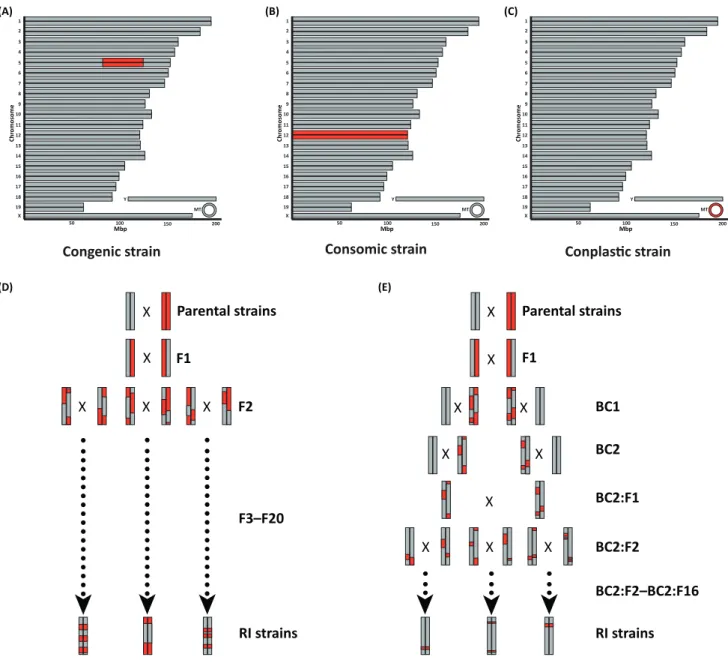
Consomic strain
Conplas
Ɵ
c strain
Congenic strain
Recombinant inbred strains
Recombinant congenic strains
50 100 150 200 1
2 3 4 5 6 7 8 9 10 11 12 13 14 15 16 17 18 19 X
Y
MT
Chr
omosome
Mbp 50 100 150 200
1 2 3 4 5 6 7 8 9 10 11 12 13 14 15 16 17 18 19 X
Y
MT
Chr
omosome
Mbp 50 100 150 200
1 2 3 4 5 6 7 8 9 10 11 12 13 14 15 16 17 18 19 X
Y
MT
Chr
omosome
Mbp
F1
F2
F3–F20
BC2:F2–BC2:F16
RI strains
RI strains
Parental strains
F1
BC1
BC2
BC2:F1
Parental strains
X
X
X
X
X
X
X
X
X
X
X
X
BC2:F2
X
X
X
(A)
(D) (E)
(B) (C)
The alternative to dealing with large chromosomal regions and the narrowing process is to use mouse genetic reference populations (GRPs). RI stains of mice are popular due to their long-term genetic stability, which helps in integrating data collected in different settings and reproducibility over a long time. The most extensively used mouse GRP is the BXD family of recombinant inbred strains. They are derived from a cross between C57BL/6J and DBA/2J mice [24]. To obtain an F1 generation, C57BL/6J and DBA/2J mice were crossed. The resulting F1 generation is mated to achieve the F2 generation, which is subsequently brother– sister mated for at least 20 generations to generate inbred mouse strains with afixed genetic architecture. Completely inbred strains are then called BXD strains, which are genotyped once (one animal per line, not every individual) and can be phenotyped indefinitely for every trait of interest. Currently, there are 156 BXD strains available[25]. For decades, recombinant inbred strains such as the BXD family have been used extensively as tools for genetic mapping of Mendelian and quantitative traits. To identify single genes that are responsible for the observed phenotype fine mapping, sequence analysis, expression profiling, and functional studies are typically performed[26]. However, the identification ofcausal gene variantsremains challenging due to the large size and the number of genes under the identified QTL region, coupled with the fact that the parental strains were identical by descent resulting in so-called‘blind spots’for genetic mapping. Wild-derived strains other thanMus musculus domesticus need to be employed to cover those spots and increase genetic variation[23]. Various resources have been established to address this issue, among them the heterogeneous stock (HS), which is derived from eight founder strains (A/J, AKR/J, BALBc/J, CBA/J, C3H/HeJ, C57BL/6J, DBA/2J, and LP/J) and maintained through random mating. No inbred mouse lines are created and therefore each mouse exhibits a unique combination of alleles with the goal of containing random variation similar to the human population[27]. The caveat of this mouse population is that every individual mouse needs to be genotyped, which might be too expensive for some researchers. However, genotyping technologies are evolving constantly and costs are decreasing rapidly.
The Collaborative Cross
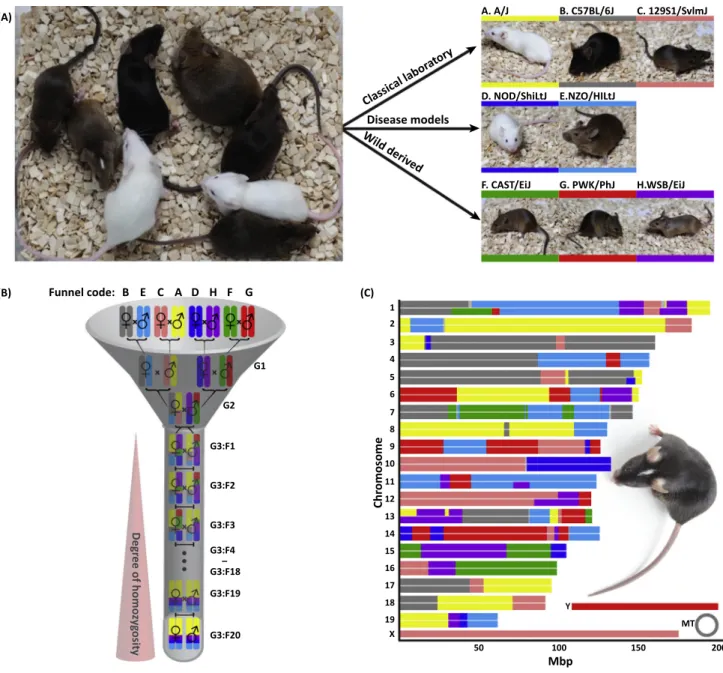
Another mouse GRP that includes otherM. musculussubspecies is the CC Mouse Resource (Figure 2), which has already been used to successfully identify highly promising candidate genes that are influencing susceptibility or resistance to viral infections (Table 2).
(A)
(B) Funnel code: B E C A D H F G (C)
G1
G2
G3:F1
G3:F2
G3:F3
G3:F4 G3:F18
G3:F19
G3:F20 –
Degr
ee of homo
zy
gosity
Mbp
Chr
omosome
Classic al labor
atory
Disease models
Wild deriv ed
A. A/J B. C57BL/6J C. 129S1/SvlmJ
D. NOD/ShiLtJ E.NZO/HILtJ
F. CAST/EiJ G. PWK/PhJ H.WSB/EiJ
1 2 3 4 5 6 7 8 9 10 11 12 13 14 15 16 17 18 19 X
50
Y
100 150 200
MT
Figure 2. Generation of the Collaborative Cross Resource.(A) The Collaborative Cross panel of recombinant inbred mouse strains is a multiparental population that is derived from eight founder strains. Among these founder strains are classical laboratory mouse strains (A/J, C57BL/B6, 129S1/SvImJ), mouse models for human diseases (NOD/ShiLtJ–type 1 diabetes, NZO/HlLtJ–obesity), and wild-derived mouse strains (CAST/EiJ, PWK/PhJ, WSB/EiJ). Every mouse strain was assigned a letter (A–H) and a particular color that are used by the entire research community. (B) Breeding-funnel design of the Collaborative Cross that guarantees equal distribution of founder alleles to the resulting CC strain. Depicted is the specific breeding funnel for chromosome 19 of the CC strain CC001. (C) Genome architecture of CC001 with founder contributions displayed in their respective colors. Photograph: Klaus Schughart.
three different locations: Oak Ridge National Laboratory in Oak Ridge, TN, which moved to the University of North Carolina at Chapel Hill[29]; the International Livestock Research Institute in Nairobi, Kenya, which moved to the Tel Aviv University in Tel Aviv, Israel[30]; and the Western Australian Institute for Medical Research/Geniad Ltd in Perth, Australia [31]. Although the theoretical plan was perfectly elaborated, hundreds of CC strains became extinct, almost half from problems in male infertility[32].
Prior to the development of thefinal CC resource, incipient CC lines that were not fully inbred yet (pre-CC lines) were used in genetic mapping studies to provide proof of concept and to show the potential of this newly designed GRP (Box 1). Candidate genes for various phenotypes, such as susceptibility to Aspergillus fumigatus infections [33], energy balance traits [34], differences in hematological parameters [35], susceptibility to Klebsiella pneumoniae [36], and neutrophilic inflammation due to house dust mite-induced asthma[37], were successfully identified. Moreover, mapping efforts revealed expression QTLs for extreme host responses to influenza A virus (IAV) infections [38], host response QTLs to IAV [39], and severe acute respiratory syndrome coronavirus (SARS-CoV) pathogenesis[40]. A common observation in all of the studies was that pre-CC lines exhibit an enhanced phenotypic range compared with the variation observed in the eight founder strains or other classical inbred strains and that it was possible to dissect traits that were thought to be inseparably entwined.
Highlighting another powerful characteristic of the CC, completely new mouse models for spontaneous colitis [41], Ebola-associated hemorrhagic fever [42], novel neurological Table 2. QTLs of CC Studies Using Different Viruses
Pathogen Phenotype QTL region % Variation Number of genes under QTL Refs
SARS-CoV Vascular cuffing HrS1: Chr. 3: 18286790–26668414 26% 26 [narrowed to one (Trim55)] [40]
Viral titer HrS2: Chr. 16: 31583769–36719997 22% 92 (narrowed to 48)
Eosinophil infiltration HrS3: Chr. 15: 72103120–75803414 26% 63 (narrowed to 25–functional change only in Bai1)
Vascular cuffing HrS4: Chr. 13: 52822984–54946286 21% 30 (narrowed to nine–Cdhr2) D3% weight HrS5: Chr. 18: 27108062–58694005 6.6% 158 [narrowed to one (Ticam2)] [61]
D4% weight HrS5: Chr. 18: 27108062–58694005 8.5% Log titer HrS5: Chr. 18: 27108062–58694005 12.9% Hemorrhage HrS5: Chr. 18: 24762824–7829634 6%
D3% weight HrS6: Chr. 9: 116476207–telomere 7% –
Log titer HrS7: Chr. 7: 55169841–11722358 12.3% –
Log titer HrS8: Chr. 12: 81649471–108529109 5.4% –
Hemorrhage HrS9: Chr. 15: centromere–64.430001 9.1% –
WNV Frequency of CD73+Tregs HI1: Chr. X: 166 Mb–telomere – 43 (narrowed to 22) [88]
Decreased frequency of CXCR3+
Tregs, CXCR3+
CD4+
, and CD8+
T cells
HI2: Chr. X: 100–106 Mb – 42 (narrowed to 26) Increased frequency of ICOS+
Tregs in spleen HI3: Chr. X: 140–145 Mb – 18 (narrowed to 11) IAV D4 weight, log titer, IHC score, D3 clinical,
airway inflammation, airway damage
HrI1: Chr. 16: 97.5 Mb–98.2 Mb 41.67% Ten (includingMx1) [39]
Box 1.Ticam2Plays a Major Role in SARS-CoV Pathogenesis
As an expansion to theirfirst paper identifying QTLs for SARS pathogenesis in pre-CC mice, the authors utilized an alternative genetic approach to understand host genetic contributions to the course and outcome of SARS-CoV infection[61]. Two pre-CC lines with divergent outcome after SARS-CoV infection were identified. CC003/Unc is resistant to SARS-CoV whereas CC053/Unc is highly susceptible. To dissect host genetic factors that lead to the different outcomes, these two strains were bred and 264 F2 animals generated. Loss of body weight, viral titer in lungs, pulmonary hemorrhage, and histopathological changes were analyzed at multiple time points after infection. Overall, F2 mice exhibited a broader phenotypic range than the parental strains. Five significant QTLs across all analyzed phenotypes were identified, one of which affected multiple SARS-CoV response phenotypes. This QTL (HrS5) on chromosome 18 (27.1–58.6 Mb) was selected for follow-up studies. Integration of different bioinformatics and database approaches led to the identification ofTicam2as a highly promising candidate gene.Ticam2is a toll-like receptor (TLR) adapter protein that had not been shown to play an important role in SARS-CoV pathogenesis. Utilizing another tool from the geneticist’s toolbox,Ticam2knockout mice (Ticam2 /
) were employed to investigate its effect on disease progression and outcome.Ticam2 /
mice exhibited significantly more weight loss, similar viral load in lungs on day 4 after infection (however, significantly higher titers on day 2 after infection were reported previously[8]), and similar histopathologicalfindings but significantly increased pulmonary hemorrhage on day 4 after infection. Thus, the authors successfully showed that a screening approach in CC mice in combination with an F2 follow-up study can lead to single candidate genes that can be confirmed using reverse genetic tools. It remains to be determined whether allele swaps can be used to identify the allele driving this disease phenotype.
responsesto Theiler’smurine encephalomyelitisvirus(TMEV)[43],andpersistentWestNile virus(WNV)infectioninthebrain[44]werediscovered,aharbingerofnewmodelsystemsthat mayemergeovertime.
TheDiversityOutbred(DO)populationofmiceisaGRPcomplementarytotheCCderivedfrom thesamesetoffounderstrains.Insteadofinbreeding,anoutbredpopulationismaintained throughrandommating, whichenhances themapping resolutioneven further throughthe acquisitionofevenmorerecombinationsites[45].EarlystudiesutilizingDOmiceledtothe identificationofaspecificisoformofApobec1contributiontoatherosclerosis[46]and sulfo-transferasesascandidategenesforbenzene-inducedgenotoxicity[47].
Designed specifically for the analysis of complex traits, the CC and DO populations of geneticallyhighlydiversemiceprovidethe firsttruesystems-geneticplatformforcumulative andintegrateddatacollection[48].Systemsgenetics,asaninnovativestrategytoinvestigate theroleofhostgeneticsthatencompassesdiversemolecularomicsdata[49],alsocatalyzed the development of a variety of analytic and informatics tools and methods [50–53] and provides state-of-the-art tools for genetic mapping and candidate geneidentification and anopportunitytotestthepromiseofpredictivegenomicmedicine.
FromComplexScreens toCandidateGenes: ARecipeforComplexGenetic Studies
the CC resource, and ways to narrow down QTLs to pinpoint single candidate genes influencing the trait of interest (reviewed in[54]) (Figure 3).
The classic CC hypothesis is that ‘my disease phenotype’ is a complex oligogenic trait regulated by multiple genetic polymorphisms in different genes, which interact to regulate disease outcomes in natural populations. In a second step, the breadth and duration of disease-associated phenotypes is selected and measured in a subset of mouse strains, which typically is either a random selection of CC strains or the eight CC founder strains (RSV–Buntzman 2016, IAV [55]). Analyses of phenotypic baselines are crucial to be able to distinguish between phenotypes that are caused by differences in genome architecture or those that are related to viral pathogen-esis. Additionally, multiple sample collection is advised to maximize phenotypic comparisons across thefinal population. This is important as it is impossible to predict phenotypic outcome as different gene variants segregate in thefinal population and traits that are closely linked might be broken apart. Another important factor that might complicate experimental design is the impact of knowngenes of major effect, likeMx1for IAV[39]orOas1bforflaviviruses[56]. Selection of CC strains that carry a variation at that locus or even a null allele might help to uncover rather small effects by other modulating genes. Utilizing up to eight different alleles at any given locus in the genome allows the discovery of gene of major effect-dependent and -independent processes (IAV [55], WNV [57]). There is a risk that genetic mapping might exclusively identify the gene of major effect if no attention is paid to these genes while selecting CC strains for the respective study. Genetic mapping offers the possibility to add covariates like batch effects to the calculation and randomization should be achieved whenever possible. Sample collection should anticipate that the CC model is likely to identify CC strains that progress to different stages in disease severity, replicating phenotypes seen in human populations and allowing the identification of susceptibility alleles that regulate disease progression from mild to severe to chronic infectionsin vivo. This is important as it has been shown that novel disease phenotypes might be discovered in the CC (severe neuroinvasive disease and chronic WNV infection [44]). New models for diseases that are completely unrelated (spontaneous colitis[41], human leukocyte adhesion and recruitment deficiencies [55]) or related to the study design (SARS-CoV[40], Ebola[42]) will generate a panel of variable disease-state mouse models that capture the different phases of disease seen in human populations.
Hypothesis
Phenotypic range Phenotypic baseline Gene of major effect
Screening Phenotype determina on
Phenotypes Allele effects Effect size Locus size Importance and number of genes
QTL(s)
Null allele/missense Conserved mo f eQTL regulatory varia on Human cohorts Known func on
Candidate gene(s)
Pre-mapping
Mapping
Post-mapping
Afterallphenotypemeasurementsareobtained,geneticmappingisutilizedtocalculatethe likelihoodofeverypositioninthegenomebeingassociatedwiththeanalyzedphenotype,and regionswiththehighestlogarithmoftheodds(LOD)scoreareidentifiedasQTLs.Zoominginto theQTLregion,bioinformaticstoolscanbeemployedtogenerateallele-effectplots,which showthecontributionofeachoftheeightpossibleallelestotheQTL.Analysesofalleleeffects are a good way to determine which parentalalleles are driving high and low responses. Afterwards, variationsthat are unique to the identified strain can be analyzedutilizing the SangerSNPbrowseri.Additionally,otherresources,likeBioGPSiiorthegenebrowserincluded inPubmediii,areofgreatusetogaininformationonknownexpressionpatternsandbiological functions.Inthelineofasystems-geneticsapproach,transcriptionalanalysescanbeusedto identifydifferentiallyexpressedgenesorrespectivepathwaysinfluencedbyaparticularQTL (WNV[58]).However,thesedownstreamanalysesshouldonlybeperformedonasubsetof extremephenotypesamples,as thisapproachishighly informativeandinexpensive. Using differentpathogensforthe sametypeofanalysiscan leadtothe discoveryofcommonor uniquefeaturesacrossdifferentviralspecies(IAVandSARS-CoV[59]).Additionaltoolsofthe complexgenetictoolkitsuchasdiallelsoftheCCfoundersandtheirreciprocalF1hybrids allowtheidentificationofdifferenttypesofheritableeffects(IAV[60]).Alternatively,onceahighly promisingcandidate geneis identified the use of knockout mouse strains to validate the contribution of this particular gene to the observed phenotype can be used (SARS-CoV [40,61]).TheInternationalKnockoutMouseConsortium(IKMC)willsoonachieveitsgoalof havingamousemutantoratargetedmESCforeverygene(http://www.mousephenotype.org), providing a crucial resource for functional annotation and validation of candidate genes. Importantly,ithasbeenshownthatthegeneticbackgroundonwhichtheknockoutiscreated playsanimportant role[62,63]and withrecent advancesofCRISPR/Cas9technologythe developmentoftheidenticalknockoutondifferentmousebackgroundsmaybeachievableina time-andcost-efficientmanner.Additionally,CRISPR/Cas9-generatedalleleswapsbetween mouse strains offer enhanced specificity, applicability, and translatability compared with completeknockoutofgenes.Translationalaspectscanbeaddressedbycomparing identi-fied SNPs with human SNP and gene databases or conserved structural elements and functionalmotifsiv,v,vi
.
ConcludingRemarksandFutureDirections
Thecontributionofhostgeneticfactorstotheprogressionandoutcomeofviralinfectionshas notonly been proved but represents a powerfulnew tool to reveal the complex interplay betweennovelgenesandtheirpolymorphismsanddiseaseseverity.Althoughcriticalvoices wereraisedinthescientificcommunity[64]aswellasinthemedia,ithasbeenshownthatdata collectedduring viral infectionsinmiceandinhumans are highlycorrelated.For example, comparingsignaturegenesderivedfromtranscriptomeanalysesofIAV-infectedCCfounder strains,butnotclassicinbredmousestrains,withinfectedhumanvolunteersrevealedthatgene expressioninthebloodofinfectedCCmicereproducesmuchmorerepresentative human signatureprofiles[65].
how to enhance the transparency of human GWASs [Strengthening the Reporting of Genetic Association Studies (STREGA)] have been published[69].
However, although human genetic factors influencing infectious disease susceptibility and outcome have been identified, significant difficulties remain in the verification of these factors in humans, mostly due to small effect sizes. Moreover, there are phenotypic traits, especially in the infectious disease context, that are difficult or even impossible to investigate in humans. The only way to unravel the effect of alleles associated with diseases that influence a specific molecular process is to investigate those alleles in controlled experimental settings either individually or in combination[12]. The mouse as the model organism of choice is currently the only mammalian systematic platform that offers not only the resources but also the technology to identify susceptibility and resistance loci for viral infections.
The CC population recombinant inbred mouse panel represents a paradigm shift for microbial pathogenesis studies, immunology, and studies of the role of complex genetic traits in disease. It offers increased mapping resolution compared with classical mouse GRPs and has already been successfully used in thefield of infectious diseases, suggesting that an even greater impact exists for thefield of immunology[70]. Systems-biology approaches in which a plethora of genetic and genomic (omics) data for the identical experimental condition is collected allows integration of data and offers the possibility of complex modeling and, ultimately, the identification of key factors driving differences in disease progression and outcome[71]. Being a relatively young and novel platform for systems genetics, the CC and its complementary resources have accelerated not only the identification of QTLs from a wide range of phenotypes but also pushed the development of genotyping and databases as well as bioinformatics tools[72]. We would like to highlight that the more that incipient lines of the CC are used in differentfields to explore different phenotypes and answer different question, the more valuable the resource itself becomes (see Outstanding Questions). Data generated by laboratories from differentfields might be of use for others, shortening their way to obtain results and saving money along the way. In summary, GWASs in mice can help to derive working hypotheses and direct human studies and, accordingly, studies in the two species are highly complementary.
Resources
i
www.sanger.ac.uk/sanger/Mouse_SnpViewer/rel-1303
ii
http://biogps.org/#goto=welcome
iii
www.ncbi.nlm.nih.gov/gene/
iv
www.ncbi.nlm.nih.gov/
v
www.rcsb.org/
vi
www.omim.org/
vii
www.ebi.ac.uk/gwas/(see catalog)
Supplemental Information
Supplemental information associated with this article can be found online athttps://doi.org/10.1016/j.tig.2018.07.005.
References
1. Gautret, P.et al.(2014) Emerging viral respiratory tract infections –environmental risk factors and transmission.Lancet Infect. Dis.
14, 1113–1122
2. Weiss, R.A. and McMichael, A.J. (2004) Social and environmental risk factors in the emergence of infectious diseases.Nat. Med.10 (12 Suppl), S70–S76
3. Kenney, A.D.et al.(2017) Human genetic determinants of viral diseases.Annu. Rev. Genet.51, 241–263
4. Choi, W.S.et al.(2017) The significance of avian influenza virus mouse-adaptation and its application in characterizing the efficacy of new vaccines and therapeutic agents.Clin. Exp. Vaccine Res.6, 83–94
5. Sommer, D.et al.(2015) TALEN-mediated genome engineering to generate targeted mice.Chromosome Res.23, 43–55
6. Harms, D.W.et al.(2014) Mouse genome editing using the CRISPR/ Cas system.Curr. Protoc. Hum. Genet.83, 15.7.1–15.7.27
Outstanding Questions Is direct translation of identified causal genes into humans possible or will it rather be a molecular pathway that is identified in mice to which the homolog in humans needs to be found?
Will it be possible to find treatment options that will have a major effect on disease progression and outcome in humans for a complex network of causal gene variants?
Can interdisciplinary approaches lead to interdisciplinary candidate genes?
Will technology development catch up with the speed and amount of data collection and revealfindings that are already present but not accessible now?
7. Cockrell, A.S.et al.(2016) A mouse model for MERS coronavirus-induced acute respiratory distress syndrome.Nat. Microbiol.2, 16226
8. Totura, A.L.et al.(2015) Toll-like receptor 3 signaling via TRIF contributes to a protective innate immune response to severe acute respiratory syndrome coronavirus infection. MBio 6, e00638-15
9. Schoggins, J.W.et al.(2014) Pan-viral specificity of IFN-induced genes reveals new roles for cGAS in innate immunity.Nature505, 691–695
10.Majzoub, J.A. and Muglia, L.J. (1996) Knockout mice.N. Engl. J. Med.334, 904–907
11.MacArthur, D.G.et al.(2012) A systematic survey of loss-of-function variants in human protein-coding genes.Science335, 823–828
12.Justice, M.J.et al.(2011) Technical approaches for mouse mod-els of human disease.Dis. Models Mech.4, 305–310
13.Hunter, K.W. and Crawford, N.P. (2008) The future of mouse QTL mapping to diagnose disease in mice in the age of whole-genome association studies.Annu. Rev. Genet.42, 131–141 14.Davisson, M.T.et al.(2012) Discovery genetics–the history and
future of spontaneous mutation research.Curr. Protoc. Mouse Biol.2, 103–118
15.Russell, W.L.et al.(1979) Specific-locus test shows ethylnitro-sourea to be the most potent mutagen in the mouse.Proc. Natl. Acad. Sci. U. S. A.76, 5818–5819
16.Russell, L.B.et al.(1989) Chlorambucil effectively induces dele-tion mutadele-tions in mouse germ cells.Proc. Natl. Acad. Sci. U. S. A.
86, 3704–3708
17.Flaherty, L.et al.(1992) Chlorambucil-induced mutations in mice recovered in homozygotes.Proc. Natl. Acad. Sci. U. S. A.89, 2859–2863
18.Russell, W.L. (1951) X-ray-induced mutations in mice.Cold Spring Harb. Symp. Quant. Biol.16, 327–336
19.Russell, L.B. and Russell, W.L. (1954) An analysis of the changing radiation response of the developing mouse embryo.J. Cell. Physiol. Suppl.43 (Suppl. 1), 103–149
20.Takeda, J.et al.(2007) Germline mutagenesis mediated by
Sleeping Beautytransposon system in mice.Genome Biol.8 (Suppl. 1), S14
21.Li, L.et al.(2016) PiggyBac transposon-based polyadenylation-signal trap for genome-wide mutagenesis in mice.Sci. Rep.6, 27788
22.Abiola, O. et al.(2003) The nature and identification of quantitative trait loci: a community’s view.Nat. Rev. Genet.
4, 911–916
23.Roberts, A.et al.(2007) The polymorphism architecture of mouse genetic resources elucidated using genome-wide resequencing data: implications for QTL discovery and systems genetics.
Mamm. Genome18, 473–481
24.Peirce, J.L.et al.(2004) A new set of BXD recombinant inbred lines from advanced intercross populations in mice.BMC Genet.
5, 7
25.Williams, R.W. and Williams, E.G. (2017) Resources for systems genetics.Methods Mol. Biol.1488, 3–29
26.Ermann, J. and Glimcher, L.H. (2012) After GWAS: mice to the rescue?Curr. Opin. Immunol.24, 564–570
27.Valdar, W.et al.(2006) Genome-wide genetic association of complex traits in heterogeneous stock mice.Nat. Genet.38, 879–887
28.Threadgill, D.W.et al.(2002) Genetic dissection of complex and quantitative traits: from fantasy to reality via a community effort.
Mamm. Genome13, 175–178
29.Chesler, E.J.et al.(2008) The Collaborative Cross at Oak Ridge National Laboratory: developing a powerful resource for systems genetics.Mamm. Genome19, 382–389
30.Iraqi, F.A.et al.(2008) The Collaborative Cross, developing a resource for mammalian systems genetics: a status report of the Wellcome Trust cohort.Mamm. Genome19, 379–381
31.Morahan, G.et al.(2008) Establishment of“The Gene Mine”: a resource for rapid identification of complex trait genes.Mamm. Genome19, 390–393
32.Shorter, J.R.et al.(2017) Male infertility is responsible for nearly half of the extinction observed in the mouse Collaborative Cross.
Genetics206, 557–572
33.Durrant, C.et al.(2011) Collaborative Cross mice and their power to map host susceptibility toAspergillus fumigatusinfection.
Genome Res.21, 1239–1248
34.Mathes, W.F.et al.(2011) Architecture of energy balance traits in emerging lines of the Collaborative Cross.Am. J. Physiol. Endo-crinol. Metab.300, e1124–e1134
35.Kelada, S.N.et al.(2012) Genetic analysis of hematological parameters in incipient lines of the Collaborative Cross.G3 (Bethesda)2, 157–165
36.Vered, K.et al.(2014) Susceptibility toKlebsiella pneumonaie
infection in Collaborative Cross mice is a complex trait controlled by at least three loci acting at different time points.BMC Geno-mics15, 865
37.Rutledge, H.et al.(2014) Genetic regulation of Zfp30, CXCL1, and neutrophilic inflammation in murine lung. Genetics198, 735–745
38.Bottomly, D.et al.(2012) Expression quantitative trait loci for extreme host response to influenza A in pre-Collaborative Cross mice.G3 (Bethesda)2, 213–221
39.Ferris, M.T.et al.(2013) Modeling host genetic regulation of influenza pathogenesis in the Collaborative Cross.PLoS Pathog.
9, e1003196
40.Gralinski, L.E.et al.(2015) Genome wide identification of SARS-CoV susceptibility loci using the Collaborative Cross.PLoS Genet.11, e1005504
41.Rogala, A.R.et al.(2014) The Collaborative Cross as a resource for modeling human disease: CC011/Unc, a new mouse model for spontaneous colitis.Mamm. Genome25, 95–108
42.Rasmussen, A.L.et al.(2014) Host genetic diversity enables Ebola hemorrhagic fever pathogenesis and resistance.Science
346, 987–991
43.Brinkmeyer-Langford, C.L.et al.(2017) Host genetic background influences diverse neurological responses to viral infection in mice.Sci. Rep.7, 12194
44.Graham, J.B.et al.(2016) A mouse model of chronic West Nile virus disease.PLoS Pathog.12, e1005996
45.Svenson, K.L.et al.(2012) High-resolution genetic mapping using the mouse Diversity Outbred population.Genetics190, 437–447
46.Smallwood, T.L.et al.(2014) High-resolution genetic mapping in the Diversity Outbred mouse population identifies Apobec1 as a candidate gene for atherosclerosis.G3 (Bethesda)4, 2353–2363
47.French, J.E.et al.(2015) Diversity Outbred mice identify popula-tion-based exposure thresholds and genetic factors that influence benzene-induced genotoxicity. Environ. Health Perspect.123, 237–245
48.Churchill, G.A.et al.(2004) The Collaborative Cross, a community resource for the genetic analysis of complex traits.Nat. Genet.
36, 1133–1137
49.Kollmus, H.et al.(2014) Systems biology and systems genetics– novel innovative approaches to study host-pathogen interactions during influenza infection.Curr. Opin. Virol.6, 47–54
50.Mott, R.et al.(2000) A method forfine mapping quantitative trait loci in outbred animal stocks.Proc. Natl. Acad. Sci. U. S. A.97, 12649–12654
51.Morgan, A.P. and Welsh, C.E. (2015) Informatics resources for the Collaborative Cross and related mouse populations.Mamm. Genome26, 521–539
52.Gatti, D.M.et al.(2014) Quantitative trait locus mapping methods for Diversity Outbred mice.G3 (Bethesda)4, 1623–1633
54.Maurizio, P.L. and Ferris, M.T. (2017) The Collaborative Cross resource for systems genetics research of infectious diseases.
Methods Mol. Biol.1488, 579–596
55.Leist, S.R.et al.(2016) Influenza H3N2 infection of the collabora-tive cross founder strains reveals highly divergent host responses and identifies a unique phenotype in CAST/EiJ mice.BMC Geno-mics17, 143
56.Graham, J.B.et al.(2015) Genetic diversity in the collaborative cross model recapitulates human West Nile virus disease out-comes.MBio6, e00493–e00515
57.Green, R.et al.(2017) Oas1b-dependent immune transcriptional profiles of West Nile virus infection in the Collaborative Cross.G3 (Bethesda)7, 1665–1682
58.Green, R.et al.(2016) Identifying protective host gene expression signatures within the spleen during West Nile virus infection in the Collaborative Cross model.Genom. Data10, 114–117
59.Josset, L.et al.(2014) Annotation of long non-coding RNAs expressed in Collaborative Cross founder mice in response to respiratory virus infection reveals a new class of interferon-stimu-lated transcripts.RNA Biol.11, 875–890
60.Maurizio, P.L.et al. (2017) Bayesian diallel analysis reveals Mx1-dependent and Mx1-independent effects on response to influenza A virus in mice.G3 (Bethesda)8, 427–445
61.Gralinski, L.E.et al.(2017) Allelic variation in the Toll-like receptor adaptor protein Ticam2 contributes to SARS-coronavirus patho-genesis in mice.G3 (Bethesda)7, 1653–1663
62.Threadgill, D.W.et al.(1995) Targeted disruption of mouse EGF receptor: effect of genetic background on mutant phenotype.
Science269, 230–234
63.Sittig, L.J.et al.(2016) Genetic background limits generalizability of genotype-phenotype relationships.Neuron91, 1253–1259
64.Seok, J.et al.(2013) Genomic responses in mouse models poorly mimic human inflammatory diseases.Proc. Natl. Acad. Sci. U. S. A.110, 3507–3512
65.Elbahesh, H. and Schughart, K. (2016) Genetically diverse CC-founder mouse strains replicate the human influenza gene expression signature.Sci. Rep.6, 26437
66.Gusareva, E.S. and Van Steen, K. (2014) Practical aspects of genome-wide association interaction analysis.Hum. Genet.133, 1343–1358
67.Cantor, R.M.et al.(2010) Prioritizing GWAS results: a review of statistical methods and recommendations for their application.
Am. J. Hum. Genet.86, 6–22
68.Hayes, B. (2013) Overview of statistical methods for genome-wide association studies (GWAS).Methods Mol. Biol.1019, 149– 169
69.Little, J.et al.(2009) STrengthening the REporting of Genetic Association studies (STREGA)–an extension of the STROBE statement.Eur. J. Clin. Invest.39, 247–266
70.Phillippi, J.et al.(2014) Using the emerging Collaborative Cross to probe the immune system.Genes Immun.15, 38–46
71.Bjorkegren, J.L.M.et al.(2015) Genome-wide significant loci: how important are they? Systems genetics to understand heritability of
coronary artery disease and other common complex disorders.
J. Am. Coll. Cardiol.65, 830–845
72.Srivastava, A.et al.(2017) Genomes of the mouse Collaborative Cross.Genetics206, 537–556
73.Khor, C.C.et al.(2011) Genome-wide association study identifies susceptibility loci for dengue shock syndrome at MICB and PLCE1.Nat. Genet.43, 1139–1141
74.Rubicz, R.et al.(2013) A genome-wide integrative genomic study localizes genetic factors influencing antibodies against Epstein–Barr virus nuclear antigen 1 (EBNA-1).PLoS Genet.
9, e1003147
75.Kamatani, Y.et al.(2009) A genome-wide association study identifies variants in the HLA-DP locus associated with chronic hepatitis B in Asians.Nat. Genet.41, 591–595
76.Li, Y.et al.(2016) Genome-wide association study identifies 8p21.3 associated with persistent hepatitis B virus infection among Chinese.Nat. Commun.7, 11664
77.Rauch, A.et al.(2010) Genetic variation in IL28B is associated with chronic hepatitis C and treatment failure: a genome-wide associa-tion study.Gastroenterology138, 1338–1345 1345.e1–e7
78.Matsuura, K.et al. (2017) Genome-wide association study identifies TLL1 variant associated with development of hepato-cellular carcinoma after eradication of hepatitis C virus infection.
Gastroenterology152, 1383–1394
79.Miki, D.et al.(2011) Variation in the DEPDC5 locus is associated with progression to hepatocellular carcinoma in chronic hepatitis C virus carriers.Nat. Genet.43, 797–800
80.Fellay, J.et al.(2009) Common genetic variation and the control of HIV-1 in humans.PLoS Genet.5, e1000791
81.International HIV Controllers Studyet al.(2010) The major genetic determinants of HIV-1 control affect HLA class I peptide presen-tation.Science330, 1551–1557
82.Everitt, A.R.et al.(2012) IFITM3 restricts the morbidity and mortality associated with influenza.Nature484, 519–523
83.Antonopoulou, A.et al.(2012) Role of tumor necrosis factor gene single nucleotide polymorphisms in the natural course of 2009 influenza A H1N1 virus infection.Int. J. Infect. Dis.16, e204–e208
84.Lindesmith, L.et al.(2003) Human susceptibility and resistance to Norwalk virus infection.Nat. Med.9, 548–553
85.Lahti, M.et al.(2016) Surfactant protein D gene polymorphism associated with severe respiratory syncytial virus infection.
Pediatr. Res.51, 696–699
86.Lofgren, J.et al.(2002) Association between surfactant protein A gene locus and severe respiratory syncytial virus infection in infants.J. Infect. Dis.185, 283–289
87.Glass, W.G.et al.(2006) CCR5 deficiency increases risk of symptomatic West Nile virus infection.J. Exp. Med. 203, 35–40