If You Give a Quartet a Coaching
By
Alexander Ullman
Senior Honors Thesis Department of Music
University of North Carolina at Chapel Hill
04/06/2015
Approved:
If You Give A Quartet A Coaching
If you give a quartet a coaching, they are going to want a metronome to go with it, When you give them a metronome, they are going to want to know how to use it,
When you show them how to tune and keep time with it, they are going to want to keep a steady tempo,
Then they’ll get excited and ask you to help them with their rhythms,
When you show them Reverse Slicing, they’re going to master polyrhythms.
But they’ll realize that they weren’t matching their vibrato so you’ll teach them how to Live, Breathe, & Die.
And as they work on Live, Breathe, and Die, they will need to develop a concept for focus, So you’ll have them share vivid imagery to go with the music.
After many coachings, they will be ready for a concert, so you’ll help them organize a performance!
They will be so moved by the performance, that they will want to keep studying music. As they continue through their career, they will take on their own students.
And if they give a quartet a coaching, they are going to want this manual to go with them.
-‐ Alexander C. Ullman
Acknowledgements:
Table of Contents
IF YOU GIVE A QUARTET A COACHING ... 1
ACKNOWLEDGEMENTS: ... 2
INTRODUCTION ... 4
METHODS ... 9
TO THE COACH ... 11
TO THE QUARTET PLAYER ... 11
WHAT IS A CHAMBER MUSIC COACH? ... 12
CHAPTER ONE: REHEARSAL STRUCTURING ... 15
COACHING A WARM-‐UP ... 15
SIGHT-‐READING AND LISTENING PARTIES ... 18
Teaching sight-‐reading: ... 21
PERFORMANCE PREPARATION ... 22
CHAPTER TWO: TECHNICAL DEMANDS ... 26
“LUCY” AND THE MESHBERG METRONOME METHOD ... 26
COUNTING TO FOUR: TEMPO, SUBDIVISION AND INTERNAL PULSE ... 29
REVERSE SLICING ... 34
CONCEPTS TO COMMUNICATE TO THE QUARTET ... 36
CHAPTER THREE: CONCEPT DEVELOPMENT AND EXECUTION ... 39
LIVE, BREATHE, AND DIE ... 39
VISUALIZATION AND CONCEPT ... 41
CONCEPTS TO COMMUNICATE TO THE QUARTET ... 44
CONCLUSIONS: ... 49
APPENDIX A: INTERVIEWS ... 50
APPENDIX B: COACHING SESSIONS TABLE ... 51
APPENDIX C ... 52
Introduction
As a musician, I believe performing and teaching chamber music are essential modes of communication and meaningful ways to have a positive impact on a community. My first experience with this was playing cello at the Greenwich Woods Health Care Center, where my great-‐grandmother, G.G. lived. She was 98-‐years old and suffered from dementia, so she could no longer hold a conversation, yet there I sat with her in the dining room during lunch. My mother had encouraged me to bring my cello so I set up my instrument and began to plunk out “Hot Cross Buns,” as a warm-‐up. G.G. smiled. Once I was ready to perform, I started to play “Twinkle, Twinkle, Little Star” and then got fancy and played an obbligato part to the same tune. My great-‐grandmother, who had been unable to
consistently connect with reality, began to tap her feet and faintly hummed the song that she had not sung in many years. I was just a kid, playing for my great-‐grandma, and,
somehow, a connection was made that brought her a moment of lucidity. I wanted to share that musical connection with people locally, and so I asked three friends of mine to form a group to play music for the elderly at Connecticut nursing homes. We played our
elementary school orchestra music as a piano quartet, and continued to perform for the next two years. Playing with this ensemble was my first introduction to chamber music even if I did not know it at the time.
enjoyed my experience so much that I continued to participate at this festival for several years.
When I was 17, I earned the opportunity to participate in the Chamber Music Institute for Young Musicians led by Asya Meshberg, whose incorporation of a metronome named “Lucy” inspired a whole chapter of this study. The festival is a two-‐session intensive string quartet study at which each group is devoted to a complete major work in the string quartet literature. The year I first participated I dove into Claude Debussy’s String Quartet in G minor, Op. 10, with three people I did not know. Under the leadership of Asya, we worked every day to learn our parts, explore what making chamber music meant for us, and how it helped us relate to the world around us. I learned more from Asya in that week −about cello playing, music making, and the world of chamber music− than I had in the previous seven years I had been playing the instrument.
I learned how to count, keep time, and play in tune as both a soloist and ensemble musician. I learned how my bow usage could create sounds that evoked the French style. I learned how to practice efficiently. Most importantly, I learned how important having a well-‐trained, experienced quartet coach was for me to grow so much in such a short span of time.
as part of the Juilliard pre-‐college program.1 The violist of that quartet, Nicholas Cords, was
originally a violinist. His first, major chamber music experience was being thrown into a Brahms quartet on viola at a music festival, at which point he was required to
simultaneously learn the viola and alto clef. Another mentor of mine, violinist Jennifer Curtis, grew up improvising chamber music by herself using a four-‐track tape recorder. She is now an acclaimed soloist and chamber musician.2
Why, then, does it seem that chamber music, which is a vital part of music education, is not accessible for most primary and secondary education students, but only experienced at the higher education level and through special programs, festivals, and camps. My public school education experience consisted of playing in school orchestra and taking private lessons, but that was it. I was fortunate enough to live in an area that had external music opportunities such as CMC, the CMIYM, and local youth orchestras and to have parents willing to drive me to them. This is consistent with the education many of my colleagues received in their public schools. The musical education of my colleagues, many professional musicians, and myself differed from that of other music students our age when we started to participate in chamber music.
In order to continue and enhance the tradition of excellent teaching at public and private schools, any subject or specialization that has as profound an impact on students as chamber music needs educator training. At universities such as the University of North Carolina at Chapel Hill there are performance courses for chamber music ensembles and advanced history lectures on the development of chamber music since the 18th century.
There is also an entire degree program at UNC-‐CH for Music Education. However, there is
no course that bridges the gap between chamber music performance, history, and music education. Instrumental music teachers study how to better educate students and teach these methods for better teaching. Schools such as the University of Hartford’s Hartt School of Music offer Masters of Music degrees in Suzuki Pedagogy for students wanting to learn a comprehensive method for teaching violin, viola, cello, piano, and guitar. Master
performers write their own methods such as János Starker’s, An Organized Method of String Playing or Ivan Galamian’s scale system as outlined in Contemporary Violin Technique.3
These are written as exercises for the student, rather than a guide for a private lesson instructor, but still provide a great deal of information that can be used by a teacher over their students courses of study.
The string quartet coach is relatively absent in music pedagogical literature when compared to other performance traditions in music. Experienced string quartets have some resources for self-‐advancement, such as The Art of String Quartet Playing, and At the Heart of Chamber Music; however, these sources are limited.4 Sources such as The Cambridge Companion to the String Quartet and films such as The Matchstick Man are devoid of descriptions of the coaching practice even when talking about master coaches or showing excerpts of the rehearsal process.5 However, inexperienced players depend on a coach to
lead them in their studies. In order to provide valuable coaching to these less experienced musicians, the coach needs techniques to apply their teaching. In current American
3 János Starker and George Bekefi, An Organized Method of String Playing: Violoncello Exercises for the Left Hand (New York: Peer International Corporation, 1965); Ivan Galamian with Frederick Neumann,
Contemporary Violin Technique, Volume 1 (New York: Galaxy Music Corporation, 1966).
4 Alfred Pochon, A Progressive Method of String Quartet Playing, In Two Parts, G. Schirmer, 1928; At the
Heart of Chamber Music, DVD, directed by Ron Marsh, (2008, Brookline, MA).
chamber music practice, coaches learn by spending years as students in ensembles both small and large, gathering knowledge by observing their own coaches. Many go on to coach quartets made up of their own students. However, they do not have the ability to study the coaching of quartets. While there is formal study of chamber music and its performance, there is no formal study of the subject of coaching these ensembles.
With this thesis, I suggest that chamber music coaching be considered a crucial learning objective for music students of all ages and through my research, provide a document that will help guide their learning processes. There is no lack of interest in the task of quartet coaching. Instead, there is no organized material to facilitate formal study. Emerging chamber music coaches need a resource that compiles the many issues that they will face in real coaching scenarios and functional, tested solutions to these problems—a pedagogy that is comprised of methods, techniques, and analyses.
For the following work, a three-‐page handout created by the Cavani String Quartet is the closest thing to a model. This was only available as an appendix to a 2012 doctoral thesis.6 This document is a good start, but it only contains some of the techniques used by only the members Cavani String Quartet and their students. I take a different direction in this presentation. Through interviews, coaching observation, and field coaching, I compiled eight techniques and methods used by coaches from a variety of musical backgrounds, consolidating them in one convenient location along with my general observations about coaching scenarios. What I ultimately envision is a text that, in a cohesive, organized manner, presents the knowledge of string quartet coaches from any school of thought that
6 Dorianne Cotter-Lockard, “Chamber Music Coaching Strategies and Rehearsal Techniques That Enable
Collaboration,” Ph.D. dissertation, Fielding Graduate University, 2012.
wishes to be included. The foundation of such a resource follows. I invite my readers to contribute, to nourish its growth. Please use it to further yourself as a teacher and player. Please use it to help your students grow as musicians and people.
Methods
This study was designed in three phases. Phase One began by interviewing professional string quartet players and coaches on their development as musicians and techniques they employ when coaching or giving master classes to chamber ensembles, as well as observing them during coachings.7 Through the interviews and my observations, I isolated eight
methods that I believed would be the most useful in applied coaching situations. The methods fell under three categories: Rehearsal Structuring, Technical Demands, and Concept Development and Execution.
The methods described in, “Rehearsal Structuring,” are designed to help coaches plan long term and short term schedules for rehearsing. Coaching A Warm-‐Up teaches how to use scales to prepare students mentally and physically for the remainder of the coaching. Sight-‐Reading and Listening Parties teaches how to use sight-‐reading as a professional skill-‐building tool, and introduces the concept of listening parties as an alternative tool for learning about a new piece of music. Performance Preparation teaches a way to help the ensemble gain endurance and confidence in the final weeks and days before a performance.
The chapter on, “Technical Demands,” are all ways the coach can help the ensemble carefully focus their attention on the rhythmic and notational details of most string quartet music. The Meshberg Metronome Method teaches how to use a metronome to help the ensemble secure rhythm and pitch. Counting to Four teaches how a game can be used to
7 I interviewed Nicholas Chords, Colin Jacobsen, Eric Jacobsen, Jennifer Curtis, Nicholas
challenge the quartet to develop internal pulse. Reverse Slicing details a method that can be used to help the ensemble through especially tricky rhythmic passages and follow the harmonic motion of the music.
The “Concept Development” chapter methods that help the group develop an artistic vision for the performance and exercises to help execute this vision. Live, Breathe, & Die is a technique that allows the coach to help the quartet match each other’s sound character and energy. Concept and Visualization teaches what strategies can encourage creativity in rehearsals and coachings and help the ensemble develop a cohesive musical idea to present to the audience.
Four string quartets made of Chapel Hill middle school and high school students provided me the opportunity to test each of the methods (Phase Two). Each ensemble received a weekly coaching, which I recorded. The quartets rehearsed independently once per week. Prior to the coachings, sections where one of the techniques could be put to use effectively were planned out.8 In my coachings I would use the techniques as planned, but
also often in places I had not anticipated their usefulness. Of course, other suggestions were given as necessary, but were beyond the official techniques I had set as my test cases. In Phase Three I reviewed the recordings, transcribing the details of my experimentation. This collection of data was then summarized in a table of concepts, the problem or
observation that made it important to teach this concept, how I addressed the problem, and how the quartet responded to the coaching they received (see Appendix C).
This manual, in many ways, presents my journey as a coach of chamber music. I set off with no pedagogy or textbook to guide me. I hope that as you begin your own journey, you will use the following text to enrich your learning and coaching experiences.
To the Coach:
There is great variety in coaching styles. Each coach brings different ideas to the table. The contents of this paper should not be misconstrued as an inflexible rule, but rather a set of guiding thoughts and a collection of professionals’ wisdom and tips gleaned from personal experience. Each educator can approach the contents as they wish, thereby maintaining the spirit of individuality and personality so important to making music. There is much more than can be addressed in this first edition of “If You Give a Quartet a Coaching.” Each chapter contains the techniques and methods that, throughout the course of my research, proved to be most often necessary and effective in the coaching setting. Beyond these techniques and methods, I give a brief teaching guide for several other methods at the end of each chapter.
To the Quartet Player:
This manuscript is primarily geared toward aspiring coaches, but string quartet musicians can also learn a lot about rehearsal expectations.9 Remember; everyday you are not
receiving a coaching, you are your own coach. The techniques contained in this manual can be applied to a regular rehearsal and often individual practice as well. If you approach these musical philosophies with a strong work ethic, you will put yourself on a road to success.
What is a Chamber Music Coach?
First and foremost, being an effective chamber music coach is not the most important aspect of coaching chamber music. I understand your primary purpose is to positively impact the lives of your students and to enrich their musical and personal horizons. While
you will have certain objectives for each ensemble or individual, each goal should cultivate the skills necessary for students’ continued growth. Recognizing that the process does not revolve around you will allow you to connect more personally with your students and to establish yourself as a positive musical and personal role model.
There are coaches that scream and yell at the quartet until everything is perfectly in tune, some that use vivid imagery to describe what is happening in the music, and others still who draw on music history or theory to inform students about the style and
performance traditions of a work or composer. People who use any of these methods—and many others—can make effective quartet coaches. Each has a clear vision of what a piece of music should sound like and pushes the ensemble to achieve that sound. In my opinion, the best coaches will recognize their ensembles’ visions, or help students develop one, and share all the tools they have to help realize that vision.10 The best coaches fit the ideal of a
coach laid out nearly nine decades ago by string educator and writer James Brown, who wrote in his Musical Times column, “The Amateur String Quartet:” “What the youngsters need at this early stage is a guide, philosopher, and friend: a guide to tell them how to start and what to aim at while they are at work; a philosopher to disentangle the motives and
arrange them into intelligible categories – as social, technical, artistic, spiritual, &c.; and a friend to encourage and warn them.”11
As a coach it is your challenge to become one of the “best coaches.” Some ensembles want to be pushed to the highest level in order to prepare for competitions and
professional performances. Other groups just want to play for fun. Some groups are mixed: some students are very serious and others will not care at all. There are diverse serious students: aspiring soloists, orchestral players, chamber musicians, teachers, gigging musicians. All of these are viable and valuable professions. You may also have skilled players who want to pursue a profession outside of music. As you get to know your
musicians, you will be able to recognize what your group is looking for. This knowledge is crucial in determining what skills you can help cultivate.
Your job as a coach is two-‐fold. You must help your group develop their vision, and once they have a vision, you must help them realize that vision into a performance that they can be proud of. To be the “best coach,” you should establish yourself as a leader with comprehensive knowledge of the music. You should be able to play all the parts on your primary instrument for demonstration. You should fully understand the piece’s form and harmonic trajectory. Ideally you will have performed the piece, so, from experience, you can focus the coaching time on the difficult sections. You also have to be willing to dedicate significant time to working with the group, both as an ensemble and as individuals. If an individual is struggling, your job is to be supportive and provide them with the help and resources they need to succeed. The same is true of your responsibility to the group as a
whole. This manual will provide you with ways to expand your coaching-‐technique repertoire and uphold this responsibility.
Yes, this sounds like an enormous amount of work. It is! And it is exciting! You are preparing to lead four people through an emotional journey upon which they can learn how to make beautiful music.12 The reward at the end is worth the effort. I promise.
12 Throughout this paper I will frequently refer to music as “beautiful.” I am not always referring to the nineteenth century romantic sound of strings that the classical music canon has come to refer to as beautiful. Many varieties of sound, including harsh or dissonant sounds can be beautiful if executed
Chapter One: Rehearsal Structuring
Coaching a Warm-‐up:The ensemble warm-‐up is critical to a successful coaching.13 Proper warm-‐up routines are
crucial to preventing long-‐term injuries.14 There are also cognitive benefits to warming-‐up
prior to rigorous mental activity, such as improved retention and improved recall speed.15
The beginning of the coaching sets the pace and mood for the rehearsal, while also mentally and physically preparing the quartet to learn and retain the most material throughout the rest of the session. Ideally, the members of the quartet will arrive with adequate time to begin warming up their fingers with whatever they use for their regular practicing warm-‐ up.
One of my favorite warm-‐ups as a coach and as a chamber musician is to lead an ensemble through a slow one-‐octave scale in the key of their piece at the beginning of their first coaching. The members of the ensemble can be initially a little irritated by how easy that seems; however, inexperienced groups struggle to play the first note to my satisfaction or their own. Whether the problem is intonation, sound quality, vibrato matching,
beginning together, or something entirely different, in my experience there is always something that can be improved. For example, I coached a quartet that worked on Beethoven’s String Quartet No. 11, Op. 95 in F minor. At the first rehearsal of the piece, I
13 In my opinion and for the purposes of this paper, a successful coaching is a coaching where the coach shares information with the ensemble in such a way that the players understand it, and can execute the changes to their playing necessitated by this new information.
14 C. Zaza and V.T. Farewell, “Musicians’ playing-‐related musculoskeletal disorders: An examination of risk factors,” American Journal of Industrial Medicine Vol 32 Issue 3 (1997): 292-‐300, doi:
10.1002/(SICI)1097-‐0274(199709)32:3<292::AID-‐AJIM16>3.0.CO;2-‐Q.
had them play a one-‐octave F minor scale.16 When the group played the F natural at the
start of the scale I stopped them immediately because none of the musicians played the pitch accurately. All I had to say was, “That is not an F natural. I heard four different F naturals. There is only one. Listen to “Lucy” (see Lucy and the Meshberg Metronome Method” 25), and played the F natural through the tuner function.
For any warm-‐up where this happens, I hold that note out on full volume for five seconds, long enough that it allows the students to get the correct pitch in their ears. Then I say, “Play that first note like you are beginning the scale again and hold it.” While they are holding the note, I play the tuner pitch for them to match. Once they have found this pitch, I ask them to commit the sensation of playing that note to memory. In order to cement that exact location in their muscle memory, I ask the ensemble to hone in on what playing the note feels like, from the tips of their fingers on the string, to the position of the feet on the floor and the way they are sitting in the chair. This is an abstract concept for students to wrap their head around, so I have them put down their hands, rest briefly, and then physically return to this feeling several times while checking for accuracy. I allow the students the opportunity to try this a few times. The students then start the entire scale again and work from there. If the first note is not perfect, I have them try again until the pitch is accurate. Once it is, the intonation of the next note becomes the working target. Continue through the whole scale, up and down, engraining the motions in both directions. Of course, by requiring the students to focus so intently on the way they are playing the first note, often the rest of the scale is played with far greater accuracy than the first note.
Warm-‐ups should prepare both brain and body for music making, and this exercise serves both purposes. Primarily, this warm-‐up serves to activate critical listening. This will allow students to quickly identify inaccuracies in their own pitch and adjust appropriately to match the rest of the ensemble throughout the remainder of the coaching. Scales are simple enough technically that it will efficiently activate the muscles without causing physical strain. This warm-‐up exercise also teaches your students a method for warming up in their own rehearsals, allowing them to take this focus with them to the practice room. If the students are encouraged to have this kind of critical analysis of their own playing, long-‐term gains in ability can be greatly increased.17
The pitch focus detailed above can be extended into other facets of music making that will improve the group’s ability to produce the sound that they want to achieve.18 As
the group works on their intonation, identify the players that are using vibrato and the ways in which they are using it. I recommend asking one of the members of the ensemble who was using vibrato. Asking the group to get involved in the analysis of their own playing helps their critical thinking and in this particular scenario serves to help them realize the importance of maintaining group awareness. It is likely that while focusing on the issue of their own intonation, they ignored their partners and were not listening beyond the pitch. With the group’s new awareness, explain that all of these varieties are valid, so they must decide as an ensemble what kind of sound they want and pick a vibrato that best achieves this sound. Give each member the opportunity to lead the group through playing the scale, while the rest of the ensemble tries to match both pitch and vibrato with the leader. This technique is explained in greater detail in Chapter 3 (38). Other components that can be
focused are bow usage, articulation, shifting, string crossing, cuing and inviting, and tone color.
Remember in coachings that you should not berate the ensemble while pointing out their inaccuracies. You can make serious comments and give excellent constructive
criticism without making the members of the ensemble feel like bad people or bad
musicians for their mistakes. They are humans and often-‐impressionable individuals. Try to make your observations somewhat humorous so that if they get a little embarrassed by a mistake they feel safe enough to laugh about it and then make a serious effort to correct it because you have given them the opportunity, necessary information, and confidence to. In my approach, your students do not need to be scared into solving the problem, they are quite capable of figuring it out on their own, or even with a little gentle prodding.
If the ensemble begins to show signs of tiring of this exercise, conclude the warm-‐up and move into work on the piece, but make the group aware that it will try again at the next coaching, so that they come mentally and physically prepared.
Sight-‐reading and Listening Parties
Sight-‐reading is commonly understood to be the performance of a piece of music upon seeing it for the first time.19 Diane Hardy’s research showed the importance of this
skill for all musicians. She polled 221 piano music educators, with over 85% of participants
saying it was the most or one of the most important pianistic skills.20 Sight-‐reading is not a
skill only necessary for pianists; for string quartets and string players in general, sight-‐ reading is a critical skill for learning music rapidly and efficiently, which aids in winning professional work. However, as a method for coaching a string quartet, sight-‐reading is not an effective technique especially if a performance is a short-‐term goal (less than three coachings away) for the ensemble.
From my field research coaching ensembles, I discovered that an initial sight-‐ reading of a piece of music with an ensemble is a stressful experience for all parties involved, as well as a waste of time.21 It is a waste for the members who can play their
parts, because a lot of the time is spent stopping to help the members who cannot read as well find their place and their notes. It is a waste of time for the members who cannot play their parts because their time would be better spent efficiently learning their parts through careful practice rather than hoping and praying that they do not miscount and lose their place. Sight-‐reading from that seat can be a stressful and traumatic one. That player feels the frustrated eyes of their colleagues, which only compound the student’s frustration with themselves for being unable to keep up. It is also a waste of time for you as a coach. Your time would be better spent giving one-‐on-‐one attention to the weaker members of the ensemble, helping another ensemble with something they are working on, improving your own understanding of the composition to better serve your students, etc.
But wait! Did I not just say, “Sight-‐reading is an important skill that every quartet player should develop?” Yes, and I stand by that. However, having your ensemble sight-‐
20 Hardy, Dianne, Teaching Sight-‐reading at the Piano, Methodology and Significance, Piano Pedagogy Forum v. 1, No. 2 http://sightreadingmastery.com/dianne-‐hardy-‐teaching-‐sight-‐reading-‐at-‐the-‐
piano/home.htm (May 1, 1998).
read and teaching them how to sight-‐read are very different things. Introducing your
ensemble to a piece of music that they are going to work on over the course of a semester is not teaching them how to sight-‐read (21).
If your goal is to help your ensemble become more familiar with the work being studied, it is more practical to use the “listening party” technique during the first coaching. A listening party is when you and the group are either selecting works to study and
perform, or have decided on a work and are trying to (re)-‐familiarize yourselves with it.22
In this process you listen to recordings while reading scores and parts without playing any instruments. There are often several editions of a work, each with different editorial markings, and it can be valuable for the group for you to point out the differences across editions. If your ensemble is at the professional or pre-‐professional level, they should be able to edit and mark their own parts. If they are not quite yet advanced enough to do this, then you should look through the parts and supply fingering and bowing suggestions for at least the most complex passages. It is a good idea to share scores, because students reading from a score will be able to see both their part and the context in which it is set. By sharing recordings, the members of the ensemble will be able to hear what the piece will sound like when it is performance-‐ready. Across several recordings, they will gain the insight of many different interpretations, which can free them to develop their own. If you have your ensemble simultaneously read and follow parts or scores while listening to recordings, they will be able to make notes on things they want to remember, try, or avoid doing. At the
end of a listening party, assign a certain segment of the piece to be learned and rehearsed for the next coaching session.
Teaching sight-‐reading:
There is a method that can make learning to sight-‐play useful and enjoyable for you and your ensemble. It is far more practical to teach the group to sight-‐read than it is to simply have them read a piece. Teaching sight-‐reading often involves an explanation of its
importance, with several suggestions of how to actually do it. It is an important skill for chamber musicians, especially in the professional environment, because ensembles commonly play gigs or perform on short notice and do not necessarily have the time to practice or rehearse the music extensively beforehand. In order to perform successfully without this practice, proficiency at sight-‐reading is necessary. Students can improve their sight-‐reading skills by:
• Learning what to look for while studying the part • Practicing reading ahead
• Learning scales and arpeggios in all keys • Practicing sight-‐reading
keys, and adding articulations and/or dynamic markings. When students reach a very high level of sight-‐reading proficiency, changing speed markings such as at ritardando, rubato, and accelerando, as well as suddenly new tempos or changing time signatures, can be added.
Interspersed with this group study of single lines, the ensemble should learn how to read different parts together as well. Classical period quartets, such as Wolfgang Amadeus Mozart’s String Quartet in C Major, K. 157, make good entry-‐level sight-‐reading material because the melody lines are simple and the harmonic motion is relatively slow.23 These
are useful for students, because generally the pieces are in simple keys for reading. As students get more advanced with working in this medium, the difficulty of the sight-‐ reading material will increase appropriately. As the coach for your ensemble, use your discretion and intuition to figure out what your group needs; for much of the beginning of your coaching career, there will be some experimenting and some failure. With practice and experience, you will learn about many types of students and get a sense of what each needs to become the best quartet player they can be.
Performance Preparation
The final stage of coaching is bringing the string quartet to the point where they can express their full potential through a musically and emotionally engaging performance.24
Much of the repertoire is lengthy; it requires an enormous amount of concentration for the entire duration and it requires a lot of physical stamina just to make it through. Many of the
23 There are also many books of gigging music such as Lynne Latham, The Wedding Album for String Quartet, (Dayon, OH) (A Lorenze Company Publication), that make for both introductory teaching material and practical sheet music to have available should the group desire to find paying engagements. Another option includes collections by Alfred Pochon, some of which are accompanied by a rehearsal strategies manual. Alfred Pochon A Progressive Method of String Quartet Playing, In Two Parts, G. Schirmer (1928).
things you can do to help, such as helping set realistic performance goals, can be
accomplished early on in the learning process. It often helps to know first, what kind of performance is expected. Is your ensemble going to perform one movement? A full work? A full recital worth of chamber music? A whole season of chamber music concerts? How long until the performance is expected? Answering these questions helps mentally prepare the group for what is to come. It will also help you develop a schedule or program that will help the ensemble master the work(s) with enough time to spare to develop confidence that what they learned is engrained.
Once you have established a schedule and your ensemble has learned and polished much of if not the entirety of a work, it is time to prepare a plan to take the group through the performance. In the ideal situation, you will have about two weeks between when the group has reached this point and the actual date of the performance. In this period, it would be ideal to give your ensemble four coachings, making the first coaching of each week a complete run-‐through of the piece and making the other coaching a listening session with a discussion of the recordings. Allow time at the end of each session for the students to ask their lingering questions.
performers tend to make because they can always fix them the next time. During a run-‐ through, the ensemble knows that they only have one chance, so they give their fullest concentration.
While they play, sit somewhere, observe, and take notes. It is actually a good idea to put pressure on them by sitting in their peripherals. The experience and endurance they gain will build their confidence so they can deliver a convincing presentation of the concepts they rehearsed. Any time remaining after the run should be given to addressing and rectifying any rhythmic or notational errors. Save errors in terms of ensemble for the listening sessions. I have found that it is much easier to adjust important concepts like balance after listening to the spot that needs fixing rather than abstractly telling a player to be louder over a few measures.25 Hearing it will allow the performer to decide how much
they need to change and whether louder playing is even necessary if a different texture or color will achieve the same effect.
The day of the performance is also crucial. Lead the ensemble through the regular warm-‐up and really work to make them comfortable. The most important thing the group needs to hear from you is how far they have come and how much they have learned. Hopefully they have earned that kind of praise. In my experience as a quartet player, when a coach commends a group on their hard work and shares their belief that the quartet will give a masterful performance, it gives an enormous boost of confidence going into the concert.
Make sure to record the concert because you are going to listen to it with your ensemble at a later date. Ask the group where they want you to sit, whether they want you
to check for projection, or to be there right in the front row for moral support. Bring a score or a notepad to the performance. If you are out of their line of sight, feel free to take notes but make sure it will not distract the group; that was just for practice playing under
pressure. At the end, applaud enthusiastically. Regardless of how well they performed, they placed themselves on a stage to be judged by their friends and families. It takes very brave individuals to do that and they deserve to be recognized for it.
Chapter Two: Technical Demands
“Lucy” and the Meshberg Metronome Method:Ludwig van Beethoven was ecstatic about the invention of the metronome in 1816. In one of his letters, he described how he had been looking for years to find an alternative to the vague descriptors of tempo, such as allegro, adagio, presto, and andante, and that universal use of the metronome would allow for more precision in music than ever before.26 Despite
Beethoven’s enthusiasm for the metronome, it seems that his did not work very well as the markings in many of his works were nonsensical.27 Over the nearly 200 years since,
metronome technology has improved to the point at which we have powerful machines such as the Dr. Beat Metronome DB-‐90.
The DB-‐90 is a powerful musical problem-‐solving tool, the sword of the rehearsal space. Like any good sword, many owners bestow a name such as “The Truth,” or simply Dr. Beat, upon the metronome. The metronome that has had the most profound influence on my life is named “Lucy” and belongs to Asya Meshberg. I had the privilege of being coached by Asya as a cellist in the Chamber Music Institute for Young Musicians while in high school. This past summer I was invited back as a coach. In preparation to coach, Asya had me study her method of using Lucy, so that I could use my own metronome the way she had as my coach.
Before using all of the metronome’s features, you must train your students to listen to the metronome and play precisely with its count, as some students have not had practice
26 Beethoven’s Letters Volume 1: Entry 211.
working with a metronome.28 This is easily trained by having students clap steadily, with
the metronome, at several tempi.29 Once this skill is engrained in your students, you can
begin using all the functions of this tool.
The first function that can be used is the pitch drone. It is imperative that the ensemble regularly tunes to the same pitch during all their coachings, rehearsals, and during their private practice.30 Consistently tuning to the same pitch establishes intonation
reliability in all mediums of music making. If the location of a pitch moves around the fingerboard of an instrument because the fundamental pitch of the open string is changing, it is incredibly difficult to establish a consistent landing point for the fingers. By
establishing that consistent landing point, problems of intonation disappear quickly. Beyond the initial tuning this function is very practical for tuning notes in the middle of pieces. You can use the drone to fix notes pitch by pitch, you can set one pitch and tune all the notes relative to it, and you can tune each note of a chord. The metronome serves as a personal ear trainer If these methods of utilizing the metronome are used correctly in coachings, rehearsals, and individual practice, intonation will be more consistent and the students will be more able to adjust on their own based on what they hear.
The DB-‐90 has four different voices programmed with different sounds. In my experience, two most useful are the first (“click”) and fourth (“count”) settings. The click setting plays a clear sound that is the same on every beat. This is very useful for pieces in which the time signature changes frequently. For music with a consistent time signature, the count setting is useful because the metronome actually says the beat number you are
28 Paul T. Henley, “Effects of Modeling and Tempo Patterns as Practice Techniques on the Performance of High School Instrumentalists,” Journal of Research in Music Education Vol. 49 No. 2: 169-‐180,
on; if more subdivisions are needed, you can set it to count the “and” of duples as well as the “ti, ta” of triplets (ex. one, ti, ta, two, ti, ta) as demonstrated in Figure 1. These two subdivisions can be used simultaneously when needed. Breaking down complicated rhythms is much easier than when using a less advanced metronome or no metronome at all.
This metronome should be in use in some capacity during the majority of rehearsals and coachings. If the group is performing a section, make sure you have set a tempo. If the tempo is too fast, slow the metronome down and work your way back to tempo gradually. Consistent metronome use fosters the development of steady tempo. If something is falling apart rhythmically, break down the rhythm part by part using the metronome as a guide for the smallest subdivision in the music. If the intonation needs attention, use the pitch setting to set a drone and have the ensemble tune using it as a guide. Using the Dr. Beat will save you an enormous amount of time that would be wasted attempting to solve these problems without a metronome with this level of sophistication.
The philosophy behind the Meshberg Metronome Method is absolute. It assumes that playing out of rhythm and out of tune are both unacceptable. It requires every member of the ensemble to play with the metronome and not be totally dependent on each other. If everyone plays exactly with the metronome in all capacities then the quartet plays “exactly together”. With enough practice, even without the metronome the exactness remains.
Critics of the method say that it leads to robotic playing without freedom or expression. Adherents believe that this method provides a stable framework around which to create expression. Having been coached and then coaching with this method, I discovered that it allows for a great deal of expression, and it requires the players to think about where to give and take time or where to emphasize a pitch. By thinking carefully about the solutions you become more able to execute them consistently.
While it is true that every player makes mistakes, when we have the power to reduce the severity and frequency of mistakes we should make the most of it. As a coach, you can help your students eliminate the errors they are prone to make. The DB-‐90 is a practical tool to help you achieve this goal.
Counting to Four: Tempo, Subdivision, and Internal Pulse
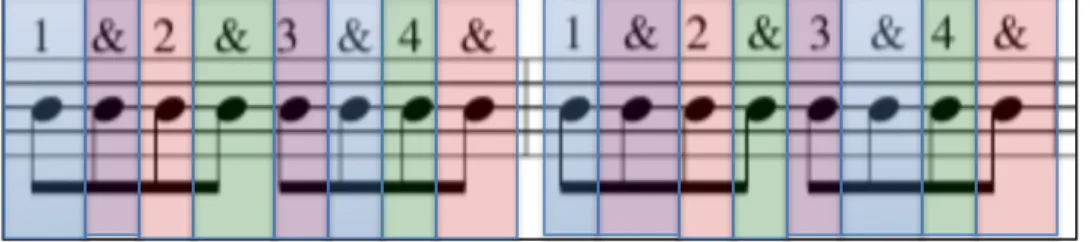
The terms rhythm, tempo, beat, subdivision, and pulse are thrown about interchangeably, which is a terrible conflation. The quartet coaching is a perfect time to set the record straight for your students. Rhythm is the organization of time in terms of “the duration of the sounds and silences” from which music is made.31 Tempo, is the rate at which musical
time passes. It has an inverse relationship to the duration of a rhythm; the faster the tempo, the shorter the sound. Beats are emphases that enable the measurement of time. Meter is the organization of beats into measured units. Subdivision more accurately measures the passage of time between beats. Pulse has several tiered levels. The simplest pulse is a beat. Within a measure, stronger pulses on certain beats create a hierarchical structure of
emphasis. Within a phrase, the pulse helps create a hierarchy of measure importance. Over
the duration of an entire movement or work, a consistent internal pulse in all the players allows the ensemble to perform without losing rhythm or tempo.
Violin II
Violin I
Cello
Viola
Figure 2 Color Coded Seating Chart
Figure 3: Quarter Note Counting
Figure 4: Eighth Note Counting