Table of Contents
Acknowledgements ………. 1
Abstract ……… 2
Introduction ………. 3
Chapter 1 ……… 16
The Space and Social Significance of Streets ……….. 16
Streets as Vectors of Citizenship ………. 17
HarassMap: Getting to the Root of Street Harassment in Egypt ………. 20
Women2Drive: Getting Women in Saudi Arabia Behind the Wheel ……….. 27
From Studio to Street: Self-Defense Training and Confidence-Building in Jordan and Egypt ... 35
Chapter 2 ……… 40
Public Space and Democracy ……….. 40
Tahrir Square: Egyptian Women’s Role in Contested and Politicized Space ………. 42
Abolishing Article 522: Lebanese Women Demonstrating on Beirut’s Corniche ……….. 46
Chapter 3 ……… 51
Internet Space and Citizenship ……… 54
Women-Only Spaces ………..………. 54
Egyptian Women and ‘Literary Counterpublics’ ……… 55
The Female Guards of Al-Aqsa: Contested Religious Space and Women’s Influence ……….. 58
Conclusions ……….. 62
Acknowledgements
This project would have been impossible without the patience and guidance of my advisor, Dr. Banu Gökarıksel. I thank her for being a wealth of knowledge and encouragement and for helping me become a better student, researcher and writer. I would like to thank my second and third readers, Dr. Michal Osterweil and Dr. Claudia Yaghoobi, both of which have taught some of my favorite courses at UNC and have eagerly extended their help and advice to me. Each of these three women have impacted my life more than they likely know, and their intelligence, passion for their subjects and dedication to students like myself, will continue to inspire me.
Thank you to Dr. Gabrielle Berlinger, the members of our Honors Thesis Seminar and all of our guest speakers. In one semester I went from being a bit intimidated by the scale of the Honors Thesis, to having much more confidence in my skills as a writer and my abilities to complete this project, and each member of our seminar contributed to that development.
Thank you to Dr. Fadi Bardawil, whose “Introduction to Arab Cultures” course three years ago set in motion and gave direction to my passion for Arab Studies.
A huge thanks to my dear friends, whose words of encouragement, company in Davis Library during late nights, and constant support have made me even more proud of what I have accomplished with this project.
ABSTRACT
Making Space and Women’s Activism in the Arab World
Marisa Breathwaite
Faculty Advisor: Dr. Banu Gökarıksel
This thesis explores how women in the Arab World have made space for social and political activism in the years leading up to, during and after the Arab Spring. By assessing the varying methodologies women in the Arab World use occupy different spatial realms, I assert that despite Western media portrayal of Arab women as non-actors or recent participants in socio-political activism they consistently take part in dynamic activism in order to fully experience citizenship and progress in the processes of empowerment. This thesis covers three distinct spatial realms: streets, public gathering places and curated, women-only spaces. I detail women’s activism initiatives from each spatial realm, with examples coming from the Arab countries Egypt, Jordan, Lebanon, Saudi Arabia, and Palestine. The examples come from news outlets, interviews and academic analyses via journals and other collaborative projects. I engage the examples with scholarship on western imagination of Arab women, patriarchal structures and feminist geography. In analyzing the significance of space in how Arab women engage in socio-political activism, I argue that Western conceptualizations of activism often exclude Arab women’s activities and that activism does not yield a penultimate status of “empowerment”, but continuous progression and pushback.
Introduction
Making Space and Women’s Activism in the Arab World
Beginning in December 2010 and extending into early 2011, the demonstrations of the Arab Spring saw crowds in the millions. From Tunis to Cairo to Damascus to Tripoli, the people of the Arab World took to streets, squares, parks and the Internet to demand change. In Egypt, calls for the basic rights of ’aish, horreya and adala egtema’eya (bread, freedom and social justice) got to the heart of what was fueling the popular uprisings. And throughout the region, chants of, “al-sha’ab yurid isqat al-nizam!” (The people demand the fall of the regime!) echoed and reverberated loudly, making the region a place the world could not take their eyes off of. With the gaze of the world locked on Arab countries in revolt, western observations and commentary about who exactly was spilling into the streets and squares became impossible to ignore. Egyptian activist Hadil El-Khouly acknowledged this when she said, "There was this sense of surprise, that 'Oh, my god, women are actually participating!' But of course women were there in Tahrir Square.” She continued, “I was there, because I'm Egyptian. Everyone was there. You really felt we were all one.” (Power 2011) Western media coverage of the protests made it clear that Arab women were not expected by outside observers to be involved in any significant way in their countries’ revolutions, let alone occupying the streets with their male counterparts and making their own demands. El-Khouly’s experience was not contained to women in Egypt, but was shared commonly among women all over the Arab World.
of Arab women in the social and political spheres of their respective countries before these revolutionary moments. Nadje Al-Ali explains that “for decades [women] had been active members in trade unions, political opposition parties and more informal networks and
organizations” (Al-Ali 2012: 27). Women’s activism did not generate upon arrival of the popular protests of the Arab Spring, but had already existed and manifested itself in Arab society in varied and nuanced manners and continues even after the revolutions and counter-revolutions of the Arab Spring.
El-Khouly and other women who were active in the years leading up to, during and after the revolutions of the Arab Spring were and remain in the center of three distinct narratives; the western imagination of them as non-actors in their own countries, their homogenization into the collective revolutionary body known as “the people” and their own realities as social and political actors with motivations and aims for their activism. Assumptions of Arab women as being statically and perpetually “disempowered” and restricted to the private sphere or as being only a part of “the people” prevents the narrative of Arab women’s activism as fluid, dynamic and productive from becoming part of popular discourse. If women have been active all along, and continue to be active since the passing of widely publicized revolutionary moments in the Arab World, why did observers in the West not see it? Why do observers in the West continue to treat women’s activism in the Arab World as a recent occurence? To counter popular Western notions of Arab women’s activism as not visible and therefore non-existent, we must reconstruct our ideas of what being socially and politically active means by expanding established views of activism as only large-scale and constantly visible to the public eye.
with the knowledge that women continually “make space” in society; that is they reclaim space and create space for themselves in different ways in order to solidify their stake in social and political spheres. The processes of making space vary depending on the women who make the space, the anticipated purposes and uses of the space as well as the implications of the way in which that space is occupied. It is important then, to understand space and the reclaiming and creating of it as a vital part of exercising social and political influence. The ways in which Arab women yield their made space are unique and constantly changing. Whether it is demonstrating their right to drive by taking to the streets in Saudi Arabia, or challenging rape culture by
occupying public gathering places with visual art in Lebanon; Arab women’s social and political activism via making space is varied, dynamic and adaptive.
Research Questions
In order to understand the ways in which Arab women influence socio-political spheres in their countries, I have outlined several research questions and will explain the approaches used to unpack these questions: How are women in the Arab World using spatial strategies and what are the impacts? How is Arab women’s activism, varied, dynamic and adaptive? How has Arab women’s activism developed during the times leading up to, during and after the Arab Spring? Why should we focus on the role of space when we observe women’s activism in the Arab World?
leading up to the Arab Spring, throughout the demonstrations of that revolutionary moment and in the seven years since the popular uprisings.
I chose specifically to examine Arab women’s navigation of the relationship between space and activism, and posit space as a critical lens to understand how Arab women have and continue to engage contested citizenship because in conceptualizing space, we can deepen our understanding of women’s activism. I argue that certain spaces, such as the streets and squares discussed in the forthcoming chapters, are at the heart of society. It is in these certain spaces that political involvement, social interaction, demonstration and movement are enacted. If we attempt to understand the status of Arab women only by assessing political events like elections, or by examining only changes in legal frameworks and exclude a spatial approach, we are honing in on revolutionary moments and excluding the crucial examination of the everyday spaces in which citizenship is enacted. The revolutionary, as we will see in the following chapters, cannot happen without access to everyday spaces, and observations of how life unfolds in everyday spaces are critical to understanding revolutionary moments and significant shifts in societal power
structures.
I chose to examine Arab women’s dealings with space and activism in this particular time frame because as detailed in previous paragraphs, the Arab Spring is thought of in popular Western mindset as a moment in which Arab women’s activism emerged and that it served as some sort of turning point that made Arab women into activists. I want to acknowledge the significance of women’s involvement in Arab Spring protests while showing that women
I explore these questions by delving into literature on space and place; literature that brings into question how spaces in society are marked, who has ownership over them and how they are made and given significance. I unpack these questions and ideas by analyzing examples from several Arab countries of how women make space in various ways. In the following section, I explain my methodology and how the paper is organized.
Arguments
Based on my research, I argue that women in the Arab World have asserted and continue to assert themselves in social and political spheres by utilizing varying tactics to gain access to and make use of different types of spaces. To prove my argument, I gather accounts from news outlets, interviews and academic analyses via journals and other collaborative projects to frame the existence of three distinct categories of spaces (which I detail in the following paragraphs) and explore how Arab women navigate and make use of the spaces within these categories. In this way, I argue that Arab women use varying methodologies depending on their activism goals and personal identities, to make space for themselves in society and use this made space to assert their rights to uncontested citizenship and access to the benefits of full participation in certain spatial spheres.
“Women and Empowerment in the Arab World”, Sherifa Zuhur initially asserts that her piece tracks Arab women’s “progress” towards “empowerment”, as if it is a place, a destination, but later makes clear that empowerment itself is a process, not a penultimate state of being (Zuhur 2003: 17-19). For the purposes of this piece, it is imperative to understand there exists a set of fluctuating circumstances that empower and disempower women simultaneously as well as an ongoing tension between successes in obtaining access and the constant pushback from systems of oppression. In delineating the societal benefits that come with made space, I situate these benefits in the context of Arab women activists and their navigation of the persisting tension between obtaining access and societal pushback in regards to the spatial realms I outline in this paper.
The following chapter discusses the first spatial realm; the streets. Streets as
infrastructure permit movement of people and goods. They connect neighborhoods, towns, cities and states. They allow us efficient movement from place to place and access to spaces and places that differ in some way from the space or place we may be situated in at any given moment. Access to the space of streets is also crucial to enacting citizenship. In this chapter, I explore the initiatives taken by Arab women to reclaim and create space in the streets in an attempt to understand access to the space of streets as the equivalent of more access to unhindered movement and full citizenship.
World and what happens when women not only enter these spaces, but enter them in unconventional ways that look different from traditional protest.
The concluding chapter offers a conversation on created spaces as they relate to the existing spaces of streets, squares and parks. The created spaces discussed are spaces made by women, for women that did not exist previously, namely Internet communities and curated women-only spaces. This chapter illuminates the importance of creating space, making it into place as well as the methodologies by which Arab women design spaces for themselves or move into spaces where they did not exist previously. The conclusion chapter also revisits critical theory on empowerment, contested citizenship and conceptualizations of Arab Women, and situates the theory within the activism initiatives detailed in the preceding chapters.
Literature Review
In this section, I present recent literature on the themes and concepts that lay the
Background Information
In this project, I am observing cases of women in the Arab World making space via varying methods. The intent of this project is not isolate Arab women as a group in order to homogenize their experience, but to construct a narrative of their experiences as being unique and built from a multitude of differences including religion, age, social class, livelihood and place of residence. Before delving into the multiplicities within Arab women’s experiences, I will clarify the identifier “Arab” in order to dispel common misconceptions about who exactly is Arab, as well as to situate the locales of cases I discuss in the following chapters.
According to the American Arab Anti-Discrimination Committee (ADC), “Arab” is a cultural and linguistic term applied to a group of people united by culture, history and the Arabic language. “Arab” is not a race, with Arabs expressing a wide range of phenotypic qualities. The Arab World consists of 22 countries in the Middle East and North Africa, or MENA region (ADC 2009). It is important to note, that though many Arab countries are located in the Middle East, not all Middle Eastern countries are Arab. Iran, Turkey and in some approaches, Pakistan and Afghanistan, are considered part of the Middle East, but these are not Arabic speaking countries, with citizens of these states speaking Persian, Turkish, Urdu and Pashto and Dari respectively. It is also important to distinguish being Arab from being Muslim. Arabs practice a variety of religions including Islam, Christianity, Judaism, the Druze and Baha’i faiths. While a large concentration of the world Muslim population is located in the MENA region, with many Arabs in the region practicing Islam, most Muslims are not Arab nor even reside in the Middle East (Desilver and Masci 2017).
that there are in fact 22 Arab countries, but this paper only discusses examples from five: Egypt, Lebanon, Saudi Arabia, Jordan and the State of Palestine.1 Each case from the respective
countries was carefully selected as it represented a unique element of women’s activism within a certain type of space. Ideally (and with much more time), I could include cases each with their own distinct addition to this project from each of the Arab states, but for now my current limitations lead us to explore cases from the five states listed previously.
Arab women come from 22 unique countries each with their own history, dialects, customs and politics, yet they have been homogenized and eroticized by the Western imaginary for centuries. The following section curates an understanding of the continued narrative
perpetuated by Western observers of Arab women; a key piece of the framework that motivated the undertaking of this project.
Arab Women in the Western Imaginary
A quick Google search of “women in the Arab World” will show you clearly the associations popular discourse makes with Arab women; questions of the status of Arab
women’s rights, empowerment and lack of opportunities fill the page. Even finding simple facts such as what percent women make up of the Arab World’s population can prove hard to find without an accompanying article detailing how many Arab women do not own cell phones or how Arab women should be populating the workforce more.
Popular discourse paints Arab women either in the image of oppression, or as exotic subjects of a voyeuristic gaze. Western narratives often entrap Arab women as indicators of a society’s progressiveness or degree of modernization, while also making them up as indulgent
objects with roots in erotic harems of the Orient (Hatem 1999: 63-86). We cannot talk about the Western lens by which Arab women are viewed without bringing up the scholar who coined the term “Orientalism” and brought to light the inaccuracies of Western depictions of “the Orient”, Edward Said. In his most notable work, Said explains that Orientalism exists as “the corporate institution for dealing with the Orient- dealing with it by making statements about it, authorizing views of it, describing it, by teaching it, settling it, ruling over it: in short, Orientalism as a Western style for dominating restructuring, and having authority over the Orient.” (Said 1978: 11)
Through this Eurocentric, authoritative and dominating lens, Arab women have been
imagined in various media as belly dancers and sex objects in popular television like The
Simpsons, James Bond films and Sex and the City as well as in publications like Maxim to name
a few (Jarmakani 2008: 140). Western media took images of veiled women and continually
reproduced them during the United States invasion of Iraq to prove how the “backwards” state of
Iraqi women was another justification for violating the political sovereignty of Iraq (Jarmakani
2008). There exists a contemporary obsession with the veil as an “obstacle or barrier behind
which Middle Eastern women are forced to hide”, an obsession that serves the purpose of
signifying invisibility while destroying the capacity of those consuming the images to see Arab
women as dynamic actors in their societies (Jarmakani 2008: 149).
It is important to assess the images consumed in the West of Arab women and situate
Western bias. Why did Western media respond in shock when images of women in the streets in
Cairo, Tunis, Manama and other places surfaced? What does this prove about the Western
Space and Place
In this paper, when I deconstruct the Western imagination of Arab women’s roles and simultaneuaously make sense of how women exercise their autonomy in actuality, I do so by assessing space and place. In this paper, both up until this point and in the chapters that follow, I use the words “space” and “place” with frequency. Though the words seem similar enough to use interchangeably, they both have distinct geographic meanings and are applied with the weight of those meanings in mind throughout the durations of this project. According to Denise Lawrence-Zuniga, “[s]pace is often defined by an abstract scientific, mathematical, or measurable
conception, while place refers to the elaborated cultural meanings people invest in or attach to a
specific site or locale.” (Lawrence-Zuniga 2017: 1) So, when I say, “Arab women are claiming
space” I mean in an abstract physical sense, these women have access to more physical space to move through, work in and utilize. When I say “public gathering places” I am acknowledging that the space of a park has been curated by the people who use it to have a certain significance, it is a place meant for gathering and socializing. Linda McDowell explains that “[p]laces touch the ground as spatially located patterns and behaviors.” (McDowell 1999: 4) That is, social patterns and behaviors give places their significance.
Geographical spaces and places both make and influence the fabric of societies. From this assertion we can glean that space and place are inextricably bound with another societal
structure; gender. Spaces and places are tied up with gender in the sense that places and spaces themselves are gendered, but the relationship goes beyond this. Spaces and places together are a force that both influences construction and understanding of gender as well as mirrors
reflection and a reproduction of the gendered norms of that space, and thus the society. The following section details how geographers unpack gendered space and place by using a feminist approach, as well as connects methods of observing gendered space and place to the goals and purposes of this project.
Understanding and Applying Feminists Geographies to the Arab World
Constructing the framework for this piece requires the introduction and understanding of feminist geography. Feminist geography is “the application of feminist theory and methodologies to understanding human geography.” (Castree et. al. 2013: 1) We know that feminism is defined
as the social, political and economic equality of men and women, so we can understand feminist
theory as a methodology of producing knowledge that is both aware of and in conversation with
feminism. In application, feminist theory critiques the assumed male bias of knowledge
production and brings to light questions of objectivity in order to challenge the exploitative roots
of this male bias (Elliot et. al. 2016). Feminist theory is critical in bringing to focus marginalized
and peripheral voices that until fairly recently, had been essentially absent from any sort of
mainstream, popular discourse. So, when feminist theory is applied in the field of geography, the
outcome is a feminist geography that “investigate[s], make[s] visible and challenge[s] the
relationships between gender divisions and spatial divisions, to uncover their mutual constitution and problematize their apparent naturalness.” (McDowell 1999: 12) McDowell’s definition encapsulates the goal of this paper, to expand our understanding of why space has to be “made” for women in, not just Arab societies alone, but in all patriarchal societies.
counter the popular Western narrative of Arab women as objects of domination that are without agency, when in fact, they wield influence through space that constantly disrupts societal patterns.
Chapter 1
Taking to the Streets: Women Securing Mobility in Egypt, Saudi Arabia and Jordan
Most people do not stop to consider the significance of the streets they use nearly every day. Whether we are driving in the street during our daily commute or walking down the street to visit a next door friend or family member, the space of streets is occupied by humans each day and for many different purposes. At the very basic level of their function, streets are connectors; they connect people to other people, to jobs, and to other spaces and places. But, if we look beyond the basic function of streets being infrastructure for transporting people and goods, we can understand streets as spaces of distinct social and political significance. The space of the street, by its function and nature, has the ability to “disrupt old patterns, upset balances of power, and isolate some [people] as they serve others (Norton 2016).”
How can layers of concrete, asphalt and painted lines disrupt traditional societal patterns and power structures? What societal patterns are even created and maintained in the space of streets? How can we imagine the main streets of our cities and towns as having the ability to isolate certain members of our communities while serving others? In this chapter, I approach these questions by presenting an analysis of three unique forms of activism that show how Arab women have acted upon the space of streets in order to interrupt established patterns of social hierarchy in order to realize unhindered movement and experience full citizenship.
The Space and Social Significance of Streets
Mobility is one of the first ideas we associate with streets. Streets play an important role in modes of mobility within societies. As detailed previously, streets connect us to opportunities to be consumers, to socialize with others, to earn a living and to spread ideas. We cannot drive cars without access to functional streets. City buses would be unable to operate as vectors of low-cost, mass transportation without functional streets. Cities and neighborhoods would lack organization and structure and be unnavigable without streets. Streets represent the facilitation of physical movement from place to place within societies.
While mobility is often characterized by our physical capacity to move from one place to another, mobility is also heavily connected to one’s social status, which includes gender
Streets as Vectors of Citizenship
Streets are part of the infrastructure that supports mobility and thus supports individuals’ access to social, political and economic opportunities. But beyond this, streets function as vectors of citizenship and play a crucial role in the ways in which individuals engage with their
membership of a state. In other words, the function of streets extends beyond mobility and directly relates to the ability or inability of a person to enact their own citizenship.
Feminist geographers have assessed the ways in which gendered public space informs citizenship, that is societal inclusivity and exclusivity projected onto space is informed by gendered hierarchies (Mitchell 2000: 211). Don Mitchell draws on Sallie Marston’s
examinations of “public inclusiveness” as it was established in the early United States. “Public inclusiveness” or how certain citizens are included in the public spaces of a society and how they are able to use those spaces, is directly based on ideas of who is considered a “legitimate”
member of the “public” who is therefore worthy of engaging in political discourse in public spaces (Mitchell 2000: 211). In the early United States, men who were white and owned land were permitted to engage in political discourse, leaving “lesser” citizens, like non-land owners, indentured servants, people of color and women, excluded from physical and imagined public spaces. In looking closer at women’s exclusion from political discourse in public spaces from the inception of the United States and many other nations globally, Mitchell asserts that “if
streets are the intersection point of citizenship, where citizens see and engage with one another, where public interaction occurs beyond engagement with only immediate family or close friends (Mitchell 2000: 209). Gerda Wekerle suggests that there is not a uniform citizenship, but
pluralistic one in which citizens engage in different arenas of public life, have a diverse set of identities, beliefs and ideologies and that the social interaction of individuals with different experiences of citizenship is crucial to democracy (Wekerle 2004: 248-249). So when women are excluded from the space of streets, they are strategically being excluded from engagement with other citizens and full participation in public political discourse with citizens who are different from them. When women are not afforded this type of free interaction in their society , they are made to be second-class citizens that do not enact their citizenship in ways male citizens who have full access to street space are able to.
The cases presented in this chapter attempt to frame an understanding of how when the masculine is believed by society to be superior, that belief manifests itself in the way women access street space and experience mobility and participate in democratic citizenship. Varying tactics keep women out of street space, and therefore, away from unhindered mobility and full citizenship. These tactics are employed daily and occur in most societies. At the same time however, there are tactics employed by women to reclaim their stake in street space and increase their access to mobility, full citizenship and autonomy. By the end of this chapter, we will see when women occupy street space in a way that defies the sexist restrictions established by society, they transform expectations of them as women and continue to reclaim their freedom to navigate streets and reap the benefits that come with mobility and full citizenship.
citizenship and unhindered mobility, in the Arab World. I categorize each of the following initiatives based on the approach they take to secure opportunities for Arab women to pursue the same unhindered mobility and use of street space their male counterparts have access to. The first type of initiative is one I categorize as the “root of the problem” approach, and it is exemplified in the Egyptian organization, HarassMap. HarassMap, based in Cairo, uses
community-based efforts to get to the root of why street harassment occurs and is so prevalent, with a goal of ending harassment altogether in Egypt. The second type of initiative focuses on securing women’s access to machinery that enables easy mobility. The Women2Drive campaign in the Kingdom of Saudi Arabia (KSA) was based on obtaining Saudi women’s access to
vehicles in order to open avenues of mobility for women and attempt to increase gender equality in the country. This particular movement will be held in discussion with the September 2017 royal decree from the KSA that will allow women to legally drive in summer 2018. Finally, the third type of initiative hones in on developing women’s confidence to enter street space. In this section, we will look at two cases, one in Egypt and one in Jordan, where formal instruction is enabling women to take to the streets armed with self-defense knowledge. Each case depicts the revolutionary endeavors of Arab women in reclaiming their stake in street space and the
implications and rewards that come with undertaking such endeavors.
HarassMap: Getting to the Root of Street Harassment in Egypt Sexual harassment in Egypt
comments, stalking or physical touch (“What is Sexual Harassment?”). Sexual harassment is a widespread problem throughout Egypt. It happens in the loud, bustling streets of downtown Cairo as well as in the rural agricultural regions like the Ismalia governorate. Women in the same report indicated that their harassers were anyone from co-workers to policeman, drivers to
university students (U.N. Women 2013: 9). In addition, 49.2% of the women surveyed reported that harassment occurred at a daily frequency (U.N. Women 2013: 8). The reports suggested that harassment happened in markets, on beaches, in public gardens and most frequently, in the streets (U.N. Women 2013: 7).
Sexual harassment and gendered hierarchy
In order for patriarchal structures to remain in society, certain mechanisms have to continually exist to maintain them. Sexual harassment is one of those mechanisms. Women who fear harassment are intimidated into avoiding confrontation and exhibit subordinate behavior. For example, when there is a threat of harassment, women may “avoid public places, dress more conservatively, and abstain from smiling or making eye contact with strangers” (Fahmy et al. 2014: 47). Women’s personal and social freedoms are curtailed simply because of the possibility of harassment occurring. The “experience of intrusion from unknown men in public” by way of verbal or physical harassment reinforces the continuum of sexual violence and supports
assault in streets, they are disadvantaged and their access to mobility is hindered greatly. According to the same U.N. report cited above, after enduring recurring sexual harassment in streets, women reported feeling depressed, hurt and frightened to return to the streets (U.N. Women 2013).
Harassment instills a fear in many Egyptian women of navigating the streets in their own cities and towns and if women remain wary of entering streets or are intimidated into not using street space, men successfully create a monopoly on that societal space (Fahmy et. al. 2014: 31). When men are given full access to a space that is crucial to mobility and citizenship and women are denied that full access because of intimidation and violence, the result is women as a societal group are second-class citizens whose participation in the politics of the street and ability to move freely is controlled by the male-upper class.
HarassMap: Bringing together GIS mapping and community
The daily occurrence of street harassment, a general culture of tolerance for harassment and even the denial that sexual harassment or, el- taḥarrush el-ginsy in Arabic, even existed in Egypt, paved the way for campaigns that sought to address the harassment epidemic.
Until late 2005, women’s advocacy groups in Egypt did not focus on sexual harassment nor did they have any campaigns addressing this problem in Egypt. The term el- taḥarrush el-ginsy, was not taken seriously by Egyptians, labeled as “American” and was often dismissed as
harassment was shaped by various campaigns and high-profile instances of harassment and made space for an initiative to target harassment unlike any others Egypt had seen.
HarassMap is a volunteer-based initiative that began in 2010 with the work of American Rebecca Chiao and Egyptian Engy Ghozlan, both of whom previously worked for ECWR (Abdelmonem and Gálan 2017: 156). HarassMap is used throughout all of Egypt today to encourage
community and active bystander strategies for confronting sexual harassment with the ultimate goal of “ending the epidemic” (“Who We Are”). Via anonymous submissions and geographic information systems (GIS)-based technology, individuals can report instances of harassment and pinpoint their exact location at the time the harassment occurred (Abdelmonem and Gálan 2017: 155). This technology is paired with campaigns that get to the root of why harassers harass as well as community outreach and education.
Analyzing HarassMap’s modes of challenging street harassment is critical to
understanding how innovative, community based activism leads to opportunities for women to feel confident and comfortable navigating street space. The following sections assess how HarassMap employs GIS technology, community-based dialogue and creative anti-harassment video and radio campaigns to end harassment in Egypt.
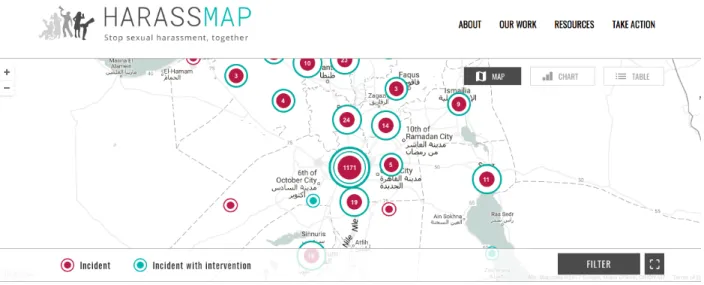
GIS technology is characterized by the coupling of spatial data that references locations on Earth and attribute data that provides additional information about the spatial data
certain street corner or near a university, users of HarassMap and HarassMap staff can see locations where harassment frequently occurs. The map also distinguishes incidents of
harassment, shown as magenta plotted points, from incidences with intervention, shown as teal plotted points.
Figure 1. Image of the GIS map on HarassMap’s website. Map is centered on the Cairo metropolitan area.
Mapping and reporting harassment on the streets of Egypt is the most identifiable
element of HarassMap’s work. The team at HarassMap does not view each report strictly as data, but as evidence. The mapping initiative at HarassMap “makes a difference” because the evidence gathered from it is used to plan campaigns, discredit criminalizing stereotypes of harassment victims and provide volunteers with useful information as they work to create an environment with zero-tolerance for harassment (“Reporting”).
travelling to the harassment “hot spots” in other places (Abdelmonem and Gálan 2017: 157). The way HarassMap mobilizes its volunteers is central to one of its chosen methods for combating harassment; community engagement. In a 2014 interview, HarassMap co-founder Rebecca Chiao elaborated on how HarassMap deploys its volunteers:
“On the community level, we’ve received about 1,000 volunteers. We train community captains who at least once a month take a team of volunteers to their own community street and convince bystanders to stand up to harassers. We focus on people with a consistent street presence like doormen and street vendors to set up safe areas. There are four elements to creating a safe area: agreement, training, distribution of materials, monitoring and evaluation.” (Chiao 2014)
HarassMap volunteers are residents of certain neighborhoods that use their intimate knowledge of the community and its residents to curate and maintain safe areas. In doing this, the culture of the safe area extends into other parts of the neighborhood. One safe area
maintained by dedicated volunteers can multiply into many safe areas, which in turn can foster a neighborhood community that does not tolerate harassment. When neighborhood communities adopt zero-tolerance for harassment as a collective mindset and each community member abides by and maintains these standards, then women can freely navigate the streets of their
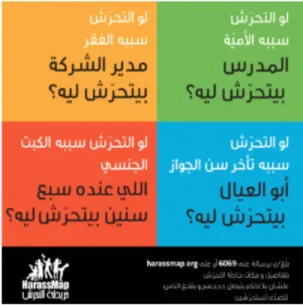
Figure 2. HarassMap campaign graphic. Reads top right to left:
“If illiteracy is his reason for harassing… Why does the teacher harass?
If poverty is his reason for harassing… Why does the company director harass?
If getting married at a late age is his reason for harassing…
Why does the father of the children harass?
If sexual suppression is his reason for harassing… Why does the seven year old harass?”
The Future: Ending sexual harassment in Egypt
The efforts of HarassMap are not isolated in Egypt, with initiatives to combat sexual harassment emerging more frequently. Startups like Rescue App, developed by 21-year old Shadw Helal, and Street Pal, developed by Abdul Fattah al-Sharqawi, have been added to the App Store and Android Market as recently as October of 2017 (Startup Scene Team 2017; Hassan 2017). Young Egyptians are driven to combine technology, dialogue and community outreach to combat one of the countries most well-known and widespread social issues.
With the work of HarassMap and other apps extending from metropolitan Cairo to Upper Egypt, to Alexandria, the opportunities for substantial social change are growing. As HarassMap continues to use its “getting to the root of the problem” platform to transform Egyptian society’s mindset about harassment, women come closer to experiencing unhindered movement in the streets of their neighborhoods, towns and cities and with the freedom to navigate their community streets comes the ability to engage in the socio-political sphere of streets.
Women2Drive: Getting Women in Saudi Arabia Behind the Wheel Access to driving and modern mobility
A staggering number of people worldwide depend on cars for access to economic, social and political opportunities. The ability to operate a personal motor vehicle addresses many hindrances of free movement such as rigid public transportation schedules, the high cost of private drivers or depending on family members for rides. The simplest tasks can be made an ordeal without access to the convenience of being able to drive one’s own vehicle.
Driving and gendered hierarchy in the Kingdom of Saudi Arabia
Until September 2017, the Kingdom of Saudi Arabia (KSA) denied its female citizens the right to operate a motor vehicle, that is, the KSA systematically denied women the right to obtain driver’s licenses and arrested women who were caught driving. The policy was not written into any law, but was established by means of a fatwa, a non-binding legal opinion delivered by a scholar of Islam (Mirza, M. et. al. 2013). Though there is not much information available about the history of the initial fatwa, numerous sources seem to agree it was handed down in 1957 and overtime, several fatwas regarding the driving ban have been issued by senior government clerics (Human Rights Watch 2011).2 In denying women of the KSA the modern convenience and freedom of driving, the fatwa operated as perhaps the most infamous part of a larger gendered-hierarchy that restricts Saudi Arabian women’s mobility and creates them to be members of a second-class, with many women experiencing less societal privilege than their own male
children (Galán 2016: 168-169). Because we can understand Saudi Arabian women as belonging to a lower social class than Saudi Arabian men, we can understand inability to navigate streets independently as a reflection of Saudi Arabian women’s lowered social status and as something that reproduces women’s lowered social status.
According to Amelie Le Renard, the gendered societal division in the KSA creates an alternate “female sphere” in which women-only spaces are maintained in accordance with established men-only spaces, and it is in the men-only spaces where convenience and quality are prioritized (Galán 2016: 168-169). When Saudi Arabian women complete an action that places them outside of the prescribed norms of their alternate “female sphere”, the actions are met with retribution, for example, arrest as a punishment for driving. On occasions where the “wrong” bodies exist and operate in the “wrong” places, it is perceived as a direct challenge to the
established norms of how men and women “should” behave, thus a direct threat to the system in which men hold and benefit from control over women’s movement and actions (Domosh and Seager 2001: 111). The rigid social dichotomies of “right” and “wrong”, “should” and “should not” in the KSA have been maintained via the driving ban, system of male guardianship, and “morality police” that regulate public veiling and “inappropriate” male-female public contact (Ladies First: Saudi Arabia’s Female Candidates 2016).
Women dissidents, personal revolution and the roots of driving activism
New York Times journalist, Mona El-Naggar, led a project in which Saudi Arabian women could submit their stories about living under the restrictive patriarchal system in their country. In El-Naggar’s article, a 19-year old woman referred to only as “H41” was quoted saying, “It’s suffocating. I’d rather kill myself than live with it. I hold on to the smallest hope I have that someday this will change.” Unsurprisingly, after the call for submissions, the
hashtagﺰﻤﯾﺎﺗ_كرﻮﯾﻮﯿﻨﻠﻟ_نﻮﻟﻮﻘﺗ_ﻻ# translated, #DontTellNewYorkTimesThat, appeared on Twitter,
encouraging women not to expose stories of their hardships to the media outlet (El-Naggar
women to contemplate ending their own lives, was and is a force behind women-organized
dissidence in the KSA. An undeniable hunger for justice drove the women activists whose
personal freedoms were being curtailed by an unwritten rule.
On November 6, 1990, 47 women were arrested and imprisoned after organizing and
participating in a driving protest. The women drove around the KSA’s capital, Riyadh, for half
an hour before police ended the demonstration, which was the first of its kind (Galán 2016: 171).
The women not only faced prison time, but they and their husbands were banned from travelling
internationally. Many of the women were fired from their jobs and publicly identified as
“immoral women” who were attempting to undermine Saudi Arabian society, which made it
difficult to find alternative employment opportunities without facing discrimination (Murphy
2008). The punishments in response to the 1990 driving protest in Riyadh were swift and harsh,
with the intention of discouraging any other demonstrations. Despite this crackdown, women
continued to drive “on the sly” and in her documentary film, Mona El-Naggar says defying the
driving ban is “one situation where the veil offers an advantage” (Ladies First: Saudi Arabia’s
Female Candidates 2016). Anonymity, even if it is government-enforced anonymity, has protected the defiance of Saudi women.
Women in the KSA continued their own intimate acts of dissidence by driving discreetly and not always with the immediate intention of protesting, but for the sake of simply
seeks to foster women’s dependence on and inferiority to men. Zakia Salime crafted the term “microrebellion” to situate women’s seemingly personal and contained activism in the space of mass revolution and social transformation (Salime 2013). Though these microrebellions aren’t widely documented, which would contradict the “micro” nature of them, it is important to understand them as activism on their own, the kind not easily identifiable and stoppable by authorities and the kind that ensures that the state of Saudi women’s freedoms is not static. Despite a few notable instances of women driving and uploading video documentation of themselves driving in 2007-2008, coverage of women dissidents driving in the KSA had not approached the scale of the 1990 protests, that is until the emergence of the Women2Drive movement.
Daring to Drive: The Women2Drive movement
Like many social revolutions in the Middle East in the early 2010s, the women organizers behind Women2Drive cited inspiration from the popular uprisings of the Arab Spring as they organized drives in opposition to the ban (Galán 2016: 167; Salime 2013). The Women2Drive campaign was orchestrated not as a mass protest in a physical sense, like many of the Arab Spring demonstrations in downtown squares, but as an online conglomeration of several of the “microrebellions” alluded to in the previous paragraph (Galán 2016: 167).
The organizers of Women2Drive were seeking to be disruptive, but were attempting a kind of productive disruption, not disruption that could have them dismissed as “immoral women”. One of the lead organizers and the woman who garnered the most international
recognition from the movement, Manal al-Sharif, was instrumental in penning instructions on how the planned June 17, 2011 driving demonstration would unfold and encouraged women to post videos of themselves driving on Facebook and YouTube (Galán 2016: 172-173). Al-Sharif, arrested for her own act of driving nearly a month before the planned demonstrations said, “For me, driving — or the right to drive — is not only about moving from A to B; it's a way to emancipate women. It gives them so much liberty. It makes them independent.” (Gross 2017)
And like so many other sentiments circulating the Arab World in 2011 regarding emancipation, liberty and independence, al-Sharif’s reverberated. But the demonstrations that resulted were strategically different from mass-mobilization to downtown squares. Individual women’s acts of dissent, concealed by the veil and at times by darkness of night, “became visible and legible as protest” where virtual spaces multiplied the effect of individual dissent (Galán 2016: 173).
transnational, and the pressure on the KSA to take a major step towards gender equality and revoke the driving ban was mounting.
Women continuing to challenge systemic discrimination in the KSA
On September 26, 2017 a royal decree read on state television announced that women would be able to legally obtain driver’s licenses, without permission from their male guardians, beginning in June 2018 (Hubbard 2017). Women and men from the KSA and all over the world took to social media in celebration of a policy move that nearly all of the world believed was long overdue. Saudi officials cited reasons for lifting the globally unpopular driving ban
including the hopes of boosting the economy by increasing women’s economic participation and its “hopes for a public relations benefit from the reform” considering the KSA’s closest political allies have long disapproved of the driving ban that has been a massive stain on the country’s global reputation (Hubbard 2017). Among the top reasons for lifting the ban, as expressed by Saudi officials was not however, attempting to realize gender equality among male and female citizens of the KSA.
Figure 3. A tweet by Manal al-Sharif.
Al-Sharif suggests the accomplishments of legalizing women drivers is one worth
celebrating, but that Saudi women being subjected to the system of male guardianship is another major hurdle to overcome in order to realize unhindered mobility in their own neighborhoods, throughout their country and globally. Saudi women still face a “deeply conservative” society, where clerics have in the past gathered in protest of lifting the driving ban and where women are forbidden from establishing organizations that address women’s rights (Hubbard 2017; Human Rights Watch 2013). Women’s rights advocates in the KSA still risk severe consequences as they pursue unhindered mobility. In her latest blog post, Omaima Al Najjar announced she has officially become a political refugee in Italy (Al Najjar 2017).
serve as a model for future adaptive and resilient activism initiatives in the KSA that yields increased access to street space.
From Studio to Street: Self-Defense Training and Confidence-Building in Jordan and Egypt
The initiatives highlighted so far in this chapter have depicted how “root of the problem” activism to combat street harassment in Egypt and the intersection of personal revolutions and social media to realize women’s right to drive in Saudi Arabia have contributed to the narrative of Arab women securing unhindered mobility and full citizenship in dynamic ways. The final initiatives I discuss in this chapter illustrate the connection between confidence and mobility and how women in Egypt and Jordan are using techniques of self-defense to equip themselves to move confidently through street space.
Ties between confidence and mobility
Women and girls expressing lack of confidence to navigate street space was one of the results of continual street harassment in Egypt, as found by a U.N. Women Study (2013). Though the study focused on women from different parts of Egypt, the logic behind the results can cross borders; when women are harassed and intimidated by men in the streets, their confidence to navigate street space suffers. The question is then raised, “How do we build women’s confidence to navigate street space while the problem of sexual harassment persists?”
When Self-Defense Yields Confidence: WenDo and SheFighter
The description of WenDo’s private Facebook group says it all. WenDo, is a “mix of physical self-defense techniques” and “mechanisms that work on self-confidence, self-assertion and body language (WenDo Egypt).” In 2013, founder Schirin Salem brought WenDo, a
women’s self-defense method curated in Canada in the 1970s, to Egypt (Abdelmonem and Galán 2017: 159). Based on the words “Wen” (short for “women”) and “Do” (the Japanese word for “path”), the name means “a path for women” and appropriately so as the organization is opening paths to unhindered mobility for women of all shapes, sizes and backgrounds in Egypt (WenDo Egypt). The mission of WenDo is not for its participants to seek conflict, but to employ strong vocal and body language responses when approached by harassers, rather than shying away or lowering their gaze (Abdelmonem and Galán 2017: 160). Yasmine Nassef, a WenDo coach says, “Our aim is to empower women and make them feel confident while walking down the streets (Raymone 2015).
in their daily encounters with harassers, but serves as a symbolic act that expresses the women’s intolerance for harassment and the negative social implications it brings on women. Breaking the board is active, not passive, in the same way confronting harassers with confidence is active, not a passive acceptance of someone else’s imposition on one’s own space.
Protecting women and their space is at the heart of SheFighter’s vision. SheFighter, a studio-based self-defense program founded in Amman, Jordan leaves no questions about the intent of the organization which is “to end violence and harassment against women (About SheFighter).” Boasting the title, “First Self-Defense Studio in Jordan and the Middle East”, SheFighter operates in the same way as a common yoga studio, with a monthly schedule of available classes tailored to fit the need of the participant (About SheFighter). In 2010, Lina Khalifeh founded SheFighter, because she claimed she, “[hadn’t found] one real solution for violence against women (Founder).” Khalifeh has an impressive background in martial arts (she holds a black belt in Taekwondo) and has dedicated her time since the inception of SheFighter to developing its “Level System” which allows women to advance through five levels before attaining “Master Level” (Founder; Presentations).
According to the United Nations Refugee Agency (UNHCR), refugee women are at higher risk for gender-based violence and harassment in streets, and refugee women in Jordan have benefitted from the confidence and self-esteem boosting techniques of SheFighter (Sarrado 2017). It is important to note that the efforts of SheFighter are combatting (in a figurative and literal sense) the implications on women in Jordan, including those who are the most at risk.
Self-defense, as proven by the efforts of WenDo and SheFighter are not merely an
more confident in their own abilities and more confident that they too, have a stake in street space.
Conclusions
In this chapter, I have illustrated three different ways in which Arab women have actively countered systemic efforts to hinder their access to street space and thus their ability to engage with fellow citizens in the political space of the streets and move freely through the streets. Activists in Egypt have invested in assessing and deconstructing the roots of its epidemic street harassment problem. Women in the KSA have pursued activism that has yielded their legal access to driver’s licenses. And self-defense instructors in Jordan and Egypt have focused on confidence building as a mode of reclaiming stake in street space.
tactics used by dominating powers all over the world, and are threats that are in constant conversation with active efforts to overcome it.
I continually used the phrases “securing mobility” and “realizing full citizenship” when referring to the goals of Arab women activists in seeking to reclaim their stake in street space. Though sexism is deeply embedded in the structures of most societies globally and makes hindrances on mobility and limitations spaces crucial to citizenship a systemic reality for many women, the women involved in HarassMap, Women2Drive, WenDo Egypt and SheFighter have employed techniques that are adaptive and develop the ways in which women in the Arab World engage in the space of streets that is free from restrictions rooted in patriarchy. By using
Chapter 2
Getting Together: The Significance of Squares, Parks and Other Public Gathering Places to Arab Women’s Activism
Public gathering places embody the spirit of cities and can go beyond that by capturing the spirit of an entire country or region, much like we saw during the mass gatherings of the Arab Spring. These public gathering places are inextricably bound to the cities, countries and citizens that constructed them, thus they are more than symbolically social and political, but a critical part of democracy. The ability to engage in political and social activities that take place in public squares and parks is therefore a crucial part of how individuals experience interact with democracy and experience citizenship.
Public Space and Democracy
We can understand squares and parks as “mixed-use and multi-dimensional environments where all kinds of activities including social, political, religious, environmental, economic etc. take place. They are places designed for all people from different social levels and incomes.” (Javadi 2016: 362) Squares, parks and other public gathering places are by design, supposed to be public and inclusive, but in reality, we find these spaces develop established norms of who can access them, when they can and cannot be accessed and what activities can or cannot happen in them.
ideal”, when in reality there is no unlimited public access to the public space of squares (Mitchell 1995: 116). Those that participate in public gathering places are not random, but are carefully chosen based on the legitimacy of their citizenship and their role in democracy (Mitchell 1995: 116). In early manifestations of democracy women were completely excluded from democratic activity such as engaging in public political discourse. Norms of a private, domestic sphere meant for women and a public, democratically-engaging sphere meant for men still exist in societies globally, and we see this manifest in the way women are excluded from public spaces or have to disrupt the normative function of public space in order to make use of it.
It is important to note however, that not all socially and politically transformative actions take place in what is traditionally known as the “public sphere”. Linda McDowell suggests that the purpose of feminist geography is to “problematize the apparent naturalness” of gendered divisions of space and this includes challenging spatial categorizations via the gender binary that characterize activity in the private sphere as being equated with dependence and lack of power (McDowell 1999: 12). Social and political exchange happens in private, and women historically organized, socialized and strategized in the confines of the private sphere, and the purpose of this project is not to denounce those activities or dismiss them as static or not enacting change, but to suggest that participation in public space is a crucial part of democracy and citizenship.
The first case in this chapter examines the ways in which Egyptian women’s participation in popular demonstrations in Tahrir Square in 2011 and throughout the tumultuous political years that followed, were met with targeted violence, including sexual violence. This case is critical in examining the exclusion of women from public spaces because it demonstrates the dynamic ways in which women made use of street space, organized and acted as part of the united
“people” of the revolution while at the same time, this case shows us the way in which Egyptian women occupied street space was threatening to men who felt entitled to that space, so entitled that they employed police brutality and sexual violence to deter women from using public space in the same way as men. The second case analyzes how women in Beirut interrupted traditional use of the city’s Corniche with a visual art display in 2017. These cases will discuss modes of conventional use of public spaces and how women are challenging what is conventional in order to act upon their rights to public spaces and the civic engagement and empowerment that is tangled up in those spaces.
Tahrir Square: Egyptian Women’s Role in Contested and Politicized Space
demand an end to the despotic regimes that had ruled their countries for decades (Democracy Now! 2011).
On January 25, 2011, a day in Egypt that was meant to honor police forces, thousands of Egyptians flooded the streets and filled Tahrir Square. Anti-government, namely anti-Hosni Mubarak chants, filled the air as the people seemed to unite in the historic square regardless of who they were, in those early revolutionary moments, it appeared as though everyone was just Egyptian (Al Jazeera 2011).
Egyptian women’s place in “the people”
Contested space and bodies in protest
Public space and citizens’ engagement in public space is crucial to having stake
democracy and citizenship. I assert that historically, women have been explicitly excluded from engaging in public space and that systems remain intact today designed to keep women from public space and further the process of disempowerment by not making these spaces fully available. These systems of exclusion are upheld by harassment, discriminatory policy and lawmaking, dominant discourses that create women to be non-actors, violence and more specifically, sexual violence.
One woman, whose case became high-profile and gained international attention, Samira Ibrahim, pressed charges but saw no justice when in November of the same year, the military officers were acquitted (Human Rights Watch 2011). Ibrahim recounted the pain of the physical exam performed on her while she was in military custody. She detailed how military officers passing by the clearly visible scene were laughing at her nakedness and her exposed body during the virginity test, a test that was meant to not only exact physical pain on women but shame and utter humiliation that was meant to keep them out of the square for good (Hafez 2014: 173-174). The narrative of the “immoral woman” was strategically employed by the media and perpetuated by Egyptians, men and women alike (Hafez 2014: 24-25). Victim-blaming and isolating
Figure 4. “The girl in the blue bra”, Tahrir Square 2011 (BBC)
The media smear campaign against the anonymous woman targeted her supposed
“immorality”, with anchors questioning what she wore underneath her abaya and made space for a discourse that suggested the exclusion of women from the square who did not abide by certain expectations of morality or submission. The targeted violence against revolutionary women was a manifestation of the concept that women who were “immoral” were not worthy of the right to protest and engage the public space of Tahrir. Women considered “loose” were deemed unfit to exercise their full rights as citizens and enter the square (Hafez 2014: 25).
Abolishing Article 522: Lebanese Women Demonstrating on Beirut’s Corniche
In late 2016 to early 2017, a specific article in Lebanon’s penal code garnered attention from international media. Article 522 or the “rape law” as it is known by many, exempted a rapist from any sort of punishment if he married his victim (UN Women 2017). Media outlets including The Guardian, BBC and Al Jazeera commented on how grossly outdated and overtly sexist the article was, with commentary reflecting the common question, “How can a law like this exist in 2017?” Lebanese women were asking the same question, and had been for years, but it was not until a joint campaign by ABAAD, a Lebanese NGO, and UN Women in 2016 that Article 522 was exposed on a national scale as an archaic piece of Lebanon’s penal code that legalized violence against women (UN Women 2017). The dual effort on part of ABAAD and UN Women was focused on the penultimate goal of abolishing Article 522, and involved numerous demonstrations, campaigns like the “A White Dress Doesn’t Cover the Rape Campaign”, a national concert and the production of a song by singer Mike Massy about the effects of violence on women (“Advocacy”, UN Women 2017). The ABAAD and UN Women campaign also made use of one of Beirut’s most popular public gathering places, the Corniche.
Interrupting public spaces: Art activism and the Corniche
under the “normal” category disrupt the space. When the normal operation of a space is disrupted, it gets attention, which is exactly what ABAAD organizers did by bringing an unsettling art installation to the Corniche.
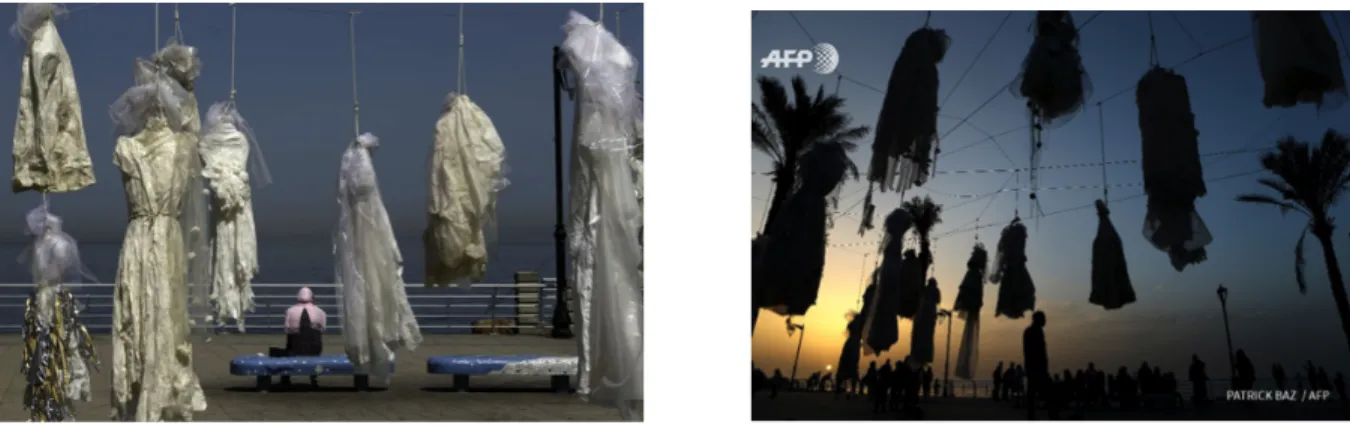
Lebanese artist Mireille Honeïn, who splits her time between Paris and Beirut, designed an installation that was coordinated by ABAAD organizers to symbolically tell the story of women subjected to the violence of Article 522. The installation was comprised of 31 white wedding dresses, made of tulle and other fabric, that hung from nooses that dangled from the palm trees lining the Corniche. The symbolic hanging of women who were forced to be brides after being raped, created a disturbing picture that drew international attention (BBC 2017).
Figure 5. & Figure 6. Mireille Honeïn’s installation on the Beirut Corniche, 2017 (BBC, Patrick Baz)
upward to the ghostly depictions of forced marriage and interpersonal violence. Even in photos, the installation is unsettling and not easy to digest, which is contradictory to the leisurely, social nature of the Corniche.
Conclusions
Full citizenship and participation in democracy are contingent upon access to public spaces like squares and parks. These spaces are where citizens see each other, engage in political discourse and carry out activism. The spaces are public, visible and social, which makes them highly contested and bound tightly to citizenship and empowerment. Traditionally,
the “interruption” becomes the accepted and women approach unhindered access to the public and to full citizenship.
Chapter 3
Conclusions and Conversations on Created Spaces
Women in the Arab World make up an incredibly diverse body of people in which there exists just as many distinguishing characteristics as there are commonalities. But despite this, the prevailing narrative of Arab women as social and political actors is homogenizing and suggests the “arrival” of Arab women to the scene took place during the popular demonstrations of the Arab Spring. There has been little Western coverage of Arab women’s activism before and after the Arab Spring, and even less on activism that breaks away from traditional popular
demonstrations. The lack of a popular, accurate narrative of Arab women’s activism contributes to the Western trope of the oppressed, forcibly veiled, mysteriously seductive and perpetually disempowered Arab woman, a widely disseminated and grossly inaccurate narrative.
I undertook this project with the intention of challenging the popularized image of the oppressed Arab woman by examining the ways in which Arab women occupy and manipulate space in order to carry out transformative, adaptive and dynamic activism. By accepting only a handful of circulated images of Arab women waving flags in squares during the Arab Spring and subsequently marking Arab women as recent political actors, Western media erases a nuanced and historically rich narrative of Arab women as activists. Though my project has its geographic and temporal limitations, the purpose of it is to expose readers to the ways women in the Arab World are navigating contested space, making space and claiming their rights to full citizenship and movement within their respective communities.
ideas and dialogue. Streets are vectors of citizenship, they are the grounds on which citizens communicate and engage in the public and there exist numerous tactics of patriarchal society that seek to exclude women from the space of streets, including harassment, restricted access to motor vehicles and violence. Arab women continue to craft activism initiatives in direct opposition to forces of gendered hierarchy that seeks to isolate them from the streets, and by using technology, community outreach, social media, street mobilization and self-defense, women are creatively asserting themselves in street space, accessing unhindered movement and claiming citizenship.
Much in the same way, public squares and parks are central to the Habermasian
conceptualization of “the public”, and women activists in the Arab World have experienced both the consequences and socio-political rewards of interrupting the normal operations of public gathering places. Women in Tahrir, who claimed their stake in public space during the revolution faced violence, including sexual violence made to particularly deter women from accessing the public arena. The backlash proved though, that women accessing public space is an immediate threat to the stability of patriarchal structures and male monopolies on power, and as Arab women continue to assert themselves into “the public”, despite the consequences, they work to dismantle exclusionary structures. Women activists in Beirut exemplified the creative and successful ways women interrupt public gathering places and change the way we conceptualize women’s activism.
how women create and maintain their own counterpublics; spaces that produce and reproduce narratives counter to normative public discourse.
The occupation and use of public spaces like streets and squares by Arab women is a crucial part of the way in which these women experience full citizenship and challenge patriarchal norms in their respective countries. The previous chapters established the dynamic ways in which Arab women have continued to claim stake in public space, employing the use of technology, community outreach and art. Public space is crucial for enacting citizenship but it is important to also understand the intimacy of women-only spaces and curated online communities as vital to the way in which women in the Arab world enact citizenship. The following sections should be understood within the same framework as the previous, that is that access to space creates more room for women to participate in activism. enact citizenship and move forward in the processes of empowerment, but in the cases of women-only spaces and curated online spaces, the women are creating the space themselves, not asserting themselves into established space.