https://doi.org/10.1177/0022034516686562
Journal of Dental Research 2017, Vol. 96(3) 277 –284
© International & American Associations for Dental Research 2017
Reprints and permissions: sagepub.com/journalsPermissions.nav DOI: 10.1177/0022034516686562 journals.sagepub.com/home/jdr
Research Reports: Clinical
GWAS Identifies New Loci for Painful
Temporomandibular Disorder: Hispanic
Community Health Study/Study of Latinos
A.E. Sanders
1,2, D. Jain
3, T. Sofer
3, K.F. Kerr
3, C.C. Laurie
3, J.R. Shaffer
4,5,
M.L. Marazita
4,6,7,8,9, L.M. Kaste
10, G.D. Slade
11,12, R.B. Fillingim
12, R. Ohrbach
13,
W. Maixner
14, T. Kocher
15, O. Bernhardt
15, A. Teumer
16, C. Schwahn
17,
K. Sipilä
18,19,20,21, R. Lähdesmäki
20,22, M. Männikkö
23,24, P. Pesonen
20, M. Järvelin
25,26,
C.M. Rizzatti-Barbosa
27, C.B. Meloto
28, M. Ribeiro-Dasilva
29, L. Diatchenko
30,
P. Serrano
31, and S.B. Smith
14Abstract
Temporomandibular disorder (TMD) is a musculoskeletal condition characterized by pain and reduced function in the temporomandibular joint and/or associated masticatory musculature. Prevalence in the United States is 5% and twice as high among women as men. We conducted a discovery genome-wide association study (GWAS) of TMD in 10,153 participants (769 cases, 9,384 controls) of the US Hispanic Community Health Study/Study of Latinos (HCHS/SOL). The most promising single-nucleotide polymorphisms (SNPs) were tested in meta-analysis of 4 independent cohorts. One replication cohort was from the United States, and the others were from Germany, Finland, and Brazil, totaling 1,911 TMD cases and 6,903 controls. A locus near the sarcoglycan alpha (SGCA), rs4794106, was suggestive in the discovery analysis (P = 2.6 × 10⁶) and replicated (i.e., 1-tailed P = 0.016) in the Brazilian cohort. In the discovery cohort,
sex-stratified analysis identified 2 additional genome-wide significant loci in females. One lying upstream of the relaxin/insulin-like family peptide receptor 2 (RXP2) (chromosome 13, rs60249166, odds ratio [OR] = 0.65, P = 3.6 × 10⁻⁸) was replicated among females in the
meta-analysis (1-tailed P = 0.052). The other (chromosome 17, rs1531554, OR = 0.68, P = 2.9 × 10⁻⁸) was replicated among females
(1-tailed P = 0.002), as well as replicated in meta-analysis of both sexes (1-tailed P = 0.021). A novel locus at genome-wide level of significance (rs73460075, OR = 0.56, P = 3.8 × 10⁻⁸) in the intron of the dystrophin gene DMD (X chromosome), and a suggestive locus
on chromosome 7 (rs73271865, P = 2.9 × 10⁻⁷) upstream of the Sp4 Transcription Factor (SP4) gene were identified in the discovery
cohort, but neither of these was replicated. The SGCA gene encodes SGCA, which is involved in the cellular structure of muscle fibers and, along with DMD, forms part of the dystrophin-glycoprotein complex. Functional annotation suggested that several of these variants reside in loci that regulate processes relevant to TMD pathobiologic processes.
Keywords: epidemiology, functional annotation, population, genetics, Hispanic Americans, musculoskeletal pain
Introduction
Chronic pain is pain that persists beyond the normal healing time (Bonica 1953) and no longer serves the adaptive warning function of nociception. In the United States, 25 million adults report chronic pain on a daily basis (Nahin 2015), and preva-lence of pain disorders increased, including facial pain, from 1997–1999 to 2011–2013 (Case and Deaton 2015). Because mechanisms underlying chronic pain are largely unknown, treatment in general has low effectiveness. For example, man-agement with nonsteroidal anti-inflammatory drugs has lim-ited efficacy (da Costa et al. 2016).
Much of the burden of chronic pain is attributable to tension headache, low back pain, neck pain, fibromyalgia, and face pain. One such condition, temporomandibular disorder (TMD), is a musculoskeletal condition characterized by nonodonto-genic pain and loss of function in the region innervated by the
trigeminal nerve. The condition is diagnosed clinically by assessing palpation tenderness and functional pain in the mas-seter and temporalis masticatory muscles (myalgia) and/or the temporomandibular joint/s (arthralgia). In contrast, most popula-tion-based surveys classify the condition using screening ques-tions. For example, in the 2014 US National Health Interview Survey, 4.6% of adults reported pain in the face or jaw in the previous 3 mo, with prevalence being higher among women (5.8%) than men (3.4%) (Blackwell et al. 2014).
headache, irritable bowel syndrome, low back pain, and chronic widespread pain. In a study that asked 200 women with persistent TMD to indicate the anatomic locations of their painful body sites on manikins, only 19% indicated sites lim-ited to the trigeminal system (Türp et al. 1998). Of the 5% of adults with TMD pain in 2000 to 2006 National Health Interview Surveys, 53% reported concomitant headache/ migraine and 64% reported concomitant low back pain (Plesh et al. 2011). Prevalence was similar in Sweden, affecting 5% of women and 2% of men (Lövgren et al. 2016), but higher preva-lence was reported in other population-based studies, including Germany (Gesch et al. 2004) and Italy (Ciancaglini and Radaelli 2001). Genetic studies are beginning to shed light onto the molecular basis for pain perception and to identify putative genes associated with various chronic pain disorders. Although these associations have not been consistently repli-cated (Foulkes and Wood 2008; Mogil 2012), a genetic basis for TMD pain seems plausible. The largest twin study of 1,236 monozygotic and 570 dizygotic female twin pairs estimated that the heredity of TMD pain was 27% (95% confidence limit [CL], 15 to 38) of the population variance in TMD pain (Plesh et al. 2012).
The discovery phase of this study sought to identify genetic loci associated with painful TMD via a genome-wide associa-tion scan of 10,153 men and women of Hispanic/Latino ances-try. The top signals were tested for replication in a meta-analysis using data from independent studies that conducted genome-wide association scans of painful TMD. We also conducted functional genomic analysis of significant loci to assess how the associated alleles could modulate gene or protein function.
Materials and Methods
Ethical Statement
This study was conducted according to the principles expressed in the Declaration of Helsinki. This study was approved by the institutional review boards (IRBs) of the 4 Hispanic Community Health Study/Study of Latinos (HCHS/SOL) field centers affiliated with San Diego State University, Northwestern University in Chicago, Albert Einstein College of Medicine in the Bronx area of New York, and the University of Miami. The Orofacial Pain: Prospective Evaluation and Risk Assessment (OPPERA) study was approved by the IRBs at the 4 study sites
1Department of Dental Ecology, University of North Carolina at Chapel Hill, Chapel Hill, NC, USA 2Center for Pain Research and Innovation, University of North Carolina at Chapel Hill, Chapel Hill, NC, USA 3Department of Biostatistics, University of Washington, Seattle, WA, USA
4Department of Human Genetics, Graduate School of Public Health, University of Pittsburgh, Pittsburgh, PA, USA
5Center for Craniofacial and Dental Genetics, Department of Oral Biology, School of Dental Medicine, University of Pittsburgh, Pittsburgh, PA, USA 6Center for Craniofacial and Dental Genetics, School of Dental Medicine, University of Pittsburgh, Pittsburgh, PA, USA
7Department of Oral Biology, School of Dental Medicine, University of Pittsburgh, Pittsburgh, PA, USA 8Department of Psychiatry, School of Medicine, University of Pittsburgh, Pittsburgh, PA, USA
9Clinical and Translational Science Institute, School of Medicine, University of Pittsburgh, Pittsburgh, PA, USA 10Department of Pediatric Dentistry, University of Illinois at Chicago, Chicago, IL, USA
11Department of Dental Ecology, University of North Carolina at Chapel Hill, Chapel Hill, NC, USA 12Pain Research & Intervention Center of Excellence, University of Florida, Gainesville, FL, USA 13Department of Oral Diagnostic Sciences, University at Buffalo, Buffalo, NY, USA
14Department of Anesthesiology, Center for Translational Pain Medicine, Duke University, Durham, NC, USA
15Department of Restorative Dentistry, Periodontology, Endodontology, Preventive Dentistry and Pediatric Dentistry, University Medicine Greifswald,
Greifswald, Germany
16Institute for Community Medicine, University Medicine Greifswald, Greifswald, Germany
17Department of Prosthetic Dentistry, Gerodontology and Biomaterials, University Medicine Greifswald, Greifswald, Germany 18Institute of Dentistry, University of Eastern Finland, Kuopio, Finland
19Oral and Maxillofacial Department, Kuopio University Hospital, Kuopio, Finland
20Research Unit of Oral Health Sciences, Faculty of Medicine, University of Oulu, Oulu, Finland
21Oral and Maxillofacial Department, Medical Research Center Oulu, Oulu University Hospital, Oulu, Finland 22Oral and Maxillofacial Department, Medical Research Center Oulu, Oulu University Hospital, Finland 23Center for Life Course Health Research, Faculty of Medicine, University of Oulu, Oulu, Finland 24Faculty of Biochemistry and Molecular Medicine, University of Oulu, Oulu, Finland
25Biocenter Oulu, University of Oulu, Center for Life Course Health Research, University of Oulu, Finland 26Unit of Primary Care, Oulu University Hospital, Oulu, Finland
27Department of Prosthesis and Periodontology, Piracicaba Dental Scholl, University of Campinas, Piracicaba, Brazil 28The Alan Edwards Centre for Research on Pain, Faculty of Dentistry, McGill University, Montreal, QC, Canada 29University of Florida, College of Dentistry, Gainesville, FL, USA
30Alan Edwards Pain Centre, McGill University, Montreal, QC, Canada
31Piracicaba Dental School, State University of Campinas, Department of Prosthesis and Periodontology, Brazil
A supplemental appendix to this article is available online.
Corresponding Author:
A.E. Sanders, University of North Carolina at Chapel Hill, Koury Oral Health Sciences Building, Rm 4502 CB# 7450, 385 South Columbia Street, Chapel Hill, NC 27599-7450, USA.
at the University of North Carolina at Chapel Hill, University of Maryland at Baltimore, University of Buffalo, University of Florida at Gainesville, and the data coordinating center Battelle Memorial Institute. The Study of Health in Pomerania (SHIP) was approved by the IRB affiliated with study at the University of Greifswald, Germany. The Northern Finland Birth Cohort (NFBC) study was approved by the human study ethical com-mittees of the University of Oulu and the Northern Ostrobothnia Hospital District. The Brazilian study was approved by the IRB affiliated with the University of Campinas, Piracicaba, São Paulo in Brazil.
This study conformed with Strengthening the Reporting of Observational Studies in Epidemiology (STROBE) guidelines for observational studies.
HCHS/SOL
The HCHS/SOL is a population-based cohort in the United States. Between 2008 and 2011, the HCHS/SOL enrolled 16,415 study participants who were recruited as self-identified Hispanic/Latino participants aged 18–74 y at each of 4 US com-munities located in the Bronx, New York; San Diego, California; Miami, Florida; and Chicago, Illinois. The stratified multistage area probability sample of the 4 study sites was purposefully designed to have high concentrations of specific Hispanic/ Latino backgrounds, allowing estimation of prevalence rates of diseases and risk factors for each background. Details of the design, recruitment, and implementation of HCHS/SOL have been published (Lavange et al. 2010; Sorlie et al. 2010). The present study reports cross-sectional analysis of baseline data.
TMD Phenotype in the Discovery
HCHS/SOL Cohort
The HCHS/SOL Oral Health Questionnaire asked participants, “In the past 12 mo have you had or do you currently have pain in your face?” They were also asked, “In the past 12 mo have you had or do you currently have pain in your jaw joint?” Response options for both questions were yes/no. To be classi-fied as a TMD case, participants had to report having had pain in both their face and in their jaw joint. The requirement of pain in both face and jaw joint is a stringent case definition. The rationale was to reduce misclassification bias due to other causes underlying one or the other pain locations and limit phe-notypic heterogeneity that could arise from the presence of pain in either the muscle or the joint. However, no information was available on the duration of symptoms; thus, TMD cases may include individuals with acute (i.e., self-limited short-term pain) or chronic (i.e., persistent) TMD.
Descriptive univariate multivariate analyses were con-ducted on all 15,344 HCHS/SOL participants who provided information about TMD symptoms. These analyses were weighted to account for the stratified multistage area probabil-ity sampling and to at least partially adjust for any bias effects due to differential nonresponse in the selected sample at the
household and person levels. The adjusted weights were also trimmed to limit precision losses due to the variability of the adjusted weights and calibrated to the 2010 Census character-istics by age, sex, and Hispanic background in each field site’s target population. All analyses also account for cluster sam-pling and the use of stratification in sample selection.
Genome-Wide Association Study Quality Control
In the HCHS/SOL, DNA was extracted from blood samples according to standard protocols. Participants were genotyped on the HCHS Custom 15041502 B3 array (Illumina Omni2.5M+custom content). Quality control was conducted as previously described (Laurie et al. 2010; Conomos et al. 2016). In brief, DNA samples were checked for annotated versus genetic sex discrepancies, gross chromosomal anomalies, missing call rates, contaminations, and batch effects. Single-nucleotide polymorphism (SNP) quality metrics included Illumina/LA Biomed assay failure indicator, missing call rates, deviation from Hardy-Weinberg equilibrium, Mendelian errors, and duplicate sample discordance. After quality control, there were about 1.7 million genotyped SNPs and 10.3 million imputed SNPs available for analysis.
Genotypes were prephased using SHAPEIT2 and imputed using IMPUTE2 into the 1000 Genomes Phase 1 reference panel. For imputed SNPs, we calculated the imputation quality scores “info” and “oevar” (ratio of observed to expected vari-ance of imputed dosage) for each SNP and excluded SNPs with oevar <0.3 (Li et al. 2010). Finally, SNPs with 50 or fewer counts of the expected or effective number of copies (effN) of the minor allele were excluded from analysis (Cade et al. 2016). A variant’s effN is approximately its minor allele count and was estimated as 2 × MAF × (1−MAF) × N × oevar, where MAF is the frequency of the minor allele, N is the number of participants, and oevar is set to 1 for genotyped variants. After quality control, there were about 1.4 million genotyped SNPs and 7 million imputed SNPs available for analysis.
Statistical Analysis in HCHS/SOL
To account for population structure and relatedness, we applied a logistic mixed model using GMMAT (Chen et al. 2016) to test for a SNP genotype and case versus control status. The model adjusted for fixed effects of age, sex, recruitment site, log sam-pling weight, 5 principal components of ancestry, and 6 genetic analysis groups. We provide 95% CLs obtained from the replica-tion cohort but not the discovery cohort; confidence intervals from the discovery study underestimate the plausible range of values for the measure of association (Zhong and Prentice 2008). We provide 95% CLs obtained from the replication cohort, as these are expected to have the correct 95% coverage, while the confidence limits from the discovery study underestimate the plausible range of values for the measure of association.
shown by Conomos et al. (2016) that it is advantageous to adjust for this variable, compared to self-reported ethnicity.
Meta-Analysis
We looked for replication of the top findings in 4 independent cohorts of examiner-determined TMD. Meta-analysis was used to combine the effects of all replication cohorts, where possible, as a primary test of replication. For SNPs that were not found in multiple replication cohorts, evidence from the single available cohort was used to assess replication. Random-effects meta-analysis was performed using PLINK 1.07 software (Purcell et al. 2007). Allelic odds ratios (ORs), 95% CLs, and P values were calculated separately for each genome-wide association study (GWAS) included in the meta-analysis. Study-specific SNP fil-ters for imputation quality and minor allele frequency (MAF) were imposed, as described for each study. All SNPs passing quality assurance (QA)/quality control (QC) filters in at least 2 cohorts were included in the meta-analysis. The forward strand allele (using reference assemble GRCh37) was used as the ref-erence to standardize direction of ORs. As replication implicitly requires the same direction of effect as the original finding, P values were calculated for one-sided tests; P < 0.05 in a 1-sided test was considered the threshold for a replicated association. The Cochrane’s Q statistic P value was used as a measure of heterogeneity between studies (Xu et al. 2008).
Replication Cohorts
Details of the clinical examination used to determine TMD case classification are described in the online Appendix. Here we describe the TMD phenotype.
OPPERA
The OPPERA case-control cohort included 3,030 participants, of whom 999 were TMD cases and 2,031 TMD-free controls. Examiners determined classification of TMD according to the Research Diagnostic Criteria for TMD (Dworkin and LeResche 1992). As reported previously (Ohrbach et al. 2011), cases met all 3 of the following criteria: 1) pain reported with sufficient frequency in the cheeks, jaw muscles, temples, or jaw joints during the preceding 6 mo; 2) pain reported in the examiner-defined orofacial region for at least 5 d out of the prior 30 d; and 3) pain reported in at least 3 masticatory muscles or at least
1 temporomandibular joint in response to palpation of the oro-facial muscles or maneuver of the jaw.
SHIP
The German cohort was derived from a large cross-sectional survey of a representative sample of Pomerania, Germany, the SHIP study (Bernhardt et al. 2004). Participants were aged 20 to 81 y and included 51% females. Participants reported symptoms by questionnaire regarding pain in the temporomandibular joint and facial muscles; presence and frequency of pain were assessed. During a clinical exam, the examiner inquired about pain or discomfort upon palpation of masticatory tissues, includ-ing temporomandibular joints (dorsocranial and lateral) at 2 kg/cm2
and masseter, temporalis, and medial pterygoid at 1 kg/cm2.
NFBC
The NFBC is a cohort study of all births in 1966 in the Oulu and Lapland provinces of northern Finland. An assessment for TMD was performed at the 46-y follow-up time point. Participants (52% female) reported symptoms by responding to a questionnaire with the following questions: 1) “Do you experience temple, temporomandibular joint, face, or jaw pain once a week or more often?” 2) “Do you experience pain once a week or more often while opening your mouth wide?” A clinical exam determined the presence of examiner-evoked pain in 3 or more temporomandibular muscles and/or joints.
Brazilian Cohort
The Brazilian participants were enrolled in a community-based case-control study in Piracicaba, São Paulo, Brazil, and included females between the ages of 18 and 44 y. Pain history was deter-mined by asking participants the following question: “Have you had pain in your head, face, jaw, or in front of the ears in the last 30 d?” The examiner manually palpated lateral and posterior temporomandibular joints (0.45 kg) and asked participants to report yes or no responses to the presence of pain.
Results
Descriptive univariate associations between study participant characteristics and TMD in the full HCHS/SOL cohort are reported in Appendix Table 1 along with recruitment
Table 1. Summary of the Association Results of the Discovery GWAS in the HCHS/SOL.
Analysis Chromosome Position rsID Nearest Gene A1/A2 A1.freq n OR P Value
All 23 32283492 rs73460075 DMD G/C 0.964 10,142 0.563 3.79E-08 All 17 48238294 rs4794106 SGCA T/C 0.549 10,153 1.296 2.60E-06 All 7 21399327 rs73271865 SP4 C/T 0.959 10,153 0.559 2.91E-07 Females 13 32084901 rs60249166 RXP2 C/T 0.812 5,820 0.645 3.57E-08 Females 17 79380547 rs1531554 BAHCC1 T/C 0.476 5,820 0.678 2.92E-08
site-adjusted OR and 95% CL. Prevalence of TMD was 5.1%. Females had 2-fold greater odds of TMD than males. Odds of TMD declined after age 55 y. Adults who did not graduate high school had 20% greater odds of TMD than those with edu-cation beyond high school eduedu-cation. Current smokers had 30% greater odds than lifetime nonsmokers. Depressive symptoms, anxiety, and poor mental and physical health were all associated with increased odds of TMD. Odds of TMD did not differ among Hispanic/Latino groups or differ on the basis of nativity, body mass index, or health insurance status.
The genome-wide scan of the HCHS/ SOL cohort used DNA from whole blood collected at baseline from 10,153 study par-ticipants (769 TMD cases and 9,384 con-trols). Excluded from analysis were 2,603 participants with missing information for the TMD trait and an additional 63 partici-pants with missing information for genetic subgroup. A quantile-quantile (Q-Q) plot analysis was conducted of the observed versus expected P values for all 8,441,843 SNPs that passed quality filters (effN > 50 in both cases and controls) and had a MAF of >3% (Appendix Fig. 1). Departures in the extreme tail of the distribution of test statistics are due to regions with a strong signal for association. The genomic infla-tion factor (lambda statistic 1.007) shows no evidence of genomic inflation.
The discovery GWAS (Table 1) revealed a novel locus that exceeded the genome-wide threshold for significance on the X chromosome, rs73460075 (Manhattan plot, Fig. 1), OR = 0.56, P = 3.8 × 10⁻⁸. A
regional association plot (Fig. 2) shows all SNPs in this region plotted according to the significance of their association with TMD and color-coded according to their linkage disequilibrium (r2) with the most
significant SNP. This locus is rare in European populations (MAF < 0.001) but is common in African populations (MAF = 0.146), according to the 1000 Genomes Project Phase 1. This SNP lies in the intron of the dystrophin-encoding DMD gene responsible for Duchenne muscular dystro-phies. In addition, we found suggestive
evidence of an association with TMD for 2 loci (Appendix Fig. 4A, B). One was rs4794106 near the sarcoglycan alpha (SGCA) gene (OR = 1.30, P = 2.6 × 10⁻⁶), and the other was rs73271865
upstream of the Sp4 transcription factor (SP4) gene (OR = 0.56, P = 2.9 × 10⁻⁷) (Appendix Fig. 2A, B).
The Q-Q plots for sex-stratified genome-wide association analyses did not indicate any evidence for systematic increase in false positives as the observed distribution did not deviate from the expected distribution (Appendix Fig. 3). The sex-stratified genome-wide association in females identified 2
Figure 1. Manhattan plot showing association between the tested single-nucleotide polymorphisms and painful temporomandibular disorder for men and women combined in the Hispanic Community Health Study/Study of Latinos discovery genome-wide association analysis. The X axis shows the chromosomal position, and the Y axis shows the significance level with the horizontal dashed line indicating the genome-wide significance threshold (P = 5 × 10⁻⁸).
Figure 2. Regional association plot (LocusZoom) for the DMD-region (X chromosome) significantly associated with painful temporomandibular disorder in the Hispanic Community Health Study/Study of Latinos discovery cohort, men and women combined. The –log10 of
additional significant loci shown in the Manhattan plot (Fig. 3). The first, rs60249166 on chromosome 13 (P = 3.6 × 10⁻⁸),
lies upstream of the RXP2 gene (relaxin/insulin-like family peptide receptor 2, Appendix Fig. 4A). The second, rs1531554 on chromosome 17 (P = 2.9 × 10⁻⁸), is located in the first exon
of the BAHCC1 gene (BAH domain and coiled-coil containing 1, Appendix Fig. 4B).
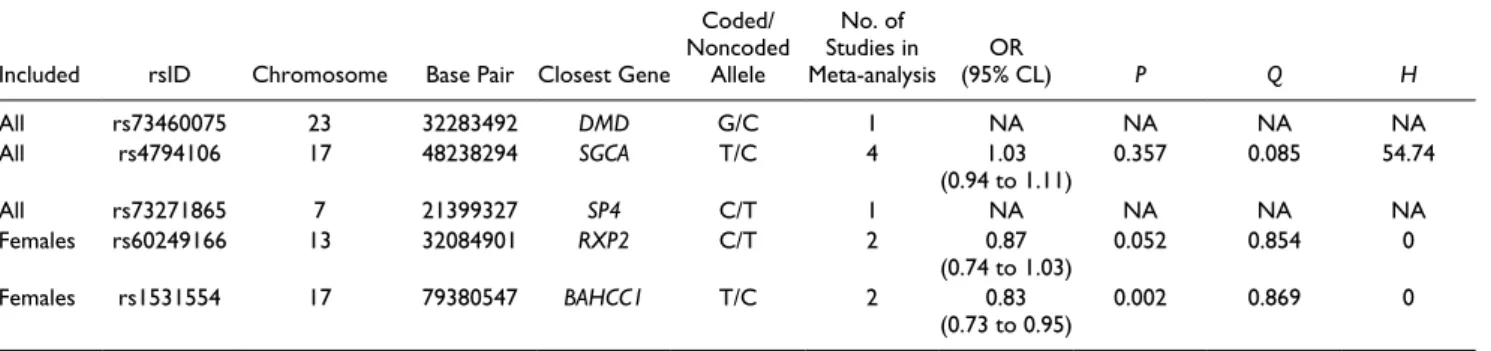
The 3 SNPs associated with TMD among all adults (rs73460075, rs4794106, and rs73271865) and the 2 SNPs associated with TMD among females only (rs60249166, rs1531554) in the HCHS/SOL discovery phase were further evaluated in 4 independent cohorts (Appendix Table 2), as well as in a meta-analysis of their combined evidence of associa-tions (Table 2). These independent studies are OPPERA (con-ducted in the United States), SHIP (con(con-ducted in Germany), NFBC, and a case-control study of TMD conducted in Piracicaba, São Paulo, Brazil.
The SNPs in the DMD (rs73460075) and SP4 (rs73271865) loci were only available in the OPPERA cohort, and neither was significantly associated with TMD (P = 0.28 and 0.36, respectively). However, the SNP near the SGCA locus (rs4794106) was found in all 4 replication cohorts. Although the combined evidence from the 4 cohorts was not significant (meta-analysis P = 0.40), the association observed in the cohort from Brazil supported the original finding (P = 0.02). To
confirm the female-specific findings, we used the results of sex-stratified analyses in the replication cohorts. There was evidence from the meta-analysis of 2 studies to sup-port the association near the RXP2 locus (rs60249166, P = 0.05), although it was not significant in either the OPPERA study (P = 0.10) or SHIP study (P = 0.11) alone. Finally, the SNP in the BAHCC1 locus was significant in both OPPERA (P = 0.001) and SHIP (P = 0.03), as well as in the meta-analysis of both cohorts (P = 0.002).
Discussion
This GWAS in the HCHS/SOL cohort revealed several promising association sig-nals for painful TMD, with supporting evi-dence from both biological relevance to nociception as well as replication in a meta-analysis of 4 independent cohorts. Two prominent associations (near DMD and SGCA) implicate the same dystrophin-glycoprotein pathway, suggesting that biome-chanical properties of muscle fibers contribute to orofacial pain. Although we were not able to replicate the association at the DMD locus, the association at the SGCA locus was signifi-cantly replicated in 1 independent cohort and was consistent in direction in the meta-analysis of 4 cohorts. The SGCA gene encodes SGCA, which is involved in the cellular structure of muscle fibers and, along with DMD, forms part of the dystrophin-glycoprotein complex. Likewise, we were limited in our ability to confirm the suggestive association at the SP4 locus, but the effect direction was the same in the 1 independent cohort with data available. As SP4 is a transcription factor for the transient receptor potential vanilloid 1 (TRPV1), which is upregulated in chronic pain states, this finding should be investigated further. The biological relevance to nociception of the 2 loci discov-ered in the female-only GWAS analyses (near RXP2 and BAHCC1) is not as easily explained, but these associations were consistently supported by the replication cohorts and may be important novel discoveries.
A potential limitation of the HCHS/SOL discovery cohort was its dependence on self-reported facial pain, which is known to have good specificity (95%) but poor sensitivity
Figure 3. Manhattan plot showing the chromosomal position and –log10 (P value) of the
single-nucleotide polymorphisms (SNPs) among females in the Hispanic Community Health Study/Study of Latinos discovery genome-wide association analysis (P < 5 × 10⁻⁸ indicated by
the dotted black line). Two SNPs exceed the genome-wide significance threshold.
Table 2. Summary of the Association Results of the Meta-analysis.
Included rsID Chromosome Base Pair Closest Gene
Coded/ Noncoded
Allele
No. of Studies in
Meta-analysis (95% CL)OR P Q H
All rs73460075 23 32283492 DMD G/C 1 NA NA NA NA
All rs4794106 17 48238294 SGCA T/C 4 1.03
(0.94 to 1.11) 0.357 0.085 54.74
All rs73271865 7 21399327 SP4 C/T 1 NA NA NA NA
Females rs60249166 13 32084901 RXP2 C/T 2 0.87
(0.74 to 1.03) 0.052 0.854 0 Females rs1531554 17 79380547 BAHCC1 T/C 2 0.83
(0.73 to 0.95) 0.002 0.869 0
(43%) compared to examiner-determined TMD (Janal et al. 2008).
However, in most situations, misclassification that is non-differential with respect to the genotype will bias estimates toward the null, assuming that the misclassification of TMD pain is independent of other errors. Based on this assumption, our estimates of association in the discovery cohort are conser-vative and reduce the risk of false-positive genetic associa-tions. A related point is that 3 of the 4 replication cohorts used examiner-determined case classifications for TMD, which means that data from those studies do not satisfy requirements for “exact replication” of the HCHS/SOL discoveries (Ioannidis et al. 2009). This is a common problem for GWAS replication studies where at least some variation in phenotype definitions has been described as “unavoidable” (Kraft et al. 2009). The replication studies also varied in sampling methods, study pop-ulation, and demographic characteristics. We therefore inter-pret the current findings of consistency among cohorts as evidence that the associations are robust and generalizable to different study populations.
Overall, we discovered and replicated SNP associations with TMD in multiple loci. For 2 loci, we propose plausible mechanism of regulation and potential causal SNPs via com-prehensive functional annotation of processes relevant to TMD pathology.
Author Contributions
A.E. Sanders, contributed to conception, design, data analysis, and interpretation, drafted and critically revised the manuscript; D. Jain, T. Sofer, contributed to data analysis and interpretation, drafted and critically revised the manuscript; K.F. Kerr, C.C. Laurie, J.R. Shaffer, M.L. Marazita, contributed to data interpretation, criti-cally revised the manuscript; L.M. Kaste, contributed to data acquisition, critically revised the manuscript; G.D. Slade, C. Schwahn, contributed to data analysis and interpretation, critically revised the manuscript; R.B. Fillingim, R. Ohrbach, W. Maixner, T. Kocher, O. Bernhardt, A. Teumer, K. Sipilä, R. Lähdesmäki, M. Männikkö, P. Pesonen, M. Järvelin, C.M. Rizzatti-Barbosa, C.B. Meloto, M. Ribeiro-Dasilva, L. Diatchenko, P. Serrano, contrib-uted to data acquisition and interpretation, critically revised the manuscript; S.B. Smith, contributed to design, data analysis, and interpretation, drafted and critically revised the manuscript. All authors gave final approval and agree to be accountable for all aspects of the work.
Acknowledgments
We thank the participants and staff of the Hispanic Community Health Study/Study of Latinos (HCHS/SOL). The baseline exami-nation of HCHS/SOL was supported by contracts from the National Heart, Lung, and Blood Institute (NHLBI) to the University of North Carolina (grant number N01-HC65233), University of Miami (N01-HC65234), Albert Einstein College of Medicine (N01-HC65235), Northwestern University (N01-HC 65236), and San Diego State University (N01-HC65237). The National Institute on Minority Health and Health Disparities, National Institute on Deafness and Other Communication Disorders, National Institute of Dental and Craniofacial Research
(NIDCR), National Institute of Diabetes and Digestive and Kidney Diseases (NIDDK), National Institute of Neurological Disorders and Stroke, and National Institutes of Health (NIH) Office of Dietary Supplements also contributed funding to HCHS/SOL. The Genetic Analysis Center at the University of Washington was sup-ported by NHLBI and NIDCR contracts (grant numbers HHSN268201300005C AM03 and MOD03). Additional analysis support was provided by 1R01DK101855-01 and 13GRNT1 6490017. Genotyping efforts were supported by NHLBI HSN 26220/20054C, NCATS CTSI grant UL1TR000124, and NIDDK Diabetes Research Center (DRC) (grant DK063491). Additional support for rs117672662 functional studies was provided by grant R01 DK072193. Data from HCHS/SOL are available through the NIH database of Genotypes and Phenotypes (dbGaP): phs000810. v1.p1.
OPPERA was supported by NIDCR (grant number U01DE017018). The OPPERA program also acknowledges resources specifically provided for this project by the respective host universities: University at Buffalo, University of Florida, University of Maryland–Baltimore, and University of North Carolina–Chapel Hill. Funding for genotyping was provided by NIDCR through a contract to the Center for Inherited Disease Research at Johns Hopkins University (HHSN268201200008I). Data from the OPPERA study are available through the NIH dbGaP: phs000796.v1.p1, phs000761.v1.p1.
SHIP is part of the Community Medicine Research net of the University of Greifswald, Germany, by the Federal Ministry of Education and Research (grant numbers 01ZZ9603, 01ZZ0103, and 01ZZ0403), the Ministry of Cultural Affairs, and the Social Ministry of the Federal State of Mecklenburg–West Pomerania and the network “Greifswald Approach to Individualized Medicine (GANI_MED),” funded by the Federal Ministry of Education and Research (grant number 03IS2061A).
Genome-wide data have been supported by the Federal Ministry of Education and Research (grant number 03ZIK012) and a joint grant from Siemens Healthcare (Erlangen, Germany) and the Federal State of Mecklenburg–West Pomerania. The University of Greifswald is a member of the Caché Campus pro-gram of the InterSystems GmbH.
late Academian of Science Leena Peltonen. The study has been financially supported by the Academy of Finland, the European Commission (EURO-BLCS, Framework 5 award QLG1-CT-2000-01643), the Sigrid Jusélius Foundation, and US National Institute of Mental Health (5R01MH 63706:02).
The Brazilian cohort has been funded by the São Paulo Research Foundation (grant numbers 2006/56019-8R and 2009/02520-6), and genotyping was funded by the Canadian Excellence Research Chairs (CERC) Program (grant CERC09).
The authors declare no potential conflicts of interest with respect to the authorship and/or publication of this article.
References
Bernhardt O, Gesch D, Schwahn C, Bitter K, Mundt T, Mack F, Kocher T, Meyer G, Hensel E, John U. 2004. Signs of temporomandibular disorders in tinnitus patients and in a population-based group of volunteers: results of the Study of Health in Pomerania. J Oral Rehabil. 31(4):311–319. Blackwell DL, Lucas JW, Clarke TC. 2014. Summary health statistics for U.S.
adults: national health interview survey, 2012. Vital Health Stat. 10(260):1–161. Bonica JJ. 1953. The management of pain. Philadelphia (PA): Lea & Febiger. Cade BE, Chen H, Stilp AM, Gleason KJ, Sofer T, Ancoli-Israel S, Arens R,
Bell GI, Below JE, Bjonnes AC, et al. 2016. Genetic associations with obstructive sleep apnea traits in Hispanic/Latino Americans. Am J Respir Crit Care Med. 194(7):886–897.
Case A, Deaton A. 2015. Rising morbidity and mortality in midlife among white non-Hispanic Americans in the 21st century. Proc Natl Acad Sci U S A. 112(49):15078–15083.
Chen H, Wang C, Conomos MP, Stilp AM, Li Z, Sofer T, Szpiro AA, Chen W, Brehm JM, Celedon JC, et al. 2016. Control for population structure and relatedness for binary traits in genetic association studies via logistic mixed models. Am J Hum Genet. 98(4):653–666.
Ciancaglini R, Radaelli G. 2001. The relationship between headache and symp-toms of temporomandibular disorder in the general population. J Dent. 29(2):93–98.
Conomos MP, Laurie CA, Stilp AM, Gogarten SM, McHugh CP, Nelson SC, Sofer T, Fernandez-Rhodes L, Justice AE, Graff M, et al. 2016. Genetic diversity and association studies in US Hispanic/Latino populations: appli-cations in the Hispanic community health study/study of Latinos. Am J Hum Genet. 98(1):165–184.
da Costa BR, Reichenbach S, Keller N, Nartey L, Wandel S, Juni P, Trelle S. 2016. Effectiveness of non-steroidal anti-inflammatory drugs for the treatment of pain in knee and hip osteoarthritis: a network meta-analysis. Lancet. 387(10033):2093–2105.
Dworkin SF, LeResche L. 1992. Research diagnostic criteria for temporoman-dibular disorders: review, criteria, examinations and specifications, cri-tique. J Craniomandib Disord. 6(4):301–355.
Edwards RR, Grace E, Peterson S, Klick B, Haythornthwaite JA, Smith MT. 2009. Sleep continuity and architecture: associations with pain-inhibitory processes in patients with temporomandibular joint disorder. Eur J Pain. 13(10):1043–1047.
Foulkes T, Wood JN. 2008. Pain genes. PLoS Genet. 4(7):e1000086. Gesch D, Bernhardt O, Alte D, Schwahn C, Kocher T, John U, Hensel E. 2004.
Prevalence of signs and symptoms of temporomandibular disorders in an urban and rural German population: results of a population-based study of health in Pomerania. Quintessence Int. 35(2):143–150.
Ioannidis JP, Thomas G, Daly MJ. 2009. Validating, augmenting and refining genome-wide association signals. Nat Rev Genet. 10(5):318–329. Janal MN, Raphael KG, Nayak S, Klausner J. 2008. Prevalence of myofascial
temporomandibular disorder in US community women. J Oral Rehabil. 35(11):801–809.
Kraft P, Zeggini E, Ioannidis JP. 2009. Replication in genome-wide association studies. Stat Sci. 24(4):561–573.
Laurie CC, Doheny KF, Mirel DB, Pugh EW, Bierut LJ, Bhangale T, Boehm F, Caporaso NE, Cornelis MC, Edenberg HJ, et al. 2010. Quality control and quality assurance in genotypic data for genome-wide association studies. Genet Epidemiol. 34(6):591–602.
Lavange LM, Kalsbeek WD, Sorlie PD, Aviles-Santa LM, Kaplan RC, Barnhart J, Liu K, Giachello A, Lee DJ, Ryan J, et al. 2010. Sample design and cohort selection in the Hispanic Community Health Study/Study of Latinos. Ann Epidemiol. 20(8):642–649.
Li Y, Willer CJ, Ding J, Scheet P, Abecasis GR. 2010. Mach: using sequence and genotype data to estimate haplotypes and unobserved genotypes. Genet Epidemiol. 34(8):816–834.
Lövgren A, Häggman-Henrikson B, Visscher CM, Lobbezoo F, Marklund S, Wänman A. 2016. Temporomandibular pain and jaw dysfunction at dif-ferent ages covering the lifespan—a population based study. Eur J Pain. 20(4):532–540.
Manfredini D, Bandettini di Poggio A, Cantini E, Dell’Osso L, Bosco M. 2004. Mood and anxiety psychopathology and temporomandibular disorder: a spectrum approach. J Oral Rehabil. 31(10):933–940.
Mogil JS. 2012. Pain genetics: past, present and future. Trends Genet. 28(6):258–266. Nahin RL. 2015. Estimates of pain prevalence and severity in adults: United
States, 2012. J Pain. 16(8):769–780.
Ohrbach R, Fillingim RB, Mulkey F, Gonzalez Y, Gordon S, Gremillion H, Lim PF, Ribeiro-Dasilva M, Greenspan JD, Knott C, et al. 2011. Clinical findings and pain symptoms as potential risk factors for chronic TMD: descriptive data and empirically identified domains from the OPPERA case-control study. J Pain. 12(Suppl 11):T27–T45.
Plesh O, Adams SH, Gansky SA. 2011. Temporomandibular joint and muscle disorder-type pain and comorbid pains in a national US sample. J Orofac Pain. 25(3):190–198.
Plesh O, Noonan C, Buchwald DS, Goldberg J, Afari N. 2012. Temporomandibular disorder-type pain and migraine headache in women: a preliminary twin study. J Orofac Pain. 26(2):91–98.
Purcell S, Neale B, Todd-Brown K, Thomas L, Ferreira MA, Bender D, Maller J, Sklar P, de Bakker PI, Daly MJ, et al. 2007. Plink: a tool set for whole-genome association and population-based linkage analyses. Am J Hum Genet. 81(3):559–575.
Smith MT, Wickwire EM, Grace EG, Edwards RR, Buenaver LF, Peterson S, Klick B, Haythornthwaite JA. 2009. Sleep disorders and their association with laboratory pain sensitivity in temporomandibular joint disorder. Sleep. 32(6):779–790.
Sorlie PD, Avilés-Santa LM, Wassertheil-Smoller S, Kaplan RC, Daviglus ML, Giachello AL, Schneiderman N, Raij L, Talavera G, Allison M, et al. 2010. Design and implementation of the Hispanic community health study/study of Latinos. Ann Epidemiol. 20(8):629–641.
Türp JC, Kowalski CJ, O’Leary N, Stohler CS. 1998. Pain maps from facial pain patients indicate a broad pain geography. J Dent Res. 77(6):1465–1472. Von Korff M, Simon G. 1996. The relationship between pain and depression.
Br J Psychiatry Suppl. (30):101–108.
Xu H, Platt RW, Luo ZC, Wei S, Fraser WD. 2008. Exploring heterogene-ity in meta-analyses: needs, resources and challenges. Paediatr Perinat Epidemiol. 22(Suppl 1):18–28.