Iranian Rehabilitation Journal, Vol. 8, No. 12, December 2010
Original Article
Concurrent Validity of Functional Gait Assessment, Timed Up and
Go, and Gait Speed Tests in the Persian Community-Dwelling elderly
Ahmad Ali Akbari Kamrani, MD
University of Social Welfare and Rehabilitation Sciences, Tehran, Iran
Seyed Hojjat Zamani Sani
*, Zahra Fathi Rezaie
Shahid Beheshti University, Tehran, Iran
Mohammad Taghi Aghdasi
Tabriz University, Tabriz, Iran
Objectives: The purpose of this study was to evaluate the concurrent validity of the Farsi version of Functional Gait Assessment (FGA), Timed Up & Go (TUG), and Gait Speed tests in Persian community-dwelling older adults.
Method: Subjects were 100 males in falling or no falling history group (50 subjects in each group). Subjects were community-dwelling adults aged 60-90 years who were living in Tehran city. Each subject completed FGA, TUG, and GS tests once and was scored simultaneously by one tester.
Results: Results show that the FGA and the TUG test were negative and significant correlated (r=-0.81; P<0.01), FGA and the Gait speed test were negative and significant correlated (r=-0.77; P<0.01) and also TUG test and the Gait speed test were positive and significant correlated (r=0.67;P<0.01).
Conclusion: Concurrent validity has been established for the FGA, TUG and Gait speed tests in Persian community-dwelling older adults with and without falling history. FGA, TUG and Gait Speed tests are appropriate gait and balance tools for people with and without falling history, and appear to be more sensitive in identifying and detecting Persian elderly at risk of falling.
Keywords: Functional Gait Assessment, Timed Up & Go test, Gait Speed test, Concurrent validity, Persian elderly
Introduction
Falling is a major problem in older individuals, with 30% to 50% of older adults reporting a fall each year (1). Thus, it is important to find methods to identify and recognize the old people who are at risk of falling.
The development and applying of tools that screen for falling risk are useful to discover the elderly who are at risk of falling and prescribe the appropriate intervention. Several fall risk screening tools have been developed for and tested with older adults. Also, several measures of mobility and balance have been examined in relation to falls. Three samples of these tests are Functional Gait assessment, Gait Speed test and Timed Up and Go test.
The Functional Gait Assessment (FGA) tool is a standardized test for assessing postural stability during various walking tasks (2). The test is a modified version of the Dynamic Gait Index (DGI), which was developed to assess gait and risk of falling in adults over 60 years of age by testing their
ability to respond changing gait tasks and requirements (3, 4). The FGA is a 10-item gait test that comprises 7 of the 8 items of the original DGI and 3 new items, including “gait with narrow base of support,” “ambulating backwards,” and “gait with eyes closed” (5). So the tool is a modification of the DGI that was developed to improve the reliability of the DGI and to reduce the ceiling effect seen with the DGI. Wrisley and colleagues examined the psychometric properties of the FGA within a population of patients with vestibular disorders. Interrater reliability was good (ICC=0.86), as was intrarater reliability (ICC= 0.74). Concurrent validity with other balance measures, including the TUG (r = -0.50), DGI (r = 0.80), number of falls (r = -0.66), Activities-specific Balance Confidence Scale (ABC scale) (r = 0.64) and Dizziness Handicap Index (r = -0.64) (2).
be used as a single measure of functional gait, since it is simple, quick, and appears to be a composite measure of temporal and distance variables (6). The third test is the Timed Up and Go test. The TUG measures the time it takes a subject to stand up from an armchair, walking a distance of 3 m, then turning, walking back to the chair, and sitting down. It was developed originally as a clinical measure of balance in elderly people and was scored on an ordinal scale of 1 to 5 based on an observer’s perception of the performer’s risk of falling during the test (7). Podsiadlo and Richardson modified the original test by timing the task (rather than scoring it qualitatively) and proposed its use as a short test of basic mobility skills for frail community-dwelling elderly (8).
Wrisley and Kumar reported correlation of Functional gait assessment and TUG - 0.84 (9). Also Freter and Fruchter reported correlation of TUG and Gait Speed 0.74 (10). Wrisley et al in investigation of reliability, internal consistency, and validity of data obtained with the Functional Gait Assessment expressed the correlation of FGA and TUG - 0.50 and correlation of FGA and number of falls - 0.66 (5). In this regard, the objective of this study was to determine the concurrent validity of Farsi version of Functional Gait Assessment, Timed Up and Go, and Gait Speed tests in Persian community-dwelling older adults. If concurrent validity is established, these tools can be used with this population as a measure of balance and gait.
Materials and Methods
Our study was designed to include 100 subjects in two groups of with and without of falling history (50 subjects in each group). Subjects were volunteers and community-dwelling adults aged 60- 90 years from Tehran that were chosen by availability sampling. For the purposes of our study, community dwellers were defined as elderlies living independently with no assistance in activities of daily living. We relied on subjects’ self-claims to determine whether criteria were met. We recruited our subjects from four parks of Tehran (Gholrizan, Mellat, Niavaran ,…). Individuals were invited to participate if on a written questionnaire, they claimed having no history of vestibular problems or dizziness, neurological disorders, cerebral palsy, stroke or amputation, or any other serious medical conditions that limit their mobility. None of our subjects were using an assistive device during testing. Subjects were required to understand and sign a consent form and to follow verbal commands.
All participants met the following inclusion criteria: living independently in the community; being able to stand independently longer than 1 minute; and having a Mini-Mental State Examination score of greater than 24.
Data collection was performed at different locations as a convenience to subjects and to reach the largest number of test subjects.
Procedures
Patients performed the Functional Gait Assessment, Timed Up and Go, and Gait Speed tests. During the same session, participants completed the following assessment in the order listed: FGA, TUG, and Gait speed test. All tests were administered by the same rater (Z.F.Rezaie.), a motor behavior expert, with 3 years of experience, who was trained in the administration of the tests by the other author (A.A.A.Kamrani), an elderly medicine specialist well experienced in working with tests of the evaluation and treatment of patients with balance dysfunction.
Instruments
Functional Gait Assessment consists of ten gait tasks including: 1- Gait level surface, 2- Change in gait speed, 3- Gait with horizontal head turns, 4- Gait with vertical head turns, 5- Gait and pivot turns, 6- Step over obstacle, 7- Gait with narrow base of support, 8- Gait with eyes closed, 9- Ambulating backward and 10- Steps. The range of this scale scores is from 0- 3, that total maximum score is 30. Higher scores indicate better status (2).
Gait speed, a recognized and reliable indicator of gait performance was also used as a validation tool for the FGA. Participants were asked to walk 10 m (33 ft) at a comfortable speed, wearing their own shoes. Self-paced gait speed was calculated from the mean of two walking trials. Gait speed was calculated using this method: The subjects were asked to start at about 3 ft before the first mark, and continue to walk at a comfortable pace, and keep walking for at least 3 ft after the second mark. Using a stopwatch, we calculated the middle time of walking (marked) 10 m. (Further data are mentioned in introduction section) (6, 11).
Data analysis
To determine the concurrent validity among the Functional Gait Assessment, the Timed Up and Go test, and Gait Speed correlation among the scores on the three tests was calculated using Pearson Correlation. The Spearman rank order correlation used to determine if there was a correlation among scores on the Functional Gait Assessment, the Timed Up and Go test, and Gait Speed and number of falls. The significance level was set at p<0.05. Data were analyzed using the SPSS 18 statistical package.
Results
Descriptive information about the characteristics of the study population is included in Table 1. Mean FGA scores were 24.5 (±3.1) for non-fallers and 18.80 (± 3.1) for fallers, mean TUG scores were 8.4 (±1.1) for non-fallers and 10.3 (± 1.7) for fallers, and mean Gait Speed were 8.4 (±1.2) for non-fallers and 11.4 (± 2.4) for fallers.
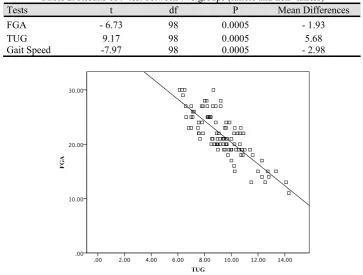
The Functional Gait Assessment and the Timed Up and Go test were negative and Significant Correlated (r=-0.81;P<0.01) (Figure 1). The range of the scores on the Functional Gait Assessment was 19-30 with a mean score of 24.5 for non-fallers and was 11-25 with a mean score of 18.8 for fallers. The range of scores on the Timed Up and Go test was 6.12–10.70 with a mean score of 8.4 for non-fallers and was 6.80-14.30 with a mean score of 10.34 for fallers. The Functional Gait Assessment and the Gait Speed test were negative and Significant Correlated (r = - 0.77; P< 0.01) (Figure 2). The range of the scores on the Gait Speed test was 6–11 with a mean score of 8.4 for non-fallers and was 7.5-16.4 with a mean score of 11.4 for fallers.
The Timed Up and Go test and the Gait Speed test were positive and significantly correlated (r = 0.67; P< 0.01) (Figure 3).
The correlation between number of falls and FGA, TUG and Gait Speed respectively was - 0.70, 0.58 and 0.64 at the 0.01 level.
Also, for identification and differentiation of two groups (fallers and non-fallers) in three assessments t-test was applied (Table 2). The results showed two groups were significantly different.
Discussion
The true gold standard for determining validity of a balance scale is fall risk. All the published studies that have considered fall risk have used retrospective data (4, 13, 14). The true validity of the Functional Gait Assessment, Timed up and go test and Gait Speed to predict risk of falling can only be established through prospective data, following subjects for a sufficient length of time to compare the difference in scores between those who fell and those who did not. Future research should include prospective studies designed to explore the ability of the Functional Gait Assessment, Timed up and Go test and Gait Speed tests to predict patients’ risk of falling.
Conclusion
Concurrent validity has been established for the Functional Gait Assessment, Timed up and Go and
Gait Speed tests in Persian community-dwelling elderlies with and without falling history. These measures provide valuable information to clinicians about patients’ functional balance capabilities. However, the lack of perfect correlation indicates that the tests measure different aspects of the balance. The Functional Gait Assessment is an appropriate balance tool for people with and without falling history, and appears to be more sensitive in detecting and identifying Iranian elderly at risk.
Acknowledgements
This study was supported in part by grants of Iranian Research Center on Ageing University of Social Welfare and Rehabilitation Sciences.
Table 1. Descriptive data of two groups in three tests Age
Group N
Yong old Old FGA TUG
Gait Speed (time)
Fallers 50 36 14 18.8 (± 3.1) 10.3 (± 1.7) 11.4 (± 2.4)
Non- Fallers 50 44 6 24.5 (±3.2) 8.4 (±1.1) 8.4 (±1.2)
Fallers: one or more fall history in the last 6 month; Non- Fallers: No fall history in the last 6 month Yong old= 61- 75 Years; Old= 76- 90 years
Table 2. Results of t- test between two groups (fallers and non- fallers)
Tests t df P Mean Differences
FGA - 6.73 98 0.0005 - 1.93
TUG 9.17 98 0.0005 5.68
Gait Speed -7.97 98 0.0005 - 2.98
GaitSpeed
20.00 15.00
10.00 5.00
0.00
FG
A
30.00
20.00
10.00
0.00
Figure 2.The Functional Gait Assessment and the Gait Speed scores for people with and without falls history (n = 100).
GaitSpeed
20.00 15.00
10.00 5.00
0.00
TUG
15.00
10.00
5.00
0.00
Figure 3.The Timed Up and Go test and the Gait Speed scores for people with and without falls history (n = 100).
References:
1. Rubenstein LZ, Josephson KR. (2002). The epidemiology of falls and syncope. Clin Geriatr Med; 18: 141–158. 2. Wrisley DM, Marchetti GF, Kuharsky DK, Whitney SL.
(2004). Reliability, internal consistency, and validity of data obtained with the Functional Gait Assessment. Phys Ther, 84: 906- 918.
3. Shumway-Cook A, Woollacott MH. Motor Control: Theory and Practical Applications. (2005). Baltimore, Md: Lippincott Williams & Wilkins.
4. Whitney SL, Wrisley DM, Furman JM. (2003). Concurrent validity of the Berg Balance Scale and the Dynamic Gait Index in people with vestibular dysfunction. Physiother Res Int. 8: 178 –189.
5. Wrisley DM, Marchetti GF, Kuharsky DK, Whitney SL. (2004). Reliability, Internal Consistency, and Validity of
Data Obtained With the Functional Gait Assessment. Physical Therapy. Volume 84. Number 10. 906- 918. 6. Shumway- cook, A. Woollacott, M. (2007). Motor control.
Lippincott williams & wilkins.
7. Mathias S, Nayak US, Isaacs B. (1986). Balance in elderly patients: the “Get-Up and Go” Test. Arch Phys Med Rehabil. 67: 387–389.
8. Podsiadlo D, Richardson S. (1991). The timed “Up & Go”: a test of basic functional mobility for frail elderly persons. J Am Geriatr Soc. 39: 142- 148.
9. Wrisley DM, Kumar NA. (2010). Functional Gait Assessment: concurrent, discriminative, and predictive validity in community dwelling older adults. Phys Ther. 90: 761-773.
orthopaedic rehabilitation population. Clin Rehabil January,. 14(1): 96-101
11. Richards CL, Malouin F, Dumas F, et al. (1995). Gait velocity as an outcome measure of locomoter recovery after stroke. In: Craik R, Oatic C, editors. Gait analysis: Theory and applications. St. Louis, MO: Mosby, pp. 355 – 364. 12. Cohen LA. (1961). Role of eye and neck proprioceptive
mechanisms in body orientation and motor coordination. Journal of Neurophysiology; 24: 1–11.
13. Shumway-Cook A, Baldwin M, Polissar NL, Gruber W. (1997a). Predicting the probability for falls in community dwelling older adults. Physical Therapy. 77: 812–819. 14. Shumway-Cook A, Gruber W, Baldwin M, Liao S. (1997b).