Testing Electronic Friction Models: Vibrational De-excitation in
Scattering of H
2
and D
2
from Cu(111)
Paul Spiering and Jo
̈
rg Meyer
*
Leiden Institute of Chemistry, Gorlaeus Laboratories, Leiden University, P.O. Box 9502, 2300 RA Leiden, The Netherlands
*
S Supporting InformationABSTRACT: At present, molecular dynamics with electronic friction (MDEF) istheworkhorse model to go beyond the Born−Oppenheimer approximation in modeling dynamics of molecules at metal surfaces. Concomitant friction coefficients can be calculated with either the local density friction approximation (LDFA) or orbital-dependent friction (ODF), which, unlike LDFA, accounts for anisotropy while relying on other approximations. Due to the computational cost of ODF, extensive high-dimensional MDEF trajectory calculations of experimentally measurable observables have hitherto only been performed based on LDFA. We overcome this limitation with a continuous neural-network-based representation. In our first application to the scattering of vibrationally excited H2and D2from Cu(111), we predict up to three times higher vibrational de-excitation probabilities with ODF than with LDFA. These results indicate that anisotropic electronic friction can be important for specific molecular observables. Future experiments can test for this“fingerprint” of different approximations underlying state-of-the-art MDEF.
T
he motion of atomic and molecular adsorbates on metal surfaces underlies every elementary reaction step in heterogeneous catalysis. Due to the absence of an energy gap between valence and conduction band electrons, these motions can result in the excitation of electron−hole pairs (EHPs) and thus violate the Born−Oppenheimer approximation.1−3 A growing number of experiments points to the importance of this nonadiabatic energy loss channel.4On the other hand, the development of suitable theoretical models to account for these nonadiabatic effects is still an ongoing process.5−9For systems with weak nonadiabatic coupling, molecular dynamics with electronic friction (MDEF)10 is currently the most popular approach.11MDEF relies on a potential energy surface (PES), nowadays typically obtained from density functional theory (DFT),3 and accounts for the effects of the EHPs on the motion of the nuclei by electronic friction coefficients.10One state-of-the-art technique for calculating these coefficients as functions of the adsorbate positions relies on mapping to an atom-in-jellium model for which only the surface electron density is considered (local density friction approximation, LDFA12,13). Alternatively, the electronic states of the molecule−surface system can be taken into account (orbital-dependent friction, ODF10,14). For the inelastic scattering of H atoms from Au(111), millions of MDEF trajectories based on a high-dimensional PES15 and LDFA have recently been demonstrated to yield accurate scattering probabilities in excellent agreement with experimental data.16The situation is quite different for molecules. Due to its combination with the independent atom approximation, the LDFA completely neglects any molecular effects.12ODF on the other hand accounts for the anisotropic tensorial character of friction coefficients on corrugated metal surfaces and along adsorbate-internal bonds,17−19 which is why ODF has been argued to be “theoretically” more accurate for (diatomic)
molecules.20However, this discussion12,20,21has still remained inconclusive because an evaluation of ODF comes at very high computational costs. Consequently, extensive MDEF trajectory calculations for molecules including all relevant degrees of freedom (DOF) can be easily performed with LDFA,11,12 whereas only two molecular DOF have so far been included for ODF.22The very recent on-the-fly evaluation of ODF within ab initio molecular dynamics by Maurer et al.19 is an important step, but the less than 20 calculated trajectories make direct validation via molecular beam experiments impossible. Modeling the nonadiabatic contribution to vibrational lifetimes of molecules adsorbed on metal surfaces on the other hand does not require such extensive statistical averaging.23,24 The most recent implementations of LDFA and ODF both yield results that agree with experimental data within the error bars.25,26Furthermore, Novko et al. have shown recently in this context27 that the numerical evaluation of friction tensors within ODF19,26 effectively includes potentially spurious electronic memory effects with unclear consequences for MDEF.28 Given this situation, theoretical understanding and modeling relying on MDEF faces an important question: Is the molecular anisotropy as described by ODF important for any observables that can be validated by high-precision molecular beam experiments like for atoms?16
In this work, we provide an answer to this question using H2 and D2 on Cu(111). For this system, weak nonadiabatic coupling and static surface approximation are well
justi-fied,29−31 and an accurate DFT-based PES relying on the semiempirically constructed“SRP”exchange−correlation
func-Received: December 1, 2017 Accepted: March 12, 2018 Published: March 12, 2018
Letter
pubs.acs.org/JPCL
Cite This:J. Phys. Chem. Lett.2018, 9, 1803−1808
tional is available.32,33We construct a six-dimensional neural-network-based continuous representation of ODF that allows us to perform extensive MDEF trajectory calculations on equal footing with LDFA. While dissociative sticking probabilities are hardly affected in general and by the type of electronic friction coefficients used, wefind vibrational de-excitation probabilities to be a“fingerprint”that can be used to distinguish and validate LDFA and ODF in future experiments.
Quasi-classical trajectory calculations32within MDEF rely on a generalized Langevin equation10
∑ ∑
η = −∂∂ − ̇ +
α
α β
α β β
α α = = m R t V R R F t R R R d d ( ) ( ) ( ) ( ) i i i j N
i j j
i i 2 2 1 1 3 fric -(1)
wherei,jindicate atoms andα,βCartesian coordinates. Atomic masses and positions are denoted by mi and Ri, respectively. For a H2or D2molecule on a static surface, the total number of moving atomsNis two, resulting in six DOF. In addition to the forces from the PES −∂∂
α
V R
R
( )
i , which yield the adiabatic dynamics, nonadiabatic effects on the nuclear dynamics originate from electronic friction forces Fifricα(R) and thermal white noise -iα( )t , respectively. In this work, V(R) is mainly taken to be the static surface PES based on the SRP48 exchange−correlation functional from ref 33, but we also compare with the PW91-PES from earlier work.34The friction forces are linear in nuclear velocitiesṘjβand are in general given by a symmetric 6×6 friction tensorηiαjβ(R), which consists of 21 independent elements each depending on six nuclear coordinates. These coordinates can be CartesianR= (R1,R2) or expressed in the center-of-mass centered spherical coordinate system R = (X,Y,Zd,θ,ϕ), which is commonly used for diatomics and described by Figure 1A.
Within ODF, these 21 friction coefficients are obtained according to a Fermi golden rule-like expression resulting from time-dependent perturbation theory, which can be written in the quasi-static limit as10,24,26,35
∑
ηi jα β ( )R =2πℏ gα( )R*·gβ( ) (Rδ ϵ − ϵ) (δϵ − ϵ)
ab ab i ab j a b k
k k k k
ODF
F F
(2)
The electron−phonon matrix elements gkiαab describe the nonadiabatic coupling between two electronic states of the molecule at the metal surface with band indicesaandbat wave vector k due to the motion of (adsorbate) atom i along direction α. In general, the ODF tensor can have different diagonal elements even for the same atom. This anisotropy yields very different friction forces when the atoms move (with the same velocity) in different directions. Its generally nonzero off-diagonal elements are responsible for coupling the motion in different directions and between both atoms in a way that is not accounted for by the PES. In particular, this can lead to a strong damping of the molecular stretch vibration of a diatomic molecule and thus a pronounced molecular anisotropy.19,20,22
In order to use the so-calculated ηiODFαjβ(R) in MDEF trajectory calculations of generic experimentally measurable observables, a continuous representation of this 6×6 tensor is required that can be evaluated at low computational cost. We have designed such a representation based on a symmetry-adapted neural network fit that is briefly described in the
Supporting Informationand will be discussed extensively in a forthcoming publication.
Within LDFA, friction coefficients for hydrogen atomsηH(ρ) are obtained from a spherical atom-in-jellium model with background densityρ, which is solved via DFT at the level of the local density36 or generalized gradient approximation.37 Mapping of the actual surface problem is accomplished by taking the electron density of the bare surface (without the molecule) at each atom’s position ρ(Ri) as the background density of the jellium.12This independent-atom approximation (IAA) results in electronic friction coefficients that are isotropic for each atom and depends on its own three coordinates alone. In Cartesian coordinates, only diagonal elements of the friction tensor are nonzero
ηi jα β ( )R = η ( ( ))ρ Ri δ δαβ ij
LDFA H
(3)
A continuous representation of ηiLDFAαjβ (R) for extensive MDEF trajectory calculations can be easily constructed.12,38
Going beyond the IAA within LDFA is possible, for example, by determining the background electron density using an atoms-in-molecules technique (LDFA-AIM).25 However, this approach does not lift the isotropy and, as detailed in the
Supporting Information, cannot be applied to H2 and D2 molecules. The other way round, isotropic friction can be constructed from ODF by neglecting the coupling between different directions and atoms plus averaging the remaining (generally anisotropic) friction over different directions
∑
ηα β = η δ δ
γ
γ γ αβ
‐
R R
( ) 1
3 ( )
i j i j ij
ODF iso ODF
(4)
This ODF-iso allows one to disentangle the influence of anisotropy from the very different electronic structure inherent to ODF and LDFA.
Figure 2A−C shows ηZd, ηdd, and ηZZ, respectively, as obtained from eqs 2−4 along the minimum-energy reaction path for dissociative chemisorption over the bridge site, as depicted in Figures 2D and 1B. We focus here on these three particular friction coefficients in order to compare with the earlier two-dimensional ODF calculations.20,22The agreement is quite good except for some differences close to the transition state for ηZZODF. As the molecule approaches the surface, each model yields increasing friction for the six diagonal elements of the friction tensor, and the absolute values of the off-diagonal
Figure 1. (A) Molecular coordinate system denoting the center of
elements increase likewise in the case of ODF. Furthermore, ODF directly reflects the strong rearrangement of (Kohn− Sham) orbitals when approaching the dissociation barrier by significantly higher friction along the molecular bond (and thus reaction) coordinate, resulting in ηddODF ≈ 3η
dd
LDFA at the
transition state, in agreement with earlier work.20 For the observables calculated below, friction beyond the dissociation barrier is not relevant. Quite remarkably,ηddODF‑iso(ηZZODF‑iso) and ηddLDFA(ηZZLDFA) are almost identical up to the transition state and thus much more alike than what has originally been found for the diffusion of H atoms on Pd(100).17,39
In order to study the effect of the different friction models on actual experimental observables, we perform MDEF calcu-lations according to the quasi-classical trajectory method.28In view of the short interaction time of the molecules with the Cu(111) surface during all simulated trajectories, we neglect thefluctuating forces ineq 1.
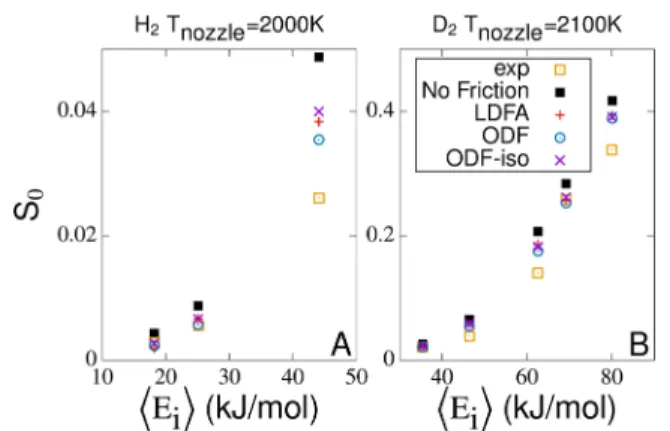
Figure 3A,B shows the results for the dissociative chemisorption probability S0 for both H2 and D2 molecular beams based on the SRP48-PES, respectively. Due to the construction of the latter,32,33already the adiabatic calculations yield good agreement with the experimental data.40,41Inclusion of electronic friction reduces S0, leading to even better agreement with the experimental data, in particular, at high incidence energies. The reduction is strongest for ODF and weaker for LDFA and ODF-iso, which are very similar to each other. It can be rationalized by the differences of the friction models for the frictionηddalong the reaction coordinate close to the dissociation barrier (seeFigure 2B). This effect ofηddODF onS0for H2and D2on Cu(111) has not been reported for two-dimensional ODF calculations.22Consequently, a
high-dimen-sional treatment of ODF in MDEF, on an equal footing with LDFA,21 is important. However, the overall small effect of electronic friction on S0makes this not an optimal observable for experimental validation of the different friction models.
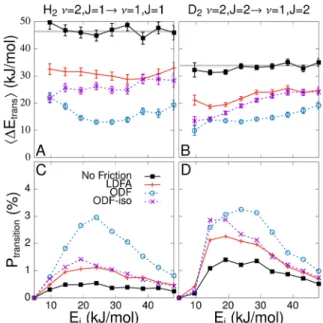
Instead, we have identified vibrational de-excitation proba-bilities Ptransition to yield a clearly distinguishable difference between LDFA and ODF. On the basis of 50000 MDEF trajectories, we calculate Ptransition as a function of incidence energy Ei from the scattered trajectories by a conventional binning procedure. The concomitant average gain in transla-tional energy ⟨ΔEtrans⟩ is calculated from the final center-of-mass velocities. As detailed in theSupporting Information, the error bars reflect the error due to statistical sampling of the initial conditions. Only by employing our continuous representation to compute a large amount of trajectories were we able to reduce these errors so that the different electronic friction models can be distinguished. We focus the discussion on de-excitation from vibrational stateν= 2,J= 1 (2) toν= 1,
J= 1 (2) for H2(D2), respectively, as shown inFigure 4A,C (B,D). Unlike for other vibrational transitions,42 for this transition, we obtain results that are not only qualitatively but even almost quantitatively identical to corresponding results obtained with the PW91-PES (see the Supporting Informa-tion).
At low incidence energies, with increasingEi, more and more molecules come close enough to the surface so that the curvature of the PES and electronic friction lead to an increase ofPtransition. Both effects are additive and result in de-excitation probabilities that are up to 6 (2) times larger for H2(Figure 4C) and up to 3 (2) times larger for D2with ODF (LDFA), respectively (Figure 4D). At high incidence energies, the dissociation channel (seeFigure 3A,B) becomes more effective, which is why Ptransition decreases again in all cases. For the adiabatic simulations on the static surface,⟨ΔEtrans⟩is equal to the rovibrational energy loss of one vibrational quantum and thus by about√2 larger for H2than that for D2(Figure 4A,B). Electronic friction reduces the energy gain. The reduction is almost twice as large for ODF compared to that for LDFA. The fact that it does not very strongly depend onEifor the energy range considered here suggests that it is dominated byηddand thus directly reflects the differences observed along the
Figure 2.(A−C)ηdZ,ηdd, andηZZin the molecular coordinate system
(seeFigure 1A), respectively, along the minimum-energy reaction path
for dissociative chemisorption over the bridge site (seeFigure 1B) as depicted in (D) together with the corresponding two-dimensional PES cut. The blue, red, and purple lines indicate the continuous representation from this work for ODF, LDFA, and ODF-iso, respectively, as obtained from eqs 2−4. Blue (red) dots show the ODF (LDFA) results from previous work of Luntz et al.,20,22and the reaction coordinate is defined in the same way as in that work. The barrier and thus the transition state for dissociation are located at the vertical gray line (i.e. 0 Å) in (A−C) and indicated by the empty circle in (D). Negative numbers up to the transition state denote the approach from the gas phase (i.e., decreasing heights Z above the surface).
Figure 3.Calculated reaction probabilitiesS0based on the SRP48-PES
minimum-energy path depicted in Figure 2A−D. Conse-quently, when comparing MDEF with other nonadiabatic models43−45 for vibrational de-excitation, our results suggest that it is crucial to also take into account whether the friction coefficients include any molecular anisotropy. Unfortunately, because molecular beam experiments for this system have hitherto focused on rovibrational excitation rather than de-excitation,46−48 experimental verification of this effect is still pending.
Although ODF-iso inherits the spurious memory effects as well as going beyond the independent atom approximation from ODF, quite remarkably, for Ei> 15 (20) kJ/mol for H2 (D2), we obtain results with ODF-iso that are almost identical to those with LDFA. That means that (at least in this energy range) these do not affect the dynamics and the molecular anisotropy is the most important difference. For lower incidence energies, scattering over the top site has been found to dominate vibrational de-excitation from ν = 1 in adiabatic calculations.42Indeed, for top sites, ηddODF‑iso is rather different from ηddLDFA so that the difference in electronic structure inherent to LDFA and ODF also becomes visible in the dynamics in this case. If the molecular anisotropy could be experimentally validated, it would greatly encourage future theoretical work to develop extensions to LDFA that might be able to (at least approximately) account for it.
In summary, we have obtained different observables for H2 and D2 on Cu(111) from extensive MDEF trajectory calculations for the first time using full-dimensional friction tensors based on both LDFA and ODF. The molecular anisotropy as described by ODF and absent from LDFA leads to strongly enhanced friction for motion along the molecular axis when the molecules are close to the surface. The
dissociative sticking probability is almost negligibly reduced compared to adiabatic simulations. The effect is slightly stronger for ODF compared to LDFA and improves the agreement with experimental data in both cases. For the state-to-state scattering of vibrationally excited molecules (fromν= 2,J= 1 (2) toν= 1,J= 1 (2) for H2(D2)), we predict up to six (two) times larger vibrational de-excitation probabilities with ODF (LDFA) compared to adiabatic simulations. Remarkably, isotropicalization of ODF yields results almost identical to LDFA for incidence energies larger than 15 (20) kJ/mol for H2 (D2). The predicted differences between the vibrational de-excitation probabilities are a “fingerprint” of the molecular anisotropy as described by ODF. Recently suggested techniques to prepare H2molecular beams with 1 ≤ν ≤ 449 should allow testing for this fingerprint. This would provide unprecedented insight into the accuracy of state-of-the-art electronic friction models for molecules and allow analysis of the importance of concomitant approximations.
■
COMPUTATIONAL DETAILSIn eq 2, we calculate the electron−phonon matrix elements
ϕ ϕ
= ⟨ | | ⟩
α ∂ν
∂ α
g ab i
a b
k k Ri k
KS
from the change of the Kohn−Sham
potential ∂ν
∂Riα
KS with respect to nuclear coordinateR
iα, which is
obtained from density functional perturbation theory (DFPT)50employing the PW9151exchange−correlation func-tional as implemented in the QUANTUM ESPRESSO package.52 Surfaces are modeled by 2×2 Cu(111) slabs with four layers and 10 Å of vacuum. A plane-wave cutoffenergy of 816 eV is used, together with ONCV pseudopotentials53 from the SG1554 library and an 18 × 18 k-point grid. These settings reproduce the PW91-PES from ref 34up to a few meV. They also enable an accurate evaluation of the sum over electronic states in eq 2at the Fermi level using an equivalent Gaussian envelope technique to broaden theδ-function with a width of 0.6 eV as suggested in ref 26. We note that this implies the possible presence of spurious electronic memory effects, as argued in ref27.
The neural networkfits for the 21 independent elements of ηiODFαjβ(R) are based on∼30000 ODF coefficients obtained from
DFT calculations on the same seven lateral sites that have been used to construct the SRP48-PES.33For LDFA, we extract the background electron densityρ(Ri) from a DFT calculation with the same computational setup as described above. Employing the functional form for ηH(ρ) suggested in ref 38, we then construct three-dimensional neural network interpolations for ηH(ρ(R
i)) based on the symmetry-adapted coordinates 55,56
in order to obtain a continuous representation ofηiLDFAαjβ (R).
■
ASSOCIATED CONTENT*
S Supporting InformationThe Supporting Information is available free of charge on the
ACS Publications websiteat DOI:10.1021/acs.jpclett.7b03182. LDFA-AIM for H2and D2, continuous representation of 6×6 friction tensors, errors due to statistical sampling, and vibrational de-excitation for PW91-PES (PDF)
■
AUTHOR INFORMATIONCorresponding Author
*E-mail: [email protected]. Phone: +31 (0)71 527 5569.
Figure 4.Vibrational de-excitation probabilities Ptransition(lower row)
ORCID
Paul Spiering: 0000-0001-7692-7273
Jörg Meyer: 0000-0003-0146-730X Notes
The authors declare no competingfinancial interest.
■
ACKNOWLEDGMENTSJ.M. gratefully acknowledges financial support from The Netherlands Organisation for Scientific Research (NWO) under Vidi Grant No. 723.014.009. We would like to thank Geert-Jan Kroes and Reinhard Maurer for very insightful and stimulating discussions.
■
REFERENCES(1) Wodtke, A. M.; Tully, J. C.; Auerbach, D. J. Electronically Non-Adiabatic Interactions of Molecules at Metal Surfaces: Can We Trust the Born-Oppenheimer Approximation for Surface Chemistry? Int. Rev. Phys. Chem.2004,23, 513−539.
(2) Kroes, G.-J. Frontiers in Surface Scattering Simulations. Science
2008,321, 794−797.
(3) Golibrzuch, K.; Bartels, N.; Auerbach, D. J.; Wodtke, A. M. The Dynamics of Molecular Interactions and Chemical Reactions at Metal Surfaces: Testing the Foundations of Theory.Annu. Rev. Phys. Chem.
2015,66, 399−425.
(4) Wodtke, A. M. Electronically Non-Adiabatic Influences in Surface Chemistry and Dynamics.Chem. Soc. Rev.2016,45, 3641−3657.
(5) Shenvi, N.; Roy, S.; Tully, J. C. Nonadiabatic Dynamics at Metal Surfaces: Independent-Electron Surface Hopping.J. Chem. Phys.2009, 130, 174107.
(6) Meyer, J.; Reuter, K. Electron-Hole Pairs during the Adsorption Dynamics of O2on Pd(100): Exciting or Not?New J. Phys.2011,13, 085010.
(7) Ryabinkin, I. G.; Izmaylov, A. F. Mixed Quantum-Classical Dynamics Using Collective Electronic Variables: A Better Alternative to Electronic Friction Theories.J. Phys. Chem. Lett.2017,8, 440−444. (8) Dou, W.; Miao, G.; Subotnik, J. E. Born-Oppenheimer Dynamics, Electronic Friction, and the Inclusion of Electron-Electron Inter-actions.Phys. Rev. Lett.2017,119, 046001.
(9) Rittmeyer, S. P.; Meyer, J.; Reuter, K. Nonadiabatic Vibrational Damping of Molecular Adsorbates: Insights into Electronic Friction and the Role of Electronic Coherence. Phys. Rev. Lett. 2017, 119, 176808.
(10) Head-Gordon, M.; Tully, J. C. Molecular Dynamics with Electronic Frictions.J. Chem. Phys.1995,103, 10137−10145.
(11) Alducin, M.; Díez Muiño, R.; Juaristi, J. I. Non-Adiabatic Effects in Elementary Reaction Processes at Metal Surfaces. Prog. Surf. Sci.
2017,92, 317−340.
(12) Juaristi, J. I.; Alducin, M.; Díez Muiño, R.; Busnengo, H. F.; Salin, A. Role of Electron-Hole Pair Excitations in the Dissociative Adsorption of Diatomic Molecules on Metal Surfaces.Phys. Rev. Lett.
2008,100, 116102.
(13) Novko, D.; Blanco-Rey, M.; Alducin, M.; Juaristi, J. I. Surface Electron Density Models for AccurateAb InitioMolecular Dynamics with Electronic Friction. Phys. Rev. B: Condens. Matter Mater. Phys.
2016,93, 245435.
(14) Hellsing, B.; Persson, M. Electronic Damping of Atomic and Molecular Vibrations at Metal Surfaces.Phys. Scr.1984,29, 360−371. (15) Janke, S. M.; Auerbach, D. J.; Wodtke, A. M.; Kandratsenka, A. An Accurate Full-Dimensional Potential Energy Surface for H-Au(111): Importance of Nonadiabatic Electronic Excitation in Energy tTansfer and Adsorption.J. Chem. Phys.2015,143, 124708.
(16) Bünermann, O.; Jiang, H.; Dorenkamp, Y.; Kandratsenka, A.; Janke, S. M.; Auerbach, D. J.; Wodtke, A. M. Electron-Hole Pair Excitation Determines the Mechanism of Hydrogen Atom Adsorption. Science2015,350, 1346−1349.
(17) Askerka, M.; Maurer, R. J.; Batista, V. S.; Tully, J. C. Role of Tensorial Electronic Friction in Energy Transfer at Metal Surfaces. Phys. Rev. Lett.2016,116, 217601.
(18) Inoue, K.-i.; Watanabe, K.; Sugimoto, T.; Matsumoto, Y.; Yasuike, T. Disentangling Multidimensional Nonequilibrium Dynam-ics of Adsorbates: CO Desorption from Cu(100).Phys. Rev. Lett.2016, 117, 186101.
(19) Maurer, R. J.; Jiang, B.; Guo, H.; Tully, J. C. Mode Specific Electronic Friction in Dissociative Chemisorption on Metal Surfaces: H 2 on Ag(111).Phys. Rev. Lett.2017,118, 256001.
(20) Luntz, A. C.; Makkonen, I.; Persson, M.; Holloway, S.; Bird, D. M.; Mizielinski, M. S. Comment on “Role of Electron-Hole Pair Excitations in the Dissociative Adsorption of Diatomic Molecules on Metal Surfaces.Phys. Rev. Lett.2009,102, 109601.
(21) Juaristi, J. I.; Alducin, M.; Muiño, R. D.; Busnengo, H. F.; Salin, A. Juaristi et al. Reply.Phys. Rev. Lett.2009,102, 109602.
(22) Luntz, A. C.; Persson, M. How Adiabatic is Activated Adsorption/Associative Desorption?J. Chem. Phys.2005,123, 074704. (23) Krishna, V.; Tully, J. C. Vibrational Lifetimes of Molecular Adsorbates on Metal Surfaces.J. Chem. Phys.2006,125, 054706.
(24) Forsblom, M.; Persson, M. Vibrational Lifetimes of Cyanide and Carbon Monoxide on Noble and Transition Metal Surfaces.J. Chem. Phys.2007,127, 154303.
(25) Rittmeyer, S. P.; Meyer, J.; Juaristi, J. I.; Reuter, K. Electronic Friction-Based Vibrational Lifetimes of Molecular Adsorbates: Beyond the Independent-Atom Approximation. Phys. Rev. Lett. 2015, 115, 046102.
(26) Maurer, R. J.; Askerka, M.; Batista, V. S.; Tully, J. C.Ab Initio Tensorial Electronic Friction for Molecules on Metal Surfaces: Nonadiabatic Vibrational Relaxation. Phys. Rev. B: Condens. Matter Mater. Phys.2016,94, 115432.
(27) Novko, D.; Alducin, M.; Blanco-Rey, M.; Juaristi, J. I. Effects of Electronic Relaxation Processes on Vibrational Linewidths of Adsorbates on Surfaces: The Case of CO/Cu(100). Phys. Rev. B: Condens. Matter Mater. Phys.2016,94, 224306.
(28) Kroes, G.-J.; Juaristi, J. I.; Alducin, M. Vibrational Excitation of H2 Scattering from Cu(111): Effects of Surface Temperature and of Allowing Energy Exchange with the Surface.J. Phys. Chem. C 2017, 121, 13617−13633.
(29) Diaz, C.; Pijper, E.; Olsen, R. A.; Busnengo, H. F.; Auerbach, D. J.; Kroes, G.-J. Chemically Accurate Simulation of a Prototypical Surface Reaction: H2 Dissociation on Cu(111). Science 2009, 326, 832−834.
(30) Nattino, F.; Genova, A.; Guijt, M.; Muzas, A. S.; Díaz, C.; Auerbach, D. J.; Kroes, G.-J. Dissociation and Recombination of D2 on Cu(111): Ab Initio Molecular Dynamics Calculations and Improved Analysis of Desorption Experiments.J. Chem. Phys.2014,141, 124705. (31) Kroes, G.-J.; Díaz, C. Quantum and Classical Dynamics of Reactive Scattering of H2 from Metal Surfaces.Chem. Soc. Rev.2016, 45, 3658−3700.
(32) Díaz, C.; Olsen, R. A.; Auerbach, D. J.; Kroes, G.-J. Six-Dimensional Dynamics Study of Reactive and Non Reactive Scattering of H2 from Cu(111) Using a Chemically Accurate Potential Energy Surface.Phys. Chem. Chem. Phys.2010,12, 6499−6519.
(33) Mondal, A.; Wijzenbroek, M.; Bonfanti, M.; Díaz, C.; Kroes, G.-J. Thermal Lattice Expansion Effect on Reactive Scattering of H2 from Cu(111) at Ts = 925 K.J. Phys. Chem. A2013,117, 8770−8781.
(34) Diaz, C.; Olsen, R. A.; Busnengo, H. F.; Kroes, G.-J. Dynamics on Six-Dimensional Potential Energy Surfaces for H2/Cu(111): Corrugation Reducing Procedure versus Modified Shepard Interpola-tion Method and PW91 versus RPBE. J. Phys. Chem. C2010, 114, 11192−11201.
(35) Butler, W. H.; Pinski, F. J.; Allen, P. B. Phonon Linewidths and Electron-Phonon Interaction in Nb. Phys. Rev. B: Condens. Matter Mater. Phys.1979,19, 3708−3721.
(37) Gerrits, N.; Juaristi, J. I.; Meyer, J. Atoms in jellium revisited -Implications for the Local Density Friction Approximation. In preparation.
(38) Saalfrank, P.; Juaristi, J. I.; Alducin, M.; Blanco-Rey, M.; Muiño, R. D. Vibrational Lifetimes of Hydrogen on Lead Films: An Ab Initio Molecular Dynamics with Electronic Friction (AIMDEF) Study. J. Chem. Phys.2014,141, 234702.
(39) Askerka, M.; Maurer, R. J.; Batista, V. S.; Tully, J. C. Erratum: Role of Tensorial Electronic Friction in Energy Transfer at Metal Surfaces [Phys. Rev. Lett. 116, 217601 (2016)].Phys. Rev. Lett.2017, 119, 069901.
(40) Rettner, C. T.; Michelsen, H. A.; Auerbach, D. J. Quantum-State-Specific Dynamics of the Dissociative Adsorption and Associative Desorption of H2 at a Cu(111) Surface. J. Chem. Phys. 1995, 102, 4625−4641.
(41) Michelsen, H. A.; Rettner, C. T.; Auerbach, D. J.; Zare, R. N. Effect of Rotation on the Translational and Vibrational Energy Dependence of the Dissociative Adsorption of D2 on Cu(111). J. Chem. Phys.1993,98, 8294−8307.
(42) Muzas, A. S.; Juaristi, J. I.; Alducin, M.; Díez Muiño, R.; Kroes, G.-J.; Díaz, C. Vibrational Deexcitation and Rotational Excitation of H2 and D2 Scattered from Cu(111): Adiabatic versus Non-Adiabatic Dynamics.J. Chem. Phys.2012,137, 064707.
(43) Luntz, A. C.; Persson, M.; Sitz, G. O. Theoretical Evidence for Nonadiabatic Vibrational Deexcitation in H2(D2) State-to-State Scattering from Cu(100).J. Chem. Phys.2006,124, 091101.
(44) Golibrzuch, K.; Shirhatti, P. R.; Rahinov, I.; Kandratsenka, A.; Auerbach, D. J.; Wodtke, A. M.; Bartels, C. The Importance of Accurate Adiabatic Interaction Potentials for the Correct Description of Electronically Nonadiabatic Vibrational Energy Transfer: A combined Experimental and Theoretical Study of NO(v = 3) Collisions with a Au(111) Surface.J. Chem. Phys.2014,140, 044701. (45) Krüger, B. C.; Bartels, N.; Bartels, C.; Kandratsenka, A.; Tully, J. C.; Wodtke, A. M.; Schafer, T. NO Vibrational Energy Transfer on ä Metal Surface: Still a Challenge to First-Principles Theory. J. Phys. Chem. C2015,119, 3268−3272.
(46) Hodgson, A.; Moryl, J.; Traversaro, P.; Zhao, H. Energy transfer and vibrational effects in the dissociation and scattering of D2 from Cu (111).Nature1992,356, 501.
(47) Rettner, C. T.; Auerbach, D. J.; Michelsen, H. A. Observation of Direct Vibrational Excitation in Collisions of H2 and D2 with a Cu(111) Surface.Phys. Rev. Lett.1992,68, 2547−2550.
(48) Hodgson, A.; Samson, P.; Wight, A.; Cottrell, C. Rotational Excitation and Vibrational Relaxation of H 2 (υ= 1, J= 0) Scattered from Cu (111).Phys. Rev. Lett.1997,78, 963.
(49) Perreault, W. E.; Mukherjee, N.; Zare, R. N. Preparation of a Selected High Vibrational Energy Level of Isolated Molecules.J. Chem. Phys.2016,145, 154203.
(50) Baroni, S.; de Gironcoli, S.; Dal Corso, A.; Giannozzi, P. Phonons and Related Crystal Properties from Density-Functional Perturbation Theory.Rev. Mod. Phys.2001,73, 515−562.
(51) Perdew, J. P.; Chevary, J. A.; Vosko, S. H.; Jackson, K. A.; Pederson, M. R.; Singh, D. J.; Fiolhais, C. Atoms, Molecules, Solids, and Surfaces: Applications of the Generalized Gradient Approximation for Exchange and Correlation. Phys. Rev. B: Condens. Matter Mater. Phys.1992,46, 6671−6687.
(52) Giannozzi, P.; Baroni, S.; Bonini, N.; Calandra, M.; Car, R.; Cavazzoni, C.; Ceresoli, D.; Chiarotti, G. L.; Cococcioni, M.; Dabo, I.; et al. QUANTUM ESPRESSO: A Modular and Open-Source Software Project for Quantum Simulations of Materials.J. Phys.: Condens. Matter
2009,21, 395502.
(53) Hamann, D. R. Optimized Norm-Conserving Vanderbilt Pseudopotentials. Phys. Rev. B: Condens. Matter Mater. Phys. 2013, 88, 085117.
(54) Schlipf, M.; Gygi, F. Optimization Algorithm for the Generation of ONCV Pseudopotentials.Comput. Phys. Commun.2015,196, 36− 44.
(55) Meyer, J. Ab Initio Modeling of Energy Dissipation during Chemical Reactions at Transition Metal Surfaces. Ph.D. thesis, Freie Universität Berlin, Germany, 2012.