
ONE DIRECTION REAL PERSON FICTION ON WATTPAD.COM: A TEXTUAL ANALYSIS OF SEX AND ROMANCE
Ashley Hedrick
A thesis submitted to the faculty at the University of North Carolina at Chapel Hill in partial fulfillment of the requirements for the degree of Master of Arts in the School of Media and
Journalism.
Chapel Hill 2018
Approved by:
Francesca Dillman Carpentier Daniel Kreiss
ABSTRACT
Ashley Hedrick: One Direction Real Person Fiction on Wattpad.com: A textual analysis of sex and romance
(Under the direction of [Francesca Dillman Carpentier])
This study conducted a textual analysis of 24 of the most popular real person fiction stories published on Wattpad.com about the members of the boy band One Direction. The analysis identified several problematic themes across the stories regarding gender roles and gendered sexual scripts. Males dominated sexual interactions, initiating kissing and sexual activity and actively participating in kissing and sexual activity twice as often as females in the dataset. The language used to describe kissing and sexual activity often insinuated male
ACKNOWLEDGEMENTS
I am so grateful for the wonderful people who supported me while conducting this research. I especially want to thank Dr. Francesca Dillman Carpentier for all of her
encouragement and guidance that kept this project moving in the right direction. I also want to thank Dr. Daniel Kreiss, and Dr. Kate Weisshaar for their helpful feedback and advice
TABLE OF CONTENTS
LIST OF FIGURES………...…….…vi
CHAPTER 1: INTRODUTION……….………..1
CHAPTER 2: LITERATURE REVIEW………...…..6
Sexual scripts………...6
Gender as a multi-level system………..10
Fan studies……….12
Wattpad.com and youth fanfiction……….16
One Direction fandom………20
Research questions……….23
CHAPTER 3: METHODOLOGY…..………..……….25
Overview………25
Sample and procedure………25
CHAPTER 4: RESULTS...………31
Gendered sexual scripts……….31
Negotiating consent………...41
Gendered behavior……….55
CHAPTER 5: DISCUSSION AND CONCLUSION………..…………..63
Discussion………..63
Conclusion………...…..69
LIST OF FIGURES
Figure 1- Level of sexual interaction according to band member……….……31
Figure 2- Initiating kissing……….………32
Figure 3- Initiating sexual activity……….………33
Figure 4- Active participation during kissing………35
Figure 5- Active participation during sexual activity………36
Figure 6- Pain/discomfort………..40
Figure 7- Negotiating consent………...….42
Figure 8- Hesitance/unease…………...……….45
Figure 9- Sexual violence………..…………53
Chapter 1: INTRODUCTION
“He what?! And you said no?” She doesn’t let me answer before she continues- but yeah I guess. ‘You know I read somewhere that in Sweden, at the point where a girl says no and the man keeps touching her it’s rape, also even though he doesn’t actually rape her...It’s the law!’ she’s talking fast, her voice loud and shrill. I pull down the sleeves of my sweater, to cover up the faint but sore finger sized bruise, that I showed her, where
’s thumb had bored into my bone on each of my wrists.
I roll my eyes, trying to calm her down. I should have known she’d freak out and make such a big deal out of it. I should have never said anything. Though I’m grateful she cares so much.
‘We’re not in Sweden , and it’s not helping. It wasn’t that bad,’ I don’t even remember it clearly. ‘And I’m sure he wasn’t just drunk, him and those friends were definitely on something stronger,’ I add.
The passage above is an excerpt from “ a real person fiction story—a type of fanfiction written about celebrities instead of fictional characters, abbreviated as RPF—written about former One Direction band member . The ninety-two chapter story, written by an author penned , has garnered over 21.9 million reads on
community; some of the most popular One Direction RPF stories published on Wattpad.com have topped 100 million reads.
The above excerpt from features protagonist and her
friend, , discussing the behavior of at a party the night before. As and had kissed at the party, began groping her and using excessive force. In the previous chapter, ’s narration indicated that she attempted to push him away three times during the aggressive make-out-session. Finally, managed to get a word in and begged to stop. In response, he stormed off into the crowd of partiers.
and ’s retrospective conversation about ’s actions conveys a complex conceptualization of consent. ’s voice clearly expresses the severity of ’s behavior; even though he didn’t “actually rape her,” his actions were wrong enough to be considered illegal in another country. However, brushes off ’s concerns, excusing his actions as not “that bad” and placing the blame on ’s drug-induced high instead of himself. The story has already informed readers that is a former drug dealer and still uses cocaine, although he had previously promised he would stop. eventually forgives when he apologizes for his actions at the party. Later in the story, she engages in consensual sex with
, who clearly asked for permission to proceed before and throughout the liaison.
boyfriend’s behavior as rape when she retells the details of her trauma to her current boyfriend,
former band member . writes:
He didn’t have a condom and I was in between birth control so I didn’t want to have sex. That didn’t stop him though. You would have thought it would though since he loved me and all. But nope- it didn’t. That night he raped me, but he didn’t say that it was since I was his girlfriend. I didn’t want to do it. I told him to stop but the rage and alchol [sic] mixed took away all of his senses…He came to my house the next day apologizing. I didn’t want to hear it. I broke up with him.
Similarly, while some stories portray egalitarian relationships between romantic partners, others exemplify patriarchal dominance. Again, illustrates gender roles as complicated within romantic relationships; although seems to assert her equality in the relationship by not tolerating ’s jealousy of her male friends, she also repeatedly forgives for lying about his drug use and even for lying about a murder he committed during a drug-dealing scuffle. In contrast, in breaks up with for several months for lying, albeit about compromising his career plans to follow her during her writing internship in . Also, it is clear throughout the story that values ’s intelligence and success. He expresses this sentiment in his wedding vows in the story’s
epilogue, vowing to “cheer [ ] on when [she] change[s] the world through [her] words, and to always listen to [her].”
consist of adolescent girls and young women in their early twenties; authors often include apologies for delayed story updates because of high school or university assignments, reader comments on the stories frequently reference personal experiences regarding grade school, romantic involvement with boys, and romantic interest in the male band members of One Direction, and many authors encourage readers to find their personal social media accounts, which usually belong to young females.
On its face, the widely-circulated valorization of rape and abusive romantic relationships among young females quickly raises questions of social import—do participants in this
community learn to idolize dangerous relationships? Does Wattpad.com perpetuate female acquiescence to patriarchal dominance and violence? However, questions like these are
reductionist and unfair to participants in the community. As “ and “ demonstrate, writers and readers express nuanced understandings of sexual consent and gendered roles in sexual and romantic relationships. Therefore, this study conducts a textual analysis in order to explore the complexity of these themes in One Direction RPF stories on Wattpad.com. The results of this textual analysis certainly carry social significance;
understanding how authors write about sex and romance in this context could reveal meaningful knowledge about the way that these young women—and likely millions of others in the
enormous One Direction RPF community—understand and navigate sexual consent and romantic relationships in a global society still plagued by rape culture and gender inequality.
Furthermore, while the literature documents fandoms’ transition from print to blogs and other online spaces, little research investigates how the most current fanfiction platforms, like Wattpad.com, shape fan experiences. Therefore, this research addresses these gaps in the fan studies scholarship.
Chapter 2: LITERATURE REVIEW Sexual Scripts
The sexual scripting theoretical model claims that people tend to interpret others’ actions and model their own behavior according to internalized scripts, which are “the cognitive models that people use to guide and evaluate social and sexual interactions” (Rose & Frieze, 1993, p. 499). Emerging from Goffman’s (1959) social constructionist paradigm, scripting theory holds that all human behavior is imbued with symbolic meaning and that human behavior unfolds in accordance with ritualized scripts. Thus, people interpret others’ behavior in relation to the script they think typifies the present situation and respond accordingly with the actions prescribed by the script. Simon and Gagnon (1986) applied scripting theory to human sexual behavior, rejecting the notion that sex is primarily a biological function and insisting that it is a social behavior that is highly ritualized and laden with symbolic meaning.
1998; Diekman, McDonald, & Gardner, 2000), and sexual identity among minority groups (Stephens & Phillips, 2003; Mutchler, 2000).
While this study focuses on the content of the sexual scripts depicted in the narratives of One Direction RPF stories, any interpretation of these scripts should be informed by an
While it seems likely that the sexual scripts depicted in a One Direction RPF story will contain elements of the author’s intrapsychic sexual scripts—since the act of writing an erotic narrative inherently involves cognitive rehearsal of a sexual interaction—these scripts do not provide a direct or holistic representation of the authors’ personal attitudes and ideals about sex and romance. Rather, they represent the product of a confluence of social factors that is tailored to a specific audience and that is afforded fictional license to defy the boundaries of realism. Therefore, while this study aims to use One Direction RPF narratives to glean meaningful insights about their authors’ intrapsychic scripts and their role as a source of interactional script development for readers, these insights must be tempered by a consideration of the cultural, interpersonal, and intrapsychic inputs that filter into and shape the production of these scripts under the conditions of the unique context of the One Direction fan community on Wattpad.com.
The scripts analyzed in this study also gain significance because of their production and circulation amongst adolescents and young adults. Simon and Gagnon theorized about the significance of the sexual scripts acquired during adolescence and early adulthood; they claim that adolescents’ cognitive rehearsal of intrapsychic scripts, although they are often not acted upon during adolescence, allow for a crystallization of sexual identity that may become an enduring hallmark of the adult intrapsychic. Thus, if integrated as an element of young
participants’ sexual scripts, this content may have an impact on the way in which they approach sexual interactions throughout adulthood.
both groups were critical of sexualized portrayals of women in popular media. On the other hand, a survey of undergraduate women determined that amount of TV exposure and perceived realism of TV content were associated with higher endorsement of gendered sexual scripts with lower female sexual agency (Seabrook, Ward, Cortina, Giaccardi, & Lippman, 2017). Kreager, Staff, Gauthier, Lefkowitz, and Feinberg’s (2016) longitudinal study evidenced a double
standard in boys and girls’ sexual scripts from 6th to 9th grade: girls who had sex reported losing friendships, while boys who had sex gained more friendships. However, girls who kissed boys reported gains in the number of friends at school, and boys reported that they lost male
friendships for kissing girls (without sex) but did not report a social cost among female friends for kissing.
Krahé (2000) found that the prominence of risk elements—specifically alcohol and drug use, ambiguous communication of sexual intentions, and high levels of sexual activity— in individuals’ intrapyschic sexual scripts may be related to the risk of employing sexual aggression or being sexually victimized. Subsequent studies applied these risk factors to adolescents. Krahé, Bieneck, and Scheinberger-Olwig (2007a) found that German tenth and eleventh graders’
intrapsychic scripts for first consensual intercourse with a new partner contained fewer risk elements than the scripts they perceived to belong to others in their age group as a whole. Thus, the authors concluded that optimistic bias may affect teens’ reports of personal sexual attitudes and behaviors. The same authors also conducted a longitudinal study with German teens (2007b), finding that higher risk scores in teens’ individual scripts predicted sexual aggression among boys and sexual victimization among girls over the next two years.
then they measured the women’s reports of sexual victimization after an academic quarter had passed. Their results found that college women who reported sexual victimization were more likely to have previously written narratives that involved “severe outdoor assault perpetrated by someone they knew less than 1 month” (p. 364). In short, women whose rape scripts did not resemble acquaintance rape were more likely to experience sexual assault. The authors reasoned that these women may be more vulnerable since they are “less likely to recognize important risk cues in contexts that do not fit their idea of a real rape” (p. 365). Krahé, Bieneck, and
Scheinberger-Olwig (2007a) found that the teens in their study also reported rape scripts that involved force against a victim who showed active resistance. However, they found that boys were more likely than girls to additionally include elements characteristic of date rape in their rape scripts, like the use verbal pressure and lack of physical resistance by the victim.
Gender as a multi-level system
developed several theories about how gender is constructed at structural, interactional, and individual levels of analysis and how these levels interact.
Smith-Lovin and McPherson’s (1993a) network theory of gender inequality may be most relevant to this study. According to this theory, gender inequality ultimately stems from the differences in nature between men and women’s networks of social relationships. Network theory explains that women tend to form more interconnected social networks that require higher investments of time, emotional labor, etc. In contrast, men’s social networks tend to be less interconnected, meaning that they are able to form a larger quantity of simpler relationships in career settings and amongst friends because they do not require as intensive of investments. Smith-Lovin and McPherson explain (1993a) that as a result of these differences, men tend to have more expansive social networks that accordingly contain and circulate more information and opportunities. Over time, these small differences in access to information accumulate to produce large differences in attainment, which generates and fosters gender inequality.
However, Wattpad.com may have the potential to mitigate this disadvantageous
organization of social networks for its participants, especially regarding information sharing of sexual scripts. The previous section provides evidence of an information gap between adolescent boys and girls regarding information about rape and sexual consent; teen boys are more likely than teen girls to hold rape scripts that resemble date rape, like coercion, while teen girls are more likely to hold rape scripts that resemble attack from a stranger (Krahé, Beinbeck, &
mechanism of gender inequality that fuels other meso and micro-level sources of gender
inequality. According to this perspective, then, the apparent information gap between adolescent boys and girls regarding rape scripts must be rooted in some way in the differences between their social networks. Thus, Wattpad presents an interesting vehicle for social change; by connecting its overwhelmingly young female participants to an expansive a network of millions of other users discussing sex, the online community creates a unique opportunity for girls to diversify their social networks in a way that diminishes or even eliminates the existing gap in sexual information between boys and girls. Wattpad.com’s potential to create positive social change in a way that lessens its participants’ vulnerability to sexual assault is contingent, however, upon the content of the scripts that are circulated on the site. Thus, in my analysis of the dominant sexual scripts in the One Direction RPF community on Wattpad.com, I will carefully consider whether scripts about sexual consent, sexual assault, and rape are conceptualized in a way that would diminish or reinforce the information gap between teen girls and boys described above.
Additionally, though, a thorough review of the fan studies literature, Wattpad.com, and the One Direction fandom are also necessary to understand how other factors may complicate the production, dissemination, and interpretation of the dominant sexual scripts within the community.
Fan studies
of heightened sexual tension with minimal depictions of sex (Becque, 2012). However, most writing and research about fanfiction agrees that producing sexual content offers a feminine and/or queer response to male, heterosexual-centered texts, which provides women and LGBTQ individuals with safe spaces to discuss sex without shame (Jenkins, 1992; Larsen & Zubernis, 2012; Bury, 2005; Woledge, 2005; Dandrow, 2016; Barnes, 2015).
In accordance with a feminist methodology, this body of literature frequently features the voices of fans, fanfiction writers, and fanfiction consumers (Jenkins, 1992; Bury, 2005; Lammers & Marsh, 2015; Woledge, 2005; Tian & Adorjan, 2016). Often, these fan voices testify to
fandom’s positive impact on personal sexual scripts. Megger’s (2012) survey of 485 adult fans (with an average age of thirty-one) extensively reported fans’ responses to questions about the relationship between their participation in online fan communities that involve erotic fanfiction and their personal attitudes about sex. 55.7% of fans in Megger’s sample indicated that
participating in online fandom influenced their personal attitudes about sex. Megger found three prominent themes in the fans’ reflections: they experienced reduced stigma towards diverse sexualities; increased self-acceptance of desires, kinks, sexual orientations, and gender identities; and improved sex education. For example, one fan wrote,
mentioned the practice of writing fanfiction. Thus, it is still not clear what sexual scripts were most influential in promoting positive personal change and how they prompted it, in conjunction with other activities linked to participation in erotic fanfiction communities. Additionally, while the respondents extolled fanfiction’s impact on their opinions about sexuality, no responses reported in this article addressed the relationship between fanfiction and thoughts about gendered roles in sexual and romantic relationships.
peak. In the same year, female X-Files fans created the “David Duchovny Estrogen Brigade” (DDEB) to celebrate their favorite X-Files character. To meet the increasing demand for
membership in these groups, the moderators created DDEB2 and DDEB3 and eventually capped their membership at fifty in 1994.
However, by the early and mid 2000s, changing technologies, namely online media, seemed to have afforded more varied uses and impacts on fan communities. Jenkins (2002) observed that while new online spaces allowed fans to communicate more frequently and more effectively organize consumer activism efforts, some fans felt “alienated from the expanding number of strangers entering their community” (p. 162). In 2013, Duffet wrote that “Blogging has become the new [fan]zine culture” (p. 185). He explained that although the “blogosphere” and reader comments on blogs create a network, blogs still constitute more individually focused spaces than the collaborative fanzine culture. He also compared the convenience and public nature of blogging to the labor intensive and more secluded nature of fanzines, claiming that “when fan publishing entered the digital era, it was as if the underground went overground” (p.186). One popular blogging platforms for fans, LiveJournal, has similarly received mixed treatment in fan studies scholarship. The site’s design encourages social networking more than other blogging platforms (Brennan, 2014), and Kendall (2007) claims that the site promotes relationship building. However, Wellman (2001) argues that the site promotes a “networked individualism” that may still isolate users.
Zeynep Tufecki’s book (2017), Twitter and Tear Gas: The Power and Fragility of Networked Protest, may also help explain how internet technology has impacted fandom. In her
assembled groups often lack the internal organizational structure to effectively make decisions, respond to challenges, and endure for long periods of time. Similarly, while new blogging and other online fanfiction platforms can quickly reach hundreds of millions of readers, it could be that the networked relationship structure of pre-internet fandoms may have dissolved in the transition to online spaces, resulting in a different conceptualization of the fan community and new expectations, uses, and valuation of fan communication (i.e., reader comments) by members of the online community (i.e., the fan fiction authors).
Wattpad.com and youth fanfiction
authors to directly address their readers in an “author’s note” at the end of each chapter, offering explanations for their writing choices, soliciting and addressing feedback, and encouraging readers to vote for their story. This ongoing, reciprocal dialogue between readers and writers on Wattpad.com further entangles the interactions between fans’ intrapsychic sexual scripts and the interactional influence that reader feedback could have in the production of the sexual scripts in One Direciton RPF stories. Yet, given the extremely high volume of readers and reader feedback that authors receive on Wattpad.com, it seems that this dialogue is symptomatic of blogging platforms’ loose network ties (Jenkins, 2002; Duffet, 2013; Wellman, 2001), compared to the highly organized social networks of pre and early-digital fandoms.
inevitably adjust their “mask” in reaction to their audience’s responses and feedback. The anonymity possible on Wattpad.com and the site’s loosely structured social network may
heighten the ability to which users can adjust their masks, since their masks may not be bound to a particular identity nor consistently received by the same group of people. This process even further complicates the relationship between interpersonal and intrapyschic scripting and the sexual scripts produced in One Direction RPF, since participants’ presentation of the
intrapyschic sexual scripts may be interactionally constructed as well.
Other research on Wattpad.com emphasizes its benefits for young participants,
considering its potential as an English language and vocabulary learning tool for youths (Sari, 2016; Garcia, 2016). Fan studies scholarship on other youth-focused fanfiction communities similarly praises it as an opportunity for youth to develop critical reading and writing skills. For example, Lammers and Marsh’s article “Going Public: An Adolescent’s Networked Writing on Fanfiction.net” (2015) profiles the experiences of a 16-year-old’s fanfiction writing about the Broadway musical Wicked. The authors found that the girl’s involvement on fanfiction.net helped her develop writing skills that are often unaddressed in high school curriculum, like anticipating and catering to the expectations of an abstract audience. The authors suggest that these skills likely contributed to the girl’s academic success in English and literature courses.
fanfiction as a positive educational resource. Several respondents explained that since their family or friends didn’t candidly discuss sex, erotic fanfiction provided much needed information missing from their sex education. As one fan summarized, “Thanks to the
knowledge I have gleaned through my time as a fan, I have remained safe and intelligent through my sexual behaviors in the meantime” (p.71). McLelland (2016) uses similar logic to oppose growing restrictions to teens’ access to information about sex online. Synthesizing research on Harry Potter and Japanese animation fanfiction communities as evidence, McLelland concludes that there is an “absence of any research pointing to the dangers of young people engaging in these kinds of online fantasy spaces” (p.17) and that “these online sexualized fantasy spaces could be seen as a safe space [for adolescents] to explore and develop ‘sexual literacies’” without adult interference (p. 18).
While McLelland briefly cited research that noted the presence of coercive sex, rape, violence, and abjection in Harry Potter erotic fanfiction, he only considered its function as a plot tool. Fast, Vachovsky, and Bernstein’s (2016) research, however, provides more evidence on these themes’ prevalence on Wattpad.com; their statistical analysis of over 600,000 stories demonstrated that, across the site, males are most likely to be portrayed as arrogant, active, violent, angry, or sexual while females are most likely to be described as childish, hysterical, submissive, afraid, or domestic.
the characters deal with the rape” (p. 84). Deffenbacher (2014) analyzed the literary constructs that make rape narratives more palatable in both romantic fiction and fanfiction. Several of these tropes included invoking the offender’s paranormal nature as a justification for sexually
aggressive behavior, differentiating the female protagonist from stereotypically feminine romantic heroines, juxtapositioning the offender’s sexually coercive behavior with “real” stranger rape, and featuring female protagonists’ retroactive consent. Additionally, narratives fantasizing rape may be reflective of many women’s real life experiences. In a survey of 355 college women, Bivona & Critelli (2009) found that 62 percent of women reported having had a rape fantasy, while 14 percent reporting having rape fantasies once a week. These fantasies were classified on an aversive-erotic continuum, with 9 percent considered completely aversive, 45 percent considered completely erotic, and 46 percent considered both aversive and erotic.
The presence of rape and sexually abusive scripts on Wattpad.com is not an anomaly in fanfiction at large, and the website’s structural affordances are situated within fandom’s
technological evolution. Therefore, the findings from this study may be relevant to other online fanfiction platforms as well. However, the site’s extremely high volume of traffic and
The size, success, and intensity of the One Direction fandom undeniably contribute to the social significance of this study. The band’s impressive accolades certainly testify to the fan base’s remarkable size. Just to name a few, their debut album, Up All Night, sold 4.5 million copies in 2012, making it the third best-selling album internationally for the year, and their first performance at Madison Square Garden sold out in ten minutes (Bernberg, 2013). Their 2015 “On The Road Again” tour sold over 2.36 million tickets—more than Taylor Swift or Ed Sheeran’s ticket sales for that year (Ingham, 2016). One Direction’s extensive social media following also demonstrates their massive fan following. Currently, the music video for their hit single “What Makes You Beautiful” has over 899 million views on YouTube, the official One Direction Twitter account has 31.7 million followers, band member Harry Styles has 31.4
million followers, and the official One Direction Facebook page has 38.5 million likes. Although One Direction unofficially dissolved in 2015 as it entered an indefinite “hiatus,” the band
members’ popularity continues to flourish across Twitter, Instagram, Snapchat, and Youtube as they pursue their individual music careers.
The sheer size of the One Direction fandom renders any social phenomenon occurring within it socially significant. However, the fans’ intense level of devotion compounds this
nominated for awards, and comprehensively synthesize each band members’ media appearances, fan sightings of the band members, and social media activity—down to each time a band
member likes or favorites a social media post. These accounts also promote and retweet fans’ personal marketing initatives, like hanging promotional flyers and posters around their
hometowns. In addition to heightening the social significance of phenomena in the fandom, the demonstrated intensity of fans’ devotion may have profound implications for scripting theory—it seems likely that high levels of fan devotion could intensify or otherwise affect the way that RPF participants intrapsychically internalize sexual scripts acquired via the fandom.
These implications are especially noteworthy given the prevalence of rape and abuse themes in One Direction RPF and in One Direction’s media itself. In my previous research, which I presented at the 2016 Pop Culture Association in the South/American Culture
Association in the South Conference, I found that suggestions of rape, sexual aggression, and violence are present One Direction’s song lyrics, Snapchat account, and a music video. Furthermore, the structure of the media containing these suggestions either mimics the perspective of someone interacting with the band members or places listeners/viewers in the perspective of the band members themselves. In short, fans are encouraged to both imagine dating and imagine being the band members, who are depicted as sexually violent. Although I intend to focus on interpersonal and intrapsychic sexual scripting in this research, the inductive research methods I propose below allow flexibility for any emergent findings about the
relationship between One Direction’s media and fans’ cultural sexual scripts.
wielded in fan communities (Korobkova & Rafalow 2016, Korobkova & Black, 2014) and the supreme importance of the One Direction “fanon”—or fandom cannon, which includes song lyrics, details about the band members’ lives and social media accounts, popular RPF stories, memes, and specific slang (Korobkova & Rafalow 2016, Korobkova & Black, 2014). While this literature acknowledges the fandom’s complexity, it doesn’t tackle how it works, operates, or functions, presumably because it is impenetrable to the outsider. Korobkova & Black (2014) aptly explain that the identity work required to establish oneself as an authentic One Direction fangirl involves “mobilizing specific epistemic, linguistic, and literate resources…to be literate or knowledgeable as a fangirl, one must be steeped in particular discourses. ” (p. 620).
However, as a millennial and longtime fan of One Direction, I wield the cultural capital necessary to understand the discourse, intricate web of fanon references, and inside jokes that drive One Direction fan activity on Wattpad.com. I have followed the band’s career since my senior year of high school in 2012, purchasing all their albums, attending a concert, following the band members on social media (Twitter, Instagram, and Snapchat), and watching a countless number of the band members’ interviews and media appearances posted on Youtube over the years. As I began developing a research interest in fan studies in my undergraduate courses, I started reading small amounts of fanfiction in the One Direction and other fandoms with a critical interpretive lens, eventually including an in-depth analysis of a One Direction RPF story from onedirectionfanfiction.com in my undergraduate thesis. In other words, although I haven’t actively participated in an online fan community, I am still confidently literate in the One Direction fanon and uniquely have access to the One Direction fandom.
Inspired by the literature on sexual scripts, gender studies, and fan studies, the present study addresses the following research questions using a textual analysis of One Direction RPF stories on Wattpad.com:
RQ1: What sexual scripts are dominant in One Direction RPF on Wattpad.com?
a. How do the scripts in these narratives portray females’ roles in romantic relationships? b. How do the scripts in these narratives portray sexual relationships, sexual consent, rape, and sexual violence?
As indicated above, I will conduct a textual analysis of One Direction RPF stories on
Chapter 3: METHODOLOGY Overview
This study consists of a textual analysis of the most popular One Direction RPF stories on Wattpad.com. My purpose in targeting the most popular stories is to reach the conversation leaders in this community; their written content generates the most discussion on the website and constitutes the most-viewed and arguably most influential sexual scripts in the community. Sample and Procedure
I used a sampling method that was stratified according to the band member portrayed as the love interest in the story. This method compensated for potential differences in content between stories about different band members. For example, narratives about band member Zayn Malik, commonly known among fans as “the mysterious one,” (Gibsone, 2015) might differ in nature from stories about Niall Horan, who is frequently portrayed as the sweet or goofy band member (Gibsone, 2015)—the qualities that the author values in a romantic partner, which would likely influence the content of their story, may coincide with which band member s/he writes about.
To obtain a stratified sample, first I searched each band member’s name on
between two band members, which fell outside this this scope of this study’s interest the portrayal of females’ roles in romantic relationships and sexual interactions.
In analyzing the data, I modeled the approaches of several contemporary scholars who strategically combine the benefits of traditional interpretive-focused approaches to qualitative data analysis with the rigor of systematic processes for data analysis. In her book Salsa Dancing with the Social Sciences (2012), Kristin Luker explains that effective qualitative research utilizes
inductive systematic coding, but simultaneously involves the researcher in engaging in other activities, like discussing and debating emerging analytic theories with colleagues and reading diverse scholarly literatures relevant to the data. Luker also emphasizes the importance of coding for patterns instead of searching for linear relationships, since this practice better preserves the social meanings underlying complex relationships between different patterns in the data. Daniel Kreiss describes a similar analytic process in the methodological appendix for his book,
Prototype politics: Technology-intensive campaigning and the data of democracy (2016). Kreiss
described fusing his analytic coding process with a commitment to “living” with his data, which includes activities like paraphrasing pieces of the data in his own words, reorganizing the data chronologically in a strategy of “narrative sense-making,” and reading extensively from relevant scholarship in order to try out different theoretical perspectives and tools to see which fit the data in interesting ways (p.232). Emerson, Fretz, and Shaw (1995) emphasize the practice of writing theoretical memos throughout the coding process to ensure thoughtful reflection of symbolic social meaning. According to the authors, early in the coding process, theoretical memos should focus on simply making sense of the types of behaviors and phenomena the researcher is
uncover what these emergent connections say about the symbolic social meanings in the data. They eloquently liken the iterative process of shifting between context-specific social meanings and abstracting to generalizable social phenomena to “someone who is simultaneously creating and solving a puzzle, or like a carpenter alternately changing the shape of a door and then the shape of the door frame to obtain a better fit” (p.144).
I used a combination of these contemporary approaches to analyze my data. Because the activities of teen fangirls remain largely unexplored in the fan studies literature, a description of the complexities and nuances of the content they produce and publish online is a significant contribution of this research in and of itself, and I prioritized a commitment to describing the rich social meanings embedded throughout the data. I maintained systematic rigor by utilizing Atlas.ti 8 to effectively organize and manage analysis of this large dataset, which consisted of twenty-four One Direction RPF stories that ranged from 30 to 179 chapters long. Atlas.ti 8 has several functions that are conducive to coding that accurately analyzes the intricacies of social meaning: it easily allows users to combine, divide, and rename codes; it allows users to attach extended memos to specific pieces of data; it enables calculation of the co-occurance of codes to facilitate the exploration of patterned phenomena; and it enables calculation of the frequency with which different codes precede, overlap, enclose, and follow each other to analyze the significance of different patterns. Finally, throughout the analytic process, I discussed, evaluated, and revised emerging codes and themes with my advisor, in addition to consulting scholarship from the fields of study outlined in my thesis proposal, including fan studies, media effects, and gender studies. The strategies described above facilitated an analysis that is both systematic and
While I am confident that my proximity to the One Direction fandom is the key to the validity of this research, I carefully heeded Baym’s advice in Internet Inquiry: Conversations About Method (2009) and critically reflect on how my perspective as a fan shapes each part of
the research process. Discussing the importance of reflexivity in any qualitative research, but especially online, she explains: “Our work is strengthened when we second-guess ourselves and think deeply about how our background and personal reactions shape our research focus,
approach, and interpretation…To do this well, researchers must not only engage in continuous honest reflection on their own experience but they must also show how those reflections lead to insights” (p. 181).
In accordance with the fan studies paradigm, I embraced my identity as an “aca-fan”— simultaneously an academic and a fan—as an asset that allows me to understand fanon-laden discourse and appreciate the complexity of fannish activities. Jenkins (1992) explained the fault in former positivist approaches to fandom, since “In the past, scholars with little direct
young females. One fan featured in this article explained, “…this sort of emotional campaign is exactly what gives us supposedly grown-up fans a bad name” (p.30). Another fan elaborated, “Seriously people, you’re making yourselves—and by extension, the rest of us fans—look ridiculous” (p. 30). Dandrow acknowledges fandoms’ habit of saving face by degrading certain groups as too extreme, explaining, “fans tend to group themselves and to distance themselves from other groups, as if Othering groups that are somehow worse will make their group seem less crazy” (p.10).
Often times, young female fans are pegged as the “groups that are somehow worse.” Therefore, just as Jenkins (1992) wielded his own direct knowledge and emotional investment in fan communities to ensure their accurate and respectful portrayal in his work, I extended the same diligence to the One Direction fans in this study in attempt to debunk the prevailing cultural stereotype of “fangirls” as hysterical. However, I also maintained my commitment to feminist scholarship by critically analyzing the potential normalization of rape culture, physical and emotional abuse, patriarchal dominance perpetuated by some One Direction RPF stories. A priori, no singular solution for negotiating this tension between celebrating and criticizing young
female fans’ experiences clearly stands out as the best course of action. Nonetheless, this tension is central to my involvement in this research, and aimed to critically reflect upon my analytic perspective throughout this research.
relationships within an extensive community of adolescent and young women —a topic that often remains tabooed for this demographic in non-anonymous spaces. By learning more about how these topics are conceptualized and discussed within the community, we may be able to harness these authors’ success in a way that empowers these fans against rape culture. The literature review above synthesized research that demonstrated the significance of intrapsychic rape scripts; young women with rape scripts that describe stranger assault instead of
acquaintance rape are more likely to experience sexual assault (Turchik, Probst, Irvin, Chau, & Gidycz, 2009), but teen girls may be more likely to hold rape scripts only involving stranger assault (Krahé, Bieneck, and Scheinberger-Olwig, 2007a). If this research uncovers potential strategies for promoting literacy of acquaintance rape scripts among young female fan
Chapter 4: RESULTS
All stories in the dataset involved kissing. However, only nine included graphic
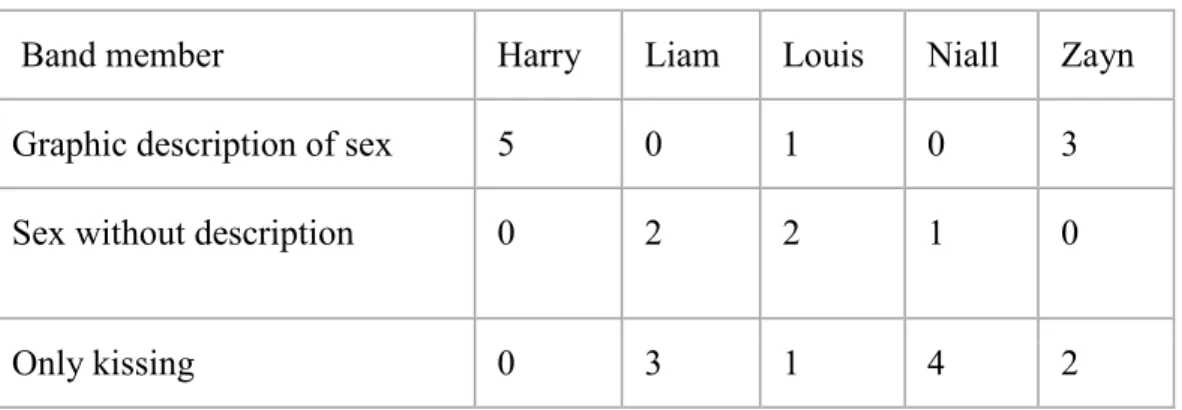
descriptions of sex and five indicated that sex occurred, but these five ended the narrative as the sexual interaction is beginning or before it occurs. Significantly, no stories about Niall or Liam featured graphic descriptions of sex, confirming the presence of qualitative differences in content between stories about different band members. This difference likely stems from the different personality roles the band members are frequently portrayed as fulfilling; Niall is frequently portrayed as the sweet and goofy member of the group, Liam is the down-to-earth or “meet the parents” personality, and in contrast, Zayn and Harry hold the mysterious and womanizer reputations (Gibsone, 2015; Holcomb, 2013). Therefore, the rest of this analysis continues to stratify data by band member in order to more accurately represent the range of the different scripts in the data. The table below features the number of stories featuring each level of sexual interaction (kissing, sex implied, or graphic description of sex) according to which band member was featured as the primary romantic interest.
Band member Harry Liam Louis Niall Zayn
Graphic description of sex 5 0 1 0 3
Sex without description 0 2 2 1 0
Prevalence of males’ vs. females’ active participation during sexual activity
When the character intentionally performed any physical action while kissing, I coded this act as active participation during kissing. The purpose of this measure was to capture how often characters actively participated in kissing interactions, as opposed to merely reacting to a partner’s actions or describing thoughts and feelings related to kissing. Thus, bodily reactions to a partner’s kissing, like involuntarily sighing or becoming erect, were not included in this code. To consistently distinguish active participation during kissing from active participation during sexual activity, I coded all actions following undressing or sexual touching underneath clothes/undergarments as active participation during sexual activity. I coded all actions preceding undressing, including sexual touching above clothes, as active participation during kissing. If characters removed clothes or undergarments while kissing but did not pursue further sexual activity, the actions were still coded as active participation during kissing. However, if characters pursued sexual activity with undergarments still intact, i.e. sexual touching over undergarments until orgasm, then the actions were coded as active participation during sexual activity.
Kissing. Since word count more accurately reflected the narrative space allocated for
active participation than frequency of codes employed, I used the frequency of words devoted to this type of sexual activity to understand the relative prominence of male versus female
and driven by males. A closer look at descriptions of kissing and sexual activities in these stories further reinforces a masculinist conceptualization of these activities.
Females supplement. For example, females’ actions appeared to be more likely than
males’ actions to describe behavior that was supplemental but not directly in reference to the primary sexual activity itself (i.e., the actual intercourse)— touching their partner’s hair, shoulders, back, and abdomen were primarily referenced for females. Descriptions like, “My hands ran up and down his bare and broad back, my nails digging into his skin slightly” from
and “My hands making their way back up to his hair, fingers running through his silky tousled curls that I loved so much” from constitute hallmarks of females’ participation in sexual narratives. In contrast, males’ actions tended to focus more exclusively on the sex act in progress. However, this trend was not as prevalent within female active participation during kissing, where females seemed closer to equal in performing specific kissing actions.
Attack of the kiss. While coding inductively, a theme regarding aggressive and assaultive language to describe kissing and sex also emerged as prevalent across the dataset. This code was employed 96 times to describe the presence of phrases like “assault on his neck,” “attack on her lips,” “slammed into her” and “crashed onto his lips” to describe actions performed by males and females during kissing or sexual activity. For the most part, this language did not actually
describe sexual assault—the code only co-occurred with other codes indicating instances of sexual assault and nonconsensual physical activity eight times. Rather, this language permeates the regular physical interactions between males and females in the dataset.
surely did leave my neck giving off a tingling sensation.” A few moments later, ’s
narration of the interaction continued to emphasize aggressive force: “His lips slammed against mine and I felt my whole body literally move back slightly from the force.” This description of
’s kissing involving being “slammed” after a “not so gentle assault” creates a jarring contrast with the rest of the scene’s light-hearted imagery, where the two “looked like a bunch of kids running around the kitchen throwing cake batter at one another.” Although this language sometimes described females’ actions as well (co-occurring with female active participation in kissing and sexual activity thirteen times), the framing of sexual activity through assaultive language was nonetheless more common for male-initiated activity and therefore seems to prioritize machismo as a frame for understanding physical interactions.
A surprise kiss. Additionally, I documented the frequency with which characters
surprised a romantic partner with an unexpected kiss or other sexual action. To trigger the use of this code, the receiving character must have described being surprised or startled by a partner’s sudden act, not having time to react to the partner’s action. For example, the following
interaction from by “ ” exemplifies this type of action: …he glared at me icily for a good brief two seconds before he strides toward me. I
stumble back, feeling threatened but I don't have any time to react when he wraps his
hands around my neck, pulling me forward and smacking our lips harshly against one
another.
In total, males surprised females with a kiss or other sexual action 52 times across the
dataset, compared to females’ 14 times where they initiated the surprise. Although surprise
actions related to kissing and sex were often received with enthusiasm (i.e., in
quickly fall into the pit of comfort that is ’s kiss”), these actions sometimes hindered the
recipient’s ability to negotiate consent or served to obscure violations of the recipient’s
intentions. In , unintentionally kisses someone other than her boyfriend,
, because of the confusion created by the “surprise action” of her male best friend. In the
story, “She goes to open her mouth to say something but he,” the friend, “cuts her off by
smashing his lips on hers. He presses himself against her on the wall and she’s left dumbfounded
and she does the unthinkable and kisses him back with just as much force.” When she quickly
comes to her senses, immediately attempts to break the kiss. After he dismisses her verbal
protests, she slaps him to finally end the interaction. When explaining the situation and resulting
hickies to , though, accepts responsibility for the kiss that she was forced into,
claiming it as a mistake she made. She pleads, “‘ , I swear to God it was a mistake. I didn’t
know what I was doing.”
In addition to serving as a means for placing blame on victims of forced physical
interaction, when employed in clearly consensual sexual interactions, this surprise action
appeared to reinforce an ideal of brash masculine dominance, showing this dominance as
desirable. In by “ ,” for instance, and speedily enter a
sexual interaction after a prolonged separation, hastily establishing consent and immediately
engaging in foreplay that enjoys. When initiating vaginal intercourse, though, ’s
actions constitute a “male ‘surprise’ action.” narrates: “He unbuckled and unbuttoned his
belt and jeans in a matter of seconds. Before I could even process what was about to happen, I
felt his erection push all the way inside of me as he roughly thrust his hips, causing my back to
speedily-initiated vaginal intercourse, her narration serves to praise a style of sexual interaction that, if
translated to other contexts, would eliminate females’ opportunities to negotiate consent.
The emergent themes of language of aggression and attack to describe kissing and sexual
activity and “surprise” actions both serve to bolster the male’s upper hand in these narratives,
often valorizing sudden and aggressive behavior that silences female voices and actions. Even
when these themes applied to female behavior, I felt these actions only served to normalize this
male-typed behavior as typical of romantic interactions.
Hurts so good. Although not as prevalent throughout the sexual interactions depicted,
female pain or discomfort during kissing and sex still emerged as a salient element of females’ experiences in romantic interactions. The following table illustrates the frequency with which any mention of female pain or discomfort occurred during sex and during kissing, stratified by band member.
Band member Harry Liam Louis Niall Zayn
Female pain/ discomfort related to sex
8 0 3 0 5
Female pain/discomfort during kissing
5 1 0 1 1
Figure 6- Female pain/discomfort
Not surprisingly, pain during sex occurred most frequently in the categories with the highest number of stories involving graphic descriptions of sex. Of the sixteen instances of female pain/discomfort during sex, only one co-occurred with female hesitance/unease for sexual interaction and only one co-occurred with male coercion (see Negotiation of Consent section below for more discussion of these codes). Amongst the eight instances of female
of the sixteen times the code female pain/discomfort during sexual activity was employed were related to the loss of virginity. Rather, female pain during sex and kissing was most often portrayed as a normal and recurring element of the feminine romantic experience, co-occurring with male active participation during sexual activity ten times and with male active participation during kissing seven times.
In summary, the distribution of frequencies for initiating and actively participating during kissing and sexual interactions clearly indicates that males dominate the physical interactions between females and males in these stories. Additionally, the linguistic construction of these sexual scripts further emphasizes females’ auxiliary roles in physical interactions and favors masculinist values like aggression and impulsive behavior that disregards its impact on others. The primacy of these values is paired with the prevalence of females’ experiences of pain within the same narratives.
Negotiating consent
This section of the analysis carefully considers the negotiations of consent present in these narratives and the themes that surfaced as relevant to these discussions of consent. First, a measurement of consent’s frequency within different moments during sexual interactions frames a discussion of the different ways that sexual consent is negotiated throughout the dataset. Then, I present the analysis of how different themes related to consent—specifically hesitation or unease for sexual interaction, assumption of consent, and sexual violence—contribute to different conceptualizations of what sexual consent means and what behaviors represent a violation of consent.
As expected, frequencies for total instances of consent negotiation were highest for the band member with the most stories with graphic depictions of sex (Harry) and descended accordingly. However, band members whose stories did not contain graphic descriptions of sex still contained the lowest frequencies for negotiations of consent for kissing/non-sexual physical behavior and for not having sex. For stories written about Harry, which all contain graphic descriptions of sex, consent was most often negotiated before initiating sexual activity, occurring 27 times, followed by negotiation of consent before a sex act occurring 15 times, and consent for continuing sex acts occurring 6 times. For stories written about Louis, frequency of negotiations of consent followed a similar pattern according to chronological placement within a sexual interaction, with sexual consent occurring most frequently before initiating sexual activity. In Zayn’s stories, negotiation of consent most frequently surrounded kissing and non-sexual behaviors. Regarding sexual consent, though, negotiations of consent before initiating sexual activity and before initiating a sex act were equal in frequencies. These observations, taken as a whole, imply that, when sex isn’t considered as a possibility, perhaps consent becomes irrelevant to the stories’ characters for all other kinds of romantic interactions.
The different ways in which sexual consent is negotiated and established also play a significant role in setting the tone for the sexual interaction. When and have sex for the first time in , negotiation of consent is depicted as an ongoing process throughout the scene. After, upon ’s suggestion, they successfully sneak past her parents to her bedroom in order to have sex, pauses their kissing to ask, “Do you trust me?”
“Are you okay?" He asks as he tried to keep his eyes open. He was in obvious bliss
compared to what I was feeling.
"Y-Yeah," I croak, trying to sound calm, "Just hurts a little."
"You wanna... Like, roll over and be on top?" He asks softly, and before I could refuse, he
says, "It'd be easier for you to adjust to the pain now rather than later."
I bite my lip and nod. It sounded reasonable. But I'm not sure if it would actually help me
adjust. Then again, I was still new to this so I may as well.
finds that the adjustment of position helps, and she continues to lead the sexual
interaction, providing the majority of the active participation during the scene.
In other stories, when consent was negotiated less carefully, that negotiation seemed to
correspond with less female active participation throughout the interaction. During a sexual
interaction between and in , for example, begins undressing
when she meets him at the gym where he trains for his career as a boxer. Consent is
brusquely discussed when asks “‘Are we doing this? In the gym?,’” and replies, “If
they leak any of the footage, I’ll sue them.” In this scene, the word count for the codes of
“female active participation during sexual activity” totaled 47 words, whereas “male active
participation during sexual activity” totaled 195 words.
Hesitation or unease during kissing or sexual activity
apparently decided to go all in with the shots. Yes he maybe should have stopped, but as
far as I remember I didn't really take no for an answer. It would have been different if it
was my first time, but I wasn't, so I think it's alright really.
The narratives that involved female hesitance or unease for kissing or sexual activity were more numerous and complex than male causes of hesitance. Whereas personal feelings did not surface as a cause of male hesitance or unease for kissing or sex, feelings were the primary driver of hesitance or unease among females. For example, a few of the personal feelings that sparked hesitation during female kissing or active participation in sexual activity included personal feelings towards the band member in light of conflict in the relationship, conflicting feelings between sexual desire and reasons not to have sex, and the inability to think clearly or retain control of the situation while overwhelmed by emotions. Additionally, discomfort with inappropriate times and places for kissing or sex, insecurities about their own bodies, generalized anxiety, and confusion stemming from sexual inexperience all contributed to female hesitance or unease for kissing or sex, as well.
For example, in , ’s feelings of insecurity about her body cause her to experience unease for a pending sexual interaction. “ ” writes,
Involuntarily, I clamp my legs and his hands restrict me from closing the shut.
"Relax."
I calm down but the whole idea of being exposed to him is awkward and I feel insecure
by all means. I keep myself well groomed but I still feel so iffy about this. It would've
been better if this was done at night with the lights off instead of in the afternoon. This is
embarrassing and all but that would've at least made me feel more comfortable about
The relationship between hesitance and unease for sexual activity and several of the themes mentioned above is especially striking during ’s first time having sex in . First, ’s hesitation to respond to ’s attempt to obtain consent is characterized by a feeling of being unable to think clearly while overwhelmed with emotions. Author
“ ” writes:
My pulse sped, skittish nerves causing my fingers to tremble. "Do you want this?"
whispered against my cheek, prompting the flush in it. The question made my head pound. My thoughts were all over the place. I wasn't in the state to return a rational answer. " ?" He inquired, fingers brushing my cheek. All I needed to do was give him an answer. Rational decisions were always hard to make when was involved. The few minutes we had spent together made it very hard for me to refuse him now. I loved him, I wanted him close. That was all I knew.
I acted before my mind could process the wholeness of this situation. I returned a nod and he dipped to kiss me again.
As the sexual interaction continues to unfold, ’s narration is laced with comments noting how her lack of knowledge about sex made the experience confusing and uncomfortable. I coded the following passage with “female hesitance/unease for sexual interaction,” “sexual
inexperience/lack of knowledge,” and “female pain/discomfort during sex”:
My fingers lightly tugged at his hair. The stinging pain grew everytime I felt him move. I wasn't aware of the dynamics, how this worked. As far as I knew, it wasn't supposed to hurt. Why would people do it if it did? Something was wrong.
In the above passage, doesn’t realize exactly what behaviors she had consented to until vaginal intercourse had already begun. Her narration conveys her feelings of uneasiness,
stemming from her confusion and pain; she keeps her eyes shut to make the “far from pleasant” sensations “easier somehow,” and she clearly notes that, “Something was wrong.” ’s narration throughout the remainder of the sexual interaction continues to express her heightening unease for her present situation; author “ ” writes, “I didn't want to open my eyes.
I wouldn't be able to handle the sight. This wasn't me
.
” Later, continues to describe herresponse to her experienced confusion as tearful: “ continued to push into me and at a point I felt like I was on the verge of tears. What would we achieve from these actions? What would come after this?” After the sexual interaction’s conclusion, ’s narration once more reiterates her troubled and confused feelings: “The clamorous thumping of my heart filled my ears, my head pounded with conflicting thoughts. It just wasn't sinking it yet, what we had just done. What I had just done.”
Assumption of consent
either interpreting females’ bodies or interpreting silence or unclear confirmations as consent. Other ambiguous “cues” that males relied on in the dataset for consent for kissing and consent for sexual interaction included wordless moans, looking into the female’s eyes for a sign of consent, or simply absence of obvious resistance.
Some male assumptions of female consent represented appropriate interpretations of nonverbal cues and indicated the male’s social competence. Fox example, in , reasonably interprets the female protagonist’s blushing and smiling at him as an affirmative answer to his request to kiss her. Author “ ” writes from ’s perspective: “"Do ya think it'd be too soon for me to kiss you?" I asked, licking my lips. This made
blush even more, and by the way she smiled at me, I knew she wanted to kiss me, too. I didn’t hesitate to lean in and crash my lips into hers.”
In other stories, males’ assumption of consent relied on more ambiguous evidence. During a heated make-out session in , pauses to evaluate the female protagonists’ body language before touching her breasts over her bra. Author “ ” writes from ’s perspective:
I let my right hand travel down to the hem of her top, putting a bit more weight on her, kissing her again. I caress the skin of her stomach, and slowly I trace my light touch upwards towards her bra. I open my eyes to see if she's freaking out. But her eyes are closed, so I keep kissing her with more and more passion. I reach up and cup one of her breasts on top of her bra, and I catch myself in softly pressing my crotch against her right knee in a slow thrust.
wonders about what would’ve happened if ’s little brother hadn’t interrupted, and she responds to her friend’s inquiry about her desire to have sex with with the answer: “Well…Yeah I guess.” While her answer suggests that didn’t misinterpret her lack of “freaking out,” it still indicates a hesitance for impending sexual interaction that, if not for
’s little brother, would’ve likely followed suit.
In some situations, though, the male’s assumption of consent clearly incorrect; in
, “ ” narrates the thoughts of the female protagonist, named : “I unfolded my legs and stretched them out. They were starting to cramp up. must’ve
interpreted it the wrong way because he slid me down from the baseboard and hovered over me.
It happened too fast that I couldn’t protest.” This incorrect assumption sparks a series events that
culminates in the female’s first sex act, which begins without her consent. After forcefully
sliding the from the baseboard, immediately launches into 169 words of
uninterrupted and unreciprocated “dirty talk,” involving how aroused must be in the
moment, sexual actions he desires to perform, and his own current state of arousal. Upon
finishing his soliloquy, guides the female’s hand beneath his boxers and begins rubbing
his erection, even though her “hand was stiff.” Then, he inquires about consent, asking,
“Please…just do this baby.” The female nods in agreement and continues the hand job by
herself.
In , , cast as the king of a
in the story, relies on his interpretation of females’ bodies to justify his rape of a palace
maid. Author “ ”’s narration clearly features the maid’s protests, but attempts to
justify his actions to himself and the maid. “ ” writes: “He felt her wetness through
saying yes,’ let out a masculine chuckle as he slowly lifted her skit[sic]…” This
disconcerting rape scene was clearly intended to contribute to ’s development as an
immoral, violent, and abusive character. However, as the author continues to narrate the rape
scene, ’s incorrect assumption of consent appears to gain some validity; the maid’s protests
of “Please, let me go” shift to “Please, my king, take me!,” and when asks, “Tell me, does
your husband ever make you feel this good?,” she answers “N-no.” The authors’ third-person
narration reinforces the sincerity of her shift from no consent to consent by repeating the phrase
“moans of pleasure” twice to describe the maid’s reactions. Thus, while this scene in
at first appeared to correctly identify in instance where male assumption of
female sexual consent constitutes rape, the following narration obscured the story’s conceptual
clarity surrounding rape and sexual assault.
Sexual violence
story’s plot centers around ’s resistance to his sexual advances, his sexual violence towards her, and her eventual attempts to prevent from killing her family and loved ones and to by acquiescing to his desires. The sum of the codes involving
sexual violence reached 28 within .
Unclear understanding about rape/nonconsensual activity. In some situations or
narrations of characters’ thoughts, the blame of rape, assault, or nonconsensual sex was either deflected from the perpetrator or identified as a less severe offense. Evidence of unclear understanding occurred 21 times during the dataset, all during stories written about .
, and both place a portion of the blame for the lack of sober sexual consent on for adamantly pursuing sexual interaction while intoxicated and for becoming so
intoxicated in the first place. Similarly, although sexual activity does not occur while the female protagonist is intoxicated during , the female muses that if they had engaged in sex, “it wouldn’t exactly be taking advantage of me if I was willing.”
The presence of an unclear understanding of rape and sexual assault was found to be
more complicated throughout , the story about a
raped her, she recalls, “As much as she hated it, she climaxed, she reached the point of pleasure under his touch, something he had not been able to force her to do.” This reflection reiterates the idea that certain elements of her rape—the “pleasure” she experienced “under his touch” and her orgasm—were not a result of ’s force and fall outside the construct of rape. Additionally, the language throughout the story narrowly interprets rape as forced vaginal intercourse where the victim actively attempts to stop the interaction. Thus, the numerous times that forces
to unwilling perform sex acts other than vaginal intercourse, like giving or receiving oral sex, are described as nonconsensual but not as rape. Furthermore, as the narrative progresses,
stops actively resisting ’s sexual advances in order to avoid triggering his threats to
. Even though all these sexual interactions are forced through coercion, the narrative fails to explicitly identify many of them as rape or sexual assault.
In summary, while depictions of enthusiastic sexual consent and nonconsensual sexual assault were clearly differentiated within the dataset, the middle ground of the spectrum between these opposite representations of consent was often obscured by a number of different factors— including but not limited to the ability of females to soberly or knowledgeably consent to sexual behavior, interpretations of body language and bodily responses as proxies for or reaffirmations of consent, and narrow conceptualizations of rape and nonconsensual physical activity.
Gendered behavior
![Di μ α pyrrolidinonato bis[cis diamminechloroplatinum(III)] sulfate dihydrate: a head to head isomer](data:image/gif;base64,R0lGODlhAQABAIAAAP///wAAACH5BAEAAAAALAAAAAABAAEAAAICRAEAOw==)