ORIGINAL ARTICLE
Social-ecological factors associated with selling sex among men who have sex
with men in Jamaica: results from a cross-sectional tablet-based survey
Carmen H. Logiea,b, Ashley Lacombe-Duncana, Kathleen S. Kennyc, Kandasi Levermored, Nicolette Jonesd, Stefan D. Barale, Ying Wanga, Annecka Marshallfand Peter A. Newmana
aFactor-Inwentash Faculty of Social Work, University of Toronto, Toronto, ON, Canada;bWomen’s College Research Institute, Women’s College Hospital, Toronto, ON, Canada;cGillings School of Global Public Health, University of North Carolina at Chapel Hill, Chapel Hill, NC, USA;dJamaica AIDS Support for Life, Kingston, Jamaica;eJohns Hopkins Bloomberg School of Public Health, Johns Hopkins University, Baltimore, MD, USA;fInstitute for Gender and Development Studies, Mona Campus, University of the West Indies, Kingston, Jamaica
ABSTRACT
Background: Globally, men who have sex with men (MSM) experience social marginalization and criminalization that increase HIV vulnerability by constraining access to HIV prevention and care. People who sell sex also experience criminalization, rights violations, and violence, which elevate HIV exposure. MSM who sell sex may experience intersectional stigma and intensified social marginalization, yet have largely been overlooked in epidemiological and social HIV research. In Jamaica, where same sex practices and sex work are criminalized, scant research has investigated sex selling among MSM, including associations with HIV vulnerability.
Objective: We aimed to examine social ecological factors associated with selling sex among MSM in Jamaica, including exchanging sex for money, shelter, food, transportation, or drugs/ alcohol (past 12 months).
Methods: We conducted a cross-sectional survey with a peer-driven sample of MSM in Kingston, Ocho Rios, and Montego Bay. Multivariable logistic regression analyses were con-ducted to estimate intrapersonal/individual, interpersonal/social, and structural factors asso-ciated with selling sex.
Results: Among 556 MSM, one-third (n = 182; 32.7%) reported selling sex. In the final multivariable model, correlates of selling sex included: individual/intrapersonal (lower safer sex self-efficacy [AOR: 0.85, 95% CI: 0.77, 0.94]), interpersonal/social (concurrent partnerships [AOR: 5.52, 95% CI: 1.56, 19.53], a higher need for social support [AOR: 1.08, 95% CI: 1.03, 1.12], lifetime forced sex [AOR: 2.74, 95% 1.65, 4.55]) and structural-level factors (sexual stigma [AOR: 1.09, 95% CI: 1.04, 1.15], food insecurity [AOR: 2.38, 95% CI: 1.41, 4.02], housing insecurity [AOR: 1.94, 95% CI: 1.16, 3.26], no regular healthcare provider [AOR: 2.72, 95% CI: 1.60, 4.64]).
Conclusions: This study highlights social ecological correlates of selling sex among MSM in Jamaica, in particular elevated stigma and economic insecurity. Findings suggest that MSM in Jamaica who sell sex experience intensified social and structural HIV vulnerabilities that should be addressed in multi-level interventions to promote health and human rights.
ARTICLE HISTORY Received 14 August 2017 Accepted 22 December 2017
RESPONSIBLE EDITOR Maria Emmelin, Umeå University, Sweden
KEYWORDS
MSM; stigma; Jamaica; HIV risk; HIV prevention
Background
Men who have sex with men (MSM) who sell sex include diverse populations who often experience criminalization and intersecting forms of stigma, vio-lence and social marginalization that elevate HIV risks [1–7]. Yet MSM who sell sex have largely been over-looked in epidemiological and social HIV research. MSM are a key population in the global HIV pan-demic [8,9], including in Caribbean and Latin American countries [10–12]. In Jamaica, MSM remain at elevated risk for HIV acquisition with a reported HIV prevalence between 28% and 32% [2,12] in com-parison with a general population prevalence of 1.7% (95% CI: 1.4–2.0) among reproductive aged adults
[13,14]. This prevalence is among the highest in the Caribbean [2,15], and is shaped, in part, by the
crim-inalization of same-sex sexual behaviors.
Criminalization of ‘homosexuality’ in Jamaica contri-butes to stigma and discrimination, family rejection, and a lack of human rights protections across employ-ment, education, and healthcare systems, as well as socially sanctioned violence from community and the police [16–18].
People who sell sex, that is, persons who exchange sex for money or other goods, in general, are a key population that experiences criminalization, rights violations, and violence that elevate their HIV expo-sure [1,19]. The prevalence of selling sex among MSM varies across contexts, in part due to
CONTACTCarmen H. Logie [email protected] Faculty of Social Work, University of Toronto, 246 Bloor Street East, Toronto, ON, M5S 1V4, Canada
https://doi.org/10.1080/16549716.2018.1424614
© 2018 The Author(s). Published by Informa UK Limited, trading as Taylor & Francis Group.
methodological challenges in sampling a
margina-lized, and often criminalized, population
[1,2,4,12,20–23]. Among MSM (n = 24,051) in 17 Latin American countries, 7.2% reported transac-tional sex [24]. Other studies report higher preva-lence. One-quarter of MSM in Brazil (n = 658) recruited via respondent-driven sampling reported ever receiving payment for sex [4]. In Jamaica, cross-sectional surveys conducted with MSM in 2007 (n = 201) [12] and 2011 (n = 449) [2] identified the prevalence of sex-selling as 35.9% overall [2], and 30.5% and 39.4% among HIV negative and positive persons, respectively [12]. In contexts with pervasive sexual stigma and discrimination, MSM may experi-ence limited access to education and employment, and may lose familial support; this may contribute to poverty, homelessness, and engagement in survival sex work for money in addition to food, rent, shelter, drugs, and/or alcohol [5,6,20,25].
In some low- and middle-income countries, sex-selling among men has been associated with elevated HIV transmission risks [2,24–32]. Yet, scant research has examined the experiences of MSM who sell sex in contexts where both same-sex practices and sex work are criminalized, such as Jamaica [33]. Two prior studies in Jamaica examining sex-selling among MSM have reported different findings regarding sex work and HIV infection risks. A 2007 study found that HIV prevalence did not differ based on sex work involvement [12], whereas a 2011 study reported higher HIV prevalence among MSM involved in sex work (41.1%) compared to other participants (21.0%) [2]. This study [2] used bivariate analyses to identify structural factors associated with ever being paid for sex among MSM, including homelessness and unem-ployment. Significant knowledge gaps remain, how-ever, regarding factors associated with selling sex, including multivariable analyses that identify inde-pendent effects of multi-level factors, and the possible association between sexual stigma and sex-selling among MSM in Jamaica [2]. Stigma is a particularly important area to examine among MSM who sell sex, who may face intersecting stigma, including sexual stigma, and HIV-related stigma, in addition to sex work stigma [4,5,34–38]. Stigma has been identified as a barrier for male sex workers in accessing HIV prevention services [3].
Perceived sexual stigma,concerns about rejection and negative treatment by others because of actual or perceived lesbian, gay, or bisexual (LGB) identity, and enacted sexual stigma, experiences of acts of violence and unequal treatment based on actual or perceived LGB identity [34,39], profoundly shape the lives of sexually diverse persons. Internalized homophobia, feelings of shame and self-blame [40– 43], may contribute to mental health challenges. Sexual stigma may limit access to education and
employment, threatening economic security [5]. In addition, sexual stigma, sex work, and HIV-related stigma may limit access to sexual health and HIV information, prevention, and testing and care ser-vices [44,45]. Both qualitative [46] and quantitative [47–50] studies describe stigmatizing attitudes by university students and health/social service provi-ders towards people living with HIV and lesbian, gay, bisexual, and transgender (LGBT) persons in Jamaica, with the highest levels of stigma directed towards MSM living with HIV [49,50].
In addition to sexual stigma, other ecological fac-tors are associated with selling sex among MSM. Baral and colleagues [3] conducted a review of studies focused on men who sell sex and identified factors associated with sexual risk practices at biological and behavioural, social, and community levels, consistent with a modified social ecological model [51]. The modified social ecological model conceptualizes multi-level domains associated with HIV infection risks, including proximal intrapersonal and interper-sonal level risks (e.g. condomless sex) in addition to distal structural level risks (e.g. stigma) [51]. Examining multi-level HIV risks is particularly important among MSM who sell sex. While factors at a structural level (e.g. sexual stigma, economic insecurity) are interconnected and may contribute to increased engagement in sex-selling among MSM, these factors may also be exacerbated among MSM after they begin to sell sex, when they may subse-quently experience the intersection of sexual stigma and sex work stigma [3]. Quantitative studies in var-ious global contexts have identified factors associated with sex-selling among MSM, including socio-demo-graphic factors (e.g. age [22], education [22]), indivi-dual risk factors (e.g. condomless anal intercourse [4,22,36], HIV knowledge [22], sexually transmitted infections (STI) history [52,53], higher number of sexual partners [1,2], substance use [54]), and social level factors (e.g., forced sex, harassment and violence [1,2,4,36]). Alternately, social cohesion among MSM who sell sex has been identified as a protective fac-tor [3].
There has been less attention to stigma and multi-level ecological factors, particularly at the structural level, among MSM who sell sex in the Caribbean. Our study objective was to test a conceptual model, based on a social ecological framework, examining intrapersonal/ individual, interpersonal/social, and structural level fac-tors associated with sex-selling among MSM in Jamaica.
Methods
Setting, study design, and participants
2015–2016. Eligibility for participation included: a) self-identification as a gay or bisexual man, or a man who has sex with, or is sexually attracted to, other men; and b) aged 18 years and older.
Kingston is the capital and largest city of Jamaica, with approximately 600,000 inhabitants [55]. Ocho Rios has a smaller population of approximately 10,000 people [56], but has a large influx of tourists. Outside of urban parishes, parishes with significant tourism-based economies have the next highest level of cumulative number of reported HIV cases, includ-ing St Ann’s parish, where Ocho Rios is located [57]. We aimed to include geographic diversity and com-munities most affected by HIV in Jamaica.
We worked with a national community-based AIDS service organization (Jamaica AIDS Support for Life) and a team of seven peer research assistants (PRAs), who identified as lesbian, gay, bisexual, MSM, or other sexually and/or gender diverse identities. PRAs contrib-uted to survey design and recruitment, and adminis-tered the survey. We used chain-referral sampling, a form of peer-driven recruitment, often applied to access hidden or hard-to-reach populations [58]. In this pro-cess, each participant was given a unique participant identification (ID) number, and at the end of the survey was given up to five coupons with study information and a coupon ID number and invited to refer peers to the study who met eligibility requirements.
The survey was administered in person by PRA using tablets and an online survey with FluidSurveys™ software. Participants provided written informed con-sent at the time of their interview, and received $1000 Jamaican dollars (approximately $8 USD) for complet-ing the 45-minute survey, and an additional $500 Jamaican dollars (approximately $4 USD) for each par-ticipant they successfully recruited to participate. PRA read the informed consent information aloud to the participant from the tablet; before being permitted to complete the survey, eligible participants provided voluntary written informed consent on the tablet. The Research Ethics Board at the University of Toronto and the University of West Indies, Mona Campus, provided research ethics approval for this study.
Survey measures
Sex-selling
Sex-selling was assessed by asking participants if they had exchanged sex for money, shelter, food, trans-portation, or drugs/alcohol in the last 12 months. Participants who self-reported selling sex for any of the above reasons were coded as‘yes’and those self-reporting no sex selling were coded as‘no’.
Socio-demographic factors
We assessed socio-demographic factors including: age (continuous); education level (less than high school/
completed high school); city of residence (categories: Kingston, Montego Bay, Ocho Rios, and other); and monthly income (continuous; we report in US dollars).
Intrapersonal/individual factors
Intrapersonal/individual factors assessed included: HIV status (positive/negative; assessed by self-report), lifetime STI history (positive/negative, measured by self-report of having received an STI test and the results with a diagnosis), depression symptoms in the past 2 weeks (continuous, measured with Patient Health Questionnaire-2 [59], scale range 0–8, Cronbach’s α = 0.67); resilient coping, measured using the Brief Resilience Scale [60] (continuous six-item scale, range 6–30, Cronbach’sα= 0.66), safer sex self-efficacy, using Kalichman et al.’s (2001) scale for negotiating safer sex (continuous, range: 5–20, Cronbach’s alpha: 0.75), and internalized homopho-bia, using the 12-item version of the Internalized Homophobia Scale developed by Currie et al. [61] (continuous 12-item scale, range 12–77, Cronbach’s α= 0.50). We also assessed lifetime number of sexual partners (continuous) and consistent condom use in the last 4 weeks (no/yes; participants were coded as
‘yes’if there was parity in the number of times they reported having sex and the number of times they reported using condoms).
Interpersonal/social factors
Interpersonal/social factors included: relationship sta-tus (categories: in a relationship, casual dating, no partner, concurrent partners); social support, mea-sured with a scale developed by Bernal et al. [62], which included two subscales: the need for social support (Cronbach’s a = 0.81, range 7–35) and satis-faction with the quality of social support (Cronbach’s a = 0.86, range 2–10); lifetime history of childhood sexual abuse (no/yes), lifetime history of childhood physical abuse (no/yes), and lifetime history of forced sex (no/yes).
Structural factors
We assessed HIV-related stigma using Steward et al.’s item perceived stigma subscale (continuous 10-item scale, range 8–100, Cronbach’s α = 0.92). We measured sexual stigma using Diaz et al.’s scale [63] that includes perceived sexual stigma (continuous five-item scale, range 7–35, Cronbach’s α = 0.73) and enacted sexual stigma (continuous seven-item scale, range 7–49, Cronbach’sα= 0.88). We assessed food insecurity (no/yes; participants were coded as
house vs in their own room in an apartment/house), employment (unemployed vs employed or studying), barriers to healthcare (no/yes; participants were coded as ‘yes’ if they reported one or more barriers to accessing healthcare services); and having a regular healthcare provider (no/yes).
Statistical analyses
Theoretically important factors mapping onto indivi-dual, social and structural levels of the social ecologi-cal model [51] were examined as correlates of sex-selling in the last 12 months in bivariable logistic regression analyses using proc genmod with a logit link. Variables with p values of <0.05 were considered for inclusion in the full multivariable logistic regres-sion model. A forward stepwise model-building
pro-cedure using logistic regression and Akaike’s
Information Criterion (AIC) was used to determine variables for inclusion in the final model. The final model was preferred over reduced models because of the smaller AIC value. Only those variables indepen-dently associated with the outcome of selling sex were retained in the final model. All statistical analyses were conducted using SAS software version 9.3 (SAS Institute, Cary, NC, USA).
Results
Study population
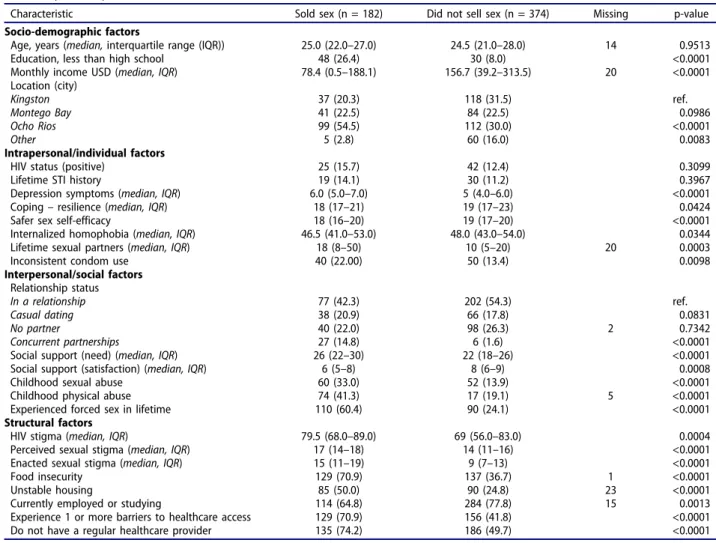
In Table 1, we present the characteristics of study participants by sex-selling status in the last 12 months. Of 556 MSM participants, 182 (32.7%) reported sell-ing sex in the past 12 months. There were no sig-nificant differences in HIV status or lifetime STI history by sex-selling; 12.1% (n = 67) of all partici-pants reported being HIV-positive and 8.8% (n = 49) reported a lifetime STI history.
Logistic regression modeling of sex-selling among MSM in Jamaica
Factors associated with sex-selling among MSM in bivariate and multivariable analyses are displayed in
Table 2. In bivariate analyses, socio-demographic fac-tors correlated with sex-selling at alpha <0.05 included: lower likelihood of completing high school education, lower income, lower likelihood of living in an‘other’area vs Kingston, and higher likelihood of living in Ocho Rios vs Kingston. Intrapersonal/indi-vidual factors correlated with sex-selling at alpha <0.05 included: higher depression symptoms, lower resilient coping, lower safer sex self-efficacy, lower internalized homophobia, and greater odds of incon-sistent condom use. Interpersonal/social factors cor-related with sex-selling at alpha <0.05 included:
higher likelihood of concurrent partnerships vs a relationship, a higher need for social support, lower satisfaction with social support, higher likelihood of childhood physical and sexual abuse, increased odds of lifetime forced sex. Structural factors correlated with sex-selling at alpha <0.05 included: higher HIV stigma, and higher perceived and enacted sexual stigma, food insecurity, unstable housing, current unemployment, one or more barriers to healthcare access, and not having a regular healthcare provider. In the final multivariable model, socio-demo-graphic correlates of sex-selling included residing in Ocho Rios (AOR: 2.18, 95% CI: 1.18, 4.04) or‘other’ regions (AOR: 0.31, 95% CI: 0.10, 0.95) in compar-ison with Kingston. Intrapersonal/individual level correlates of sex-selling included lower levels of safer sex self-efficacy (AOR: 0.85, 95% CI: 0.77, 0.94). Interpersonal/social level factors associated with sex-selling included having concurrent partner-ships (AOR: 5.52, 95% CI: 1.56, 19.53), a higher need for social support (AOR: 1.08, 95% CI: 1.03, 1.12), and experiencing forced sex in one’s lifetime (AOR: 2.74, 95% CI: 1.65, 4.55). At the structural level, MSM who sell sex experienced higher enacted sexual stigma (AOR: 1.09, 95% CI: 1.04, 1.15), and twofold higher odds of food insecurity (AOR: 2.38, 95% CI: 1.41, 4.02), unstable housing (AOR: 1.94, 95% CI: 1.16, 3.26), and not having a regular healthcare provider (AOR: 2.72, 95% CI: 1.60, 4.64).
Discussion
This study applies a social-ecological framework to examine multi-level factors, including sexual stigma, associated with selling sex among MSM in Jamaica. Approximately one-third of participants reported selling sex in the past 12 months. While higher than some other global contexts [4,20,24], this prevalence is similar to prior studies with MSM in Jamaica [2,12]. Our finding that selling sex was not associated with differences in HIV serostatus corroborates find-ings from a 2011 study with MSM in Jamaica [2], yet contrasts with other global studies [2,26–32]. However, the association of HIV prevalence and sex work among MSM is inconsistent across studies due to a number of factors, including different sex roles of male sex workers in different sociocultural contexts, frequency of condom use, baseline HIV prevalence, and sampling [3]. Nevertheless, MSM in our study overall had sevenfold higher HIV prevalence (12.1%) than the general population in Jamaica [13,14]; and those MSM who sell sex experienced multiple social and structural drivers of HIV that can inform pre-ventive interventions.
We found sex working MSM had greater odds of experiencing a range of HIV vulnerabilities spanning
Table 1.Individual, social, and structural factors and sex selling in the past 12 months among men who have sex with men in Jamaica (n = 556).
Characteristic Sold sex (n = 182) Did not sell sex (n = 374) Missing p-value
Socio-demographic factors
Age, years (median,interquartile range (IQR)) 25.0 (22.0–27.0) 24.5 (21.0–28.0) 14 0.9513
Education, less than high school 48 (26.4) 30 (8.0) <0.0001
Monthly income USD (median, IQR) 78.4 (0.5–188.1) 156.7 (39.2–313.5) 20 <0.0001
Location (city)
Kingston 37 (20.3) 118 (31.5) ref.
Montego Bay 41 (22.5) 84 (22.5) 0.0986
Ocho Rios 99 (54.5) 112 (30.0) <0.0001
Other 5 (2.8) 60 (16.0) 0.0083
Intrapersonal/individual factors
HIV status (positive) 25 (15.7) 42 (12.4) 0.3099
Lifetime STI history 19 (14.1) 30 (11.2) 0.3967
Depression symptoms (median, IQR) 6.0 (5.0–7.0) 5 (4.0–6.0) <0.0001
Coping–resilience (median, IQR) 18 (17–21) 19 (17–23) 0.0424
Safer sex self-efficacy 18 (16–20) 19 (17–20) <0.0001
Internalized homophobia (median, IQR) 46.5 (41.0–53.0) 48.0 (43.0–54.0) 0.0344
Lifetime sexual partners (median, IQR) 18 (8–50) 10 (5–20) 20 0.0003
Inconsistent condom use 40 (22.00) 50 (13.4) 0.0098
Interpersonal/social factors Relationship status
In a relationship 77 (42.3) 202 (54.3) ref.
Casual dating 38 (20.9) 66 (17.8) 0.0831
No partner 40 (22.0) 98 (26.3) 2 0.7342
Concurrent partnerships 27 (14.8) 6 (1.6) <0.0001
Social support (need) (median, IQR) 26 (22–30) 22 (18–26) <0.0001
Social support (satisfaction) (median, IQR) 6 (5–8) 8 (6–9) 0.0008
Childhood sexual abuse 60 (33.0) 52 (13.9) <0.0001
Childhood physical abuse 74 (41.3) 17 (19.1) 5 <0.0001
Experienced forced sex in lifetime 110 (60.4) 90 (24.1) <0.0001
Structural factors
HIV stigma (median, IQR) 79.5 (68.0–89.0) 69 (56.0–83.0) 0.0004
Perceived sexual stigma (median, IQR) 17 (14–18) 14 (11–16) <0.0001
Enacted sexual stigma (median, IQR) 15 (11–19) 9 (7–13) <0.0001
Food insecurity 129 (70.9) 137 (36.7) 1 <0.0001
Unstable housing 85 (50.0) 90 (24.8) 23 <0.0001
Currently employed or studying 114 (64.8) 284 (77.8) 15 0.0013
Experience 1 or more barriers to healthcare access 129 (70.9) 156 (41.8) <0.0001
Do not have a regular healthcare provider 135 (74.2) 186 (49.7) <0.0001
Table 2.Bivariable and multivariable analyses of individual, social, and structural factors associated with sex-selling in the past 12 months among men who have sex with men in Jamaica (n = 556), March 2015–October 2015.
Characteristic Unadjusted OR (95% CI) Adjusted OR (95% CI)
Socio-demographic factors
Education, less than high school 4.11 (2.50, 6.76)**
Monthly income 0.79 (0.70–0.89)a***
Location (city)
Ocho Rios (vs Kingston) 2.82 (1.78, 4.46)*** 2.18 (1.18, 4.04)*
Other (vs Kingston) 0.15 (0.09, 0.71)** 0.31 (0.10, 0.95)*
Intrapersonal/individual factors
Depression symptoms 1.40 (1.25, 1.57)b**
Resilience/coping 0.96 (0.92, 1.00)b*
Safer sex self-efficacy 0.82 (0.76, 0.88)b** 0.85 (0.77, 0.94)b**
Internalized homophobia 0.98 (0.96, 1.00)b*
Inconsistent condom use 1.83 (1.15, 2.89)b*
Interpersonal/social factors Relationship status
Concurrent partnerships (vs in a relationship)
10.92 (4.74, 30.0)*** 5.52 (1.56, 19.53)**
Social support (need) 1.13 (1.10, 1.17)b*** 1.08 (1.03, 1.12)b**
Social support (satisfaction) 0.87 (0.80, 0.95)b**
Childhood sexual abuse 3.05 (1.99, 4.66)**
Childhood physical abuse 2.99 (2.01, 4.43)**
Experienced forced sex in lifetime 4.82 (3.30, 7.05)** 2.74 (1.65, 4.55)**
Structural factors
HIV stigma 1.01 (1.01, 1.03)b*
Perceived sexual stigma 1.22 (1.15, 1.29)b**
Enacted sexual stigma 1.21 (1.17, 1.26)b** 1.09 (1.04, 1.15)b**
Food insecurity 4.19 (2.86, 6.15)** 2.38 (1.41, 4.02)*
Unstable housing 3.03 (2.07, 4.45)** 1.94 (1.16, 3.26)*
Currently unemployed 1.91 (1.28, 2.83)b**
Experienced 1 or more barriers to healthcare access 3.39 (2.31, 4.95)**
Do not have a regular healthcare provider 2.90 (1.97, 4.28)** 2.72 (1.60, 4.64)**
a
per 100 USD increase. bper 1-unit increase.
sex partners),social(higher odds of forced sex, need for social support), and structural domains (enacted sexual stigma, food and housing insecurity, no regu-lar healthcare provider). These findings can inform the development of tailored interventions to address population-specific HIV vulnerabilities among MSM who sell sex in Jamaica, including a focus on under-standing regional differences among MSM who sell sex in Ocho Rios and Kingston. Figure 1 illustrates this conceptual model of social ecological factors associated with selling sex among MSM in Jamaica.
At the individual level, sex-selling was associated with lower odds of safer sex self-efficacy. While only significant in bivariate analysis, it is also notable that MSM who sell sex, in addition to tenfold higher odds of concurrent partners, had nearly double the odds of inconsistent condom use. This contrasts with studies among more formal male sex workers or those affiliated with the gay entertainment industry that indicate higher levels of condom use than among other MSM [13,14]. This difference may reflect the economic insecurity characteristic of the present sam-ple, pervasive forced sex, and the lesser networking with HIV prevention outreach than among other more formal groups of MSM who sell sex [13,14]. In their review of HIV risk factors for young MSM, Mustanski and colleagues [25] suggested several potential mechanisms by which safer sex self-efficacy may be constrained in the context of selling sex,
including: lacking essential skills to discuss condom use and HIV/STI with clients; condoms may not be readily available for free and, given other needs (food, shelter, clothing), may not be prioritized for pur-chase; MSM who are street-based sex workers may not carry condoms due to sex work criminalization and fear of being detained; and the economic inse-curity that is often paired with sex work for MSM, which may lead some MSM to accede to clients who may request condomless sex for higher pay. Associations between inconsistent condom use and some of these factors (e.g. economic insecurity, low educational attainment) have been identified in other studies with MSM who sell sex globally [21,36]. Thus, as suggested by Newman and colleagues in studies of MSM who sell sex in other low- and middle-income countries [25], interventions predicated on individual level factors, such as HIV knowledge, condom nego-tiation and safer sex self-efficacy, would likely be more effective if paired with interventions to increase condom access and address economic security among MSM who sell sex.
At the social level, we identified risk factors for HIV acquisition (forced sex, need for social support) associated with selling sex among MSM. Most (60%) MSM who sold sex in our sample experienced forced sex; these men had almost three times the odds of experiencing forced sex relative to MSM who did not sell sex. Our findings corroborate studies in other
structural (sexual stigma, food and housing insecurity, no
healthcare provider)
interpersonal/social
(concurrent partnerships, higher social support needs,
lifetime forced sex)
intrapersonal/individual
(lower safer self self-efficacy)
contexts that report elevated risks for experiencing sexual and other physical violence among MSM who sell sex [1,2,4,7,36]. This prevalence of forced sex is very high, particularly in comparison to data from other low- and middle-income countries which show prevalence ranging from 6.5 to 40.5% [1,64]. Forced sex among our sample of MSM was also higher than rates of forced sex reported in a prior study with MSM in Jamaica (18.9%) [2]. In a qualitative study with sex workers in Jamaica, which included male sex workers, narratives revealed experiences of violence, including kidnapping, physical abuse, stabbing, rob-bery, and rape [33]. These findings suggest the need for structural interventions to combat sexual and other physical violence against MSM who sell sex. Future studies may seek to include a measure of sex work social cohesion in addition to social support, which has been linked with increased condom use
efficacy among sex workers in Canada [65].
Nevertheless, the potential benefits of social cohesion and social support may be mitigated in the context of criminalization of same-sex behaviors and structural violence, which may exacerbate the risks associated with disclosure of one’s sexual behaviors or iden-tity [65].
Our findings of a significant association between sexual stigma, a structural factor, and selling sex among MSM corroborate Baral et al.’s call for the need to address intersecting stigma among male sex
work – associated with HIV, same-sex practices,
poorer socioeconomic status, and the criminalization of sex work [3]. Future studies should examine inter-sectional stigma [66], including sex work stigma, and its association with the health and wellbeing of MSM who sell sex in Jamaica [34].
In addition to sexual stigma, we identified other structural factors among MSM who sell sex that may
elevate HIV vulnerabilities. Sex-selling MSM
reported higher levels of economic insecurity, with increased unstable housing and food insecurity. Our finding regarding housing insecurity corroborates a prior study with MSM in Jamaica, whereby home-lessness was associated with ever being paid for sex in bivariate analyses [2]. Similarly, Oldenburg et al.
[24] reported unemployment was associated with
increased odds of selling sex in a review of MSM across 17 Latin American countries. Enacted sexual stigma may be a driver of economic insecurity and contribute to sex-selling; enacted sexual stigma scale items include losing a place to live or a job/career opportunity due to one’s sexual identity. Future studies that use longitudinal designs can better ascertain the relationships between enacted sexual stigma, economic insecurity, and sex-selling among MSM in Jamaica.
A particularly concerning finding was that sex-selling MSM were almost three-fold more likely to
not have a regular healthcare provider relative to MSM who do not sell sex. MSM who sell sex may actively avoid healthcare, as well as HIV testing, due to anticipated stigma: a survey with 332 staff of healthcare and social service agencies in Jamaica and the Bahamas found that while most respondents said they believed that people living with HIV, MSM, and sex workers deserved quality care, they expressed a high level of blame and
negative moral judgments towards MSM [50]. A
study with MSM (n = 2035) in Latin America [67] reported that transactional sex was associated with reduced engagement in HIV medical care, under-scoring the importance of addressing intersec-tional stigma targeting MSM, sex workers, and people living with HIV. A recent qualitative
study [18] exploring HIV testing experiences
with young MSM (n = 20) and community-based key informants (n = 13) in Kingston, Jamaica found that experiences of perceived and enacted stigma in healthcare settings due to sexual stigma and HIV-related stigma presented barriers to accessing HIV testing and sexual healthcare. This suggests the importance of structural level inter-ventions that promote access to healthcare, and reduce discrimination in healthcare against MSM, including those who sell sex, as a crucial measure to intervene in the HIV epidemic among MSM in Jamaica.
Conclusions
There is a dearth of intervention studies tailored for the needs of MSM who sell sex [3]. Future studies could aim to culturally adapt and rigorously evaluate evi-dence-based HIV prevention and care interventions for MSM in Jamaica. Interventions for MSM who sell sex could integrate and evaluate successful components of community mobilization interventions with female sex workers as recommended by the Global Network of Sex Work Projects [69] and outlined in several sources, including the Sex Worker Implementation Tool
(SWIT) [70]. These include extensive community
engagement, political advocacy, building social rela-tionships, and targeted individual support through peer outreach [71]. Given the high rates of forced sex in our findings among MSM who sell sex, interventions can also address community norms and work with state actors (e.g. police) to reduce violence and increase access to justice for MSM in Jamaica [72]. Finally, healthcare providers could benefit from interventions to reduce intersecting stigma to better care for MSM who sell sex [73]. Ultimately, challenging social and structural contexts of stigma and violence targeting
MSM – and particularly MSM who sell sex – in
Jamaica is necessary to increase health, human rights, and reduce HIV vulnerabilities.
Acknowledgments
We would like to thank all of the participants, peer research assistants, and collaborators: Jamaica AIDS Support for Life, JFLAG: Jamaica Forum for Lesbians, All-Sexuals and Gays, Caribbean Vulnerable Communities
(CVC), and Aphrodite’s Pride.
Author contributions
CHL was the nominated principal investigator, conceptua-lized the study and led manuscript writing. KL, AM, and PAN were study investigators and contributed to study design. KL, NJ, TE, AN, and NB contributed to developing the survey instrument and conducted data collection. KK led data analysis, CHL contributed to data analysis. ALD and KK contributed to manuscript writing. AM, NJ, and PAN provided edits and feedback. All authors have read and approved the final manuscript.
Disclosure statement
No potential conflict of interest was reported by the authors.
Ethics and consent
The Research Ethics Board at the University of Toronto and the University of West Indies, Mona Campus, pro-vided research ethics approval for this study.
Funding information
This research was funded by the Canadian Institutes of Health Research (CIHR) Operating Grant 0000303157; Fund: 495419, Competition 201209. CHL is supported by an Ontario Ministry of Research and Innovation Early Researcher Award from the Ministry of Research, Innovation and Science.
Paper context
Men who have sex with men (MSM) who sell sex often experience criminalization, stigma, and violence that ele-vate HIV risk. Limited research has examined the experi-ences of this population in contexts where both same-sex practices and sex work are criminalized. Our study addresses these knowledge gaps by examining social and structural factors associated with selling sex among MSM in Jamaica, including stigma and economic insecurity. The findings inform multi-level policy and practice intervention approaches.
References
[1] Newman PA, Chakrapani V, Cook C, et al. Correlates of paid sex among men who have sex with men in
Chennai, India. Sex Transm Infect. 2008;84:434–438.
[2] Figueroa JP, Cooper CJ, Edwards JK, et al.
Understanding the high prevalence of HIV and other sexually transmitted infections among socio-econom-ically vulnerable men who have sex with men in
Jamaica. PLoS One.2015;10:e0117686.
[3] Baral SD, Friedman MR, Geibel S, et al. Male sex workers: practices, contexts, and vulnerabilities for
HIV acquisition and transmission. Lancet. 2015
17;385:260–273.
[4] Tun W, De Mello M, Pinho A, et al. Sexual risk behaviours and HIV seroprevalence among male sex workers who have sex with men and non-sex workers
in Campinas, Brazil. Sex Transm Infect.2008;84:455–
457.
[5] Padilla M, Castellanos D, Guilamo-Ramos V, et al. Stigma, social inequality, and HIV risk disclosure among Dominican male sex workers. Soc Sci Med.
2008;67:380–388.
[6] Bianchi FT, Reisen CA, Zea MC, et al. Sex work among men who have sex with men and transgender
women in Bogotá. Arch Sex Behav. 2014;43:1637–
1650.
[7] Chakrapani V, Newman PA, Shunmugam M, et al. Structural violence against Kothi-identified men who have sex with men in Chennai, India: a qualitative
investigation. AIDS Educ Prev.2007;19:346–464.
[8] Beyrer C. Global prevention of HIV infection for neglected populations: men who have sex with men.
Clin Infect Dis.2010;50:S108–S113.
[9] Baral SD, Poteat T, Strömdahl S, et al. Worldwide burden of HIV in transgender women: a systematic
review and meta-analysis. Lancet Infect Dis.
2013;13:214–222.
[10] Garcia PJ, Bayer A, Carcamo CP. The changing face of HIV in Latin America and the Caribbean. Curr HIV/
AIDS Rep.2014;11:146–157.
among key populations in Latin America and the
Caribbean. Salud Publica Mex.2013;55:S65–S78.
[12] Figueroa JP, Weir SS, Jones-Cooper C, et al. High HIV prevalence among men who have sex with men in Jamaica is associated with social vulnerability and other sexually transmitted infections. West Indian
Med J.2013;62:286–291.
[13] De Boni R, Veloso VG, Grinsztejn B. Epidemiology of HIV in Latin America and the Caribbean. Curr Opin
HIV AIDS.2014;9:192–198.
[14] Figueroa JP, Duncan J, Byfield L, et al. A comprehen-sive response to the HIV/AIDS epidemic in Jamaica: a review of the past 20 years. West Indian Med J.
2008;57:562–576.
[15] UNAIDS. Jamaica country progress report. Geneva:
UNAIDS;2014.
[16] Allen CF, Simon Y, Edwards J, et al. Factors associated with condom use: economic security and positive pre-vention among people living with HIV/AIDS in the
Caribbean. AIDS Care. 2010;22:1386–1394.
[17] Logie CH, Lee-Foon N, Jones N, et al. Exploring lived experiences of violence and coping among lesbian, gay, bisexual and transgender youth in Kingston,
Jamaica. Int J Sex Health.2016;28:343–353.
[18] Logie CH, Lacombe-Duncan A, Brien N, et al. Barriers and facilitators to HIV testing among young men who have sex with men and transgender women in Kingston, Jamaica: a qualitative study. J Int AIDS
Soc.2017;20:1–9.
[19] Shannon K, Kerr T, Strathdee SA, et al. Prevalence and structural correlates of gender based violence among a prospective cohort of female sex workers.
Br Med J.2009;11:339.
[20] Garofalo R, Herrick A, Mustanski BS, et al. Tip of the iceberg: young men who have sex with men, the internet, and HIV risk. Am J Public Health.
2007;97:1113–1117.
[21] Ramanathan S, Chakrapani V, Ramakrishnan L, et al. Consistent condom use with regular, paying, and casual male partners and associated factors among men who have sex with men in Tamil Nadu, India: findings from an assessment of a large-scale HIV
prevention program. BMC Public Health.2013;13:827.
[22] Tang W, Mahapatra T, Liu F, et al. Burden of HIV and syphilis: a comparative evaluation between male sex workers and non-sex-worker men who have sex
with men in Urban China. PLoS One.2015;10:1.
[23] Newman PA, Lee S-J, Roungprakhon S, et al. Demographic and behavioral correlates of HIV risk among men and transgender women recruited from gay entertainment venues and community-based orga-nizations in Thailand: implications for HIV
preven-tion. Prev Sci.2012;13:483–492.
[24] Oldenburg CE, Perez-Brumer AG, Biello KB, et al. Transactional sex among men who have sex with men in Latin America: economic, sociodemographic, and psychosocial factors. Am J Public Health.
2015;105:e95–e102.
[25] Mustanski BS, Newcomb ME, Du Bois SN, et al. HIV in young men who have sex with men: a review of epidemiology, risk and protective factors, and
inter-ventions. J Sex Res.2011;48:218–253.
[26] Bacon O, Lum P, Hahn J, et al. Commercial sex work and risk of HIV infection among young drug-injecting men who have sex with men in San Francisco. Sex
Transm Dis.2006;33:228–234.
[27] Belza M. Risk of HIV infection among male sex
work-ers in Spain. Sex Transm Infect.2005;81:85–88.
[28] Dandona L, Dandona R, Kumar GA, et al. How much attention is needed towards men who sell sex to men for HIV prevention in India? BMC Public Health.
2006;6:31.
[29] Pisani E, Girault P, Gultom M, et al. HIV, syphilis infection, and sexual practices among transgenders, male sex workers, and other men who have sex with men in Jakarta, Indonesia. Sex Transm Infect.
2004;80:536–540.
[30] Van Griensven F, Thanprasertsuk S, Jommaroeng R, et al. Evidence of a previously undocumented epidemic of HIV infection among men who have sex with men
in Bangkok, Thailand. Aids.2005;19:521–526.
[31] Nguyen TA, Nguyen HT, Le GT, et al. Prevalence and risk factors associated with HIV infection among men having sex with men in Ho Chi Minh City, Vietnam.
AIDS Behav.2008;12:476–482.
[32] Oldenburg CE, Perez-Brumer AG, Reisner SL, et al. Transactional sex and the HIV epidemic among men who have sex with men (MSM): results from a sys-tematic review and meta-analysis. AIDS Behav.
2015;19:2177–2183.
[33] Eldemire-Shearer D, Bailey A. Determinants of risk behaviour of sex-workers in Jamaica. A qualitative
approach. West Indian Med J. 2008;57:450–455.
[34] Baral S, Holland CE, Shannon K, et al. Enhancing benefits or increasing harms: community responses for HIV among men who have sex with men, trans-gender women, female sex workers, and people who
inject drugs. Jaids. 2014;66:S319–S328.
[35] Brahmam GNV, Kodavalla V, Rajkumar H, et al. Sexual practices, HIV and sexually transmitted infec-tions among self-identified men who have sex with men in four high HIV prevalence states of India. Aids.
2008;22:S45–S57.
[36] Chemnasiri T, Netwong T, Visarutratana S, et al. Inconsistent condom use among young men who have sex with men, male sex workers, and
transgen-ders in Thailand. AIDS Educ Prev. 2010;22:100–109.
[37] Kong TS. Risk factors affecting condom use among male sex workers who serve men in China: a
qualita-tive study. Sex Transm Infect.2008;84:444–448.
[38] Crowell TA, Keshinro B, Baral SD, et al. Stigma, access to healthcare, and HIV risks among men who sell sex to
men in Nigeria. J Int AIDS Soc.2017;20:1–9.
[39] Parkhurst JO. Structural approaches for prevention of sexually transmitted HIV in general populations: defi-nitions and an operational approach. J Int AIDS Soc.
2014;17:19052.
[40] Meyer IH. Prejudice, social stress, and mental health in lesbian, gay, and bisexual populations: conceptual
issues and research evidence. Psychol Bull.
2003;129:674–697.
[41] Meyer IH. Minority stress and mental health in gay
men. J Health Soc Behav.1995;36:38–56.
[42] Herek GM. Confronting sexual stigma and prejudice:
theory and practice. J Social Issues.2007;63:905–925.
[43] Herek GM. Hate crimes and stigma-related experi-ences among sexual minority adults in the USA: pre-valence estimates from a national probability sample. J
Interpers Violence.2009;24:54–74.
women in San Salvador, El Salvador. AIDS Behav.
2015;19:60–71.
[45] Logie CH, Newman PA, Weaver J, et al. HIV-related stigma and HIV prevention uptake among young men who have sex with men and transgender women in
Thailand. AIDS Patient Care STDS. 2016;30:92–100.
[46] White RC, Carr R. Homosexuality and HIV/AIDS
stigma in Jamaica. Cult Health Sex.2005;7:347–359.
[47] Bain BC. Improving community care for persons with the acquired immunodeficiency syndrome in Jamaica.
West Indian Med J.1998;47:37–39.
[48] Wickramasuriya TV. Attitudes of medical students toward the acquired immune deficiency syndrome
(AIDS). West Indian Med J.1995;44:7–10.
[49] Norman LR, Carr R, Jimenez J. Sexual stigma and sympathy: attitudes toward persons living with HIV
in Jamaica. Cult Health Sex.2006;8:423–433.
[50] Rogers SJ, Tureski K, Cushnie A, et al. Layered stigma among health-care and social service providers toward key affected populations in Jamaica and The Bahamas.
AIDS Care.2014;26:538–546.
[51] Baral S, Logie C, Grosso A, et al. Modified social ecological model: a tool to guide the assessment of the risks and risk contexts of HIV epidemics. BMC
Public Health.2013;13:482.
[52] Ward H, Rönn M. Contribution of sexually trans-mitted infections to the sexual transmission of HIV.
Curr Opin HIV AIDS.2010;5:305–310.
[53] Verhaegh-Haasnoot A, Dukers-Muijrers NHTM,
Hoebe CJPA. High burden of STI and HIV in male sex workers working as internet escorts for men in an observational study: a hidden key population com-pared with female sex workers and other men who
have sex with men. BMC Infect Dis.2015;15:291.
[54] Newman PA, Rhodes F, Weiss RE. Correlates of sex trading among drug-using men who have sex with
men. Am J Public Health.2004;94:1998–2003.
[55] CIA. The World Factbook: Jamaica. 2016. Available
from:
https://www.cia.gov/library/publications/the-world-factbook/geos/jm.html
[56] World Population Review. Population of cities in
Jamaica (2016).2016. Available from:http://worldpopu
lationreview.com/countries/jamaica-population/cities/ [57] Jamaica Ministry of Health. HIV epidemiological
pro-file 2014, facts & figures.2014. Kingston, Jamaica.
[58] Heckathorn DD. Respondent-driven sampling: a new approach to the study of hidden populations. Soc
Probl.1997May;44:174–199.
[59] Kroenke K, Spitzer RL, Williams JBW. The Patient Health Questionnaire-2: validity of a two-item
depres-sion screener. Med Care.2003;41:1284–1292.
[60] Smith BW, Dalen J, Wiggins K, et al. The brief resi-lience scale: assessing the ability to bounce back. Int J
Behav Med.2008;15:194–200.
[61] Currie MR, Cunningham EG, Findlay BM. The Short Internalized Homonegativity Scale: examination of the factorial structure of a new measure of internalized
homophobia. Educ Psychol Meas.2004;64:1053–1067.
[62] Bernal G, Del Río MS, Maldonado-Molina MM. Development of a brief scale for social support: relia-bility and validity in Puerto Rico. Int J Clin Health
Psychol.2003;3:251–264.
[63] Diaz RM, Ayala G, Bein E, et al. The impact of homophobia, poverty, and racism on the mental health of gay and bisexual Latino men: findings from
3 US cities. Am J Public Health. 2001;9:927.
[64] Micheni M, Rogers S, Wahome E, et al. Risk of sexual, physical and verbal assaults on men who have sex with men and female sex workers in coastal Kenya. Aids.
2015;29:S231–S236.
[65] Argento E, Duff P, Bingham B, et al. Social cohesion among sex workers and client condom refusal in a Canadian setting: implications for structural and
com-munity-led interventions. AIDS Behav.2016;20:1275–
1283.
[66] Logie CH, James L, Tharao W, et al. HIV, gender, race, sexual orientation, and sex work: a qualitative study of intersectional stigma experienced by HIV-positive women in Ontario, Canada. PLoS Med.
2011;8:e1001124.
[67] Biello KB, Oldenburg CE, Rosenberger J, et al. Is involvement in sex work associated with engagement in HIV-related medical care in Latin American men who have sex with men? Results of a large,
multi-national internet survey. LGBT Health. 2016;3:233–
237.
[68] Kendall C, Kerr LR, Gondim RC, et al. An empirical comparison of respondent-driven sampling, time loca-tion sampling, and snowball sampling for behavioral surveillance in men who have sex with men, Fortaleza,
Brazil. AIDS Behav.2008;12:S97–S104.
[69] World health Organisation. Prevention and treatment of HIV and other sexually transmitted infections for sex workers in low- and middle-income countries: recommendations for a public health approach.
Geneva: WHO;2012.
[70] World Health Organisation UNPF, Joint United Nations Programme on HIV/AIDS, Global Network of Sex Work Projects, The World Bank. Implementing comprehensive HIV/STI programmes with sex work-ers: practical approaches from collaborative
interven-tions. Geneva: World Health Organization;2013.
[71] Jana S, Basu I, Rotheram-Borus MJ, et al. The Sonagachi Project: a sustainable community
interven-tion program. AIDS Educ Prev.2004;16:405–414.
[72] The Caribbean Vulnerable Communities Coalition (CVC) and El Centra de Orientacion E Investigacion Integral (COIN). Caribbean civil society showcase ser-ies: empower to prevent HIV, a sex-worker led inter-vention with police. Kingston, Jamaica: The Caribbean Vulnerable Communities Coalition (CVC) and El Centra de Orientacion E Investigacion Integral
(COIN);2013.
[73] Nyblade L, Stangl A, Weiss E, et al. Combating HIV stigma in health care settings: what works? J Int AIDS