INCIVILITY IN CONGRESSIONAL COMMUNICATION \\\\
Anthony J. Chergosky
\\\\
A dissertation submitted to the faculty at the University of North Carolina at Chapel Hill in partial fulfillment of the requirements for the degree of Doctor of Philosophy in the Department
of Political Science in the College of Arts and Sciences.
\\\\ Chapel Hill 2018 \\\\ Approved by: Jason M. Roberts Virginia Gray
ii © 2018
iii
ABSTRACT
Anthony J. Chergosky: Incivility in Congressional Communication (Under the direction of Jason M. Roberts)
Incivility is a significant feature of the contemporary Congress. In this dissertation, I treat incivility as a form of strategic behavior that members of Congress use, under certain
iv
v
ACKNOWLEDGEMENTS
I would like to express my appreciation to a number of individuals who have provided support and assistance throughout the process of writing this dissertation. First, I would like to thank my advisor, Jason Roberts. I have worked with Jason in a number of ways during graduate school, and I have benefited greatly from these experiences. Jason has provided advice,
feedback, and encouragement at all stages of this dissertation project, and for that, I am immensely appreciative. I would also like to thank my dissertation committee. Sarah Treul, Michael MacKuen, Tom Carsey, Isaac Unah, and Virginia Gray have all been generous with their time and have offered helpful feedback. As such, each member of my dissertation committee has contributed significantly to this project.
Additionally, I am grateful to the members of the State Politics Working Group at UNC for providing feedback on much of my dissertation. The members of this group include Tom Carsey, Virginia Gray, Chris Clark, Kelsey Shoub, Andrew Tyner, Ryan Williams, Steven Sparks, John Lovett, Eric Hansen, John Curiel, and Leah Christiani.
For sparking my interest in political science, I would like to thank two members of the political science faculty at the University of Minnesota: Kathryn Pearson and Joanne Miller. Kathryn and Joanne helped me develop an interest in Congress and political communication. They are also excellent teachers, and thus helped me gain an interest in political science education.
vi
offered encouragement along the way. Brianna Jacoboski has been amazingly patient with me during graduate school. I appreciate her love and support.
vii
TABLE OF CONTENTS
LIST OF TABLES ……….ix
LIST OF FIGURES ………...………xi
CHAPTER 1: AN INTRODUCTION TO INCIVILITY IN CONGRESS ………....1
What is Incivility? ………...4
Incivility in Congress: The Contemporary Context ………4
Why Study Incivility in Congress? ……….6
Overview of Dissertation ………8
CHAPTER 2: INCIVILITY IN CONGRESSIONAL CAMPAIGN COMMUNICATION ………10
Incivility as a Campaign Strategy ……….12
The Relationship Between Incivility and Polarization ………...…..17
Operationalizing Incivility in Political Communication ………...……19
Data and Methods ……….22
Results: Campaign Websites ……….29
Results: Campaign Advertisements (Analysis #1) ………....36
Results: Campaign Advertisements (Analysis #2) ………..…….42
Discussion and Conclusion ………...……46
CHAPTER 3: INCIVILITY IN CONGRESSIONAL FLOOR SPEECHES ………...50
Incivility and Lawmaking ………...………..52
viii
Results: Causes of Incivility in Floor Speeches ………....64
Discussion and Conclusion ………...76
CHAPTER 4: INCIVILITY IN CONGRESSIONAL MEDIA INTERVIEWS ………..………78
Partisan Surrogate Representation ………...….80
Data and Methods ……….86
Results: Appearances in Uncivil Media ………...……….97
Results: Outrage Utterances in Interviews ………..………104
Results: Out-of-State Fundraising ………..……….110
Discussion and Conclusion ……….116
CHAPTER 5: ASSESSING INCIVILITY IN CONGRESS ………..119
Directions for Future Research ………..……….119
Implications for Understanding Incivility ………...………122
APPENDIX 1: EXPLANATION OF OUTRAGE TYPES ………126
APPENDIX 2: CODING RELIABILITY ……….……….129
APPENDIX 3: SUPPLEMENTAL ANALYSIS FOR CHAPTER 2 ……….……131
APPENDIX 4: SUPPLEMENTAL ANALYSIS FOR CHAPTER 3 ………...…………..135
APPENDIX 5: SUPPLEMENTAL ANALYSIS FOR CHAPTER 4 ……….………139
ix
LIST OF TABLES
Table 1: Counts and Percentages of Outrage Types on Campaign
Websites ………...……….30
Table 2: Descriptive Statistics for Analysis of Campaign Websites ………...….32
Table 3: Explaining Outrage Rhetoric on MCs’ Campaign Websites ………..……33
Table 4: Counts and Percentages of Outrage Types on Campaign Advertisements ………...………..37
Table 5: Descriptive Statistics for Campaign Advertisements (Ad-Level Analysis) ……….………..39
Table 6: Explaining Outrage Rhetoric on Campaign Advertisements (Ad-Level Analysis) ………..40
Table 7: Descriptive Statistics for Campaign Advertisements (MC-Level Analysis) ……….………..43
Table 8: Explaining Outrage Rhetoric on Campaign Advertisements (MC- Level Analysis) ………...………..44
Table 9: Counts and Percentages of Outrage Types in One-Minute Speeches ………64
Table 10: Descriptive Statistics for Speech-Level Analysis ………...……..66
Table 11: Explaining Outrage Rhetoric in One-Minute Speeches (Speech- Level Analysis) ……….67
Table 12: Descriptive Statistics for MC-Level Analysis ………..71
Table 13: Explaining Outrage Rhetoric in One-Minute Speeches (MC-Level Analysis) ………...72
Table 14: Descriptive Statistics for Analysis of Cable News Appearances ……….98
Table 15: Explaining Appearances by MCs on Copartisan Cable News ………101
Table 16: Counts and Percentages of Outrage Types in Interviews ………...105
x
Table 18: Explaining Outrage Rhetoric in Cable News Interviews ………...……….108
Table 19: Descriptive Statistics for Analysis of Out-of-State Fundraising …………...……….112
Table 20: Explaining Out-of-State Fundraising by Senators ………..………113
Table 21: Descriptive Statistics for MCs With Campaign Website ………...131
Table 22: Descriptive Statistics for MCs Without Campaign Website ………..131
Table 23: Analysis of Outliers (Campaign Websites) ………..…………..133
xi
LIST OF FIGURES
Figure 1: Distribution of Outrage Statements on Campaign Websites ……….31
Figure 2: Primary Election Performance and Use of Outrage Statements on
Campaign Websites ………...……34
Figure 3: General Election Competition and Use of Outrage Statements on
Campaign Websites ………..………...………….35
Figure 4: Distribution of Outrage Statements on Campaign Advertisements ………..…38
Figure 5: Competitiveness of Race and Use of Outrage Statements on
Campaign Advertisements ………...………41
Figure 6: Distribution of Outrage Statements in MCs’ Ads (MC-Level
Analysis) ………..………….43
Figure 7: Competitiveness of Race and Use of Outrage Statements by MCs ………..……45
Figure 8: Distribution of Outrage Statements in One-Minute Speeches ………..……65
Figure 9: Days Until Next Election and Outrage Statements in One-Minute
Speeches ………68
Figure 10: Distribution of Outrage Statements Uttered by Each MC ………...71 Figure 11: MCs’ Dw-Nominate Scores and Outrage Statements During a
Congress ………73
Figure 12: Distribution of Prime Time Cable News Appearances by Senators ………….……..98
Figure 13: Distribution of Cable News Appearances by Senators ………...………99
Figure 14: Senators’ Dw-Nominate Scores and Prime Time Cable News
Appearances ………..…..102
Figure 15: Senators’ Dw-Nominate Scores and Total Cable News
Appearances ………..…………..103
Figure 16: Distribution of Outrage Statements by Senators in Cable News
Interviews ………..…………..106
Figure 17: Senators’ Dw-Nominate Scores and Outrage Statements During
xii
Figure 18: Distribution of Out-of-State Fundraising by Senators …………..………111
Figure 19: Cable News Appearances and Out-of-State Fundraising ……….……….115
Figure 20: MCs’ Dw-Nominate Scores and Outrage Statements During a
1
CHAPTER 1: AN INTRODUCTION TO INCIVILITY IN CONGRESS
On July 19, 2003, the Democrats of the U.S. House Ways and Means Committee were fed up. Outraged by last-minute changes to a pension bill, the Democrats on the committee staged a dramatic walk-out of a hearing. Congressman Pete Stark of California was the lone Democrat to stay behind, in order to monitor the actions of the Republican majority. As Stark belittled the members of the committee, Congressman Scott McInnis (R-CO) interjected and told Stark to “shut up.” “You think you are big enough to make me, you little wimp?” Stark retorted. “Come on. Come over here and make me, I dare you. You little fruitcake.”1
A number of scholars, journalists, and political elites have expressed concern about the lack of civility in the contemporary Congress – the lack of civility illustrated by Stark. Lee Hamilton, a former member of the House of Representatives who served in Congress for 34 years, wrote that “certainly the history of Congress has been marked by rough periods, but too often in recent years politics has meant bitter partisan exchanges and mean personal attacks” (Hamilton 2004, 47). Political scientists and longtime congressional observers Thomas Mann and Norman Ornstein place “growing incivility” alongside “partisan tensions” and “the demise of regular order” as among the most significant problems facing the contemporary Congress, which they deem utterly dysfunctional and “broken” (Mann and Ornstein 2006, 11). Juliet Eilperin, a reporter for the Washington Post, observes that “it is hard to exaggerate how much House Republicans and Democrats dislike each other these days...They speak about their
1Ornstein, Norman. “Foul Mouths in Congress? Big [Expletive] Deal.” Washington Post, 28 March 2010,
2
opponents as if they hail from a distant land with strange customs, all of which are twisted” (Eilperin 2007, 6).
In the case of the public, the Center on Congress at Indiana University found in a
December 2014 public opinion survey that 59% of Americans viewed incivility as a “significant problem” facing Congress.2 Meanwhile, 54.5% of those surveyed in December 2011 believed that the problem of incivility in Congress had gotten “significantly worse” in the past several years, and 90% responded that the level of civility would likely stay the same or get worse in the next several years.3 The Center on Congress also conducts regular surveys of political scientists who study Congress, and these observers share the public’s dim view of the civility and quality of deliberation in Congress. For instance, the survey conducted in 2013 asked the scholars to assign an A-F grade for the extent to which the House and Senate engage in productive discussion. 85% of those surveyed assigned the House a grade of D or F, while the “World’s Greatest Deliberative Body” received an A from none of the academics and a grade of D or F from 37.5% of respondents.4 In addition, 57.5% of the political scientists surveyed agreed that incivility is a “significant problem” in Congress.5
2“Culture of Political `Eye-Poking’ on Capitol Hill Yields Poor Ratings for Congress in Center Survey.” Center on
Congress, 5 March 2015, https://corg.indiana.edu/culture-political-%E2%80%9Ceye-poking%E2%80%9D-capitol-hill-yields-poor-ratings-congress-center-survey-0.
3“The Public’s Opinions on Congress: Q & A with Center Research Director Carmines.” Center on Congress, 4 April
2012. https://corg.indiana.edu/the-public%E2%80%99s-opinions-congress-q-center-research-director-carmines-1.
4The Senate’s reputation for having superior deliberation to the House comes from the “confusion and
impersonality” of House floor debates contrasted with the “informal and friendly” nature of Senate floor debates
(Froman 1967, 7). Although the ratings from political scientists indicate that deliberation in the Senate is still viewed favorably relative to deliberation in the House, the quality of deliberation, debate, and bargaining in the Senate has nevertheless appeared to decline quite significantly throughout the past few decades (Smith 2014).
5“2013 Political Scientists Survey.” Center on Congress, 3 February 2014,
3
Examples of incivility in Congress abound. The aforementioned Pete Stark (D-CA) once called Congresswoman Nancy Johnson (R-CT) a “whore for the [health] insurance industry” who got her information from “pillow talk.”6 More recently, Congressman Alan Grayson (D-FL) described Republicans in Congress as “utterly unscrupulous” and “foot-dragging, knuckle-dragging Neanderthals.”7 Grayson’s colleague from Florida, Congressman Allen West (R-FL), countered that Nazi propagandist Joseph Goebbels would be “very proud” of the Democratic Party due to its “incredible propaganda machine.”8 Meanwhile, Congressman Mo Brooks (R-AL) accused the Democratic Party of “dividing America by race” through “waging a war on whites.”9
All told, incivility in the contemporary Congress has attracted attention and concern from a variety of observers, and egregious examples of incivility are not difficult to find. Incivility is seemingly a significant feature of the contemporary Congress. In the next three chapters of my
6Stark said this to Johnson in a private meeting that took place in 1995. To defend his boss, Stark’s press secretary
noted that “He didn’t call her a `whore.’ He called her a `whore of the insurance industry’.” Stark was known for insulting his colleagues in the House of Representatives. In addition to calling Scott McInnis a “fruitcake,” Stark
accused Republican lawmakers of sending the nation’s troops to Iraq “to get their heads blown off for [President
George W. Bush’s] amusement.” See Weisman, Jonathan. “Stark’s Latest Gaffe Is Just One In a Long Line.”
Washington Post, 24 October 2007, http://www.washingtonpost.com/wp-dyn/content/article/2007/10/23/ AR2007102302165.html.
7 Grayson made this statement on September 30, 2009 in an interview with CNN. In the same interview, Grayson
refused to apologize for claiming in a floor speech that “Republicans want you to die quickly if you get sick” to reduce the nation’s health care costs. See Mooney, Alexander. “Grayson calls Republicans `knuckle-dragging
Neanderthals’.” CNN, 30 September 2009, http://politicalticker.blogs.cnn.com/2009/09/30/grayson-calls-republicans-knuckle-dragging-neanderthals/.
8 Allen West told this to reporters in the Capital on December 15, 2011. West was defeated in his 2012 reelection
bid but has become a popular political commentator since leaving Congress. See Bendavid, Naftali. “Rep. Allen West Concedes Defeat.” Wall Street Journal, 20 November 2012, https: //blogs.wsj.com/washwire/2012/11/20/ rep-allen-west-concedes-defeat/.
9 Brooks made this claim in a radio interview with conservative commentator Laura Ingraham on August 4, 2014,
and refused to apologize, stating that “it’s high time folks started calling out the Democrats for their racial appeals.” See McCalmont,Lucy. “Brooks: Dems wage `war on whites’.” Politico, 4 August 2014,
4
dissertation, I will systematically examine the characteristics, causes, and implications of congressional incivility. Doing so will enter the study of incivility into theoretical frameworks concerning partisanship, campaigning, representation, and legislating in the contemporary Congress.
What is Incivility?
Settling on a definition of incivility has proven to be a difficult task for scholars. In fact, no single definition might prove adequate, because what qualifies as civility and incivility often depends on the situational context (Benson 2011). Thus, scholars from different disciplines have advanced different definitions of civility and incivility (Jamieson et al. 2017). Still, if there is a common thread to be identified among these various scholars, most scholars who study civility and incivility agree that “civility connotes a discourse that does not silence or derogate
alternative views but instead evinces respect” (Jamieson et al. 2017, 206). Respect is arguably the key word here, as it is key to understanding the contrast between civility and incivility. Indeed, Coe, Kenski, and Rains (2014) offer a representative definition of incivility as communication that is “unnecessarily disrespectful” (660). Through conveying this sort of disrespect, those engaging in uncivil communication seek to insult, denigrate, and humiliate the target of their communication. In Chapter 2, I tackle the challenge of turning scholarly
conceptualizations of incivility into something observable.
Incivility in Congress: The Contemporary Context
5
Representative Preston Brooks in May 1865 (Uslaner 1991). As Uslaner (1991) reports,
Congress in the years surrounding the Civil War was a particularly “raucous” and uncivil place due to the breakdown of the political system (47).
Fortunately, standards of behavior in Congress have changed for the better, and violent outbursts on the House and Senate floor are a relic of congressional history. Still, meaningful variation in incivility can be observed throughout the history of Congress. Dodd and
Schraufnagel (2013) examined the correlation between party polarization in Congress and references to congressional incivility in newspapers for a time series spanning 1891-2012. They report a strong, positive correlation and argue that increases in polarization lead to greater levels of incivility. Thus, as polarization declined during the late 1920s and early 1930s, and remained relatively low through the 1970s, incivility in Congress was relatively uncommon. Dodd and Schraufnagel (2013) report more media references to congressional incivility during the more polarized periods of the 1890s through the 1920s, as well as the 1980s through the present.
Uslaner (1991; 1996) agrees that civility in Congress has declined since the 1970s. However, he attributes this trend to the decline of comity in the broader social context.
According to this argument, norms of comity and civility in Congress reflect adherence to these norms in the mass public. When the public places less of a priority on civil discourse, members reflect this in their own behavior within Congress and do not fear electoral punishment for doing so.
6
examine incivility occurring in Congress since 2005, the context for my study is clear: during these years, incivility is at a relative high point in the broader context of congressional history.
Why Study Incivility in Congress?
The anecdotes from scholars, journalists, members of Congress (MCs), and public opinion data speak to a widespread concern about incivility in Congress. These are not the only reasons to study incivility in Congress, however. Theoretical insights can be gained through the systematic analysis of congressional incivility.
First, the literature on the role of parties in Congress has emphasized various dimensions of party conflict. Ideological conflict has been a particular point of focus, and for good reason. The two parties are more ideologically divided than they have been in over a century (Theriault 2008). However, as Lee (2009) points out, the principled ideological struggle between the two parties is not the only lens through which party conflict can be viewed. The parties also engage in non-ideological conflict (Lee 2009). The study of incivility contributes to this line of inquiry through measuring and explaining a type of conflict that is not explicitly ideological in nature. While I observe and study incivility in a variety of different contexts, the incivility I observe is all aimed at attacking one’s political opponents. Thus, though studying incivility, I contribute to the growing scholarly emphasis on conflict in Congress that goes “beyond ideology,” to borrow the words of Lee (2009).
In addition, I emphasize MCs’ goal-seeking behavior throughout this dissertation, placing incivility within the context of how MCs pursue their objectives. In doing so, I follow the lead of Herbst (2010) in conceptualizing incivility as a strategic behavior. Depending on one’s
7
intensely strategic and are always considering how their actions relate to their goals. According to this perspective, why should incivility be any different than other actions taken by MCs?
This perspective is quite understandable, but at the same time, some scholars would likely argue that incivility should be treated separately from other actions that MCs might take in pursuing their goals. Indeed, some scholarly accounts treat incivility as the triumph of passion over reason, as the expression of intense emotion rather than careful logic (Herbst 2010). To treat uncivil behavior in Congress as purely the actions of careful cost-benefit analyses and utility maximizing behavior, therefore, would likely encounter resistance from a number of scholars who have theorized about incivility in the political and social realms.
In my dissertation, I will form expectations based on the premise that incivility is a type of strategic behavior in Congress. If I find evidence that supports these expectations, then I will have found evidence that even incivility can be understood within the framework of MCs as strategic maximizers of their utility.
8
Overview of Dissertation
In Chapter 2, I examine uncivil communication in the context of congressional campaign rhetoric. I develop a coding scheme that I use to detect incivility in congressional campaign websites and televised campaign advertisements. I expect and find that MCs become more likely to use uncivil rhetoric as their electoral vulnerability increases. Specifically, I demonstrate that members who are vulnerable to an intra-party electoral challenge use more uncivil rhetoric on their campaign websites, while members who are vulnerable to an inter-party electoral challenge use more uncivil rhetoric on their televised campaign advertisements. In other words, MCs who face the greatest electoral risk from within their own party target uncivil rhetoric to a relatively small audience of their core supporters and fellow partisans. MCs who face the greatest electoral risk from the other major party target uncivil rhetoric to a broader audience of voters.
In Chapter 3, I analyze incivility in congressional floor speeches. I theorize that MCs will use more uncivil rhetoric in their floor speeches when they are unable to achieve their goal of enacting good public policy. My findings are consistent with this expectation. Through analyzing more than 7,000 speeches in the House of Representatives and measuring uncivil rhetoric in these speeches, I find that members of the minority party are more likely to violate norms of civility than members of the majority party. In addition, I find that violations of civility increase as the next election approaches and members decrease their focus on policymaking. Finally, I demonstrate that members who have relatively extreme ideological views and policy preferences are more likely to violate norms of civility than their relatively moderate colleagues. This is a notable finding because it links ideological polarization with incivility, indicating that
9
As noted, some scholars have proposed that polarization and incivility are related (Dodd and Schraufnagel 2013), and Chapter 3 offers empirical evidence to support this notion.
In Chapter 4, I use television news transcripts to examine incivility in television appearances by members of Congress. My analysis is centered on appearances in the outrage industry – an industry of anger-inducing political media outlets that includes partisan cable news channels such as Fox News and MSNBC (Sobieraj and Berry 2011; 2014).10 Here, I again demonstrate a connection between ideology and incivility. Ideologically extreme senators not only make more appearances on Fox News and MSNBC, but the ideologically extreme senators are also more likely to use uncivil rhetoric in their media appearances. I then demonstrate that appearing on Fox News and MSNBC helps senators build a base of support beyond their state. Specifically, I use data on out-of-state fundraising to show that appearances on partisan news lead senators to gain more out-of-state dollars.
Finally, in Chapter 5, I summarize the central findings of the dissertation, offer suggested avenues for future research, and discuss the broader normative implications of my findings. Given that many citizens, commentators, and even MCs themselves find incivility to be distasteful and harmful to the institution, I reflect on what my findings convey about the prospects for reducing congressional incivility.
10 Indeed, cable news channels such as Fox News and MSNBC are crucial elements of the outrage industry. This
10
CHAPTER 2: INCIVILITY IN CONGRESSIONAL CAMPAIGN COMMUNICATION
On his campaign website in 2016, Congressman Jody Hice (R-GA) had harsh words for the Obama administration. He referred to Obama’s energy policy programs as “inexcusable” and “unpatriotic.” He lamented that “sadly, many on the left today do not view our nation as good. They dishonor our founding principles and our history.” Hice characterized Obama’s foreign relations with Russia as both “radical” and “foolish.” To make matters worse, according to Hice, Obama and the Democrats in Congress “have abandoned loyalty to the Constitution” in pursuit of their “ultimate goal of a socialist America.”
Six years earlier, in the 2010 election cycle, Congressman Alan Grayson (D-FL) ran a television advertisement that referred to his Republican opponent, Daniel Webster, as “Taliban Dan” due to Webster’s anti-abortion views. The narrator warned that “Daniel Webster wants to impose his radical fundamentalism on us.” The ad concluded, “Taliban Daniel Webster. Hands off our bodies. And our laws.”
In the 2014 election cycle, Hice narrowly secured his party’s nomination. He barely won the first round of voting in the Republican primary with 33.5% of the vote, and then emerged victorious in the subsequent run-off election with 54.3% of the vote. He easily won the 2014 general election with 66.5% of the vote.
11
the most vulnerable incumbents and one of their top targets in the 2010 election cycle (Bergerson and Banyan 2011).
Hice and Grayson exhibit one commonality: they both violated norms of civility in their campaign appeals. However, as I will demonstrate in this chapter, the nature of the electoral vulnerability that each of these two MCs faced prompted them to target their uncivil messages to different audiences. Rather than airing uncivil messages to a broad audience on television, Hice used these messages on his campaign website, a forum that draws engaged citizens and strong supporters of the candidate (Druckman, Kifer, and Parkin 2009). By contrast, Grayson targeted his uncivil messages to a much broader audience through airing his appeals on television.
In this dissertation chapter, I argue that incivility acts as an attention-grabber and call to action. By violating norms of civil discourse, MCs increase their ability to grab the attention of an audience and highlight the urgency of a situation. This helps them prompt some kind of response from the audience. Specifically, in this chapter, I present evidence that MCs use incivility to rally and motivate their supporters. In the context of campaigns and elections, this means that as the electoral risk to MCs heightens, they will be more likely to use uncivil rhetoric.
This dissertation chapter examines incivility in the context of congressional campaigns. I aim to make two contributions in this chapter. First, I develop a data source – campaign
12
most uncivil rhetoric on their campaign websites. I do not find evidence that ideologically
extreme MCs use more uncivil rhetoric than relatively moderate MCs. Uncivil campaign rhetoric is driven by responses to the electoral environment of MCs, and I find no direct link between ideological polarization and uncivil campaign rhetoric.
Incivility as a Campaign Strategy
Debates within Congress and on the campaign trail often involve vigorous disagreements about the merits of particular policy proposals and ideological perspectives. Such debates are important because they inform voters about the distinctions between candidates and parties (Geer 2008). In Congress, civil debates and exchanges are founded on the assumptions that “the
differences between members and parties are philosophical not personal, that parties to a debate are entitled to the presumption that their views are legitimate even if not correct, and that those on all sides are persons of goodwill and integrity motivated by conviction.”11 Through operating under these assumptions, MCs can passionately disagree and debate while still exhibiting
decorum.
At some point, though, political debates and arguments can cross a line from constructive exchanges of ideas to exchanges that suggest “a lack of respect” for the opposition (Mutz and Reeves 2005, 5). When this happens, political communication is characterized by a sense of “rudeness or impoliteness” (Maisel 2012, 406). While civility facilitates the maintenance of relationships among people who disagree, incivility causes these relationships to become damaged or destroyed (Strachan and Wolf 2012).
When people remain civil through adhering to norms of politeness and respect,
“communication between potentially aggressive parties” becomes possible (Brown and Levinson
11 Jamieson, Kathleen Hall. “Civility in the House of Representatives.” Annenberg Public Policy Center, 1 March
13
1987, 1). Adherence to norms of respect helps an organization maintain a sense of comity (Uslaner 1996). By contrast, when people violate these norms and use an “unnecessarily
disrespectful tone,” the substance of the communication is undermined and the level of civility is reduced (Coe, Kenski, and Rains 2014, 660).
Following Herbst (2010), I will treat incivility as a strategic political behavior. By this, I mean that MCs will use civil or uncivil rhetoric based on the expected costs and benefits of maintaining a civil communication style or using an uncivil communication style. I
conceptualize incivility as a strategy that offers both potential benefits and potential risks.
Violating norms of civil discourse can invite a backlash, but this can also excite the supporters of MCs and prompt these supporters to take action.
Congresswoman Michele Bachmann (R-MN) illustrates this dynamic. On October 17, 2008, Bachmann made an appearance on the MSNBC program Hardball with Chris Matthews. During her appearance, Bachmann expressed her concern that then-Senator Barack Obama “may have anti-American views” and called for a media investigation into which MCs are
“pro-America or anti-“pro-America.”12 National media attention quickly focused on Bachmann’s remarks. Bachmann’s Democratic opponent in the 2008 election, Elwin Tinklenberg, raised more than $1.9 million in the 18 days between Bachmann’s interview and the election. With money pouring in from across the country, Tinklenberg was able to triple his planned budget for this stretch of the campaign.13 However, Bachmann’s supporters did not abandon her. Instead, Bachmann’s campaign quickly raised around $1 million during this 18-day period and used the money to fund
12Condon, Patrick. “Bachmann says Obama `may’ be anti-American.” Associated Press, 17 October 2008,
https://www.mprnews.org/story/2008/10/17/bachmann_obama_anti_american.
13Grow, Doug. “After loss to Michele Bachmann, El Tinklenberg faces decision: what to do with those leftover
14
attack ads against Tinklenberg. After narrowly defeating Tinklenberg, Bachmann faced new threats to her chances of reelection in the subsequent election cycle, but she was also able to quickly leverage and expand the fundraising prowess she developed during the 2008 cycle.
In the 2010 election, Bachmann faced a well-funded and well-known Democratic challenger, Tarryl Clark. Moreover, Bachmann continued attracting controversy through
accusing Obama of “infantilism” and claiming that he was “turning our country into a nation of slaves,” among other attention-grabbing comments.14 Just as Bachmann continued to make news for her controversial comments, she raised eye-popping sums of campaign money. Bachmann raised nearly $13.6 million during the 2010 cycle, more than eight times the average fundraising haul for incumbent members of the House in 2010.15 Bachmann raised significantly more money than Clark and won reelection by a comfortable margin.
In sum, Bachmann experienced both positive and negative consequences after she violated norms of civility, as her uncivil remarks prompted increased political activity among both her supporters and detractors. Indeed, people exposed to violations of civility in the context of politics and campaigns experience increased levels of political interest and participation (Brooks and Geer 2007). Incivility generates an angry response from the audience (Herbst 2010), and anger prompts greater political participation (Valentino et al. 2011). Importantly, the
audience could become angry at a politician for violating norms of civility in his or her rhetoric, or this politician could be causing the audience to become increasingly angry at the target of his or her remarks.
14 Eggen, Dan and T.W. Farnam. “Michele Bachmann, others raise millions for political campaigns with `money
blurts’.” Washington Post, 19 June 2011, https://www.washingtonpost.com/politics/michele-bachmann-others-raise-millions-for-political-campaigns-with-money-blurts/ 2011/06/16/AGROkubH_story.html.
15“Rep. Michele Bachmann.” Center for Responsive Politics, https://www.opensecrets.org/politicians/
15
Therefore, I theorize that the example of Bachmann is broadly generalizable. When MCs violate norms of civility, they gain increased power to rally their supporters and copartisans. In doing so, MCs become more likely to prompt action from these groups. Partisans in the mass public have come to increasingly dislike the opposing party (Iyengar, Sood, and Lelkes 2012; Mason 2015), creating opportunities for MCs to tap into these emotions and call their supporters and copartisans to action through uncivil rhetoric that lights the fuse of anger toward the political opposition. However, MCs who pursue this strategy risk a backlash, as they may receive
condemnation for violating norms of civil discourse and thereby generate a response from their political opponents. When MCs violate norms of civility, by definition, they deviate from patterns of expected behavior. This increases their ability to attract attention – from supporters and opponents alike.
In crafting an explanation for when and why MCs use uncivil rhetoric on the campaign trail, I will make the assumption that MCs are, above all else, driven by the goal of getting elected and reelected (Mayhew 1974). Thus, MCs can be expected to engage in strategic
behavior that they believe will maximize their chances of prevailing in elections. Importantly for my theory, MCs must prevail in both the primary and general election in order to continue their congressional careers.
Drawing on the work of Fenno (1978), I assume that MCs perceive their constituency as four concentric circles: their geographic constituency, their reelection constituency, their primary constituency, and their personal constituency.16 The more vulnerable MCs are to an electoral
16The geographic constituency consists of an MC’s entire state or district, while the reelection constituency
includes voters who are likely to support the MC in the general election. An MC’s primary constituency includes
strong supporters of the MC who may support the MC in a primary election and provide the MC’s campaign with
key resources, such as donations and volunteer hours. Finally, the personal constituency contains an MC’s closest
16
challenge from within their own party, the more they must focus their attention on maintaining the support of the primary constituency. In doing so, these MCs aim to protect themselves from losing their party’s nomination. Meanwhile, MCs who face a serious threat of defeat in the general election must focus on motivating the reelection constituency.
These strategic calculations carry observable implications for the use of uncivil campaign messages. I will assume that MCs would prefer to avoid violating norms of civility, given the potential backlash that such an action can invite. MCs are known for running scared, meaning that they view themselves as being more electorally vulnerable than is objectively the case (Fiorina 1989). Thus, MCs can be expected to avoid risk-taking actions on the campaign trail when taking such risks would expose them to the possibility of unnecessary electoral harm. However, as their electoral vulnerability increases, so will MCs’ risk acceptance (Druckman, Kifer, and Parkin 2009). As I have argued, incivility is a risky strategy, given that uncivil
messages can rally one’s opponents and supporters alike. Consequently, I expect that MCs facing the greatest levels of electoral vulnerability will be the most likely to violate norms of civility in their campaign rhetoric.
17
Hypothesis 1: MCs who face relatively high levels of electoral competition from within
their own party will be more likely than other MCs to target uncivil messages to their primary
constituency.
Hypothesis 2: MCs who face relatively high levels of electoral competition from the other
party will be more likely than other MCs to target uncivil messages to their reelection
constituency.
The Relationship Between Incivility and Polarization
The study of political conflict in Congress has focused heavily on the growing
ideological divisions between the two parties (Layman, Carsey, and Horowitz 2006). However, Theriault (2013) argues that focusing solely on ideological polarization in Congress could cause researchers to overlook a form of conflict called partisan warfare. Partisan warfare entails embarrassing, demeaning, and questioning the motives of one’s political opponents. In other words, partisan warfare involves violating the assumptions that are necessary for maintaining civility.
The relationship between partisan warfare and ideological polarization is unclear. Are members who engage in partisan warfare simply the more ideologically extreme members? If so, then polarization has not merely made Congress more ideologically divided. Indeed, under this scenario, ideologically extreme members have contributed to this growing ideological divide while also contributing to the lack of civility in politics. Given the implications of this potential connection between polarization and incivility, unpacking this relationship is important for furthering scholarly understandings of partisanship and polarization in Congress.
18
MCs. On the one hand, when members of an organization share a common set of values, the opportunity for discord declines and the probability of comity increases (Uslaner 1996). By contrast, widening gaps between individuals in their values produce opportunities for discord. Thus, ideologically extreme MCs could be more likely than other MCs to violate norms of civility. These MCs may perceive a greater sense of urgency than other MCs to attack the other party, given the difficulty that ideologically extreme MCs might experience in negotiating and agreeing to compromises with members of the opposing party. This sense of urgency could cause ideologically extreme MCs to use incivility as a way of motivating the public to rally against the other party.
However, a compelling case can also be made for treating incivility on the campaign trail as a distinct form of conflict, entirely separate from ideological conflict. In the context of
crafting and executing a campaign strategy, if MCs are purely responding to the political environment and either taking or avoiding risks based on their level of electoral vulnerability, then ideology and polarization would have no significant connection with incivility. In such a scenario, MCs are purely acting to maximize their chances of reelection. Any other objective that could influence their actions is set aside.
19
similar or distinct forms of conflict, however, I will test the following hypothesis in the context of MCs’ campaigns:
Hypothesis 3: MCs who have relatively extreme ideologies will be more likely to use
uncivil messages in their campaign communications than MCs who have relatively moderate
ideologies.
Operationalizing Incivility in Political Communication
Given the theoretical value of studying MCs’ civility and incivility, one might wonder why political scientists have not produced more work addressing this subject. Challenges
pertaining to data and measurement are the likely culprits. Indeed, a rich literature has developed exploring the causes, consequences, and dynamics of ideological polarization in Congress. This has occurred, in no small part, due to the development and widespread availability of
Dw-Nominate scores, a measure of MCs’ ideology estimated via roll call votes (Poole and Rosenthal 2007). No such off-the-shelf measure of incivility is available.
The task of measuring political incivility remains in its infancy, and I could identify few extant attempts to measure the usage of uncivil rhetoric in congressional communication. I seek to develop such a measure, and two goals inform my efforts. First, I aim to develop a
measurement procedure that validly operationalizes the concept of incivility. Second, I seek to develop a measurement strategy that can capture the variation in incivility that may exist across different MCs’ campaign communication.
20
exaggeration, mockery, and improbable forecasts of impending doom” (Sobieraj and Berry 2011, 20). Under this framework, the presence and prevalence of outrage in political communication are measured through 13 factors: insulting language, name calling, emotional display, emotional language, verbal fighting/sparring, character assassination, misrepresentative exaggeration, mockery, conflagration, ideologically extremizing language, slippery slope, belittling, and obscene language.17
While Sobieraj and Berry (2011; 2014) focus their analysis on the usage of outrage rhetoric by television commentators, radio talk show hosts, bloggers, and newspaper columnists, this measurement framework ought to translate well to the domain of elite political discourse. The varying dimensions of outrage rhetoric all involve attempts to embarrass and denigrate one’s political opponents. This type of communication is therefore ideal for measuring the extent to which MCs violate norms of civility. Although the concepts of outrage and incivility are not synonymous, Sobieraj and Berry (2011; 2014) conceptualize outrage as being a particularly egregious form of uncivil communication. Thus, the outrage framework will not capture the full universe of uncivil rhetoric, but this approach will identify the most blatant and dramatic
violations of civility.18
This is the case because in order to prompt an angry response from the audience, those who use outrage as a rhetorical strategy exhibit significant disrespect for the target of their communication. Some dimensions of outrage involve explicit expressions of derision toward a
17 Sobieraj and Berry provide in-depth descriptions of each factor in their outrage codebook, which can be
accessed at http://as.tufts.edu/politicalscience/sites/all/themes/asbase/assets/documents/berry/
codebookOutrageIndustry.pdf. As I will explain, I use a modified set of factors to measure outrage in campaign communications. In the appendix, I provide examples and brief explanations for each type of outrage speech that I examine.
18 In other words, my analysis will produce a conservative estimate of the amount of incivility in congressional
21
subject – particularly the insulting language, name calling, character assassination, mockery, and belittling dimensions of outrage. The obscene language dimension involves directing a vulgar, profane expression toward a subject. Emotional displays, emotional language, and verbal fighting/sparring each involve a speaker demonstrating his or her fury and resentment toward a subject, thereby demonstrating that the subject is not worthy of respect. Misrepresentative exaggeration, conflagration, ideologically extremizing language, and slippery slope might be seen as the relatively mild forms of outrage, but they nevertheless indicate the same disrespect toward a subject that the other forms of outrage do. These forms of outrage all involve
expressions so hyperbolic in nature that they significantly obscure the truth about a subject. Moreover, they obscure the truth in a manner that portrays the subject in a negative light. Because these forms of outrage involve extreme fabrications and downright falsehoods, the speaker is engaging in bad faith tactics that undermine respect for the target of the
communication.
22
Data and Methods
To test my first and second hypotheses, I need to use forms of campaign communication that are targeted to two distinct audiences: an MC’s primary constituency, and an MC’s
reelection constituency. In the case of communication aimed at MCs’ primary constituency, campaign websites serve as an ideal source of data. Designers of congressional campaign
websites report that supportive activists, supportive voters, and highly engaged voters comprise a disproportionately large share of the website audience. These groups visit campaign websites significantly more often than undecided voters and voters in general (Druckman, Kifer, and Parkin 2009). For my first hypothesis to receive support, MCs who are relatively vulnerable to intra-party electoral challengers would use more outrage rhetoric on their campaign websites than MCs who are relatively safe from intra-party electoral challengers.
23
challengers would use more outrage rhetoric in their campaign television commercials than MCs who are relatively safe from inter-party electoral challengers.
Throughout the two weeks before the 2016 general election, I located all of the active official websites for all major party U.S. House candidates. I saved screen shots for each main section of each website. These sections typically provided a biography of the candidate, a description of the candidate’s issue positions, photos and videos from the campaign trail, campaign news, and pages where people could donate to the campaign or sign up to volunteer.
In 2016, 42 incumbent members of the House declined to seek reelection, leaving 393 incumbents who did seek reelection. Of these 393 incumbents, five were defeated in primary elections. This leaves 388 incumbents who appeared on the ballot in the general election. I located active campaign websites for 375 of these 388 MCs.19
I read the biography and issues pages for these 375 websites.20 To code the content on these pages, I drew on the codebook that Sobieraj and Berry (2011; 2014) use in their content analysis of the political media. For each sentence I read, I asked if anything in the sentence could be categorized as outrage speech, according to the coding scheme. If not, I read to the next sentence. If content in the sentence could be categorized as outrage speech, I identified the category in the coding scheme that best reflected the type of outrage being used.
After testing this coding scheme with a small number of websites, I made some minor adjustments. I viewed the insulting language, name calling, and character assassination factors as
19 See the appendix for a comparison of MCs who had active campaign websites with those MCs who did not have
active campaign websites.
20While MCs’ campaign websites differ in content, virtually all includea biography and a statement of the MC’s
issue positions. I randomly sampled 100 of these websites and viewed the version of each website in the sample
24
somewhat redundant, and thus collapsed the three categories into a single category that I termed insulting language. Similarly, I found the misrepresentative exaggeration and conflagration categories to be quite similar while attempting to distinguish between them, so I collapsed these two categories into a single category for misrepresentative exaggeration. Emotional display proved difficult to detect in the written word, so I did not code for this category. The verbal fighting/sparring category is used when there are multiple speakers, so this category did not apply to my coding of campaign websites. I expected that I would not encounter any obscene language in either the campaign websites or advertisements, and this expectation proved correct. These adjustments to the coding scheme, plus the lack of any obscene language, left me with seven categories of outrage that encompass the full range of outrage rhetoric I observed.21
With these categories established, I read and coded the content on the biography and issues pages for the 375 campaign websites included in my analysis. The main dependent
variable I generated for my analysis of campaign websites is the total count of sentences on each website containing content coded as outrage.
I examined campaign television advertisements through drawing on data collected by the Wesleyan Media Project. I used data on television advertisements from the 2012 campaign, which was the most recent data available at the time I conducted my analysis.
In the first step of my analysis of campaign advertisements, the population of interest is all airings of campaign advertisements sponsored by House incumbents. From this population, I randomly selected 200 observations. I viewed each advertisement in my sample and coded each sentence spoken during the advertisement as either containing outrage rhetoric or not containing
25
outrage rhetoric.22 For the sentences that did contain outrage rhetoric, I determined which category of outrage rhetoric best represented the content of the sentence. I used the seven categories of outrage that I employed for the campaign websites, with one slight adjustment: I changed the “emotional language” category to “emotional language/display,” since I was able to identify emotional displays in campaign advertisements.23 The main dependent variable I
generated for my analysis of campaign advertisements is the total count of sentences spoken during each advertisement containing content coded as outrage.
In the second step of my analysis of campaign advertisements, the population of interest is all MCs who aired at least one campaign advertisement during the 2012 general election. I found that this population comprised 128 MCs. From this population, I took a random sample of 80 MCs. For each MC in the sample, I viewed all of the advertisements that his or her campaign committee produced during the 2012 general election campaign. I counted all outrage utterances contained in all of the campaign advertisements produced by the MC’s campaign committee. This time, then, my unit of analysis is the individual incumbent MC, and my dependent variable of interest is the count of sentences containing outrage in all commercials produced by the MC’s campaign committee. I will therefore evaluate my second hypothesis through using two different approaches – one approach that uses the individual advertisement as the unit of analysis, and one approach that uses the individual MC as the unit of analysis.
22 Each of the advertisements in the sample was 30 seconds in duration.
23 I use a single category for emotional language and emotional displays because, as Sobieraj and Berry’s codebook
explains, these two forms of expression “will often present concurrently.” Emotional language involves someone saying that they feel a negative emotion (for example, saying “I am disgusted with President Obama!”), while
26
My first hypothesis involves the level of intra-party electoral competition faced by an MC. I measure this through the percentage of the vote that each MC received in the primary election during the previous election cycle.24 I expect that the percentage of the vote an MC receives in the primary is negatively associated with an MC’s vulnerability to an electoral challenge from within his or her own party. A relatively low vote share will signal to potential future challengers that the MC maintains weak support from within the party and is thus is vulnerable to a primary challenge. A relatively high vote share will signal the opposite – that the MC maintains strong support from within his or her own party, and credible prospective
challengers should therefore avoid launching a primary challenge to the MC.
My second hypothesis involves the level of electoral competition an MC faces from the opposing party. To measure this level of competition, I used the electoral forecasts from the
Cook Political Report to generate a measure of each race’s competitiveness. The Cook Political Report classifies each individual House race as tossup, lean, likely, or safe for each party. I scored an MC’s race as a 0 if it was categorized as a safe victory for the MC, 1 if the race was categorized as likely victory for the MC, 2 if the race leaned toward the MC, 3 if the race was a tossup, and 4 if the race leaned toward the candidate of the other party.25
To generate these scores, I used the Cook Political Report’s first forecasts of congressional election outcomes that were published in the election years I examine.26 The
24 Thus, I use vote shares from the 2010 primaries for my analysis of campaign advertisements, and vote shares
from the 2014 primaries for my analysis of campaign websites.
25 No MCs in my data set were in races categorized by the Cook Political Report as being a likely or safe victory for
the other party.
26 I am not the first to use these forecasts to measure the competitiveness of House general elections. See Evans,
Cordova, and Sipole (2014) as well as Keele, Fogarty, and Stimson (2004) for examples of political science research
that use the Cook ratings to measure the competitiveness of congressional elections. I use the February ratings
27
forecasts I use for my analysis of the campaign websites from the 2016 election cycle were released in February 2016. Meanwhile, the forecasts I use for my analysis of campaign advertisements from the 2012 election cycle were released in February 2012.
In my analysis, I include a dummy variable indicating whether or not each MC faced a challenger from the opposing major party in the general election. MCs who are uncontested in the general election could use their lack of inter-party competitors as an opportunity to focus attention on their primary constituency and solidify support from within their own party. The same could be true of MCs who face token opposition from the opposing party.
To measure MCs’ ideology, I rely on Poole and Rosenthal’s Dw-Nominate scores from the 114th Congress (January 2015 through January 2017) for my analysis of campaign websites and Dw-Nominate scores from the 112th Congress (January 2011 through January 2013) for my analysis of campaign advertisements. I calculated the absolute value of each MC’s Dw-Nominate score to create a measure of ideological extremism. Scores that are relatively close to zero
indicate more ideologically moderate MCs, while scores that are relatively far from zero indicate more ideologically extreme MCs. For my third hypothesis to receive support, more ideologically extreme MCs would use more outrage rhetoric in their campaign communications than less ideologically extreme MCs.
Since I am interested in how MCs respond to particular elements of their constituency rather than their full geographic constituency, I will statistically account for the average mass-level ideology of congressional districts. To do so, I use the estimates of district-mass-level policy preferences generated by Tausanovitch and Warshaw (2013). Drawing on data from
approximately 240,000 respondents in the Cooperative Congressional Election Studies,
28
Tausanovitch and Warshaw (2013) estimate the mean policy preference, along the
liberal-conservative dimension, for the citizens in each congressional district. These scores range from a low of -1.08 (indicating the district with the most liberal average policy preferences) to 0.70 (indicating the district with the most conservative average policy preferences). Here, I am interested in how ideologically extreme a district is relative to the average district. Since the mean score is 0 (representing a district with a perfectly centrist average policy preference), I simply used the absolute value of the district ideology scores. Higher values on this variable therefore indicate mean district policy preferences that are relatively extreme, while lower values on this variable indicate mean district policy preferences that are relatively moderate.
In my statistical models, I include a dummy variable for MCs’ party affiliation, with Democrats coded as 1 and Republicans coded as 0. The electoral context can create elections that are particularly competitive for candidates from one of the two major parties. While uncertainty surrounded exactly which party the broader context in 2012 and 2016 favored, I opted to be cautious and thus controlled for the effects of differences in party affiliation.
I also include a dummy variable to indicate the gender of each MC, with female MCs coded as 1 and male MCs coded as 0. Female candidates tend to face more competition in congressional primary elections than do male candidates (Lawless and Pearson 2008). In addition, cultural norms may make violations of civility by female MCs less acceptable to the public than violations of civility by male MCs.
29
Similarly, for the second step of my campaign advertisement analysis, in which my outcome of interest is the total count of outrage utterances in all of the ads produced by an MC’s campaign, I control for the number of advertisements produced by a candidate’s campaign committee. I assume that producing more advertisements offers more opportunities for MCs to violate norms of civility.
Finally, I use a dummy variable to account for whether or not an MC is in a state that uses a top-two primary system. In such states, candidates from all parties compete in a single primary election, with the top two vote-getters advancing to compete in the general election. Suggestive evidence indicates that the top-two primary system encourages more candidates to run, in comparison to the traditional primary election system.27 Reformers argue that the top-two system favors moderate candidates who have broad appeal, while political science research has found little evidence to support these claims and has actually found that candidates cater to their party’s base even more after the implementation of the top-two system.28 Out of an abundance of caution, I will account for whether or not MCs competed in top-two primary systems due to the added competition they may face and the uncertain effects of this system on their campaign strategy.
Results: Campaign Websites
I begin my analysis by inspecting the distribution of outrage types I observed from the campaign websites. All told, I found 1,202 sentences that contained one of the seven outrage
27Myers, John. “Unusual election outcomes are the new normal with California’s top-two primary rules.” Los
Angeles Times, 8 June 2016, http://www.latimes.com/politics/la-pol-ca-top-two-primary-california-results-20160609-snap-story.html.
28 For a discussion of this research, see Enten, Harry. “Chuck Schumer Is Wrong About the Top-Two Primary.”
30
types. This amounts to an average of 3.21 sentences on the pages I read from each MC’s
campaign website. Misrepresentative exaggeration and ideologically extremizing language were the two most common types of outrage rhetoric I observed. Combined, these two types of rhetoric comprised 59.65% of all outrage instances. Mockery/sarcasm was the least common type of outrage rhetoric I observed, as just nine of the 1,202 sentences containing outrage rhetoric were coded as containing mockery/sarcasm.
The count of total outrage statements on an MC’s campaign website is the dependent variable for this stage of my analysis. Figure 1 offers a visual display of this variable. 1 is the modal number of outrage statements that appeared on MCs’ campaign websites, as 86 of the 375 campaign websites (22.93%) contained a single sentence that I coded as an outrage statement. The second most common outcome was 0 outrage statements, as 85 of the 375 campaign websites (22.67%) did not contain any sentences that I coded as an outrage statement.
(R-31
AZ), and Raul Grijalva (D-AZ) tied for the maximum observed count of sentences coded as containing a form of outrage. In total, 25 outrage statements appeared on the campaign websites for each of these MCs.29
To analyze why some MCs use more outrage rhetoric than others, I conducted a regression analysis to explain variation in this type of rhetoric. The dependent variable for this analysis is the count of sentences on the MC’s website containing some type of outrage rhetoric.
32
My key independent variables of interest include the percentage of the vote in the primary election the MC received in 2014, a dummy variable indicating whether or not the 2016 general election was uncontested, the competitiveness of the 2016 general election as measured through the Cook Political Report’s forecasts from February 2016, the absolute value of the MC’s Dw-Nominate score from the 114th Congress (January 2015 through January 2017), and the absolute value of the mean policy preference (along the liberal-conservative dimension) for each MC’s district, as reported by Tausanovitch and Warshaw (2013). The model also contains a dummy variable indicating the party affiliation of the MC, a dummy variable indicating the gender of the MC, the number of pages I read on the MC’s website, and whether or not the MC is from a state that uses a top-two primary system. Because the dependent variable is measured as a count, I use negative binomial regression for the analysis. Table 3 displays the results of the analysis.
33
34
In addition, I find a statistically significant association between whether or not the general election was uncontested and the count of outrage statements an MC used on his or her campaign website. This is consistent with my theoretical expectations. The model predicts that MCs who did not face any major party opposition in the 2016 election used 3.74 outrage statements on their campaign websites, while MCs who did face a major party opponent used 2.33 outrage statements on their campaign websites. Similarly, the competitiveness of the
35
who entered 2016 as virtually certain to win the general election (scoring a 0 on the
36
threat, leading them to place more emphasis on targeting uncivil campaign appeals to their primary constituency.
The coefficient for the measure of absolute district ideology does not significantly differ from 0. Thus, MCs in relatively centrist districts did not tend to use more or less outrage rhetoric on their campaign websites than MCs in more ideologically extreme districts. Just as the average ideological distance from the center among the district’s mass public had no effect on MCs’ usage of outrage rhetoric, neither did the ideological positioning of the MCs themselves. The coefficient for the measure of each MC’s absolute Dw-Nominate score from the 114th Congress (January 2015 through January 2017) does not significantly differ from 0. Thus, my third
hypothesis – predicting that ideologically extreme MCs would use more uncivil rhetoric than ideologically moderate MCs – does not receive support from my analysis of campaign websites.
My statistical model also finds that incumbent Democratic MCs used significantly fewer outrage statements on their campaign websites than did incumbent Republican MCs, controlling for the effects of the other variables in the model. Candidates in states with a top-two primary system used significantly fewer outrage statements on their campaign websites than did the candidates from states that do not use the top-two system. Female MCs did not use fewer outrage statements on their campaign websites than did male MCs.
Results: Campaign Advertisements (Analysis #1)
As with my analysis of campaign websites, I begin my analysis of campaign
37
the types of outrage present across the broader population of all airings of all ads, so that I can get a sense of the most prevalent types of outrage that the television audience encounters.
Insulting language and belittling emerge as the two most frequently utilized forms of outrage communication on the campaign advertisements in my sample. Together, insulting language and belittling accounted for 47.21% of all the outrage statements in the campaign advertisements. These two types of outrage only accounted for 15.48% of all outrage statements on the campaign websites I analyzed. The two most common types of outrage statements on the campaign websites, misrepresentative exaggeration and ideologically extremizing language, were the third and fourth most common types of outrage on the campaign advertisements.
38
39
January 2013), and I created dichotomous indicators for the MCs’ party affiliation, gender, and the type of primary election used by their state.
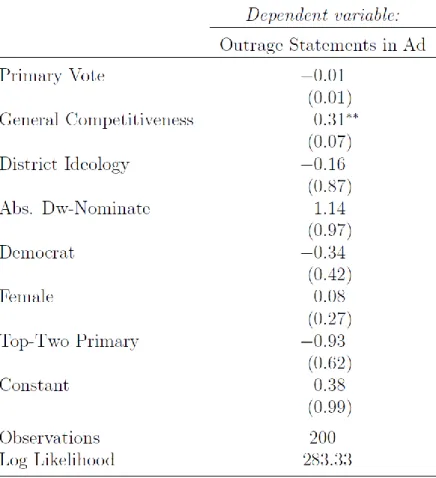
With these variables, I estimated a negative binomial regression model to identify the factors that explain the usage of outrage rhetoric in campaign advertisements. The model is reported in Table 6. Only one coefficient significantly differs from 0 at conventional levels of statistical significance, as I find a positive and significant coefficient for the competitiveness of the general election. The model indicates that ads sponsored by MCs in more competitive
40
Figure 5 displays the relationship between the competitiveness of the general election and the utilization of outrage rhetoric in campaign advertisements. An advertisement sponsored by an MC with a competitiveness score of 0 (indicating the lowest possible level of competitiveness) is predicted to contain 0.60 sentences containing outrage rhetoric. An advertisement sponsored by an MC with a competitiveness score of 2 (indicating a slight advantage for the MC over his or her opponent) is predicted to use 1.11 sentences containing outrage rhetoric. Finally, an
advertisement sponsored by an MC in a race scoring a 4 for competitiveness (indicating that the
41
While the level of intra-party vulnerability faced by an MC influenced incivility on campaign websites, this characteristic of the primary election environment had no association with incivility in campaign advertisements. This supports my theoretical expectations that MCs will tend to target uncivil messages to their primary constituency when their electoral
42
Uncivil campaign messages are strategically targeted to different parts of the constituency in response to the nature of an MC’s electoral threat.
Just as my third hypothesis did not receive support from my analysis of campaign
websites, this hypothesis does not receive support from the first step of my analysis of campaign advertisements. The coefficient for absolute Dw-Nominate scores does not significantly differ from 0, indicating that an ad sponsor’s distance from the ideological center did not influence the usage of uncivil rhetoric in campaign advertisements.
Results: Campaign Advertisements (Analysis #2)
As I have noted, I can also evaluate my hypotheses through altering the unit of analysis and examining television advertisements at the MC level. Altering the unit of analysis in this way yields an additional potential dependent variable of interest: the total count of outrage statements in all of the advertisements produced by a given MC’s campaign. In what follows, I provide an analysis that employs this dependent variable.
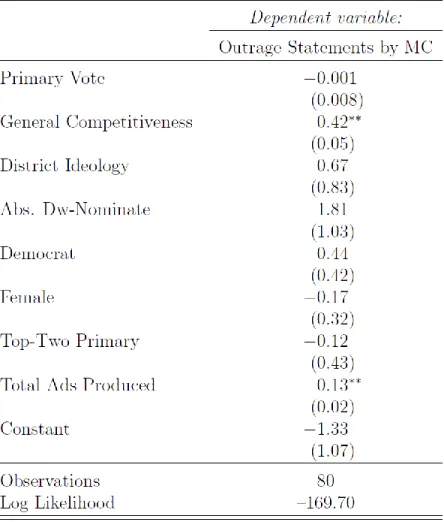
44
The findings reported in Table 8 provide even more support for Hypothesis 2. Controlling for the effects of the other variables in the model, the competitiveness of the general election is positively associated with the count of outrage statements contained in the ads produced by an MC’s campaign.
45