BASIC MORAL PARITY
Nevin E. Johnson
A thesis submitted to the faculty at the University of North Carolina at Chapel Hill in partial fulfillment of the requirements for the degree of Master of Arts in the Department of Philosophy.
Chapel Hill 2019
ABSTRACT
Nevin E. Johnson: Basic Moral Parity (Under the direction of Alex Worsnip)
Egalitarians hold that, despite the great variation in human beings and their properties, human beings are in some fundamental sense morally equal, an idea often referred to as basic moral equality. But there is a problem reconciling the fact of continuous human variation with a commitment to human moral equality. Previous attempts to solve this problem focus on
ACKNOWLEDGEMENTS
TABLE OF CONTENTS
LIST OF FIGURES.……….……….vii
I.) INTRODUCTION.……….……… 1
II.) EXPLICATING THE EXPLANANDUM: WHAT IS BASIC MORAL EQUALITY?………. 4
a.) Clarifying the concept.………4
b.) Two distinctions within basic moral equality.………7
III.) EXPLAINING THE EXPLANANDUM: SOME PROPOSED EXPLANANTIA OF BASIC MORAL EQUALITY, AND WHAT THEY HAVE IN COMMON……….………10
IV.) A DIFFERENT APPROACH.………19
a.) Parity ..……….………20
b.) Parity of the value of persons.………..28
c.) Similarity and difference.……….35
d.) Responding to the variability problem.………41
e.) But are we really all in the same overall “neighborhood” of value?………43
V.) CONCLUSION ……….………..48
LIST OF FIGURES
I.) INTRODUCTION
Equality is taken to play a central role in morality. It seems that for a moral theory to be reasonable, it must “acknowledge[] and appreciate[] the fact that all persons (or even, on some views, all sentient beings) are in an important sense equal, and that, correspondingly, all are equally entitled to fundamental conditions of well-being and respect.” 1
Because of this, a commitment to moral equality is often taken to be assumed, 2 foundational, or axiomatic. For example, in a work focusing on political equality, T. M. 3 4 Scanlon writes:
One important idea of equality that I will presuppose but not argue for is what might be called basic moral equality—the idea that everyone counts morally, regardless of differences such as their race, their gender, and where they live. 5
Wolf, 31. Wolf is not discussing the reasonableness of moral theories per se, but is just saying what the
1
main moral theories have in common.
Waldron, 35 (writing, in the context of philosophers’ having to explain basic equality, that “I really do
2
think philosophers have the task of explicating things that everyone else has the luxury of taking for granted.”); Carter, 540 (“In ordinary political discourse, the claim that “all humans are equal” is often assumed to be obviously true.”).
“Liberalism and our modern allegiance to human rights rest on a foundational commitment—often
3
voiced but little understood—to moral equality.” Sangiovanni, 1.
“Given the fundamental moral equality of all individual persons, which I take to beaxiomatic…”
4
Richardson, 64-65.
Scanlon 2018, 4.
Though basic moral equality (or just basic equality) are common phrases used to capture this idea (and the ones I will use interchangeably in what follows), others have employed the phrases 6 “fundamental moral equality” or “basic human equality” to convey the same notion. 7 8
So some kind of commitment to equality is taken to be morally fundamental. But just because something is taken to be fundamental does not mean it is not amenable to further
examination. We are then tempted to ask: (1) What is basic moral equality, exactly?; and (2) does anything explain our commitment to basic equality; is there anything in virtue of which basic moral equality obtains, in virtue of which we are one another’s equals?
Philosophers have dutifully answered the call by coming up with a great variety of answers to both of these questions. On the first question, some have argued that the concept is uninformative or unimportant, and that we should drop talk of such a notion. Others agree that it is significant, but offer very different theories for what it is, and hence for what explains it.
One reason for the great propagation of different theories of basic moral equality is the difficultly in overcoming the variability problem. People differ from one another in their natural, empirical characteristics. If we paint with broad enough strokes it is easy to find similarities, but because of nature’s messiness, if we look closely enough we will find essentially continuous variation with regards to any natural property we pick out.
And yet despite the fact that equality is a rather strict notion, in the moral context we claim people are equal. The number 1.0001 is very close to the number 1.0002, but these two
“Basic moral equality” appears in Nathan 14 (footnote 32); Arneson 33; Wolf 2015, 33; Scanlon, 2018,
6
4-5. “Basic equality” appears in Nathan; Waldron; Arneson, 30.
Used in Carter, 540 and Richardson, 64-65.
7
Arneson, 30; Waldron, 8.
numbers are not equal. The first dictionary definition for “equal” is “as great as; the same as.” 9 But how can one person be “the same as” another person? How can we reconcile the strictness of equality with the continuous variation with which nature has brought forth human beings?
The main thesis of this paper is that, strictly speaking, there is no such thing as basic moral equality; what there is, though, is basic moral parity. But even though basic moral equality does not obtain, the basic moral parity view keeps what really matters about basic moral equality, namely, the basic moral parity view preserves the idea that persons are arranged
non-hierarchically with regards to their value. That is, even though persons are not equal in their value, they are not greater than or less than one another in their value, either.
The basic moral parity view is motivated by my multi-criterial approach to the nature of value. On my view, our moral value is grounded in our capacity to create value, where value is understood pluralistically. Because of the different values, and the many different ways in which values can be manifested in the world, I argue it does not make sense to speak of basic moral equality, and instead we must think in terms of basic moral parity. But the basic moral parity view keeps what matters most about basic moral equality, namely, we get to keep a kind of moral egalitarianism, since the basic moral parity view denies that the relevant class of persons is arranged hierarchically with regards to their value.
In the next section (Section II) I try to provide some measure of clarity to the concept of basic moral equality by offering an explanation for why talk of this important idea is so varied. Having hopefully clarified the concept somewhat, I then briefly survey (in Section III) some of the main theories of basic moral equality. I argue that they all approach the variability problem
Random House Unabridged Dictionary (2019).
by adopting the same general approach (what I call the SIMILARITY APPROACH). Because there is reason to believe that the SIMILARITY APPROACH will not succeed, I submit that adopting another approach may be fruitful. This new approach, the DIFFERENCE APPROACH, leads us to reject basic moral equality in favor of basic moral parity. The fruits of my adopting the DIFFERENCE APPROACH appears in Section IV. Section V concludes.
II.) EXPLICATING THE EXPLANANDUM: WHAT IS BASIC MORAL EQUALITY?
a.) Clarifying the concept.
Despite the fact that basic moral equality is supposed to be a near-universal commitment, it is difficult to pin down precisely what basic moral equality is. Part of the problem is found in the fact that the language used to convey the idea is quite varied. As Waldron, writes, “[t]here are many ways of characterizing basic equality.” Arneson characterizes basic moral equality as 10 holding that “All persons share a fundamental equal moral status. All persons simply by virtue of being persons have equal basic dignity and worth. These claims about basic human equality are profound and widely shared.” For Waldron, basic equality can be presented “as a principle of 11 ‘equal worth’”: either “equal worth in the eyes of God, or just [] equal worth (if one does not want to talk in religious terms).” “Another concept invoked in these discussions is that of 12 human dignity. Dignity, I believe, is best understood as a status term: it refers to the standing of human beings in the great scheme of things, their status as persons who command a high level of concern and respect.” 13
Waldron, 2.
10
Arneson, 30.
11
Waldron, 2.
12
Waldron, 3.
Statements of basic moral equality can include references to quite a variety of
philosophical phenomena: status, dignity, worth, interests. Some of these are statements that a particular moral rule, duty, or reason exists, that is, that there is a rule/duty/reason to treat persons as equals, or to equally consider their interests.
I submit that one reason that might explain why philosophers are throwing around all of these different notions (value, reasons, dignity) when trying to articulate the nature of basic moral equality is that philosophers have a general ontological disagreement about what is normatively basic. Many philosophers think that certain normative notions can be defined or explained in terms of other, more basic normative notions. The three main normative notions at play here in this debate are (1) reasons, (2) value, and (3) fittingness.
Reasons fundamentalism is the view that reasons are normatively basic. Also defended 14 in the literature are value fundamentalism and fittingness fundamentalism. The advocate of 15 16 some version of one of these fundamentalisms would likely then go on to offer an explanation of their preferred normatively basic notion in terms of the others. So a reasons fundamentalist would explain values and fittingness in terms of reasons, a value fundamentalist would explain reasons and fittingness in terms of value, and a fittingness fundamentalist would explain reasons and value in terms of fittingness.
It seems rather natural, if one is a reasons fundamentalist, to think that basic moral equality is a reason of some kind, perhaps a fundamental reason to treat people as equals. Scanlon arguably is indirectly referring to a reason of this sort when he identifies basic moral
See, e.g., Scanlon, 1998; Schroeder, 2007.
14
See, e.g. Moore, 1903; Maguire, 2016.
15
See, e.g., McHugh & Way 2016; Howard (forthcoming).
equality with “the idea that everyone counts morally” (because the idea of “counting” morally in this sense seems to be connected to some kind of reason to take someone into consideration). Stated in terms of value, basic moral equality might be to say that persons are equal in their value. Stated in terms of fittingness, basic moral equality might be the idea that it is fitting to 17 treat people as equals, or fitting to take other persons’ interests into account equally.
So we could say generally that basic moral equality involves identifying one’s preferred normatively basic notion (either reasons, value, or fittingness), and holding that equality obtains with regards to one’s preferred normatively basic notion when it comes to the moral status of persons.
Another reason that statements of what basic moral equality is are quite varied is that the precise content of basic moral equality, once it is fleshed out, will tend to be different depending on which first-order moral theory one adopts. As Arneson explains, on a generic rights-based non-consequentialism, “basic equality amounts to the claim that everyone has the same basic moral rights, specified by a list, and everyone has the rights in the same full-blooded way.” For 18 a generic welfarist consequentialist who thinks one ought to maximize the well-being of all sentient beings, the basic equality idea amounts to the idea that “any well-being gain or loss that would accrue to one individual person has exactly the same moral value as a same-sized gain or loss that would accrue to any other individual person in the calculation that determines what morally one ought to do.” 19
For what it is worth, I am partial to the value fundamentalism view, and will also be discussing basic
17
moral equality in terms of value when I propose my own solution.
Arneson, 31.
18
Arenson, 31.
So the precise content of basic moral equality will depend on one’s broader first-order and higher-order normative commitments. Different first-order theories of morality, and different higher-order (or meta-ethical) theories of what is normatively basic will likely change how one wants to cash out what basic moral equality is.
To put my cards on the table, my own theoretical commitments are to a pluralist, value-first consequentialism. So, while much of what I say in what follows will ring in that register, most of what I say could likely be translated instead into talk of reasons, or of fittingness.
Before I get to a discussion of the different theories of the ground of basic moral equality, though, I wish to draw upon two important distinctions that have been made in discussions of basic moral equality. I will draw upon these distinctions in offering my own theory of the phenomenon called basic moral equality.
b.) Two distinctions within basic moral equality.
Here I discuss two distinctions that I think help to further illustrate what basic moral equality is taken to be. The first is from Waldron, who helpfully identifies two different dimensions to the concept of basic moral equality:
These terms—“basic equality,” “equal worth,” “equal concern and respect,” and “human dignity”—are not synonyms. But they cluster together to form a powerful body of principle. Each of them does two jobs, one vertical and one horizontal: vertically, it identifies a particular value or set of requirements that attend our dealings with each human person; horizontally, it asserts an equality of that value or a sameness of those requirements across all human persons. In each case, the user of the term promises to explain the content of the idea: what our worth or dignity, for example, requires, what it is supposed to be based on, and why it is the same for everyone. 20
Waldron, 3. Notice that this passage also includes references to both value and requirements.
The vertical dimension of basic moral equality raises human persons above the “non-moral plane,” where the non-moral plane is occupied by all those things which are not owed any direct moral attention at all; it is occupied by those things that do not have intrinsic moral value. The vertical dimension of basic moral equality brings us to a certain level such that we are owed a certain amount of moral attention, a kind of moral attention not owed to rocks or TV remotes. The horizontal dimension of basic moral equality refers to the sameness of that moral status amongst persons. This is the first important distinction within basic moral equality I wish to point out, but I table it for the time being.
Several thinkers have also found it useful to illustrate the idea of basic moral equality by spelling out what it denies. Waldron makes a careful study of a philosophical racist named Reverend Hastings Rashdall, whom he takes to have rejected basic moral equality. Reverend Rashdall had written that “the lower Well-being—it may be ultimately the very existence—of countless Chinamen or negroes must be sacrificed that a higher life may be possible for a much smaller number of white men.” One of the lessons Waldron draws from studying Rashdall is 21 that “[t]he principle of basic equality is opposed to any claim that there are moral distinctions and differentiations to be made among humans like unto or analogous in scale and content to the moral distinctions commonly made between humans and others animals.” 22
Elizabeth Anderson begins her explication of the point of equality by first laying out what egalitarian political movements rejected, namely, “unequal social relations” like
Waldron, 22 (quoting Rashdall, The Theory of Good and Evil, 238-239).
21
Waldron, 30. Waldron calls this the principle of continuous equality. “The principle of continuous
22
“marginalization, status hierarchy, domination, exploitation, and cultural imperialism.” She 23 elaborates:
Egalitarian political movements oppose such hierarchies. They assert the equal moral worth of persons. This assertion does not mean that all have equal virtue or talent. Negatively, the claim repudiates distinctions of moral worth based on birth or social identity—on family membership, inherited social status, race, ethnicity, gender, or genes. There are no natural slaves, plebeians, or aristocrats. Positively, the claim asserts that all competent adults are equally moral agents: everyone equally has the power to develop and exercise moral responsibility, to cooperate with others according to principles of justice, to shape and fulfill a conception of their good. 24
Sangiovanni employs a novel methodology in developing his intricate account of basic equality by making this negative component of basic equality foundational. He argues “that the most fruitful way to develop” an account of basic equality “is to explore what is at the heart of denials of moral equality—to explore, that is, what it is to treat someone as a moral unequal, and hence as an inferior, and why such treatment is wrong.” Sangiovanni argues that our commitment to 25 equality is actually grounded in, and less basic than, a commitment to rejecting inequality. 26
Drawing upon these insights, and adopting Anderson’s usage of the words ‘positive’ and ‘negative’, I propose the following two ways of characterizing basic moral equality:
POSITIVE CONCEPTION: With regards to their value, human persons are equal.
NEGATIVE CONCEPTION: With regards to their value, human persons are arranged non-hierarchically, that is, they are not divided into classes of superiors and inferiors.
Anderson 1999, 312.
23
Anderson 1999, 312.
24
Sangiovanni, 73 (emphasis in original).
25
“[T]he wrongness of treating another as inferior is prior to an affirmation of the idea of treating another
26
One might think these two claims entail one another. That is, if human persons are equal in value, then this entails they are arranged non-hierarchically with regards to their value. And if human persons are arranged non-hierarchically with regards to value, then their value is equal. As I will argue though, the two conceptions comes apart. My own basic moral parity view rejects the Positive Conception while preserving the Negative Conception. To reject the Positive 27
Conception might seem like a fatal flaw for a moral theory, but a commitment to the NEGATIVE CONCEPTION is sufficient to be a committed egalitarian.
For now, though, I wish to table the POSITIVE CONCEPTION and NEGATIVE CONCEPTION of basic moral equality (along with the horizontal and vertical dimensions of basic moral
equality) in order to survey some of the theories of basic moral equality that have been proposed thus far. I survey these theories of basic moral equality because they will stand in contrast with my own theory, and because I argue they all adopt the same approach in theorizing about basic moral equality, an approach that ought to be rejected.
III.) EXPLAINING THE EXPLANANDUM: SOME PROPOSED EXPLANANTIA OF BASIC MORAL EQUALITY, AND WHAT THEY HAVE IN COMMON.
Having clarified the explanandum (basic moral equality), I move now to a discussion of some of the main explanantia that have been proposed to account for basic moral equality. Call the explanans of basic moral equality the ground or basis of equality. 28
So while a commitment to the Positive Conception does still entail a commitment to the Negative
27
Conception, a commitment to the Negative Conception need not commit one to the Positive Conception as well.
Waldron speaks of the “grounding” of basic equality. Waldron, 84. Carter favors the phrase the “basis
28
The explanantia that have been proposed to ground or explain basic moral equality have focused almost exclusively on capacities. For example, perhaps human persons matter morally 29 because they have the capacity to reason, or the capacity to experience pain and suffering, or 30 31 the capacity to enter into relationships with one another (especially loving relationships). 32
Take the capacity to reason. The precise relevance of this can be taken in different ways. A Kantian might think “our capacity to freely choose ends on the basis of reasons” grounds our moral worth. Waldron provides an interpretation of Locke where the capacity to reason grounds 33 our moral worth because it enables us to come to know the existence of and commune with God. 34
The problem is that any capacities related to moral reasoning, or deliberating about and acting on the basis of reasons more generally (what Arneson calls rational agency capacities) are going to vary from person to person, and hence not be equal. This is the root of the variability problem. As Arneson puts it,
If the fact that I possess greater rational agency capacity than a normal cat or chimp justifies my claim to have a moral status and accompanying moral entitlements greater than they possess, by the same token it would seem that the fact that I possess less
The only two exceptions I can think of are the views that (1) moral worth is grounded in having human
29
DNA, or (2) moral worth is grounded in having/being an immortal soul. I do not discuss these views in detail here.
“The capacity most commonly cited in our tradition as the basis of human worth and dignity is reason.”
30
Waldron, 92.
Bentham famously wrote on the topic of which beings should command our moral attention: “Is it the
31
faculty of reason, or perhaps, the faculty for discourse?...the question is not, Can they reason? nor, Can they talk? but, Can they suffer?” Bentham, 311.
See Waldron, 90-91. Waldron discusses Williams, who mentions “the capacity to feel affection for
32
others” as a possible basis of moral equality.
Sangiovanni, 37.
33
Waldron, 92-96.
rational agency capacity than many other humans would seem to show that I am less morally considerable than they are. The rational agency account does not yield a basis for a basic equality claim but rather for its denial. I have greater affective and cognitive and volitional ability than even a very competent gorilla but much less of such abilities than many of my fellow humans. 35
This fact of empirical variation seems to hold not just for the psychological abilities related to reasoning, but any psychological or physical capacities whatsoever. 36
And notice that this empirical variation occurs within the class of persons who are
uncontroversially regarded as equal to one another in value. There is great debate, largely in what we can call the area of bioethics, over the moral status of so-called “marginal cases,” that is, people at very early stages of development (e.g., shortly after conception) or at stages where they once had, but have lost, rational agency capacities (e.g., cases of extreme Alzheimers), and also how the moral status of “marginal” humans relates to that of non-human animals. 37
This issue discussed in bioethics exists apart from the variability problem. Even setting aside “marginal cases” and non-human animals, we are still confronted with the fact that all “normal” human adults have continuously variable rational agency capacities, and are seemingly continuously variable with regards to any other natural, empirical properties we can think of. As Sangiovanni puts it: “[n]ame any valued human trait—curiosity, intelligence, wit, charm,
strength, inventiveness—and you will find an inexhaustible variety and complexity in their
Arneson, 36.
35
Carter, citing Williams, states that there are not “any physical or mental abilities…that persons possess
36
in equal measure.” Carter, 43-544. Rawls writes “There is no natural feature with respect to which all human beings are equal, that is, which everyone has (or which sufficiently many have) to the same degree.” Rawls, 444.
A well-known argument in favor of the positions of both Singer and Regan with regards to the moral
37
expression across individuals.” So in this work I am not so much concerned with “marginal 38 cases,” and instead focus my attention on those who are part of what we can call the
“uncontroversial moral community,” that is, the class of human beings whose moral status is not the main subject of the aforementioned debate in bioethics. So even within this uncontroversial moral community, there is continuous variation that calls out for explanation.
One response to the variability problem would be to give up the search for natural properties entirely. Kant would grant that, while persons’ empirical capacities do vary from person to person, noumenally they do not. The noumenal self, unlike the empirical self, is free, 39 and so we all equally share the capacity to act on the basis of universalizable rules, and hence we are all equally moral agents. This view comes at a cost, of course, not only in the form of a controversial metaphysics, but also because it completely separates moral worth from something that clearly seems to matter, namely, people’s actual empirical characteristics. 40
There are other possible responses to the pervasive presence of variability between persons in their natural characteristics. One might grant that there is variation, but say that the variation is only very slight, so that the differences do not translate into any noticeable difference in moral value or considerability. Or one might try to identify some property that can be 41
possessed only in a binary fashion and hence does not vary empirically. I take it this is the idea behind Sher’s proposal that having a subjective view of the world is the basis of equality. Or 42
Sangiovanni, 1.
38
See Carter, 544.
39
See Williams, 235-236; Carter, 544.
40
Discussed at Arneson, 37.
41
See Sher, 22.
one might say that moral equality does not have a basis in any facts in the world at all, but is rather a kind of commitment we make. 43
A popular strategy appeals to the notion of a range property to ground moral worth or status. The range property idea originates with Rawls. The idea is that while there is an empirical property which varies by degree along a spectrum, supervening on this spectrum there is also a range property, which is the property of falling on a particular range on the spectrum. The idea is then to say that the range property, as opposed to any particular property on the spectrum, is what grounds moral worth and hence moral equality. Rawls’ range property was moral personhood, “where a moral person is a being that has a capacity for a conception of the good and a capacity for a sense of justice.” “[B]eing a person with a minimal ability to understand and assess 44 reasons supervenes on a scalar, namely degree of rational (and emotional) capacity, but it does not vary with respect to one’s distance from the threshold dividing those who are and those who aren’t moral persons.” 45
But positing a range property is not enough. It is incumbent on the proponent of a range property account to offer an explanation why variation within the range does not affect moral worth. I do not have the space here to assess the merits of the explanations for why variation 46
Sher takes Singer to be saying something like this where Singer says “Equality is a moral ideal, not an
43
assertion of fact.” Sher, 18 (quoting Peter Singer’s 1975 Animal Liberation). Waldron takes Hannah Arendt to be proposing something in the neighborhood of this, writing that Arendt “suggested that the members of a society might adopt a principle of treating one another as equals not on account of any natural similarities between them but because such a principle might make possible a form of political community they could not otherwise have.” Waldron, 58.
Carter, 549.
44
Sangiovanni, 47.
45
Sangiovanni asks “Why, if worth depends on possession of some (minimal) degree of rational capacity,
46
within the range does not matter morally, but other commentators have expressed great skepticism about its merits. 47
In fact, deep skepticism has been expressed that any theory will be able to explain the fundamental commitment to moral equality in the face of human variation. McMahan entertains the view, “offensive to our liberal egalitarian commitments” though it is, that human moral worth, and hence the wrongness of killing “normal” adult human beings, varies from individual to individual. McMahan is left feeling “profoundly uncomfortable” because, on the one hand, “It seems virtually unthinkable to abandon our [“all-or-nothing”] egalitarian commitments,” but on the other, “the properties on which our moral status appears to supervene are all matters of degree.” 48
Peter Singer seems more comfortable with a rejection of the moral equality of all human persons, expressing some sympathy for the view that we should “abandon the idea of the equal value of all humans, replacing that with a more graduated view in which moral status depends on some aspects of cognitive ability, and that graduated view is applied both to humans and
nonhumans.” 49
Again, I cannot assess these views in detail. What this survey shows, though, I think, is that it is reasonable to think that the existing strategies may not be successful, and that an alternative approach is worth pursuing.
For criticism of the range property approach, see Sangiovanni, 47-48 and Arneson, 36. A more
47
sympathetic treatment of the range property approach is found in Waldron, Chapter 3 (“Looking for a Range Property.”).
McMahan, 104. Arneson expresses a similar sentiment: “My tentative and provisional conclusion is
48
gloomy. In this area of thought, the available alternative positions are all bad. Choose your poison.” Arneson, 52.
Singer 2006, 575.
In fact, I can agree that the search for the ground of basic moral equality should be abandoned. But, unlike Arneson and McMahan who despair at the possibility that basic moral 50 equality cannot be vindicated, I think there is an alternative that will allow us to keep what is most important about basic moral equality, while nonetheless rejecting its existence, strictly speaking.
As I see it, most (if not all) of the theories of basic moral equality surveyed here have adopted what I will call the SIMILARITY APPROACH.
SIMILARITY APPROACH: In looking for what grounds the equal moral value of persons, one should look for properties that are instantiated similarly across persons.
Someone who has adopted the SIMILARITY APPROACH in solving the problem of basic equality will look for what people have in common in order to find what grounds their moral value. That which people have in common is also that in virtue of which they are the same. This focus on sameness makes sense because, intuitively, things can be equal only insofar as they are the same.
For example, Waldron writes that in answering the question of basic equality “we are looking for similarities. We are looking for a ‘host property,’ a property that humans share that is key to their equality.” Sher writes “If a given empirical property is the basis of a person’s moral 51 standing, and if all persons are moral equals, then it seems that all persons must possess that property to the same degree.” In setting up the problem of basic equality Carter similarly asks 52 the question “Is there a property that [people] possess to an equal degree such that they can be
“In this area of thought, the available alternative positions are all bad. Choose your poison.” Arneson,
50
52.
Waldron, 86.
51
Sher, 17.
reasonably described as equals?” Tom Regan, in seeking the ground of moral value (for 53
humans and non-humans alike), says that the differences between individuals, like their different “talents or skills, intelligence and wealth, personality or pathology,” are all “to be discarded as irrelevant.” Instead, “[i]t is the similarities between those human beings who most clearly, most 54 noncontroversially have such [inherent] value—the people reading this, for example—it is our similarities, not our differences that matter most.” 55
We see the SIMILARITY APPROACH at work when it is taken to be incumbent upon the proponent of the range property approach to show why differences between individuals are irrelevant to their moral worth, and that instead it is the possession of the range property (which all individuals have in common) that bestows moral value upon them. Waldron writes, of those adopting the range property approach, “[o]ne has to explain why we are to rivet our attention on the range property rather than the scalar differences.” Carter similarly argues that the “range 56 property should itself rule out as irrelevant the scalar properties on which it supervenes.” 57
The SIMILARITY APPROACH is taken to a metaphysical extreme in Kant. Recall that Kant, in responding to the variability problem, would point us not to the empirical self (replete as it is with individual differences) but to the noumenal self, which lacks any differentiating empirical characteristics at all. By shearing us of all those things which make us different, one can even
Carter, 539.
53
Regan, 21.
54
Regan, 22. Regan continues, “And the really crucial, the basic similarity is simply this; we are each of
55
us the experiencing subject of a life.”
Waldron, 121.
56
Carter states this in the form of a question, but one to which I take it Carter answers in the affirmative
57
begin to think, in Schopenhauerian fashion, that at the noumenal level we are so similar that we are not actually distinct at all. 58
So whether it is the possession of a range property, the having of a noumenal self, or possessing some other binary property which purportedly does not vary in its possession by different individuals (like Sher’s having-a-subjectivity view), the SIMILARITY APPROACH looks for that which is the same, similar, or in common between moral persons in order to ground their equal moral value. The SIMILARITY APPROACH accordingly leads one to look for some property that does not vary from person to person, or to try to explain why individual differences are irrelevant and justifiably ignored for purposes of assessing moral worth. I submit, though, we should consider an alternative to the SIMILARITY APPROACH. So I propose the
DIFFERENCE APPROACH: In looking for what grounds the non-hierarchical moral value of persons, one should look for differences between persons (in addition, perhaps, to the similarities between persons).
I call this the DIFFERENCE APPROACH, rather than the DIFFERENCE THEORY, because I think there are many distinct yet still reasonable theories which could adopt the DIFFERENCE APPROACH as their methodology. 59
There are a few different ways one could understand the DIFFERENCE APPROACH. One could think that what makes us valuable, the thing that satisfies both the horizontal and vertical dimensions of basic moral equality, are the differences between persons. So the differences both
I take it that Schopenhauer thought that, because the noumenal level lacks the individuating
58
characteristics of the empirical level, that the noumenal will, which we all somehow share or participate in, is singular.
Susan Wolf brought to my attention that Catharine MacKinnon uses similar terminology in describing
59
(1) make us valuable as opposed to not valuable at all, and (2) make us arranged in a non-hierarchical way with regards to our value.
This is not quite my view. This is because I think it is not just the differences between individuals that are relevant to our moral value. Rather, both differences and similarities have a role to play. Roughly speaking, the bare presence of certain capacities — like the capacity to experience pain and pleasure, or the capacity to love one another — makes us valuable as opposed to not valuable. That is, the bare possession of this property does some work in
satisfying the vertical dimension of basic moral parity. But the differences between individuals, that is, the qualitatively different aspects of our value, has the biggest role to play in achieving the horizontal dimension of basic moral value. So we need to appeal to the qualitative
differences between individuals in order to fully explain why we are on a par with one another (rather than greater than, less than, or equal to one another), and hence why we are
non-hierarchically arranged with regards to our value.
In what follows I adopt the DIFFERENCE APPROACH and spell out why one might think people are valuable in virtue of their differences. I reject Tom Regan’s call to “discard[] as irrelevant” the differences between individuals in assessing their basic moral value. As I will show, I think this emphasis on differences leads us to reject basic moral equality in favor of basic moral parity. Nonetheless, I affirm a (and perhaps the) central commitment of basic equality, namely the NEGATIVE CONCEPTION of basic moral equality.
IV.) A DIFFERENT APPROACH.
proposed value relation, in addition to the three more commonly recognized value relations, 60 namely, less than, greater than, and equal to. After describing the structure of what it looks like when things are on a par with one another, I argue that the case of the moral value of persons can be understood as an instance of parity. Within this framework, I argue, we can find a new, fruitful strategy for addressing the variability problem. Though strictly speaking I deny the existence of basic moral equality, I instead argue for the existence of basic moral parity, which nonetheless allows us to keep what was important about basic moral equality.
a.) Parity.
Consider Mozart and Michelangelo. Both men were very creative; they gave the world 61 brilliant works of art which have stood the test of time for hundreds of years. We might want to say that the two men are equal with regards to their creativity, given their greatness. However, the precise respects or ways in which they are creative are rather different. Mozart produced works of musical genius, whereas Michelangelo produced brilliant works of visual art. One thing that is interesting in comparing Mozart with Michelangelo is that it seems we can make some kind of overall comparison with respect to their creativity, even though the inputs or components which go into our judgments of their overall, all things considered level of creativity are rather different. For example, the components of our judgment in the case of Mozart deal with music arts, whereas the components of our judgment in the case of Michelangelo deal with visual arts.
Following Chang, I use the phrase “value relation” to denote a relation that obtains between normative
60
notions. So a value relation can relate not only the value of things, but also others normative notions, like the weight of reasons.
This example appears in Chang 2002 and Chang 2016.
Let us call that in respect of which two (or more) things are compared the covering consideration or the covering value. We do not make unqualified judgements of the value of 62 things. That is, we do not make comparative judgments of the value of things simpliciter. For example, we do not say “Mozart is better than Michelangelo.” Well, we might say this, but that would be because lying in the background is an elliptical statement to the effect that “Mozart is better than Michelangelo with respect to creativity.” In this case the covering consideration is 63 creativity.
Let us call the components of the covering value (or consideration) the component values or the component considerations. In the case where creativity is the covering value, we can 64 come up with quite a few component considerations we might look to in reaching our all things considered judgments with respect to a person’s creativity. We might look to things like: the beauty of their work, how their works make us feel, the quality of their overall body of work, the quality of their “peak" works, the originality of their work, the emotional intensity of their work, etc. Each of these components “mix together” in some way to create an overall, all things
considered assessment with regards to their creativity.
There is no single, formulaic way that component values mix together to generate covering values. For some sorts of covering values we might want to say that the component values are merely additive, such that the covering value is nothing but a sum of all of the
Following Chang 2002, 666; Chang 2012, 112 (which use the term “covering consideration”) and
62
Chang 2016 (which uses the term “covering value”).
“Since explicit reference to a covering consideration in every instance is cumbersome, we omit such
63
reference, but an appropriate covering consideration is always implied.” Chang 2002, 666.
I take a little more liberty here in departing from the terminology as it appears in Chang 2002, 687
64
component values. In other cases, though, we might want to say that the component values mix 65 together in a more complex, holistic way, such that the covering value is a non-summative organic unity of the various component considerations. 66
When items lie along a single, quantitative scale of some kind of value, it is natural to think that they can be compared using one of the three value relations of less than, greater than, or equal to. Consider the amount of pleasure associated with talking with friends for one hour. That amount of pleasure is less than the quantity of value associated with talking with friends for two hours (setting aside the worry that if we spend too much time with our friends we get sick of them). The same thing could be done with amounts of pain.
But it does not always seem so appropriate to rank things on a single, quantitative scale when the two items being related differ substantially with regards to the qualitative aspects of their value. For example, when we have a lot of some kind of thing, and the individual instances of the kind do not differ much from each other with regards to their qualities, we are very comfortable placing them along a single qualitative scale of value (as I tried to do with the examples of qualitatively very similar pleasures and pain). But when some thing is very qualitatively distinct from other things, like a one-of-a-kind work of art, for example, we are much more likely to say that the value of the item cannot be captured by speaking in merely quantitative terms.
The attempt to quantitatively capture the value of something that is qualitatively unique can bring us to say rather funny things. For example, one occasionally hears people say that a
See Chang 2002, 667.
65
See Chang 2002, 674.
one-of-a-kind thing has infinite value. That this could even be close to a plausible thing to say 67 shows there is something special about qualitative uniqueness when it comes to value, but that it is something that cannot easily be captured, or perhaps captured at all, by assigning some
numerical value to it. A similar thought I think is also behind the resistance to the idea that willingness-to-pay for some thing can fully capture the nature of that thing’s value. Money, as a 68 quantitative measure, is going to necessarily leave out some important qualitative aspects of a thing’s value. But, just because the qualitative differences between things cannot be fully 69 captured in quantitative terms, that does not mean that no comparison of qualitatively distinct things can be made with regards to how valuable they are.
Say you are deciding between a career in law and a career in philosophy. The legal 70 career would have longer, more draining hours than the philosophy career, but it offers higher pay than the philosophy career. The legal career also affords certain concrete opportunities to do good in the world, such as to “fight the power” by representing “the little guy.” The
philosophical career does not offer those same concrete opportunities, but it does offer other, qualitatively distinct opportunities, like the freedom to explore the ideas you are interested in and to share knowledge with colleagues and students. Let us say you come to judge that the legal
See, e.g., McCauley, 2006: “I suggest that the aggregate value of a chunk of nature — its aesthetic
67
beauty, cultural importance and evolutionary significance — is infinite, and thus defies incorporation into any ecosystem service programme that aims to save nature by approximating its monetary value.”
Thank you to correspondence with Doug MacLean on this topic.
68
I should not make it seem as if this claim is not controversial however. Cass Sunstein, a proponent of
69
cost-benefit analysis, apparently thinks it can fully capture the qualitative aspects of the things we value: “Notwithstanding its apparent crudeness, and notwithstanding the simplicity of the monetary measure, [cost-benefit analysis] honors qualitatively diverse goods that people care about for diverse
reasons” (Sunstein, 73).
An example often used by Chang, and one which resonates with me especially.
career and the philosophical career are neither better than nor worse than each other with regards to their goodness as a career for you.
One might therefore think that the two careers are equal with regards to their goodness as careers. But, as Chang argues, this cannot be so. Take the legal career and improve it slightly by increasing the annual salary by $500. If the two careers were equal prior to the improvement, then surely an improvement with regards to one of the aspects of its value would make the legal career better than the philosophical career. But the improvement to the legal career does not make the legal career better than the philosophical career. Instead, Chang argues a fourth value relation obtains in both cases: the legal career and the philosophical career are on a par with one another. 71
How can a value relation obtain between two things despite quantitative variation in some aspect of their value? The answer has to lie with the qualitative aspects of the relata. The legal career and the philosophical career each have certain qualitative features which do not appear in the other career, and not just any qualitative features, but qualitative features that matter to the overall value of the career. The legal career offers the opportunity to help the little guy fight the power; the philosophical career offers intellectual freedom, etc.
The way that the “matteringness” of the career’s qualitative aspects shows up is that it generates a kind of permissiveness (within a certain range) when it comes to the quantitative aspects of the career’s value. The qualitative aspects matter, and they cannot be fully captured along a single quantitive scale of value. If the qualitative aspects could be captured fully with a
There are other alternative explanations for small improvement cases. Perhaps the relata are
71
single quantitative scale, then we would not have the quantitative permissiveness: small quantitative improvements would make one of the careers better than the other. Qualitative uniqueness grounds quantitative permissiveness.
The qualitative specialness of each career, the fact that each career has certain features that the other does not — the uniqueness of each career — gives them a certain strength of value. This strength of value, grounded in the thing’s unique qualities, gives a certain elbow room for quantitative variation. The significance of qualitative uniqueness cannot be captured in fully quantitative terms; the qualitative dimension of a thing’s value cannot be fully reduced to the quantitative dimension of thing’s value. So the permissiveness of small improvements in cases of parity is explained by the irreducible multidimensionality of a thing’s value.
So, but for the qualitative uniqueness, small quantitative changes to two items that are initially non-hierarchically arranged with regards to their value (that is, that are equal with regards to their value) would make one item better than the other. So the qualitative uniqueness is part of what explains why marginal quantitative variations do not make relata hierarchically arranged with regards to their value. (Analogously, as I will explain later, persons’ qualitative uniqueness is part of what explains why quantitative variation in persons’ value does not make them better or worse than one another.)
But this is not to say that things that stand on a par with one another can tolerate any quantitative change. If we were to increase the salary of the legal career not by $500 but instead by $5,000,000, then the legal career would be better than the philosophical career.
with respect to the covering value.” The legal career and the philosophical career are different 72 qualitatively, but they are in the same neighborhood overall with regards to their goodness.
Qualitative differences can show up in cases of parity in two separate ways. One is where one of the component considerations for one of the relata is different from the component
considerations of the other relata. For example, in assessing the relative status of Usain Bolt 73 and Nolan Ryan as athletes, a component consideration for the former would be “running speed” whereas a component consideration for the latter would be “pitching speed.” That these two individuals are two of the best ever with regards to these qualitatively different aspects of being an athlete would make it reasonable to say that Usain Bolt and Nolan Ryan are on a par with respect to athleticism.
The second way in which qualitative difference can show up in cases of parity is when the very same component consideration is instantiated or expressed in qualitatively different ways. For example, we might say that the legal career and the philosophical career are both 74 rewarding, which is to that they both allow for opportunities to make one feel that one has made a positive contribution to the world, but that they are rewarding in qualitatively different ways. 75 The legal career offers opportunities to affect people’s lives in very concrete ways, either by fighting for their cause or changing the law for the better. A career in philosophy tends to offer different sorts of rewards, like the pleasures of contemplation, intelligent discussion, and sharing
Chang, 2016.
72
“One way items can be qualitatively very different is if they bear very different contributory
73
components of the covering value.” Chang, 2016.
“Another way items can be qualitatively very different is if they bear very different qualities of the
74
same contributory components of the covering value.” Chang, 2016.
The choice of example is broadly from Chang (2002, 668), but the details are slightly altered.
knowledge with others. So the very same component value (rewardingness) which goes into the overall judgment with regards to the covering value (goodness as career) can be realized in qualitatively different ways such that one might want to say that these qualitative differences make it the case that the two careers are on a par with one another.
Notice that, with cases of parity, similarity and difference combine in a certain way to make it the case that two relata are on a par with one another. Similarity shows up in the
requirement that the two relata be in the same overall neighborhood of value, whereas difference shows up in the requirement that the two relata have qualitative differences. In the case of the two careers, they are similar most obviously in that they have certain features that make them both careers in the first place (e.g., they are both ways of making a living). Perhaps there are some other similarities that go into making them on a par with one another. For example, the salaries are non-trivial and work is not menial or hard labor. But the differences also need to show up in order for the two things to be on a par with one another (here I appealed to the qualitatively different ways in which they are rewarding). Analogously, and in accordance with the DIFFERENCE APPROACH, I will later point out how I think that similarity and difference work together to account for the basic moral value of human beings.
So, to summarize, two items are on a par with one another with respect to some consideration when they differ qualitatively in substantial ways, but they are in the same
b.) Parity of the value of persons.
On my view, the basis of persons’ moral value is the capacity to create value. That is, what makes persons morally valuable is their capacity to bring value into the world. But “value” is not some single thing. Rather, lots of different things are valuable, and they are valuable in different ways. There are different kinds of values.
It is not remarkable to think that what makes people valuable is strongly tied to other first-order questions of what is valuable. A hedonistic utilitarian, who thinks that the only thing that is valuable in itself is pleasure, would be naturally drawn to the idea that persons (and non-persons for that matter) are morally valuable, or worthy of moral attention, in virtue of some relationship they bear to the only thing that is valuable in itself, namely, pleasure.
So a hedonistic utilitarian might naturally ground the moral value of persons in persons’ capacity to experience pleasure and pain. This is arguably the position adopted by Bentham, when he says “the question is not, Can they reason? nor, Can they talk? but, Can they suffer?” Bentham here is rejecting the capacity to reason as the ground of moral status, in favor of the capacity to experience pleasure and pain. He does this because for him the only thing that is valuable in itself is pleasure.
I am not the first person to articulate such a connection. Goodpaster writes “if one’s conception of the good is hedonistic in character, one’s conception of a beneficiary [of moral considerability] will quite naturally be restricted to beings who are capable of pleasure and pain. If pleasure or satisfaction is the only ultimate gift we have to give, morally, then it is to be expected that only those equipped to receive such a gift will enter into our moral deliberation.” 76
Goodpaster, 321.
Now as a purely logical or conceptual matter, these two things might come apart, and so therefore the connection between hedonism and identifying the capacity to experience pleasure and pain as the ground of moral status or moral considerability may not be a matter of strict entailment, but there does generally seem to be “a nonaccidental affinity between a person’s or a society’s conception of value and its conception of moral considerability.” 77
I, too, see a nonaccidental connection between my conception of value and my
conception of moral considerability. Whereas a hedonist adopts a kind of value monism, I adopt a kind of value pluralism. So instead of there being one kind of value relevant to the moral considerability of persons, I see many different kinds of value as being relevant to the moral considerability of persons. (We could even imagine the Benthamite and I giving the same initial answer to the question “what makes persons morally valuable?” We could both answer with the capacity to bring about value in the world. It is just that the Benthamite and I would have quite different things to say when we go on to explain what we mean by value.)
Pleasure is valuable in itself (though I would construe it differently than Bentham: pushpin is not as good as poetry, ceteris paribus), but so are other things. Well-being, beauty, knowledge, reason, and close personal relationships (amorous and otherwise) are valuable in themselves also.
And when people bring these different kinds of value into the world, they are drawing on different kinds of capacities to do so. But even when we restrict our attention to some single kind of value (like pleasure or well-being, perhaps), we notice that these “single” capacities are themselves complex and multidimensional.
Ibid.
For example, the capacity to bring well-being into the world includes not just one’s own capacity to experience pain and pleasure, but also the capacity to bring happiness to others in any of a number of ways: by making them laugh, by writing good books for others to enjoy, by saving other people’s lives by performing surgeries on them, etc. There is thus individual variation with regards to the qualitative ways in which they bring pleasure into the world.
The capacity to bring knowledge into the world includes everything from something as simple as being able to perceive the world and thereby know what it is like, but it also includes any abilities one might have to explore the world in new ways to advance human understanding in some field of inquiry. The capacities a philosopher draws upon to bring knowledge in the world is qualitatively different from the capacities a marine biologist might draw upon to bring a different kind of knowledge into the world. The capacity to bring knowledge into the world differs qualitatively amongst individuals.
The capacity to enter into personal relationships (romantic and otherwise) is also very complex; it plausibly includes the capacity to experience empathy, the capacity for humor, the capacity to respect others, the capacity to feel genuine interest in others, the capacity to trust others, the capacity to be an object of trust, the capacity to love, etc. Further, the precise kinds 78 of relationships that a given person can enter into depends on what that person is like. For example, extroverts tend to have different sorts of friendships than introverts. So people differ qualitatively from one another in their capacities to enter into personal relationships.
Not only are there different values which themselves differ qualitatively from one another, but, as this survey already suggests, there are qualitatively very different ways in which
The value of love is an important theme in Wolf, 2015 (especially chapters 9-11).
the very same value can be realized, and hence qualitative differences in persons’ capacities to bring about these values in the world. Mill made a well-known distinction between two qualitatively different kinds of pleasure: the lower “bodily” pleasures and the higher
“intellectual” pleasures. But even within these two qualitative classes it is easy to find further 79 qualitative differences. The intellectual pleasure of experiencing a great symphony is different from the intellectual pleasure of reading a great work of philosophy. The bodily pleasure of eating delicious tiramisu is different from the bodily pleasure of soaking in a warm bath after a long day on one’s feet. The physical bases which make possible these experiences, while drawing upon some of the same resources (all require sentience, for example), nonetheless will be different in each case. Examples like these can be propagated easily.
And that is just pleasure. The knowledge that the Earth revolves around the Sun is
qualitatively different from the knowledge that Jim Crow laws are unjust. The beauty of the final movement of Beethoven’s Ninth Symphony is different from the beauty of the Christ the
Redeemer in Rio de Janeiro. A friendship between two introverts is qualitatively different from a friendship between two extroverts, both of which in turn are qualitatively different from a friendship between an extrovert and an introvert.
See Mill 2002.
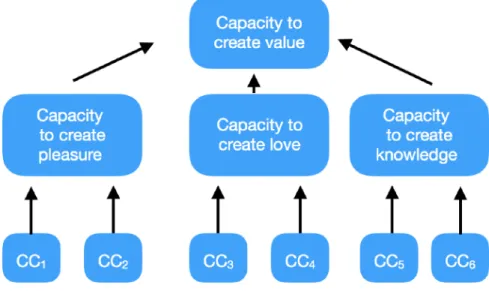
All this can be illustrated with the following picture.
Figure 1. The metaphysical structure of persons’ capacity to create value.
At the peak (the top level) we have what for me is the property that grounds the moral value of persons, the capacity to create value. Below that are the component considerations which go into the capacity to create value. These are all of the individual capacities to create 80 the different kinds of value (I include capacities for only three values here because of space and simplicity; I think there are more than three values). But these component considerations
themselves stand as covering considerations with regards to something else, namely, the various component considers (marked as CC1, CC2, etc.) which go into comprising the capacities to bring about the particular kinds of value.
I hope to remain noncommittal about the exact metaphysical relation that is expressed by the arrows: it
80
In principle, each of these three levels is a possible “location” for qualitative difference to enter into the picture. They can enter into the bottom level if there are qualitative differences in the component considerations that go into determining the capacities at the middle level.
Qualitative differences can enter in again at the middle level, if the ways in which the component considerations join together to create the capacities identified in the middle level happens in the organic unity (as opposed to merely additive) sort of way. If the capacity to create pleasure is nothing but the additive collection of the various component considerations, then all qualitative differences will already be fully captured at the bottom level. But if the capacity to create pleasure is itself a kind of organic unity of the component considerations which go into it, qualitative differences could exist at the middle level which cannot be found at the bottom level.
Qualitative differences can show up also at the top level, again depending on whether the capacities identified at the middle level join together in a merely additive way, or whether they join together in such a way that the capacity to create value is an organic unity of the various capacities to create the individual values.
Again, this chart is an oversimplification of matters. While there will be reasonable disagreement about how many component considerations there are for a given value, and for how they should be individuated, there will almost certainly be more than two component
considerations (as I have it here for illustrative purposes) for each of the capacities to bring about the particular values in the world.
POSITIVE CONCEPTION: With regards to their value, human persons are equal.
NEGATIVE CONCEPTION: With regards to their value, human persons are arranged non-hierarchically, that is, they are not divided into classes of superiors and inferiors.
The view offered here is not consistent with the POSITIVE CONCEPTION of basic moral equality, but it does embrace the NEGATIVE CONCEPTION. Even though persons are not equal in their value, they are also not greater than or less than one another with regards to their value, either. Persons are on a par with one another with regards to their value. Therefore, persons are not arranged hierarchically with regards to their value.
A final comment about my view. Since I say that my own view of basic moral equality is the capacity to create value, it might seem that I propose a single property to ground human moral value, and thus that my view is a uni-criterial account of moral status. Uni-criterial accounts of moral status include the theories already mentioned: Kant’s moral agency theory (i.e., the capacity to engage in moral reasoning), the sentience theory (i.e., the capacity to experience pleasure and pain), and “relationship-based theories” (i.e., the capacity to enter into certain kinds of relationships). However, given all I have just said, it is best to say my account 81 is multi-criterial given the multitude of simpler capacities out of which the capacity to create is value is composed. For example, my view includes both the capacity to experience pain and 82 pleasure and the capacity to enter into relationships with one another as part of our broader capacity to bring about value in the world (among other capacities, mentioned above).
These theories are collected and classified as “uni-criterial” in Warren 2005, from which I also borrow
81
the names used here.
The term “multi-criterial” is again from Warren, 2005.
I have encountered other multi-criterial accounts in the literature, though the differences between these others theories and my own are significant. For example, Mary Anne Warren and Elizabeth Anderson employ multi-criterial accounts to explain the relative value of human
beings, non-human animals, and the environment. For example, both sentience and the capacity 83 to enter into relationships of mutual recognition matter, and so animals that are merely sentient will have a different status from those animals that are sentient and with which we can also enter into relationships of mutual accommodation.
The way I employ my own multi-criterial approach here though is rather different from Warren and Anderson. I am not concerned here with explaining the relative value of humans and non-humans, but rather with explaining why human beings are arranged non-hierarchically with regards to their value. I do this by emphasizing the interaction between similarity and difference within a multi-criterial approach, a direction not taken by Anderson and Warren. In the next sub-section I spell out in more detail the roles played by similarity and difference in basic moral parity.
c.) Similarity and difference.
We can see now more clearly how the joint roles of similarity and difference interact to make human beings stand on a par with one another, thus satisfying the NEGATIVE CONCEPTION. As with the case of the two careers discussed earlier, similarities between individuals are going to show up when it comes to satisfying the first necessary condition of parity, namely, that the relata be in the same neighborhood overall with regards to their value. Differences are clearly
See Warren 2005, and Anderson 2004. Anderson does not call her view multi-criterial explicitly, but she
83
going to show up in the second necessary condition for parity, namely, that the relata be qualitatively different from one another.
In the case of persons, the similarities here are familiar from the other uni-criterial accounts discussed earlier. Human persons are similar in that they are those beings capable of living a conscious life over time. They can experience pleasure and pain, and bring knowledge and beauty into the world. They can enter into intrinsically valuable relationships with one another. Other similarities could be found, but these are some of the most noticeable and important ones.
The differences are found in the varied ways these similarities find expression in particular individuals. The differences are harder to talk about, because there are so many of them. And it is especially hard for my view because I think that each individual has qualitative differences that matter, and which go into satisfying the second necessary condition of parity. But here is a start. Some people bring pleasure in the world through comedy, or by volunteering for a good cause, or through their relationships. Some people bring beauty in the world through art, or by being kind to others, or even by refining and cultivating their own bodies. Some people bring knowledge into the world by teaching others or through abstract thought experiments and difficult theorizing. Other people bring knowledge into the world through great patience, discipline, and even grit, perhaps by trying out 1,000 different filaments for a light bulb before the best one is found.
Benjamin Bagley, in seeking to explicate the nature of the irreplaceability of the beloved (a topic that dovetails nicely with some of the ideas expressed here), discusses how the qualitative character of different loving relationships, where a loving relationship involves the open-ended pursuit of joint ends on the part of the lovers, necessarily differs depending on the persons who are in those relationships (though he says this in the course of making a different point):
[T]he best lovers often seem like opposites: consider Elinor and Marianne, Holmes and Watson, Kirk and Spock. These people all share certain fundamental concerns with their partners—ones centered, respectively, on ideals of feminine autonomy and the enjoyment of everyday beauty, the pursuit of justice tinged with an attraction to danger and a curiosity about criminality, and boldly going where no one has gone before—but embody these concerns very differently from them. 84
Bagley here is pointing out that even within a single relationship, though the two lovers share a joint end, they participate in the end in (qualitatively) different ways. This enables them to accomplish things with a lover that they would not be able to do by themselves: “This unity within diversity enables the lovers to see how their own values might be realized in ways they probably wouldn’t have recognized on their own: moved by Marianne’s indignation, Elinor might find it important to stand up to an offense she would otherwise have passively endured; appreciative of Elinor’s considered response, Marianne might better understand why her indignation was warranted in the first place.” 85
If we think the qualitative differences between human relationships is axiologically significant, and that these differences arise out of our different capacities to enter into certain kinds of relationships (and hence who we are as people), and that these capacities differ from
Bagley, 505-506.
84
Id. at 506.
person to person, then I think we are well on our way to the idea that the qualitative differences between persons makes it appropriate to say we are on a par with one another.
Return now to Waldron’s vertical and horizontal dimensions of basic moral equality. The vertical dimension represents the fact that human persons are “raised above” the non-moral plane; we matter morally in way that tables and chairs do not. The horizontal dimension
represents the fact that we are all at the same “altitude,” that we are all equally raised above the non-moral plane.
A big problem with the SIMILARITY APPROACH in answering the question of basic moral equality was in trying to find some single property that satisfies both the vertical and horizontal dimensions of basic moral equality. That is, under the SIMILARITY APPROACH, the same property that raises us above the non-moral plane has to be one which persons possess equally, otherwise we cannot capture the horizontal dimension of basic moral equality.