THE ROMANOVS’ MILITANT CHARITY: THE RED CROSS AND PUBLIC MOBILIZATION FOR WAR IN TSARIST RUSSIA, 1853-1914
Andrew J. Ringlee
A dissertation submitted to the faculty of the University of North Carolina at Chapel Hill in partial fulfillment for the requirements for the degree of Doctor of Philosophy in the Department of History
Chapel Hill 2016
Approved by:
Louise McReynolds
Donald J. Raleigh
Wayne Lee
Susan Pennybacker
ii
iii
ABSTRACT
ANDREW J. RINGLEE: The Romanovs’ Militant Charity: The Red Cross and Public Mobilization for War in Tsarist Russia, 1853-1914
(Under the directon of Louise McReynolds)
This dissertation analyzes the creation and evolution of the Russian Society of the Red
Cross to understand the possibilities for and limits to the development of civil society in
authoritarian political structures. Founded in 1867, the Russian Red Cross’s chartered mission
was to provide civilian medical aid for wartime relief. By signing the Geneva Convention of
1864, tsarist Russia embraced a European humanitarian movement geared toward aiding
individuals wounded in war and victims of natural disasters. Over the next five decades, the Red
Cross grew into one of the largest charities in tsarist Russia. This study reveals how the ruling
Romanov family and members of educated society found a common space in which both parties
could promote the empire’s welfare by tending to its neediest subjects. However, Russia’s
decision to mobilize educated society for national relief proved to be a double-edged sword for
the tsarist regime. During the Russo-Turkish War of 1877-1878 and Russo-Japanese War of
1904-1905, limited funds, bureaucratic mismanagement, and scandals in the press incited
members of educated society to demand greater oversight of Russia’s Red Cross, calls that
undermined the political regime’s legitimacy during moments of crisis. Despite these challenges,
the Red Cross did provide an avenue for women to enter the nursing profession, although
Russian nurses never achieved the professional status enjoyed by their colleagues in the West.
iv
in foreign conflicts, members of the tsarist state and society used this organization as a unique
instrument with which to conduct “soft power” imperialism by dispatching teams of doctors and
v
ACKOWLEDGEMENTS
This dissertation is the culmination of labor by a large group of people over many years.
The debts of gratitude I owe stretch well beyond my committee of five supervisors and extend to
the archives, libraries, classrooms, and faculty offices of numerous institutions in the United
States and Russia. I could not have written or defended this dissertation without the tireless help
and constant support of the following individuals. First and foremost, I would like to thank my
parents, Stephen and Constance Ringlee, who kindled in me a passion for learning and teaching,
and encouraged me along a path that I often doubted. I am beholden to my brother and best
friend, Peter, for his insistence that I follow my dreams. I am indebted to my sister-in-law, Laura
Miranda Brown, for her fortitude, hospitality in New York, and tolerance of Peter’s and my
misadventures.
The faculty of the History Department at The University of North Carolina at Chapel Hill
welcomed me into their community and nurtured my development as a scholar. My adviser,
Louise McReynolds, tutored me through every stage of this process with invaluable oversight,
mentorship, and backing. Louise never withheld criticism, but, more importantly, she refused to
let me think that I would not see this project through to completion. Donald J. Raleigh provided
me with an ideal model of a professor. Everything he does as a scholar and professor—from his
approaches to sources and writing to his strategies for grading and optimistic demeanor—I have
tried to emulate in my own research and courses. Wayne Lee inspired in me an enthusiasm for
military history and taught me to think about historical problems over the longue durée. Joseph
vi
Pennybacker made me see how Britain was not so dissimilar to Russia. Jeffrey Jones gave me
the warmest support on my dissertation and valuable advice on navigating UNC. Matthew
Andrews enabled me to understand how I could integrate a love of history with a passion for
sports. These professors always stressed that history must be enjoyable, a belief I try to impart to
my students.
At Indiana University, I am indebted to Ben Eklof for his steadfast support and
friendship. My knowledge of the Russian language has come at the expense of tireless hours of
labor and pain from a remarkable group of endearing language instructors. At Duke University, I
am most grateful to Elena Maksimova for her inexhaustible commitment to improving my
Russian. At Indiana University, Jerzy Kolodziej and Anna Sharogradskaia provided the warmest
instruction and encouragement. The women and men of the KORA Center in Vladimir, Russia,
sacrificed hundreds of hours on what must have seemed their most hopeless student.
This research would not have been possible without generous funding from the
Fulbright-Hays Doctoral Dissertation Research Abroad fellowship from the U. S. Department of
Education. Short-term research grants from the Kennan Institute of the Woodrow Wilson Center
and the University of Illinois at Urbana-Champagne’s Russian, East European, and Eurasian
Center enabled me to conduct research in Washington, DC, and Champagne-Urbana during two
separate summers. In Moscow, the staffs of the Russian State Military Historical Archive, the
State Historical Museum, and the Russian State Library provided invaluable assistance and
direction. The staffs of the Russian State Historical Archive and the National Library of Russia
in St. Petersburg helped me as well.
I have benefitted enormously from my colleagues and friends who contributed to my
vii
warmest friendship and tireless input throughout my entire journey as a graduate student. The
hours we spent discussing Russian history and watching football remain some of my fondest
memories. I am thankful to Inna Korableva and Zhanna Kamenskaya for their friendship and
hospitality in Moscow. At UNC, my cohort of Russian historians welcomed me into their fold
and enabled me to grow and thrive as a student, mentor, and friend. My affection for Stephen
Riegg, James Slater, Trevor Erlacher, Daniel Giblin, Gary Guadagnolo, Dakota Irvin, Joseph
Pinella, Aaron Hale-Dorrell, Edward Geist, Louis Porter, Emily Baran, Michael Paulauskas,
Jennifer Parks, Audra Yoder, Virginia Olmsted, Adrienne Jacobs, and Marko Dumančić knows
no bounds. In addition to the group of Carolina Russianists, Patrick Tobin, Kelly Morrow,
Gregory Mole, Christopher Cameron, Laura Sims, Joseph Bryan, Joshua Lynn, Samuel
Finesurrey, Alyssa Bowen, Sarah McNamara, Jeanine Navarrete, Justin Blanton, Joel Hebert,
Max Lazar, Michael Skalski, Jesse Stavis, Nicholas Levy, Joseph Crescente, Brandon and Anna
Rice, and Sergei Kazakovtsev provided goodwill and friendship throughout the course of my
studies. Lastly, I cherish Jaime Hughes, who gave me the most warmhearted and devoted
companionship during the final months of work on this dissertation. Her fondness for craft beer,
hiking, and yoga guided this project through to completion. This list of names is long because it
needed to be this way; every one of these individuals has benefitted me as a pupil and a scholar.
viii
TABLE OF CONTENTS
LIST OF TABLES
INTRODUCTION ... 1
Historiography ... 8
Sources ... 11
Structure ... 14
CHAPTER 1: THE CRIMEAN WAR AND THE EXALTATION SOCIETY OF NURSES .... 18
Nursing Societies under Nicholas I... 19
Elena Pavlovna... 26
N. I. Pirogov ... 28
Russian Nurses in Crimea ... 34
Russian Nurses in the Press ... 39
E. M. Bakunina ... 48
Nursing Societies Following the Crimean War ... 51
Conclusion ... 60
CHAPTER 2: RUSSIA AND THE GENEVA CONVENTION OF 1864 ... 62
The 1863 Conference and Russia ... 67
The Creation of the Russian Aid Society for Wounded and Sick Soldiers ... 76
Conclusion ... 92
ix
The United States’ Sanitary Commission ... 98
The Russian Red Cross’s Early Activities ... 104
Press and Advertising ... 110
Nurses ... 112
Feldshers and Doctors ... 121
Conclusion ... 125
CHAPTER 4: THE FRANCO-PRUSSIAN WAR AND THE LESSONS OF MASS MOBILIZATION ... 128
The Russian Red Cros and the Franco-Prussian War of 1870-71 ... 131
Postwar Reforms of the Russian Red Cross ... 138
Temporary Hospitals ... 142
Peacetime Disaster Relief ... 146
Red Cross Aid to the Central Asian Expeditions of the 1870s ... 154
The Universal Conscription of Reform of 1874 ... 159
Conclusion ... 163
CHAPTER 5: THE RUSSIAN RED CROSS AND THE BALKAN WARS, 1875-1878 ... 166
The South Slavic Uprisings of 1875-76 and Russian Intervention ... 168
The Russo-Turkish War of 1877-78 ... 177
Medical Services in the Balkans ... 182
The Russian Red Cross in the Russo-Turkish War ... 187
Mobile Ambulances ... 194
Red Cross Personnel ... 199
Private Aid in the Caucasus ... 207
x
The Red Cross in the Russian Press ... 214
Red Cross Finances during the Russo-Turkish War ... 219
Conclusion ... 224
CHAPTER 6: THE INTERWAR DECADES, 1880-1909 ... 228
Institutional Development ... 230
Urban First Aid ... 235
Activities in the Arctic ... 238
Red Cross Nurses, an Unprofessional Caste ... 240
The Famine of 1891-92 ... 249
Famine Relief from 1897 to 1901 ... 261
Conclusion ... 269
CHAPTER 7: THE RUSSIAN RED CROSS IN WAR AND REVOLUTION, 1904-07 ... 271
Problems with Red Cross Relief in the Russo-Japanese War ... 287
The General Zemstvo Organization (GZO) ... 293
Conclusion ... 308
CHAPTER 8: TSARIST HUMANITARIAN MISSIONS ABROAD, 1896-1913 ... 312
The Italo-Abyssinian War of 1896 ... 313
The South African War ... 333
The Balkan Wars of 1912 and 1913 ... 335
Conclusion ... 340
CONCLUSIONS... 343
xi
LIST OF TABLES
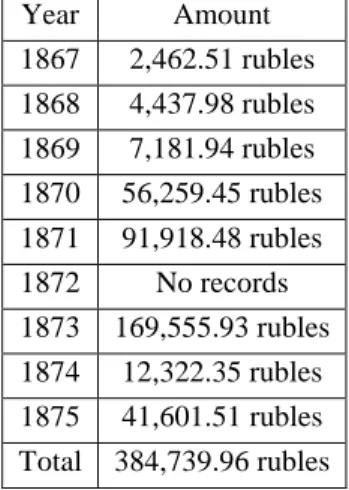
Table 1. Donations to the Main Directorate in St. Petersburg, 1867-1875 ... 108
Table 2. Main Directorate Expenditures, 1867-1875 ... 109
Table 3. Red Cross Institutions and Chapters, 1880-1896 ... 231
Table 4. Red Cross Funds, 1880-1904 ... 231
Table 5. Number of Red Cross Nurses, 1888-1896 ... 232
Table 6. Number of Patients to the St. George’s Society Hospital and Clinic, 1884-1889 ... 234
1
INTRODUCTION
This dissertation analyzes the creation and evolution of the Russian Society of the
Red Cross (Rossiiskoe Obshchestvo Krasnogo Kresta) during the last seven decades of tsarist
Russia (1853-1914) to explore the bonds between the autocracy and educated society in
prerevolutionary Russia. Founded in 1867, the Russian Red Cross’s chartered mission was to
provide “private aid” (chastnaia pomoshch’) for wartime relief. Private aid consisted of
dispatching civilian doctors, nurses, and privately donated medical supplies to set up
hospitals near the front, operate mobile ambulances at the front, and staff temporary medical
facilities in rear areas. This association was voluntary because its members chose to join as
members or donate to its philanthropic campaigns. Even though Romanov empresses headed
this Red Cross and ministers and other elite handled its day-to-day governance, this
organization did not depend on the state to conduct its missions. Members within the
organization had a degree of leeway to innovate with new types of institutions and projects.
Additionally, this charity and its obligations shifted with need, capacity, and public opinion.
My first objective is to try to understand why tsarist Russia, an illiberal, undemocratic
state, embraced a humanitarian movement that originated in Geneva and encouraged tsarist
subjects to participate in Red Cross chapters and programs. I contend that the Russian Red
Cross reveals how the Romanovs and tsarist subjects found a common space, which enabled
both parties to serve Russia. Peter I (1682-1725) instilled in the autocracy the moral
2
mandate.1 Peter I’s contribution, while incredibly painful and crude, was a state capable of mobilizing human and material resources to make Russia a European power. Catherine II
(1762-1796) exemplified noblesse oblige. She gave the empire educational, cultural, and
legal institutions that raised Russian culture to rival European achievements in the arts and
sciences. Alexander I (1801-1825) devoted his energies toward protecting Russia from the
European crises emanating from the French Revolution and Napoleonic disruption; his
successor, Nicholas I (1825-1855) continued to insulate Russia from European perils by
instilling the ideology of Official Nationality. All four of these rulers viewed the state as the
instrument by which they would carry through the autocratic moral imperative. By the
middle of the nineteenth century, however, the need to confront modernity and keep up with
European rivals left the autocracy unable to continue this project without the involvement of
the educated public.
The Russian Red Cross sought to alleviate the plight of the wounded in war and to
reduce the woes of disaster-stricken civilians. For the autocracy, patronage of a national
relief organization gave the Romanovs legitimacy because it helped locate philanthropy at
the center of the tsarist regime’s concerns. For Russian subjects, participation in this
organization affirmed bonds with the autocracy and enabled the donor to participate in the
moral imperative to improve Russia. The key donors and activists who worked for the Red
Cross were the Russian subjects who felt they had the strongest connection with the
autocracy. This dissertation explores how, even in an authoritarian, undemocratic political
1 I borrow this concept from Vasilii Kliuchevskii, who summed up the Petrine paradox in the line: “Autocracy
3
system, state and society can work in tandem—rather than in competition—to fulfill an
essential responsibility of the modern state: to promote the welfare of its subjects. In late
imperial Russia’s case, civil society did not solely exist as a division between tsar and
people, but it also linked people to the ruling dynasty.
Guided from above yet sustained from below, the Red Cross served as a means for
the autocracy to introduce and channel educated society’s involvement in promoting the
empire’s well-being. Educated society could also sway its Red Cross to take on certain tasks,
but the autocracy and bureaucrats running this organization often controlled how far
campaigns would go. I seek to understand why this association intervened in certain cases
and what it hoped to gain from these campaigns. Tied to this question is the difference
between philanthropy and charity. By philanthropy, I mean a gesture or act directed toward
eliminating the root causes of misfortune or malaise. Authority and power are embedded
within this activity, in particular, the authority to identify the problem, decide on the solution,
and determine when the threat has been nullified. Charity, I define as the direct assistance to
those immediately suffering. These definitions are important because they can help determine
tsarist subjects’ attitudes toward the Red Cross. Russians used both “charitable
(blagotvoritel’nyi)” and “philanthropic (filantropicheskii)” when describing the Red Cross,
but this organization was always more oriented toward charity, in this case relief of sudden
pains, of which there were many, especially in war, than alleviating all plight in a huge,
multiethnic empire. And the reading public’s lofty expectation that a national relief
organization would be able to fill all the holes in Russia’s military medical services in war
and overcome all the empire’s disasters undermined support for the Red Cross and the
4
national relief, as this dissertation demonstrates, proved to be a double-edged sword for the
tsarist regime. Limited funds, scandals in the press, and complaints of bureaucratic
indifference or inaction tempted members of educated society to call for greater public
oversight and control of Russia’s national relief organization.
Since women within the Romanov court played an instrumental role in creating the
Russian Red Cross and guiding many of its early endeavors, this dissertation considers the
challenges and possibilities for women’s involvement in philanthropy in tsarist Russia.
Romanov empresses acted as the nominal heads of the Red Cross, the organization’s stated
aim was to prepare women as wartime nurses, and the majority of this institution’s members
were female nurses. These characteristics encouraged tsarist subjects to view the Red Cross
as a women’s philanthropic institution, but, at the same time, this organization’s mandate as
the empire’s national relief organization for war and natural disaster meant that male generals
and bureaucrats occupied all important leadership posts. Therefore, the Red Cross occupied a
paradoxical position among Russian charitable institutions in that it was a women’s
organization dedicated to the masculine task of war-making.
This dissertation considers the Red Cross in the context of historian Adele
Lindenmeyr’s interpretation of the difficulties women’s philanthropic institutions faced in
tsarist Russia. Women participated widely in tsarist charities, but they often eschewed
leadership roles within organizations and hesitated to call for legal reforms because they
feared charges of political radicalism. In one telling speech from 1891, when key tsarist
cultural figures called on educated society to fight a famine that threatened most of European
Russia, the renowned historian V. O. Kliuchevskii contrasted in a public speech F. M.
5
Rtishchev, a close adviser to Tsar Alexis (1645-76), designed policies to enable the Russian
state improve its subjects’ welfare, while Osor’ina, the widow of a provincial nobleman,
embodied the selfless Orthodox woman, dedicated to relieving the suffering of those
surrounding her. The Red Cross struggled with its position within this binary, as tsarist
cultural attitudes asked women to serve this organization out of feminine Christian and
patriotic duty, but the grave nature of this institution’s mission often required the masculine
tasks of policy making and social reform. Furthermore, Lindenmeyr assets that tsarist women
hesitated to adopt ideas on scientific philanthropy emanating from the West because they
deemed these methods un-Russian and unfeminine.2 The Russian Red Cross, as this
dissertation explores, suffered from similar challenges. In 1904, zemstvo advocates, members
of provincial governing boards, denounced the Red Cross for corruption and amateurism
after a decade of agricultural and military disasters and founded their own national aid
organization to conduct war and famine relief. The zemstvo advocates motivation for this
move was to reform Russia’s national relief organization into an institution that would
undertake the masculine task of addressing the empire’s social ills with policy changes and
employ the newest scientific methods to these problems.3
This dissertation also asks what role the Red Cross played in the military history of
tsarist Russia. I begin with historian Geoffrey Best’s characterization of nineteenth-century
thought on war as a contest between war and peace movements. Best locates the Red Cross
within the peace movement, but he then supposes that, as the century progressed,
2 Adele Lindenmeyr, “Public Life, Private Virtues: Women in Russian Charity, 1762-1914,” Signs 18, no. 3
(Summer 1993): 562-91.
3 The zemstvos were local government boards in many Russian provinces created by a legal reform in 1864.
6
humanitarianism became militarized.4 This dissertation tests this theory by considering how the Red Cross advanced militarism, the intentional application of military structures and
values to civilian society, in tsarist Russia. How did this organization balance its
commitments to wartime and peacetime endeavors? Conversely, I consider, when possible,
what the Russian military, especially its medical practitioners, thought of the Red Cross. The
relationship between the army and its national relief organization sheds new light on
civil-military relations in tsarist Russia and on autocrat-civil-military relations as well.
Since the Red Cross’s primary mission was supplementing army medical services in
wartime, this dissertation must address the history of the medical profession. Russian doctors
bemoaned the poor state of the empire’s health, and many blamed the autocracy for not
empowering them to enact widespread reforms to improve public health or develop medicine
as an independent profession. Military doctors often felt the most marginalized, since the
state and officer corps simultaneously obstructed them.5 In wartime, however, physicians often found a warm bedfellow in the Red Cross. The Red Cross, as an independent agency,
had the ability to conduct the type of medicine that it chose. This organization also had
greater resources to purchase medical supplies and devices. Thus civilian doctors often
signed up for wartime Red Cross work in hopes of reaching new discoveries and advancing
the science of medicine. For a small but prestigious coterie of doctors, the Red Cross served
as a way of advancing the medical profession. But if this organization proved beneficial for
one type of medical professional, it restricted another. Nursing as a profession, which
established itself in Britain and, to a lesser extent, Germany, did not develop as an
4 Geoffrey Best, Humanity in Warfare (New York: Columbia University Press, 1980), 131-35, 141. 5 John Hutchinson, Politics and Public Health in Revolutionary Russia, 1890-1918 (Baltimore: The Johns
7
independent medical profession in tsarist Russia. This dissertation seeks to understand why
the Red Cross prevented nursing from becoming an independent profession in tsarist Russia.
As a signatory of the Geneva Convention of 1864, the international conference that
granted national relief organizations a role in war and codified some rules for the treatment
of the wounded, the Russian Red Cross mediated in foreign conflicts between member-states
by dispatching material aid and sanitary brigades. These missions were popular with the
tsarist public, but the Russian state did not always see eye-to-eye with newspaper readers,
who usually backed one side in these conflicts. The bureaucrats controlling the Red Cross,
especially after the Russo-Turkish War of 1877-78, knew better than to let popular pressures
drive Russia to violate the Concert of Europe. When the tsarist Red Cross sent aid workers to
intervene in foreign conflicts, especially on behalf of anticolonial or nationalist movements,
they made sure these initiatives were undertaken according to international agreements on
humanitarian intervention and carefully controlled these campaigns. This dissertation seeks
to explore how an undemocratic state responded to popular pressures to send aid workers
abroad and what these projects meant for Russian subjects.
Lastly, I must address a question that has consumed far too much attention from
Russian historians. Did the Red Cross, which valued self-initiative and personal contribution,
lead to the political democratization of Russia? No, but political reform was never the goal;
most members of the Russian Red Cross feared political change and sought to strengthen the
regime. My intention in this dissertation is not to explain why the 1917 revolutions happened
in Russia or, as historian Joseph Bradley put it, to identify “what did not happen” that caused
the Romanov regime proceed down its ill-fated Sonderweg. Instead, I seek to explore the
8
structure. In this case the focus is on associational activities intended to supplement the
state’s role in protecting the welfare of its subjects.6
Historiography
My methodology draws upon three subdisciplines of history: social history, to
determine how this voluntary association contributed to the development of civil society in
Russia; institutional history to trace the development of the Red Cross as an organization;
and military history, to analyze how Russia mobilized civilian resources for war. The few
works on the Russian Red Cross focus heavily on gender, but I begin with Joseph Bradley’s
paradigm for understanding the political role of voluntary societies in tsarist Russia.7 On the surface, the Russian Red Cross fit most of Bradley’s criteria for modern voluntary
associations.8 The Russian Red Cross’s membership was voluntary, it was governed by a charter, it enjoyed a degree of license to determine its activities, and it printed its own
materials. This organization always asserted it was a “private society” (chastnoe
obshchestvo) participating in the “associational life” (obshchestvennost’) of the country. But
Bradley made no mention of the Red Cross in his monograph on voluntary associations in
6 For portraits of the diverse number of avenues that tsarist subjects used to develop civil society in
prerevolutionary Russia, see Edith W. Clowes, Samuel D. Kassow, and James L. West, eds., Between Tsar and People: Educated Society and the Quest for Public Identity in Late Imperial Russia (Princeton: Princeton University Press, 1991).
7 John Shelton Curtiss, “Russian Sisters of Mercy in the Crimea, 1854-1855.” Slavic Review 54
(March 1966): 84-100; P. P. Shcherbinin, Voennyi faktor v povsednevnoi zhizni russkoi zhenshchiny v XVII – nachale XX v. (Tambov: Iulis, 2004), 292-408; Laurie R. Stoff, Russia’s Sisters of Mercy and the Great War:
More than Binding Men’s Wounds (Lawrence: University Press of Kansas, 2015).
8 Using the Free Economic Society as his template, Joseph Bradley believed that voluntary associations in
9
tsarist Russia, a curious omission.9 His final criteria for a voluntary organization was that it must possess an independent structure of authority, a murky condition for the Russian Red
Cross. Even though the organization’s governing board was elected, the titular heads of the
organization were always empresses, and the state or Romanovs often intervened to subsidize
Red Cross activities. Therefore, I contend that this organization was a voluntary one, and it
certainly contributed to the development of civil society in Russia, but it occupied an unusual
place among voluntary organizations because of its association with the autocracy.
Expanding its activities to include peacetime medical and disaster relief, the Russian
Red Cross became an instrument for promoting public health and philanthropy.10 The scholarship on public health in imperial Russia often centers on the contestation between the
autocracy and the medical profession over how to ensure the wellbeing of the population.11 Searching for reasons why Russian liberals failed to avert the Bolshevik victory in 1917,
these studies fault either the autocracy for not giving doctors the autonomy to practice their
craft effectively, or medical professionals for backing away from the mission to serve the
9 See Joseph Bradley, Voluntary Associations in Tsarist Russia: Science, Patriotism, and Civil Society
(Cambridge: Harvard University Press, 2009).
10 There are several Russian-language works on the history of the Red Cross in tsarist Russia. See M. V.
Beliaeva, “Rossiiskoe Obshchestvo Krasnogo Kresta v istorii Rossii 1867-1921 gg.” (Ph.D. diss., Stavropol State University, 2002); E. N. Kozlovtseva, Moskovskie obshchiny sester miloserdiia v XIX – nachale XX veka
(Moscow: PSTGU, 2010); A. M. Oleshkova, “Evoliutsiia organizatsii i deiatel’nosti Rossiiskogo obshchestva Krasnogo Kresta vo vtoroi pol. XIX v. – 1917 g. (na materialakh Urala)” (Ph.D. diss., Nizhnyi Tagil State Pedagogical Academy, 2012); E. V. Okseniuk, Deiatel’nosti Rossiiskogo Krasnogo Kresta v nachale XX veka
(1903-1914) (Moscow: PSTGU, 2014).
11 Richard G. Robbins, Famine in Russia, 1891-1892 (New York: Columbia University Press, 1975); Nancy
Freiden, Russian Physicians in the Era of Reform and Revolution, 1856-1905 (Princeton: Princeton University Press, 1981); John F. Hutchinson, Politics and Public Health; Laura Engelstein, The Keys to Happiness: Sex and the Search for Modernity in Fin-de-Siècle Russia (Ithaca: Cornell University Press, 1992); Harley D. Balzer, ed., Russia’s Missing Middle Class: The Professions in Russian History (Armonk: M. E. Sharpe, 1996); Adele Lindemeyr, Poverty Is Not a Vice: Charity, Society, and the State in Imperial Russia (Princeton:
10
masses. This study of the Russian Red Cross pushes the conversation in a new direction: I
seek to identify not what the state refused to do for medical professional, but what it did do.12
The Red Cross’s mission also made it unusual among Russian voluntary
organizations, but not unique among national relief organizations.13 In the modern era, states have monopolized war-making, and to expect a government to refuse to direct and intervene
in the activities of its national aid society runs counter to teleological narratives that have
viewed the nineteenth century as a period when revolutions in manpower, managerial
capacity, and industrial output have increased the magnitude of violence armies could
deliver.14 Therefore, the Russian Red Cross was hardly unique in that it was always under the close purview of the state. The German Red Cross was closely aligned with the monarchy
and military, the Japanese Red Cross was an auxiliary of the military, and, by the turn of the
twentieth century, the French, British, and even American aid societies had begun to move
closer to the state.15 But none of these governments totally absorbed their Red Cross societies in the decades prior to the First World War, even though the Japanese came very close.
Membership and donations were usually voluntary, and Red Cross societies possessed
12 Jacqueline Lee Friedlander, “Psychiatrists and Crisis in Russia, 1880-1917” (Ph.D. diss., University of
California, Berkeley, 2007); Elisa M. Becker, Medicine, Law, and the State in Imperial Russia (New York: Central European University Press, 2010); Galina Kichigina, The Imperial Laboratory: Experimental Physiology and Clinical Medicine in Post-Crimean Russia, The Wellcome Series in the History of Medicine (New York: Rodopi, 2009).
13 Pierre Boissier, From Solferino to Tsushima (Geneva: Henri Dunant Institute, 1985).
14 John F. Hutchinson, Champions of Charity: War and the Rise of the Red Cross, (Boulder: Westview, 1996),
27.
15 Jean H. Quataert, Staging Philanthropy: Patriotic Women and the National Imagination in Dynastic
Germany, 1813-1916 (Ann Arbor: The University of Michigan Press, 2001), 243-46; Olive Checkland,
Humanitarianism and the Emperor’s Japan, 1877-1977 (Houndmills, Basingstoke, Hampshire: St. Martin’s Press, 1994), xii-xiii; Julia F. Irwin, Making the World Safe: The American Red Cross and a Nation’s
11
freedoms to choose which peacetime endeavors to undertake and how to conduct these
campaigns. My work contributes to this conversation by exploring how the Russia’s national
aid organization related to the tsarist state, and I analyze how this organization negotiated its
obligations between wartime mobilization and peacetime benevolence.
Sources
The most substantial repository of information on the Russian Red Cross are located
in the records of this organization’s Main Directorate (Glavnoe upravlenie) in the Russian
State Military History Archive in Moscow (RGVIA, f. 12,651). This repository contains the
minutes from the Main Directorate’s meetings, financial reports, policy briefs,
communications with other ministries, and reports from agents in the field. A second helpful
resource is the personal files of Maria Fedorovna, the matron of the Russian Red Cross,
located in the State Archive of the Russian Federation (GARF, f. 642). This microfilm
collection includes numerous reports on Red Cross projects and activities. The State
Historical Museum in Moscow holds a small archive with the records for the General
Zemstvo Organization (GIM, f. 84) and the Moscow Women’s Committee (GIM, f. 17). The
Central Historical Archive of Moscow houses the files for the Moscow Governor-General,
another collection with materials on the early Red Cross organization (TsIAM, f. 16). In St.
Petersburg, I consulted collections for two important figures in the Red Cross, P. M. von
Kaufman (RGIA, f. 954) and N. P. Balashev (RGIA, f. 892), at the Russian State Historical
Archive. These documents provided insight into actors who were in the Red Cross during the
famine-relief campaign of the 1890s and the Russo-Japanese War.
The Russian Red Cross was by no means modest when it came to informing the
12
in 1870, Vestnik obshchestva popecheniia o ranenykh i bol’nykh voinakh (Herald of the Aid
Society for Wounded and Sick Soldiers). In 1877, the Russian Red Cross changed the name
of its newsletter to Vestnik narodnoi pomoshchi (Herald of People’s Aid) and began
publishing it biweekly. Following the Russo-Turkish War of 1877-78, this periodical altered
its name again to Vestnik Rossiiskogo obshchestva Krasnogo Kresta (Herald of the Russian
Society of the Red Cross). And once more, after the Russo-Japanese War, they renamed the
publication Vestnik Krasnogo Kresta (Herald of the Red Cross) and expanded the format into
a longer, monthly journal. This source reproduced reports from Red Cross institutions,
transcripts from meetings, treatises on the application of private aid to war, and memoirs
from Red Cross members. These publications are detailed and informative, but they present
little criticism of the organization or its members.
Red Cross agents nearly always produced postwar or campaign reports that detailed
every action and expense. The Red Cross’s own press or those of Russian state ministries
published these accounts. After the Russo-Turkish War, for example, several of the surviving
agents penned lengthy accounts of what the Red Cross accomplished.16 Not long after the Russo-Japanese War, the organization synthesized the reports from all of the agents into a
thick, two-volume set.17 These works were likely published to show the public that the Red
Cross was accountable for its donations and to prove to the army that this organization made
a significant contribution to the war effort. Another small but useful set of documents are
16 For example, see S. Kolomnin, Obshchii meditsinksii ocherk Serbo-Turetskoi voiny 1876 g. i tyla armii v
Bessarabii i Rumynii vo vremia Turetskoi voiny 1877 goda, vol. 1 (St. Petersburg: A. Suvorin, 1878); P. A. Rikhter, Krasnyi Krest v Rumynii i Severnoi Bolgarii 1877-1878. Otchet glavnoupolnomochennogo obshchestva popecheniia o ranenykh i bol’nykh voinakh (St. Petersburg: Rossiiskyi Krasnyi Krest, 1879); N. Abaza, Kransyi krest v tylu deistvuiushchei armii, 1877-1878, vols. 1-2 (St. Petersburg: Rossiiskoe Obshchestvo Krasnogo Kresta, 1880).
17Otchet o deiatel’nosti Rossiiskogo Obshchestva Krasnogo Kresta vo vremia russko-iaponskoi voiny, vols. 1-2
13
official histories and published collections of documents. Although the official histories often
present a simplistic and triumphalist view on the state of this organization, these volumes
offer an encyclopedic synthesis of all of the Red Cross’s activities.18
Famous physicians would either be commissioned by the Red Cross to inspect
medical facilities during campaigns and produce book-length reports, as the famous surgeon
N. I. Pirogov did in 1877, or they published independent studies of medical projects.19 As informative as the Red Cross’s official works, these accounts proffer more criticism and
recommendations. Memoir sources, although they very in quality, sometimes provide
interesting commentary on what kind of people worked for the Red Cross and what they
thought about their experiences.20
Finally, I tapped medical and military journals. Such publications as Vrach
(Physician), Moskovskaia meditsinskaia gazeta (Moscow Medical Gazette), Meditsinskii
vestnik (Medical Herald), and Voenno-meditsinskii zhurnal (Military-Medical Journal)
contained accounts about the application of private aid in war. The two most famous military
journals in tsarist Russia, Voennyi sbornik (Military Miscellany) and Morskoi sbornik (Naval
Miscellany) offered a few articles on the Geneva Convention and foundation of the Russian
18 See, for example, M.M. Fedorov and V. F. Botsianovskii, Istoricheskii ocherk deiatel’nosti Rossiiskogo
Obshchestva Krasnogo Kresta (St. Petersburg: Gosudarstvennaia tipografiia, 1896); Rossiiskoe Obshchestvo Krasnogo Kresta, sostoiashcheee pod Avgusteishim pokrovitesl’stvom ee imperatorskogo velichestva gosydaryni imperatritsy Marii Feodorovny. Ocherk vozniknoveniia i deiatel’nosti Rossiiskogo Obshchestva Krasnogo Kresta (St. Petersburg: Gosudarstvennaia tipografiia, 1913).
19 N. I. Pirogov, Voenno-vrachebnoe delo i chastnaia pomoshch’ na teatre voiny v Bolgarii i v tylu
deistvuiushchei armii v 1877-1878 gg., vols. 1-2 (St. Petersburg: Glavnoe upravlenie Obshchestva popecheniia o ranenykh i bol’nykh voinakh, 1879); E. V. Pavlov, Na Dal’nem Vostoke v 1905 godu, vol. I (St. Petersburg: Shmidt, 1907).
20 I located almost all of the memoirs cited in this dissertation using Petr Zaionchkovskii’s index of
prerevolutionary Russian personal narratives. See, Istoriia dorevoliutsionnoi Rossii v dnevnikhakh i
14
Red Cross. I also examined the newspaper Golos (Voice), which supported the Red Cross
during the Russo-Turkish War, and Novoe vremia (New Time), for its coverage of the
Italo-AbyssinianWar, to gain an understanding of how newspapers reported on this organization.
Structure
This dissertation is divided into eight chapters that chronologically follow the Red
Cross’s evolution in tsarist Russia. The first chapter analyzes the precursor to the Red Cross,
the Exaltation Society of Nurses, that Elena Pavlovna created during the Crimean War. A
visionary Romanov, Elena Pavlovna created this society to alleviate suffering, support
Russia’s war effort, and respond to British and French projects to mobilize women for war.
N. I. Pirogov led a detachment of these women and published numerous accounts of their
exploits in the most widely read journal of the period because he wanted to begin to develop
nursing as a female profession in Russia, and, inspired by the beginning of the Great
Reform-era, he saw value in expanding public roles for women. The Exaltation Society nearly failed
because the military would not give the remaining nurses permission to work in army
hospitals and the nursing order had no peacetime mission or endowment. This chapter
demonstrates that Russia experienced a precursor to private aid in wartime in the Crimean
War, so there were supporters of the Red Cross in the tsarist empire before this institution
existed.
Chapter 2 shifts the narrative to Europe, where Henri Dunant brought delegates from
several countries to sign the Geneva Convention in 1864. I consider why Russia waited to
embrace this movement and then analyze how a small coterie of tsarist subjects with
connections to the Romanov court convinced the tsar to create a national aid society. These
15
of Russia’s national aid society and felt it was too European for Russia. But autocracy
trumped Orthodoxy, and the Russian aid society came into being because the court supported
it, albeit with a few unpopular changes to please Filaret. This chapter identifies some of the
difficulties of relocating European institutions to Russia, but it demonstrates that Russians
with connections to the Romanov court could lead reform initiatives.
Chapter 3 analyzes the Russian Red Cross’s first activities in peacetime. This society
did not know how to expand its membership or endowment because of the empire’s
low-level of cultural and economic development and because Russia was at peace. What the
Russians most admired was the United States Sanitary Agency, an organization that taught
them to consider private initiative and innovation without political subversion. During the
early years, the Russian Red Cross developed a newsletter to advertise its mission, but the
organization struggled to attract interest from medical professionals. The Franco-Prussian
War convinced the Russians that a properly organized, sizeable aid agency could perform
great feats in war. In chapter 4, I consider how the Russians learned from the
Franco-Prussian War that they needed to conduct peacetime activities to convince the public to
support the Red Cross. In the 1870s, the Russian Red Cross welcomed private initiative to
create barracks hospitals for civilians and to raise funds to relieve peasants during the famine
of 1874. This push to expand the Red Cross into the Russian provinces coincided with the
implementation of universal conscription in Russia, a reform that private aid advocates
believed might benefit their organization. By 1875, this society had the capability to manage
small-scale, isolated philanthropic projects, such as temporary hospitals, and quickly
organize large-scale famine-relief campaigns. For the Red Cross, visibility was key; the
16
Russians had to see their aid organization to understand that it was active and they could
contribute to it.
By 1875, the Red Cross was active but not yet popular. The South Slavic uprisings
against the Turks in the Balkans quickly changed this situation. Chapter 5 discusses how
Russians embraced the idea of intervening on behalf of their Orthodox coreligionists. The
missions to assist the South Slavs ran counter to the autocracy’s foreign policy, and mission
creep, the tendency for military interventions to expand their size and list of objectives as
new challenges arise, in the Balkans pulled Russia into a war for which its armies were
unprepared. This chapter considers the Red Cross’s accomplishments in the Russo-Turkish
War, when this organization drew widespread support from many sides of society. Still, the
military had to subsidize the Red Cross during this conflict, and many postwar commentators
believed that private aid was too detached from the military.
Chapter 6 analyzes the Red Cross during the interwar decades. Largely ignored by the
military, the Red Cross expanded its activities to target urban populations and continued the
large-scale famine relief campaigns. I consider the impetus behind these projects and what
the autocracy and Red Cross planners sought to gain. Lastly, I offer an explanation for why
nursing did not develop as a profession in tsarist Russia during these years.
Chapter 7 describes the Red Cross’s efforts at delivering relief during the
Russo-Japanese War. Even though the society was unprepared for war in 1904, the Red Cross
mobilized tremendous resources for the campaigns in the Far East. I show how doctors used
the Red Cross as a means to experiment and develop the field of wartime psychiatry. I end by
discussing a new rival to the Red Cross, the General Zemstvo Organization, a national body
17
and 1906 to relieve famine in rural Russia. Here the contrast between the ethos of
philanthropy and charity starkly appear. The Red Cross wanted to help peasants in immediate
need; the General Zemstvo Organization wanted to transform the peasants so there would be
no more famines.
In the final chapter, I discuss three of the Russian Red Cross’s humanitarian missions
abroad in the decades before World War I. I argue that these missions enabled Russians to
affirm their status as a European power, use medicine as a form of diplomacy, and alleviate
domestic pressures. Unlike the humanitarian interventions in the Balkans in 1876, these
missions were carefully controlled by the state to coincide with Russia’s foreign policy
18
CHAPTER 1 – THE CRIMEAN WAR AND THE EXALTATION SOCIETY
Russia possessed a precedent for the Red Cross in the voluntary nursing brigades
created by Grand Duchess Elena Pavlovna during the Crimean War. Amid the strict
conservatism of Nicholas I’s reign, progressive members of the Romanov court organized
brigades of volunteer nurses to tend to wounded soldiers in the Crimea. And educated society
followed these women’s exploits; Morskoi sbornik (Naval Miscellany), the most progressive
journal of the era, serialized news on the nurses at the front and published their memoirs after
the war ended in 1856. Therefore, the cultural framework for the foundation of the Russian
Red Cross did not derive solely from Western imports.21 True, the Geneva Convention of 1864 and Western influences shaped the structure of and the activities that Russia’s national
aid society eventually undertook, but the groundwork for what Russians expected this
organization to accomplish was established by developments in Crimea.
With Europe’s largest army and a small number of military doctors, Russia’s
participation in the Crimean War was virtually assured to be a disaster for tsarist soldiers.
Even though recent scholarship on the Crimean War has questioned whether Russian military
medical services lagged that far behind their Western adversaries, eyewitness reports and the
Ministry of War’s immediate reform of the military medical establishment after the Peace of
Paris in 1856 indicates that contemporary Russians believed the empire desperately needed
21 Alexander II chartered the Aid Society for Wounded and Sick Soldiers in May 1867. This organization
19
improvements.22 The Russian Red Cross came to play a role in the project to improve
military sanitation by training and mobilizing women and civilian doctors to work in wartime
hospitals, and it encouraged the Russian public to donate medical supplies and monies for
wartime aid.
This society’s activity served two purposes. First, the Red Cross drew the educated
public toward the autocracy, which needed greater participation from below to manage a
multinational empire struggling with the challenges of modernity. Second, civilian
participation in relief in the Crimean War enabled the public to know of and correct some of
the worst abuses within the army, the most important institution in the Russian state. Civilian
doctors and nurses in the Crimea, as direct agents of the autocracy, possessed an unusual
capacity to identify corruption within the ranks and police violators. For this reason, when
Russia created its Red Cross, the early advocates in this project, who had participated in the
Crimean War, insisted this organization be independent from the military and bureaucracy
but still under the patronage of the autocracy. The Romanovs’ imperial mandate, therefore,
gave this organization leeway in deciding how best to conduct wartime relief. This chapter
analyzes how three exceptional figures, Grand Duchess Elena Pavlovna, N. I. Pirogov, and E.
M. Bakunina, the early head of nurse of this movement, built upon historical precedents and
established Russia’s first wartime nursing brigades.
Nursing Societies under Nicholas I
In many ways similar to the West, Russia possessed a small network of nursing
societies (obshchiny sester miloserdiia) prior to the Crimean War, and these houses served as
one type of institutional precursor that would be brought under the auspices of the Russian
22 Iu. A. Naumova, Ranenie, bolezn’ i smert: Russkaia meditsinskaia sluzhba v Krymskuiu voinu 1853-1856 gg.
20
Red Cross after 1867. France led the way in European nursing with its large network of Saint
Vincent de Paul’s Filles de la Charité, or Sisters of Charity. This Catholic movement
emerged during the seventeenth century as a way to reengage the laity by promoting social
welfare after the French Wars of Religion; by the nineteenth century, the Saint Vincent de
Paul order had spread chapters across the globe.23 These institutions contracted with
hospitals, orphanages, and schools to provide trained women to serve as nurses, apothecaries,
and teachers.24 In Central Europe, the Lutheran Evangelical Theodor Fliedner established the
Deaconess Institutes in Dortmund in 1844 and in Berlin in 1847. These institutes won the
support of King Frederick Wilhelm of Prussia, and the network of houses spread to more
than thirty locations with nearly 1600 deaconesses by the time of Fliedner’s death in 1864.
Britain and Ireland also possessed communities of Catholic and Anglican nurses in the
Sellonites in Devonport and Elizabeth Fry’s Institute for Nursing Sisters.25 All of these
nursing societies had strong religious components, and, while these orders might take on new
tasks in wartime, the founders emphasized the peacetime missions of caring for the poor,
sick, and homeless.
Russia had a strong tradition of Orthodox lay communities, which began to emerge
after Catherine II reduced the number of female monasteries in 1764. With less opportunity
to join regular monasteries and the cloistered life of an Orthodox nun unappealing to some,
lay communities became a space where women, often from the lower estates, could devote
23 Susan E. Dinan, Women and Poor Relief in Seventeenth-Century France: The Early History of the Daughters
of Charity (Burlington: Ashgate, 2006), 141-42.
24 See Colin Jones, The Charitable Imperative: Hospitals and Nursing in Ancien Regime and Revolutionary
France (London and New York: Routledge, 1989), especially chapter 5, pp. 162-208.
25 Helen Rappaport, No Place for Ladies: The Untold Story of Women in the Crimean War (London: Arun,
21
themselves to religion and practice charity. These communities usually developed around a
pious matron who established or managed almshouses in rural Russia. Metropolitan Filaret
Drozdov, the most important figure in the Russian Orthodox Church from 1821 to 1867,
encouraged lay communities by providing them with spiritual guidelines and enabling some
to transform into monasteries. These communities filled a niche in the Russian empire; they
borrowed the commitment to charity, practiced by some Catholic religious communities in
the western provinces, and combined this direction with Orthodox piety and peasant
generosity.26 For practitioners of Russian Orthodoxy, the individual’s selfless donation of alms to the suffering was necessary for salvation. What Orthodoxy lacked was Protestant
Evangelicalism’s commitment to social mission. Mainstream Orthodox believers cared less
about whether the beggars proved themselves worthy of alms or what they did with the help
than that the pious frequently made donations to the needy.27
The Romanov women showed their dedication to Russia by establishing
state-sponsored charities. Catherine II established a number secular institutions, such as foundling
homes and schools for girls, but her successor, Maria Fedorovna (1759-1828), née Sophie
Dorothea of Württemberg, the wife of Tsar Paul I (1796-1801), set the imperial standard by
greatly expanding the number of state-sponsored charities and bringing them under the
organizational management of the Institutions of Empress Marie, a division of the
government. Noblewomen followed the empress’s lead by setting up their own charities.
During the reign of Nicholas I, philanthropic activities emerged as one avenue for ambitious
26 Wendy Rosslyn, Deeds, Not Words: The Origins of Women’s Philanthropy in the Russian Empire
(Birmingham: Centre for Russian and East European Studies, the University of Birmingham, 2007), 138-44.
27 Adele Lindenmeyr, “The Ethos of Charity in Imperial Russia,” Journal of Social History 24, no. 4 (Summer
22
women to overcome legal restrictions that forbade female participation in voluntary
associations.28 Russian women prior to the 1870s enjoyed no opportunities in state
institutions of higher or professional education, but aristocratic culture preferred highborn
women be trained in European refinements. Under the guidance of private tutors, gentry
princesses learned French, gained a familiarity with the fine arts, and developed the requisite
social graces to entertain guests and manage the household.29 A few women transcended confinement at home and sought liberation in philanthropic pursuits. The Grand Duchess
Elizaveta Fedorovna, wife of Nicholas I, and the nobles E. V. Golitsyna and N. Trubetskaia
were among a small number of women who founded private clinics.30 Others created Women’s Charitable Committees (Damskie komitety), the most famous of which was the
Women’s Patriotic Society, originally founded in 1812 to provide aid to victims of the
Napoleonic Wars. These women’s committees proliferated during the 1850s and 1860s as an
outlet for female patriotism.31
The empire’s wealthiest women established nursing confraternities, which turned
philanthropy into a full-time occupation.32 The inspiration for Russia’s humanitarian nursing communities came from foreign sources. Small communities of the Catholic Sisters of Mercy
existed in Riga and Vil’na (Vilnius), which had likely been imported from France to the
28 Joseph Bradley, Voluntary Associations, 8-10.
29 Richard Stites, The Women’s Liberation Movement in Russia: Feminism, Nihilism, and Bolshevism,
1860-1930 (Princeton: Princeton University Press, 1978), 4-6.
30 L. G. Kondrashkina, “’Zhenskii vopros v Rossii i vozniknovenie sestrinskogo dvizheniia v 40-50-e gg. XIX
v.,” in Zhenshchina v grazhdanskom obschestve: istoriia, filosofiia, sotsiologiia. Materialy VI konferentsiia “Rossiiskie zhenshchiny i evropeiskaia kul’tura”, posviashchennoi teorii i istorii zhenskogo voprosa i obshchestvennogo dvizheniia, ed. G. A. Tishkin (Saint Petersburg: Sankt-Peterburgskogo filosofskogo obshchestva, 2002), 154-55.
23
Polish-Lithuanian Commonwealth before tsarist Russia acquired these provinces. These
orders managed hospitals and wards for the poor and assisted prisoners.33 Prussia’s
humanitarian, quasireligious nursing organizations, which were usually tied to patriotic
leagues for women (Valerländische Frauenvereine), surely also influenced the Romanov and
other elite Russian women that set up nursing societies. The German nursing orders gave
“outpatient care” (weibliche Krankenpflege) to the needy and emphasized monarchism, class,
and patriotism among aristocratic women.
Two key characteristics of the Prussian-type of nursing societies narrowed their
appeal to elite women. First, these orders did not pay the nurses, whose devotion was
supposed to come from maternal love and Christian piety. This policy also ensured that the
nurse’s lifestyle was really available to aristocratic women only in early nineteenth-century
Prussia. Second, the nursing orders were quasireligious, meaning these institutions’ members
were often pious and their mission statements, rules, and names often reflected Christian
themes. However, Protestant anticlericalism gave little possibility for religious orders to
develop in Prussia, and these nursing orders avoided several key characteristics of Catholic
religious orders. Prussian nurses usually took vows pledging loyalty to the order and its
mission, but, unlike priests or nuns, they could walk away at any time. Also, members of
Protestant nursing orders could own and inherit property, so long as it remained in the care of
family members while they resided in the community. Thus elite Prussian women did not
have to give up their aristocratic pretensions when they signed up for these orders.34 This
33 Rosslyn, Deeds, Not Words, 147-51.
34 Lora Joyce Wildenthal, “Colonizers and Citizens: Bourgeois Women and the Woman Question in the German
24
type aristocratic institution appealed to the Russian nobility during reign of Nicholas I, which
wanted to expand its social mission without surrendering class pretentions.
Grand Duchess Aleksandra Nikolaevna and Princess Theresa Ol’denburgskaia
established Russia’s first nursing community, the Holy Trinity Society (Sviato-Troitskaia
obshchina), in St. Petersburg in 1844. This society received an imperial charter in 1848,
which listed a clinic, hospice, school, and reformatory at the facility.35 The purpose of this institution was not merely to relieve suffering and care for the sick but also to improve
behavior, “to lead those who have fallen on the path to truth.”36 The first leader of this
society, S. A. Biller, was a British Quaker raised in Russia.37 In Moscow, F. P. Gaaz, a doctor and renowned prison reformer, and S. S. Shcherbatova founded the Nikolai Community, a
society associated with the Women’s Ward for the Poor, to treated victims of the cholera
epidemic of 1848.38
These early nursing societies began from patriotic and philanthropic desires to relieve
the sick or help with orphans, particularly girls, and they were not professional medical
institutions.39 Even though they employed religious symbols and slogans, these institutions were not part of the Orthodox Church. A women’s committee headed by Princess Aleksandra
Nikolaevna and staffed by noble women and other court favorites oversaw the Holy Trinity
35 P. V. Vlasov, Blagotvoritel’nost’ i miloserdie v Rossii (Moscow: Tsenterpoligraf, 2001), 403.
36Polnoe sobranie zakonov rossiiskoi imperii (hereafter PSZ), second series, 55 vols. (St. Petersburg,
1825-1881) 23 (1848), no. 22626: 612.
37S. K. Makhaev, Podvizhnitsy miloserdiia: Russkie sestry miloserdiia, kratkii biograficheskii otchet (Moscow:
G. Liosner and D. Sovko, 1914), 38-39.
38 E. N. Kozlovtseva, Moskovskie obshchiny sester miloserdiia v XIX – nachale XX veka (Moscow: PSTGU,
2010), 34.
25
Society.40 Women between the ages of twenty and forty were permitted to join or leave the society freely, so long as they passed the probationary training period and remained
unmarried. Nurses could own property, but it had to stay with their parents or remain in the
care of financial institutions while they served.41 These communities even lacked the requirement that nurses be Orthodox. However, the societies regulated behavior, visiting
hours, work regiment, and uniforms. Nurses were not allowed personal clothes or items, and
any monies that they earned became the property of the society.42 The lifestyle may have
mandated simplicity, but the fact these women acted as full-time philanthropists made them
atypical for Nicholaevan Russia. Each nursing home employed a doctor tasked with
instructing the women in all medical procedures associated with the feldsher (paramedic)
trade except bloodletting.43 And nurses taught at the primary school for poor girls as well.44 Prior to the Crimean War, Russia’s nursing communities conducted poor relief and
gave limited medical assistance. In times of national emergency, these organizations might
provide some assistance to wounded soldiers, but that was not their full-time occupation.
Once Russia was drawn to war with Turkey in 1853, and Britain, France, and several minor
states intervened the following year, concern for the substantial number of wounded led
Grand Duchess Elena Pavlovna to create the first nursing community specifically designed
for war relief, the Exaltation of the Cross Society (Krestovozdvizhenskaia obshchina), the
true precursor of the Russian Red Cross. This institution enjoyed success at the front and in
26
the press due to two principle actors: Russia’s most exceptional woman of her era, Grand
Duchess Elena Pavlovna, and the empire’s most renowned surgeon, Nikolai Ivanovich
Pirogov, who led the Exaltation Society during its wartime trial.
Elena Pavlovna
Born Princess Friederike Charlotte Maria of Württemburg in 1806, the future Grand
Duchess Elena Pavlovna’s life in many ways resembled her German predecessor Empress
Catherine II’s experiences in Russia. Both princesses moved to Russia at young ages for
nuptial arrangements; neither enjoyed a happy marriage; and both dedicated considerable
effort toward improving their adopted empire. Educated in Paris at the private lycée of
Madame Campan, the future Elena Pavlovna moved to St. Petersburg in 1823 to marry
Mikhail Pavlovich, Tsar Alexander I’s younger brother. Like her renowned Pomeranian
predecessor, Elena Pavlovna quickly mastered Russian and converted to Orthodoxy. She
displayed a deep interest in science, art, and medicine, and possessed Peter I’s compulsion to
learn directly from leading specialists.45 The marriage to Mikhail Pavlovich proved trying, since he was an awkward martinet, who, similar to his father, disdained the company of
intelligent women and sought escape on the parade ground. Even though the Russian court’s
formalities bored Elena Pavlovna, her charm and tact left a deep impression on all those she
encountered. Maria Fedorovna, Elena Pavlovna’s mother-in-law, placed the network of
state-sponsored charitable institutions, the Department of the Institutions of Empress Maria, at the
young princess’s disposal in 1828.46 This department managed a web of medical and
educational institutions and possessed capital reserves that grew to equal some state
45 “Velikaia kniagina, Elena Pavlovna, 1806-1873,” Russkaia starina 33 (March 1882): 790.
46 Shane O’Rourke, “The Mother Benefactress and the Sacred Battalion: Grand Duchess Elena Pavlovna, the
27
ministries.47 Empowered by talent, wit, and, the most precious of tsarist commodities, proximity to the sovereign, “the scholar of the family,” as Nicholas I labeled her, soon
broadened her interests from philanthropy to legal reform.48
Around 1845, Elena Pavlovna began hosting a salon at the Mikhailovskii Palace that
drew a diverse group of Russian bureaucrats, nobles, and even some nonaristocratic
professionals. The atmosphere of the salon shifted from charades and literary aesthetics to
political debates and reform projects after Mikhail Pavlovich’s death in 1849.49 Nicholas’s
Russia may have become more closed after the Revolutions of 1848, but Elena Pavlovna’s
clique remained the clubhouse for the coterie of men Bruce Lincoln labeled the “enlightened
bureaucrats.”50 Grand Duke Konstantin Nikolaevich, the minister of the navy; Prince D. A.
Obolenskii, minister of justice; the Miliutin brothers, future ministers interior and war;
historian K. D. Kavelin; and Prince V. A. Cherkasskii frequently attended these soirees. This
group closely followed the Slavophile-Westernizer debates of the 1840s and 1850s and
dissected ideas coming from European progressives. Devoted to “a better order in Russia,”
this company envisioned the autocracy as the only viable engine for change.51 Protected by their proximity to Nicholas I, who resided in the building next door, this group began to
experiment with minor innovations during the Crimean War as the “Iron Tsar’s” health
47 Adele Lindenmeyr, Poverty is Not a Vice, 75.
48 W. Bruce Lincoln, “The Circle of the Grand Duchess Yelena Pavlovna, 1847-1861,” The Slavonic and East
European Review 48, no. 112 (July 1970): 375.
49 Paige Lincoln Thorner Snoddy, “A Jewel of the Crown: Grand Duchess Elena Pavlovna’s Crusade for
Autocratic Reform in Mid-Nineteenth Century Russia,” (M.A. thesis, University of North Carolina – Chapel Hill, 1996), 25-44.
50 Lincoln, “The Circle,” 374-5.
51 Ibid., 380; D. A. Obolenskii, “Moi vospominaniia o Velikoi Kniagine Elene Pavlovne,” Russkaia starina 137
28
faded. Subsequently, during the reign of Alexander II, the same group of statesmen who
graced Elena Pavlovna’s salon came into their inheritance and introduced reforms into every
corner of the Russian state and society. Elena Pavlovna was not merely hostess to the
reformers: She actively involved herself in the emancipation of the serfs by chairing a key
inquiry on the serf question from the German spa of Wilbad in 1857, by experimenting with
emancipation plans on her estate in Karlovka, and by personally goading Alexander II into
action, all of which shaped the legislation Russia implemented in 1861. She also expanded
Russian charities during the 1860s and promoted the fine arts by founding the Russian
Musical Society with A. G. Rubenshtein and Iu. F. Abaza in 1868.52
The most remarkable Russian woman of her era, Elena Pavlovna’s ambition, position,
and connections to the best the tsarist empire had to offer enabled her to create the Exaltation
of the Cross Society, Russia’s first wartime nursing society and precursor to the Red Cross,
during the Crimean War. In order to give this project legitimacy and ensure it had a chance at
success, she turned to Russia’s most prominent doctor of the nineteenth century, N. I.
Pirogov, for direction.
N. I. Pirogov
Nikolai Ivanovich Pirogov bore the most responsibility for promoting the idea that
Russia needed wartime nursing. Pirogov not only led groups of Exaltation Society nurses to
the Crimean theater of war, but he also advocated on behalf of women’s future in medicine
by praising these nurses in one of the most progressive journals of the 1850s, Morksoi
sbornik, the Ministry of the Navy’s official publication. One of tsarist Russia’s most famous
surgeons and a hero to the nineteenth-century intelligentsia, Pirogov was the second most