SUCCESSION PLANNING AND MANAGEMENT PRACTICE IN WASHINGTON STATE LOCAL PUBLIC HEALTH AGENCIES: THE CURRENT SITUATION AND RECOMMENDATIONS FOR BETTER PRACTICE
John Michael Wiesman
A dissertation submitted to the faculty of the University of North Carolina at Chapel Hill in partial fulfillment of the requirements for the degree of Doctor of Public Health in the Department of Health Policy and Management within the Gillings School of Global Public Health.
Chapel Hill 2012
Approved by:
Edward L. Baker Jr, MD, MPH Suzanne Havala Hobbs, DrPH, MS Dorothy Cilenti, DrPH, MPH, MSW Karl Umble, PhD, MPH
©2012
ABSTRACT
JOHN MICHAEL WIESMAN: Succession Planning and Management Practice in Washington State Local Public Health Agencies: The Current Situation and Recommendations for Better Practice
(Under the direction of Dr. Edward Baker, Jr)
Strong organizational leaders make it a priority to ensure their organization grows its future leaders and that leaders are ready to lead the challenges of tomorrow, not today or yesterday. This mixed methods study examined succession planning and management practices (SP&M) in local public health agencies (LPHAs) in Washington State using a web-administered survey and semi-structured interviews in three exemplary LPHAs.
the importance of having a top local public health official that championed the need and modeled its importance.
To my mother, Lois Wiesman, who passed on during my dissertation year, and to my father, Leo Wiesman,
ACKNOWLEDGEMENTS
I have come to learn and much appreciate that the completion of a doctoral degree is a group effort, which is made more achievable with the encouragement, love, and support of many family, friends, and colleagues. To all of these people in my life, I am forever grateful. Particular mention must be made for the following individuals.
• To my entire dissertation committee, your overall guidance and encouragement enabled me to complete my degree just about on time and your feedback on my drafts greatly improved my product. Each of you also had a special role. Dr. Ed Baker, my committee chair, I am indebted to you for your overall direction, guidance, and wisdom in making sure I had a manageable researchable question and a strong supportive committee. Dr. Sue Hobbs, your early shaping of my dissertation topic and edits on preliminary work instilled in me the confidence to move forward. Dr. Dorothy Cilenti, as a former student in this program, your guidance on how to survive and thrive while undertaking a dissertation was invaluable. Dr. Karl Umble, your feedback and input into my methods and quantitative survey were invaluable. And Pat Libbey, your governmental public health and your national public health association experience greatly enriched the practice realities of my dissertation topic and strengthened my plan for action. To each of you, my heartfelt thank you for being on this journey.
and Bennet Waters for broadening my leadership lessons, to Dr. Sandra Greene for helping me get a solid start on my dissertation methods, to Dr. Rebecca Wells for expanding my systems and strategic thinking, to Gene Matthews, JD for helping me understand the legal basis for my administrative practice, to Dr. Jon Oberlander who helped me understand health care systems and improved my research writing, and to Marci Thomas who impressed upon me the importance of my fiduciary responsibilities.
• To Mellanye Lackey, MSI, for fast-forwarding my literature research skills 22 years and to Mona Kilany, MSPH and doctoral student, for easing my transition back into academia. • And again to Drs. Sue Hobbs and Ed Baker for the personal interest you took in my academic
achievement and professional growth.
• To all the staff in my department, Clark County Public Health, for putting up with my translating my academic learning to the workplace and for the encouragement you have given me all along the way. And to my leadership team, Alan, Jeff, Jonnie and Marni and to Chris and Julie, thank you ever so much for keeping things running when I was away and for your moral support; I could not ask for a better team!
TABLE OF CONTENTS
LIST OF TABLES ... xii
LIST OF FIGURES ... xiii
LIST OF ABBREVIATIONS ... xiv
CHAPTER 1: INTRODUCTION ... 1
SUCCESSION PLANNING AND MANAGEMENT DEFINITIONS ... 3
Definitions from the Literature ... 3
Definitions for Dissertation ... 4
IMPORTANCE OF THIS RESEARCH ... 4
Workforce Turnover... 4
Accreditation ... 5
DISSERTATION AIMS AND RESEARCH QUESTIONS ... 6
BENEFITS AND PRODUCTS OF THIS RESEARCH ... 7
EXISTING RESOURCES ... 7
Leadership Training Programs ... 7
ASSUMPTIONS AND BELIEFS ... 9
CHAPTER 2: LITERATURE REVIEW ... 11
LITERATURE REVIEW RESEARCH QUESTIONS ... 11
SP&M—BEST PRACTICES ... 11
Methods ... 11
RESULTS ... 16
Description of the Literature... 17
DISCUSSION ... 29
SP&M—PRACTICE-BASED MODELS ... 34
Leadership Pipeline Model ... 34
CHAPTER 3: METHODOLOGY ... 43
MY PHILOSOPHICAL WORLDVIEW ... 43
STUDY SUBJECTS AND ORGANIZATIONS ... 44
STUDY DESIGN AND INVESTIGATOR ROLE ... 45
WEB-DELIVERED SURVEY ... 47
Survey Instrument and Data Collection Procedures ... 47
Variables and Measures ... 48
Data Checking ... 49
Data Analysis ... 49
CASE AGENCY DESCRIPTION COMPONENT ... 50
Case Agency Data Collection Procedures ... 51
Variables and Measures ... 52
Analysis ... 52
RESEARCH QUESTIONS LINKED TO DATA COLLECTION ... 53
IRB AND CONFIDENTIALITY ISSUES ... 54
CHAPTER 4: ANALYSIS AND DISCUSSION ... 55
DATA FROM SURVEY ... 55
Demographics of Subject Agencies ... 55
Importance of and Agency Capacity for SP&M ... 57
Implementation of SP&M Best Practices ... 57
LPHA SP&M Plans and Workforce Profiles ... 63
LPHA SP&M Activities ... 63
Identifying, Developing, and Promoting HP-HP ... 65
Composite Succession Score and Linear Regression Model ... 66
DATA FROM SEMI-STRUCTURED INTERVIEWS ... 69
Case Agency Description – Small-Sized LPHA ... 69
Case Agency Description – Medium-Sized LPHA ... 76
Case Agency Description – Large-Sized LPHA ... 84
KEY FINDINGS AND DISCUSSION ... 94
Top LPHO Turnover Potential ... 94
Research Question 2 ... 96
Research Question 3 ... 98
IMPORTANCE OF FINDINGS AND FUTURE RESEARCH ... 106
STUDY LIMITATIONS ... 108
CHAPTER 5: PLAN FOR ACTION ... 109
LEADERSHIP MODEL ... 109
THE PLAYERS, RESOURCES, AND PARAMETERS ... 110
SPECIFIC RECOMMENDATIONS AND PLANS FOR CHANGE ... 111
1. Establishing a Sense of Urgency ... 111
2. Forming a Powerful Guiding Coalition ... 113
3. Creating a Vision ... 114
4. Communicating the Vision ... 116
6. Planning for and Creating Short-Term Wins ... 118
7. Consolidating Improvements and Producing Still More Change ... 119
8. Institutionalizing New Approaches ... 120
CONCLUDING REMARK ... 120
APPENDIX A : JOHN’S FIRST ALL STAFF MEETING ... 121
APPENDIX B : PUBLIC HEALTH ACCREDITATION BOARD STANDARDS AND MEASURES RELATED TO WORKFORCE DEVELOPMENT ... 124
APPENDIX C : WEB SURVEY PROTOCOL ... 128
APPENDIX D : LETTER, E-MAIL INVITATION, AND PHONE FOLLOW-UP FOR THE WEB-BASED SURVEY ... 130
APPENDIX E : WEB SURVEY INSTRUMENT (AND ASSOCIATED DATA TABLES) ... 134
APPENDIX F : LPHA INVITATION TO BECOME CASE AGENCY ORGANIZATION AND INVITE TO POTENTIAL INTERVIEWEES .. 152
APPENDIX G : SEMI-STRUCTURED INTERVIEW CONSENT FORM ... 155
APPENDIX H : SEMI-STRUTURED INTERVIEW QUESTIONS ... 159
APPENDIX I : PRESIDENT’S REMARKS EXCERPT ... 166
LIST OF TABLES
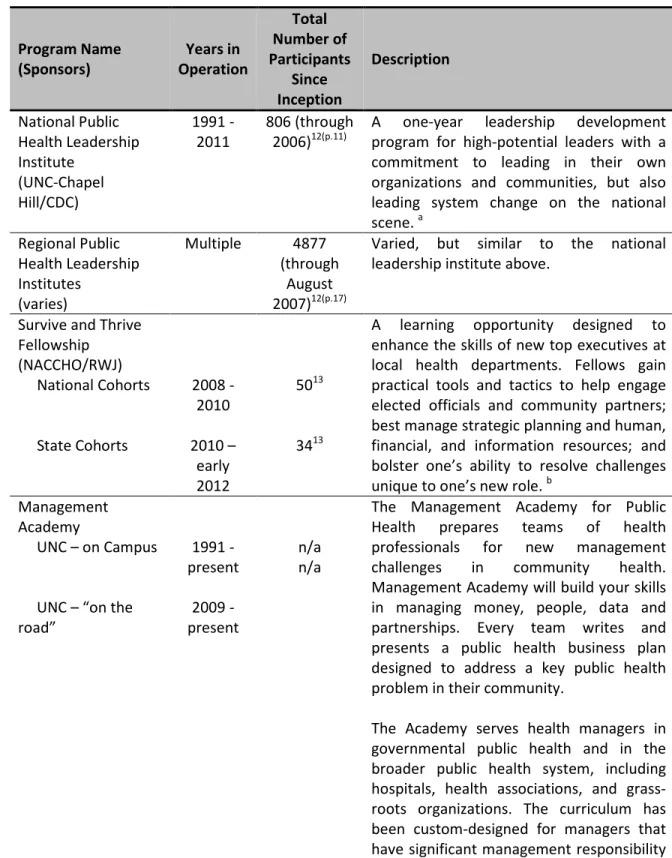
Table 1.1. Summary of Public Health Specific Leadership Training Programs ... 8 Table 2.1. Electronic Databases Searched and the Years of Coverage ... 12 Table 2.2. Search Strategy for the Question, "What Does the Literature Indicate are
the Best Practices in Organizational SP&M to Develop Its Leadership Pipeline?" ... 13 Table 2.3. Abstraction Form Variables ... 15 Table 2.4. Flow of Articles through the Different Phases of this Systematic
Literature Review ... 17 Table 2.5. Articles Describing Research Studies on Succession Planning and Management ... 24 Table 2.6. Skills, Use of Time, and Work Values Associated with Management
Levels and Passages of the Leadership Pipeline Model ... 36 Table 2.7. Standards for Judging Potential from Charan, Drotter, and Noel as
Cited from Drotter Human Resources, Inc. ... 40 Table 3.1. Data Collection Instruments that Provide Data to Answer the Study
Research Questions ... 54 Table 4.1. SP&M Best Practices Used by at Least 50% of the LPHAs ... 58 Table 4.2. SP&M Best Practices Used by Less than 50% LPHAs ... 59 Table 4.3. Frequency of Who Identified or Nominated Employees to be Part of a
HP-HP Pool ... 66 Table 4.4. Power Calculations for the Binomial Analysis of the Variables Used in
LIST OF FIGURES
Figure 2.1. Succession Planning Best Practices - Findings from Research Studies ... 20 Figure 2.2. Succession Planning Best Practices - Expert/Author Opinion ... 21 Figure 2.3. Succession Planning Best Practices - Practice-based Literature ... 22 Figure 2.4. Reproduction of Charan, Drotter, and Noel's Critical Career Passages
in a Large Business Organization Diagram ... 35 Figure 3.1. Graphic Depiction of Mixed Methods Study Design and Sequential
LIST OF ABBREVIATIONS
ASTHO Association of State and Territorial Health Officials FTE Full-Time Equivalent (employees)
HP-HP High Performer(s)-High Potential(s)
HRSA Health Resources and Services Administration LPHA(s) Local Public Health Agency/Agencies
LPHO(s) Local Public Health Official(s)
NACCHO National Association of County and City Health Officials NALBOH National Association of Local Boards of Health
CHAPTER 1: INTRODUCTION
There once was a junior public health employee who had sequential supervisors that recognized his high performance and his high potential. They gave him stretch projects, supported him during his successes and failures, and encouraged his self-development. He was by all accounts successful and became a top local public health official (LPHO).
Shortly before his first day on the job of his first top LPHO position, he discovered the book, The First 90 Days: Critical Success Strategies for New Leaders at all Levels.1 He developed an entrance plan into his new local public health agency (LPHA) based on that book as well as his observations of his previous supervisors’ leadership. He sent his new staff an introductory e-mail message even before he arrived on site, and followed up with an all-staff meeting within his first two hours on the job during which he further introduced himself, shared the framework of his entrance plan, and described his expectations. He e-mailed the information from that meeting to all of his new staff.
Eager to do a great job, he took full responsibility for his department and the functioning of his leadership team and his first-line management group. But as time marched on, he learned from his managers during individual meetings and full management team meeting debriefs that he was not delegating appropriately nor effectively coaching those who reported to him. He realized something major was wrong. He was holding back his managers and the agency; he was a problem. He realized he had not let go of being the technical expert. He also discovered, while reading the first edition of The Leadership Pipeline: How to Build the Leadership-Powered Company,2 that his own promotions from one level of management to another had occurred without his mastering all of the important transitions: transition from technical line staff to supervisor to manager of managers, and finally to functional manager of a LPHA.
That top LPHO would be me, John Wiesman, DrPH doctoral student and director of Clark County Public Health in Washington State (see Appendix A page 121 for the content of my first all staff meeting).
I believe my failures in acquiring the necessary skill changes between levels of management are similar to many top LPHOs. My experience fuels my passion to change the system in which we prepare our future managers and leaders. As I have grown into my position, I see managers in my LPHA who have not been developed and coached into their current roles, just like I was not. That cycle must end with us top LPHOs. We are developing the future leaders. We need to ensure that those future leaders have the skill sets they need for the challenging management and leadership environments they will face during their leadership years.
the current environment of SP&M in Washington State’s LPHAs, and developed a plan for change to improve LPHA’s SP&M.
SUCCESSION PLANNING AND MANAGEMENT DEFINITIONS
Definitions from the Literature
Succession processes can be thought of as a continuum in which replacement planning would be on one end of the continuum, and succession management on the other end, and succession planning somewhere in the middle.3 All three are intended to identify successors for positions. Most often, replacement planning and succession planning systems focus on the top two or three levels in an organization while succession management systems focuses on all management levels. The active development of successors is more likely to be found in succession planning and succession management than in replacement planning. However, replacement planning, succession planning, and succession management are often used interchangeably as there are no standardized definitions in the field at this time. Thus, when one reads the literature, one must contextually figure out what is being studied and reported.
I am greatly influenced by the following two definitions of succession planning, given my pragmatic worldview and systems thinking, which in my mind, border on succession management. The first definition was found in a book authored by Charan, Drotter, and Noel2(p.207): “Succession planning is perpetuating the enterprise by filling the pipeline with high-performing people to ensure that every leadership level has an abundance of these performers to draw from, both now and in the future.”
The second definition was found in Rothwell’s book3(p.6) reporting on work by Norman H. Carter, in which Carter defines succession planning as:
flexibility in lateral management moves and to ensure that as individuals achieve greater seniority, their management skills will broaden and become more generalized in relation to total organizational objectives rather than to purely departmental objectives.4(p.13-14)
Both definitions focus on all levels of organizational hierarchy, thereby taking a systems perspective. The succession process was taken further by Rothwell3(p.6) as he described a SP&M
program as: “a deliberate and systematic effort by an organization to ensure leadership continuity in key positions, retain and develop intellectual and knowledge capital for the future, and encourage individual advancement.”
And finally, Rothwell3(p.6 & 9) identified systematic succession planning as occurring when: “an organization adapts specific procedures to insure the identification, development, and long-term retention of talented individuals.”
Definitions for Dissertation
I used the following definitions for my research:
SP&M: the systems and procedures used to identify, develop, and retain high performing-high potential individuals (HP-HP) for future management and leadership roles and how HP-HP are placed into those roles.
HP-HP: persons who are performing very successfully in their current role and for whom the organization deems as having strong potential for promoting within the organization.
IMPORTANCE OF THIS RESEARCH
Workforce Turnover
than two years,5(p.28) which was down from 27% in 2008.6(p.28) That is a large number of new local leaders, an estimated 600+, taking on demanding health leadership roles over a two-year period of time.
Those same data can be used to project future demand for top LPHOs. In 2010, almost one-quarter (23%) of the top LPHOs were 60 years or older, suggesting they were already eligible for retirement or would be within five years. Added to that, another 45% were 50 through 59 years of age.5(p.27)
These two perspectives demonstrate that, at the top LPHO position alone, large numbers of individuals will be needed to assume dynamic leadership positions. Include the leadership and management positions at the other organizational levels, and there is an even greater need for HP-HP public health leaders.
Accreditation
The Institute of Medicine issued a report in 2003 entitled, The Future of the Public’s Health, in which it recommended that: “The Secretary of DHHS should appoint a national commission to consider if an accreditation system would be useful for improving and building state and local public health agency capacities.”7(p.158) That recommendation, following the development in 1998 of The National Public Health Performance Standards Program,7(p.156) work by a Voluntary Accreditation Committee established by NACCHO,7(p.157) and the Exploring Accreditation Group8 lead to an 8 year process that resulted in the first national accreditation program for governmental public health agencies. The Public Health Accreditation Board (PHAB) released Version 1.0 of the PHAB Accreditation Standards and Measures in July 2011 and launched the application process in September 2011.9
8.1, “Encourage the Development of a Sufficient Number of Qualified Public Health Workers”, contains the following measure of importance: “[e]stablish relationships and/or collaborate with schools of public health and/or other related academic programs that promote the development of future public health workers” (measure 8.1.1). The second standard, Standard 8.2, “Assess Staff Competencies and Address Gaps by Enabling Organizational and Individual Training and Development Opportunities”, contains two measures of importance: 1) “Maintain, implement and assess the health department workforce development plan that addresses the training needs of the staff and the development of core competencies” (measure 8.2.1), and 2) “Provide leadership and management development activities” (measure 8.2.2). These standards and measures are reproduced in Appendix B on page 124.
My doctoral research adds to the workforce development literature at the very time that LPHAs are applying for national accreditation and need to focus on workforce development.
DISSERTATION AIMS AND RESEARCH QUESTIONS
My dissertation aims were to identify and understand how LPHAs are and are not implementing SP&M and to make recommendations for improvement. Therefore, my three primary research questions were:
1. What are the best practices in SP&M?
2. What elements of SP&M are being implemented in LPHAs and do LPHAs have a comprehensive SP&M program?
BENEFITS AND PRODUCTS OF THIS RESEARCH
My dissertation developed a plan for change that if implemented can promote the adoption of comprehensive SP&M systems in LPHAs to help meet accreditation standards, and more importantly, to develop leaders who are prepared to lead the public health system into the future. Along the way, I hope I will have inspired my colleagues and created urgency for them to implement SP&M best practices in their organization, and in doing so, increase their own leadership skills as they prepare our future leaders.
My vision is that my dissertation findings and resulting plan for action will lead to transformational changes in LPHAs. My plan uses Kotter’s eight stages of transformation as a guiding framework. My intention is to influence the Washington State Association of Local Public Health Officials, the NACCHO, and the National Association of Local Boards of Health (NALBOH) to take on projects that support the top LPHOs in developing and implementing SP&M programs. The goal is that future, first-time, top LPHOs enter their tenure well prepared for the challenges of their positions.
EXISTING RESOURCES
Leadership Training Programs
include traveling to off-site trainings, time away from the worksite, and financial cost to participants or their organizations.
Table 1.1. Summary of Public Health Specific Leadership Training Programs
Program Name (Sponsors) Years in Operation Total Number of Participants Since Inception Description National Public Health Leadership Institute (UNC-Chapel Hill/CDC) 1991 - 2011 806 (through 2006)12(p.11)
A one-year leadership development program for high-potential leaders with a commitment to leading in their own organizations and communities, but also leading system change on the national scene. a
Regional Public Health Leadership Institutes
(varies)
Multiple 4877 (through
August 2007)12(p.17)
Varied, but similar to the national leadership institute above.
Survive and Thrive Fellowship (NACCHO/RWJ) National Cohorts State Cohorts 2008 - 2010 2010 – early 2012 5013 3413
A learning opportunity designed to enhance the skills of new top executives at local health departments. Fellows gain practical tools and tactics to help engage elected officials and community partners; best manage strategic planning and human, financial, and information resources; and bolster one’s ability to resolve challenges unique to one’s new role. b
Management Academy
UNC – on Campus
UNC – “on the road” 1991 - present 2009 - present n/a n/a
The Management Academy for Public Health prepares teams of health professionals for new management challenges in community health. Management Academy will build your skills in managing money, people, data and partnerships. Every team writes and presents a public health business plan designed to address a key public health problem in their community.
Program Name (Sponsors)
Years in Operation
Total Number of Participants
Since Inception
Description
and health backgrounds, but may lack formal management training. Managers are selected for the program in teams of three to six participants. c
a
This description was taken from www.phli.org/about/index.htm on January 23, 2010 at 1055hrs, Pacific Time.
b
This description was taken from www.naccho.org/topics/infrastructure/surviveandthrive on January 23, 2010 at 1101hrs, Pacific Time.
c
This description was taken from www.maph.unc.edu/whatis/index.htm on February 12, 2012 at 1240hrs, Pacific Time.
ASSUMPTIONS AND BELIEFS
I entered into this dissertation study with the following assumptions based upon my years of experience in local public health practice.
• I assumed that few LPHAs had SP&M programs in place.
• I assumed that many current managers and LPHOs were ill prepared for their positions in terms of having acquired the skills, use of time, and work values that correspond to their level of management position.
• I assumed there was a hunger for this type of information as evidenced by the large attendance NACCHO receives at its annual pre-conference session for top LPHOs who are in their first two years of the job to hear from more seasoned top LPHOs, as well as the large interest in the public health leadership programs noted earlier. • I assumed that many, if not most, top LPHOs who work in departments in a larger
As LPHOs, we health leaders are responsible for ensuring that our LPHAs are strategically positioned to best meet the public health needs of our communities, not only for today, but also for the future. I believe that if we implement SP&M programs we will:
• Have managers who better manage and support their staff, which will improve the quality of our programs and services.
CHAPTER 2: LITERATURE REVIEW
LITERATURE REVIEW RESEARCH QUESTIONS
My literature review answered the first research question: “What are the best practices in SP&M?” and informed the development of the survey questions and semi-structured interview questions used to answer the other two research questions. I examined both the scientific and practice-based literature given the practice-based nature of my dissertation topic. To answer the first research question, the following literature review questions were asked:
What does the literature indicate are the best practices in organizational succession planning to develop its leadership pipeline?
Do they differ between the private sector and the governmental sector?
SP&M—BEST PRACTICES
Methods
Search Methods
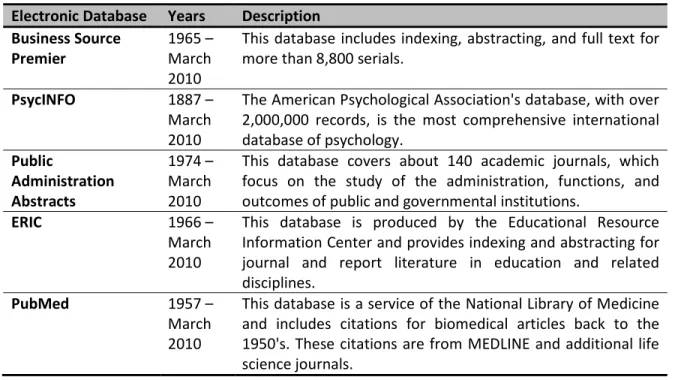
SP&M is not unique to the fields of public health, health services, or government. It spans business, management, and social sciences disciplines and is indeed relevant to all fields and types of organizations that have managers and leaders. Therefore I searched a broad array of electronic databases on the UNC University Libraries web page (www.lib.unc.edu/) that were available to me as a UNC student in March 2010. Five electronic databases were searched. Those databases and their descriptive information are presented in Table 2.1.
Table 2.1. Electronic Databases Searched and the Years of Coverage Electronic Database Years Description
Business Source Premier
1965 – March 2010
This database includes indexing, abstracting, and full text for more than 8,800 serials.
PsycINFO 1887 –
March 2010
The American Psychological Association's database, with over 2,000,000 records, is the most comprehensive international database of psychology.
Public Administration Abstracts 1974 – March 2010
This database covers about 140 academic journals, which focus on the study of the administration, functions, and outcomes of public and governmental institutions.
ERIC 1966 –
March 2010
This database is produced by the Educational Resource Information Center and provides indexing and abstracting for journal and report literature in education and related disciplines.
PubMed 1957 –
March 2010
This database is a service of the National Library of Medicine and includes citations for biomedical articles back to the 1950's. These citations are from MEDLINE and additional life science journals.
Table 2.2. Search Strategy for the Question, "What Does the Literature Indicate are the Best Practices in Organizational SP&M to Develop Its Leadership Pipeline?"
Succession Planning AND Best Practices
(“succession plan” OR “succession planning” OR “succession management” OR “executive development” OR “leadership pipeline” OR “talent pipeline”)
AND
(best practice OR best practices OR guideline OR guidelines OR
evidence based practice)
I believe that these search terms gave construct validity to the research question. In terms of external validity, I did not include population limiting search terms in order to stay true to the operational definition used in this dissertation. That definition conceptualizes a leadership pipeline, which indicates that to become an executive, one must gain the skills necessary over progressive levels of management: from technician to supervisor to manager to functional leader to executive leadership. One does not prepare top LPHOs through a specialized or unique SP&M system but rather through an overall succession system encompassing all levels of organizational leadership. Similarly, the system does not vary much from one type of organization to another.
In addition to the electronic database results, additional material was identified through a review of references in retrieved articles.
Inclusion and Exclusion Criteria
I decided not to limit my searches only to academic journals because I anticipated scarce literature in peer reviewed journals; instead, I included any materials identified in the database searches. I also decided to categorize materials into research studies, expert opinion, or practice-based material derived from other knowledge. I excluded three types of material from actual review: 1) Dissertations, due to limited access and time constraints, 2) Books, due to time constraints, and 3) Review articles or book reviews that reported on other literature, as those would not add new information to this review.
Articles that only addressed a portion of SP&M, such as the identification of talent, or that only addressed SP&M at a departmental level versus the larger organization, were excluded. My rationale for excluding was that anything that looked at less than an organization-level approach indicated an isolated approach, and did not support the larger system.
Review of Search Results
I conducted the entire material review and made all decisions. While most systematic reviews would include at least two people independently conducting reviews, this would have been impractical for my dissertation.
The review of material was conducted in the following manner.
1. Each item was screened based upon its title. If the title indicated that the material was from another topic area, it was immediately excluded and the topic area and reason for exclusion noted in the abstraction form. If there was any doubt about whether or not an article might be relevant, it was passed on to the next step.
the exclusion was noted on the abstraction form. If no abstract was available, it was passed on to the next step. If there was any doubt about whether or not an article might be relevant, it was passed on to the next step.
3. The full material, if available, was then retrieved electronically. If it was not available electronically, it was requested through interlibrary loan and, if available, I reviewed it. I read each article for applicability. If it was not applicable, the reason for exclusion was noted on the abstraction form. All applicable materials had information abstracted and entered into the abstraction form.
All references were entered into the abstraction form as a way to account for my decision-making and to track the exclusion process. Table 2.3 below identifies the abstraction variables.
Table 2.3. Abstraction Form Variables For all database references:
• Included in final review? (yes or no)
• If excluded, at what step of the process (title, abstract, or article review) • If excluded, what was the reason?
• Authors
• Publication year • Publication title
• Journal title, volume, number and pages For all materials included in the review
• Source type (research study, expert opinion, practice-based material) • Type of study, if relevant
• Subject(s), subject descriptions, and subject recruitment, if relevant • Study purpose and methods, if relevant
• Research themes, if relevant • Best practice findings, if any • Outcome and conclusions, if any
• Future research suggested by authors, if any
RESULTS
The five electronic databases were queried using the pre-identified Boolean search strategy. Business Source Premier was queried on March 6, 2010, and the remaining four databases were queried on March 7, 2010. In all, 141 references were identified with 11 duplicates, resulting in 130 unique references.
Table 2.4. Flow of Articles through the Different Phases of this Systematic Literature Review Business Source Premier Psyc INFO Public Admin Abstracts
ERIC Pub Med Total Number of
References 101 16 2 10 12 141
Duplicates Removed N/A (reference database)
7 2 0 2 11
Number Remaining 101 9 0 10 10 130
Removed by Title
Review 0 0 0 0 0 0
Number Remaining 101 9 0 10 11 130
Removed by Abstract Review:
Family or Business Succession Off Topic or a Book Dissertations 18 37 0 0 2 3 0 0 0 0 7 0 0 1 0 18 47 3
Number Remaining 46 4 0 3 10 62
Removed by Article Review
Family or Business Succession Off Topic Duplicate Report of a Single Study Not New Knowledge/ Review Article 1 31 2 3 0 3 0 0 0 0 0 0 0 2 0 0 1 5 1 1 2 41 3 4
Number Remaining 9 1 0 1 2 12
Additional Articles Identified by Scanning Article
Citations 1
FINAL NUMBER OF REFERENCES
13
Description of the Literature
in SP&M. Researchers usually interviewed senior leaders in these organizations and gathered documentation of the organization’s SP&M systems. Researchers then looked for themes that described the organization’s approach and reported on those.
Even more lacking were attempts to measure the effectiveness of SP&M systems. Only one article attempted to measure effectiveness but did so without clearly defined measurement. Most mentioned the importance of evaluation, and most encouraged ongoing quality improvement.
Much of the literature was published in trade publications and books. For this review, books were eliminated, leaving mostly individual authors describing what they believed to be important elements of SP&M.
The literature that remained presented a common framework from which most articles viewed SP&M and there was significant repetition of identified best practices.
Common Framework
I found three common elements to SP&M systems. Those were: developing talent pools, having CEO leadership, and linking to an organization’s strategic future.
The field has clearly moved away from succession planning simply as replacement planning where an organization identifies an heir apparent for key positions. Succession planning was contemporarily viewed as succession management in which potential talent is consciously and carefully identified and systematically selected and developed over time, creating a pool of talented individuals that could fill multiple positions from early to middle management all the way to the CEO of an organization. This is known as creating a talent or leadership pipeline.
resource departments should be doing alone; they emphasized the importance of human resources and CEO and all levels of management and employee involvement in succession management.
The final theme was that identifying, selecting, and preparing future leaders requires a SP&M system connected to an organization’s strategic future. To do this the organization identifies the types of experiences for which one needs to be most prepared (e.g., international experiences for a global economy) and identifies strategic action learning projects for its HP-HP. These strategic action learning projects give HP-HP an opportunity to grapple with strategic issues and management the opportunity to see how the HP-HP perform on those strategic projects. They also allow the organization to implement findings so that these are not just exercises but are real work that moves an organization strategically forward.
SP&M Best Practices
2
0
2
1
2
2
Formal Research Study Results
2
4
Table 2.5. Articles Describing Research Studies on Succession Planning and Management
ID # Author
Journal Year Study Subjects Methods
14
Bhatnagar J
Industrial and Commercial Training
2008 One anonymous multi-national company in India.
• 461,000 employees in 190 countries.
• Electrical and electronics engineering.
Interviews
Review of archival data
Note: article did not report the interview questions or archival data examined. 15 Groves KS Journal of Management Development
2007 30 CEOs and human resource executives across 15 unidentified best practice U.S. national health care organizations
• 7 single-site hospitals, 7 multi-site health care systems, and 1 medical group
• renowned for best practice leadership development methods and highly successful CEO
successions
• identified by senior partners in an unidentified leading national U.S. health care executive search firm
Interviews
Note: article did not report the interview questions.
16
Conger JA and Fulmer RM
Harvard Business Review
2003 Six organizations that had achieved a high degree of success in succession
management compared to 16 sponsoring companies.
• Six high degree of success
organizations: Dell, Dow Chemical, Eli Lilly, PanCanadian Petroleum,
Site visits with in-depth interviews
Detailed questionnaires collected quantitative data
2
5
Sonoco Products, and Bank of America.
• 16 sponsoring companies not identified
interview or questionnaire questions.
17 U.S. General Accounting Office Government Accounting Office report 03-914
2003 Government agencies (number
unspecified) in four foreign countries. The countries were studied earlier by the GAO for their implementation of results-oriented management and human capital reforms. Questionnaires received from 30 senior human capital officials and 50+ interviews with government officials in national audit offices, central
management, and human capital agencies.
• Australia, Canada, New Zealand, and the United Kingdom
Questionnaires
Interviews
Document review
Note: article did not report the questionnaire or interview questions.
18
Karaevli A and Hall DT
2002 “Representatives” from thirteen businesses known for their succession planning and talent identification and development programs (undefined):
• BP, Boeing Co., Chase Manhattan, Citigroup Inc., Dell Computer Corp., Eli Lilly and Company, Ericsson, Hewlett-Packard Co., JP Morgan, Motorola Inc., Southwest Airlines Co., Sun Microsystems Inc., and U.S. Army
Interviews
Taken together, these studies described a logical, systematic approach to SP&M (see Figure 2.1 for the mind map combining the findings of these studies). When you examine this map, you can see that SP&M includes both a) systems components for developing an organization’s capacity to implement SP&M (identified in green) and b) systems components that develop individuals (identified in orange).
As already stated, only one article, by Karaevli and Hall,18 evaluated the effectiveness of SP&M. They evaluated thirteen organizations for best practices and, through interviews, assessed whether or not these systems were creating leaders prepared to lead in turbulent times. They used a report card approach for their evaluation, giving grades for areas they deemed important. Unfortunately, there was no measurement definition for the grading scale, so it was difficult to tell what they were grading against. Still, their findings were instructive.
Only one of the four evaluated areas was given a high grade. The authors found good news in progress these organizations were making towards defining and using “learning agility” in their SP&M. They stated that:
[s]ince leaders have boundary-spanning roles between organizations and their environment, these leaders’ adaptability and cognitive complexity directly affect organizational responsiveness to environmental discontinuities. Thus, the question is whether succession planning processes include elements to identify and develop adaptable and mentally agile leaders.18(p.69)
They found that these organizations recognized learning agility as a critical skill and incorporated the concept into their HP-HP talent selection and development systems. For this progress, they assessed a grade of “A-”.
Furthermore, this talent replacing process did not promote diversity at the top of the organization, which, in their view, meant a “lack of variety in perspectives, knowledge and skills, which limits firms’ ability to foresee and respond to sudden crises effectively.”18(p.71) They gave these organizations a “D” grade when it came to eliminating “executive cloning.”
The two authors also gave two “C” grades. One was for putting too much stress on the identification of talent rather than on the actual development of the workforce itself. They pointed out that the people who were offered development were the ones that were selected through the identification process. Having focused so much energy on selecting individuals that somehow differentiated them from others, leaders neglected the opportunity to influence the overall environment that supported development to which everyone would have been exposed and benefited. They argued that spending more time promoting a learning agility environment and other development would create a larger pool of people with the motivation to stretch themselves and stay engaged in the organization.
The second “C” grade was given for linking executive development to strategy. Their interviews found that for many organizations this link was more rhetoric than implementation. The identified barriers seemed to be that there was not a clear single corporate strategy that drove SP&M and that, in fact, different business units used their own operating strategies and identified different needs. Furthermore, line managers were so focused on operational demands that they did not have much time to think about longer-term strategy.
Expert Opinion Results
same issue and proposed that by incorporating role theory into succession planning one could better link succession planning to the organization’s strategy and its likely future business scenario. They proposed a process that had two elements. The first, which is not new, had executives identifying key business issues they believed their organizations would face, which, if addressed, would strengthen the organization’s business strategy. The second element that enhanced SP&M was to incorporate role theory by asking, “What roles will that leader need to perform to effectively address the key business issues of the future?” That question identified the type of leadership and leader the organization would need to be successful in the future. Twelve different roles were identified at the enterprise leader level. Those roles were: business performance driver, change sponsor, coach, cultural leader, executive-at-large, external influencer, internal influencer, international executive, strategist, talent manager, team leader, and visionary. While many, if not all of these roles are part of executive positions, they proposed that certain roles would play more prominently in the future challenges the leader would face and that those should be identified and be incorporated into the development and selection process. For example, if one determined that increased diversity in the population was going to challenge the organization’s success, the upcoming CEO may need to emphasize her role as a cultural leader. If the organization was in need of a major turnaround, the upcoming CEO may need to emphasize his role as a change sponsor.
Practice Based Results
The practice-based literature23,24,25,26 also described best practices that were in sync with the primary research studies and the expert opinion articles (see Figure 2.3). This literature emphasized the importance of:
• Undertaking SP&M.
• Making use of electronic tools to help management track the talent pool both for filling open positions and monitoring diversity of the candidate pool and to help candidates take responsibility for their information and their development plans. • Making sure the succession planning process is tied directly into the organization’s
strategic plans.
DISCUSSION
The first question to ask when evaluating how these best practice findings translate to local public health practice is, “How similar or dissimilar are the organizational environments and do those differences impact the external validity of the findings?” Two obvious differences include the for-profit business environment and the size of the organizations. I propose that both of these differences impact how LPHOs are able to translate the findings into practice.
Three of the five case study articles14,16,18, and most likely a fourth15, exclusively examined for-profit organizations, which are more likely than governmental public health agencies to have employees with business and/or management degrees as well as employees who are driven more by financial profit than by social justice or community service. This could translate to SP&M programs in the private sector that are more attuned to business models that focus on strategy and leadership, have a better appreciation for lateral moves in disparate parts of the agency to learn the various elements of an agency, and that have profit as a motivator in employee retention practices. It is also probable that the private sector can be more agile when it comes to trying new approaches and giving employees differential opportunities.
I propose that these major differences require both a different mindset to SP&M as well as some probable adaptation of the best practices. While SP&M is about creating a pool of talent ready to take the place of higher-level managers and leaders within an organization, I propose that LPHOs will need a more collaborative than competitive mindset. Given the relatively skewed number of small to medium-sized LPHAs, there may not be a “pool” of persons to fill higher-level positions. If that is the case, there may indeed be an heir apparent or none. If there are limited opportunities for promotion and there is a pool of candidates, LPHOs will need to accept that they are grooming talent to move on to other organizations. This is where LPHOs are going to have to take a larger systems approach and focus more on cooperation rather than competition.
I also propose that the best practices for local governmental public health themselves are likely to need modification. The first area for modification is in the area of talent development. When looking at competency and leadership development, the mere fact that most public health professionals lack formal business and management training means that we will have to create a wider range of business and management training opportunities that span from very basic to advanced. This may require obtaining outside resources and increasing the cost of SP&M. Similarly, there may be a lack of internal mentors if the existing managers and leaders have underdeveloped management and leadership skills. This may require senior leadership to bear more of this responsibility and/or that LPHOs will need to look outside their organizations and perhaps the public health field for mentors. If so, this may create an unintended opportunity to increase HP-HP exposure to other disciplines and community partners, and thereby enrich their development.
governmental job classification structure or a union work environment, you may be more constrained in allowing people to work out of their assigned job classification. And if you do work them out of classification, it may increase your financial outlay if you need to pay additional compensation.
Thirdly, cross-functional task forces may be more challenging in small LPHAs simply because there may not be a pool of talent to groom for higher positions. This could require looking for opportunities outside one’s immediate LPHA, which again could be an opportunity to increase a LPHA’s external partnerships.
Another area for adaptation is likely to be the organization’s system for identifying and tracking a talent pool. For LPHOs that have little business and management training, the chief executive may not be versed in or appreciate the need for SP&M. Since chief executive involvement was an important element in best practice organizations, national associations like NACCHO may need to educate their members on its importance. Similarly, if a LPHA does not have a strategic plan or if its LPHO does not support strategic thinking, the LPHA may struggle with identifying the future needs of the organization and therefore not have the information to select potential talent that is prepared to lead programs and organizations in the future.
implement quality improvement, smaller organizations may need to seek this expertise elsewhere.
There may very well be other barriers created by the different business orientation and/or the much smaller employee scale. The opportunity, however, is that these barriers can increase collaboration with other local partners, promoting a systems orientation to workforce development, or can increase collaboration with neighboring LPHAs, which could promote shared services across multiple jurisdictions.
Quality of Primary SP&M Studies
The first major limitation to the primary research studies was how corporations were identified for inclusion. It is left unstated how the one, anonymous multi-national corporation in Bhatnagar’s study14 was selected, other than it was somehow known to have a talent pipeline system. Groves’ study15 relied upon senior partners in a “leading” (undefined) national US health care executive search firm to identify 15 health care organizations “renowned” (again, undefined) for best practice leadership. And Conger and Fulmer16 somehow identified, six undefined “high degree of success in succession management” organizations. Without having specific inclusion or exclusion criteria, it is difficult to examine this research for selection bias or to know if there is internal validity with the subjects being studied across these three case studies.
if our practices are really best practices or simply what we do because it seems to be the right thing to do.
A third limitation is that the methods are not clearly identified. None of the studies reported on the interview questions or the methods for identifying archival or supporting documentation. This makes it impossible to evaluate for construct validity.
Limitations and Future Research
As mentioned earlier, there are a number of books written on SP&M that include best practices and are likely to present some research evidence. Because this review excluded books, it is possible that significant best practices have been missed or even that contradictory evidence has been discovered.
This review also limited electronic searches to those databases that UNC-Chapel Hill had available on their library web site and that seemed most appropriate for this review. It is possible that there are human resource or organizational development specific electronic databases that would have identified other SP&M research. However, a quick review of the journals list for Business Source Premier found seven journals that started with “human resource” and 11 academic journals that began with “organization” or “organizational” so clearly some of this literature is in this electronic database.
design and conduct some prospective case/control studies or at least a time series to evaluate controlled systems and implementation for best practice confirmation.
In the meantime, leaders must be pragmatic. With the baby boomers retiring, the significant number of public health jobs needing new managers and leaders, and accreditation requiring workforce development, SP&M principles and best practices as known today are likely to move LPHAs forward if implemented. In doing so, leaders would be wise to prioritize formative evaluations, quality improvement processes, and outcome evaluation studies to contribute to our knowledge and understanding of what works, what does not work, and what innovations can be developed.
SP&M—PRACTICE-BASED MODELS
While books were excluded for my formal literature review, I have reviewed a few for this dissertation. The first book, The Leadership Pipeline: How to Build the Leadership-Powered Company,2 was a book I acquired prior to my doctoral program as part of my self-development and my interest in developing other managers. The second book, Effective Succession Planning: Ensuring Leadership Continuity and Building Talent from Within,3 was a book recommended to me by a colleague who had an employee take a succession planning course through the University of Washington prior to my doctoral program. These two books have informed some of my thinking and have influenced my plan for action.
Leadership Pipeline Model
The Model2
movement from one level to another represents a change in organizational position—that is a passage, and those passages are described as a pipeline turn. They are described in this manner because a person moving from one level to the next is required to increase her complexity of leadership and is required to focus her skills, time applications, and work values differently. The number of turns varies by the complexity of the organization. To illustrate this concept, I am reproducing the authors’ figure illustrating this concept2(p.8) (see Figure 2.4), followed by Table 2.6 that I constructed, highlighting the skills, use of time, and work values required of the seven levels and six passages depicted in their figure.
Figure 2.4. Reproduction of Charan, Drotter, and Noel's Critical Career Passages in a Large Business Organization Diagram
Figure is recreated with permission from Charan R, Drotter S, Noel J. The Leadership Pipeline: How to Build the Leadership Powered Company. Second ed. San Francisco, CA: Jossey-Bass; 2011.
Business Manager
Group Manager
Manage Self
Manage Others Manage Managers
Functional Manager Enterprise Manager
Passage 3 Passage
5 Passage
6
Passage 4
Passage
2 Passage
3
6
Table 2.6. Skills, Use of Time, and Work Values Associated with Management Levels and Passages of the Leadership Pipeline Model2
Category Manage Self (Individual Contributor)
Manage Others (1st Line Manager)
Manage Managers (2nd Level Management)
Functional Manager
Passage One Passage Two Passage Three Passage Four
Skills Do assigned work within given time frames and ways that meet objectives. They make increased contributions and are then considered “promotable”.
• Quality work. Appropriate content.
Learn to plan work, fill jobs, assign work, motivate others, coach others, and measure work of others.
• Planning
• Coaching
Learn to identify and select individuals for management and coach them to
management. They bring people into the leadership pipeline—big responsibility.
• Assigning managerial and leadership work to their managers and measuring their progress as managers (and coaching them).
• Strategic thinking— identify strategic issues that support the overall business. Think beyond their functional area.
• Coaching mangers into managers rather than individual contributors. Return managers to individual contributor levels if they can’t embrace management.
Learn to become skilled in taking other functional concerns and needs into consideration because they report to multifunctional general managers.
• Team play with other functional managers AND compete for resources based on business needs.
• Become proficient strategists for their functional area as well as blending w/ the overall business strategy.
• Delegate responsibility for overseeing many functional tasks to direct reports.
3
7
Category Manage Self (Individual Contributor)
Manage Others (1st Line Manager)
Manage Managers (2nd Level Management)
Functional Manager
Passage One Passage Two Passage Three Passage Four
Use of Time Learning involves planning so that work is completed on time and of quality.
• Reliable.
Learn to reallocate their time so they not only complete their assigned work but also help others perform effectively. Shift from doing work to
getting work done through others. Learn to let go of their “old” work— technical—and embrace management.
• Make time for others.
• Coaching managers (implement the
instruction-performance-feedback cycle repeatedly).
• Participating in business team
meetings and working with other functional managers.
Work Values Accept company culture and adopt professional standards.
Usually the most difficult change. Learn to value managerial work rather than just tolerate it. Learn to value making others productive.
Learn to value strategic and go beyond individual contributions and functional work.
Learn to value areas outside their own functional expertise.
3
8
Category Business Manager Group Manager Enterprise Manager
Passage Four Passage Five Passage Six
Skills Learn to integrate functions (not just becoming more strategic and cross-functional in thinking). Learn to shift from looking at plans and proposal functionally to a profit perspective and long-term view.
• Skilled in working with a wider variety of people than ever before.
• More sensitive to
functional diversity issues.
• Communicating clearly and effectively.
• Balance between future goals and present needs and making trade-offs between the two.
• Meet quarterly profit, market share, product and people targets, and plan 3-5 yrs into future.
Learn to run two or more businesses.
• Inspire and support the performance of business managers that report to you.
• Proficient at evaluating strategy for capital
allocation and deployment (learn to ask the right questions, analyze right data, and apply right corporate perspective to evaluate multiple strategies).
• Develop business managers.
• Evaluate the portfolio of businesses (right mix, what to add/subtract).
• Assess core capabilities to win (avoid wishful
thinking). Factor complexities of running multiple businesses.
• Long-term visionary thinkers.
• Develop operating mechanisms to know and drive quarter-by-quarter performance in tune w/ long-term strategy.
• Well-developed external sensitivity, ability to manage external constituencies, sense external shifts and do something about them proactively.
3
9
Category Business Manager Group Manager Enterprise Manager
Passage Four Passage Five Passage Six
Use of Time Learn to take thinking time.
• Stop “doing” every second of the day and reserve time for reflection and analysis. (Leadership pipeline becomes clogged if this doesn’t happen.)
• Assemble high-achieving and ambitious direct reports (know some want his job).
Work Values Learn to value and effectively use staff functions.
• Trust, accept advice, and receive feedback from all functional managers.
Learn to value multiple businesses.
• Value the success others.
The premise of this leadership pipeline model is that only sustained (defined as at least three years) high performers at one level with anticipated ability and capacity to develop the new skills and willingness to take on the higher level challenges that come with the next turn should be promoted. To assist in making these pipeline turn judgments, the authors created three categories of employee “potential”: turn potential (ready for promotion), growth potential (assigning more challenging work at the same level), and mastery potential (helping one improve in their current role with the same effort). They provide concrete standards for this judging of potential, citing a source of Drotter Human Resources, Inc., for which is reproduced below2(p.212-213) in Table 2.7.
Table 2.7. Standards for Judging Potential from Charan, Drotter, and Noel as Cited from Drotter Human Resources, Inc.
Turn Potential (can be promoted through the next passage within three to five years)
NOTE: This designation needs at least one-over-one confirmation, as the immediate boss has not hired people for her own level but her boss has.
• Exhibits operating, technical, and professional skills that are extremely broad and deep
• Exhibits managerial skills that are expected at the next highest organizational level • Demonstrates leadership skills that are expected at the next highest organizational
level
• Regularly works at building new skills and abilities • Aspires to higher level challenges and opportunities • Demonstrates “fire in the belly”
• Has a business perspective beyond the current organizational level
• Is oriented toward total business results, not just focused on the success of own area
Growth Potential (can be promoted to a bigger job at the same leadership level within three years)
• Exhibits operating, technical, and professional skills that are high for the current organizational level
• Exhibits managerial skills that are high for the current organizational level • Frequently demonstrates leadership skills that are high for the current position • Adds new skills when the job calls for it
• Has a business perspective beyond the current position • Is focused on the success of own area and the team Master Potential (can improve in current role with some effort)
NOTE: This individual may have the desire, but may not yet have demonstrated the ability, to progress to bigger jobs.
• On balance, exhibits operating, technical, and professional managerial, and leadership skills that are acceptable for the current organizational level
• Demonstrates little effort to build new skills but keeps current skills sharp
• Aspires to stay with the company, as opposed to assuming bigger challenges or higher personal contributions
• Is motivated to do what is needed in the current job • Understands the job
• Is focused primarily on technical issues.
Table is recreated with permission from Charan R, Drotter S, Noel J. The Leadership Pipeline: How to Build the Leadership Powered Company. Second ed. San Francisco, CA: Jossey-Bass; 2011.
The authors encourage giving candidates stretch projects or assignments that incorporate the skills needed in the next level of management to help measure their capacity to perform at the next management level. This model shies away from the loosely defined term of “high potentials” and substitutes it with this more measurable definition.
Discussion
This model offers many advantages for a LPHO looking to implement a SP&M program. First, it is very concrete, practical, and flexible. It clearly outlines important elements for success in each level of management that can form the foundation for the development of job descriptions and performance review criteria. This can then be easily incorporated into performance management and evaluation systems and tools. Because it is flexible, one can adapt the management position labels and the number of passages or turns to the scope and size of the LPHA.
so, it helps the employee understand what she needs to give up and what she needs to take on as she moves into the next management level. This can inform her self-development plan.
Third, this provides a concrete model from which to coach employees. Knowing the skills, use of time, and work values required of the various levels facilitates the diagnosing of performance problems and provides a foundation on which to coach improvement. It also provides the supervisor, and the organization, with a framework in which to judge an individual’s potential for and to support the development of a pool of candidates for succession. This facilitates a supervisor’s knowledge to understand and identify stretch assignments and projects that can help an employee grow in the direction of the next level of management.
Fourth, this provides the organization with a framework to understand organizational inefficiencies and dysfunctions. Organizations that are struggling to get the work done or to get the “right” work done often have leaders and managers that are working at a level or two below the appropriate level. Subordinates experience this situation as micromanaging and limiting their potential, in fact, disincentivizing their performance. This references the lesson learned for me as I reported in the introduction.