
MULTIPARTY MEDIATION: A MORE OPTIMISTIC VIEW
Elizabeth J. Menninga
A thesis submitted to the faculty of the University of North Carolina at Chapel Hill in partial fulfillment of the requirements for the degree of Master of Arts in the Department of Political Science.
Chapel Hill 2011
ABSTRACT
ELIZABETH J. MENNINGA: Multiparty Mediation: A More Optimistic View (Under the direction of Stephen E. Gent.)
TABLE OF CONTENTS
LIST OF TABLES . . . iv
Introduction . . . 1
Multiparty Mediation . . . 2
Selection Effects . . . 3
Challenges of Multiparty Mediation . . . 6
Multiparty Mediation’s Unique Advantages . . . 7
Data and Methods . . . 11
Model and Results . . . 14
Conclusions . . . 19
Appendix . . . 21
LIST OF TABLES
Table
1 Logistic Regression of Peace Endurance . . . 15
2 Predicted Probabilities Full Sample . . . 16
3 Predicted Probabilities Mediation Only . . . 17
4 Cox Proportional Hazard Results . . . 18
5 Logistic Regression 2 Year Threshold . . . 21
Introduction
Mediation is a popular conflict resolution tool used by the international community to engage conflicts and encourage settlements. Of the 146 peace agreements resolving civil wars signed between 1989 and 2005, 117 reached agreement through mediation.1 Studies of conflict resolu-tion, peace agreements, and the techniques used to influence outcomes, however, tend to treat all mediation efforts as equivalent. As B¨ohmelt (2010) points out, mediators self-select into conflicts, making mediation efforts inherently non-random and the selection of multiple parties into the same conflict at the same time even more interesting. Much of the theory building done to understand the influence and effectiveness of mediation on conflicts assumes a single mediat-ing party (e.g. Kydd (2003); Maoz and Terris (2006)). Seventy-three percent of the mediated resolutions in the Uppsala Conflict Data Program Peace Agreement Dataset, however, were not single-party efforts. When multiple parties offer to mediate, individual mediator interests and preferences will rarely align to create unanimity in the pace, process, or preferred outcomes of negotiations. This diversity questions if single-party mediation theories are always applicable to multiparty efforts. Furthermore, many of the empirical studies of mediation focus on the inherent difficulty of the conflicts that turn to mediation and how mediated agreements tend to be less successful in establishing an enduring peace than agreements reached directly by the combatants (e.g. Beardsley (2008)). These conclusions about the usefulness of mediation over-look the variance across mediation efforts and how this variance shapes the outcome of mediation.
Gartner and Bercovitch (2006) argue that mediation in international conflicts has opposing selection and process effects. Since accepting mediation incurs costs on the conflicting parties, including loss of authority and decision-making, disputants that are able to reach a resolution without outside help would prefer to do so. Therefore, mediation is only employed in the most difficult of conflicts. Mutwol (2009) implies that these selection effects would be even stronger in civil wars as they tend to be more intractable than interstate conflicts. Moreover, Stedman (1991) acknowledges that civil wars polarize society and marginalize moderate forces within the state. By the time the participants to a civil conflict are willing to accept the costs of mediation, finding a resolution that is not only acceptable at the time of the signing but that will also
1This sample of agreements is taken from the Uppsala Conflict Data Program Peace Agreement Database
persist will be incredibly difficult, even with the help of mediation.
During the negotiations, however, mediation has positive process effects that encourage res-olution. Mediators serve three important roles in the resolution of conflict: an informational role through the transmission of messages and identification of common interests between the conflicting parties, a procedural role through structuring the agenda of meetings, controlling the pace and formality of meetings, and arranging the time and location of negotiations, and, potentially, a coercive role rewarding concessions and punishing disagreement (Walter 2002). Gartner and Bercovitch (2006) find support for their hypothesis that despite these positive pro-cess effects, mediated agreements do not overcome the inherent difficulty of their conflicts. Thus negotiations conducted with a mediator are more likely to be short-lived2 than those conducted without a third party. Gartner and Bercovitch treat all mediation efforts as equivalent, but these process effects need not be uniform across mediator types. Exploration of the differences in pro-cess effects across mediation efforts would help us better understand the role of mediation in resolving disputes and how mediation contributes to stable resolutions. While mediation efforts vary along many dimensions, this thesis explores how multiparty mediation efforts differ from single-party efforts and how these differences affect the resolution of conflicts and the persistence of peace settlements.
This exploration starts with a discussion of the past literature, specifically the process effects that enable mediation to bring difficult conflicts to resolution. Then, the past literature’s consid-eration of multiparty mediations exposes the additional complications that adding more people to the negotiating process produce. Finally, elaboration upon how these added complications actually better enable multiparty mediation to resolve the conflicts in which they intervene more effectively produces this paper’s expectation that agreements resulting from multiparty media-tion should persist longer than those produced by a single mediator. This assermedia-tion is tested using both logistic and duration analyses, finding mixed support.
Multiparty Mediation
For the discussion and analysis in this work, mediation is defined using Bercovitch’s (1992) definition: “a process of conflict management, related to but distinct from the parties’ own efforts, where the disputing parties or their representatives seek the assistance, or accept an
2Their definition of short-lived is lasting less than 8 weeks. Agreements that endure for longer than 8 weeks
offer of help, from an individual, group, state or organization to change, affect, or influence their perceptions or behavior, without resorting to physical force or invoking the authority of law” (7). Crocker, Hampson, and Aall (1999b) follow this broad definition of mediation, focus specifically on multiparty mediation, and separate multiparty mediation into three distinct types: sequential, simultaneous but independent, and coalition efforts. The designation of simultaneous mediation captures interventions in which multiple parties offer (and are accepted) to mediate the same conflict at the same time, but do so independently of one another. Crocker, Hampson, and Aall define coalition efforts to be those in which a group of actors offer and are accepted in unison. Unless the mediators explicitly characterize themselves as a coalition, identifying the mediators as simultaneous but independent or working as a coalition can be difficult. This is amplified by the incentives of simultaneous efforts to coordinate eventually in order to produce an agreement3 . Given the difficulty of separating simultaneous and coalition efforts, the phrase “multiparty mediation” in this paper will refer to efforts by both multiple independent actors and coalition meditation.4
Selection Effects
B¨ohmelt (2010) is the first to decompose the variance between multiparty and single-party mediation quantitatively by considering the onset of multiparty mediation5 in international territorial disputes. Looking at the disputants’ interests, potential mediators’ interests, and the relationship between disputants and potential mediators, B¨ohmelt finds that multiparty medi-ation is more likely to be used in highly salient conflicts and in conflicts with a wider gap in military capabilities, which he argues are also the most difficult cases to mediate. This supports Gartner and Bercovitch’s argument that mediation efforts are used only in the most difficult to resolve cases and illustrates that this argument applies to the use of multiparty mediation as well.
Crocker, Hampson, and Aall (1999b, 2001b) compiled what are likely the most expansive collection of work by academics and practitioners on the experiences, conditions, and effects of multiparty mediation in resolving international and civil wars. The qualitative studies of these volumes explore conflicts in which a multiparty mediation effort has been accepted, highlighting
3See, for example, Crocker’s account of the efforts by the United States and the Soviet Union, which were
initially simultaneous but at odds with each other and then became a coordinated effort, in Namibia (Crocker 1999).
4The exclusion of sequential mediation efforts is not meant as a reflection of their importance, but rather their
very different nature. Sequential efforts involve multiple mediators intervening at different points of the conflict in order to respond to the current conflict dynamics and encourage communication, compromise, and peace. These efforts are therefore inherently conditioned by the past efforts, their previous success or failure, and the type of agreements that stemmed from those interactions. A thorough analysis of this is outside the scope of the current paper but merits future exploration and research.
the role multiparty mediations have played in negotiating these disputes and the lessons learned by practitioners and scholars from these cases. Overall, these chapters conclude that multiparty mediation is complicated, time consuming, and potentially counter-productive to establishing peace, much less a lasting one. This pessimism reflects the selection process that presents mediators with the most difficult disputes as well as the extra complication of additional players in the negotiating process. These factors that make multiparty mediation complicated, however, are also the factors that allow for a more thorough consideration of the conflict, a more comprehensive and relevant solution to the dispute, and thus a more lasting peace than single-party mediation.
Mediation’s Process Effects
If mediators only see the most difficult conflicts, and thus the agreements they negotiate are so fragile, then why do mediators continue to expend time and resources intervening in conflicts and disputants continue to ask for mediators to assist in the negotiating process? Mediation’s process effects help mediators encourage parties to even entrenched conflicts meet at the negoti-ation table and compromise. Rubin (1992) identifies six bases of power a mediator can employ: reward, coercive, expert6 , legitimate7 , referent8 , and informational. By offering rewards or threatening negative sanctions, mediators can change the negotiating environment and influence the parties’ expected outcomes and payoffs, making settlement look more attractive. In addition to altering the anticipated costs and benefits of the conflicting parties, mediators help overcome informational problems by sharing knowledge and providing counsel to the disputants. Addi-tionally, they can provide legitimacy to the negotiations giving the government political cover9 or use expertise to recast the dispute, shaping the perceived bargaining space. Furthermore, mediation in civil disputes is more successful when the intermediary has leverage over the com-batants (Assefa 1987). Stedman (1991) identifies several ways mediators can exert leverage over the combatants: coercion, remuneration, charisma, appeal to values and principles (normative conformity), and shared knowledge or information. These sources of leverage rely not only on the power of the mediator to change the negotiating environment, but also the mediator’s con-nections and relations with the disputants that promote trust, understanding, and potentially agreement.
6Expert power refers to the use of real or perceived expertise to influence outcomes (Rubin 1992, 255). 7Legitimate power “requires the influencer to persuade on the basis of having theright to make a request.”
(Rubin 1992, 255)
8Referent power is based in the structure and type of relationship between the mediator and combatant (Rubin
1992, 256).
9Beardsley (2010) discusses mediation’s role as a source of political cover for governments facing unpopular
Mediators can also communicate with the parties in the dispute directly, even if these parties are not willing to talk to each other. This indirect connection across opposing sides increases the inclusiveness of the negotiations, a critical characteristic of a durable peace (Licklider 2001). Inclusiveness is difficult for states experiencing civil conflict to achieve alone. Incumbent govern-ments to a civil conflict are reluctant to negotiate with their opposition as they do not want to legitimize the rebel movement (Mutwol 2009). Both the state at war and neighboring states will be reluctant to legitimize the opposition for fear of encouraging other domestic or regional fac-tions to use violence to gain concessions from the government (Walter 2002). In such situafac-tions, mediators can play an important role by talking to both formal parties to the negotiations as well as parties that are not officially part of the process, but capable of influencing the agreement’s stability. Crocker’s (1999) discussion of the Namibian conflict supports this assertion as the United States’ ability to link issues across Southern Africa and involve other relevant African states led to a successful resolution.
Finally, scholars of civil conflict resolution have found that agreements accompanied by third-party security guarantees are more likely to persist (e.g. Walter (2002)). Such arrangements allay fears of defection from the agreement, helping to resolve the security dilemma disputants face during and after negotiations. Such agreements, however, require international actors or organizations to not only agree to, but also follow through on, providing such a security force. Despite the benefits, the international political will for such post-conflict intervention is often lacking as the international community faces free-riding and collective action problems (Solomon 1999). Nonetheless, Walter (2002) finds a substantial correlation between the participation of a mediator during the negotiation process and the provision for third-party enforcement in the resulting agreement. This correlation is perhaps not surprising as the presence of a mediator indicates the conflict is of interest to at least some members of the international community and provides an advocate who can encourage and coordinate an international security force.
Challenges of Multiparty Mediation
The case studies in Crocker, Hampson, and Aall (1999b, 2001b) identify several recurring challenges faced by multiparty mediation. In a multiparty mediation effort, each mediator has unique interests or intentions that motivate them to offer (or accept an invitation) to mediate the dispute in the first place. Touval and Zartman (1985) argue that mediators are rarely indifferent, even if the preference of the mediator is for peace above all else (see also Bercovitch (1992)). Furthermore, mediation is costly. Grieg and Regan (2008) consider who intervenes in which conflicts, asserting that serving as a mediator incurs reputational, political, and strategic costs. Therefore, the pool of possible mediators is limited to actors who also anticipate benefits from resolving the conflict. These benefits will differ across mediators. Thus, all mediators will rarely have the same preferences or the same ideal outcomes, resulting in contradicting claims about the goals of the mediation efforts, the process and direction of the negotiations, or the intent and objectives of the mediators. These contradictions not only slow negotiations down, but also encourage the disputants to search for the most sympathetic mediator to their grievances or preferences. Crocker, Hampson, and Aall (1999a, 674) refer to these complications as “mixed messages” and “forum shopping”, which undermine the value of mediation by fractionalizing the process.
Also given the costs of mediation, the presence of other mediators in the negotiations can encourage individual actors to free-ride off other mediator’s efforts (Crocker, Hampson, and Aall 2001a). These incentives are not unique to a specific mediator or type of mediator. Thus, multiparty mediation can result in many parties but little action, as each mediator waits for the others to do the hard work. In a related way, potential mediators, especially states, want to avoid blame for failed policies. Therefore, states have an incentive to minimize involvement at critical moments when the risk of failure is highest, hoping other mediators will keep the negotiations on track. These incentives result in the loss of valuable opportunities throughout the negotiation process.
with the parties that are in conflict, but also among the various mediators.
Even before these discussions of techniques and security guarantees can occur, the mem-bers of the mediation effort must have a shared analysis of the conflict and potential solutions. Disagreement over the importance of the causes of the conflict, resulting from the divergent in-terests, biases, and objectives of the various parties to the mediation, can lead to intra-mediation disputes over solutions (Crocker, Hampson, and Aall 2001a, 506). This added level of needing to reach agreement among the mediators to order to then try to reach an agreement between the parties at war lead Crocker, Hampson, and Aall to conclude that multiparty mediation is at the very least inherently more complicated than mediation by a single party. Soto (1999) goes so far as to say that collective mediation does not work and “may well be a contradiction in terms” (382). While the literature so far has presented a pessimistic view of multiparty mediation’s role in conflict resolution, the added levels of complication and discussion that accompany additional mediators’ participation in the negotiation process is precisely what makes multiparty mediation more effective.
Multiparty Mediation’s Unique Advantages
Multiparty mediation brings together international actors that are all interested enough in the outcome of a particular domestic conflict to intervene despite (or perhaps because of) another actor’s decision to intervene. Multiparty mediation unites actors with different types of power and sources of leverage, increasing the strategies available to the mediators as they influence the negotiation environment to encourage a settlement. Multiparty mediation efforts are also more easily able to include peripheral third parties that, while not central to the conflict, can affect the stability of the agreement. Furthermore, multiparty mediation efforts have more resources at their disposal than single-party mediators, increasing the comprehensiveness of the final agreement and the probability that the settlement will include a third-party security guar-antee or oversight commissions. Together these positive effects of multiparty mediation generate more effective peace agreements than those negotiated by a single mediator. Thus, multiparty mediation negotiates agreements that are more likely to persist. The rest of this section explores these mechanisms and how they generate more durable agreements.
the stability of the agreement (Hopmann 2001). The production of an agreement is a very difficult hurdle for mediators. In fact, often the measure of success in the literature is this first dimension. Unfortunately, not all agreements that are signed, however, last. Thus, this first dimension represents a rather short-sighted definition of success. Optimality and fairness of the agreements, while important characteristics, are very subjective determinations and thus difficult to systematically study. Furthermore, the perceived fairness of the agreement will be captured indirectly by whether or not the disputants sign onto the agreement and then if they continue to abide by the agreement. Therefore, the fourth dimension is of greatest interest in this paper. The long-term stability of the agreement reflects the influence that the agreement had on the underlying causes of the conflict as well as the agreement’s impact on the state and its citizens. Therefore, in this paper a mediation effort is effective if the agreement it produces is stable and endures. Exploring the success of multiparty mediation along the other three dimensions is reserved for future research.
Different potential mediators have different comparative advantages. States are more flexible than organizations, but less able to demonstrate impartiality; individuals often have more flexi-bility as they do not need to consider the political interests of their home state or organization but very little material power. Intergovernmental organizations have greater legitimacy and are perceived as less biased than other potential mediators, while regional organizations are more familiar with the conflict environment and the actors involved both directly or indirectly in the dispute10 . Despite this deeper knowledge, many regional organizations operate by consensus which can hinder the effectiveness of such organizations when acting alone11. Therefore, while some mediators may be more effective in different types of conflicts or environments, multiple actors can take advantage of their relative strengths and weaknesses, play to their advantages, and together influence negotiations more efficiently with all available tools.
Multiparty mediation, therefore, brings together various actors with different types of power and leverage to encourage cooperation. A mediator that is well suited to exercise reward power, perhaps in the form of aid packages or trade deals, is often not also able to exert coercive power easily should the parties in the conflict need additional incentives. Thus, while additional medi-ators might require additional coordination of efforts in order to decide which sources of power to use when, the presence of these additional mediators presents new strategies to the mediators,
10See for example the discussion discussion of intergovernmental organizations and the comparative advantages
of the UN versus regional organizations for conflict prevention and resolution in Peck (2001).
11McDougall’s account of the negotiations in Haiti show both the value of regional organizations, but also how
better enabling them to respond to changes in the conflict environment. Different actors will also have different amounts of leverage, but more importantly, different mediators will have leverage over different parties to the conflict. An IGO might have coercive or remuneration leverage over the incumbent government officially recognized by the United Nations or receiving aid from the International Monetary Fund. Non-governmental organizations might be able to exert normative conformity over the rebels, or at least their supporters12. Often, civil wars persist for as long as they do because of outside support given to both the opposition and government forces, and thus an agreement signed with at least the tacit support of the suppliers of the disputants is more likely to hold than one that does not. Finding a mediator that possesses leverage over not only the disputants, but also those shaping the conflict environment by funding or otherwise sup-pling the militarized forces is therefore valuable and will most likely require more than one actor.
While forum-shopping is a concern of multiparty mediation when it results in fractional-ization, the ability for the conflicting parties to identify a mediator they believe to be either impartial or who will protect their interests deepens negotiations by drawing the parties to the conflict more fully into the negotiating process. By presenting the disputants with a media-tor they trust as part of the negotiation team, the disputants will be more willing to share their concerns, interests, and needs, resulting in a more complete understanding of the parties’ grievances, concerns, fears, and demands. A deeper understanding of the parties’ perceptions of the conflict enables the mediators to more effectively encourage compromise and structure the peace settlement to account for future concerns and post-war anxieties.
Moreover, internal conflicts are entangled in wider regional and international strategic envi-ronments. The inclusion of more than one mediator with different views and knowledge of the conflict increases the negotiators’ understanding of the context in which they find themselves, facilitating communication with or consideration of other relevant third-parties. Bartoli high-lights the importance of the partnership between the Community of Sant’ Egidio and the United States in providing the United States enough context about the history, roots, and implications of the Mozambique conflict to adequately negotiate the peace (1999). Influencing or even just interacting with this larger context is difficult for single-party mediation. A single mediator that is both knowledgeable about and willing to be involved in the negotiation process is likely to be perceived as biased. If not initially perceived as such, then extending a line of communication to an unfriendly or unpopular actor might damage their credibility with another party to the
12Bartoli (1999) illustrates this through her telling of how the Sant’ Egidio community’s role in communicating
conflict, making the balance between inclusion and perception difficult. With more than one mediator, however, channels of discussion can be opened more easily as each mediator will have different reputational concerns. Additionally, more mediators mean more resources. By not act-ing alone, the mediators distribute the material costs of time and personnel required to gather information. More mediators mean more time and personnel available to talk with peripheral parties to the peace. This extends the inclusiveness of the process, deepening the strength of any resulting agreement and improving the probability of an enduring peace.
While distributing responsibility and costs is non-trivial, multiparty mediation efforts already involve a group of international actors in communication about the best resolution for a given conflict. Thus, while still demanding significant effort to arrange and implement, multiparty mediations are more likely to result in security guarantees or oversight commissions when nec-essary to encourage a more lasting peace. Multiparty mediation efforts have more resources with which to organize such arrangements, but also a greater understanding than single-part mediation, identifying more accurately what form of third-party involvement during the im-plementation of the agreement would be most valuable. All of these advantages to multiparty mediation highlight how multiparty mediation results in a more flexible, powerful, and inclusive negotiation environment. This environment encourages deeper consideration and understanding of the grievances, context, and relevant parties to the conflict. This manifests in settlements that not only temporarily terminate the fighting but also produce a lasting peace, generating this thesis’s first testable hypothesis:
Hypothesis 1: Peace agreements negotiated by multiparty mediation will endure longer than
agreements negotiated by a single third party.
Despite the many advantages of multiparty mediation, the risks of forum shopping, mixed messages, and free riding are still challenges that must be overcome. A leader who, while a part of the multiparty effort, steps up to consolidate, direct, and unify the efforts of the various third-parties should minimize the ability of the disputants to exploit the multiparty arrangement by coordinating the efforts and keeping track of the overall negotiation process. Moreover, sharing the leadership role can overcome the incentives to free ride or avoid risk to the detriment of the negotiations. For example, in the mediation efforts in Haiti, leadership shifted from the OAS to the UN to the US throughout the negotiations process, allowing each actor to be sensitive to its constituents’ needs while continuing to encourage peace and support a settlement.13 Thus,
the presence of a leader not only helps the mediators overcome the problems of multiparty mediation, but it also enables a more effective solution as it facilitates continuous progress and coordinates the efforts of each mediator to ensure that their knowledge, expertise, and efforts are incorporated in the settlement that results from these efforts. This generates the second testable hypothesis:
Hypothesis 2: Agreements reached through multiparty mediation efforts that are coordinated
by a leader will persist longer than those in which the mediation team is a collection of equals.
The next section explains the data and methods through which these hypotheses are tested.
Data and Methods
The Uppsala Conflict Data Program (UCDP) Peace Agreement Dataset14 (Harbom, H¨ogbladh, and Wallensteen 2006) contains a sample of civil war peace agreements signed from 1989 and 2005. For inclusion in the dataset at least two of the opposing primary parties to the armed conflict15 had to sign the agreement, and the agreement had to address the incompatibilities of the conflict by either solving or regulating the disputants’ grievances.16
The UCDP Peace Agreement Dataset includes both the date upon which the agreement was signed, as well as the date upon which the agreement is considered to have ended.17 These dates were used to code the endurance of the agreement. First, a dichotomous variable captures whether or not the agreement lasted for at least 10 years.18 A second measure of the dependent variable counts the number of months for which the agreement lasted after being signed. Each of these measures will be regressed separately on the following independent variables.
process see (McDougall 1999).
14The UCDP Peace Agreement Dataset is downloadable from http://www.pcr.uu.se/research/ucdp/datasets/.
Version 1.0 was used for these analyses.
15The UCDP defines an armed conflict as “a contested incompatibility that concerns government and/or
terri-tory where the use of armed force between two parties, of which at least one is the government of a state, results in at least 25 battle-related deaths” (Gleditsch et al. 2002).
16While not perfect, the UCDP Peace Agreement Dataset is the best data currently available for this project.
Many of the alternative sources that report signed agreements do not record the duration of the agreement. Others (such as Regan (2002) and Walter (2002)) include mediation as a dummy variable without enough information to disaggregate multiparty from single-party mediation.
17An agreement is considered to have ended when one side annuls the agreement or “violence clearly shows
that the parties have left the agreement” (Harbom, H¨ogbladh, and Wallensteen 2006).
18This variable was alternatively coded with the cut-off relaxed from 10 years to 5 and then 2 years to consider
The key independent variable is the type of mediation that assisted the negotiating process. The UCDP Peace Agreement Dataset lists the third parties to the conflict if any as well as a description of their role in producing the agreement. The type of mediation was coded from the list of third parties and the accompanying comments. When the UCDP Peace Agreement Dataset’s description was vague, alternative data sources (primarily Regan (2002)) were con-sulted to identify in what capacity the listed third parties intervened. Altogether this generates a categorical measure of mediation type: no mediation, single-party mediation, or multiparty mediation.
The second key independent variable is leadership. Leadership is considered present when the mediation team included a major power or the warring state’s former colonial ruler. This coding captures the states with the most individual leverage over the conflict and thus attempts to capture if the mediation team had a member who would be seen by both the country in conflict and the rest of the mediators as a natural leadership choice. Obviously this coding has limitations as the United States can participate in a mediation team without necessarily taking a leadership role; regional powers or neighbors to the conflict could also play the role of leader for many mediation teams. This proxy, however, is a more conservative measure than one including additional regional states. While qualitatively accessing the mediation team of each agreement to identify whether or not leadership was present, such determinations are difficult ex post and subject to researcher subjectivity and thus bias. Therefore, this paper uses the leadership proxy of major powers and colonial rulers.
In order to account for other characteristics of the conflict or negotiation environment that would influence the durability of peace, several control variables were also included. Hartzell, Hoddie, and Rothchild (2001) argues that the opposition’s past experience with the government should influence the amount of trust and mutual willingness to abide by the settlement. There-fore, higher levels of democracy at the time of the agreement’s signing should positively influence opposition expectations about future interactions, and thus increasing the probability the peace will persist. The level of democracy is recorded from the Polity IV Project19 as the polity score of the state in the year in which the agreement was signed.
Another common control is the intensity of the conflict. Conflict intensity is an indicator of
19The Polity IV: Regime Authority Characteristics and Transitions, 1800-2009 Dataset can be accessed at
the combatants’ readiness for resolution (Gartner and Bercovitch 2006; Hartzell, Hoddie, and Rothchild 2001; Bercovitch, Anagnoson, and Wille 1991). Rothchild, for example, asserts that the greater intensity of the conflict the more likely the disputants’ should seek a resolution, but the more distrusting and impatient they will be. Thus increases in conflict intensity are expected to decrease the probability of that the peace agreement succeeds. Using the UCDP Battle-Related Deaths Dataset’s20 best estimate for the number of battle-related deaths in each conflict-year, intensity is measured as the conflict’s cumulative total of battle deaths in the in the year the agreement was signed, divided by 1,000.21 The duration of the war, however, should lengthen the duration of the post-agreement peace (Hartzell, Hoddie, and Rothchild 2001). As the conflict persists, both sides learn more about the conflict and their opponent making a settlement more appealing. Thus, the longer the war, the more likely a signed agreement will produce a stable, lasting peace. The duration of the conflict is coded as the number of years between the conflict’s first inclusion in the UCDP Armed Conflict Dataset22 and the last year of its inclusion before the signing of the peace agreement.
Finally, whether or not the agreement provided for a peace-keeping operation (coded from the UCDP Peace Agreement Dataset) was included in order to control for the effect of institutional arrangements made within the agreement. A peace-keeping operation is coded as present if the agreement provided for the provision of an operation. The indicator does not consider whether or not the peace-keepers ever arrived in the country or for how long they were deployed.
Other control variables were estimated in alternative model specifications but none of these controls substantively or statistically changed the results of the following regressions, and thus are not included in the final models discussed and reported below. These additional controls were coded from the UCDP Peace Agreement Dataset and included the primary issue (territory or government) over which the war was fought (Gartner and Bercovitch 2006; Bercovitch and Houston 2000; Bercovitch, Anagnoson, and Wille 1991) as well as institutional arrangements within the peace agreement such as territorial autonomy (Walter 2004; Hartzell, Hoddie, and Rothchild 2001), the provision for a commission to oversee or monitor the implementation of the agreement (Mutwol 2009), and the provision for a power-sharing arrangement (Walter 2002; Mutwol 2009).
20The UCDP Battle-Related Deaths Dataset v.5-2010, 1989-2008 is part of the Uppsala Conflict Data Program
and is available from Uppsala University at www.ucdp.uu.se.
21The average number of battle deaths per year was also coded and substituted for total battle deaths in all
subsequent analyses with no significant or substantial changes in results.
Model and Results
The first model tests if agreements mediated by multiple parties are more likely to generate an enduring peace than those mediated by single-party efforts. A logistic regression, regressing whether or not the agreement endured for at least 10 years on mediation type, leadership, the interaction between multiparty mediation and leadership as well as the control variables.23 Two iterations of this model are reported. The first iteration includes all peace agreements to civil conflicts in the UCDP Peace Agreements Dataset. Despite the discussion of selection effects and how mediators face the most difficult cases, a selection model is not appropriate for this research design. The focus of this paper is not when conflicts seek mediators, or when mediators offer their services, but rather the durability of resulting agreeemnts. A selection model focusing on the choice to employ multiparty mediation would miss the variance I am most interested in understanding, which is if single and mulitparty mediation efforts have different implications for the endurance of a peace agreement. Therefore, the inclusion of all peace agreements most appropriately explores this question.
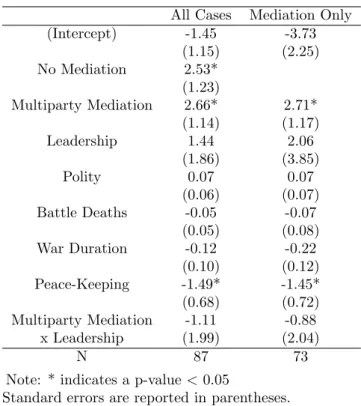
In the first model, the interaction of two categorical variables generates five possible states of the negotiations relevant to the hypotheses: no mediation, single-party mediation without leadership, single-party mediation with leadership, multiparty mediation without leadership, and multiparty mediation with leadership. The second model only has four possible states, re-moving no mediation. The baseline category for both models is single-party mediation without leadership. The results from these logistic regressions are reported in Table 1.
23Two alternative specifications in which the dependent variable captured whether or not the peace lasted 2 or
Table 1: Logistic Regression of Peace Endurance
All Cases Mediation Only
(Intercept) -1.45 -3.73
(1.15) (2.25) No Mediation 2.53*
(1.23)
Multiparty Mediation 2.66* 2.71* (1.14) (1.17)
Leadership 1.44 2.06
(1.86) (3.85)
Polity 0.07 0.07
(0.06) (0.07)
Battle Deaths -0.05 -0.07
(0.05) (0.08)
War Duration -0.12 -0.22
(0.10) (0.12)
Peace-Keeping -1.49* -1.45*
(0.68) (0.72) Multiparty Mediation -1.11 -0.88
x Leadership (1.99) (2.04)
N 87 73
Note: * indicates a p-value<0.05
Standard errors are reported in parentheses.
The baseline category for mediation is single-party me-diation.
Table 1 indicates that for the model with all civil war agreements, observations with no mediator are more likely to persist than agreements mediated by a single-party. Likewise, mul-tiparty mediation generates agreements that are, in the absence of leadership, more likely to persist than those resulting from single-party efforts. Moreover, the effects of no mediation and multiparty mediation without leadership are not statistically different.24 This seems to indicate that despite the selection effects that present mediators with the most difficult cases, multiparty mediation helps overcome those unfavorable selections. Furthermore, this supports the thesis that the treatment of all mediation efforts as equivalent masks interesting variance and results in unnecessarily pessimistic conclusions about the durability of a mediated peace.
Leadership in single-party mediation efforts (i.e. when the mediator was a major power or the colonial ruler) increases the probability that a peace will persist for 10 years over single-party mediation without leadership, but this increase is not statistically significant.25 When a multi-party mediation effort also has leadership, the probability the conflict will endure increases, but this increase is not statistically different from single-party mediation with leadership.26
Alto-24The difference of means calculation results in a t-statistic of -0.1840621 with a corresponding p-value of
0.8544424 on 78 degrees of freedom.
25The model was tested for multicollinearity to see if high correlation between leadership and the other
inde-pendent variables lead to exaggerated standard errors, but no variance inflation factors were larger than 10.
26The marginal effect of mediation with leadership generates a t-statistic of 0.9299561 with a corresponding
gether this indicates that leadership, at least as measured here, is not a significant factor in the probability of a peace enduring.
In order to more easily understand the results from Table 1, Table 2 reports the predicted probability of persisting for 10 years for each of these possible mediation states, holding all other variables at their means.
Table 2: Predicted Probabilities Full Sample
Without Leadership With Leadership
No Mediation 0.49
Single-Party 0.07 0.24
Multiparty 0.52 0.60
Note: All other variables held at their means.
Agreements resulting from single-party mediation without leadership have a probability of persisting for at least 10 years of only 7 percent, while no mediation has a probability of success of 49 percent. This reinforces Gartner and Bercovitch’s (2006) finding that mediation settle-ments are not as persistent as agreesettle-ments reached without a third party. The selection argument, therefore, seems to hold until the predicted probability of an agreement resulting from multiparty mediation efforts is considered. Even without leadership, multiparty generated agreements have a 52 percent probability of enduring. Adding leadership increases the probability of a multiparty mediation effort persisting to 60 percent and a single-party mediation effort to 24 percent. The differences between the predicted probability of single and multiparty mediation indicates that perhaps the different process effects at work in different mediation types changes the effectiveness of these efforts substantially.
The only control variable that is significant in the model is the presence of a peace-keeping operation after the conflict. Surprisingly, the provision for a peace-keeping operation decreases the likelihood that the peace will persist a decade. While this result contradicts expectations, given the costs of peace-keeping, such operations will only find the international support nec-essary for their provision in conflicts where the perceived costs and risk of failure is very high, supporting works such as Fortna (2004).
inter-action term are highly correlated.27 While multicollinearity is to be expected when including an interaction term in a model, this indicates that the standard errors on these coefficient es-timates are larger than they ought to be, perhaps understating the significance of the effect of leadership. Once again multiparty mediation with leadership produces agreements that are more likely to persist than single-party agreements with leadership, but the difference is not statisti-cally significant.28 Also in line with the full sample specification, the only control variable that is statistically significant is the provision in the agreement for peace-keeping forces. Predicted probabilities from the second model are reported below to more easily consider the effects of me-diation and leadership on the probability of success. Once again, all other independent variables are held at their means.
Table 3: Predicted Probabilities Mediation Only
Without Leadership With Leadership
Single-Party 0.06 0.17
Multiparty 0.49 0.57
Note: All other variables held at their means.
These predicted probabilities are not substantively different from the first logistic model con-tinuing to reflect the variance between single and multiparty mediation. These logistic models together indicate that the past dichotomous treatment of whether or not mediation assisted the negotiations does not provide a complete picture of the effects of mediation on successful conflict resolution. While single-party mediation efforts do not seem to overcome the selection effects mediation faces, multiparty efforts are as likely to endure as those agreements reached bilaterally.
One of the primary benefits of estimating a logistic model is that it dichotomizes the obser-vations into simple successes and failures. This reduces the necessary precision of measurement of the dependent variable. Identifying exactly when an agreement ended is very difficult. Parties might break off the agreement but not act upon this break for several months, thereby leading observers to consider the agreement still in effect. Alternatively, small amounts of violence by spoilers could generate uncertainty about the parties’ commitment to the peace, resulting in an end to the peace as these attacks incite retaliatory violence. Coders must then determine if the initial attacks marked the end of the agreement, if the parties stayed committed despite the spoiler’s efforts, or if they stayed committed for a certain period of time before nullifying the agreement. The logistic model only requires the measurement to capture whether or not the model persisted 10 years, not exactly how many months under or over 10 years it lasted,
27The estimates of leadership and the interaction term both have variance inflation factors of about 31 No other
coefficients had high variance inflation factors.
28The marginal effect of multiparty mediation produces a t-statistic of 1.07505 with an associated p-value of
decreasing the amount of potential measurement error in the dependent variable. Unfortunately, logistic regression models have their own shortcomings. Specifically, logistic regressions cannot account for the censoring of data. Peace agreements ongoing in 2005, but in place for less than 10 years cannot be included in the analysis, causing a truncation of the dataset as seen by the decreases in sample size from the total 144 observations in which data on all variables were available29 to 78.
To address this problem of truncation, the effects of multiparty mediation were also estimated using a Cox proportional hazard model. This duration model does not examine if the peace persisted or not, but rather for how long did the peace persist and how does mediation type influence the hazard rate of failure. Cox proportional hazard models account for the right-censoring of this data in the estimation process, thus resolving the truncation problem. The specification of the right-hand side of the model was the same as the logistic, replacing the dependent variable with the number of months the agreement lasted.30 The Cox proportional hazard model was also estimated on the full dataset as well as only those agreements that resulted from mediation efforts in order to better capture the effect of leadership. The results of these estimations are reported in Table 4.
Table 4: Cox Proportional Hazard Results
All Cases Mediation Only No Mediation -0.65
(0.51)
Multiparty Mediation -0.51 -0.47 (0.39) (0.40)
Leadership 0.10 0.36
(1.06) (2.19)
Polity -0.06 -0.07
(0.04) (0.04)
Battle Deaths 0.03 0.02
(0.03) (0.04)
War Duration -0.07 -0.03
(0.05) (0.06)
Peace-Keeping 0.76* 0.67
(0.36) (0.38) Multiparty Mediation -0.20 -0.20
x Leadership (1.17) (1.17)
Likelihood Ratio Test 18.86* 11.93
Wald Test 16.89* 10.67
Note: * indicates a p-value<0.05
Standard errors are reported in parentheses. Both mod-els satisfied the proportionality assumption.
In the first model, the coefficients on no mediation and multiparty mediation are negative,
29Two of the 146 observations are missing polity scores.
30The model was also estimated with number of years as the dependent variable but the use of years did not
indicating that no mediation and multiparty mediation decrease the log odds of failure. Their standard errors, however, indicate that these decreases are not statistically significant. Expo-nentiating the coefficients, no mediation decreases the hazard of failure by 48 percent while multiparty mediation without leadership decreases the hazard of failure by 40 percent when compared to the baseline of party mediation without leadership. Leadership in a single-party mediation effort has a positive coefficient, indicating that it increases the hazard of failure, but this coefficient is substantively small and not statistically significant. Exponentiating the coefficient on leadership indicates that the increase in hazard is only 6 percent. Multiparty mediation efforts with leadership have a non-significant effect of -0.10 on the log-odds of failure or a decrease in the hazard rate of about 10 percent over single-party mediation with leadership. Similar to the logistic regressions, the only control variable that appears significant is the provi-sion for peace keeping operations. Peace-keeping operations increase the risk of failure, raising the hazard rate by 114 percent. An increase in number of battle deaths increases the hazard rate while increases in level of democracy and the duration of the war decrease the hazard rate. While these results match the theoretical expectations, they are not statistically significant in these models. The results from the second model are very similar to the results of the first model, although the effect of the provision for peace-keeping operations is no longer statistically significant.
Conclusions
This paper explored the variance across types of mediation, specifically differences between single and multiparty efforts. Considering the process effects of mediation and the unique ad-vantages of multiparty mediation in shaping the negotiating environment and influencing the disputants, multiparty mediations were expected to generate more durable peace agreements than those resulting from single-party mediation. An empirical analysis of 146 peace agreements tested this assertion.
logis-tic regression. This increased precision is likely accompanied by increased measurement error, as identifying the specific period at which the agreement terminated is difficult. Measurement error in the dependent variable, while leaving the coefficient estimates unbiased, produces inefficiency and increases standard errors. Furthermore, none of the models found the effect of leadership to be significant. Perhaps this indicates that the value of leadership has been overstated, but more likely, this indicates that the measure of leadership used in this paper is inadequate to capture the concept of interest. The lack of significance on all variables, including those found to be significant in the literature, calls into question these models and exhibits the need for further exploration of the theory and hypotheses proposed in this thesis.
Appendix
Table 5: Logistic Regression 2 Year Threshold
All Cases Mediation Only
(Intercept) 0.87 0.89
(0.54) (1.01) No Mediation 0.78
(0.73)
Multiparty Mediation 0.08 0.09 (0.53) (0.54)
Leadership -0.91 -1.86
(1.41) (2.89)
Polity 0.10* 0.11*
(0.05) (0.05)
Battle Deaths -0.05 -0.05
(0.04) (0.05)
War Duration 0.07 0.05
(0.07) (0.07)
Peace-Keeping -0.89 -0.97*
(0.48) (0.49) Multiparty Mediation 0.83 0.89
x Leadership (1.56) (1.56)
N 139 112
Note: * indicates a p-value<0.05
Standard errors are reported in parentheses.
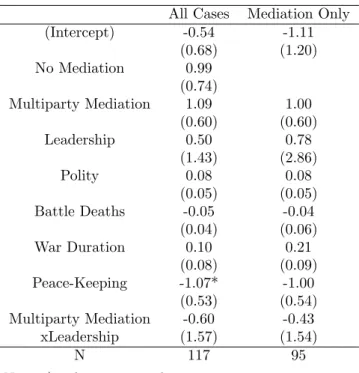
Table 6: Logistic Regression 5 Year Threshold
All Cases Mediation Only
(Intercept) -0.54 -1.11
(0.68) (1.20) No Mediation 0.99
(0.74)
Multiparty Mediation 1.09 1.00 (0.60) (0.60)
Leadership 0.50 0.78
(1.43) (2.86)
Polity 0.08 0.08
(0.05) (0.05)
Battle Deaths -0.05 -0.04
(0.04) (0.06)
War Duration 0.10 0.21
(0.08) (0.09)
Peace-Keeping -1.07* -1.00
(0.53) (0.54) Multiparty Mediation -0.60 -0.43
xLeadership (1.57) (1.54)
N 117 95
Note: * indicates a p-value<0.05
References
Assefa, Hizkias. 1987. Mediation of Civil Wars. Westview Press.
Bartoli, Andrea. 1999. “Mediating Peace in Mozambique: The Role of the Community of Sant’Egidio.” In Herding Cats: Multiparty Mediation in a Complex World, ed. Chester A. Crocker, Fen Osler Hampson, and Pamela Aall. United States Institute of Peace Press pp. 245– 274.
Beardsley, Kyle. 2008. “Agreement without Peace? International Mediation and Time Inconsis-tency Problems.”American Journal of Political Science52(4): 723–740.
Beardsley, Kyle C. 2010. “Pain, pressure, and political cover: Explaining Mediation Incidence.”
Journal of Peace Research47(4): 395–406.
Bercovitch, Jacob. 1992. “The Structure and Diversity of Mediation in International Relations.” In Mediation in International Relations: Multiple Approaches to Conflict Management, ed. Jacob Bercovitch, and Jeffrey Z. Rubin. St. Martin’s Press pp. 1–29.
Bercovitch, Jacob, and Allison Houston. 2000. “Why Do They Do It Like This? An Analysis of the Factors Influencing Mediation Behavior in International Conflict.”The Journal of Conflict Resolution44(2): 170–202.
Bercovitch, Jacob, J. Theodore Anagnoson, and Donnette L. Wille. 1991. “Some Conceptual Issues and Empirical Trends in the Study of Successful Mediation in International Relations.”
Journal of Peace Research28(1): 7–17.
B¨ohmelt, Tobias. 2010. “Why Many Cooks If They Can Spoil the Broth? The Determinants of Multi-Party Mediation.”Paper Presented at the Annual Meeting of the American Political Science Association.
Crocker, Chester A. 1999. “Peacemaking in Southern Africa: The Namibia-Angola Settlement of 1988.” InHerding Cats: Multiparty Mediation in a Complex World, ed. Chester A. Crocker, Fen Osler Hampson, and Pamela Aall. United States Institute of Peace Press pp. 207–244.
Crocker, Chester A., Fen Osler Hampson, and Pamela Aall. 1999a. “Rising to the Challenge of Mulitparty Mediation.” In Herding Cats: Multiparty Mediation in a Complex World, ed. Chester A. Crocker, Fen Osler Hampson, and Pamela Aall. United States Institute of Peace Press pp. 665–700.
Crocker, Chester A., Fen Osler Hampson, and Pamela Aall. 2001a. “Is More Better? The Pros and Cons of Multiparty Mediation.” In Turbulent Peace: The Challenges of Managing International Conflict, ed. Chester A. Crocker, Fen Osler Hampson, and Pamela Aall. United States Institute of Peace Press pp. 497–514.
Crocker, Chester A., Fen Osler Hampson, and Pamela Aall, eds. 2001b. Turbulent Peace: The Challenges of Managing International Conflict. United States Institute of Peace Press.
Fortna, Virginia Page. 2004. “Does Peacekeeping Keep Peace? International Intervention and the Duration of Peace after Civil War.”International Studies Quarterly48: 269–292.
Gartner, Scott Sigmund, and Jacob Bercovitch. 2006. “Overcoming Obstacles to Peace: The Contribution of Mediation to Short-Lived Conflict Settlements.”International Studies Quar-terly50: 819–840.
Gleditsch, Nils Petter, Peter Wallensteen, Mikael Eriksson, Margareta Sollenberg, and Havard Strand. 2002. “Armed Conflict 1946-2001: A New Dataset.”Journal of Peace Research39(5): 615–637.
Grieg, J. Michael, and Patrick M. Regan. 2008. “When Do They Say Yes? An Analysis of the Willingness to Offer and Accept Mediation in Civil Wars.”International Studies Quarterly52: 759–781.
Harbom, Lotta, Stina H¨ogbladh, and Peter Wallensteen. 2006. “Armed Conflict and Peace Agreements.”Journal of Peace Research43(5): 617–631.
Hartzell, Caroline, Matthew Hoddie, and Donald Rothchild. 2001. “Stabilizing the Peace After Civil War: An Investigation of Some Key Variables.”International Organization55(1): 138– 08.
Hopmann, P. Terrence. 2001. “Bargaining and Problem Solving: Two Perspectives on Interna-tional Negotiation.” InTurbulent Peace: The Challenges of Managing International Conflict, ed. Chester A. Crocker, Fen Osler Hampson, and Pamela Aall. United States Institute of Peace Press pp. 445–468.
Kydd, Andrew. 2003. “Which Side Are You On? Bias, Credibility, and Med.”American Journal of Political Science47(4): 597–611.
Licklider, Roy. 2001. “Obstacles to Peace Settlements.” InTurbulent Peace: The Challenges of Managing International Conflict, ed. Chester A. Crocker, Fen Osler Hampson, and Pamela Aall. United States Institute of Peace Press pp. 697–718.
Maoz, Zeev, and Lesley G. Terris. 2006. “Credibility and Strategy in International Mediation.”
International Interactions32: 409–440.
McDougall, Barbara. 1999. “Haiti: Canada’s Role in the OAS.” In Herding Cats: Multiparty Mediation in a Complex World, ed. Chester A. Crocker, Fen Osler Hampson, and Pamela Aall. United States Institute of Peace Press pp. 387–404.
Peck, Connie. 2001. “The Role of Regional Organizations in Preventing and Resolving Con-flict.” InTurbulent Peace: The Challenges of Managing International Conflict, ed. Chester A. Crocker, Fen Osler Hampson, and Pamela Aall. United States Institute of Peace Press pp. 561– 584.
Regan, Patrick M. 2002. “Third-Party Interventions and the Duration of Intrastate Conflicts.”
The Journal of Conflict Resolution46(1): 55–73.
Rubin, Jeffrey Z. 1992. “International Mediation in Context.” In Mediation in International Relations: Multiple Approaches to Conflict Management, ed. Jacob Bercovitch, and Jeffrey Z. Rubin. St. Martin’s Press pp. 249–272.
Solomon, Richard H. 1999. “Bringing Peace to Cambodia.” In Herding Cats: Multiparty Me-diation in a Complex World, ed. Chester A. Crocker, Fen Osler Hampson, and Pamela Aall. United States Institute of Peace Press pp. 275–324.
Soto, Alvaro De. 1999. “Ending Violent Conflict in El Salvador.” InHerding Cats: Multiparty Mediation in a Complex World, ed. Chester A. Crocker, Fen Osler Hampson, and Pamela Aall. United States Institute of Peace Press pp. 345–386.
Stedman, Stephen J. 1991. Peacemaking in Civil War: International Mediation in Zimbabwe, 1974-1980. L. Rienner Publishers.
Touval, Saadia, and I. William Zartman, eds. 1985. International Mediation in Theory and Practice. Westview Press.
Walter, Barbara F. 2002.Commiting to Peace: the Successful Settlement of Civil War. Princeton University Press.
Walter, Barbara F. 2004. “Does Conflict Beget Conflict? Explaining Recurring Civil War.”



![Cytochrome P450 Monooxygenase Mediated Metabolic Utilization of Benzo[a]Pyrene by Aspergillus Species](data:image/gif;base64,R0lGODlhAQABAIAAAP///wAAACH5BAEAAAAALAAAAAABAAEAAAICRAEAOw==)