i
A COMPARATIVE STUDY BETWEEN PROBLEM BASED
LEARNING AND INQUIRY-BASED LEARNING TO TEACH
READING OF RECOUNT TEXT
THESIS
Submitted in Partial Fulfillment of the Requirement for the
Degree of Bachelor of Education in English Education
Department
B
y:
Nur Faizah
Student Number: 1503046069
PENDIDIKAN BAHASA INGGRIS
FAKULTAS ILMU TARBIYAH DAN KEGURUAN
UNIVERSITAS ISLAM NEGERI WALISONGO
SEMARANG
2019
ii
THESIS STATEMENT
I am the student with following identity
Name
: Nur Faizah
Students’ Number
:1502046069
Department
: Education
Field of Study
: English Language Education Department
Certify that the thesis untitled
A Comparative Study between Problem-Based Learning and
Inquiry-Based Learning to Teach Reading of Recount Text
is definitely my own work. I am completely responsible for the
content of the thesis. Other researcher’s opinions or findings included
in the thesis are quoted or cited in accordance with ethical standards.
Semarang, 24
thJuly 2019
The Writer,
Nur Faizah
NIM. 1503046069
iv
ADVISOR APPROVAL
Semarang, 24
thJuly 2019
To
The Dean of Faculty of Education and Teacher Training Walisongo
State Islamic University
Assalamu’alaikum Wr. Wb
I inform that I have given guidence, briefing, and correction to
whatever extent necessary of the following thesis identification:
Title
:
A Comparative Study between
Based Learning and Inquiry-Based
Learning to Teach Reading
of Recount Text
Name
:
Nur Faizah
Students’ Number
:1502046069
Department
: English Language Education Department
I state that the thesis is ready to be submitted to Faculty of Education
and Teacher Training of State Islamic University Walisongo to be
examined at Munaqosah session.
Advisor I
Dr. Hj. Siti Mariam M.Pd.
NIP. 19650727 199203 2 002
v
ADVISOR APPROVAL
Semarang, 24
thJuly 2019
To
The Dean of Faculty of Education and Teacher Training Walisongo
State Islamic University
Assalamu’alaikum Wr. Wb
I inform that I have given guidance, briefing, and correction to
whatever extent necessary of the following thesis identification:
Title
:
A Comparative Study between
Based Learning and Inquiry-Based
Learning to Teach Students Reading
Recount Text
Name
:
Nur Faizah
Students’ Number
:1502046069
Department
: English Language Education Department
I state that the thesis is ready to be submitted to the Faculty of
Education and Teacher Training of State Islamic University
Walisongo to be examined at Munaqosah session.
Advisor II
Nadiah Ma’mun, M.Pd.
NIP. 19781103 200701 2 016
vi
ACKNOWLEDGEMENT
ميح رلا نمح رلا لاله مسب
I do thank Allah who has given me insight and strength to
finish this research completely. Sholawat and Salam always are given
to the prophet Muhammad who brings us from the darkness to the
brightness.
The researcher realized that there are many people who are
already helped her in arranging and writing this thesis directly or
indirectly. In this chance, the writer would like to express my gratitude
for all them.
1.
Dr. H. Rahardjo, M. Ed the dean of Tarbiyah & Teacher Training
Faculty of UIN Walisongo Semarang.
2.
Dr.H.Ikhrom, M.Ag, as the chief of English Department &
Teacher Training Faculty UIN Walisongo Semarang.
3.
Dr. Hj. Siti Mariam, M.Pd, and Nadiah Ma’mun M. Pd as my
advisor for the hospitality and giving great motivation, helpful
corrections and suggestion to improve this thesis during the
consultation.
4.
All lectures in Tarbiyah Faculty who have given the knowledge
patiently.
5.
Ashari S. Ag, S. Pd as the head master of MTs Al-Mubarok who
has given permission for doing the research.
6.
Raida Munythofiyah N, S. Pd
as the teacher of MTs Al-Mubarok
who guided and helped during research in the school.
7.
The deepest gratitude for my beloved mother and father (Mrs.
Sulastri and Mr. Mutholib) who always support me and make me
who I am.
8.
My beloved family, my older brother and his wife (Nur Taufiq
and Nur Khasanah) and my older sister (Khamdanah and Afifatul
Hidayah) who always gives me inspiration and motivation.
vii
10.
All of PPL team ( Zulfa, Meilani, Anis and Alfi), and KKN team
(Naufal, Bagus, Mulki, Dewi, Atiqoh, Wahyu, Ayu, Eka, Intan,
Tika, Rinda and Amal)
11.
Last but not least, those who cannot be mentioned one by one who
have supported, given motivation to the researcher to finish this
thesis.
Finally, the researcher realizes that this thesis is far from
being perfect; therefore, the writer will happily accept constructive
criticism in order to make it better. The researcher hopes that this
thesis would be beneficial to everyone. Aamiin.
Semarang, 29
thJuly 2019
The Researcher
Nur Faizah
1503046069
viii
DEDICATION
In the name of Allah the Beneficent and the Merciful, this final project
is dedicated to:
1.
My beloved mother Mrs. Sulastri and beloved father Mr. Mutholib
Who always support me emotionally and materially with unending
pray, love, help, and patience. Thank you for the effort and
contribution in making my education success and run well. I love
you so much.
2.
My brother Nur Taufiq and his wife Nur Khasanah, my sister
Khamdanah and Afifatul Hidayah Who always support me to
study hard for reaching my dreams. Thank you for your pray,
motivation and advice so that I can finish my thesis well. I love
you so much.
ix
ABSTRACT
Faizah Nur (1503046069)
A COMPARATIVE STUDY BETWEEN
PROBLEM
BASED
LEARNING
AND
INQUIRY-BASED
LEARNING TO TEACH READING OF RECOUNT TEXT.
The purpose this study is to investigate the students’ proficiency in
reading recount text taught using problem-based learning and taught
using inquiry-based learning. The researcher found the phenomenon
that most of students didn’t care with their ability in reading
comprehension. Although they already learn English since Elementary
School, they still have difficulties in mastering each skill of English
skill, especially reading skill. The research used quasi-experimental
(posttest only design nonequivalent groups). VIII A was chosen as
experimental 1 class and VIII B was chosen as experimental 2 class.
The instrument of this research was test. Post-test is given to measure
the students’ ability after got treatment. The instrument of the posttest
is multiple choice. The researcher conducted the research in the 30
thApril until 11
stMay 2019 in the second semester. The formula that
researcher used to analyze the data of post-test was t-test. After
collecting the data, it was found that the mean of VIII A students
using PBL score was = 47.52, and the mean score of VIII B students
using IBL was score 52.5. It was obtained that test was 1.22 and
t-table was 2.012 for alpha (5%). T-test lower than t-t-table (1.22<2.012).
Ha rejected and H
0was accepted.
Based on the results of the study,
the researcher concluded that the mean of reading recount text on
proficiency is little difference between problem-based learning and
inquiry-based learning at the eighth grader of MTs Al-Mubarok
Bonang Demak in the academic year of 2018/2019.
Keywords: Inquiry-based learning, Problem-based learning,
,Recount text, Teaching reading
x
TABLE OF CONTENT
PAGE OF TITLE ...
i
THESIS STATEMENT ...
ii
RATIFICATION ...
iii
ADVISOR APPROVAL ...
iv
ACKNOWLEDGEMNET ...
vi
DEDICATION ...
viii
ABSTRACT ...
ix
TABLE OF CONTENT ...
x
CHAPTER I : INTRODUCTION
A.
Background of the Study ...
1
B.
Reasons for Choosing the Study…………
6
C.
Research Questions ...
6
D.
Objective of the Study ...
7
E.
Significance of the Study ...
7
F.
Limitation of the Study ...
8
CHAPTER II : REVIEW OF RELATED LITERATURE
A.
Previous Study ...
9
B.
Theoritical Review ...
17
a.
Reading ...
17
1.
Definition of Reading ...
17
2.
Purpose of Reading ...
19
b.
Teaching Reading………... 20
xi
1.
Teaching Reading ...
20
2.
Strategies to Teaching Reading ...
22
3.
The Activity of Reading Class ...
28
c.
Recount Text ...
29
1.
Definition of Recount Text ...
29
2.
The Kinds or Recount Text...
30
3.
The Purpose of Recount Text ...
30
4.
The Generic Structure of Recount
Text ...
31
5.
Language Features of Recount
Text ...
31
d.
Problem-Based Learning ...
32
1.
Theory of Problem-Based
Learning ...
32
2.
The Goals of Problem-Based
Learning ...
33
3.
The Stages of Problem-Based
Learning ...
34
e.
Inquiry-Based Learning ...
36
1.
Theory of Inquiry-Based Learning 36
2.
The Goals of Inquiry-Based
Learning ...
37
3.
The Stages of Inquiry-Based
Learning ...
39
xii
f.
Teaching Reading Recount Text through
Problem-Based Learning and Inquiry-Based
Learning ...
40
1.
Teaching Reading Recount Text through
Problem-Based Learning ...
40
2.
Teaching Reading Recount Text through
Inquiry-Based Learning ...
41
C.
Conceptual Framework...
42
D.
Hypothesis ...
42
CHAPTER III : RESEARCH METHOD
A.
Research Design ...
44
B.
Research Setting ...
45
C.
Research Participants ...
46
D.
Population ...
46
E.
Variable and Indicator ...
47
F.
Technique of Collecting the Data...
50
G.
Technique of Data Analysis ...
52
CHAPTER IV : RESEARCH FINDING AND DISCUSSION
A.
Description of Finding ...
57
B.
Result of the Research ...
58
a.
The Validity of Instrument ...
58
b.
The Reliability of Instrument ...
60
xiii
a.
Statistical Test (t-test) ...
71
b.
T-table ...
73
D.
Discussion of the Finding...
75
CHAPTER V : CONCLUSION AND SUGGESTION
A.
Conclusion...
77
B.
Suggestion ...
78
REFERENCES
APPENDICES
xiv
APPENDICES
Appendix 1a Lesson Plan of Experimental 1 Class
Appendix 1b Lesson Plan of Experimental 2 Class
Appendix 2
The Schedule of the Research
Appendix 3
Instrument Test of Validity
Appendix 4
Analysis of Validity
Appendix 5
Analysis of Reliability
Appendix 6
Instrument Test of Post-test
Appendix 7
Students’ Name List of Experimental 1 Class (VIIIA)
Appendix 8
Students’ Name List of Experimental 2 Class (VIII B)
Appendix 9
The Score and Average of Experimental 1 Class
Appendix 10 The Score and Average of Experimental 2 Class
Appendix 11 Documentation
Appendix 12 Research Permission Letter
Appendix 13
Letter of Research Statement
Appendix 14
School Profile
xv
LIST OF TABLES
Table 3.1
School Organizational Structure
Table 3.2
Population of Research
Table 3.3
Variable and indicators
Table 4.1
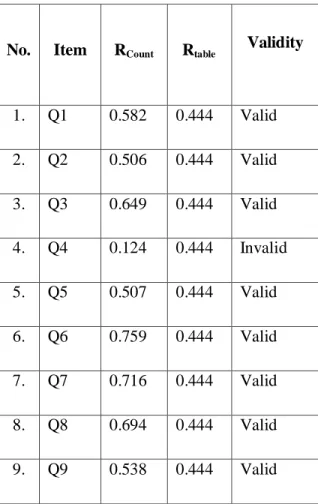
The Validity of The Test
Table 4.2
The Criteria of Reliability Analysis
Table 4.3
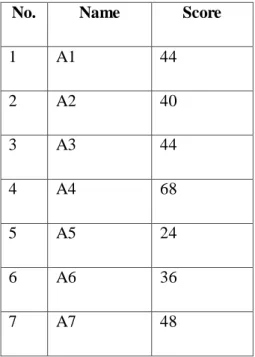
The VIII A Students
Table 4.4
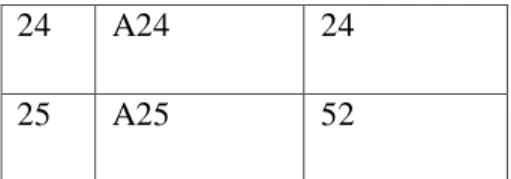
The VIII B Students
Table 4.5
Mean and Standard Deviation of Two Variables
Table 4.6
The Statistic Descriptive of the Research
Table 4.7
The Calculation Result of the Hypothesis
xvi
LIST OF FIGURES
Figure 1
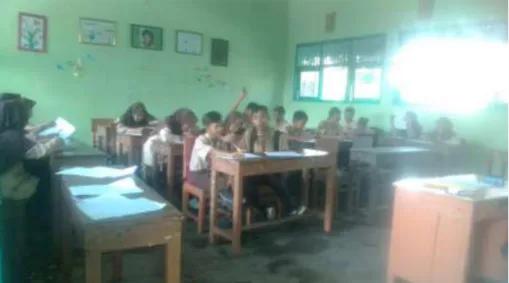
Treatment in Experimental 1 Class
Figure 2
Treatment in Experimental 2 Class
Figure 3
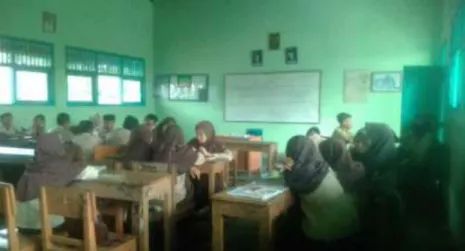
Post-test in Experimental 1 Class
Figure 4
Post-test in Experimental 2 Class
1
CHAPTER I
INTRODUCTION
This chapter presents about background of study, reasons
for choosing the topic, questions of the study, objective of the
study, significance of the study, and limitation of the study.
A.
Background of Study
In the process of learning English language consists of
four language skills; such as listening, reading, speaking, and
writing. One of the important skills is reading. Reading is the
practice of using text to create meaning.
1Reading is also included
in receptive skill besides listening. Receptive skill is the way in
which people extract the meaning of the discourse they see or
hear. It is part of communication and the way of building
knowledge
.2It is a stated in Al-Qur’an surah Al- ‘Alaq ayah 1-5:
( َقَلَخ يِذَّلا َكِِّبَر ِمْساِب ْأَرْقا
١
( ٍقَلَع ْنِم َناَسْنلإا َقَلَخ )
٢
ْأَرْقا )
( ُمَرْكلأا َكُّب َر َو
٣
( ِمَلَقْلاِب َمَّلَع يِذَّلا )
٤
( ْمَلْعَي ْمَل اَم َناَسْنلإا َمَّلَع )
٥
(
1
Andrew P. Johnson, Teaching Reading and Writing: A Guidebook
for Tutoring and Remediating Students, (United States of America: Rowman
& Littlefield Education, 2008). p. 3
2
Jeremy Harmer, The Practice of English Language Teaching, (London: Longman, 2001), p. 199
2
“
Recite in the name of your Lord who created (1),
Created man from a clinging substance (2), Recite, and your Lord
is the most Generous (3), Who taught by the pen (4), Taught man
that which he knew not (5)”
.
3This Surah is the surah which first
came down to the Prophet Muhammad SAW; down at the
beginning of prophethood when he did not know what the read
was and what was faith, then Jibril came to him carrying
revelation and telling him to read, he said," read it ". It can be
concluded that reading is an important way to get general or detail
information and new knowledge from the text.
In the school setting, the students get English textbooks
which are written in English. These textbooks contain a lot of
information related to the subjects the students learned. In order to
access the information, the students should have the skill of
reading. Based on the researcher observation at eighth grade in
MTs Al-Mubarok Bonang Demak, the researcher found the
phenomenon that most of the students didn’t care with their ability
in reading comprehension. There are some students who feel that
English is a difficult subject. Although they already learn English
since Elementary School, they still have difficulties in mastering
each skill of English, especially reading skill.
It appropriates with the statement from Nunan (2003) who
states that: “With strengthened reading skills, learners will make
3
A. Yusuf Ali, The Holy Qur’an Text, Translation and
3
greater progress and development in all other areas of learning”.
4The statement means that the students should be mastered in
reading skills because it can help students in improving and
developing their abilities skill and their ability in other areas of
learning.
The curriculum of 2013 should use in education decided
by The Ministry of Education and culture of Indonesia, cited
(Khotimah, 2014)
“This curriculum was made based on the national
education purpose; thinking pattern arrangement founded
on students’ necessities, developing and intensifying
material, reinforcing the teaching-learning process, and
adjusting students’ and teachers’ tasks. The expectations
of this curriculum are developing students’ critical
thinking, cooperativeness, awareness towards their
surroundings, the responsibility of their task, and
developing student-centered learning”.
The curriculum recommends the use of a scientific
approach in the learning process. Furthermore, it suggests the
application of teaching methods such as project based learning,
Problem-based Learning, discovery learning, Inquiry-Based
4
Ika Fatma Amriani, (11101080092), “A Study on Teaching Reading Comprehension Recount Text Using Student Teams Achievement Divisions ( Stad ) Technique to The Eighth Grade Students of Smpn 8 Kediri In Academic Year 2014 / 2015”, Thesis, (Kediri: Faculty of Teacher Training and Education, Universitas Nusantara PGRI Kediri, 2015), p. 5
4
Learning, case based learning, and just-in-time teaching.
5These
methods focus to emphasize the process of learning, not the
outcome of it. These methods the center of teaching-learning is
the students.
Both of the methods offered by the curriculum of 2013 are
Problem-based Learning and Inquiry-Based Learning. Yew
(2009:11) states that:
“Problem-based Learning is a learning method approach
that seeks to create a learning environment where students
learn in the context of meaningful problems, actively
constructing mental models in the process, constructing
ideas with peers in a collaborative fashion and developing
self-directed learning skills in the process. Thus, PBL
brings together four fairly new insights into leaning,
namely that learning can be considered a constructive,
self-directed, collaborative and contextual activity.”
6Based on the definition above, the researcher can
conclude that Problem-based Learning is a method using problems
to begin teaching and learning to train the students to think
critically solving the problems.
5
Siti Khotimah, The Use of Problem-based Learning to Improve Students’ Speaking Ability, Journal of English Language Teaching, (Vol.3, No.1, 50-56, 2014), p. 51
6
Siti Khotimah, The Use of Problem-based Learning to Improve Students’ Speaking Ability,..., p. 51
5
Inquiry-based learning (or enquiry-based learning) has
been recognized as a powerful tool for learning about a subject
domain, and more importantly for learning how to learn, as it
helps people to develop their independent learning skills.
7The
researcher can conclude that Inquiry-Based Learning is a method
used by the teacher to facilitate the students to learn with prepare
questions by students seek for the truth.
Based on the reason above, the researcher analyzed the
significant differences between Problem-based Learning (PBL)
and Inquiry-Based Learning (IBL) in learning reading. The
researcher conducted research entitled “
A Comparative Study
between
Problem-Based
Learning
and
Inquiry-Based
Learning to Teach Reading of Recount Text
”
B.
Reasons for Choosing the Topic
The researcher chooses this topic due to the following reasons:
1.
The method has a big influence on teaching and learning
activities that must be prepared by the teacher then the
students can understand the lesson well.
2.
Reading skill is very important to improve the students’
understanding about the materials in English textbooks.
7
Mark Hepworth, & Geoff Walton, Teaching Information Literacy
6
C.
Questions of the Study
Based on the background of the study above, the problems of the
study are as follows:
1.
How high is reading proficiency of recount text taught by
using problem-based learning at the eighth grader of MTs
Al-Mubarok Bonang Demak, in the academic year of
2018/2019?
2.
How high is reading proficiency of recount text taught by
using inquiry-based learning at the eighth grader of MTs
Al-Mubarok Bonang Demak, in the academic year of 2018/2019?
3.
Is there any significant difference in reading proficiency of
recount text taught by problem-based learning and
inquiry-based learning at the eighth grader of MTs Al-Mubarok
Bonang Demak, in the academic year of 2018/2019?
D.
The Objective of the Study
Based on the research statement, this particular study aimed to:
1.
To investigate reading proficiency of recount text taught by
problem-based learning at the eighth grader of MTs
Al-Mubarok Bonang Demak, in the academic year of 2018/2019
2.
To investigate reading proficiency of recount text taught by
inquiry-based learning at the eighth grader of MTs
Al-Mubarok Bonang Demak, in the academic year of 2018/2019
3.
To explain proficiency difference in reading of recount text
7
at the eighth grader of MTs Al-Mubarok Bonang Demak, in
the academic year of 2018/2019
E.
The Significance of the Study
By doing this research, may this research gives benefit for:
A.
Theoretically
1.
The result of this study is suggested to apply
Problem
Based Learning
and
Inquiry-Based Learning
to increase
the students’ competence in reading skill.
2.
The use of
Problem Based Learning
and
Inquiry-Based
Learning
in reading can make the students easier to
understand the materials.
B.
Practically
1.
The result of this study is expected to be able to widen the
skill of teachers in using
Problem Based Learning
and
Inquiry-Based Learning
in order to improve students’
reading comprehension.
2.
As a reference to other researchers who want to do the
research of comparative study in
Problem Based
Learning
and
Inquiry-Based Learning
more intensively
in teaching reading recount text.
C.
Pedagogically
In the pedagogical perspective, the researcher hopes
that this research can give a new reference in teaching reading
of recount text through problem-based learning and
inquiry-8
based learning by regarding the stages implemented in this
research finding.
F.
Limitation of the Study
This limitation of this study can be described as follow:
1.
This study is to compare between problem based learning
and inquiry-based learning to teach students’ reading on
recount text. The researcher focused on the measure of
teaching reading using between problem based learning
and inquiry-based learning to teach students’ reading
proficiency on recount text.
2.
The object of this study is only the eighth grader students
of MTs Al-Mubarok Bonang Demak in the academic year
of 2018/2019.
9
CHAPTER II
REVIEW OF RELATED LITERATURE
This chapter presents previous studies, a review of related
literature, conceptual framework and hypothesis.
A.
Previous Studies
The researcher considers five previous research: (I)
Nurouzatul Jannah (NIM 1042011147), 2015, The Effectiveness
of Using Problem Based Learning (PBL) on Students’ Speaking
Performance of Second Grade Students at SMA Negeri 2 Langsa.
(Ii) Sitti Maryam Hamid, The Effect of Using Problem Based
Learning (PBL) Method Toward Students’ Speaking Skill,
Journal Keguruan dan Ilmu Pendidikan, 2014. (Iii) Arum
Febriana Putri (NIM 13101080007), 2017, Teaching Speaking
Using Problem Based Learning to Seventh Grade Students of
SMP Pawyatan Daha 1 Kediri in the Academic Year 2016/2017.
(IV) Ermawati, Nasmilah Yunus and Abidin Pammu, The
Implemetation
of
Inquiry-Based
Learning
to
Reading
Comprehension of EFL Students, International Journal of Science
and Research (IJSR), 2015. (V) Xiao Shao, The Analysis of the
Limitations Which Hinder Inquiry-Based Learning and Students’
Creativity Development in Chinese Science Education, 2014.
The first previous study was “The Effectiveness of Using
Problem Based Learning (PBL) on Students’ Speaking
10
Performance of Second Grade Students at SMA Negeri 2
Langsa” by Nurouzatul Jannah, 2015. The aims of this study
were a research to improve the students’ speaking performance
by using Problem Based Learning (PBL). The research belongs
to experimental research which applied male class as
experimental class and female class as the controlled class. Based
on the result of the research, the development can be seen from
the speaking test result between experimental and controlled
class. After conducting treatment, the students’ speaking score at
experimental class was 52,82 and the controlled class was 48,78.
Based on the result of hypothesis testing, the researcher got that t
observed > t table. Based on the result of analysis, the writer got t
observed is 3, 627 and t table is 2,825. It means that is 3,627 >
2,825. Therefore, Ha was accepted and Ho was rejected.
Therefore, the Problem Based Learning (PBL) to improve the
students’ speaking performance at the second grade students of
SMA Negeri 2 Langsa.
8The similarity of previous study with this current study is
using learning method of problem based learning and the
differences of previous study with this research are previous
study was used speaking skill to improve speaking performance
8
Nurouzatul Jannah, (1042011147), “The Effectiveness of Using Problem Based Learning (PBL) on Students’ Speaking Performance of Second Grade Students at SMA Negeri 2 Langsa”, Thesis, (Cot Kala Langsa: Faculty of Tarbiyah and Teacher Training, State Institute for Islamic Study (IAIN) Zawiyah Cot Kala Langsa, 2015)
11
and the research conducted in Senior High School. While, this
current study was used to teach reading in term of recount text,
using Inquiry Based Learning to compare with Problem Based
Learning and this research conducted in Junior High School.
The second previous study was “The Effect of Using
Problem Based learning (PBL) Method toward Students’
Speaking Skill” by Sitti Maryam Hamid, 2014. This research
aimed at finding out whether or not the effect of using Problem
Based Learning (PBL) method toward students’ speaking skill in
term of vocabulary at the second year students of SMA Negeri 1
Bantaeng. The researcher used quasi experimental research. The
researcher took two classes, XI IPS 1 as a control class with 31
students, XI IPS 2 as an experimental class with 29 students. The
researcher used cluster sampling technique. The research
instrument was students retell interesting story or their experience
to know the students’ vocabulary in speaking. The finding of this
research shows that the value of t-test in the post-test is higher
than t-table (2.875> 2.048). Problem Based Learning (PBL) to
improve the students’ vocabulary of experimental class in
speaking English. The speaking achievement it was proved by the
mean score of experimental class in pretest was 58.2 then
improved to be 72.0. In control class the mean score of pre-test
was 63.8, score of post-test 65.1. It means that there is
improvement and effect by using problem based learning (PBL)
method between experimental class and control class. Then in
12
addition the t-test value is bigger than t-table value (2.875
>2.048). It means that there is significant difference between the
students’ speaking achievement before and after using Problem
Based Learning (PBL) method.
9The similarity of previous study with this current study is
to measure the effect of using Problem Based Learning and the
differences previous study with this current study are previous
study was focused in speaking skill in term of vocabulary and the
research was conducted in Senior High School. While, this
current study was used Problem Based Learning compare Inquiry
Based Learning to teach reading skill in term of recount text and
the research conducted in Junior High School.
The third previous study was “Teaching Speaking Using
Problem Based Learning to Seventh Grade Students of SMP
Pawyatan Daha 1 Kediri in the Academic Year 2016/2017Arum
Febriana Putri (2017)” by Arum Febriana Putri, 2017.
This study
aimed to know the effectiveness of Problem Based Learning
(PBL) to the students’ speaking skill in the seventh grade. The
type of this research was quantitative research used pre
experiment. The design of pre-experimental is one-shot case
study. This research took place in SMP Pawyatan Daha 1 Kediri
on May 2017. The subject of this research was the seventh grade
students of SMP Pawyatan Daha 1 Kediri consists of 17 male and
9
Sitti Maryam Hamid, The Effect of Using Problem Based Learning (PBL) Method Toward Students’ Speaking Skill. Jurnal Keguruan Dan Ilmu
13
23 female. The writer chose 7A as the sample. The researcher
analyzed the data, using statistical formula. The researcher used
test to get the data, post-test gave the students after the writer
gave treatment to the students. The result shows that there was
132 score found the means of the score was 66 score for
pronunciation, the second, frequent score was 127 found the
means of the score was 63 score for fluency, the third, 101 score
found the means of the score was 50 score for accuracy in
grammar. The means total is 60 score effective enough. Teaching
speaking after being taught using Problem-based Learning (PBL)
is effective enough, students speaking skill is improved for
pronunciation, and the students can speak English confidently.
10The similarity of previous study with this current study is
to measure the effectiveness of Problem Based Learning and the
differences of previous study with this research are previous
study was focused to improve speaking skill and was conducted
the research in seventh grade of Junior High School. While, this
current study was compared Problem Based Learning and Inquiry
Based Learning to teach reading skill in term of recount text and
the research conducted in eighth grade of Junior High School.
10
Arum Febriana Putri, (13101080007), “Teaching Speaking Using Problem Based Learning To Seventh Grade Students of SMP Pawyatan Daha 1 Kediri In The Academic Year 2016 / 2017”, Thesis Article, (1(2), Teacher Training And Education Faculty, University of Nusantara PGRI Kediri, 2017)
14
The fourth previous study was “The Implemetation of
Inquiry-Based Learning to Reading Comprehension of EFL
Students” by Ermawati, Nasmilah Yunus and Abidin Pammu
International Journal of Science and Research (IJSR), 2015. The
study was aimed to find out whether or not the use of IBL had
improved reading comprehension and how IBL in reading class
was implemented. Forty students of third semesters at STKIP
Muhammadiyah Sidrap, Indonesia were the samples of this study.
While, this applied quantitative method with quasi-experimental
design control and experimental groups: 21 students in
experimental class and 19 students in control class by providing
pre-test and post-test for both groups. The instrument used was
test of IELTS reading. The data were analyzed through SPSS 22.
This study revealed that the IBL approach was able to improve
reading comprehension of EFL students showed in the significant
difference between post-test scores of control and experimental
group. Also, it investigated the implementation of IBL which
referred to previous research that was 5E model aligned with the
strategies applied in the reading subject of EFL Learners:
engaging with the topic, exploring reading comprehension
strategies, explaining the result of the reading comprehension
strategies used, elaborating answers of formulated questions
related with the text and evaluating the whole text through
finding new vocabulary and learning process. This study resulted
15
in the use of IBL theoretically and pedagogically in reading class
of undergraduate students of English Education major.
The similarity of previous study with this current study is
using inquiry-based learning in teaching learning process in
reading comprehension and the differences of previous study
with this current study are previous study was only using IBL to
improved students reading comprehension and the research was
conducted at STKIP Muhammadiyah Sidrap. While, the current
study was using PBL and IBL to teach students’ reading recount
text and the research was conducted at MTs Al-Mubarok Bonang
Demak.
The fifth previous study was “The Analysis of the
Limitations Which Hinder Inquiry-Based Learning and Students’
Creativity Development in Chinese Science Education” by Xiao
Shao, 2014. The study was aimed to analyze the combination of
creativity development and science education in China through
the vision of inquiry-based learning and to emphasize the
importance of students’ creativity ability training and
demonstrate the limitations of science education in China. The
results of the study were inquiry-based learning can significantly
benefits students’ learning. However, the “hierarchy of subjects”,
“stereotypes”, “spoon feeding”, “killing creativity”, and
“knowledge acquisition” in public education has been criticized
as obstacles in the process of nurturing children’s creativity in
Chinese education. Based on the literature review, the limitations
16
in Chinese science education can be attributed to the influence of
the score-orientated science education in China, the unified
content and management, lacking equipment in classrooms and
laboratories, teachers and students’ traditional beliefs, teachers’
authority in classroom, the isolated academic courses, the size of
Chinese classrooms, the inadequateness of teachers’ capabilities,
the overload of teachers’ work, as well as students’ internal
deficiencies.
11The similarity of previous study with this current study is
using inquiry-based learning in teaching learning process and the
differences of previous study with this current study are previous
study was the research to increase students’ creative development
and the research was conducted in China. While, this research
was compared Problem Based Learning and Inquiry-Based
Learning to teach reading in term recount text and this research
was conducted at the eighth grader p in MTs Al-Mubarok
Bonang Demak.
11 Xiao Shao, “The Analysis of the Limitations Which Hinder
Inquiry-based Learning and Students’ Creativity Development in Chinese Science Education”, Thesis, (Canada: Faculty of Education, University of Windsor, 2018)
17
B.
Theoretical Review
1.
The Nature of Reading
There are four skills in English such as listening, reading,
speaking and writing. All of those skills have each different
function in English. All of the skills must be mastered by English
learners. Reading is one of the key skills in language learning. It
reinforces the skills of the students acquire in listening, speaking
and writing.
There are many definitions of reading, which have been
stated by many experts in this field. Loucky (2005) states that
“Reading is a complex, multi-faceted activity, involving a
combination of both lexical and text-progressing skills that are
widely recognized as being interactive”.
12Bernhardt (1991)
states that “Reading is about understanding written texts. It is a
complex activity that involves both perceptions and thought”.
13Nunan (2003) defines that “reading as a fluent process of
readers considering information represented in a text and their
12
Raihani Ferdila, The Use of Extensive Reading in Teaching Reading. Journal of English and Education, (Vol.2. No.2, 68–80, 2014), p. 68
13
Elizabeth S. Pang, et al, Teaching Reading, (Chicago: University of Illinois, 2012), p. 6
18
prior knowledge to get the meaning of the text. He also adds that
the purpose of reading is comprehension”.
14Reading as a skill requires primary interest and passion,
creativity and imagination. It requires deep vocabulary expertise
and prior experience with books.
15The readers need to improve
their reading skills. Especially, in English, the readers not only
read however the readers should mastery of vocabulary and
grammar, prior knowledge and experience with textbooks. Their
interesting and passion become their motivation to read English
textbooks and it will improve their creativity and imagination.
From the definitions above, it can be concluded that
reading is an activity to get information and knowledge to
improve their ability using their skill in reading the text. Reading
is a part of the way to communicate with each other in the reader
daily life. The readers is not engaged in a reading activity, they
will miss new information. By reading can also improve their
ability in writing.
14
Ayu Sonia Habibah Fisher, Students’ Reading Techniques Difficulties in Recount Text,….., p. 3
15
Kartika Ayu Septianingrum, et al, A Portrait of Learner’s Autonomy Through Metacognitive Strategy on Reading Comprehension,
Vision: Journal for Language and Language Learning,(Vol.7. No.1, 76–91,
19
a.
The purposes of Reading
The purposes of reading have to do with goals or
aims of reading. There are some purposes of reading
according to Grabe & Stoller (2013) are follows
16:
1.
Reading to search for simple information and reading to
skim
In reading to search, the readers typically scan
the text for a specific word, or a few representative
phrases, or a specific piece of information. Similarly,
reading to skim (i.e. sampling segments of the text for a
general understanding) is a common part of many
reading tasks and a useful skill in its own right.
2.
Reading to learn from texts
Reading to learn typically occurs in academic
and professional contexts in which a person needs to
learn a considerable amount of information from a text.
3.
Reading to integrate information, write and critique
texts
Reading to integrate information requires
additional decisions about the relative importance of
complementary, mutually supporting and the likely
restructuring of a rhetorical form to accommodate
information from multiple sources. In this respect, both
16
William Grabe, & Fredricka L. Stoller, Teaching and Researching
20
readings to write and reading to critique texts may be
task variants of reading to integrate information. Both
require abilities to selective, critique and compose
information from a text.
4.
Reading for general comprehension
Reading for general comprehension when
accomplished by a skilled fluent reader, requires very
rapid and automatic processing of words, strong skills in
forming a general meaning representation of main ideas,
and efficient coordination of many processes under very
limited time constraints.
2.
Teaching Reading
a.
Teaching Reading
According to Merriam-Webster’s Dictionary and
Thesaurus, “Teaching is the act or process of imparting
knowledge or skills to another”.
17Sequeira (2012) states that
“Teaching is a set of events, outside the learners which are
designed to support the internal process of learning. Teaching
(Instruction) is outside the learner”.
1817
https://www.merriam-webster.com/thesaurus/teaching accessed on 26 February 2019 at 2:00 p.m.
18
A. H. Sequeira, Introduction to Concepts of Teaching and Learning. Ssrn, (India: National Institute of Technology Karnataka, 2012), p. 3
21
According to Brown (2007) states that teaching may
be defined as “Showing or helping someone to learn how to
do something, providing with knowledge, causing to know or
understand.”
19Teaching is not telling activity. It’s helping
students to understand the materials. The center of the
teaching is the students, not the teachers.
From the definitions above, it can be concluded that
teaching is a process of transfer knowledge or skills by the
teacher to the students in learning. Teaching can be doing at
school or at home. Because, there are no restrictions on space
and time in teaching, and the importance of teaching process
there is preparing and readiness of the teachers and the
presence of students to receive knowledge.
Based on the expert statements about teaching
reading, Louisa C. Moats (1999) wrote in her monograph
Teaching Reading is Rocket Science
state that:
“Teaching reading is a job for an expert. Contrary to
the popular theory that learning to read is natural and
easy, learning to read is a complex linguistic
achievement. For many children, it requires effort
and incremental skill development. Moreover,
teaching reading requires considerable knowledge
19
Rosiati Putri Murtakim, (133221189), “The Effectiveness of Teaching Reading Comprehension by Using Herringbone Technique at the Tenth Grade of SMA Muhammadiyah 1 Klaten in the Academic Year 2016/2017”, Thesis, (Surakarta: English Language Education, State Islamic Institute of Surakarta, 2017), p.181
22
and skill, acquired over several years through
focused study and supervised practice”
20Teaching reading is very important and very much
needed in language learning. Because, teachers need to
prepare and mastery their knowledge and skills, teachers
have to focused study in several years. According to Nunan
(2003:
68),
teaching reading usually has two aspects. First,
people who learn to read for the first time. Second, people
who have been able to read in the first language.
21b.
Strategies for Teaching Reading
In teaching reading, the teacher should be creative in
applying the strategies to achieve the goal of teaching
reading process in the classroom. So, the teaching and
learning process can be achieved as well. The strategies are
including visualization strategy, highlighting strategy, and
anticipation guide strategy, as follow
22:
20
Jeanne Shay Schumm, Reading Assessment and Instruction For
All Learners Solving Problems, (New York: The Guilford Press, 2006), p. 10
21
Rosiati Putri Murtakim, (133221189), “The Effectiveness of Teaching Reading Comprehension by Using Herringbone Technique at the Tenth Grade of SMA Muhammadiyah 1 Klaten in the Academic Year 2016/2017”,….., p.43
22
Muhammad Khairi Ikhsan, The Alternative Strategies for Teaching Reading Skill for EFL Students, Journal Pendidikan Bahasa,
23
1.
Visualization Strategy
According to Antonacci et.at (2009:154) states that
visualization is an instructional strategy that facilitates
comprehension of informational text through the use of
imagery. It is supported by Roe et.at (2010:197) who
argues that visualization is the process of forming mental
images that depict reading content, such us story setting,
character, etc.
In addition, Paris (2010:69) inserts that visualization
is strategies that can help students to develop their idea
and imagination in the story also help the students
increase their comprehension in reading. It means that
visualization is a strategy to easier the students learning
to find important information of the ideas of written text
and improve their comprehension by students’ focus.
To teach reading by using the visualization strategy,
here some steps proposed by Antonacci et al (2009)
should be followed
23:
a)
Introduce the topic to the students (teacher presents
a selected topic of the text through brainstorming
activity).
b)
Model analysis of the text features (teacher
conducts a text walk before read-aloud, nothing
23
Antonacci et al, Developing Content Area Literacy: 40 Strategies
for Middle and Secondary Classroom, (New York: SAGE Publication, Inc,
24
map, visual aids, and chapter heading. Selected
key vocabulary words are presented in context and
discussed).
c)
Read aloud selected passage (teacher reads aloud
the selected passage and direct students to sketch
their idea while listening)
d)
Discuss version of illustration (students share the
image of the passage and discuss variation among
them. Teacher asks the students to mote patterns
across image such as scenes, objects and emotions.
e)
Facilitate students application to text (teacher asks
students continue to write a summary of the
passage based on the discussion. Students continue
to read the text and use the visualization strategy to
process the information.
2.
Highlighting Strategy
According to Cerveny et al (2003) states that
highlighting is a strategy which uses highlighting the
main ideas and supporting details to help teacher teach
students to improve the organization of reading. it is
supported by Schumm (2006: 280) states that highlighted
text which concerns with the key ideas is important a test
and classroom discussion. Meanwhile, Hedgock et al
(2009: 176) points out that highlighting is valuable
25
intensive reading skill, both for comprehension
monitoring while reading and for review after reading.
It can be concluded that highlighting is a strategy to
look for key ideas, help students to improve the
organization of reading.
To run this strategy, the following procedures can be
considered as proposed by Hervey et al (2007), as
followed
24:
a)
Look carefully at first time and the last line of
each paragraph: important information is often
contained there.
b)
Highlight only necessary word and phrases, not
entire sentence.
c)
Jot notes in the margin or on a stick note to
paraphrase the information, merge your thinking
with it, and better remember it.
d)
Do not get thrown off by interesting details.
e)
Make notes in the margin to emphasize a
pertinent a highlighted word or phrase.
f)
Note signal words
g)
Pay attention to the vast array of nonfiction
features that signals important.
h)
Pay attention to surprise information.
24
Hervey, B. D, Language Assessment Principles and Classroom
26
i)
When finished, check to see that no more than a
half the paragraph is highlighted.
3.
Anticipation Guide Strategy
According to Richardson et al (2009: 71) states that
anticipation guide strategy is a strategy to access prior
knowledge focusing on reading and stimulate students’
interest in a topic. Similar to the statement above, Moss
(2013: 71) states that anticipation guide is an active
pre-reading to activate prior knowledge and preconceptions
strategy begin to read the texts, as well as to provide
reinforcement of key concept after reading.
In can be concluded that anticipation guide strategy is
appropriate for teaching social studies contents and help
students clarify their ideas and voice their opinion about
the topic. This strategy gives the students strengthening
of key conception after reading process.
The procedures of applying this strategy, Berg (2003)
divides three main parts of activity: preparation,
anticipation, reading and discussion. For more detail
explanations, it can be obviously seen as follows
25:
a)
Preparation ( this activity will be applied before
the reading process)
25
E. Berg, Reading in Content Areas-boosting Achievements in
Grades 7-12, (New York: International Center for Leadership in Education,
27
-
The teacher selects a reading for students
based on the content of the reading.
-
Determine the points of the text.
-
Write the statements (it can be five or six
statements)
-
Include space after statement for students to
write agree or disagree
b)
Anticipation
-
Introduce the topic
-
Distribute anticipation guide sheet
-
Direct the students to agree or disagree by
each statements as appropriate
-
Discuss each statement in the class
c)
Reading and discussion will be the last part of
anticipation
-
The teacher asks the students to read for
purpose, looking for information that will
either prove or disprove their personal
responses to the statements.
-
After reading, ask students to discuss their
findings in small group or with partners.
-
The last step is discussion, they learned and
how it relates to the misconception they had
before reading.
28
c.
The Activities of Reading Class
There are three kinds of activities involved in
relation to the reading class activities: pre-reading activities,
while-reading activities, and post-reading activities.
261.
The pre-reading activities
The pre-reading (warm up, into, before reading)
activities phase helps students define selection criteria
for the central theme of a story or the major argument of
an essay. The pre-reading activities include: discussing
author or text type, brainstorming, reviewing familiar
stories, considering illustrations and titles, skimming and
scanning (for structure, main points, future directions).
2.
While–reading activities
While-reading (during, through reading) exercise
helps students develop reading strategies, improve their
control of the foreign language, and decode problematic
text passages. For helping students to employ strategies
while reading can be difficult because individual students
control and need different strategies.
3.
Post-reading activities
Post-reading activities (after, follow up, beyond
reading) exercises first check students’ comprehension
26
Elif Leyla Toprak, & Gamze Almacioglu, Three Reading Phases
and Their Applications in the Teaching of English as a Foreign Language in Reading Classes with Young Learners Abstract. Journal of Language and29
and then lead students to a deeper analysis of the text,
when warranted. For example, scanning is an appropriate
strategy to use with newspaper advertisements whereas
predicting and following text cohesion are effectives
strategies to use with short stories.
3.
Recount Text
a.
The Definition of Recount Text
“Recount text is a text that retells past events. The
purpose of a recount is to give the audience a description of
what occurred and when it occurred.”
27According to Knapp
(2005: 224) states that “Recount text is written out to make a
report about the experiences of a series of related events. A
recount is written out to inform an event or to entertain
readers. Recount text is text function as for telling an incident
in the past.”
28From the definitions above, it can be concluded that
recount text is a text to retell about the experience in the past
events.
27
Hanita Masithoh, & Sayyidatul Fadlilah, Grammatical Cohesion Found in Recount Texts Of “ Pathway to English ” X Grade Curriculum 2013 General Program by Erlangga, Vision: Journal for Language and Language
Learning, (Vol.6, No.1, 62–79, 2017), p. 81
28
Natanael Saragih, et al , The Effectiveness of Using Recount Text
to Improve Writing Skill For Grade III Students of Kalam Kudus Elementary School 2 Pematangsiantar. IOSR Journal of Humanities and Social Science, (Vol.19, No.1, 56–64, 2014), p. 5730
b.
The Kinds of Recount Text
Recount text divided into five types
29, are follows:
1. Personal Recount. This text usually retells an event that
the writer was personally involved in.
2. Biography Recount. This text usually retells accounts of a
person's life.
3. Factual Recount. This text usually retells an incident, for
example, a science experiment, police report.
4. Imaginative Recount. The writer writes a text about an
imaginary role and giving details of events in the
recounts, for example, a day in the life of a pirate; a story
of a mango tree.
5. Historical Recount. This text retells historical events in the
past (Sudarwati and Eudia Grace, 2013: 197).
c.
The Purpose of Recount Text
The purpose of the recount text is to inform or to
entertain the reader or listener about past events in
chronological order.
30It means that recount text can be used
by the writer to write what happen in their experiences and
events in order to give idea and to amuse the reader.
29
Hanita Masithoh, & Sayyidatul Fadlilah, Grammatical Cohesion Found in Recount Texts Of “ Pathway to English ” X Grade Curriculum 2013 General Program by Erlangga,….., p. 81
30
Nira Erdiana, et al, QAR: Strategy Implementation for Reading Comprehension of Recount Texts, Studies in English Language and
31
d.
The Generic Structures of Recount Text
The generic structures of the text Anderson and
Anderson (2003: 24-25)
31states that:
1. Orientation. It introduces the participants, place and time
in the first paragraph.
2. Events. It describes a series of event that happened in the
past.
3. Re-orientation. It is optional. It explains the personal
comment of the writer to the story.
e.
Language Features of Recount Text
Language features of recount text are follows
32:
1. Use of nouns and pronouns to identify people, animals or
thing involved,
2. Use of past action verbs to refer the events,
3. Use of past tense to locate events in relation to the
speaker’s or researcher’s time,
4. Use of conjunction and time connectives to sequence the
event.
31
Ismalianing Eviyuliwati, & Cesar Abi Sarwan, The Effect of Hamburger Strategy on Students’ Reading Comprehension of Recount Texts.
IJEE (Indonesian Journal of English Education), (Vol.5, No.1, 49–60, 2018),
p. 52
32
Nira Erdiana, et al, QAR: Strategy Implementation for Reading Comprehension of Recount Texts,….., p.250
32
4.
Problem Based Learning
a.
Theory of Problem Based Learning
Problem Based Learning Method is “a method which
provides a forum in which essential skills will be developed.
The basic principle supporting the concept, PBL is older than
formal education itself, namely, learning is initiated posed
problem, query, or puzzle that learner wants to solve.”
33Tai and Yuan (2007: 1) states that Problem Based
Learning uses “real world problems and tasks as the initiative
objective in constructing knowledge and enhancing learning
experience.”
34Whereas Philips (2008) states that “Problem
based learning is processed by illustrating, expressing,
analyzing the problem and preparing plans for the solution”.
In prepared studies on significant topics, it was found that
problem based learning is developed in order to eliminate the
lacks and weakness or traditional teaching.”
35According to Hmelo-Silver (2004) states that “PBL
has been defined as an innovative self-directed collaborative
33
Barbara J. Duch, et al, The Power of Problem-Based Learning, (Virginia: Stylus Publishing LLC, 2001), p. 6
34
Siti Khotimah, 2014, The Use of Problem Based Learning to
Improve Students’ Speaking Ability, p. 52
35
Huseyin Uzunboylu, & Cansu Meryem Birinci, Assessment of the
Studies on Problem Based Learning Studies through the Content Analysis.
Procedia - Social and Behavioral Sciences, (Vol.143, No.1978, 1192–1199,
33
approach to learning which makes use of students’
problem-solving skills. Other characteristics involve intrinsic
motivation on the part of the learner and a revision of the role
the teacher plays”
36From the definitions above, it can be concluded that
Problem Based Learning (PBL) is an approach improve
students' ability to solve problems that occur/given by the
teacher, with analyzing problems, solving problems then
students can find new knowledge on the problems that they
are analyzing.
b.
The Goals of Problem Based Learning
The goals of problem based learning include the
ability to identify critical issues, to be self-directed, to
integrate knowledge from different disciplines, to evaluate
ideas and research, and to develop content knowledge.
37Accordings to Arends (2001:350) cited (Fahma,
2016:19-20) states that the first goal of PBL is for thinking
skills and problem solving. On thinking skills used to
describe people have their way to think, explains the thought
process and higher-order thinking. The second goal is the
36
Loghman Ansarian, & Teoh Mei Lin, Problem-based Language
Learning and Teaching An Innovative Approach to Learn a New Language,
(Singapore: Springer, 2018), p. 4
37
Margot Filipenko, & Jo-Anne Naslund,
Problem-Based Learningin Teacher Education. Problem-Based Learning in Teacher Education,