STRANDS OF POWER, TOOLS OF RESISTANCE: BLACK HAIR AND CONSCIOUSNESS AS CONCEPT AND MEDIUM
Adriana Michelle Burkins
A thesis submitted to the faculty at the University of North Carolina at Chapel Hill in partial fulfillment of the requirements for the degree of Master of Art History in the Department of Art
and Art History in the College of Arts and Sciences.
Chapel Hill
2019
Approved by:
Victoria Rovine
JJ Bauer
ii
© 2019
iii
ABSTRACT
Adriana Michelle Burkins: Strands of Power, Tools of Resistance: Black Hair and Consciousness as Concept and Medium
(Under the direction of Victoria Rovine)
This thesis explores the efficacy of hair as a tool in art to address assertions of femininity,
citizenship, consciousness, and identity within the black experience in the United States and in
South Africa. I interpret depictions of hair in the art of four contemporary female artists of color:
Sonya Clark and Mequitta Ahuja, from the United States, and Tracey Rose and Zanele Muholi,
from South Africa. Centering my analysis on shared histories of racism and resistance through
self-fashioning, I draw from exhibition catalogues, texts on hair and hair in art, and writings on
identity politics to further explore the relationships that have existed between women of color in
both nations. Inspired by the development of the natural hair movement among women of color,
I argue that Clark, Ahuja, Rose, and Muholi demonstrate how references to black hair in art can
iv
ACKNOWLEDGEMENTS
I wish to thank the members of my committee, Professor Victoria Rovine, Professor JJ
Bauer, and Dr. Mary Pardo, for their patience in guiding me through this process. I wish to thank
the graduate students of the Department of Art and Art History at the University of North
Carolina at Chapel Hill for the years of laughter and support that helped to get me to the finish
line. I wish to thank the many members of my extended family: Ann R., C. Lindsay F., Abby B.,
Puja P., Cristina B., Glenda P., Chetze L., and Ms. Michelle. Eddie T., Francine K. B., and C.
Alex J., I’m thankful for our good times and countless ventures around the Triangle. I’m
especially thankful for all of the study/therapy sessions with you, Alex. Trevor J., thank you for
support, for always lending an ear and a hug, and for reminding me that I will finish. Thank you
to the staff at the North Carolina Museum of Art and Kidzu Children’s Museum for the support,
advice, and encouragement (*Tina dance*). And lastly, to my parents, thank you for your advice,
v
TABLE OF CONTENTS
LIST OF TABLES...v
LIST OF FIGURES...vii
INTRODUCTION...1
Methodology...3
The Body and Hair as Art...4
CHAPTER ONE: BEGINNINGS OF THE NATURAL ...8
On Hair Politics in the United States...8
On Hair Politics in South Africa...14
CHAPTER TWO: BLACK HAIR AS CONSCIOUSNESS AND MEDIUM IN THE UNITED STATES...20
Sonya Clark Part I: Medium and Texture...20
Sonya Clark Par II: Performances of Identity... 22
Sonya Clark Part III: Assertions of Femininity and Identity... 26
vi
Mequitta Ahuja Part II: Construction of a Black, Feminist Identity...33
Conclusion...37
CHAPTER THREE: BLACK HAIR AS CONSCIOUSSNESS AND MEDIUM IN SOUTH AFRICA...38
The Threads of the Apartheid State and the Female Body...38
Tracey Rose Part I: Performance of Identity...41
Tracey Rose Part II: Hair Removal as Reclamation...46
Zanele Muholi Part I: Performance of Identity...48
Zanele Muholi Part II: Feminism Through Media...51
Conclusion...55
CHAPTER FOUR: TYING UP LOOSE ENDS...56
FIGURES...62
vii
LIST OF FIGURES
Figure. 2.1 - Sonya Clark, Heritage Pearls, 2010,human hair, found box, silver...21
Figure. 2.2 - Sonya Clark, Hair Neck Lace, 2002, human hair……...23
Figure. 2.3 - Sonya Clark, Spider, 1998, cloth and thread...24
Figure. 2.4 - Sonya Clark, Hair Craft Project, 2014...25
Figure 2.5 - Sonya Clark, Hair Craft Project, 2014 ...25
Figure 2.6 - Photographs from J.D. Okhai Ojeikere...27
Figure 2.7 - Mequitta Ahuja, Tress I, 2008, waxy chalk...29
Figure. 2.8. - Mequitta Ahuja, Tress IV, 2009, waxy chalk...30
Figure. 2.9. - Cathleen Lewis, Extensions (Ethnic Signifiers), 1996, millinery wire, synthetic hair...31
Figure. 2.10. - Mequitta Ahuja, Fount, 2009, waxy chalk on paper...32
Figure. 2.11. - Lorna Simpson, Earth and Sky #32, 2016, collage and ink on paper...33
Figure. 2.12. - Mequitta Ahuja, Crown and Throne, 2007, enamel on paper...33
Figure. 2.13. - Mequitta Ahuja, Dream Region, 2009,enamel on paper...35
Figure. 2.14. - Mequitta Ahuja, Afrogalaxy, 2007, enamel on paper...36
Figure. 3.1 - Tracey Rose, Span II, 1997,installation view...41
Figure. 3.2. - Tracey Rose, Span I, installation view, 1997...42
viii
Figure. 3.4 - Tracey Rose, detail of wall inscription from Span I, 1997...47
Figure. 3.5. - Zanele Muholi, MaID X, Durban, 2015...50
Figure. 3.6. - Zanele Muholi, Bester I, Mayotte, 2015...51
Figure. 3.7. - Zanele Muholi, Bester V, Mayotte, 2015...52
Figure. 3.8. - Zanele Muholi, Ntozakhe II, Parktown, 2016...53
Figure. 3.9. - Zanele Muholi, Nolwazi II, Nuoro, Italy, 2015...54
Figure. 4.1 - Mary Sibande, (Conversation with) Madam CJ Walker, 2009, synthetic hair on canvas, mixed media installation...59
Figure 4.2 - Madam CJ Walker, 1903...59
1
INTRODUCTION
Speaking to an audience at the University of North Carolina at Chapel Hill, Sonya Clark
began her lecture by discussing the afro and the work required to perfect what she describes as a
“gravity defying” hairstyle that ultimately allows her to feel closer to the universe.1 For Clark, a
black American artist, “hair is the essence of identity.”2 As she states: “deep within each strand,
the vestiges of our roots resound.”3 As an identifiable marker, the hair of people of color has
been used to communicate social status and ethnic identity. However, it has also been the focus
of a long history of discrimination based on hegemonic standards of beauty as fueled by racism
and sexism against bodies of color. Reflecting on the shared histories of segregation in the
United States and South Africa, as well as the shared histories of resistance movements, this
thesis explores the use of hair in the work of Mequitta Ahuja and Sonya Clark, two black female
artists from the United States, and Tracey Rose and Zanele Muholi, two black female artists from
South Africa. I argue that Clark, Ahuja, Rose, and Muholi demonstrate how the use of and
reference to black hair in art can represent complex visual narratives of the self and the
community.
1Sonya Clark, “Sculptural Headdresses,” Ornament: The Art of Personal Adornment (1997): 34.
2Ibid, 34.
2
Clark, Ahuja, Muholi, and Rose, who were born within the span of nine years, grew up
during the seventies and eighties, during pivotal periods in the history of people of color in the
United States and in South Africa. Clark, a fiber artist known for her hair sculptures and
performances pieces, began working in the mid-1990s, while Ahuja, who produces waxy chalk
drawings and enamel paintings, began exhibiting work in 2007. Muholi, who is associated with
photographs that focus on the documentation and visibility of South Africa’s LGBTQI+
communities, began working in the early 2000s, while Rose began exhibiting installation and
performance pieces in the late 1990s. While other artists of color have also referenced hair in
their work, I am interested in Clark, Ahuja, Muholi, and Rose because, as I will describe in the
next chapter, these artists are working around the same time of the resurgence of “natural” 4
hairstyling among women of color in the early 2000s. Additionally, I focus on these four artists
because of the prominence of hair in their work and because of their use of self-portraiture as a
subject.
Hair has been used to transmit information about an individual or a community,
immediately communicating information such as one’s wealth, religion, and ethnic identity.
However, during the eras of legalized segregation in the United States and Apartheid in South
Africa, physical attributes, such as hair, were used as markers of distinction and oppression. “Jim
Crow” laws, enforced from the late 19th century until 1965 following the end of slavery and the
era of Reconstruction, enacted policies of systematic and institutional racism against persons of
color in the United States. During the Civil Rights Movement of the 1950s and 1960s and the
3
Black Power Movement of the 1970s, black Americans used nonviolent methods, such as sit-ins
and marches, to fight for their freedoms and eventually bring an end to legalized segregation.
Apartheid, a term which itself means “separateness,” was a policy of systematic and
institutionalized racial segregation in South Africa, as enacted by white minority rule, from 1948
until 1994. Black South Africans also began using non-violent forms of protest in the 1950s
through the establishment of organizations such as the African National Congress (ANC) and the
spread of the Black Consciousness Movement, which will be further discussed in chapters one
and four. Apartheid legislation was repealed in 1991, thus setting the stage for the democratic
presidential election of Nelson Mandela, a black South African, in 1994. Nonetheless, the
continued policing and forms of discrimination against black bodies demonstrates the legacies of
these detrimental periods in the United States and South Africa. Building on the shared histories
between these two nations, this thesis explores the efficacy of black hair as a medium in art to
address assertions of femininity, citizenship, consciousness, and identity from within the black
experience in the United States and in South Africa.
Methodology
To understand the context of hair politics in the United States and in South Africa, I draw
from Liberated Threads by Tanisha Ford. Ford investigates how black women in Africa and in
the Diaspora used their bodies as sites of resistance, and their hair as assertions of black
womanhood in the 1950s to the 1990s. Black Americans and black South Africans were looking
to each other for inspiration in search of expressions of “blackness” and “authenticity.” As
Ford’s text reveals, these relationships resulted in forms of adaptation and agency that
demonstrate the ways in which black women incorporated their experiences and realities into
4
by black American and black South African women served to empower the individual and the
community. I continue Ford’s analysis of the relationship between hair and black American and
black South African women by studying the use of hair as a medium and subject in the art of
Clark, Ahuja, Rose, and Muholi.
I expand Ford’s scope of research, which encompasses hair, fashion, and black feminism,
to include an analysis of contemporary South African and African American art, in addition to
“New South African Feminism,” which will be addressed in chapter three. Ford’s text resonates
with the artworks presented because the pieces engage with Ford’s interest in the notion of the
body as a site of memory, one that allows people to revisit past histories to better understand and
(re)present the present. I assert that Clark, Ahuja, Rose, and Muholi reflect Ford’s exploration of
diasporic and communal networks through uses of and references to black hair in art. Through a
manipulation of the possibilities of style and significance of black hair, these artists use the fiber
as a means to mediate their relationships with the histories and experiences that make up their
vibrant identities.
The Body and Hair as Art
In“Beauty Rites: Towards an Anatomy of Culture in African American Women’s Art,”
Judith Wilson surveys the use of hair by African American artists. Wilson discusses the
development of hair practices among enslaved black Americans, which she argues borrowed
from African aesthetic preferences and represented complex forms of adaptation to new
circumstances within the United States.5 Although Wilson notes that male African American
5Judith Wilson, “Beauty Rites: Towards and Anatomy of Culture in African American Women’s Art,” International
5
artists were the first to address black pride through images featuring hair, she finds that black
female artists, such as Adrian Piper and her 1972-75 series The Mythic Being, were the first to
utilize hair as a means through which to investigate their relationship with their identities as
Americans and as women of color.
Turning to Africa, the importance of hair in art is apparent through various art forms.
Niangi Batuluksi notes that in classical African figurative sculpture, “coiffures testify to an
aesthetic activity integrated in ritual practices, and to the inextricable bonds between art and
culture on the one hand, and between art and belief on the other.”6 For example, the sowei masks
of the Sande women’s initiation society, found among ethnic groups such as the Mende in
southern Sierra Leone and western Liberia, have represented ideals of feminine beauty through
the depiction of significant facial features and the carving of elaborate braided hairstyles.7 The
isicholo presents an example of the conflation of hair and art in South Africa. Worn by married
Zulu women during the 20th century, the isicholo originated as a conical-shaped hairstyle. As
women began to incorporate additional elements into the style, such as pigment, the isicholo
evolved into elaborately designed hats that could be removed, some of which included the use of
hair.8
6Niangi Bataulukisi, “Hair in African Art and Cultures,” Hair: in African Art and Culture (Edited by Roy Sieber and Frank Herreman,The Museum for African Art: New York, 2000), 37.
7William Siegman, “Women’s Hair and Sowei Masks in Southern Sierra Leone and Western Liberia,” In Hair in
African Art and Culture, 169-174, Edited by Roy Sieber and Frank Herreman,The Museum for African Art: New York, 2000. 71.
6
Authors such as Annie Coombes, Mgcineni Pro Sobopha, and Emma Bedford analyze
incorporations of the body in examples of post-apartheid art in South Africa that revisit, rewrite,
and challenge what could not be addressed under Apartheid. In “Re-presenting the Body: In
Search of a Postcolonial Moment,” Bedford states, “the body is being reasserted as one of the
primary vehicles for the expression of new ideas and concerns [because] this discursive artistic
prioritization of the body was curiously absent from earlier South African art as a result of
political repression, conservatism and religious mores.”9 Sobopha asserts that the body has been
used by South African artists to discuss themes of history, race, gender, violence, trauma,
sexuality, and memory, and that the body essentially becomes a language, specifically, a
“language, form, speech, site, and context” in relation to the various forms of media that artists
utilize.10 Thus, art that focuses on the body, i.e., hair, enables female artists of color to reimagine
both history and the present. As such, I seek to expand Tanisha Ford’s analysis of the
relationships between black American and South African women through an investigation of the
use of hair and the body by female artists of color in both nations.
This thesis begins with a look into the history of hair politics in the United States and
South Africa to explore how hair has been used as a key element within complex negotiations of
blackness, femininity, gender, and citizenship. The second chapter will focus on the United
States and interpret the hair sculptures and performances pieces of Sonya Clark and the paintings
and drawings of Mequitta Ahuja. The third chapter will look to South Africa and discuss two
9Mgcineni Pro Sobopha, “Re-presenting the Body: In Search of a Postcolonial Moment,” Visual Century: South
African Art in Context, Vol4 (Edited by Thembinkosi Goniwe, Mario Pissarra, and Mandisi Majavu, Johannesburg: Wits University Press; Oslo: Visual Century Project, 2011), 93.
7
installation pieces by Tracey Rose along with the Somnyama Ngonyama, Hail the Dark Lioness
photography series by Zanele Muholi. Borrowing from Annette Blum’s analysis of the “‘New’
South African Feminism,”11 chapter three additionally questions how and if women in South
Africa have viewed their experiences as separate from women in the United States, and how this
is read through art. The conclusion will consist of a summary that considers all presented artists
to address the effectiveness of the various representations of hair as seen in photographs,
sculptures, drawings, installations, and paintings. These comparisons will place the artists,
artworks, and texts in conversation with one another to reveal common narratives and diverging
paths, while also asserting new ways to look at these artists’ works and experiences.
8
CHAPTER ONE: BEGINNINGS OF THE NATURAL
This chapter surveys the history of hair practices in the United States and in South Africa.
First, I discuss the evolution of styling in the United States from the early 1900s to the rise of the
afro, and to the beginnings of the “natural hair movement” in the mid-2000s to analyze the ways
in which hair has been central to notions of femininity, blackness, and identity. Next, I turn to
South Africa and to the effects of Apartheid on the body. I recount the ways in which black
South African women borrowed and translated practices from black American women to respond
to the realities of life during and after Apartheid. The impetus of this chapter is to create a
context for my discussion of the use of hair by Clark, Ahuja, Rose, and Muholi as assertions of
black womanhood in the United States and in South Africa, particularly in art.
On Hair Politics in the United States
Neal Lester writes about the effects of slavery on hairstyling among enslaved Africans.
As head shaving was used as a form of punishment and practices of elaborate hairstyling were
suppressed, the use of cropped styles in combination with headwraps and bandanas increased.12
Lester, along with Ayana D. Byrd and Lori L. Tharp, notes that enslaved peoples recognized the
better work positions and higher communal standards experienced by persons with lighter skin
9
and less kinky hair, and as a result, enslaved peoples often engaged in dangerous hair care
methods.13
Commercial straightening practices for black women were developed in the early 1900s
as Sarah Breedlove, also known as Madam C.J. Walker, marketed a series of hair care products
and adapted the straightening iron for textured hair.14 (Walker, who remains a significant figure
in the history of black hair care and entrepreneurship, will be revisited in chapter two as well as
in the conclusion.) Although these practices were popular between the 1910s and the 1920s, not
all women of color adopted the “Walker method,” and some black leaders criticized what they
saw as self-hatred and the erasure of natural features.15 Malcolm X, who had previously worn the
“conk,” a popular black men’s hairstyle from the 1920s to the 1960s that straightened natural
hair through the application of dangerous chemicals, vividly described the psychological impact
of altering one’s hair:
This was my first really big step toward self-degradation: when I endured all of that pain, literally burning my flesh to have it look like a white man’s hair. I had joined that
multitude of Negro men and women in America who are brainwashed into believing that the black people are ‘inferior’--- and white people ‘superior’---that they will even violate and mutilate their God-created bodies to try to look ‘pretty’ by white standards.16
13Lester notes the use of wheel axle grease to make hair sleeker, straighter, and smoother. Byrd and Tharp find that women would slather their hair with butter, bacon fat, or goose grease, before using a heated butter knife as a crude curling iron. Aside from the use of strings and nylon to achieve loose curls, women would also use lye, mixed with potatoes, an act that could “eat the skin right off a person’s head.” For more see, Ayana D. Byrd and Lori L. Tharps, Hair Story: Untangling the Roots of Black Hair in America (New York: St. Martin’s Griffin, 2001), 17.
14Kennell Jackson, “What is Really Happening Here? Black Hair Among African-Americans and in American Culture.” Hair in African Art and Culture (Edited by Roy Sieber and Frank Herreman.The Museum for African Art: New York, 2000), 184.
15Ibid, 184.
10
While Maxine Craig argues that the conk was popularized by black male entertainers rather than
originating from notions of inferiority, the quote from Malcolm X nonetheless demonstrates the
effects of hegemonic notions of beauty as experienced by black Americans, and the ways in
which hair can serve as an extension of one’s self-pride and identity.17
In the early 1950s, the au naturel (shortly cropped afro)style was associated with
high-fashion circles among black and white elites.18 During this period, in which black women were
encouraged to wear the au naturel style in order to develop healthy hair practices and express
solidarity with newly independent African nations, Robin D.G. Kelley notes that the au naturel
style entered into public consciousness as a fashion statement when black female models in New
York and entertainers such as Nina Simone and Odetta adopted the style.19 As the au naturel
style remained fashionable for some women during the sixties, Ford also notes that young black
women involved in Civil Rights Movement organizations, such as the Student Nonviolent
Coordinating Committee (SNCC), recognized that, when used strategically, their sartorial
choices could symbolically incorporate a broader representation of the diversity of the black
American experience into the fight for civil rights.20 Tanisha Ford notes that hair styling
17Maxine Craig, “The Fall of the Conk; or, How to Read a Process,” Fashion Theory 1, no 4, (1997): 399-420.
18Robin D.G. Kelley, “Nap Time: Historicizing the Afro,” Fashion Theory 1, no 4 (1997): 341.
19Ibid, 341.
20Tanisha Ford notes that the rejection of pressed hair and properclothing, known as one’s “Sunday best attire,”
11
practices provided a form of liberation and sisterhood for young black female college students in
the seventies, especially those who attended primarily white institutions in the United States.21
As the use of natural styles increased and the afro itself grew bigger for young black
college students, the sixties and seventies saw the afro take on another meaning. Following its
adoption by black men, the afro became associated with the “death of the ‘Negro” and the rise of
the Black Power Movement, in addition to the “birth of the militant, virulent black man.”22
Kelley notes that during this time, “dozens of books, dissertations and manuals appeared that
literally re-wrote the history of the afro--erasing its roots in the ‘au naturel’ fashion
movement.”23 As Kelley states, “the power of text, oral narratives, and the power of political
movements allowed militants and hairstylists to invest the afro with new political meanings.”24
These texts on the afro were written by black men and by advocates of natural hair. Although
they ignored the trendy history of the afro, these publications did discuss the diversity of hair
practices by various cultures in Africa due to a “desire to illuminate the black man’s struggle for
identity through his hair,” but to also highlight that prior to European colonization and American
slavery, straightening practices were non-existent.25 The appeal of natural hair for black men and
women during the seventies was the result of an interest in identity politics and health concerns,
specifically the damage caused by straighteners and chemicals. This included a symbolic
21Ibid, 116.
22Kelley, “Nap Time: Historicizing the Afro,” 344.
23Ibid, 344.
24Ibid, 344.
12
withdrawal from dominant hair care companies and a recognition of the harmful practices and
tools that have contributed to the stigmatization of textured hair.26
As the newfound appreciation for the “natural” resulted in a new market of hair care
products, the afro lost its connection to black nationalist politics, its imaginary connection to
Africa, and its associations with urban rebellion.27 Instead, it became the style choice of a new
form of masculine beauty during the latter half of the seventies. As the ideal of black female
beauty shifted to include straight hair and the autonomy to choose straight or natural hair, Ford
and Kelley note that women who continued to wear their hair naturally were criticized in public
by black women who adhered to straightening practices and by black men who preferred hair
that met “feminine standards.”28 While ideal conceptions of black masculinity remained
unchallenged despite the fluctuations of style politics, Kelley notes, “for black women, more so
than black men, going ‘natural’ was not just a valorization of blackness or Africanness, but a
direct rejection of a conception of female beauty that many black men themselves had upheld.”29
For black women, embracing their natural hair was also a rejection of gendered black beauty.
During the seventies, an influx of immigrants from Liberia, Ghana, Nigeria, Sierra
Leone, and Senegal brought diverse braiding styles to the United States, while at the same time,
African American stylists and scholars were also traveling, conducting research, and practicing
26 Ibid, 346.
27 Ibid, 347.
28 Ford, Liberated Threads, 49.
13
hairstyles influenced by Africa and the diaspora.30 Styling practices for black hair began to
incorporate braided hair extensions, colored string, shells, beads, and a variety of braiding
styles.31 Black feminism in the seventies and eighties incorporated the significance of African
ancestry and “naturalness” as emphasized during the Black Power period in combination with a
focus on “autonomy, sisterhood, and alternative sexualities.”32 Visual expressions of these
aspects of black female identity included the use of closely cropped afros or African braided
styles. This explosion of hair styling was occasionally met with conflicts in the workplace, as
women were banned from wearing braids and threatened with losing their jobs.33 Nonetheless,
black women again began to embrace their natural hair in the 2000s through the establishment of
black-owned hair care businesses. Known as the natural hair movement,34 this period has given
black women the tools needed to express themselves through a wide variety of products geared
towards the plethora of black hair textures and concerns, as well as through communal blog
posts, tutorial videos, and hair care expos.35
30Jackson, “What is Really Happening Here?” 181.
31Jackson notes that in the 1980s a Harlem-based braiding shop advertised “An African Braid Explosion” featuring a menu of styles such as: corkscrew, flat twist, senegalese, box braids, doobie braids, spaghetti braids, and African-American plaits among others. Ibid, 181.
32Kelley, “Nap Time: Historicizing the Afro,” 349.
33Jackson notes that in 1977, cornrows almost resulted in the court-martialing of a U.S. Army woman, and in 1988 a firing resulted in a complaint before the federal Equal Employment Opportunity Commission.
34Lynsey Chutel, “South Africa’s embrace of natural hair care illustrates movement’s power,” Quartz Africa, accessed April 7, 2018. https://qz.com/africa/1239772/south-africas-embrace-of-natural-hair-care-illustrates-the-movements-power/.
14 On Hair Politics in South Africa
For people of color in South Africa, hair was deeply entangled in the ways in which
Apartheid classified and controlled the lives of the nation’s citizenry. With the establishment of
the Apartheid structure in 1948, policies enforced specific forms of systematic and institutional
racial segregation that divided the country by race and ensured that citizens experienced different
rights and privileges based on their race.36 Discriminatory practices, such as the “pencil test,”
were used to determine one’s race as was required by the Population Registration Act (1950).
This act classified South Africans into one of four racial groups (“black,” “white” “coloured” or
“Indian”) based on appearance, ancestry, cultural lifestyle, and socioeconomic status. The pencil
test was usually performed on persons with racially ambiguous features: if a pencil were to be
inserted into one’s hair and the kinkiness held the pencil in place, he or she was labeled
“coloured,” as straight hair was associated with whiteness.
Writing in 1997 after the end of Apartheid, Zimitri Erasmus notes that black hair, as
politicized by class, gender and race, left a “deep mark on conceptions of beauty.”37 Recounting
the seventeen necessary stepsfor “good hair,” Erasmus notes that for most colored communities,
“good hair” meant sleek and straight hair. The processes of washing and “texturising,” a
euphemism for chemically altering hair, reflected class differences between working-class
women and the middle-class women who could afford to style their hair.38 Emphasizing the ways
36Nancy L. Clark and William H. Worger, “Early Apartheid Legislation,” South Africa: The Rise and Fall of Apartheid (Harlow, England; New York: Longman/Pearson, 2011), 49.
37Zimitri Erasmus, “Oe! My Hare Gaan Huistoe”: Hair-Styling as Black Cultural Practice,” Agenda: Empowering
Women for Gender Equity, Vol. 32 (1997): 13.
15
in which apartheid’s reach classified and controlled the body in public, Erasmus further details
the derogatory terms for hair that was not “sufficiently sleek” (korrelkop, boesmanskop, af-kop,
and vos-koppie), and the terms for hair that was “worked” (fluffed, relaxed, ge-Wella, permed,
braided, woven, twisted, locked, or dreadlocked) as opposed to “natural” hair that was allowed to
grow curly.39
Legendary South African singer and activist Miriam Makeba proudly wore an au naturel
style as a form of resistance both in her films and in her global travels in the 1950s.40 Because
Makeba participated in a network of female entertainers, including Nina Simone, who introduced
their own style politics and notions of black femininity, the visibility of the cropped afro
promoted pride in one’s natural appearance.41 Ford chronicles how black South Africans
borrowed from the resistance practices of black Americans, and incorporated style politics into a
form of Black Consciousness particular to South Africa that translated pride into fashion.42 As
such, young black South African women also styled their hair to make personal and political
statements.
39Ibid, 12. Erasmus continues to reveal terms for texture in Black hair that included: kroes (kinky), lekker-hare (nice or sleek hair), and peper-korrels (pepper-corns). Moreover, she notes how different classes used different
products. For example, middle-class women used Sheen Strate, while working-class women used Medi-Scalp
products.
40Known for songs that criticized apartheid, Makeba was denied reentry into South Africa in 1960 and lived in exile for three decades following this restriction. In 1963, the South African government banned her records and revoked her passport. Makeba didn’t return to South Africa until 1991. For more see “Miriam Makeba” Britannica, accessed Feburary 28, 2019. https://www.britannica.com/biography/Miriam-Makeba.
41Ford, Liberated Threads, 37.
16
During the seventies, American afro wigs were imported to South Africa. As a part of the
“Afro look,” these wigs allowed black South African women to fashion themselves according to
a facet of an American notion of blackness that was influenced by a search for authenticity in
Africa.43 As the enlarged afro style became more visible in South Africa during this time, many
women used these wigs to assert their sexuality or to experiment with alternate identities.44
Nonetheless, many leaders were quick to criticize what they saw as a “cultural and imperial
invasion” from the United States that was not “the progeny of a beauty conscious ancestry.”45
Articles written in the South African magazine Drum condemned the potential ties to American
capitalism, in addition to what many saw as an abandonment of the elaborate plaiting styles
unique to specific ethnic groups and the closely cropped natural style popularized by Miriam
Makeba.46 Female members of SASO (the South African Students’ Organization) who were
inspired by new conceptions of black consciousness in South Africa, wore their hair cropped and
natural as a political statement.47 These women rejected the artifice of afro wigs and the
associations with superficial fashion trends that the hairpieces could signify.48 Ford notes that
these complex debates over styling and identity practices have given black women a critical role
and lasting impact on the South African beauty industry.49 Speaking on the legacy of
43Ford, Liberated Threads, 184.
44Ibid, 177.
45Ibid, 177.
46Ibid, 179.
47Shannen L. Hill notes the importance of “the transgression of expectations” for female African activists who had to “be outrageous to be heard, let alone to be taken seriously.”
48Ford, Liberated Threads,” 179.
17
fashioning as resistance and empowerment by black South Africans, Ford states that fashion
“enables the wearers, whether consciously or not, to participate in a collective remembering of
the era of black freedom and black feminism across the diaspora.”50
In a study of hair in Pretoria, South Africa, Mathias Alubafi et al. emphasize the fact that
Apartheid devalued and attempted to erase pride in the black African self. For many black South
African women, hair could not be a priority, nor did most women have the ability to afford
styling.51 However, in post-apartheid South Africa the recognition, promotion, and presentation
of black hair is an aspect of black cultural heritage.52 Empowered by the country’s progressive
constitution, the post-apartheid era has fostered a confidence in cultural representation. This is
not to say that the realities of life in South Africa always match the ideals presented in the
constitution; however, the freedom of expression through hair styling is seen as a revival of pride
in one’s ancestry and as an act of defense and decolonization.53 The majority of stylists and
braiders in South Africa are West African immigrants, with an increasing number of male
braiders from Ghana,54 but the creativity and skill associated with these stylists allows black
50Ford, Liberated Threads, 184.
51Ibid, 6.
52Mathias Fubah Alubafi, Molemo Ramphalile, and Agnes Sejabaledi Rankoana. “The shifting image of black women’s hair in Tshwane (Pretoria), South Africa,” Cogent Social Sciences (2018): 8.
53Alubafi, et. al, note that many Black South African mothers make it a point to visit salons with their daughters, to essentially encourage their hair choices despite school policies.
18
South African women to constantly reinvent themselves through their hair, as a reflection of their
beauty.55
In the face of continued bias against black bodies and natural hair within the media and
the workplace, the work of Clark, Ahuja, Rose, and Muholi is significant. In 2016, in the United
States, the Perception Institute paired with Shea Moisture, a black-owned hair and body products
company, to conduct the “Good Hair Study.”56 With the intention of understanding the
connections between bias and textured hair, the study found that women of color suffered more
hair-related anxieties than white women, and found that the strongest bias against naturally
textured hair came from white women who “rated it as less beautiful,” “less sexy/attractive,” and
“less professional than smooth hair.”57
In the same year, in 2016, controversy emerged in South Africa when a thirteen-year-old
student at a formerly white Pretoria school for girls began to protest the years of bans, detentions,
and oppression against unpermed, natural hairstyles.58 Though not the only instance of such
discrimination, this incident garnered international headlines. Thus, I place the work of Clark,
Ahuja, Muholi, and Rose within the context of the continued ways in which women of color use
hair as a statement of being,in addition to the celebration of natural hair, and, as emphasized by
55Alubafi, et. Al, “The Shifting Image,”12.
56Karen Grigsby Bates, “New Evidence Shows There’s Still Bias Against Black Natural Hair,” North Carolina Public Radio, last modified Feb. 2017, https://www.npr.org/sections/codeswitch/2017/02/06/512943035/new-evidence-shows-theres-still-bias-against-Black-natural-hair .
57The study found that Black women spent more on hair care and were almost twice as likely to experience social pressures to straighten their hair as opposed to women of other races.
19
Ford, the legacy of collective remembering and resistance.59 The following chapter will analyze
the ways in which the aesthetic properties of hair are reframed within the work of Sonya Clark
and Mequitta Ahuja.
59Lynsey Chutel, “South Africa’s Embrace of Natural Hair Care Illustrates the Movement’s Power,” Quartz Africa. Apr. 7, 2018,
20
CHAPTER TWO: BLACK HAIR AS CONSCIOUSNESS AND MEDIUM IN THE UNITED STATES
In this chapter, I focus on the work of Sonya Clark and Mequitta Ahuja to study the use
of hair in contemporary art by black women in the United States. For each artist, I begin with a
broad overview of their background before focusing on specific works within their oeuvre and
connecting them to similar artists. The use of hair as medium and concept through Clark’s
sculptural and performance pieces and Ahuja’s two-dimensional drawings and paintings allow
both artists to address the significance of hair in addition to demonstrating the ways in which hair
is art.
Sonya Clark Part I: Medium and Texture
Clark was born in Washington, D.C. and is of Jamaican, Trinidadian, and Scottish
descent. She received degrees from Amherst College in Massachusetts, the School of the Art
Institute at Chicago, and Cranbrook Academy of Art of Michigan. Her work has been exhibited
globally and in the United States in over 350 galleries and museums. Among Clark’s prominent
works is her comb portrait of Madam CJ Walker (2008), which will be revisited in the
conclusion, and performance pieces that target the history of the Confederate flag. Clark uses a
variety of media, such as hair, combs, and cloth, to “acknowledge the head as visual statement of
21
site of personal empowerment.”60 Clark credits her studies as the spark that fueled her interest in
the “sociohistorical underpinnings of textiles.”61 She was also inspired by her grandmother, a
professional tailor, who instilled in her an appreciation for craft and the importance of the
handmade.62
Clark states that when she allowed her “short, cropped, and natural” hair to grow, it
became her medium. Through this use of hair as medium, Clark capitalizes on how hair is
understood based on personal experiences, in addition to the ways in which hair texture can be
explored through art. Heritage Pearls (2010) (Fig. 2.1), which will frequently be discussed in
this chapter, features a necklace encased in a box and is an example of Clark’s exploration of
personal encounters. One may notice the juxtaposition of a sleek jewelry box with the coarseness
of the necklace beads. Instead of gleaming white pearls, the beads feature the artist’s own hair,
matted by hand into the shape of spherical forms. Streaks of gold peek out from under the
spheres of black hair that reveal a textured and tightly coiled nature. A viewer may be intrigued
or disgusted by the sight of hair, out of context, that is not their own. Perhaps the viewer may
imagine the feel of the tactile “beads” on his or her fingers. I assert that Clark’s use of hair
invites viewers to imagine themselves wearing and interacting with her hair work due to the
tactile nature of the medium.
60Ashley Kistler, “Authentic Obsessions,” Sonya Clark Solo Exhibition, (San Antonio, Texas:Southwest School of Art, 2011), 21.
61Buszek, Maria Elena, “Labor is My Medium:” Some Perspective(s) on Contemporary Craft,” Archives of American
Art Journal, Vol. 50, No. ¾. (2011): 70.
22
It is significant that Clark utilizes actual African American hair, especially her own, as
her work reprises the precedent of 18th and 19th century Western traditions of hair work and
jewelry.63 Created using the hair of a deceased person, these forms of jewelry symbolized the
dead to ensure that their memory was preserved. In the 19th century, the introduction of complex
designs for this jewelry meant that these works were additionally valued for their aesthetic
properties and for the craftsmanship required to create them, along with the symbolic
incorporation of a person’s hair. Despite the notion that widowed men in the 18th century also
wore hair jewelry and companies established in the 19th century participated in the production of
these pieces, women creating hair jewelry by hand in the feminized space of the home
nonetheless maintained the primary role of memorialization through craft.64 Although Namita
Gupta Wiggers asserts that Clark’s work is not sentimental nor is it a part of the memento mori
tradition, I argue that Clark’s work reprises and translates the role of memorialization through
craft into the masculinized space of the museum to initiate a bond with viewers.65 Sonya Clark Part II: Performances of Identity
Through the creation of wearable items using hair, Clark’s work attempts to relate
identity with how one adorns their body. One could argue that Clark demonstrates the potential
63At the inception of this trend, hair was used to line the backing of portraits of loved ones, to combine the physical essence of the person with their visual likeness. Widowers often wore watch chains made of their late wives’ hair and often, gold or brass clasps bearing the names of deceased loved ones. For more see, Allison Ferris, “Hair and Mourning,” Hair (Sheboygan, Wisconsin: John Michael Kohler Arts Center, 1993), 4.
64Helen Sheumaker, "This Lock You See": Nineteenth-Century Hair Work as the Commodified Self," Fashion Theory:
The Journal of Dress, Body & Culture 1, no. 4 (1997): 421-445.
23
of hair as an agent of power that holds meaning as embellished by context. Clark’s work is
illuminated by Ford’s discussion of black women’s “style sensibilities” and “respectability
politics” during the Civil Rights Movement. Ford highlights how, on one hand, straightened and
curled hair carried a sense of pride and identity for black women. The process of getting one’s
hair pressed became a respite to fight the grueling toll that the non-violent protests and sit-ins of
the 1960s enacted on the body.66 On the other hand, female members of the Student Nonviolent
Coordinating Committee67 also wore closely cropped afros, for practical means in addition to
serving as an expression of solidarity with the experiences of women sharecroppers in the
American South and an interest in social class. According to Ford, “SNCC women who
consciously chose to wear casual clothing were exposing the problematics of class stereotypes
related to dress and the body.”68
Clark’s work seems to also engage with the notion of “respectability politics” through the
transformation of black female hair into aesthetically pleasing pieces of jewelry, adornment, and
to an extent, protection through knowledge. Hair Neck Lace (Fig. 2.2), made of hair and thread,
is a long braid of brown hair with five evenly-spaced branches hanging vertically. An image of
Hair Neck Lace shows a model pinching the ends of the piece and stretching the work across her
back as if it were a shawl. The daintiness implied by the “lace” maintains a sense of femininity
and beauty, while the branch motif recalls the strength of roots. One could argue that such a
piece suggests that knowledge can trickle or grow down the body, almost providing armor for the
66Ford, Liberated Threads, 72-73.
67The Student Nonviolent Coordinating Committee was a major non-violent organization during the Civil Rights Movement.
24
wearer. Heritage Pearls and Hair Neck Lace are imbued with the power that Clark seems to
recognize in hair. These pieces that allude to jewelry marvel in the texture of hair and reject the
sleek and smooth appearance of conventional gems and materials. Through these works, Clark
seems to value the tactile nature of unprocessed hair through manipulation, while she also
transforms hair into a medium that covers more than just the head. Clark’s work is empowered
by the notion that one’s form of ornamentation is a form of self-presentation and self-expression.
A similar acknowledgement of the importance of the translation of ancestry and history
into personal identity is seen in Ford’s text, as well as in Clark’s Mom’s Wisdom or Cotton
Candy (2010). As aforementioned, Ford writes of the body as a “site of memory” as dress
denotes the ways in which one makes sense of “present realities” and memories. Ford highlights
how many college-age women in the seventies in the United States looked to the ways in which
their mothers made sense of their experiences and incorporated various practices into their ways
of self-fashioning. Mom’s Wisdom or Cotton Candy features a photo of a large ball of curly
white hair, held between two brown-skinned hands. The reference to cotton candy seems to
imply that knowledge and heritage can be consumed, similar to the passage of customs through
medicine or ritual foods. The title also seems to engage with the continuity of familial customs,
practices, and beliefs, as the ball of hair, gray with experience and wisdom, represents the
passage of knowledge from one generation to the next, like Heritage Pearls.
In Clark’s work one can see that the visible expression of identity and ancestry includes
the notion of skill through practice and is demonstrated in the ways in which she uses hair to
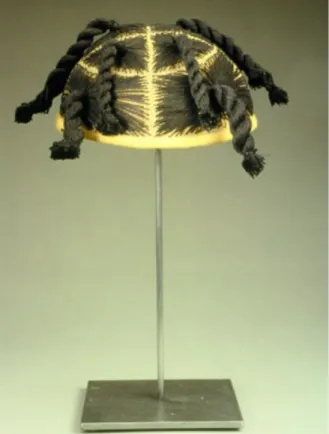
highlight the passage of information. Headpieces such as Spider (1998) (Fig. 2.3)and Onigi:13
25
hair as a child. Using threads tightly wound into large braids that accentuated sections of the
scalp, the wigs emphasize the “radiating energy” of the styles and the intricacies of the braided
techniques that passed through the hands of Clark’s neighbors, to her own, and to the media of
the headpieces. The Hair Craft Project (2014) (Figs. 2.4 & 2.5), is another example of Clark’s
conflation and translation of identity through skill and reclamation. During this performance
piece, Clark’s own head of hair served as a figuratively blank canvas for twelve female hair
braiders, who were also given stretched canvases and thread to further display their technique.
In one photograph of The Hair Craft Project, Clark stands against a bright orange
background with her back to the camera, while a brown-skinned woman with a blue hair wrap
smiles at the camera. Clark’s hair has been elegantly braided, as four two-strand plaits are visible
and separated by loops of tightly twisted hair, embellished with beads, that snake up the middle
of the back of her head to conjoin with the other loops emanating from the tops of the four
two-strand twists and the loops above her ears. In another photograph, the composition is fixed on
Clark’s hairstyle, an updo with plaits braided to her head in the shape of a fingerprint. The
completed canvases and colorful portraits of the stylists with a shot of each iteration of Clark’s
different hairstyles were showcased in galleries in Virginia, Michigan, and Boston. Chaunda
King, one of the featured stylists, described how the project caused her to reflect on the cyclical
pattern and influence of cultural hairstyling. King states, “Think about all of the different styles
that we unleash on client’s hair. None of us have been to Africa, but some of our styles speak
volumes, maybe, of our ancestors.”69
In 2014, Clark also worked in collaboration with a stylist on a project to reinterpret the
26
hairstyle of an Akan commemorative portrait head from the African collection at the Virginia
Museum of Fine Art. Titled Commemorative Portrait Head, the sculpture was created as a
memorial to a deceased Akan royal family member and was intended to house the spirit of the
dead. The ceramic sculpture,which depicts the hairstyle of the deceased, would have been
involved in memorial rites and placed on an altar before being moved to a mausoleum. Clark’s
use of her head as the site of creation and her hair as her medium embodies the sculpture and
presents a continuity of customs through the body. Through this direct reinterpretation of a
sculptural hairstyle, Clark’s work relates to that of Janet Stephens, a hairdresser and
“hair-archaeologist”70 who has studied and written on Ancient Roman hairstyles as taken from busts,
statues and funerary monuments. Though Stephens is not an artist and her intention is not to
create works of art, she provides workshops demonstrating the feasibility and process of sculpted
Ancient styles to bring them into the 21st century and everyday life. Clark and Stephens shed
light on the ways in which hair has been cherished as an art form for centuries, but most
importantly, both women highlight the ways in which styling serves to understand and re-present
the past.
Sonya Clark part III: Assertions of Femininity and Identity
As the reinterpretation of a pearl necklace, Heritage Pearls is an example of Clark’s
exploration of reclamation of femininity, beauty, and identity through adornment and word play.
As an object made of natural hair, Heritage Pearls alludes to the complicated relationships that
70“Reconstructing Roman Hairstyles with hair archeologist Janet Stephens,” The University of North Carolina at
27
exist between the social practices that give hair value. Relating to the precedent of 19th century
hair jewelry, Clark’s use of her hair represents her own body. The presence of the words
“heritage” and “cultured” on the jewelry box lid of Heritage Pearls adds a layer to Clark’s work.
“Heritage,” as defined as something handed down from the past, relates to such as a tradition or
legacy, and “culture” refers to the customary beliefs, social forms, practices and material traits of
a racial, religious, or social group.71 As a verb, “cultured” refers to the cultivation of living
material, such as the cultured pearls that are fostered by an oyster farmer under controlled
conditions.72 In the context of the hair politics in the female black American experience, one
could argue that the word play of “cultured pearls” refers to the ways in which hair has been
shaped by black culture and history, as well as by hegemonic notions of beauty. Almost as if to
retell a narrative to a viewer, Heritage Pearls serves as an implied bond between the artist and
viewer that serves as a form of remembrance and power through knowledge.
Through The Hair Craft Project andthe display of twelve distinctive braided techniques,
Clark both prizes the ephemerality of African American hairstyles and solidifies their existence
and elegance. The photographs from The Hair Craft Project reveal similarities to the work (Fig.
2.6) of Nigerian photographer J.D. Okhai Ojeikere. Ojeikere’s black and white images captured
the plethora and significance of hair styling and braiding in the lives of Nigerian women in the
latter half of the 20th century. Emboldened by the “cultural pride that accompanied Nigerian
independence [in 1960],” Ojeikere’s photographs praise the beauty behind each hairstyle.
Ojeikere feared that an increase in the use of wigs during the fifties threatened traditional
71“Heritage,” Merriam-Webster, Last modified 2017, https://www.merriam-webster.com/dictionary/heritage.
28
hairdressing.73 Similar to Clark’s use of photography in The Hair Craft Project, Ojeikere used
photography to document forms of cultural history and pride as demonstrated through hair.
When Clark stood against a wall full of Ojeikere’s photographs in the fifty-fifth Venice
Biennale during the Hair Craft Project, her newly plaited hairstyle brought Ojeikere’s images
and their hairstyle portraits to life. Writing on this impromptu “participation,” Brooke Davis
Anderson writes:
Upending the curatorial role by deciding to include herself and her collaborators in the largest and oldest international art show in the world and by bringing the art of
hairdressing (usually referred to by the mainstream as a ‘low art’ or ‘craft’) into one of the most elite art-world projects, the artist slyly answered each and every time when asked if she was a part of the Venice exhibition [or some such], ‘Yes, I am in the Biennale, and so are you!’74
The Hair Craft Project works similarly to Heritage Pearls toquestion notions of class, status
and wealth, as it also blurs the boundaries between the global and the local, to expand the reach
of Clark’s practice. As with much of Clark’s work featuring hair, the Hair Craft Project and
Heritage Pearls aim to elevate notions of “craft” and of the feminine to equalize them with the
“fine” art of the masculinized and predominantly white museum space and art world.
Through her display of these works of art at global events such as the Venice Biennale,
Clark works to validate black hairstyling as an art form. The photographs from the 2014 project
73Regina Woods," J.D. Okhai Ojeikere: Photographs," by Andre Magnin and Hair in African Art and Culture, edited by Roy Seiber and Frank Herreman, Black Issues Book Review, 2 no. 6 (November-December, 2000): 46.
29
allowed for around 45,00075 visitors to see the work of twelve female entrepreneurs whose goals
included the empowerment of women of color and the fostering of healthy hair practices. The
places where these healthy natural hair practices typically take place are within a hair salon or
the kitchen of a stylist. As Clark commented, “Folks who might not buy an artwork in the
traditional sense will spend a lot of money on a hairstyle.”76 As such, the Hair Craft Project
emphasizes the entrepreneurship of twelve women in addition to alluding to the power and
visibility of black dollars. It illuminates the ways in which, as Kellie Jones notes, black hair
serves as a “tangible crown of African American difference” that “becomes a vehicle for
expression and an art form that becomes a method through which we convey our sense of beauty
and our creative aspirations.”77
Mequitta Ahuja Part 1: Conceptions of Hair as Media
Originally from Michigan, Ahuja is of Indian and African American ancestry. She
received degrees from Hampshire College in Massachusetts and the University of Illinois at
Chicago. Known primarily for her large paintings that play with text, portraiture, and folklore,
Ahuja has exhibited her work globally and around the United States.78 Of interest to this analysis
is a series of waxy chalk drawings from 2007 to 2009; included in this series is Tress I (2008)
(Fig. 2.7). Measuring 96 inches by 45 inches, Tress I unveils a mass of light and dark gray tones,
attached to a brown-skinned head that tilts upwards with its eyes closed and its hair cascading to
75Sonya Clark, “Then, Now, and Next: Conversation Between Sonya Clark and Emily Smith,” The Hair Craft Project, (Richmond, Virginia: Sonya Clark, 2015), 15.
76Ibid, 15.
77Kellie Jones, “In the Thick of It: David Hammons and Hair Culture in the 1970s,” Eye Minded: Living and Writing
Contemporary Art (Durham: Duke University Press, 2011), 297-8.
30
the bottom of the page, resembling a bird’s eye view of forest trees or the soft tufts of natural
hair. The dismembered head appears to be asleep or in deep thought. Standing in front of Tress I,
the viewer is confronted with the sheer size of the drawing that magnifies the texture of natural
hair through line and tone. Ahuja not only illustrates hair on a flat surface, she also uses hair as
an avenue to explore the possibilities of technique and the intricacies of one’s subconscious.
Moreover, size is one way through which she communicates the visual, invisible, and
metaphorical power of hair, especially that of people of color.
Tress I is the first in a series of four drawings using a waxy form of chalk. In Tress II
(2008), the brown head is slightly tilted to the right as the white gaps of the paper burst through
the hair, creating a glowing sensation beneath the tufts. Tress III (2008) shows the same head
with hair that resembles dense, gray plumes of smoke, or the texture of natural hair that was
previously twisted into a braid. Tress IV (2009) (Fig. 2.8) shows the brown head tilted upwards
at the chin, almost as if it is weighed down by what now are gray and black locs. 79Tress IV
ensnares the eye through these locs that curl and undulate like ropes to extend to the bottom of
the page. Ahuja gives her viewers the opportunity to observe at eye level the thinly curved lines,
texture and tone of her work, essentially communicating the beauty of black hair through an
exploitation of the aesthetic potential of natural textures.
Many of Mequitta Ahuja’s paintings and drawings are massive, engulfing the viewer,
thus her work is a visual testament to her awareness of the “psychic proportions hair has in the
31
lives of black people.”80Tress IV functions similarly to Cathleen Lewis’s Extensions (Ethnic
Signifiers) (1996) (Fig. 2.9), a maze-like room, lined from floor to ceiling with synthetic hair
wrapped around millinery wire, through which visitors must physically navigate. Created by a
female black American artist, the work references the practices of adding synthetic hair to one’s
head, in addition to the social constructions and pressures of self-fashioning and adornment.81
While Extensions creates a physical challenge for its viewers unlike Ahuja’s two dimensional
depiction of hair, Lewis’s installation and Tress IV are similar in the ways in which they utilize
the imagery of locs and the metaphorical use of size to refer to experiences in cultural styling and
the exploration of a particular type of hair.
During an interview in 2009 with curator Nicole Caruth, Ahuja recounted how her
process has progressed over time:
All the color and materials, shiny enamel and sticky oil paint, it can all be, at times, over-stimulating and I find it difficult to harness my own self-control. By limiting my
materials and palette, I have opened up other artistic possibilities. Many of the new works could fairly accurately be described as ‘pencil and paper’ and yet I feel the artistic
possibilities are inexhaustible.82
Ahuja’s goal seems to be to assert the mystery and the beauty in the tangle, kinks, and texture of
hair in her art. Ahuja’s forms are organic and resemble roots in places, or slithering, slender
forms such as snakes, entwined ropes, and mazes. The three dimensionality of Ahuja’s
80Nicole Caruth, “Project Space: Mequitta Ahuja,” ...Might Be Good, accessed Oct 2018,
http://www.fluentcollab.org/mbg/index.php/artistsspace/index/120.
81“Cathleen Lewis: Binary Oppositions,” CRG Gallery, accessed March 2019,
http://crggallery.com/exhibitions/cathleen-lewis-binary-oppositions/.
32
dimensional works create a sense of volume and body that is strengthened through her interest in
experimentation and plays of contrast. Drawings such as Fount (2009) (Fig. 2.10) demonstrate
the ways in which Ahuja can translate natural hair into explosions of energy and references to art
techniques and forms. As a six-paneled piece, Fount features two figures who bend at the waist
as their hair conjoins in the middle and the smooth waxy medium imitates the softness of
inkblots on Japanese silk screen panels.
Many of Ahuja’s paintings display a multimedia approach where the treatment of the face
differs from the vibrantly tactile rendition of hair. In Ovulation Chart (2007), the face is sketched
in pencil while the hair, painted with enamel, spreads through the three panels of the work in
swirls of dark turquoise, black roots and mysterious oval-shaped forms. Similarly, Roots (2008)
presents a face sketched in waxy chalk, with enamel-painted hair, that morphs into earth-toned
branches that expand around the head. One could also note similarities between Ahuja’s work
and the collages of Lorna Simpson, another female black American artist. Many of Ahuja’s
paintings display a multimedia approach that resembles Simpson’s collages of Ebony magazine
models with their hair replaced by colorful wisps and blots of watercolor or newspaper
clippings.83 Speaking on the promotion of the beauty of black women and black hair as evident
in Simpson’s collages, Elizabeth Alexander highlights the enticing mystery of Simpson’s
watercolors and writes of how Simpson’s work transforms hair into galaxies and solar systems.84
Simpson’s artist statement concerning her collages is a compilation of affirming phrases from the
83A monthly magazine geared towards African Americans.
33
advertisements that originally accompanied the images of the Ebony models. Encouraging black
women to “reveal the beauty that [they] conceal,” works such as Earth & Sky #32 (2016) (Fig.
2.11) replace black hair with images of mineral formations such as stalactites, thus associating
hair with nature and strength.85Earth & Sky #32, a collage on paper, features a smiling and
keeling black woman in a soft green dress,adorned with emerald gems around her neck and
waist, that splits into a cape that covers her head.
Earth & Sky #32 resembles an enamel painting on paper, Crown and Throne (2007) (Fig.
2.12), where Ahuja’s hair cascades down her back, like a cape, that transforms into the throne on
which she sits. Both works feature an elegantly dressed black woman (Ahuja wears a vivid and
floral sari)who embraces the hair that has morphed into an element that supports their bodies
and that matches the expressions of self-assurance as read on each face. Using hair as a primary
medium and influence, Ahuja molds and varies the forms in which her depictions of hair appear
and the strength that these vivid iterations demonstrate.
Mequitta Ahuja Part II: Construction of a Black, Feminist Identity
Ahuja, whose work primarily consists of self-portraits in an authoritative female form,
credits feminism as the framework through which she learned to understand gender, identity, and
race.86 Her work attempts to challenge the social constructs that seek to define race and gender,
while it nonetheless recognizes the effects of these categories.87As Ahuja explains: “the idea of
85Lorna Simpson, “Artist Statement,” Lorna Simpson: Collages (San Francisco: Chronicle Books, 2018).
86Mequitta Ahuja, “Global Feminisms: Mequitta Ahuja,” Lecture, Elizabeth A. Sackler Center for Feminist Art, Brooklyn, NY, 2007, https://www.brooklynmuseum.org/eascfa/video/videos/global-feminisms-mequitta-ahuja.