© 2020 by the Serbian Biological Society How to cite this article: Igić D, Borišev M, Vilotić D, Šijačić-Nikolić M, Ćuk M, Ilić M, Kovačević B. Variability and relationships among rooting characteristics for white poplar hardwood cuttings . Arch Biol Sci. 2020;72(2):153-63.
Variability and relationships among rooting characteristics for white poplar hardwood
cuttings
Dušan Igić1,*, Milan Borišev2, Dragica Vilotić3, Mirjana Šijačić-Nikolić3, Mirjana Ćuk2, Miloš Ilić2 and
Branislav Kovačević4
1Public Enterprise “Vojvodinašume”, Petrovaradin, Serbia
2University of Novi Sad, Faculty of Science, Department of Biology and Ecology, Novi Sad, Serbia
3University of Belgrade, Faculty of Forestry, Belgrade, Serbia
4Institute of Lowland Forestry and Environment, Novi Sad, Serbia
*Corresponding author: [email protected]
Received: January 14, 2020; Revised: January 28, 2020; Accepted: February 20, 2020; Published online: February 24, 2020
Abstract: White poplar is a key species in wood production and afforestation, but also very important for biodiversity pres-ervation and habitat improvement. Vegetative propagation from hardwood cuttings is the most desirable method of white poplar breeding. The present research analyzed the effect of various technological treatments on four white poplar clones. Selected treatments were powder formulations of indole butyric acid (IBA) and foliar treatment with urea. The variability of 14 morphometric characteristics on the rooting of cuttings was analyzed, as well as relationships between them. Dif-ferences in analyzed morphometric characteristics depended on genotype, while the effect of the examined technological treatments was detected only by Fisher’s least significant difference (LSD) test. Significant variability between genotypes was found for traits describing rooting at the basal cut (R0 and R0p), the number of leaves (LN), the total number of roots (TRN), and cutting survival in the first part of the growing season (SURV07). Application of IBA had significant stimulating effects on rooting at the lower part of cuttings (R05) compared to controls. Variability between genotypes after foliar treat-ment with urea was not detected. The examined parameters were grouped into 5 groups by principal component analysis, where shoot traits and traits that describe rooting at the basal cut were in the same group with total number of roots, and cutting survival (SURV07) was in a separate group. These results suggest a need for further testing of the characteristics of hardwood cuttings in white poplars. More efficient clone technology is needed, using auxins and/or nitrogen fertilization designed to suit the specific requirements of particular clones.
Keywords: vegetative propagation; hardwood cutting; plant nursery; Populus alba
153
INTRODUCTION
White poplar is a vigorous tree species used in wood production and afforestation of marginal soils with high salinity, acidity, or low moisture content [1,2]. In Serbia, it is a dominant tree species in riparian zone forests, and a key component of biodiversity preserva-tion and improvement strategies for these areas [3,4]. A principal advantage of most poplar species is that their hardwood cuttings can be successfully rooted. However, species from the section Populus (Leuce Duby), including white poplar, are difficult to root from hardwood cuttings, presenting problems in veg-etative propagation, planting and production of target
formation of preformed primordia is influenced by many factors, including genotypic differences, envi-ronmental conditions and technological procedures [8,14-18]. Therefore, white poplar nursery technology must be optimized for each particular clone [4,10,19]. In addition to genotypic traits, hormonal regula-tion networks also influence poplar rooting during vegetative propagation [20]. For example, Zhao et al. [21] suggest that genetic and environmental factors, including exogenous interventions and treatments, as well as physiological properties, are all essential for development of successful rooting strategies. In fact, their findings concerning hormonal regulation of root formation in poplars could be developed for practical applications. For example, auxins are known to play a central role in adventitious root formation. A particular auxin, indole-3-butyric acid (IBA), has higher root-induction capacity and better light stabil-ity than the more common indole 3-acetic acid (IAA), and undergoes conversion to IAA in the plant [22]. Likewise, nitrogen supply is critical for adventitious root formation; and nitrogen can be stimulatory or inhibi-tory, depending on the plant species, environmental conditions and concentration of applied nitrogen [20].
The aim of the present study was to compare the rooting capacity of four white poplar clones, and to evaluate the effects of IBA and urea on adventitious root formation. Our results could provide a basis for improvement of nursery technologies.
MATERIALS AND METHODS
Experiments were conducted at “Ratno ostrvo” nurs-ery, PC “Vojvodinašume”, in the vicinity of Novi Sad (45°17’05’’N 19°54’38’’E), on soil with a loamy texture surface layer (depth 0-20 cm) dominated by fine sand and silt (ca. 40%) [19]. Soil used for experiments is classified as poor due to high CaCO3 content (10.62-11.03%), pH of 7.72-8.04, and low humus content (1.12-1.78%). Total nitrogen was 0.09%-0.05%; aver-age available phosphorus was 3.44-10.79 mg per 100 g soil, and potassium was 2.30-8.41 mg per 100 g soil.
Four white poplar clones were examined: Italian clone Populus alba cl. Villafranca and three experi-mental clones: P. alba cl. L-12, P. alba cl. L-80 and P. alba cl. L-100 of the Institute of Lowland Forestry and Environment, Novi Sad, Serbia.
Cuttings were prepared and planted in the second half of March, 2017. Nursery trials were randomized, and conducted in three repetitions, with 50 hardwood cuttings per plot and 20x155-cm spacing. Cuttings were 18-20 cm long with a diameter of 8-15 mm. The effects of combined application of IBA powder on the basal cut site before planting and foliar application of 2% urea solution were examined. Foliar treatment with urea solution was performed in mid 11.05.2017.
Technological treatments
The following treatments were applied: 06i – 0.6% IBA powder; 06iu – 0.6% IBA powder and foliar treatment with 2% urea; 2i – 2% IBA powder; 2iu – 2% IBA powder and foliar treatment with 2% urea; c – con-trol; cu – foliar treatment with 2% urea. Plants were mechanically weeded and irrigated as needed. On 9 June 2017, the first ten cuttings were removed from the soil, washed and prepared for measurements. The remainder of the cuttings were left in the soil to record their survival.
Parameters measured for root cuttings
SH – shoot height; LN – number of leaves; RN0 – number of roots at the basal cut site; RN05 – number of roots 0-5 cm from the basal cut; RN510 – number of roots 5-10 cm from the basal cut; RN1020 – number of roots between 10cm from the basal cut and the top cut; SURV07 – percentage of survived cuttings at the time of measurement. The following parameters were derived: RN5 – number of roots 5 cm from the basal cut (RN5=RN0+RN05); TRN – total number of roots. Parameters describing partitions of the number of roots at defined distances from the basal cut vs. the total number of roots were as follows: RN0p – (RN0/ TRN)*100%; RN05p – (RN05/TRN)*100%; RN5p – (RN5/TRN)*100%; RN510p – (RN510/TRN)*100%; RN1020p – (RN1020/TRN)*100%.
Statistical analysis
repetition. Data describing the number of leaves and roots were transformed by square transformation ( ), and data for the partition over the total number of roots were transformed by arcsine trans-formation (arcsin ). These transtrans-formations were performed in order to meet the normal distribution of frequencies that is a condition for the applied para-metric tests. Data were analyzed by two-way analysis of variance (ANOVA) and Fisher’s least significant difference (LSD) test to evaluate the significance of the effect of the examined controlled sources of variance and differences among treatments.
The relationship between the examined parameters was described by Pearson’s correlation coefficient in-dividually for each pair of parameters, while grouping of parameters was analyzed by principal component analysis (PCA). Grouping was done according to pa-rameter loadings with principal components (PCs) selected by Kaiser’s role (λ>1, where λ stands for the eigenvalue of a particular PC), and rotated by the Va-rimax method to maximize the variance of loadings between measured parameters and PCs within the PC. Analyses concerning the relationship between parameters were performed in the R programming language using a “psych” module.
RESULTS
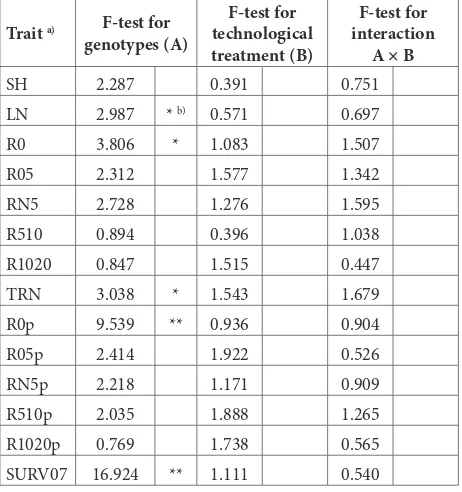
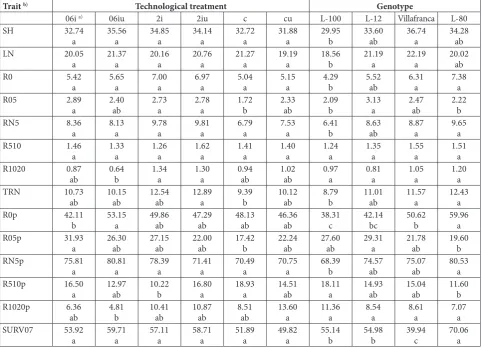
A principal problem in white poplar nursery produc-tion is the difficulty of rooting white poplar hardwood cuttings. Based on two-way factorial ANOVA (Table 1), no statistically significant effect was found for technological treatments on any of the examined traits. However, the factor genotype had a statistically significant effect on the number of leaves (LN), the number of roots on the basal cut (R0) and its partition in the total number of roots (R0p), total number of roots (TRN), and the percentage of survived rooted cuttings at the time of measurement (SURV07). The examined genotypes showed relatively good survival at the time of measurement (SURV07), ranging from 40 to 70% (Table 2).
LSD test results show that some traits differed between interaction treatments. For traits RN5, TRN, R0p, R510p and SURV07, five or more homogenous interaction treatment groups were formed (Table 3).
According to Pearson’s correlation coefficients (Table 4), shoot height and the number of leaves are highly positively correlated: generally in moderate correlation with other examined characters. However, with the exception of R0p, weak correlation was found with most traits describing partitioning of the number of roots over different parts of the cutting with respect to the total number of roots. A positive but weak cor-relation was found between the number of roots at the middle (R510) and upper (R1020) parts of cuttings; while weak or no significant correlation was found between them and traits that describe the number of roots on the lower parts of the cuttings. Analogous traits that describe the partition in the total number of roots had a high negative correlation with R0p and RN5, and a low negative correlation with R05p. The correlation of RN5 with R0 was high and positive, but moderate with R05, suggesting a much stronger
Table 1. F-test from two-way factorial ANOVA for traits of rooted
cuttings in white poplar genotypes
Trait a) F-test for
genotypes (A)
F-test for technological treatment (B)
F-test for interaction
A × B
SH 2.287 0.391 0.751
LN 2.987 * b) 0.571 0.697
R0 3.806 * 1.083 1.507
R05 2.312 1.577 1.342
RN5 2.728 1.276 1.595
R510 0.894 0.396 1.038
R1020 0.847 1.515 0.447
TRN 3.038 * 1.543 1.679
R0p 9.539 ** 0.936 0.904
R05p 2.414 1.922 0.526
RN5p 2.218 1.171 0.909
R510p 2.035 1.888 1.265
R1020p 0.769 1.738 0.565
SURV07 16.924 ** 1.111 0.540
a) Traits: SH – shoot height, LN - number of leaves, RN0 – number of roots
on basal cut, RN05 – number of roots from the basal cut to the 5th cm from
the basal cut, RN510 – number of roots from the 5th to the 10th cm from
the basal cut, RN1020 – number of roots from the 10th cm from the basal
cut to the top cut, RN5 – number of roots below the 5th cm from the basal
cut (RN5=RN0+RN05), TRN – total number of roots, RN0P – (RN0/ TRN)*100%, RN05P – (RN05P/TRN)*100%, RN5P – (RN5/TRN)*100%, RN510P – (RN510P/TRN)*100%, RN1020P – (RN1020P/TRN)*100%, SURV07 – percentage of surviving rooted cuttings at the time of measurement.
Table 2. Results of the LSD test at the level of factor operation and factor genotype for traits of rooted cuttings in white poplar genotypes.
Trait b) Technological treatment Genotype
06i a) 06iu 2i 2iu c cu L-100 L-12 Villafranca L-80
SH 32.74
a 35.56a 34.85a 34.14a 32.72a 31.88a 29.95b 33.60ab 36.74a 34.28ab
LN 20.05
a 21.37a 20.16a 20.76a 21.27a 19.19a 18.56b 21.19a 22.19a 20.02ab
R0 5.42
a 5.65a 7.00a 6.97a 5.04a 5.15a 4.29b 5.52ab 6.31a 7.38a
R05 2.89
a 2.40ab 2.73a 2.78a 1.72b 2.33ab 2.09b 3.13a 2.47ab 2.22b
RN5 8.36
a 8.13a 9.78a 9.81a 6.79a 7.53a 6.41b 8.63ab 8.87a 9.65a
R510 1.46
a 1.33a 1.26a 1.62a 1.41a 1.40a 1.24a 1.35a 1.55a 1.51a
R1020 0.87
ab 0.64b 1.34a 1.30a 0.94ab 1.02ab 0.97a 0.81a 1.05a 1.20a
TRN 10.73
ab 10.15ab 12.54ab 12.89a 9.39b 10.12ab 8.79b 11.01ab 11.57a 12.43a
R0p 42.11
b 53.15a 49.86ab 47.29ab 48.13ab 46.36ab 38.31c 42.14bc 50.62b 59.96a
R05p 31.93
a 26.30ab 27.15ab 22.00ab 17.42b 22.24ab 27.60ab 29.31a 21.78ab 19.60b
RN5p 75.81
a 80.81a 78.39a 71.41a 70.49a 70.75a 68.39b 74.57ab 75.07ab 80.53a
R510p 16.50
a 12.97ab 10.22b 16.80a 18.93a 14.51ab 18.11a 14.93ab 15.04ab 11.60b
R1020p 6.36
ab 4.81b 10.41ab 10.87ab 8.51ab 13.60a 11.36a 8.54a 8.61a 7.07a
SURV07 53.92
a 59.71a 57.11a 58.71a 51.89a 49.82a 55.14b 54.98b 39.94c 70.06a
a) Technological treatments: 06i – cutting treatment with 0.6% indole butyric acid powder, 06iu – cutting treatment with 0.6% indole butyric acid powder
and foliar treatment with 2% urea solution, 2i – cutting treatment with 2% indole butyric acid powder, 2iu – cutting treatment with 2% indole butyric acid powder and foliar treatment with 2% urea solution, c – control, cu – foliar treatment with 2% urea solution.
b) Traits: as per Table 1.
c) Values of a parameter with the same letter belong to the same homologous group according to the LSD test at the level of α = 0.05
Table 3. Results of the LSD test at the level interaction of technological treatment × genotype for traits of rooted cuttings in white poplar
genotypes.
Trait b)
Technological treatment
06i a) 06iu 2i
Genotype
L-100 L-12 Villafranca L-80 L-100 L-12 Villafranca L-80 L-100 L-12 Villafranca L-80
SH 21.17
b c) 33.89ab
35.69 40.21 37.14 35.86 35.72 33.50 32.52 34.74 36.72 35.44
a a a a a ab ab a a a
LN 14.64
d 21.93abc 22.71abc 21.48abc 21.98abc 21.56abc 22.18abc 19.82abcd 19.42abcd 20.77abc 20.46abcd 20.01abcd
R0 1.65
d 6.00bc 6.84abc 8.36ab 6.73abc 4.39bcd 4.79bcd 6.88abc 5.73bc 4.10bcd 12.12a 7.08ab
R05 1.66
bcd 3.44ab 3.24bc 3.36bc 2.90bcd 1.84bcd 2.88bcd 2.04bcd 2.41bcd 2.62bcd 3.71ab 2.26bcd
RN5 3.31
e abcd9.47 10.11abcd 11.90abc abcd9.64 6.28cde bcde7.81 abcd8.97 bcde8.13 6.65cde 16.01a abcd9.37
R510 1.00
R1020 0.53
b 0.57ab 0.93ab 1.56ab 0.54ab 0.53b 0.66Ab 0.84ab 1.39ab 1.27ab 1.06ab 1.66ab
TRN 4.86
f 10.99bcde 13.25abcd 15.32abc abcde11.71 8.36def cdef9.74 10.92bcde 10.72bcde 8.97cdef 18.33a 13.01abcd
R0p 25.83
f abcdef46.57 abcdef42.52 54.49abc 54.71abc abcde46.67 abcde48.52 62.57a bcdef39.49 bcdef39.99 62.79a 57.15abc
R05p 40.96
a 37.42ab 24.86abc 25.33abc 27.95abc 23.07abc 34.12ab 20.68abc 30.96abc 33.85ab 24.84abc 19.67abc
RN5p 68.05
abcd 84.51ab 67.92abcd 81.12abcd 83.35abcd 70.91abcd 84.10abc 83.86abcd 72.03abcd 74.77abcd 88.19a 77.04abcd
R510p 24.68
ab 10.41cdef abcde20.92 bcdef11.75 10.65cdef abcde21.52 10.79cdef 10.13def bcdef11.87 8.92ef 6.49f abcdef14.40
R1020p 5.13
b 4.88b 9.08ab 6.73ab 5.16b 5.29b 3.12b 5.93b 14.37ab 15.71ab 5.28b 7.96ab
SURV07 47.50
efghi cdefghi50.84 47.46efghi 69.40abc bcdefgh56.77 abcde67.41 45.72fghi 68.36abcd abcdefg59.35 abcdefg59.65 33.99i 74.62ab
Trait b) 2iu a) Technological treatmentc cu
Genotype
L-100 L-12 Villafranca L-80 L-100 L-12 Villafranca L-80 L-100 L-12 Villafranca L-80
SH 30.53
ab c) 39.13a 36.44a 32.11ab 30.31ab 29.12ab 40.89a 30.56ab 28.01ab 30.69ab 34.98a 33.85ab
LN 19.21
abcd 24.06ab 21.34abc 19.65abcd 19.84abcd 19.50abcd 25.46a 20.53abc 16.71cd 20.37abcd 21.15abc 18.67bcd
R0 4.63
bcd 8.87ab 6.90abc 8.43ab 5.22bcd 5.01bcd 3.77bcd 6.31bc 2.72cd 6.30bc 4.77bcd 7.32ab
R05 2.01
bcd 6.35a 2.33bcd 2.11bcd 1.42cd 2.84bcd 1.07d 1.70bcd 2.26bcd 3.24bc 1.92bcd 1.99bcd
RN5 6.64
cde 15.22ab abcd9.25 10.57abcd 6.62cde bcde7.70 5.02de bcde8.02 5.00de abcd9.57 6.69cde abcd9.30
R510 1.23
abc 1.62abc 2.17a 1.51abc 1.79abc 1.61abc 0.98c 1.31abc 0.95c 1.48abc 1.60abc 1.59abc
R1020 1.33
ab 0.79ab 1.77a 1.20ab 0.78ab 1.16ab 0.87ab 0.97ab 1.36ab 0.63ab 1.09ab 1.04ab
TRN 9.28
cdef 17.72ab 13.28abcd 13.40abcd 9.37cdef abcde11.20 6.92ef 10.33bcde 7.63def abcde11.82 9.41cdef abcde11.93
R0p 37.95
cdef abcdef42.25 abcdef45.01 62.27a abcdef43.80 32.01def 53.98abc 63.00a 29.33ef abcdef45.72 50.77abcd 60.17ab
R05p 21.35
abc 41.39a 16.67bc 16.87bc 18.51abc 19.64abc 13.65c 18.14abc 27.48abc 26.14abc 18.65abc 17.33bc
RN5p 60.20
d 83.94abcd 62.48bcd 80.94abcd 63.66bcd 60.76cd 74.17abcd 81.85abcd 61.03cd 73.31abcd 69.83abcd 78.08abcd
R510p 23.58
abcd bcdef10.90 abcde21.21 11.04bcdef 26.22a 23.67abc abcdef15.41 11.87bcdef abcdef14.36 abcdef15.30 abcdef18.17 10.64cdef
R1020p 15.42
ab 4.64b 15.48ab 7.61ab 9.39ab 11.10ab 9.98Ab 4.40b 23.11a 10.74ab 11.50ab 10.45ab
SURV07 60.07
abcdef abcdefgh57.66 37.47hi 77.81a cdefghi53.65 defghi48.31 38.87ghi abcdef66.50 cdefghi53.41 46.50fghi 36.43hi abcdef62.96 a) Technological treatments: as per Table 2.
b) Traits: as per Table 1.
c) Values of a parameter with the same letter belong to the same homologous group according to the LSD test at the level of α=0.05.
contribution from R0 to the variation of RN5. These two traits are also in strong positive correlation with the total number of roots (TRN), while the correla-tion of TRN with R05p and R1020p was weak and not statistically significant.
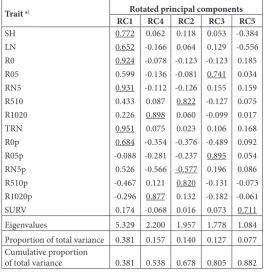
The examined traits were grouped into five groups according to their loadings with rotated first five prin-cipal components (Table 5). The traits that had their highest loadings, i.e. correlation coefficients, with the same PC were agglomerated in the same group.
DISCUSSION
Our results confirm the importance of genotype as a source of variability, in agreement with generally ac-cepted theories describing the rooting process. In fact, various authors have proposed that species specificity, as well as genotype specificity, plays a major role in the propensity of poplars for adventitious root formation
during vegetative propagation [21,23]. This process appears to be under strong genetic control, and clone (genotype) selection is an important factor in successful poplar vegetative propagation [24,25]. Interaction ef-fects between technological treatment × genotype were not found to be statistically significant for any of the examined parameters. However, there were significant differences in the reaction of some genotypes according to the LSD test, suggesting that genotype × environment interactions should be further considered with respect to rooting poplar cuttings [21]. Kovačević et al. [4], after analyzing the effects of four white poplar genotypes and two cutting preparation terms (in mid-February and mid-March, planted in late April), found a significant genotype effect in RN1020 and TRN, a significant effect of the timing of the preparation of cuttings and plant-ing in R0, R510p and R1020p, and a significant effect between the interaction of genotype × term of cutting preparations in R1020 and R1020p. They performed measurements in the beginning of June.
Table 4. Correlations among examined traits of white poplar rooted cuttings.
Trait a) SH LN R0 R05 RN5 R510 R1020 TRN R0p R05p RN5p R510p R1020p SURV07
SH
-LN 0.779
** b)
-R0 0.517
** 0.368**
-R05 0.351
** 0.424** 0.461**
-RN5 0.532
** 0.435** 0.954** 0.704**
-R510 0.404
** 0.250* 0.349** 0.115 0.320**
-R1020 0.276
* 0.038 0.156 -0.052 0.106 0.245*
-TRN 0.577
** 0.426** 0.938** 0.652** 0.970** 0.477** 0.301*
-R0p 0.362
** 0.345** 0.749** 0.063 0.620** 0.062 -0.076 0.546**
-R05p -0.236
* -0.062 -0.253* 0.573** -0.009 -0.325** -0.311** -0.105 -0.445
-RN5p 0.171 0.324
** 0.537** 0.515** 0.605** -0.264* -0.378** 0.438** 0.680** 0.329**
-R510p -0.163 -0.217 -0.473
** -0.408** -0.517** 0.418** 0.047 -0.394** -0.585** -0.218 -0.817**
-R1020p -0.011 -0.241
* -0.293* -0.379** -0.364** 0.044 0.641** -0.209 -0.451** -0.348** -0.764** 0.278*
-SURV07 0.073 -0.013 0.124 0.103 0.136 0.053 0.011 0.127 0.166 0.045 0.169 -0.135 -0.084
-a) Traits: as per Table 1
According to LSD test results, significant differ-ences were observed between some technological treatments in R05, R1020, TRN, R0p, R05p, R510p and R1020p. The highest R05 and R05p was found in treatment 06i, while controls had the lowest. The highest R510p was observed for the control, while the lowest was in 2i. The highest R1020p was in cu and the lowest in 06iu. These results suggest that IBA application stimulates rooting in the basal part of the cutting, with no significant effects in the middle and upper parts of the cuttings. Eggens et al. [26] discussed changes in the physiological status of Populus alba var. bolleana cuttings throughout dormancy. In contrast to the stimulatory effects of IBA in early spring, they described necrosis and decay in cuttings treated with IBA in the late-term (April). Also, the importance of the effect of IBA concentration was not precisely determined in our research. Some authors [10] found a positive effect on rooting cuttings of eastern cottonwood after foliar treatment with CoCl2, which inhibits ethylene accumulation induced by excess IAA. The same authors also found a positive effect on the rooting of cuttings after CoCl2 addition to an IBA powder formulation for the white poplar clone Villafranca. Root stimulation
by IBA in the basal part of the cuttings was also found in the present study. IBA is the most commonly used hormone for stimulating root formation in hardwood tree species, even more than IAA, and it is a reliable tool for this process [21]. Auxin is a major coordinator of root morphogenesis [28]. However, the efficacy of auxin, IAA or IBA treatment depends on the concentration applied [21], and it is pos-sible that high concentrations of exogenous auxin, along with prolonged exposure, could have an inhibitory effect on adventitious root growth. Although IBA is more widely used for adventitious root development than IAA, IBA can also significantly stimulate formation and activation of root primordia in poplar cuttings, but its later influence on root development is not clear [29]. The effect of IBA also depends on its conversion to IAA in plant cells after IBA uptake [30]. The rate and scale of IBA conversion to IAA has not been fully defined for poplar hardwood cuttings, and it is likely that IBA exerts its effects after conversion to IAA [22].
No significant effect was found for urea treatments added to any of the examined IBA treat-ments. However, treatment with urea alone resulted in the highest R1020p of all examined treatments, suggesting that urea has positive effects that should be further studied. The bioavailability of mineral nu-trients is of vital importance in the rooting process. Although N and P clearly impact root formation [20], the effect of nitrogen on adventitious root formation remains unclear. For example, in Pelargonium spp. and Euphorbia pulcherrima Wild. this effect depends on the concentration of applied N, light intensity, and the ratio of N supply to carbon, or sugar availability. Depending on these other factors, N supply might have a stimulatory, neutral, or even inhibitory effect [31,32]. In the present study, LSD tests suggest no significant differences between technological treatments on the percentage of surviving rooted cuttings (SURV07). Thus, in these cases urea application as a N source likely did not affect the rooting process.
Significant differences between genotypes were found for most of the examined traits. For the major-ity of traits describing the number of roots, genotype
Table 5. Loadings of rotated principal components.
Trait a) Rotated principal components
RC1 RC4 RC2 RC3 RC5
SH LN R0 R05 RN5 R510 R1020 TRN R0p R05p RN5p R510p R1020p SURV 0.772 0.652 0.924 0.599 0.931 0.433 0.226 0.951 0.684 -0.088 0.526 -0.467 -0.296 0.174 0.062 -0.166 -0.078 -0.136 -0.112 0.087 0.898 0.075 -0.354 -0.281 -0.566 0.121 0.877 -0.068 0.118 0.064 -0.123 -0.081 -0.126 0.822 0.060 0.023 -0.376 -0.237 -0.577 0.820 0.132 0.016 0.053 0.129 -0.123 0.741 0.155 -0.127 -0.099 0.106 -0.489 0.895 0.196 -0.131 -0.182 0.073 -0.384 -0.556 0.185 0.034 0.159 0.075 0.017 0.168 0.092 0.054 0.086 -0.073 -0.061 0.711
Eigenvalues 5.329 2.200 1.957 1.778 1.084
Proportion of total variance 0.381 0.157 0.140 0.127 0.077 Cumulative proportion
of total variance 0.381 0.538 0.678 0.805 0.882
L-100 achieved the lowest values, while L-12 and L-80 were at the level of Villafranca or better. Considering the number of roots on the examined portions of the total number of cuttings, genotype L-80 achieved higher values of R0p and RN5p than L-100. Clone L-100 achieved higher values of R05p and R510p then L-80 with the small number of roots in this cutting and the small number of roots in total. Low values of R0 and RN5, as well as of TRN, probably contributed to the low values of shoot parameters in this clone, as has been reported [8,17] in black poplar genotypes, but this clone exhibited better survival than Villafranca.
The clone Villafranca showed a poor survival of cuttings (ca. 40% in total), although it had a higher total number of roots compared to L-100, which had the lowest TRN compared to all other clones. Vil-lafranca also had higher values of shoot height (SH) and number of leaves (LN), as well as the number of roots on the basal cut (R0), and their partition in the total number of roots (R0p), suggesting that other traits that were not included in our study had a con-siderable effect. The poor survival performance of Villafranca compared to L-12 and L-80 was reported by Kovačević and Igić [19] after cutting preparation and planting in early April on an east-northeast-exposed plot: however, for other treatments it was at the level of L-12 and L-80. Some authors [10] reported a trend toward higher, albeit not statistically significant, sur-vival of Villafranca cuttings over L-12 in nursery trials established in April. Clone L-12, which achieved the highest cutting survival (SURV07), was also dominant in R05 and R05p – traits that define the formation of roots from preformed primordia in primary bark on the lower portions of a cutting.
According to Kovačević et al. [17], rooting in the middle and upper portions of black poplar hardwood cuttings, measured in May and June, positively cor-related to cutting survival, while this effect was weaker for root parameters measured in July. The authors proposed that root formation at the basal cut (“wound roots”) could be a sign of insufficient root formation. Kovačević [16] recorded earlier root appearance at the middle part of the cutting than in other examined black poplar genotypes, suggesting that the presence of roots in the middle part of the cutting provides a survival benefit due to earlier root formation. Accord-ing to some authors [4], a high total number of roots
is associated with better rooting in the upper part of the cuttings in four examined white poplar genotypes. All of these mentioned studies focused on differences among genotypes. In the present study, significant dif-ferences among clones were found in traits describing the number of roots in the lower part of the cutting (R0, R05, RN5), but not in R510 and R1020, so that the effect of rooting in the middle and upper parts of the cutting could not be discussed.
further elucidation of the functional properties and signaling pathways of hormonal action. Importantly, environmental factors, such as dark-light conditions, temperature, soil humidity, and water-table depth [34], etc. are highly correlated with the success of root formation in white poplar, and from cuttings of tree species in general [21,34].
The examined traits were grouped into five groups according to their loadings with the first five PCs rotated. The traits that had their highest loadings, i.e. correla-tion coefficient, with the same PC were agglomerated in the same group. Kovačević et al. [35] also achieved grouping of early rooting traits in eastern cottonwood in a study designed to assess relationships between examined eastern cottonwood genotypes, as well as between examined cuttings’ rooting parameters.
The first group (RC1) consisted of SH, LN, R0, R05, TRN and R0p, suggesting a close relationship between shoot parameters, the total number of roots and rooting at the basal part of the cutting. Kovačević et al. [35] found that, based on loadings with the first two selected and rotated PCs, all examined parameters were grouped in the first group, except for R0 and R0p, which were grouped apart from others in the second group. The second group in the present study (RC4) included R1020 and R1020p, while the third group (RC2) consisted of R510, R510p and RN5p. Trait RN5p had similar loadings with the first and second PCs, suggesting moderate but not particularly close relationships with these two groups of parameters. The fourth group (RC3) included R05 and R05p, and the fifth group (RC5) consisted only of SURV07. Loadings of the other traits with the fifth PC were weak, except for weak and moderate loadings of SH and the number of leaves, respectively. Because these loadings were negative, we assumed that white poplar root cuttings with a high shoots and a large number of leaves could face survival difficulties during early phases of growth and development. This effect was not detected by Pearson’s correlation coefficients, probably due to multicollinearity. However, according to some authors [8,17,36], in black poplars and other Populus clones high shoots were positively related to cutting survival. We assume that the reason for these differences between white and black poplar clones may be due to difficulties in rooting cuttings of white poplar species.
CONCLUSIONS
Significant differences in rooting and survival were found among cuttings from different white poplar genotypes. Fewer differences were found for examined technologi-cal treatments and between genotype × technologitechnologi-cal treatments. IBA treatments appear to have a positive effect on rooting in the lower parts of a cutting, while foliar applications of urea did not have significant positive effects on the examined traits. Shoot traits and traits that describe rooting on the basal cut were grouped with the total number of roots, while cutting survival (SURV07) was placed in a separate group from other traits. Thus, in white poplar genotypes, a strong relationship may exist between rooting at lower parts of a cutting in the first half of the growing season and the formation of a root system and shoot growth, but not with cutting survival. Therefore, further research is necessary to improve and optimize rooting of white poplar cuttings, a hard-rooting plant in vegetative propagation. New technology should be designed to suit the needs of particular clones (clonal technology).
Funding: This work is part of the projects “Studying climate change
and its influence on the environment: impacts, adaptation and mitigation” (43007), a project of Biosensing Technology and Global Systems for Continuous Research and Integrated Management of Ecosystems (43002), financed by the Ministry of Education and Science of the Republic of Serbia and the project “Improvement of lowland forest management”, financed by the PC Vojvodinašume.
Author contributions: Dušan Igić conducted field research, data
organization and manuscript writing. Milan Borišev participated in the discussion of results. Dragica Vilotić and Mirjana Šijačić-Nikolić supervised activities and reviewed the manuscript. Miloš Ilić and Mirjana Ćuk participated in discussion of the results. Branislav Kovačević participated in the design of the study, data organization, analyses and writing of the manuscript.
Conflict of interest disclosure: This manuscript has not been
published before and is not under consideration for publication anywhere else. The publication of this article was approved by all authors.
REFERENCES
4-5; Belgrade, Serbia. Belgrade: Institute of Forestry; 2012. p. 469-75.
2. Vuksanović V, Kovačević B, Kebert M, Katanić M, Pavlović L, Kesić L, Orlović S. Clone specificity of white poplar ( Pop-ulus alba L.) acidity tolerance in vitro. Fresenius Environ-mental Bulletin. 2019;28 (11):8307-13.
3. Dimitri L, Halupa L. III-2: Populus alba L. 1753. In: Rol-off A, Weisgerber UM, Lang B, Stimm P, Schütt P, editors. Enzyklopädie der Holzgewächse: Handbuch und Atlas der Dendrologie. Weinheim: Wiley-Vch Verlag; 2013. p. 1-17. 4. Kovačević B, Orlović S, Pekeč S, Katanić M, Stojnić S. The
effect of genotype and date of preparation on rooting of white poplar cuttings. In: Ristić R, Medarević M., Popović Z, editors. Proceedings of First Serbian Forestry “Future with forest”; 2010 Nov 11-13; Belgrade, Serbia. Belgrade: Faculty of Forestry; 2010. p. 306-11.
5. Abdeldayem M. Evaluation and genetic identification of some Populus species by using polyacrylamide gel electro-phoresis separation of total soluble proteins. In: Isebrands JG, Richardson J, editors. General Technical Report NC-215 of 21st session of the International Poplar Commission (IPC 2000) “Poplar and Willow Culture: Meeting the Needs of Society and the Environment”; 2000 Sept 24-28; Vancouver, Washington. St. Paul, Minnesota: North Central Research Station, USDA Forest Service; 2000. p. 1.
6. Wright W. Introduction to Forest Genetics. New York: Aca-demic Press; 1976. 463 p.
7. Kovačević B, Guzina V, Andrašev S. Varijabilnost topola u pogledu sposobnosti za ožiljavanje njihovih reznica od pruta. Topola. 2002;169/170:23-36.
8. Kovačević B, Guzina V, Kraljević-Balalić M, Ivanović M, Nikolić-Đorić E. Evaluation of early rooting traits of east-ern cottonwood that are important for selection tests. Silvae Gen. 2008;57(1):13-21.
9. Smith G, Wareing F. The distribution of latent root pri-mordia in stems of Populus x robusta and factors affecting the emergence of preformed roots from cuttings. Forestry. 1972;45:197-209.
10. Kovačević B, Orlović S, Pap P, Katanić M, Dabić S. Efekat primene praškastih formulacija sa kobalt-hloridom i indol-buternom kiselinom na ožiljavanje drvenastih reznica bele topole. Topola. 2014;193/194:117-27. Serbian.
11. Guzina V, Božić J, Tomović Z. Poplars of the Leuce Duby sec-tion (White poplars and aspens). In: Guzina V, editor. Pop-lars and willows in Yugoslavia. Novi Sad: Poplar Research Institute; 1986. p. 74-85.
12. Guzina V, Tomović Z. Mogućnosti primene metoda kulture tkiva u oplemenjivanju topola. Topola. 1989;155/156:47-56. Serbian.
13. Orlović S, Kovačević B, Pilipović A, Galić Z. Selekcija i hibridizacija topola iz sekcije Leuce Duby. Radovi Inst Topo-larstvo. 2003;28:15- 28.
14. Fege S. The practice and physiological basis of collecting, storing and planting Populus hardwood cuttings. In: Hansen EA, editor. Intensive plantation culture: 12 years research. General Technical Report. St. Paul, MN: U.S. Department of Agriculture, Forest Service, North Central Forest Experi-ment Station; 1983. p. 1-11.
15. Pregitzer S, Friend L. The structure and function of Populus
root Systems. In: Stettler E, Bradshow D; Heilman E, Hinck-ley M, editors. Biology of Populus and its implications for management and conservation. Ottawa: NRC Research Press; 1996. p. 331-54.
16. Kovačević B. Genetička divergentnost obrazovanja vegeta-tivnih organa crnih topola (sekcija Aigeiros Duby) [disserta-tion]. Novi Sad: Faculty of Agriculture, University of Novi Sad; 2003. 173 p. Serbian.
17. Kovačević B, Rončević S, Miladinović D, Ivanišević P, Katanić M. Early shoot and root growth dynamics as indi-cators for the survival of black poplar cuttings. New Forests. 2009;38:177-85.
18. De Almeida R, Aumond M, Da Costa T, Schwambach J, Ruedell M, Correa R, Fett-Neto AG. Environmental control of adventitious rooting in Eucalyptus and Populus cuttings. Trees. 2017;31:1377-90
19. Kovačević B, Igić D. Effect of early preparation and slope aspect on survival and growth of white poplar rooted cut-tings. Topola. 2018;201/202:117-26.
20. Bellini C, Pacurar I, Perrone I. Adventitious roots and lat-eral roots: similarities and differences. Ann Rev Plant Biol. 2014;65:639-66.
21. Zhao X, Zheng H, Li S, Yang C, Jiang J, Liu G. The rooting of poplar cuttings: a review. New Forests. 2014;45:21-34. 22. Pacurar I, Perrone I, Bellini C. Auxin is a central player in
the hormone cross-talks that control adventitious rooting. Physiologia Plantarum. 2014;151:83-96.
23. Nonić M, Kerkez-Janković I, Aleksić J, Igić D, Šijačić-Nikolić M. Variability of white poplar clones in a nursery trial. Bull Faculty Forestry. 2019;120:131-50.
24. Zhang B, Tong C, Yin T, Zhang X, Zhuge Q, Huang M, Wang M, Wu R. Detection of quantitative trait loci influencing growth trajectories of adventitious roots in Populus using functional mapping. Tree Genet Gen. 2009;5(3):539-52. 25. Sun P, Jia H, Zhang Y, Li J, Lu M, Hu J. Deciphering genetic
architecture of adventitious root and related shoot traits in
Populus using QTL mapping and RNA-Seq data. Int J Mol Sci. 2019;20(24):6114.
26. Eggens L, Lougheed C, Hilton J. Rooting of hardwood cut-tings of boleana poplar. Can J Plant Sci.1972;52:599-604. 27. Kovačević B, Miladinović D, Orlović S, Tomović Z, Rončević
S, Poljaković-Pajnik L. Effect of leaf treatment with cobalt
chloride on adventitious rooting of Cottonwood (
Popu-lus deltoides Bartr. ex Marsh) cuttings. Prop Orn Plants. 2012;12(1):52-7.
28. Mironova V, Omelyanchuk N, Yosiphone G, Fadeev S, Kol-chanov N, Mjolsness E, Likhoshvai V. A plausible mecha-nism for auxin patterning along the developing root. BMC Sys Biol. 2010;4:98.
29. Harfouche A, Baoune N, Merazga H. Main and interaction effects of factors on softwood cutting of white poplar ( Popu-lus alba L.). Silvae Gen. 2007;56:287-94.
30. Rogg LE, Lasswell J, Bartel B. A gain-of-function mutation in IAA28 suppresses lateral root development. Plant Cell. 2001;13:465-80
Pelargonium cuttings in relation to survival and adventitious root formation under low light. Ann Bot. 2004;94:831-42 32. Zerche S, Druege U. Nitrogen content determines
adventi-tious rooting in Euphorbia pulcherrimaunder adequate light independently of pre-rooting carbohydrate depletion of cut-tings. Sci Hort. 2009;121:340-7
33. Gonin M, Bergougnoux V, Nguzen TD, Gantet P, Champion A. What makes adventitious roots? Plants. 2019;8:240.
34. Imada S, Yamanaka N, Tamai S. Fine-root growth, fine root mortality, and leaf morphological change of Populus alba in response to fluctuating water tables. Trees. 2010;24(3):499-506. 35. Kovačević B, Orlović S, Ivanović I, Čobanović K, Nikolić-Dorić E, Katanić M, Galović V. Relationship among east-ern cottonwood genotypes according to early rooting traits. Genetika. 2011;43(2):307-20.