DENSITIES, VISCOSITIES AND SPEEDS OF SOUND FOR
BINARY LIQUID MIXTURES OF HEXYL ACETATE AND PhX
(X=F, Cl, Br, NO
2) COMPOUNDS AT DIFFERENT
TEMPERATURES.
M. V. Rathnam*
[a], Kavita R. Bhanushali
[a], Reema T. Sayed
[a]and M.S.S. Kumar
[b]Keywords: density, viscosity, excess molar volume, speed of sound, hexyl acetate; halobenzenes; nitrobenzene
Densities and viscosities of binary mixtures of hexyl acetate with chlorobenzene, bromobenzene, fluorobenzene and nitrobenzene have been measured at (298.15, 303.15, 308.15 and 313.15) K over the entire composition range. Speeds of sound of these binary liquid mixtures have also been measured at 303.15 K. From the experimental density and viscosity data, the values of excess molar volume VE , free energy
of activation for viscous flow ΔGE, while from the speed of sound data the isentropic compressibility K
S, intermolecular free length Lf, internal pressure πi, free volume Vf, and specific acoustic impedance Z have been calculated. The excess molar volumes for these binary mixtures were negative over the whole composition range at all temperatures. The viscosity values were correlated using Frenkel and McAllister (four-body) models.
Corresponding Authors* Tel.: +91-8976545095 Fax: 022 -25337672
E-Mail: [email protected]
[a] Physical Chemistry Research Laboratory, B.N. Bandodkar College of Science, Thane – 400601 – India.
[b] Department of Chemistry, Zulal Bhilajirao Patil College, Deopur,Dhule, 424 002 – India.
Tel No.- 02562- 222343, Fax No.- 02562- 220678,
E-mail: [email protected]
Introduction
Hexyl acetate a short-chain ester with fruity odor, is a significant green note flavour compound and widely used in the food industry. It has been found that hexyl acetate has a potential use1 for both the extension of shelf life and
an improvement of hygienic safety of minimally processed foods. An aryl halide (also known as haloarene or halogenoarene) is an aromatic compound in which one or more hydrogen atoms directly bonded to an aromatic ring are replaced by a halide. Aryl halides are mainly used as an intermediate in pharmaceuticals and find applications in many chemical and technological processes. Nitrobenzene is used in shoe and floor polishes, leather dressings, paint solvents and other materials to mask unpleasant odors. Nitrobenzene has also been used as an inexpensive perfume for soaps. In view of these importance it is of interest to study the thermophysical properties of these chemicals, in order to understand the intermolecular interactions in their binary mixtures.
Comelli et al2 investigated the excess enthalpies and
excess molar volumes of diethyl carbonate with alkyl acetates at 298.15K. El-Banna3 has studied densities and
viscosities of pentyl acetate and hexyl acetate each with normal alkanols. Ismadji et al4-5 determined densities and
viscosities for binary mixtures of ethyl valerate and hexyl acetate with 1-pentanol and 1-hexanol. Arce et al6
determined VLE of hexyl acetate with methanol and ethanol. Likewise, there have been some reports on
physical properties for binary mixtures of aryl halides with organic solvents.7-12 In continuation of our earlier
work,13 we report in this paper densities and viscosities
for the binary mixtures of hexyl acetate with chlorobenzene, bromobenzene, fluorobenzene and nitrobenzene at (298.15, 303.15, 308.15 and 313.15) K. Also the speeds of sound for these mixtures were determined at 303.15 K over the entire composition range. From the experimental values of density, viscosity and speed of sound, the excess molar volume VE, the free
energy of activation for viscous flow ΔGE, isentropic
compressibility KS, intermolecular free length Lf, internal
pressure πi, free volume Vf and specific acoustic
impedance have been calculated. The results of calculated excess or deviation properties viz: VE, ΔK
S, LfE, πiE, VfE, ZE were fitted to the Redlich- Kister equation.14 The
viscosity data were correlated using singal-parameter equation of Frenkel,15 and three-parameter equation of
Mc Allister’s (four-body)16 models.
Experimental
Materials : High purity and AR grade samples of hexyl acetate (Fluka AG), chlorobenzene, bromobenzene, fluorobenzene and nitrobenzene all Sigma Aldrich obtained from S.D.fine- Chem Limited, Mumbai, India were used. The claimed mass fraction purity for these chemicals range from 0.990 to 0.997. All the liquids were degassed ultrasonically and dried over 0.4 mm molecular sieves. The mass fraction purities tested by gas chromatography (HP 8610) using FID were as follows hexyl acetate (>0.994), chlorobenzene (>0.995), bromobenzene (>0.995), fluorobenzene (>0.995), and nitrobenzene (>0.997).
undergoing preferential evaporation, the mixtures were prepared by transferring aliquots via syringe into the stoppered bottles. The resulting mole fraction uncertainty was estimated to be less than ± 0.0001.
Densities of the pure and their binary mixtures were determined using a density meter a (DMA-4500 Anton Paar). The instrument was calibrated frequently before the start of the actual experiments using deionized doubly distilled water and dry air according to the established standard procedures. The instrument has a temperature sensor which measures the sample temperature right at the measuring cell. The density of the sample was measured after achieving thermal equilibrium with successive increments of 5K for a temperature range from 298.15 to 313.15 K. All measurements for each sample were made in triplicate and the results presented are the average. The average uncertainty in the density measurements was found to be less than ± 0.0002 g.cm-3.
The kinematic viscosities ν were measured with an Ubbelohde viscometer. The viscometer is kept in a transparent walled water bath with a thermal stability of ± 0.01K for about 20 min to obtain thermal equilibrium. An electronic digital stopwatch with an uncertainty of ± 0.01s was used for flow time measurements. The kinematic viscosities of liquids were calculated with the measured flow time and the calibration constants using the relation ν = At-B/t ,where t is the flow time in the viscometer. A and B are the viscometer constants, determined by calibrating viscometer with double distilled water and pure benzene. Dynamic viscosities η (mPa.s) were then determined by using the relation η = ν.ρ. The experimental viscosities were obtained by averaging five to six measures of flow times. The average uncertainty of dynamic viscosity values was found to be less than ± 0.007 mPa.s.
The speed of sound of pure liquids and liquid mixtures was measured with a singal-crystal variable path interferometer (model F-81) supplied by Mittal Enterprises, New Delhi, India. A crystal controlled high frequency generator was used to excite the transducer at a frequency of 2 MHz. The accuracy of the velocity measurements is 0.02%. The measuring cell of interferometer has a specially designed double walled vessel with provision for temperature constancy. An electronically operated digital temperature bath (model SSI-0.3 spl) supplied by Mittal Enterprises New Delhi, operating in the temperature range -10ºc to 85ºc with an accuracy of ±0.1 K has been used to circulate water through the outer jacket of the double walled measuring cell containing the sample liquid. The instrument was calibrated by measuring the velocity in standard liquids viz AR grade benzene and carbon tetrachloride. The uncertainty in the measured speeds of sound was found to be ± 1 m.s-1.
Results and Discussion
The results of density ρ, excess volume VE, and
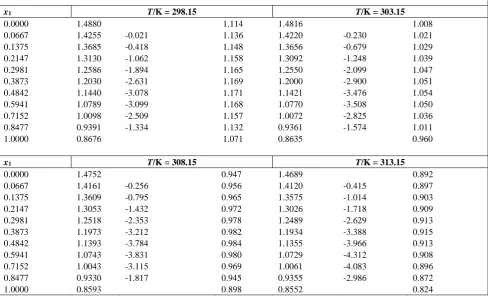
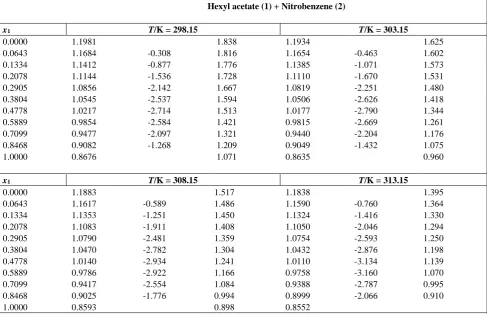
viscosity η of the studied binary mixtures at (298.15, 303.15, 308.15 and 313.15) K are given in Table 1. From the density data, excess volumes VE (cm3 mol-1) have
been calculated as
where
x, M, and ρ are the mole fraction, molar mass, and density, respectively of pure components 1 and 2 and ρ12 is the density of the liquid mixture.
The excess free energy of activation (∆G*E, J.mol-1) for
viscous flow were obtained with the expression
where η1, η and v denote the viscosity, and molar volume
of the pure components and their mixtures respectively.
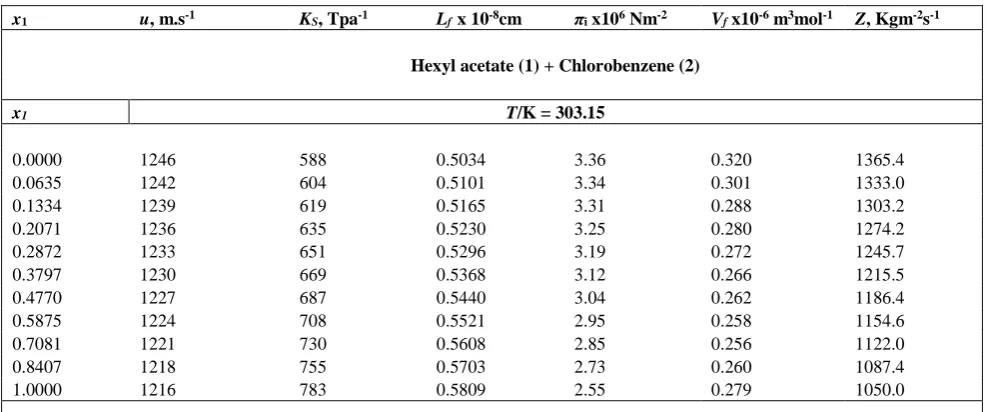
Table 2 lists the experimental values of speed of sound
u, isentropic compressibility KS, intermolecular free
length Lf, internal pressure πi , free volume Vf , and
specific acoustic impedance Z, These properties have been calculated using the following equations
where K is the temperature dependent Jacobson constant, b is the cubical packing fraction taken as 2 for all the liquids, R is the universal gas constant, T is the experimental temperature, Meff = Σximi where, x is the
mole fraction and m is the molecular weight of ith
component. The excess parameters such as isentropic compressibility ∆KS, excess intermolecular free length LfE,
excess internal pressure πiE, excess free volume VfE and
excess acoustic impedance ZE have been obtained using
the general equation
where YE refers to deviation or excess property in
question, Ym refers to the property of mixture x1Y1 and
x2Y2 refer to the mole fraction and specific property of the
pure components of 1 and 2 respectively.
(
1 1
2
2
)
1 1
2
2
(1)
12
1
2
x M
x M
x M
x M
E
V
1 1 1 2 2 2
*
ln( ) ln( ) ln( ) (2)
E
G RT x x
1/ 21
(3)
2
(4)
1/ 2
2/3
(5)
7/6
3/ 2
(6)
(7)
K SK
S
u
L
f
K
K
bRT
i
u
M
eff
M
eff
u
V
f
k
Z
u
(8)1 1 2 2
E
Table 1. Values of Density ρ, Excess Volume VE, Viscosity η for the Binary Liquid Mixtures.
x1 ρ, g.cm-3 VE, cm3.mol-1 η, mPa.s ρ, g.cm-3 VE, cm3.mol-1 η, mPa.s
Hexyl acetate (1) + Chlorobenzene (2)
T/K = 298.15 T/K = 303.15
0.0000 1.0999 0.758 1.0951 0.700
0.0635 1.0776 -0.074 0.805 1.0733 -0.118 0.740
0.1334 1.0559 -0.260 0.843 1.0518 -0.323 0.774
0.2071 1.0350 -0.481 0.880 1.0309 -0.542 0.803
0.2872 1.0146 -0.785 0.917 1.0103 -0.821 0.834
0.3797 0.9925 -1.075 0.954 0.9882 -1.107 0.866
0.4770 0.9710 -1.340 0.991 0.9669 -1.393 0.894
0.5875 0.9471 -1.388 1.026 0.9433 -1.479 0.924
0.7081 0.9223 -1.230 1.057 0.9189 -1.378 0.953
0.8407 0.8961 -0.738 1.077 0.8928 -0.898 0.971
1.0000 0.8676 1.071 0.8635 0.960
x1 T/K = 308.15 T/K = 313.15
0.0000 1.0900 0.665 1.0849 0.620
0.0635 1.0687 -0.161 0.700 1.0642 -0.214 0.650
0.1334 1.0473 -0.371 0.733 1.0430 -0.439 0.676
0.2071 1.0273 -0.688 0.758 1.0230 -0.752 0.701
0.2872 1.0069 -0.992 0.783 1.0034 -1.148 0.723
0.3797 0.9855 -1.369 0.809 0.9817 -1.487 0.747
0.4770 0.9638 -1.609 0.836 0.9600 -1.723 0.772
0.5875 0.9403 -1.713 0.865 0.9368 -1.865 0.796
0.7081 0.9153 -1.518 0.892 0.9122 -1.728 0.821
0.8407 0.8893 -1.048 0.910 0.8860 -1.218 0.835
1.0000 0.8593 0.898 0.8552 0.824
Hexyl acetate (1) + Bromobenzene (2)
x1 T/K = 298.15 T/K = 303.15
0.0000 1.4880 1.114 1.4816 1.008
0.0667 1.4255 -0.021 1.136 1.4220 -0.230 1.021
0.1375 1.3685 -0.418 1.148 1.3656 -0.679 1.029
0.2147 1.3130 -1.062 1.158 1.3092 -1.248 1.039
0.2981 1.2586 -1.894 1.165 1.2550 -2.099 1.047
0.3873 1.2030 -2.631 1.169 1.2000 -2.900 1.051
0.4842 1.1440 -3.078 1.171 1.1421 -3.476 1.054
0.5941 1.0789 -3.099 1.168 1.0770 -3.508 1.050
0.7152 1.0098 -2.509 1.157 1.0072 -2.825 1.036
0.8477 0.9391 -1.334 1.132 0.9361 -1.574 1.011
1.0000 0.8676 1.071 0.8635 0.960
x1 T/K = 308.15 T/K = 313.15
0.0000 1.4752 0.947 1.4689 0.892
0.0667 1.4161 -0.256 0.956 1.4120 -0.415 0.897 0.1375 1.3609 -0.795 0.965 1.3575 -1.014 0.903 0.2147 1.3053 -1.432 0.972 1.3026 -1.718 0.909 0.2981 1.2518 -2.353 0.978 1.2489 -2.629 0.913 0.3873 1.1973 -3.212 0.982 1.1934 -3.388 0.915 0.4842 1.1393 -3.784 0.984 1.1355 -3.966 0.913 0.5941 1.0743 -3.831 0.980 1.0729 -4.312 0.908 0.7152 1.0043 -3.115 0.969 1.0061 -4.083 0.896 0.8477 0.9330 -1.817 0.945 0.9355 -2.986 0.872
Table 1. (cont.)
Hexyl acetate (1) + Fluorobenzene (2)
x1 T/K = 298.15 T/K = 303.15
0.0000 1.0180 0.564 1.0128 0.514
0.0602 1.0032 -0.043 0.616 0.9986 -0.091 0.559 0.1243 0.9890 -0.110 0.664 0.9845 -0.161 0.603
0.1959 0.9746 -0.192 0.713 0.9703 -0.257 0.648
0.2740 0.9601 -0.252 0.763 0.9557 -0.296 0.691 0.3627 0.9455 -0.351 0.813 0.9412 -0.397 0.735 0.4592 0.9312 -0.451 0.864 0.9272 -0.528 0.779 0.5693 0.9163 -0.513 0.918 0.9121 -0.551 0.823 0.6926 0.9010 -0.497 0.972 0.8968 -0.519 0.869 0.8358 0.8850 -0.400 1.030 0.8810 -0.440 0.917
1.0000 0.8676 1.071 0.8635 0.960
x1 T/K = 308.15 T/K = 313.15
0.0000 1.0069 0.494 1.0014 0.460
0.0602 0.9934 -0.144 0.533 0.9884 -0.181 0.495 0.1243 0.9794 -0.210 0.569 0.9748 -0.277 0.526 0.1959 0.9656 -0.334 0.606 0.9610 -0.390 0.559 0.2740 0.9514 -0.406 0.645 0.9469 -0.462 0.595 0.3627 0.9368 -0.481 0.684 0.9324 -0.535 0.630 0.4592 0.9228 -0.596 0.726 0.9185 -0.649 0.668 0.5693 0.9077 -0.599 0.766 0.9035 -0.650 0.706 0.6926 0.8926 -0.577 0.813 0.8886 -0.642 0.748
0.8358 0.8770 -0.508 0.858 0.8730 -0.554 0.787
1.0000 0.8593 0.898 0.8552 0.824
Hexyl acetate (1) + Nitrobenzene (2)
x1 T/K = 298.15 T/K = 303.15
0.0000 1.1981 1.838 1.1934 1.625
0.0643 1.1684 -0.308 1.816 1.1654 -0.463 1.602 0.1334 1.1412 -0.877 1.776 1.1385 -1.071 1.573 0.2078 1.1144 -1.536 1.728 1.1110 -1.670 1.531 0.2905 1.0856 -2.142 1.667 1.0819 -2.251 1.480 0.3804 1.0545 -2.537 1.594 1.0506 -2.626 1.418 0.4778 1.0217 -2.714 1.513 1.0177 -2.790 1.344 0.5889 0.9854 -2.584 1.421 0.9815 -2.669 1.261 0.7099 0.9477 -2.097 1.321 0.9440 -2.204 1.176 0.8468 0.9082 -1.268 1.209 0.9049 -1.432 1.075 1.0000 0.8676 1.071 0.8635 0.960
x1 T/K = 308.15 T/K = 313.15
0.0000 1.1883 1.517 1.1838 1.395
The results of VE, ∆G*E, ∆K
S, LfE, πiE, VfE, and ZE versus
the mole fraction x1 are graphically represented in Figures
(1-7). The calculated values of these excess or deviation functions of the mixtures were fitted to Redlich- Kister14
polynomials of the form
where Ak are the adjustable parameters obtained by a least
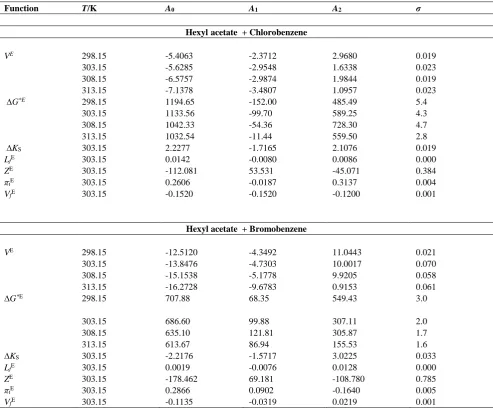
squares fit method and k is the degree of the polynomial equation. Table 3 lists the parameters with the standard deviations σ. The coefficients Ak’s were used to calculate
the solid curves of Figures 1-8. The standard deviations σ are defined as
where
D and N are the number of experimental data and equation parameters respectively.
The VE against x
1 plots of the studied binary systems at
(298.15, 303.15, 308.15 and 313.15) K are shown in Figure 1. The VE values are negative over the whole
composition range. Excess molar volumes reflect the type of interactions involving in the mixtures. For hexyl acetate + bromobenzene and hexyl acetate + nitrobenzene the negative values of VE are large in magnitude as
compared to those for hexyl acetate + fluorobenzene for which the VE values are less in magnitude and follow the
order
BrPh > O2NPh > ClPh > FPh
The VE values at other higher temperatures follow the
same trends but with different values. It is observed that there is an effect of temperature on VE as these values
increase systematically with increase in temperature. These negative values indicate the strong attractive forces involving between the liquid components. The large negative VE for the systems of bromobenzene and
nitrobenzene may be attributed to the differences in dipole moments of the liquid components leading to dipole-induced dipole interactions resulting in the formation of electron donor-acceptor complexes.17,18 No
published data was found for the present systems with which to compare our results. However comparing the present results with our earlier published data of VE for
binary mixtures of aryl halides with several esters,13 it
was found that the same trends were followed by the systems of bromobenzene and nitrobenzene. This further confirms that the large negative VE values for
bromobenzene and nitrobenzene may be due to the differences in the dipole moments of the pure components.
Figure 1. Curves of excess volumes VE versus mole fraction x 1
for the binary mixtures of hexyl acetate + chlorobenzene at (o, 298.15 ; □ , 303.15; Δ, 308.15; x, 313.15) K, hexyl acetate + bromobenzene at (▲, 298.15; ●, 303.15; ■, 308.15; , 313.15) K, hexyl acetate + fluorobenzene at ( , 298.15; , 303.15; , 308.15; + , 313.15) and hexyl acetate nitrobenzene at (X, 298.1; -, 303.15; , 308.15; +,313.15) K
Figure 2. Curves of excess free energy of activation of viscous flow ∆G*E versus mole fraction x
1 for the binary mixtures of
hexyl acetate + chlorobenzene at (o, 298.15;□, 303.15; Δ, 308.15; x, 313.15) K, hexyl acetate + bromobenzene at (▲, 298.15; ●, 303.15; ■, 308.15; , 313.15) K, hexyl acetate + fluorobenzene at ( , 298.15; , 303.15; , 308.15; + , 313.15) K and hexyl acetate + nitrobenzene at ( X , 298.15; -,303.15; , 308.15; + , 313.15) K.
The plots of ∆GE versus x
1 at (298.15, 303.15, 308.15
and 313.15) K are displayed in Figure 2, It is observed that the variation of ΔGE is completely positive over the
entire composition range of the mixtures. This indicates the existence of specific interactions in the liquid mixtures. The magnitude of ΔGE is an excellent indicator
of the strength of specific interactions in liquid mixtures.19,20 Figure 3 shows the variation of ∆K
S with
mole fraction x1 of hexyl acetate. The ∆KS values of
chlorobenzene exhibit positive deviations. For bromobenzene the ∆KS values are slightly positive in
lower mole fraction of ester (x1=0.2). 0
( ) (9)
1 2k 1 2
E k
Y x x Ak x x
e calc
0.5
2
(10)
(
)
E
E
Y
Y
D
N
Figure 3. Deviations in isentropic compressibility ∆Ks versus mole fraction x1 for the binary mixtures of hexyl acetate +
chlorobenzene at (□, 303.15) K, hexyl acetate + bromobenzene at (X, 303.15) K, hexyl acetate + fluorobenzene at (o, 303.15) K and hexyl acetate + nitrobenzene at (, 303.15) K.
Figure 4. Plots of excess intermolecular free length LfE versus mole fraction x1 for the binary mixtures of hexyl acetate +
chlorobenzene at (□, 303.15) K, hexyl acetate + bromobenzene at (X, 303.15) K, hexyl acetate + fluorobenzene at (o, 303.15) K and hexyl acetate + nitrobenzene at (, 303.15) K.
However, ∆KS becames negative as the composition of
ester increases (x1>0.2). While for fluorobenzene and
nitrobenzene the ∆KS values are completely negative over
the entire composition range. The variation of the excess intermolecular free length, LfE versus x1 displayed in
Figure 4, shows a positive deviation in LfE for mixtures of
chlorobenzene and bromobenzene. While for the mixtures of fluorobenzene the LfE values are completely
negative. Where as for nitrobenzene the LfE values
exhibit positive deviation upto x1=0.38, but as the
composition of ester increases (x1>0.38) these values
become negative. The intermolecular free length, Lf in
binary liquid mixtures can be used to assess the attraction between the component molecules. These values in a binary mixture depend on concentration. For a given binary system the intermolecular free length increases with increase in concentration of ester.
Figure 5. Plots of excess specific acoustic impedance ZE
versus mole fraction x1 for the binary mixtures of hexyl acetate
+ chlorobenzene at (□, 303.15) K, hexyl acetate + bromobenzene at (X, 303.15) K, hexyl acetate + fluorobenzene at (o, 303.15) K and hexyl acetate + nitrobenzene at (, 303.15) K.
The dependence of excess acoustic impedance with mole fraction x1 is shown in Figure 5, wherein it is
observed that ZE values for all the studied systems exhibit
negative deviation over the entire range of composition. The ZE values of nitrobenzene are large negative, while
these values are small negative for fluorobenzene and follow the order
O2NPh > BrPh > ClPh > FPh
The results of the excess internal pressure, πiE versus
mole fraction x1 at 303.15 K are displayed in Figure 6.
For the systems of chlorobenzene, bromobenzene and fluorobenzene positive πiE is observed, while for
nitrobenzene the πiE values exhibit negative deviations.
The results of excess free volume, VfE as a function of
mole fraction x1 at 303.15 K are presented in Figure 7.
Like ZE the V
fE values are completely negative over the
entire range of composition. The VfE values are small
negative for bromobenzene, while for fluorobenzene they are large negative and follow the order
FPh > ClPh > O2NPh >BrPh
Viscosity Models and Interaction Parameters
The experimental viscosities of mixtures have been correlated with the one-parameter model proposed by Frenkel and three-parameter model proposed by McAllister four–body interaction. The equations of these models are
Frenkel model:
where η is the viscosity coefficient, x1 and x2 are the mole
fractions and η12 is the interaction parameter.
2 2
Table 2. Values of Speed of sound u, isentropic compressibility KS, intermolecular free length Lf and internal pressure πi, free volume Vf and specific acoustic impedance Z of binary liquid mixtures.
x1 u, m.s-1 KS, Tpa-1 Lf x 10-8cm πi x106 Nm-2 Vf x10-6 m3mol-1 Z, Kgm-2s-1
Hexyl acetate (1) + Chlorobenzene (2)
x1 T/K = 303.15
0.0000 1246 588 0.5034 3.36 0.320 1365.4
0.0635 1242 604 0.5101 3.34 0.301 1333.0 0.1334 1239 619 0.5165 3.31 0.288 1303.2 0.2071 1236 635 0.5230 3.25 0.280 1274.2 0.2872 1233 651 0.5296 3.19 0.272 1245.7 0.3797 1230 669 0.5368 3.12 0.266 1215.5 0.4770 1227 687 0.5440 3.04 0.262 1186.4 0.5875 1224 708 0.5521 2.95 0.258 1154.6 0.7081 1221 730 0.5608 2.85 0.256 1122.0 0.8407 1218 755 0.5703 2.73 0.260 1087.4 1.0000 1216 783 0.5809 2.55 0.279 1050.0
Hexyl acetate (1) + Bromobenzene (2)
x1 T/K = 303.15
0.0000 1138 521 0.4738 3.50 0.266 1686.1 0.0667 1142 540 0.4822 3.44 0.260 1623.2 0.1375 1146 558 0.4901 3.39 0.256 1565.0 0.2147 1151 577 0.4986 3.32 0.252 1506.2
0.2981 1155 597 0.5073 3.27 0.248 1449.5
0.3873 1161 618 0.5161 3.19 0.246 1393.2 0.4842 1168 642 0.5261 3.11 0.244 1333.4
0.5941 1176 671 0.5378 3.01 0.244 1266.6
0.7152 1188 704 0.5507 2.88 0.249 1196.1 0.8477 1201 741 0.5648 2.73 0.258 1124.3 1.0000 1216 783 0.5809 2.55 0.279 1050.0
Hexyl acetate (1) + Fluorobenzene (2)
x1 T/K = 303.15
0.0000 1142 757 0.5711 3.43 0.352 1156.6 0.0602 1150 758 0.5714 3.41 0.328 1147.9 0.1243 1157 759 0.5720 3.38 0.310 1138.6
0.1959 1164 761 0.5724 3.33 0.295 1129.4
Table 2 (cont).
Hexyl acetate (1) + Nitrobenzene (2)
x1 T/K = 303.15
0.0000 1438 405 0.4178 4.55 0.128 1716.1
0.0643 1416 428 0.4292 4.42 0.130 1650.8
0.1334 1396 451 0.4406 4.28 0.133 1589.3
0.2078 1376 475 0.4525 4.12 0.138 1528.7
0.2905 1355 503 0.4657 3.95 0.145 1466.0
0.3804 1335 534 0.4798 3.76 0.155 1402.0
0.4778 1314 569 0.4951 3.55 0.168 1337.3
0.5889 1291 611 0.5132 3.32 0.184 1267.1
0.7099 1268 659 0.5328 3.08 0.205 1197.0
0.8468 1243 715 0.5551 2.83 0.235 1124.8
1.0000 1216 783 0.5809 2.55 0.279 1050.0
Table 3. Coefficients of the Redlich-Kister Equation and Standard deviations for the Excess functions of Binary mixtures.
Function T/K A0 A1 A2 σ
Hexylacetate + Chlorobenzene
VE 298.15 -5.4063 -2.3712 2.9680 0.019
303.15 -5.6285 -2.9548 1.6338 0.023
308.15 -6.5757 -2.9874 1.9844 0.019
313.15 -7.1378 -3.4807 1.0957 0.023
∆G*E 298.15 1194.65 -152.00 485.49 5.4
303.15 1133.56 -99.70 589.25 4.3
308.15 1042.33 -54.36 728.30 4.7
313.15 1032.54 -11.44 559.50 2.8
∆KS 303.15 2.2277 -1.7165 2.1076 0.019
LfE 303.15 0.0142 -0.0080 0.0086 0.000
ZE 303.15 -112.081 53.531 -45.071 0.384
πiE 303.15 0.2606 -0.0187 0.3137 0.004
VfE 303.15 -0.1520 -0.1520 -0.1200 0.001
Hexyl acetate + Bromobenzene
VE 298.15 -12.5120 -4.3492 11.0443 0.021
303.15 -13.8476 -4.7303 10.0017 0.070
308.15 -15.1538 -5.1778 9.9205 0.058
313.15 -16.2728 -9.6783 0.9153 0.061
∆G*E 298.15 707.88 68.35 549.43 3.0
303.15 686.60 99.88 307.11 2.0
308.15 635.10 121.81 305.87 1.7
313.15 613.67 86.94 155.53 1.6
∆KS 303.15 -2.2176 -1.5717 3.0225 0.033
LfE 303.15 0.0019 -0.0076 0.0128 0.000
ZE 303.15 -178.462 69.181 -108.780 0.785
πiE 303.15 0.2866 0.0902 -0.1640 0.005
Table 3 (cont).
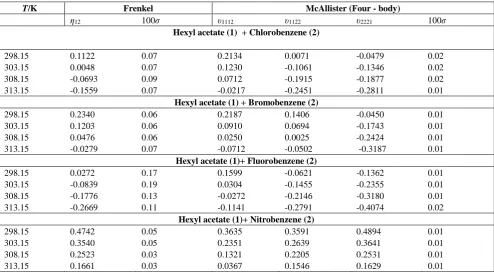
Table 4. Adjustable Parameters and Standard Percentage Deviations of Viscosity Models for Binary Liquid Mixtures
T/K Frenkel McAllister (Four - body)
η12 100σ υ1112 υ1122 υ2221 100σ
Hexyl acetate (1) + Chlorobenzene (2)
298.15 0.1122 0.07 0.2134 0.0071 -0.0479 0.02
303.15 0.0048 0.07 0.1230 -0.1061 -0.1346 0.02
308.15 -0.0693 0.09 0.0712 -0.1915 -0.1877 0.02
313.15 -0.1559 0.07 -0.0217 -0.2451 -0.2811 0.01 Hexyl acetate (1) + Bromobenzene (2)
298.15 0.2340 0.06 0.2187 0.1406 -0.0450 0.01 303.15 0.1203 0.06 0.0910 0.0694 -0.1743 0.01 308.15 0.0476 0.06 0.0250 0.0025 -0.2424 0.01 313.15 -0.0279 0.07 -0.0712 -0.0502 -0.3187 0.01
Hexyl acetate (1)+ Fluorobenzene (2)
298.15 0.0272 0.17 0.1599 -0.0621 -0.1362 0.01 303.15 -0.0839 0.19 0.0304 -0.1455 -0.2355 0.01 308.15 -0.1776 0.13 -0.0272 -0.2146 -0.3180 0.01 313.15 -0.2669 0.11 -0.1141 -0.2791 -0.4074 0.02
Hexyl acetate (1)+ Nitrobenzene (2)
298.15 0.4742 0.05 0.3635 0.3591 0.4894 0.01 303.15 0.3540 0.05 0.2351 0.2639 0.3641 0.01 308.15 0.2523 0.03 0.1321 0.2205 0.2531 0.01 313.15 0.1661 0.03 0.0367 0.1546 0.1629 0.01
Hexylacetate + Fluorobenzene
VE 298.15 -1.8815 -1.3112 -0.1815 0.012
303.15 -2.0599 -1.1687 -0.5188 0.027
308.15 -2.3204 -1.0362 -1.0608 0.028
313.15 -2.5212 -1.0091 -1.5458 0.025
∆G*E 298.15 1627.78 -528.16 525.25 2.8
303.15 1611.65 -645.80 393.60 1.5
308.15 1422.81 -456.27 370.08 3.4
313.15 1425.13 -411.46 264.52 4.7
∆KS 303.15 -1.1909 0.2125 0.6402 0.019
LfE 303.15 -0.0045 0.0008 0.0025 0.000
ZE 303.15 -29.953 12.301 -6.173 0.153
πiE 303.15 0.1601 -0.3151 0.2497 0.003
VfE 303.15 -0.1728 0.1066 -0.0904 0.001
Hexyl acetate + Nitrobenzen
VE 298.15 -10.9000 -0.5168 4.2507 0.085
303.15 -10.9000 -0.5030 1.1008 0.089
308.15 -10.9000 -1.2163 -4.4278 0.203
313.15 -10.9000 -1.6922 -7.2208 0.302
∆G*E 298.15 703.09 -85.21 384.46 2.2
303.15 702.78 -140.79 250.19 2.4
308.15 565.87 -107.18 -43.00 2.3
313.15 569.60 -133.71 -166.81 1.6
∆KS 303.15 -6.6933 -2.0456 1.5726 0.043
LfE 303.15 -0.0023 -0.0086 0.0081 0.000
ZE 303.15 -239.977 69.002 -59.020 1.183
πiE 303.15 -0.1815 -0.1449 0.0945 0.004
McAllister four-body interaction model:
where υ, υ1, υ2 are the kinematic viscosities of binary
mixtures and those of the pure components 1 and 2 respectively. υ1112, υ1122 and υ2221 are the model
parameters which are obtained by non-linear regression.
Figure 6. Plots of excess internal pressure πiE versus mole
fraction x1 for the binary mixtures of hexyl acetate +
chlorobenzene at (□, 303.15) K, hexyl acetate + bromobenzene at (X, 303.15) K, hexyl acetate + fluorobenzene at (o, 303.15) K and hexyl acetate + nitrobenzene at ( , 303.15) K.
The interaction parameters and standard percentage deviations σ(%) of the Frenkel and McAllister models at (298.15, 303.15, 308.15 and 313.15) K for the studied mixtures are presented in Table 4. It is clear that both the models are suitable for correlating the viscosities of the binary mixtures. However, as compared to one-parameter
model of Frenkel, the McAllister’s 3-parameter model gave very low σ(%) values. Thus it can be concluded that the McAllister model predicts the mixture viscosities of the studied binary mixtures more satisfactorily.
Figure 7. Plots of excess free volume VfE versus mole fraction x1 for the binary mixtures of hexyl acetate + chlorobenzene at (□,
303.15) K, hexyl acetate + bromobenzene at (X, 303.15) K, hexyl acetate + fluorobenzene at (o, 303.15) K and hexyl acetate + nitrobenzene at ( , 303.15) K.
Conclusion
Densities, viscosities for the binary mixtures of hexyl acetate with chlorobenzene, bromobenzene, fluoro-benzene and nitrofluoro-benzene have been measured at (298.15, 303.15, 308.15 and 313.15) K. While the speed of sound for these mixtures have been measured at 303.15 K. From the measured density and viscosity values, excess volume and excess free energy of activation were calculated at the respective temperatures.
From the speed of sound data isentropic compressibility
KS, intermolecular free length Lf, specific acoustic
impedance Z, internal pressure πi, free volume Vf and
their corresponding excess properties (∆KS, LfE, ZE, πiE,
VfE) have been calculated at 303.15 K. The excess or
deviation values were correlated using the Redlich-Kister Polynomial equation to obtain their coefficients and standard deviations. It has been observed that negative deviations were observed for excess volumes and positive deviations were observed for the excess free energy of activation of viscous flow. While the acoustic properties exhibit both positive and negative deviations for the studied mixtures. It was observed that the studied viscosity models exhibit the standard deviation values within the range of experimental errors. Better results for McAllister equation are due to number of experimental parameters.
Acknowledgement
The authors sincerely acknowledge the Hon’ble Editor and the reviewers for reviewing this research article.
2 2 1 2
4
3
2 2
ln
1
ln
1
4
1 2
ln
1112
6
1 2
ln
1122
3
4
2
2
4
1 2
ln
2221
2
ln
2
ln
1
1
2
3
3
1
2
4
1 2
ln
6
ln 1+
+
4
1
3
2
1
3
1
4
1 2
ln
x
x
x x
x x
x M
x x
x
x
M
M
2M
M
x x
x
M
M
M
x x
4
2
References
1Lanciotti, R., Belletti, N., Patrignani, F., Gianotti, A., Gardini,
F., Guerzoni, M. E., J. Agric. Food Chem., 2003, 51, 2958.
2Comelli, F., Ottani, S.,Francesconi, R., J. Chem. Eng. Data
1997, 42(6), 1208.
3Mohamed M, El-Banna., J. Chem. Eng. Data 1997, 42(1), 31. 4Indraswati, N., Mudjijati, W. F., Hindarso, H., Ismadji, S.,
J.Chem. Eng. Data 2001, 46(1), 134.
5Djojoputro, H., Ismadji, S., J. Chem. Eng. Data 2005, 50(2),
727.
6Arce, A., Soto, A., Orge, B., Tojo, J., J. Chem. Eng. Data 1995,
40(5), 1094.
7Ali, A., Nain, A. K., Chand, D., Lal, B., Indian J. Chem., 2005,
44(A), 311.
8Nigam, R. K., Singh. P. P., Maini, N. N., Indian. J. Chem.,
1970, 8, 998.
9Nayak, J. N., Aralaguppi, M. I.,Aminabhavi, T. M., J. Chem.
Eng. Data 2003, 48, 628.
10Joshi, S. S., Aminabhavi, T. M., Shukla. S. S., J. Chem. Eng.
Data 1990, 35, 247.
11Prasad, D. H. I., Viswanathan, S., Anand, R., J. Chem. Eng.
Data 2000, 45, 764.
12Venkateswarlu, P., Dharmaraju, G., Raman, G. K., Proc.
Indian Natl. Sci. Acod. Part A., 1982, 48, 265.
13Rathnam, M. V., Rajeev Kumar R. S., Kumar M. S. S., J.
Chem. Eng. Data 2008, 53, 265.
14Redlich, O., Kister, A. J., Ind. Eng. Chem., 1948, 40, 345. 15Frenkel, Y. I., Petroleum (London) 1946, 9(1), 27. 16McAllister, R. A., AIChE. J., 1960, 6, 427.
17Nayak, J. N., Aralaguppi, M. I., Aminabhavi, T. M., J. Chem.
Eng. Data 2003, 48, 1489.
18Jain, P., Singh, M., J. Chem. Eng. Data 2004, 49, 1214. 19Reed, T. M., Taylor, T. E., J. Phys. Chem., 1959, 63, 58. 20Meyer, R., Meyer, M., Metzger, J., Peneloux, A., J. Chim.
Phys. Phys. Chim. Biol., 1971, 63, 406.
Received: 16.01.2013. Accepted: 04.03.2013.