ISSN Online: 2333-9721 ISSN Print: 2333-9705
DOI: 10.4236/oalib.1104733 Jul. 27, 2018 1 Open Access Library Journal
On Preliminary Study of Primary and
Secondary Elements Affecting Mechanical
Properties of Rebar
Qiaozhi Sang
1, Fengzhu Yao
2, Ying Zhang
21Yisheng College, North China University of Science and Technology, Tangshan, China
2College of Architectural Engineering, North China University of Science and Technology, Tangshan, China
Abstract
The microalloying method is most widely used in the production process of high strength steel bars. However, its cost factor has become the main bottle-neck for its difficult promotion. The incomplete structure of analytic hie-rarchy model is established in this paper to identify the primary and second-ary elements affecting the performance and investigate the influence mechan-ism. The dominance numbers are especially introduced to revise the final weights. Hence under the premise of ensuring the mechanical properties of the steel bars, the cost is controlled by increasing the input of certain elements and reducing the use of other expensive micro-alloying elements.
Subject Areas
Civil EngineeringKeywords
Incomplete Structure, Analytic Hierarchy Process, Micro-Alloying
1. Introduction
At present, Micro-alloying, a new technology in materials and metallurgy, is widely used in steel mills to produce HRB400 and higher grade threaded tubes. Microalloying elements form various compounds with carbon, nitrogen, oxygen, and sulfur in the steel, which hinder the growth of prior austenite grains during heating, suppress recrystallization during the rolling process, and grow after re-crystallization, and play a role at low temperatures. Precipitation strengthens the effect and thus has multiple effects on performance. For a long time, Al has been How to cite this paper: Sang, Q.Z., Yao,
F.Z. and Zhang, Y. (2018) On Preliminary Study of Primary and Secondary Elements Affecting Mechanical Properties of Rebar. Open Access Library Journal, 5: e4733.
https://doi.org/10.4236/oalib.1104733
Received: June 21, 2018 Accepted: July 24, 2018 Published: July 27, 2018
Copyright © 2018 by authors and Open Access Library Inc.
This work is licensed under the Creative Commons Attribution International License (CC BY 4.0).
http://creativecommons.org/licenses/by/4.0/
DOI: 10.4236/oalib.1104733 2 Open Access Library Journal nology has gradually penetrated into various fields of steel production, becoming a microcosm of the advanced level of a national steel company. Different ele-ments have different ways of strengthening, rational use and optimization of components can significantly improve the performance of steel bars and reduce costs.
2. Data Preprocessing
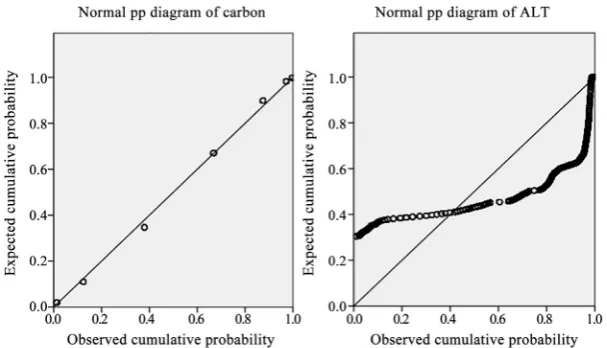
A company’s production data is collected for calculation in this paper. Due to the complexity of data collected in the actual process, there are many cases such as incorrect data (for example, the parameter is 0 or negative), missing data (with some parameters not recorded), and atypical data (data obviously deviated from the normal value and rarely occur). These data cannot be used as training samples and test samples and must be removed [4]. Generally, in the case of large samples, the data presents a normal distribution rule [5]. Therefore, the normal distribution test of chemical element data is performed by SPSS software [6]. By checking the normal PP map, it is determined whether the sample meets the normal distribution law. The normal PP diagram of C and Alt is as follows (Figure 1):
It has been found by inspection that elements do not conform to a normal distribution in the normal P-P plot of all chemical elements. Therefore, the use of a logarithmic transformation approach obeys the normalization of the log-normal distribution of data: X′ =lnX . When there exist a small value and zero, X′ =ln
(
X+1)
.3. The Primary and Secondary Factors Affecting
Performance
Mechanical Properties of Steel Bars
The mechanical properties of hot-rolled ribbed bars are mainly embodied in the mechanical strength, bending and deformation properties. This article mainly uses the three indexes of yield strength, yield strength and tensile strength (yield ratio) and elongation at break.
1) Yield strength
DOI: 10.4236/oalib.1104733 3 Open Access Library Journal
Figure 1. The normal PP diagram of C and Alt.
2) Yield ratio
The parameters yield ratio is an important indicator to measure the brittleness of steel bars. The definition is:
yield strength yield ratio
tensile strength =
The larger the value, the closer the yield and tensile strength values are, the greater the brittleness. At a constant loading rate, elongation is positively related to stretching time, which is used to measure the plasticity of the material.
3) Elongation
Elongation at break is the percentage of increase in length and initial length when the reinforcing bar is broken. The elongation at break can be measured to better reflect the toughness of the steel bar, and has a larger elongation at break. The steel bar has certain unisexual elongation when it is impacted and does not immediately break. At a constant loading rate, elongation is positively related to stretching time, which is used to measure the plasticity of the material. Therefore, the three main properties of deformed steel bars are studied: yield ratio, yield strength, and elongation after fracture. For the order of magnitude, change the yield strength to 100 Mpa and retain five decimal places.
4. Stepwise Regression
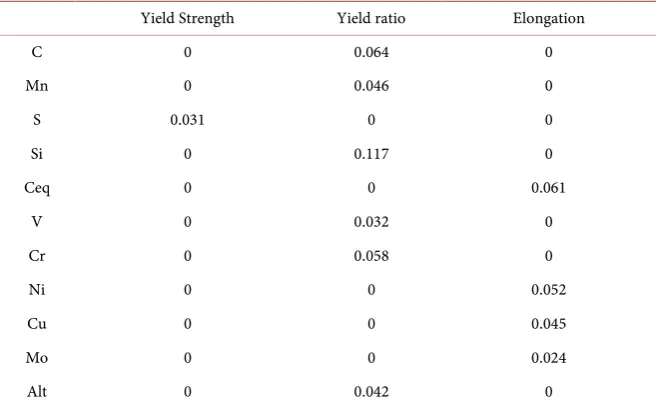
1) Rejection of irrelevant itemsFor each of the three properties, 12 chemical elements were subjected to step-wise regression processing. For the three common elements that were excluded during the stepwise regression process, their weak influence on the properties of deformed steel bars was ignored.
2) Regression coefficients
DOI: 10.4236/oalib.1104733 4 Open Access Library Journal
Ceq 0 0 0.061
V 0 0.032 0
Cr 0 0.058 0
Ni 0 0 0.052
Cu 0 0 0.045
Mo 0 0 0.024
Alt 0 0.042 0
5. Incomplete Level Analysis
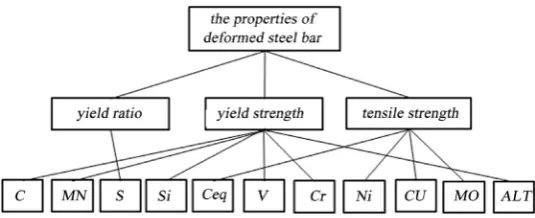
Due to the differences in the influence of different chemical element content on the microstructure and properties of steel bars, an incomplete hierarchical anal-ysis structural model was established to describe this relationship [7]. For the elements excluded from the stepwise regression analysis of a certain perfor-mance, ignoring the relationship between them and the perforperfor-mance, according to the regression coefficient obtained in the above, the correlation between the performance of the reinforcing steel and the chemical elements can be deter-mined. The final correlation result is shown in Figure 2:
In Figure 2, suppose the three properties of the standard layer reinforcement are C1, C2, C3; the 11 chemical elements in the indicator layer are P1, P2, P3, P4, P5, P6, P7, P8, P9, P10, P11. Let the weight vector of C1, C2, C3 be ( )2
(
( )2 ( )2 ( )2)
T1 , 2 , 3
w = w w w ,
C1 controls P3 in the index layer, C2 controls P1, P2, P4, P6, P7, P11 correspondingly, C3 controls P5, P8, P9, P10, the three weight vectors are denoted as:
( )
(
( ))
1 3
1 0,0, 33,0,0,0,0,0,0,0,0
w = w
( )3
(
( )3 ( )3 ( )3 ( )3 ( )3 ( )3)
2 21, 22,0, 24,0, 26, 27,0,0,0, 211
w = w w w w w w
( )3
(
( )3 ( )3 ( )3 ( )3)
3 0,0,0,0,w35,0,0, 38,w39, 310,0
w = w w
The weight of the indicator layer on the target layer is w( )3 =W( )3 ⋅w( )2, 其中
( ) ( ) ( )
(
3 3 3)
3 1 , 2 , 3
W = w w w
The importance of the three criteria of yield ratio, yield strength, and elongation after fracture is set to be the same., that is, ( )2 1 1 1, , T
3 3 3
w =
, The weights of the 11 chemical elements are then normalized using the regression coefficients in the stepwise regression process above. ( )3
13 1
w = , ( )3
21 0.064
w = , ( )3
22 0.046
[image:4.595.210.540.89.293.2]DOI: 10.4236/oalib.1104733 5 Open Access Library Journal
Figure 2. Analytic hierarchy of chemical elements and rebar performance.
Table 2. Primary and secondary factors.
Primary factors C, Si, Ceq, Cr, Ni, Cu, T Secondary factors Mn, S, V, Mo, Alt
( )3
24 0.117
w = , ( )3
26 0.032
w = , ( )3
27 0.058
w = , ( )3
211 0.042
w = , ( )3
35 0.061
w = ,
( )3
38 0.052
w = , ( )3
39 0.045
w = , ( )3
310 0.024
w = .
To obtain a rationalized result, weight the weight vector w( )2 by the number
of dominant factors, the revised one is written as w( )2 , calculate w( )3 , the
number of dominant factors C1, C2, C3 is denoted as n1, n2, n3 respectively: ( )2
(
( )2 ( )2 ( )2)
(
( )2 ( )2 ( )2)
1 1 , 2 2 , 3 3 1 1 2 2 3 3
w = n w n w n w n w +n w +n w
( )3 ( ) ( )3 2
w =W w
5. Conclusions
After solving, the final result can be obtained: ( )
(
)
3 0.097,0.069,0.091,0.177,0.122,0.048,
0.088,0.104,0.089,0.0479,0.064,0.091
w =
Therefore, the primary and secondary factors affecting the deformed rein-forcement performance are as follows (Table 2):
As can be seen from the reference data, as the carbon content in the steel in-creases, the yield point and tensile strength will increase. Si is added as reducing agent and deoxidizer in the steelmaking process. Si can significantly increase the elastic limit, yield point and tensile strength of steel; and Ceq, carbon equivalent, is the factor that determines strength and weldability in steel, carbon equivalent. With the improvement, the reinforcing steel performance will be improved ac-cordingly; Cr can significantly increase the strength, hardness and wear resis-tance, enhance the oxidation resistance and corrosion resistance of steel, but at the same time reduce the plasticity and toughness; Ni can increase the strength of steel, and Maintain good plasticity and toughness; Cu can increase strength and toughness, and verify the applicability of this method.
Conflicts of Interest
pa-DOI: 10.4236/oalib.1104733 6 Open Access Library Journal
[3] Shi, M.T. (2001) Metal Materials and Heat Treatment. Shanghai Science and Tech-nology Press, Shanghai, 85.
[4] Zhai, Z.G. and Jin, X. (2004) Research and Implementation of Data Preprocessing in Data Mining. Journal of Computer Applications, No. 07, 117-118+157.
[5] Zhu, H.B. and He, L.J. (2009) Study on the Applicable Conditions of the Consisten-cy Test of Normal Distribution Using Single Sample KS Test in SPSS. Journal of Capital College of Physical Education, 21, 466-470.
[6] Ma, T., Wu, L.C. and Huang, L. (2013) Maximum Likelihood Estimation Based on the Partial Normal Distribution Joint Location, Scale and Skewness Models. Ma-thematical Statistics and Management, 32, 433-439.