ISSN-L: 2501 - 1235 Available on-line at: www.oapub.org/edu
Copyright © The Author(s). All Rights Reserved. doi: 10.5281/zenodo.1415433 Volume 4 │ Issue 10 │ 2018
RELATIONSHIP BETWEEN SHOOTING PERFORMANCE
AND MOTORIC CHARACTERISTICS, RESPIRATORY FUNCTION
TEST PARAMETERS OF THE COMPETING SHOOTERS
IN THE YOUTH CATEGORY
Ayşegül Yapıcıi,
Çiğdem Bacak, Eylem Çelik
Pamukkale University, Faculty of Sport Sciences,
Denizli, Turkey
Abstract:
Shooting is a high precision sport, where high level performance requires several physical capacities, striking control, experience, posture control and skill of a shooter. The purpose of this study is to investigate the relationship between the shooting performance and physical capacities of the competing shooters. A total of 19 shooters participated as volunteers in the Turkish Championship youth category. Anthropometric measurements and shooting scores were recorded. Hand grip strength, flexibility, reaction time, dynamic balance, maximal oxygen consumption and respiratory function tests were applied. The correlation between shooting performance and respiratory function parameters, motoric characteristics were examined by Pearson Correlation analysis. A statistically significant correlation was found between the flexibility and shooting performance (p<0.05). There was a statistically significant correlation between right-left hand grip strengths and shooting performance (p<0.05). There was no statistically significant correlation between shooting performance and reaction time, respiratory function parameters, endurance, balance parameters (p>0.05). Motoric properties and respiratory control are important factors for successful shooting. The results of this study can provide for trainers for determining the developments and deficiencies of the different age group shooters at the point of preparation of the training plan by determining the motor characteristics during the season.
Keywords: physical capacities; breathing; shooting performance
1. Introduction
The air pistol shooting is a sports field that requires physical capacities as well as technical infrastructure and high mental focus and complex skills. The shooters shoot at the polygon located in the indoor environment, with air pistol or rifle to targets located 10 m away. Technical knowledge during shooting performance is used with mental focus. Physical strength and endurance are critical to sustaining this process throughout the entire competition. The shooter has to control a lot of extremities, joints and muscles from the feet to the wrist to keep the rifle and gun in the desired position. An air-pistol shooter should attempt to optimize their shooting position which will improve their postural stability, hold, aim, trigger control and ultimately score. To properly score a maximum value shot, a shooter must correctly perform all areas of their shooting process (NRA, 2008).
A proper marksmanship in pistol shooting is depends on many variables. Those variables include the skill of the shooter, experience, upper extremity and core strength, and posture control. Shooting is a high precision sport, where high level performance requires control of all body movements. The muscular strength, posture control and close coordination between eye, nervous system and the musculoskeletal system. In general, it is thought that heart rate, anxiety level, anthropometric measurements, health and sport related physical fitness parameters (endurance, balance, coordination, reaction time) directly affect the shooting (İskender, 2010; Gonz{lez Chas, 1997). Assessment of the physical capacities of athletes is one of the most important issues in modern sports, many test used in order that selection procedures, for screening candidates, or to monitor the efficacy of training regimes (Mon, 2006; Mon, 2009).
2. Material and Methods
2.1. Participants
A total of 19 female shooters participated as volunteers in the Turkish Championship youth category (age: 16.37±1.38 year, body height: 162.46±8.78 cm, body mass: 55.1±8.39 kg). The subjects have no health problems. They were all nonsmokers. Shooters had three years of training experience. The shooters were informed about the experimental procedures and signed an informed consent form. Participants were informed about the purpose and methods of the study prior to giving their informed consent. The study was approved by the Pamukkale University Ethics Committee, and was conducted in a manner consistent with the institutional ethical requirements for human experimentation in accordance with the Declaration of Helsinki.
2.2. Procedures
All measurements were evaluated 3 days and randomization was used. On the first day, the players participated in anthropometric measurements followed by hand grip strength, flexibility, dynamic balance measurements. On the second day, reaction time, respiratory function measurements were performed respectively. On the third day, shooters performed the multi-stage 20-m shuttle run test.
2.2.1. Anthropometric Measurements
The body height of the participants was measured using a stadiometer with an accuracy ± 1 cm (Seca, Germany), and an electronic scale (Tanita BC-418, Japan) with an accuracy of ± 0.1 kg was used to measure body mass. Leg length was measured the lower extremity length, two different starting points were identified: spina iliac anterior superior (SIAS) and umbilicus (Norton et al., 2004).
2.2.2. Shooting Point Measurements
The participants’ performance was measured by use of official paper targets, according to the Turkey Shooting Federation Rules and Regulations and as provided by the referees of the Turkish Olympic shooting federation after the competition. All shooters participated as volunteers in the Turkish Championship youth category. According to Turkey shooting federation rules, in 10 m air pistol; female were evaluated over a total of 400 points in 60 shoots in 50 minutes. After the warm-up and trial shoots, the 60 shoot results were recorded as the shoot performance score.
2.2.3. Hand Grip Strength Measurements
hands. Subjects performed three maximum attempts for each measurement and the average value of these trials was recorded. One-minute rests were given between each attempt and hands were alternated to minimize fatigue affects. No verbal encouragements were performed. The calibration of both instruments was tested periodically during the study (Arinci et al., 2002).
2.2.4. Flexibility Measurement
Flexibility measurements of the subjects were performed by sit-and-reach test on the flexibility stand. The subjects were applied to this test after warm-up. When the subjects rested their naked soles of feet on the test stand while sitting on the ground, they pushed forward ruler on the table extending forward without bending the knees and the stretching distance was recorded by standing 2 sec at the farthest point to extend (Özer, 2001; Sporis et al., 2011).
2.2.5 Reaction Time Measurements
The Plate Tapping Test (Reaction Tap Test) is a reaction test using an alternating wall tapping action which measures upper body reaction time, hand-eye quickness and coordination. This test is part of the Eurofit Testing Battery. The two yellow discs are placed with their centers 60 cm apart on the table. The rectangle is placed equidistant between both discs. The non-preferred hand is placed on the rectangle. The subject moves the preferred hand back and forth between the discs over the hand in the middle as quickly as possible. This action is repeated for 25 full cycles (50 taps). The time taken to complete 25 cycles is recorded. Performed the test twice and the best result is recorded. 1 minute rest was given between repetitions. All movements were recorded with a camera to check the score during the measurements (Eurofit, 1993).
2.2.6. Dynamic Balance Measurements
reach distance was calculated using the sum of the 3 normalized reach distances divided by 3 times the leg length, multiplied by 100 (Coughlan et al., 2012).
2.2.7. VO2 max Measurements
Subjects’ maximal oxygen uptake (VO2max) was indirectly obtained using a multi-stage
20-m shuttle run test. It involved running between two lines set 20 m apart at a pace
dictated by a recording emitting tones at appropriate intervals. Velocity was 8.5 km.h-1
for the first minute, which increased by 0.5 km.h-1 every minute thereafter. The test
score achieved by the subject was the number of 20 m shuttles completed before the subject either withdrew voluntarily from the test, or failed to be within 3 m of the end lines on two consecutive tones. All subjects performed a 10 min warm-up that included
prescribed jogging and stretching. Test results for each subject were expressed as a
predicted VO2max obtained by cross-referencing the final level and shuttle number
(completed) at which the subject volitionally exhausted with that of the VO2max table
provided in the instruction booklet accompanying the multi- stage 20-m shuttle run test. Only fully completed 20 m shuttle runs were considered (Léger and Gadoury, 1989).
2.2.8. Respiratory Function Measurements
Respiratory function characteristic were evaluated by vital capacity (VC), forced vital capacity (FVC), forced expiratory volume in one second (FEV1), the ratio of FEV1 to FVC (the Tiffeneau index), tidal volume (TV) and maximum voluntary ventilation (MVV). Respiratory analyses were measured with a BTL brand Spirometer.
2.3. Statistical Analysis
The descriptive analyzes of all the test motoric characteristics of the shooters were calculated as mean and standard deviation. The correlation between shooting performance and pulmonary function parameters, motor performance were examined by Pearson Correlation analysis. All analysis were executed in SPSS for Windows version 17.0 and the statistical significance was set at p<0.05.
3. Results
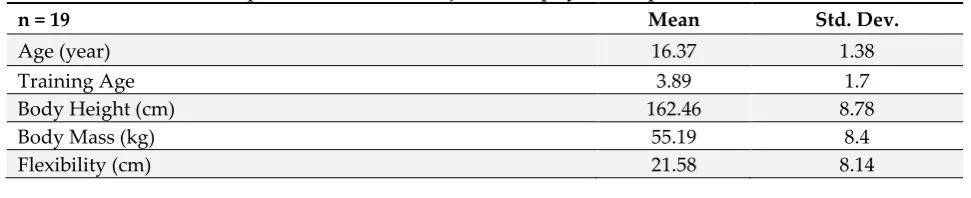
The descriptive statistics of subjects and physical capacities measurementsare given in
Table 1.
Table 1: Descriptive statistics of subjects and physical capacities measurements
n = 19 Mean Std. Dev.
Age (year) 16.37 1.38
Training Age 3.89 1.7
Body Height (cm) 162.46 8.78
Body Mass (kg) 55.19 8.4
Right hand grip strength (Nm) 28.59 8.29
Left hand grip strength (Nm) 27.26 8.23
Reaction time (s) 9.63 1.12
Right dynamic balance (cm) 118.30 1.35
Left dynamic balance (cm) 123.34 1.34
VO2max (ml.kg-1.min-1 ) 57.64 1.26
FVC (l) 3.13 0.85
FEV (l) 2.75 0.82
PEF (l/s) 3.90 1.13
FEV/FVC (%) 88.64 1.51
TV (l) 0.75 0.31
MVV (l/min) 91.61 1.81
Shooting performance 371.42 9.55
The relationship between the shooting performance and the motor characteristics of the shooters is given in Table 2.
Table 2: Pearson Correlation analysis table between shooting performance and motoric characteristics in shooters
Shooting Performance Parameters r p
Flexibility (cm) -0.58 0.01*
Right hand grip strength (Nm) 0.48 0.04*
Left hand grip strength (Nm) 0.54 0.02*
Reaction time (s) -0.04 0.87
Right dynamic balance (cm) -0.03 0.89
Left dynamic balance (cm) -0.15 0.54
VO2max (ml.kg-1.min-1 ) 0.24 0.33
*p<0.05
A statistically significant relationship was found between the flexibility and shooting performance of the shooters (p<0.05). There was a statistically significant relationship between right-left hand grip strengths and shooting performance (p<0.05). There was no statistically significant relationship between shooting performance and reaction
time, right and left dynamic balance and VO2max (p>0.05).
Table 3 shows Pearson correlation analysis between shooting performance and respiratory parameters of the shooters.
Table 3: Pearson Correlation analysis table between shooting performance and respiratory function parameters in shooters
Shooting Performance
Parameters r p
FVC (l) 0.33 0.16
FEV (l) 0.17 0.50
PEF (l/s) 0.04 0.86
TV (l) 0.15 0.53
MVV (l/min) -0.04 0.86
*p<0.05
There was no statistically significant relationship between the shooting performance and the forced vital capacity, forced expiratory volume, peak expiratory flow, the ratio of the Tiffeneau index (FEV1 to FVC), tidal volume and maximum voluntary ventilation values (p>0.05).
4. Discussion
In our study, we found that there was a statistically significant relationship between the flexibility and shooting performance. Previous studies have demonstrated (Aalto et al., 1990; Zatsiorsky and Aktov, 1990; Era et al., 1996; Konttinen et al., 1998; Mononen et al., 2007; Kayıhan et al., 2013) significant differences were found between the sets of students according to shooting accuracy groups for wrist circumference, biceps circumference, femur diameter, hand grip strength, flexibility, aerobic capacity, reaction time, balance, coordination, state anxiety level, anxiety variability, average heart rate, maximal heart rate and heart rate changes.
Shooting is an individual sport and lots of parameters affect shooter’s
performance. The muscular strength, posture control, precision, experience, skill of a shooter and upper extremity and core strength, may determine the accuracy of their shooting. The ability to stabilize the gun, related to movement of the various kinetic lines of the shooter’s body, also plays a very important role. The movements of the center of pressure on the X axis (mainly related to body movements) as well as on the Y axis (mainly related to shoulder and wrist movement control) have been associated to the vertical and the lateral movements of the gun respectively (Zatsiorsky and Aktov, 1990). That’s why all body movements is important. Also during shooting, shooters the lower extremity is static, the upper extremity is more dynamic. The increase in flexibility is important in the increase of posture control, upper extremity and core strength. The effect of flexibility on the shooting success; it is thought to be due to the positive effect of body-target harmony, which has an important place in shooting techniques. The relaxed position of the head on the shoulder and spine is thought to increase shoot success by increasing body-goal alignment.
strength and handgun qualifying score (Copay and Charles, 2001; Rodd et al., 2010; Charles and Copay, 2003; Vuckovic, G.; Dopsaj, 2007) show that 11.79 per cent of the efficiency of shooting from hand fire-arms. Under the control of gun and hand in harmony for successful shooting emphasizes that eclipse is the most important step for shooting success (Tang et al., 2008).
In our study, we found that there was no statistically significant relationship
between shooting performance and respiratory function parameters, VO2max, dynamic
balance, reaction time. Shooting requires breath control, hand-eye coordination, concentration, close coordination between eye, nervous system and the musculoskeletal system. High attention level of shooters, particularly on respiratory timing and heart rate (a low heart rate facilitating shooting between two heart beats), could also contribute to increase the performance (Konttinen et al., 1998; Tremayne et al., 1993). Shooters have to implement breathing control during the shooting process. They have to achieve eye sight alignment while breathing and finish aiming and shooting while holding breath. As soon as breathing is suspended, the body’s functions begin to depreciate as oxygen starvation sets in. One of plausible explanation for the lack of association between shooting performance and respiratory function parameters,
VO2max values could be due to the particular characteristics of the subjects.
Good postural balance is a vital component of a successful shooting performance. The study of Mononen et al. (2007) examined the relationships (r=0.33) between shooting accuracy and postural balance. The results of the Mononen et al. (2007) also suggested that postural balance is related to the shooting accuracy both directly and indirectly through rifle stability. Balance control is regulated through mechanisms of postural maintaining and stabilization, requiring management of body orientation in space by central processing of visual, vestibular and somatokinesthetic afferences (Horak et al., 1994; Massion, 1994). Static and dynamic motor skills are much important in activities such as shooting and fencing. Static balance is of major importance for shooters, fencers take much more advantage on dynamic balance (Benson et al., 1986; Fitzpatrick and McCloskey, 1994; Winter et al., 1998). Examples of field tests of dynamic balance include The Star Excursion Balance Test (SEBT). SEBT which involves stable stance with maximal targeted reach distance of the free limb in a number of directions; results from the SEBT might also be influenced by our subject’s strength, flexibility or coordination. In general, reaction time had a larger number of significant shoot variable correlates compared to accuracy, regardless of shooter skill level. A differences between skilled shooters and less-skilled shooters in not only the number of accurate shoots made during the shooting task, but also shoot reaction time, number of accurate shoots per second (Ranes et al., 2014). Despite the fact that our study group consists of elite young shooters, it may be that the test we use the reason for not finding a meaningful result for reaction time.
studies on several physical capacities in elite young shooters during national championship. There is therefore the need for further study on the importance of physical conditioning for shooting.
5. Conclusions
Motoric properties and respiratory control are important factors for successful shooting. The findings of the present study indicated that correlation between shooting performance and flexibility, right-left hand grip strengths, there was no correlation between reaction time, respiratory function parameters, endurance, balance parameters and shooting performance. The results of this study can provide for trainers for determining the developments and deficiencies of the different age group shooters at the point of preparation of the training plan by determining the motor characteristics during the season.
Conflicts of interest
The author declares no conflict of interest.
Acknowledgements
The author would like to thank all athletes for their willingness to participate in this study.
References
1. Aalto H, Pyykko I, Ilmarinen R, Kahkönen E, Starck J, 1990. Postural stability in
shooters. ORL,52(4), 232-238.
2. Anderson G.S, Plecas D.B, 2000. Predicting shooting scores from physical
performance data. International Journal of Police Science and Management. 23(4), 525-537.
3. Arinci I.N, Ceceli E, Durukan B.P, Erdem R, Yorgancioglu R, 2002. Grip strength:
Effect of Hand Dominance. Singapore Medicine Journal. 43 (5), 234-237.
4. Badau A, Badau D, Serban C, Tarcea M, Victoria R.V, 2018. Wellness integrative
profile 10 (WIP10) - an integrative educational tool of nutrition, fitness and health. Journal of the Pakistan Medical Association. 68(6), 882-887.
5. Balasubramaniam R, Riley M.A, Turvey M.T, 2000. Specificity of postural sway
to the demands of a precision task. Gait and Posture, 11, 1224.
6. Belinchon F, 2010. Estudio médico deportivo de las modalidades de tiro
olímpico. Universidad Complutense de Madrid: Madrid.
7. Benson A.J, Spencer M.B, Scott J.R, 1986. Thresholds for the detection of
8. Charles M.T, Copay A.G, 2003. Acquisition of marksmanship and gun handling skills through basic law enforcement training in an American police department. International Journal of Police Science and Management. 5(1), 16-30.
9. Copay A.G, Charles M.T, 2001. The influence of grip strength on handgun
marksmanshipin basic law enforcement training. International Journal of Police Science and Management, 24(1), 32-39.
10. Coughlan G.F, Fullam K, Delahunt E, Gissane C, Caulfield B.M, 2012. ‘A Comparison between Performance on Selected Directions of the Star Excursion Balance Test and the Y Balance Test’. Journal of Athletic Training. 47(4): 366-371. 11. Dusa F.S, Badau A, Badau D, Trambitas C, Brinzaniuc K, 2017. Investigating the
Deformation Parameters of PVC Fitness Balls in Relation to the Height and Body Mass Index of the Users. Materiale Plastice. 54(4), 606-609.
12. Era P, Konttinen N, Mehto P, Saarela P, Lyytinen H, 1996. Postural stability and skilled performance-a study on top-level and naive rifle shooters. Journal of Biomechanics. 29(3), 301-306.
13. Eurofit Tests of Physical Fitness, 1993. 2nd ed. Strasbourg: Council of Europe, Committee for the Development of Sport.
14. Fitzpatrick R, McCloskey D.I, 1994. Proprioceptive, visual and vestibular thresholds for the perception of sway during standing in humans. The Journal of Physiology. 478, 173-86.
15. González Chas J, 1997. La preparación del tirador: un estudio completo del tiro con arma corta. La Coruña: Eurotra.
16.Gorucu A, Tokay B, Badau A, 2017. The effects of three different types of
exercises on aerobic and anaerobic power. Physical education of students. 21(4),
152-157.
17. Horak F.B, Shupert C.L, Dietz V, Horstmann G, 1994. Vestibular and somatosensory contributions to responses to head and body displacements in
stance. Experimental Brain Research. 100, 93-106.
18. İskender T, 2010. The effects of the special training programme applied to the fire gun shooters on psychomotor performance. PhD Thesis, Institute of Health Scıences, Gazi University, Ankara, Turkey.
19. Kayıhan G, Ersöz F, Özkan A, Koz M, 2013. Relationship between efficiency of pistol shooting and selected physical-physiological parameters of poliçe.
International Journal of Police Science and Management. 4(36), 819-833.
20. Konttinen N, Lyytinen H, Viitasalo J, 1998. Preparatory heart rate patterns in
competitive rifle shooting. Journal of Sports Science. 16(3), 235-242.
21. Léger L, Gadoury C, 1989. Validity of the 20 m shuttle run test with 1 min stages
to predict VO2max in adults. Canadian Journal of Sport Sciences. 14(1):21-6.
22. Massion J, 1994. Postural control system. Current Opinion in Neurobiology. 4, 877-87.
24. Mon D, 2009. El trabajo de la fuerza: Bases para su aplicacion en el entrenamiento del tiro. Tiro Olímpico, 70: 22-28.
25. Mononen K, Konttinen N, Viitasalo J, Era P, 2007. Relationships between postural balance, rifle stability and shooting accuracy among novice rifle shooters. Scandinavian Journal of Medicine and Science in Sports. 17(2), 180-185. 26.National Rifle Association of America, 2008. Pistol coach school student study
guide, Fairfax, VA.
27. Norton, K, Whittingham N, Carter L, Kerr D, Gore C, Jones M, 2004. Measurement Techniques in Anthropometry, A Textbook of Body Measurement
for Sports and Health Courses. Australia: University of New South Wales P Press.
28. NSSF, 2009. A Parent’s Guide to Recreational Shooting for Youngsters, National Shooting Sports Foundation Publication, Newtown, CT.
29. Özer K, 2001. Physical Fitness, Nobel Publisher, Ankara.
30. Ranes B, Lawson B.D, King M, Dailey J, 2014. Effects of Rifle Handling, Target Acquisition, and Trigger Control on Simulated Shooting Performance, 30.
31. Rodd D, Leasure-Woodburn M, Wilson G, 2010. The effects of grip strength and firearm discharge. Indiana Law Journal. 1(8), 1-11.
32. Sporis G, Vucetic V, Jovanovic M, Jukic I, Omrcen D, 2011. Reliability and factorial validity of flexibility tests for team sports: method paper. Journal of Strength and Conditioning Research. 25(9), 1168-1176.
33. Tang W, Zhang W, Huang C, Young M, Hwang I, 2008. Postural tremor and control of the upper limb in air pistol shooters. Journal of Sports Science. 26:14, 1579-1587.
34. Tremayne P, Barry R.J, Burke S, 1993. From novices to experts in pistol shooting: what the researchers say. Sports Coaching. 16, 37-41.
35. Vuckovic G, Dopsaj M, 2007. Predicting efficiency of situational pistol shooting on the basis of motor abilities of the students of academy of criminalistic and police studies. Serbian Journal of Sports Science. 1 (1-4), 29-42.
36. Winter D.A, Patla A.E, Prince F, Ishac M, Gielo-Perczak K, 1998. Stiffness control of balance in quiet standing. Neurophysiology. 80(12), 11-21.
Creative Commons licensing terms