Available online throug
ISSN 2229 – 5046
SORET EFFECT ON DOUBLE DIFFUSIVE CONVECTION IN A VISCOELASTIC FLUID
SATURATED ANISOTROPIC SPARSELY PACKED POROUS LAYER
S. N. GAIKWAD*, ANILKUMAR PUJARI
Department of Mathematics,
Gulbarga University, Kalaburagi - 585 106, Karnataka, India.
Received On: 27-05-17; Revised & Accepted On: 16-06-17)
ABSTRACT
T
he Soret effect on the onset of double-diffusive convection in a viscoelastic fluid saturated anisotropic sparselypacked porous layer is studied using linear stability analyses. Linear theory is based on the normal mode technic.The modified Darcy law for viscoelastic fluid of the Oldroyd type model is employed for momentum equation. The onset criterion for stationary and oscillatory convection is derived analytically. The effect of Soret parameter, anisotropy parameters, Darcy-Prandlt number, and retardation retardation parameters on the stability of the system is investigated.
Keywords: Double diffusive convection, viscoelastic fluid, sparsely packed porous layer, anisotropy, Soret parameter.
NOMENCLATURE
a Wave number
c Specific heat
d Height of the porous layer
1
D Soret coefficient
Da
Darcy number, z 2K d
g Gravitational acceleration, (0, 0,−g)
i Unit normal vector in x-direction
j Unit normal vector in y-direction Κ Permeability tensor, 1 1
( ) ( )
x z
K− ii+ jj +K− kk
K
Permeability of the isotropic porous layer( . ,i e Kx=Kz+K)
k Unit normal vector in z-direction
Le
Lewis number, T s κκ
,
l m Horizontal wave number P Pressure
PrD Darcy-Prandtl number, 2
/ TZ z
vd K
γε κ
q
Velocity vector,( , , )
u v w
T
Ra Thermal Rayleigh number, βTg TdK v∆ / κTZ
s
Ra Solute Rayleigh number,βsg SdK v∆ / κTz
S
Solute concentrationr
S Soret parameter,D1βS/KTZβT
S
∆
Salinity difference between the walls T TemperatureT
∆ Temperature difference between the walls t Time
, ,
x y z Space coordinates
GREEK SYMBOLS
T
β Thermal expansion coefficient
S
β Solute expansion coefficient
η
Thermal anisotropic parameter,κ κ
Tx/
Tzε Porosity
γ
Ratio of specific heats,(
ρ
c
) /(
mρ
c
)
fΘ Dimensionless amplitude of temperature perturbation
θ
Dimensionless temperatureκ
DiffusivityS
κ Solute diffusivity
T
κ Thermal diffusivity κTx(ii+ jj)+κTz(kk)
1
λ
Stress-relaxation time2
λ
Strain-retardation time1
λ Relaxation parameter,(
κ γ
T/ d2)λ
12
λ Retardation parameter, (
κ γ
T/ d2)λ
2µ
Dynamic viscositye
µ Effective viscosity
v Kinematic viscosity,µ ρ/ 0
ξ Mechanical anisotropy parameter,Kx/KZ
Fluid density
σ Growth rate
Corresponding Author: S. N. Gaikwad*,
Department of Mathematics,
Gulbarga University, Kalaburagi 585 106,
φ Normalized porosity,
ε γ
/
Φ Dimensionless amplitude of concentration perturbation
ψ
Stream functionOTHER SYMBOLS
D d
dz
2 h
∇ 22 22
x y
∂ ∂ + ∂ ∂
2
∇ 2 2
2 h
z
∂ ∇ +
∂ 2
δ π2+a2 2
1
δ 2 1 2
a
π ξ− +
2 2
δ 2 2
a
π +η
SUBSCRIPTS AND SUPERSCRIPTS
b Basic state
c Critical
f Fluid phase
i Imaginary wall value ,
l u Lower/upper wall value
o Reference
r Real part
s Solid
m Porous medium
* Dimensionless quantity
'
Perturbed quantity F Finite amplitudeOsc Oscillatory
St Stationary
1. INTRODUCTION
In this paper, a study of the Soret effect on double diffusive convection in an anisotropic sparsely packed porous layer,saturated with viscoelastic fluid, heated from below and cooled from above is undertaken. The flow of viscoelastic fluid is of considerable importance due to its copious applications in different fields such as geothermal energy utilization, oil reservoir modeling, materials processing, petroleum, chemical and nuclear industries, bioengineering, building thermal insulation and nuclear waste disposals to mention a few. The nature of convective motion in a thin horizontal layer of viscoelastic fluid which is heated from below, in the classical Rayleigh-Benard convection geometry, has been the subject of discussion in the literature for nearly four decades, this was reviewed by Vest and Arpaci (1969), Sokolov and Tanner (1972), Rosenblat (1986),.Convection in a viscoelastic fluid saturated sparsely packed porous layer by Rudraiah et al. (1990).Martinez-Mardones and Perez-Garcia (1990,1992). Larson (1992), Khayat (1995). Viscoelastic fluids exhibit unique patterns of instabilities such as over stability that is not predicated or observed in Newtonian fluid. With the growing importance of non-Newtonian fluids in modern technology and also due to their natural occurrence, the investigations on such fluids are quite desirable. Although the problem of Rayleigh-Benard Convection (RBC) has been extensively investigated for Newtonian fluids, relatively little attention has been denoted to the thermal convection of viscoelastic fluids by Li and Khayat (2005) and references therein. The study of RBC in viscoelastic fluid may be important from a rheological point of view because the observation of the onset of convection provides potentially useful techniques to investigate the suitability of a constitutive model adopted for certain viscoelastic fluids.
Flow instability and turbulence are far less widespread in viscoelastic fluids than in Newtonian fluids because of the high viscosity of the polymeric fluids. It has long been a common belief that oscillatory convection is not possible in viscoelastic fluids in realistic experimental condition shown by Larson (1992). However, a series of experiments performed by Perkins et al. (1994) showed that dilute suspensions of long DNA molecules, in a buffer solution, behave as viscoelastic fluids, and also presented an oscillatory instability as first convective instability in that case. This possibility has been confirmed by Kolodner (1998) in his experiments on the elastic behavior of individual long strands of DNA in buffer solutions. This has pointed out the way towards obtaining a fluid in which oscillatory viscoelastic convection might be observed. He observed oscillatory convection in DNA suspensions in annular geometry. The onset of double diffusive convection in a viscoelastic fluid layer. Shown by Malashetty and Swamy(2010) .Therefore, in the present study, we intend to perform linear stability analyses of the onset of Soret effect on double diffusive convection in a viscoelastic fluid saturated anisotropic sparsely packed porous layer. Our objective is to study how the onset criterion for oscillatory convection is affected by the viscoelastic Darcy-Prandtl number, Lewis number, normalized porosity and other parameters. In the limiting cases, some previously published results can be recovered as the particular cases of our results.
2. MATHEMATICAL FORMULATION
Consider an infinite horizontal sparsely packed, viscoelastic fluid saturated anisotropic porous layer with fluid and confined between the plates z=0 and
z
=
d
, with vertically downward gravity force g acting on it. A uniform adverse temperature gradient ∆ = −T T1 Tu and a stabilizing concentration gradient ∆ =S Si −Su (T1>Tu and S1 >Su)for the Soret coefficient. The transport of heat and solute is employed for the momentum equation by Philips [20].The governing equations under Boussinesq approximation are
.q 0
∇ = (1)
(
2)
0
1 2
1 p g 1 e q .q
t t t
ρ
λ ∂ ρ λ ∂ µ µ
+ + ∇ − = + ∇ − Κ
∂ ∂ ∂
(2)
( . ) .( T. )
T
q T T
t
γ∂ + ∇ = ∇ κ ∇
∂ (3)
2 2
1
( . ) ( s. )
S
q S S D T
t
ε∂ + ∇ = κ ∇ + ∇
∂ (4)
0[1 T(T T0) S(S S0)].
ρ ρ= −β − +β − (5)
where q=( , , )u v w the velocity, p is pressure,
λ λ
1, 2 are the relaxation and retardation times respectively, gis the acceleration due to gravity,µ
is the viscosity,ρis the density,T and Sare the temperature and concentrationrespectively and
ε
is the porosity of the porous medium.κ
T =κ
Txii+κ
Tyjj+κ
Tzkk is the inverse of the permeability tensor and κT =κTxii+κTy+κTzkk is the thermal diffusivity tensor, and D1 is the Soret coefficient.γ
=(ρ
c)m (ρ
cp) ,f(
ρ
c
)
m= −
(1
ε ρ
)(
c
p) ,
fC
pis the specific heat of the fluid at constant pressure, C is the specific heat of the solid, the subscripts f s, andm
denote fluid, solid and porous medium values respectively, andβ β µ µ
T,
S,
f,
e andκ
Sare the thermal and solute expansion coefficients, fluid viscosity, effective viscosity, and solute diffusivity respectively. It is hereby stated that permeability is most strongly anisotropic than solute diffusivity. Therefore, we ignore the solute anisotropy.It is assumed that the viscoelastic liquid has relaxed enough time; typically 1 s is enough for dilute polymeric suspensions. Thus the basic state is assumed to be quiescent and is given by
(0, 0, 0), ( ), ( ), ( ), ( )
b= p= p zb T =T zb S=S zb ρ ρ= b z
q , (6)
which satisfy the following equations
b
,
b
dp
g
dz
= −
ρ
2
2
0,
b
d T
dz
=
2 2 0 ,
b
d S
dz = ρb =ρ0
(
1−α(
Tb−T0)
+β(
Sb−S0)
)
, (7)with boundary conditions
0
T =T + ∆T and S=S0+ ∆S at z=0 , (8) 0
T =T and S=S0 at z=d. (9) The steady state solutions are given as
0 1 ,
b
z
T T T
d
= + ∆ −
b 0 1
z
S S S
d
= + ∆ −
(10) with T (T T )
l u
∆ = − and S (S S )
l u
∆ = − , where T T
l > u and Sl > Su.
From the reference motionless solution we will study the stability of the system. Let the basic state be perturbed by an infinitesimal perturbation, so that
'
q=q, ' '
, ,
b b
T =T +T S =S +S ' '
, ,
b b
P=p +p ρ ρ= +ρ (11) where the prime indicates that the quantities are infinitesimal perturbations. Substituting Eq. (11) into Eqs. (1)- (5) and
using the basic state solutions, we obtaine the equations in the perturbations form
'
.q 0
∇ = (12)
(
)
'
' ' ' 2 ' '
0
1 2
1 q p g 1 e q .q
t t t
ρ
λ ρ λ µ µ
ε
∂ ∂ ∂
+ + ∇ − = + ∇ − Κ
∂ ∂ ∂
(13)
( )
(
)
'
'. ' . .
T
T T
q T w T
t d
γ∂ + ∇ − Λ = ∇ κ ∇
∂ (14)
( )
(
)
'
' ' 2 ' 2 '
1
. S.
S S
q S w S D T
t d
ε∂ + ∇ − ∆ = κ ∇ + ∇
∂ (15)
' ' '
0( TT SS ).
ρ = −ρ β +β (16) By operating curl twice on equation (13) we eliminate '
p from it and then render the resulting equation and Eqs. (14) and (15) dimensionless using the following transformations:
(
, ,)
(
, ,)
, 2 ,(
', ,' ')
Tz(
, ,)
, '( )
, '( )
Tz
d
x y z d x y z t t u v w u v w T T T S S S
d
κ γ
κ
∗
∗ ∗ ∗ ∗ ∗ ∗ ∗ ∗
= = = = ∆ = ∆
To obtain non-dimensional equations as (after dropping the asterisks for simplicity)
2
2 2 2 2 4
1 2 2
1 1
1 1 ,
PrD w RaT hT RaS hS h Da w
t t t z
λ λ γ ξ ∂ ∂ ∂ ∂ + ∇ − ∇ + ∇ = + −∇ − + ∇ ∂ ∂ ∂ ∂
(18)
( )
2 2
2 . 0,
h T q T w
t η z
∂ − ∇ + ∂ + ∇ − = ∂ ∂ (19)
( )
2 2 1. r 0,
S q S S T w
t Le φ ∂ − ∇ + ∇ − ∇ − = ∂ (20)
where RaT =βTg Td∆ Κ/υκTz the thermal Rayleigh number, RaS =βSg Sd∆ ΚZ/υκTz the solute Rayleigh number,
(
2)
1 Tz/d 2
λ = κ λ retardation parameter, Sr =D1β κ βs/ TZ T the Soret parameter,
2 /
e z f
Da=
µ
kµ
d the Darcy number,2
PrD =γενd /ΚzκTz the Darcy-Prandtl number, Le=κTx/κTz the Lewis number, ξ =kx/kz the mechanical
anisotropic parameter, η κ= Tx/κTz is the thermal anisotropic parameter, φ ε γ= / normalized porosity. Eqs. (18)- (20) are solved for stress free, isothermal and isosolutal and boundary conditions. Hence the boundary conditions for the perturbation variables are given by
0,
w= = =T S at z=0,1 (21)
3. LINEAR STABILITY ANALYSIS
In this section we predict the thresholds of both stationary and oscillatory convection using linear theory. The Eigen value problem defined by Eqs. (18)-(20) subject to the boundary conditions (21) is solved using the time–dependent periodic disturbances in a horizontal plane, upon assuming that amplitudes are small enough and can be expressed as
( )
( )
( )
(
)
0 0 0 exp ,W z W
z i lx my t
z
σ
Θ = Θ + +
Φ Φ
(22)
where l and m are the wave numbers in the horizontal plane and σ is the growth rate, Infinitesimal perturbations of the rest state may either damp or grow depending on the value of the parameterσ . Substituting Eq. (22) into Eqs. (18) - (20) we obtain
(
)
(
2 2)
2 2(
)
(
2 2)
2 2 21 2
1
1 1 ,
PrD D a W a RaT a RaS Da D a a D W
σ
λ σ λ σ
ξ
+ − + Θ − Φ = + − + −
(23)
(
2 2)
0,
D a W
σ η
− − Θ − =
(24)
(
2 2)
(
2 2)
1
0,
r
D a S D a W
Le
φσ
− − Φ − − − =
(25) where D=d dz/ and a2 = +l2 m2. In case of stress-free boundary conditions, it possible to solve analytically the
system of Eqs.(23) – (25) . This is a standard Eigen value-Eigen function problem. Here the Rayleigh number is taken as the Eigen value and it is expressed as a function of the other parameters which govern the stability of the system. The solution of Eqs. (23) – (25) satisfying the boundary conditions (21) are assumed in the form
( )
( )
( )
(
)
0 0 0sin , 1, 2, 3... .
W z W
z n z n
z
π
Θ = Θ =
Φ Φ
(26)
The most unstable mode corresponding to
n
=
1
(fundamental mode). Therefore, by substituting Eqs. (26) withn
=
1
into Eqs. (23) – (25).we obtain a matrix equation of the form
2 2
11 0
2
2 0
2 2 0
0
1 0 0
0 1
-1
T S
r
M a Ra a Ra W
S
Le
σ δ
δ φσ δ
−
− + Θ =
Φ
+
(27)
where 2 2 2
,
a
δ =π + 2 2 1 2
1 a
δ =π ξ− + and 2 2 2
2 a .
δ =π +η
The condition of non-trivial solutions of above system of homogeneous linear equations (27) yields the expression for the thermal Rayleigh number in the form
(
)
2 2 22
2 4
2 2 2
1 2 1 2
1 1 Pr 1 r T S D S
Ra Da Ra
a Le
λ σ
σ δ
σ δ
δ
σδ
δ
δ
λ σ
φσ
−δ
+ − + −
= + + +
+ +
4. STATIONARY CONVECTION
For validity of the principal of exchange of stabilities (i.e., steady case), we have
σ
=
0
(
i e
. .,
σ
r=
σ
i=
0
)
at themargin of stability, then Eq. (28) gives the Rayleigh number at which marginally stable steady mode exists as
(
)
2(
)
(
2 2)
2 2
2 2 2 2 2
2 2
1
.
S r
T
LeRa S
Ra a a Da a
a
δ δ
π
π η π
ξ δ
−
= + + + + +
(29)
The minimum value of the Rayleigh number RaTst occurs at the critical wave number a=acst where acst= x
satisfies a polynomial equation of degree four in
x
as4 3 2
0 1 2 3 4 0
c x +c x +c x +c x c+ = (30) where
2 2
0
4 2 2
1
4
2 4 6 2
2
6 8 3
8
10 5
4
6 ,
2 2 6 ,
2 ,
2
2 ,
2 .
s s s r
c Da Da
c Da Da
c Le Ra Da Le Ra LeRa S
c Da
c Da Dax
π η π η
π π η π η
π
π π η π η π η
ξ π
π ξ
π
π η
ξ
= + +
= + +
= − + + + − −
= − −
= − + −
In the absence of the Darcy number, i.e., Da=0 equation (29) implies
(
)
2(
(
2(
2) (
)
2 2)
)
2 2 2
2 2 2
1
,
S r
st T
Le Ra a S a
Ra a a
a a
π
η
π
π
π
η
ξ
π
+ − +
= + + +
+
(31)
Equation (31) exactly coincides with the result of Malashetty et.al [21].
For an isotropic porous media, that is when
ξ η
= =
1
, equation (29) gives(
)
(
) ( )
2
2 2
2 2
2 2 2
(1 )
1 ,
st s r
T
a Le Ra S
Ra Da a
a a
π
π
π
+ −
= + + +
+ (32)
This is exactly the one given by Poulikakos [15] for double diffusive convection in a horizontal sparsely packed porous layer. For a single component fluidRaS =0, the expression for stationary Rayleigh number given by equation (31) becomes
(
)
2
2 2 2
2
1 st T
Ra a a
a
π π η
ξ
= + +
, (33)
which is the one obtained by Storesletten [19] for the case of a single component fluid. Further for an isotropic porous medium
ξ η
= =
1
the above equations (33) reduces to the classical results(
)
22 2
2
1 st T
Ra a
a
π
= + , (34)
which has the critical value Racst =4
π
2 for acst =π
2 obtained by Horton and Rogers [11] and Lapwood [10].5. OSCILLATORY CONVECTION
We now set
σ σ
=
i
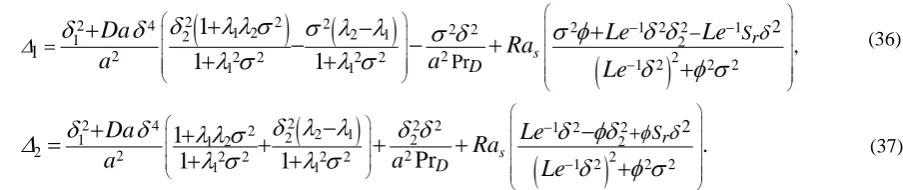
in equation (28) and clear the complex quantities from the denominator to obtain1 i 2
T
where
(
)
(
)
(
)
2 2 2
2 4 1 2 2 1 2 2 2 1 2 2 1
2
1 2
2 2 2 2 2 2 2
1 2 2 2
1 1
2
1 ,
Pr
1
1
1
sr D
S
Da
Le
Le
Ra
a
a
Le
δ
∆
δ
δ
δ
λ λ σ
σ λ λ
σ δ
σ φ
δ δ
λ σ
λ σ
δ
φ σ
− −
−
−
=
+
+
−
−
−
+
+
+
+
+
(36)
(
)
(
)
2
2 4 2 2 1 2 2 1 2 2
2
1 1 2 2 2
2 2 2 2 2 2 2 2
1 2 2 2
1 1
2
1
.
Pr
1
1
sr D
S
Da
Le
Ra
a
a
Le
φ δ
δ λ λ
δ
δ
λ λ σ
δ δ
δ φδ
∆
λ σ
λ σ
δ
φ σ
−
−
+
−
+
+
−
=
+
+
+
+
+
+
(37)Since RaT is a physical quantity, it must be real. Hence, from equation (35) it follows that eitherσi=0 (steady onset)
or
∆
2=0(
σ
i ≠0)
(oscillatory onset). For oscillatory onset∆
2=0(
σ
i ≠0)
and this gives an expression for frequency of oscillations in the form (on dropping the subscripti
)( ) ( )
22 2
0 1 2 0
a σ +a σ +a = (38)
Now equation (35) with
∆
2=0 gives,(
)
(
)
(
)
2 2 2
2 1 2 2 1 2 2 2 1 2 2
2
1 2
2 2 2 2 2 2 1 2 2 2
1 2
4
1
( ),
Pr
1
1
1
D sr
S
Da
Le
osc
Ra
Ra
T
a
a
Le
δ
λ λ σ
σ λ λ
δ
δ
σ δ
σ φ
δ δ
λ σ
λ σ
δ
φ σ
−
−
−
+
−
+
+
=
−
−
+
+
+
+
(39)
we find the oscillatory neutral solutions from equation (39). It proceeds as follows: First determine the number of positive solutions of equation (38). If there are none, then no oscillatory instability is possible. If there are two, then the minimum (over a2) of equation (39) with σ2 given by equation (38) gives the oscillatory neutral Rayleigh number. Since equation (38) is quadratic in σ2, it can give rise to more than one positive value of σ2 for fixed values of the parameters RaS,Da,λ λ1, 2,Le, , Pr ,φ D ξ and
η
. However, our numerical solution of equation (38) for the range ofparameters considered here gives only one positive value of σ2 indicating that there exists only one oscillatory neutral
solution. The analytical expression for oscillatory Rayleigh number given by equation (39) is minimized with respect to the wavenumber numerically, after substituting for σ >2
( )
0 from equation (38), for various values of physicalparameters in order to know their effects on the onset of oscillatory convection.
6. RESULTS AND DISCUSSION
The Soret effect on double diffusive convection in a viscoelastic fluid sparsely packed saturated anisotropic porous layer, which is heated and salted from below, is investigated analytically using the linear stability theory. In the linear stability theory the expressions for the stationary and oscillatory Rayleigh number are obtained analytically along with expression for frequency of oscillation. The variation of the critical oscillatory Rayleigh number with strain retardation parameter
λ
2 for different parameters is shown in figures 1 - 8. Figure 1 displays the effect of relaxation parameter1
λ
on the critical Rayleigh number. We observe that an increase of relaxation parameterλ
1, decreases the critical Rayleigh number indicating that relaxation parameterλ
1destabilizes the system. Figure 2 shows the effect of the mechanical anisotropy parameter ξ on the critical Rayleigh number. We find that an increase of anisotropy parameter decreases the critical Rayleigh number indicating that the mechanical anisotropic parameter destabilizes the system. Figure 3 indicates the variation of the critical Rayleigh number with strain retardation parameter λ2 for different values of thermal anisotropy parameterη.It is observed that an increase in the thermal anisotropy parameter η decreases the critical Rayleigh number. Thus the effect of thermal anisotropy parameter ηis to advance the onset of convection. InFigure 4 it is observed that the critical Rayleigh number decreases with an increase in the Lewis number
Le
. Thus the effect of Lewis numberLe
is to advance the onset of convection. Figure 5 shows the effect of the solute Rayleigh number on the critical Rayleigh number; we find that an increase in the solute Rayleigh numberRaS increases thecritical Rayleigh number. Thus the effect of increasing solute Rayleigh number RaS is to stabilize the system. Figure 6 shows the effect of Darcy-Prandtl number PrD on the critical Rayleigh number for fixed values of the other parameters.
We find that an increase in the value of Darcy-Prandtl number PrD decreases the region of stability indicating that the
effect of Darcy-Prandtl number PrD is to destabilize the system. Figure 7 indicates the variation of the critical Rayleigh
number with strain retardation parameter λ2for different values of the Darcy numberDa. It is observed that the
the onset of convection. From figure 8 we observe that the critical oscillatory Rayleigh number RaTc decreases with an increase of normalized porosity
φ
. Thus the effect ofφ
is to destabilize the system. Figure 9 depicts the effect of Soret parameterSr
on oscillatory Rayleigh number withRaTc. From this figure we observe that an increase in the values (positive) of the Soret parameter decreases the oscillatory Rayleigh number indicating that Soret parameter destabilizes the system for oscillatory mode. On the other hand, for increasing in the negative Soret parameter decreases the oscillatory Rayleigh number indicating that the effect of negative Soret parameter destabilizes the system for oscillatory convection.7. CONCLUSIONS
The Soret effect on the onset of double diffusive convection in a viscoelastic fluid saturated anisotropic sparsely packed porous layer is investigated analytically using the linear stability theory. The usual normal mode technique is used to solve the linear problem. The following conclusions are drawn:
1. The Soret parameter stabilizing effect on oscillatory convection and destabilizing effect on stationary convection.
2. In the neutral stability curves, the effect of strain retardation parameter, thermal anisotropy parameter Lewis number, solute Rayleigh number and Darcy number stabilize the system whereas, stress relaxation parameter, mechanical anisotropy parameter, Darcy-Prandtl number and normalized porosity destabilize the system. 3. And for critical curves, the effect solute Rayleigh number and Darcy number stabilize the system whereas,
stress relaxation parameter, mechanical anisotropy parameter, Lewis number, Darcy-Prandtl number and normalized porosity destabilize the system.
0.0 0.1 0.2
100 150 200 250
λ2
RaTc
Fig.1. Variation of critical Rayleigh number with strain retardation parameter λ
2 for different values of stress relaxation parameter λ1 .
1.2 1 0.8 0.6
λ1 = 0.4
Ras = 100, Da = 0.1, ξ = 0.5, Le = 10, η = 0.3, PrD = 10, φ = 0.4, Sr=0.005
0.0 0.1 0.2 0.3 0.4
100 150 200 250 300
02 0.9 0.5 0.2
ξ = 0.1
Ras = 100, Da = 0.1, Le = 10,
η = 0.3, PrD = 10, φ = 0.4, λ1 = 0.1, Sr=0.005
λ2
RaTc
0.03 0.06 0.09 0.12 0.15 80
100 120 140 160 180 200
1 0.6, 0.3, 0.2,
η = 0.1
Ras = 100, Da = 0.1, ξ = 0.5, Le = 10,
PrD = 10, φ = 0.4, λ1 = 0.1, Sr=0.005
λ2
RaTc
Fig.3. Variation of critical Rayleigh number with strain retardation parameter λ2 for different values of thermal anisotopy η.
0.0 0.1 0.2 0.3 0.4 0.5
50 100 150 200
λ2
75 50 25 15
Le = 10
Fig.4 Variation of critical Rayleigh number with strain retardation parameter
λ2 for different values of Lewis number Le.
RaTc
Ras = 100, Da = 0.1, ξ = 0.5, Le = 10,
η = 0.3, PrD = 10, φ = 0.4, λ1 = 0.1, Sr=0.005
0.0 0.1 0.2 0.3 0.4 0.5 0.6
50 100 150 200 250
λ2 RaTc
Fig.5 Variation of critical Rayleigh number with strain retardation parameter
λ2 for different values of Solute Rayleigh number Ras.
30 50 75 Ras=100
λ1=0.8,Le=10, PrD=10,η = 0.3, Da =0.1, ξ = 0.5,
0.005 0.010 0.015 0.020 0.025 0.030 95
100 105 110 115 120 125 130
10 9 7 6
PrD = 5
Ras = 100, Da = 0.1, ξ = 0.5, Le = 10,
η = 0.3, φ = 0.4, λ2 = 0.1, Sr=0.005
λ2
RaTc
Fig.6. Variation of critical Rayleigh number with strain retardation parameter λ2 for different values of Darcy- Prandtl number PrD .
0.00 0.05 0.10 0.15 0.20
100 125 150 175
λ2
0.01 0.02 0.03
Da = 0.1 0.05
RaTc
Ras = 100, ξ = 0.5, Le = 10,
η = 0.3, PrD = 10, φ = 0.4, λ1 = 0.8, Sr=0.005
Fig.7. Variation of critical Rayleigh number with strain retardation parameter
λ2 for different values of Darcy number.
0.0 0.1 0.2 0.3 0.4
50 100 150 200
(RaT)Osc
λ2
0.7 0.6 0.5
φ = 0.4
Ras = 100, Da = 0.1, ξ = 0.5, Le = 10,
η = 0.3, PrD = 10, λ1 = 0.8, Sr=0.005
Fig.8 Variation of critical oscillatory Rayleigh number with strain retardation parameter
0.0 0.1 0.2 0.3 0.4 0.5 0.6 0
50 100 150 200
(RaT)Osc
λ2
1 1.5, 0.07, -0.1
Sr = -0.4
λ1=0.8,Le=10, PrD=10, Da =0.1, ξ = 0.5, Ras=100
φ = 0.4
Fig.9. Variation of critical oscillatory Rayleigh number with strain retardation
parameter λ
2 for different values of Soret parameter Sr.
REFERENCE
1. Vest C. M. and Arpaci V. S. (1969): Over stability of a viscoelastic fluid layer heated from below, J. Fluid Mech.,36, 613-623.
2. Sokolov M. and Tanner R. I. (1972): Convective stability of a general viscoelastic fluid from below, Phys. Fluid, 15, 534-539.
3. Rosenblat S. (1986): Thermal convection of a viscoelastic fluid, J. Non-Newtonian fluid Mech. 21, 201-223. 4. N.Rudaiah, P. V. Radadevi, and P. N. Kaloni, (1990): Convection in a viscoelastic fluid saturated sparsely
packed porous layer.Canadian J. of Physics, 68(12):1446-1453, 10.1139/P90-207.
5. Martinez-Mardones J. and Perez-Garcia C. (1990): Linear instability in viscoelastic fluid Convection, J. Phys. Condens Matter, 2, 1281-1290.
6. Martinez-Mardones J and Perez-Garcia C. (1992): Bifurcation analysis and amplitude equations for viscoelastic convective fluids, II Nuovo Cimento, 14, 961-975.
7. Khayat R. E. (1995): linear over stability in the thermal convection of viscoelastic Fluids, J Non-Newtonian Fluid Mech, 58, 331-356.
8. Li Z and Khayat R. E. (2005): Finite-amplitude Rayleigh–Benard convection and pattern selection for viscoelastic fluids, J. Fluid Mech., 529, 221-251.
9. Horton C. W. and Rogers F. T. (1945): Convection currents in a porous medium, J. Appl. Phys., 16, 367-370. 10. Lapwood E. R. (1948): Convection of a fluid in a porous medium, Proc. Camb. Philos. Soc., 44, 508-521. 11. Brand H. R. and Steinberg V. (1983): Nonlinear effects in the convective instability of a binary mixture in a
porous medium near threshold, Phys. Letters A, 93, 333-336.
12. Nield D. A. (1983): The boundary corrections for the Rayleigh-Darcy problem: Limitations of the Brinkman equation, J. Fluid Mech., 128, 37-46.
13. Brand H. R. and Steinberg V. (1983): Nonlinear effects in the convective instability of a binary mixture in a porous medium near threshold, Phys. Letters A, 93, 333-336.
14. Poulikakos (1986): Double diffusive convection in a horizontally sparsely packed porous layer, Int. Comm. Heat Mass Transfer, 13, 55, 587-598.
15. Larson R. G. (1992): Instabilities in viscoelastic flows, Rheol. Acta, 31, 213-221.
16. Perkins T. T., Quake S. R, Smith D. E. and Chu S. (1994): Relaxation of single DN Amolecule observed by optical microscopy Science, 264, 822–826.
17. Kolodner P. (1998): Oscillatory convection in viscoelastic DNA suspensions, J. Non-Newtonian Fluid Mech., 751, 67-192.
18. Storesletten L. (1998): Effects of anisotropy on the convection flow through porous media, Transport Phenomena in Porous Media, Pergamon Press, Oxford, 261-283.
19. Zhang Z, Fu. C. and Tan W. (2008): Linear and nonlinear stability analyses of thermal convection for Oldroyd-B fluids in porous media heated from below, Phys. Fluids, 20, 084103-084112.
20. Phillips O. M. (2009): Geological Fluid Dynamics, Cambridge University Press, New York.
21. Malashetty M. S., Swamy M. and Sidram W. (2010): Thermal convection in a rotating viscoelastic fluid saturated porous layer, Int J. Heat Mass Transf., 53, 5747-5756.
22. M. S. Malashetty and M. Swamy, (2010): “The onset of double diffusive convection in a viscoelastic fluid layer,” J. Non-Newtonian fluid Mech.165, 1129, 41S.
Source of support: Nil, Conflict of interest: None Declared.