POLARIZATION STUDY OF CORROSION INHIBITION BY
GLYCINE- Zn
2+SYSTEM
J. Angelin Thangakani
[a], S. Rajendran
[b,c]*, J. Sathiyabama
[b],J. Lydia Christy
[d],
A. Suriya Prabha
[e]and M. Pandiarajan
[b]Keywords:Corrosion inhibition, mild steel, polarization studies, glycine, zinc2+
The inhibition efficiency of glycine-Zn2+ system has been evaluated by weight loss method and polarization study. Glycine alone has some
corrosion inhibition efficiency (IE). In presence of Zn2+, IE increases. Synergistic effects exist between Zn2+ and glycine. The formulation
consisting of 250 ppm of glycine and 50 ppm of Zn2+ has 86% IE. Polarization study reveals that this system function as mixed inhibitor
system, controlling the anodic reaction and cathodic reaction to an equal extent.
*Corresponding Authors
*E-mail: [email protected]
[a] CEOA Matriculation Higher Secondary School, A Kosakulam, Madurai, E.mail: [email protected] [b] Corrosion Research Centre, PG and Research, Department of
Chemistry, GTN Arts College, Dindigul- 624005, India. E.mail: [email protected]
[c] Department of Chemistry, Corrosion Research Centre, RVS School of Engineering and Technology, Dindigul 624005, India. E.mail: [email protected]
[d] Department of Chemistry, VSB Engineering College, Karur-639 111, Tamilnadu, India.
[e] Department of Chemistry, Shanmuganathan Engineering College,Arasampatti-622 507, India.
E-mail: [email protected]
Introduction
Metals are extracted from their ores by reduction process. When metals come in contact with the environment, especially oxygen and moisture, they deteriorate. This process, we call corrosion. Corrosion is the expression of desire of pure metals to go back to their original state of ores. Corrosion is a natural, spontaneous and thermodynamically stable process. The process of corrosion can be controlled but it cannot be prevented. There are many methods by which corrosion can be controlled.
One such method is the use of inhibitors. These inhibitors when added is small quantity, decrease the rate of corrosion. Corrosion inhibitors usually contain polar groups with atoms such as nitrogen, sulphur and oxygen. Correspondingly inhibitors include a wide list of organic and inorganic compounds containing the functional groups such as amines1,2 nitrocompounds3,4, amides,5,6 aldehydes,7,8 ketones, 9,10 ester,11,12 carboxylic acids,13,14 thiocompounds,15,16
phosphates,17,18 phosphonates19,20 and amino acids. 21-25
Amino acids contain both carboxyl group and amino group. There are several amino acids .The simplest amino acid is glycine. Several amino acids such as valine,26
glutamic acid,27 phenyl alanine,30 tyrosine,31 and tryptophan 32 have been used as corrosion inhibitors. These corrosion
inhibition efficiency is very much influenced by pH value of the medium since, under high pH value the carboxyl group will be in ionized form and under low pH value the carboxyl group will be in unionized form; but the amino group will be in protonated form. Interestingly, at isolectric point amino
acids will exist as zwitter ions, having both positive and negative charges. When an electric field is applied these ions will not move towards either the anode or the cathode. Hence these zwitter ions will be in the bulk of the solution. They will not be adsorbed on the metal surface. Hence their corrosion protection efficiency considerably decreases.
The present work is undertaken (i) to evaluate the corrosion inhibition efficiency of glycine in controlling corrosion of mild steel in an aqueous solution containing 60 ppm of Cl-, in the absence and presence of Zn2+ and (ii) to
investigate the mechanistic aspects of corrosion inhibition by polarization study
MATERIALS AND METHODS
Metal specimens
Mild steel specimen was used in the present study. (Composition (wt %): 0.026 S, 0.06 P, 0.4 Mn, 0.1 C and balance iron. The dimension of the specimen was 1 x 4 x 0.2 cm
Weight-loss method:
Mild steel specimens in triplicate were immersed in 100 ml of aqueous solution containing 60 ppm of Cl- in the
presence and absence of Zn2+ and glycine for one day. The
weight of the specimens before and after immersion was determined using a Shimadzu balance, model AY62.The corrosion products were cleansed with Clarke’s solution 33.
The inhibition efficiency (IE) was then calculated using the
equation:
where
W1 = corrosion rate in the absence of the inhibitor. W2 = corrosion rate in the presence of the inhibitor.
2
100 % (1)
1
W IE
W
Potentiodynamic polarization
Polarization studies were carried out in a CHI – Electrochemical workstation with impedance, Model 660A. A three-electrode cell assembly was used. The working electrode was mild steel. A saturated calomel electrode (SCE) was the reference electrode and platinum was the counter electrode. From the polarization study, corrosion parameters such as corrosion potential (Ecorr), corrosion
current (Icorr) and Tafel slopes (anodic = ba and cathodic = bc) and Linear polarization resistance (LPR) were calculated.
Results and Discussion
Analysis of weight loss method
The inhibition efficiency of glycine (Schemes1 and 2) in controlling corrosion of mild steel immersed in an aqueous solution containing 60 ppm of Cl- at pH 7.6 has been evaluated by weight loss method and polarization study, in the absence of and presence of Zn2+ ion.
Scheme1. Molecular structure of glycine
Scheme 2. Space filling model of glycine
Corrosion rates of mild steel immersed in an aqueous solution containing 60 ppm of Cl-, in the absence and presence of Zn2+ are giving in Table1. The inhibition
efficiencies are also giving in this Table.
Table1. Corrosion rates (CR) of mild steel immersed in an aqueous solution containing 60 ppm of Cl- and the inhibition efficiency (IE) obtained by weight loss method
Glycine concentration, ppm
Zn2+ concentration, ppm
0 ppm 25 ppm 50 ppm
CR IE% CR IE% CR IE%
0 50 100 150 200 250
36 - 31.68 12 30.60 15 28.80 20 27.00 25 23.04 36
30.60 15 27.00 25 25.2 30 22.32 38 21.60 40 19.80 45
28.80 20 12.60 65 10.80 70 5.40 85 5.04 86 5.02 86
Immersion period: One Day; CR – Corrosion Rate (mdd), IE -Inhibition Efficiency
It is observed that glycine alone has some inhibition efficiency. As the concentration of glycine increases, IE also increases. 50 ppm of glycine has 12% IE and 250 ppm Glycine has 36% IE.
Influence of Zn2+ on inhibition efficiency of glycine
When Zn2+ (as ZnSO
4.7H2O) is added to glycine system,
the IE of glycine increases. This suggests that a synergistic effect exists between Zn2+ and glycine. Similar synergistic
effect existing between Zn2+ and inhibitors has been
reported by several researchers. 34-38
The synergistic effect existing between Zn2+ and glycine
can be explained as follows. When glycine and Zn2+ are
mixed, Zn2+-glycine complex is formed. It is transported
towards the metal surface. On the metal surface, Zn2+
-glycine complex is broken. The released -glycine combines with Fe2+ (formed on the metal surface due to corrosion
process) resulting in the formation of Fe2+-glycine complex.
Fe2+-glycine complex is more stable than Zn2+-glycine
complex.39-43
Potentiodynamic polarization study
Corrosion is a problem facing us every day and in almost every activity. Corrosion wastes material and energy, and could prevent objects from doing the job they were made to do, possibly with dangerous consequences.
The rate at which corrosion occurs depends on the kinetics of the reactions taking place and so the electrical double layer is important.
An electrical double layer is the name given to any region between two different phases when charge is separated across the interface between them.
In aqueous corrosion, this is the region between a corroding metal and the bulk of the aqueous environment (“free solution”). In the double layer, the water molecules of the solution align themselves with the electric field generated by applying a potential to the metal. In the Helmholtz model, there is a layer of aligned molecules (or ions), which is one particle thick and then immediately next to that, free solution. In later models (proposed by Louis Georges Gouy, David Leonard Chapman and Otto Stern) the layer is not well defined, and the orientation becomes gradually less noticeable further from the metal surface. However, for the purposes of determining the rate of corrosion, the Helmholtz model will suffice. To corrode, an ion in the metallic lattice must pass through the double layer and enter free solution. The double layer presents a potential barrier to the passage of ions and so has an acute effect on corrosion kinetics.
Helmholtz Double Layer
This theory is a simplest approximation that the surface charge is neutralized by opposite sign counter ions placed at an increment of d away from the surface.
Scheme 3. Helmholtz Double Layer
If an electrode is at its equilibrium potential, both forwards and backwards reactions occur at the same rate, so no net reaction will occur. Net reactions only occur when the potential is moved away from equilibrium.
Kinetics of Corrosion - the Tafel Equation
Armed with the new Arrhenius expression and the generalized reaction:
M ↔ Mz+ + ze (2)
where M is a metal that forms Mz+ ions in solution, we can
now derive an equation describing corrosion kinetics.
Consider the rate of the anodic (oxidation, corrosion) reaction, ka
Since the reaction involves the release of electrons, its progress can be expressed as a current density, i (current per unit area).
The exchange current density, i0 is defined as the current
flowing in both directions per unit area when an electrode reaction is at equilibrium (and, hence, at its equilibrium potential).
If i0 is small, then little current flows and the reactions at
dynamic equilibrium are generally slow. Likewise, a high i0 gives a fast reaction. The metal itself affects the
value of i0, even if the reaction does not involve the metal
directly.
If over potential is applied, the activation energy is changed.
This is one form of the Tafel equation. The Tafel equation can also be written in several equivalent ways. The quantity
is given the symbol ba and is known as the anodic Tafel
slope. It has units of volts per decade of current.
Similarly, if the cathodic reaction were to be considered, the quantity would be
since (1 −) is applicable instead of and E - Ee is
negative. This quantity is the cathodic Tafel slope, bc.
The usual form of Tafel’s equation is
η=a+balgia (6)
where
Through consideration of the reaction as both a chemical and electrical process and manipulation of algebra, it has been found that the applied potential is proportional to the log of the resulting corrosion current. This is certainly different to Ohmic behaviour where applied potential is directly proportional to the resulting current.
Corrosion occurs when two electrodes with different equilibrium potentials are in both electronic and electrolytic contact. Tafel plots can be used to predict corrosion rates.
Diffusion Limited Corrosion
So far all reactions have been assumed to proceed (if they are thermodynamically possible) at the rate predicted by the Tafel analysis. In reality, reactions are often limited by other factors and don’t achieve this maximum rate. One such factor is the availability of oxygen in solution.
In aqueous solutions that contain dissolved oxygen, an important cathodic reaction is the oxygen reduction reaction:
O2 + 4 H+ + 4 e- → 2 H2O (8)
The reaction takes place at the surface of the metal and so oxygen must be present at that site. If the reaction occurs quickly enough, the concentration of oxygen at the surface cannot be maintained at the same level as that in the bulk of the solution. In this case the rate of oxygen diffusion may become a limiting factor. With less oxygen available, the cathodic reaction slows down and so must the anodic reaction to conserve electrons (electrons can only be used up at the same rate as they are released as charge must always 0
'
exp G (3)
ka ka
RT
0
0
'
exp (4)
zFk a
G
i zFka
RT
0exp (5)
zF ia i
RT
2.303RT
zF
2.303
(1 )
RT
zF
0 2.303
lg (7)
RT
a i
zF
be conserved). Fick’s first law can be used to find the maximum rate of oxygen diffusion. Since each oxygen molecule consumes 4 electrons, according to the reaction above, this maximum rate of diffusion corresponds to a maximum current density that the oxygen reduction reaction can sustain and, hence, a maximum corrosion rate for the anode (since electrons must be used at the cathode at the same rate as they are released at the anode).
Since the corrosion current is limited, the cathodic arm of the Tafel plot is flattened:
Oxygen reduction is not the only process that deviates from the Tafel analysis. The hydrogen evolution reaction can be limited by the rate at which molecules desorb from the cathode surface. This is usually the rate-determining factor for hydrogen evolution on iron, copper, platinum and other metals. Relatively few metals behave as predicted by the Tafel analysis, examples being cadmium, mercury and lead.
Passivation
Another effect that limits the rate of corrosion is
passivation. If the potential of an electrode is raised above some passivation potential, a passive product may become favorable forming a layer on the surface of the anode. In this case, the rate of corrosion can be much reduced. This is characterized by the value of log (i) peaking at a critical current density, before falling to some lower value.
In other words, the anodic arm of the Tafel plot reaches a peak and falls away to a roughly horizontal region:
Predicting Corrosion Rates
Armed with the Tafel equation and Tafel plots, it is now possible to predict whether a particular setup will result in corrosion and if so how fast the corrosion will be.
In order for corrosion to occur, there must be a suitable anodic reaction and an appropriate cathodic reaction. This is manifested as an intersection of a cathodic branch and an anodic branch on a Tafel plot. The point of intersection gives the corrosion potential and the corrosion current (or, more accurately the log of the corrosion current density).
The rate of corrosion is governed by all the factors discussed previously. When all the effects are taken into account, Tafel plots get quite complicated and some interesting effects occur:
Faraday’s law allows the current density to be expressed as the mass of material lost per unit time.
The calculation involves a few simple steps. For a corrosion reaction:
The current is converted into a rate of electron consumption using the electronic charge constant. The number of electrons is divided by the stoichiometric number of electrons in the corrosion reaction, giving the number of metal atoms lost per unit time.
This answer is then divided by Avogadro’s number to give the number of moles of metal atoms lost per unit time.
The number of moles is then converted to mass lost per unit time, using the molar mass.
The mass is then converted to a volume using the density.
The volume is then converted to a thickness lost per unit time by dividing by the area that the current passes over. If a current density was given, this step has already been done.
Overall, the thickness of metal lost per unit time is given by the formula:
where
t thickness (m),
i current density (A m-2), mM molar mass (kg mol-1), e electronic charge (C),
z stoichiometric number of electrons in oxidation reaction,
NA Avogadro’s number.
It is also possible to have a situation where corrosion does not occur for thermodynamic reasons, for example if there was a driving force for the reverse of the corrosion reaction to occur due to an applied potential. This would result in deposition (electroplating) if there were metal ions in solution available to be reduced. If deposition is being carried out commercially, for example to electroplate silver onto stainless steel cutlery, the rate must be maximized to make production as cost effective as possible. However, care must be taken to avoid the hydrogen evolution reaction starting at the cathode in addition to the metal ion deposition.
Applying an over potential to an electrode drives the reaction in one direction and away from equilibrium. Tafel’s law governs the new rate and as long as the reaction kinetics are activation controlled, the over potential is proportional to the log of the corrosion current.
Other factors may limit the maximum rate of corrosion, with oxygen depletion limiting the speed of the cathodic reaction to the rate at which oxygen can be supplied from the bulk. The anodic reaction may be limited by passivation, if a sufficiently large over potential is applied to form a passive layer. Passive layers separate the metal from the electrolyte and slow the corrosion reaction.
Faraday’s law can give meaningful results from the predicted corrosion current, i.e. giving the mass loss per unit time.
Corrosion can be slowed by either adding an inhibitor to remove hydrogen ions and move to a passivating region of the Pourbaix diagram, by adding an inhibitor to form a passive layer on the anode, or by adding an inert barrier to the surface of the anode
(9)
imM t
ezNA
Linear polarization resistance (LPR)
LPR is most effective in aqueous solutions, and has proven to be a rapid response technique. Electrical conductivity (the reciprocal of resistance) of a fluid can be related to its corrosiveness. The polarization resistance is the ratio of the applied potential and the resulting current level. The measured resistance is inversely related to the corrosion rate. The electrical resistance of any conductor is given by:
where
R = Effective instantaneous resistance V= Applied voltage
I = Instantaneous current between electrodes.
If the electrodes are corroding at a high rate with the metal ions passing easily into solution, a small potential applied between the electrodes will produce a high current, and therefore a low polarization Resistance. This corresponds to a high corrosion rate.
Polarization study has been used to investigate the passive film formed on metal surface during corrosion process in presence of inhibitors.44-48 The corrosion parameters of mild
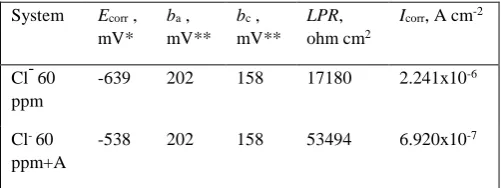
steel immersed in an aqueous solution in the absence and presence of inhibitor system are given in Table 2. The corrosion parameters include corrosion potential (Ecorr),Tafel
slopes (bc= cathodic; ba=anodic), Linear polarization
resistance (LPR) and corrosion current (Icorr).
Figure 1. Polarization curve of mild steel immersed in various test solution a) Cl- 60 ppm b) Cl- 60 ppm + glycine 250 ppm + Zn2+
50 ppm
The polarization curves are shown in Figures 1 to 3. When mild steel is immersed in the environment (aqueous solution containing 60 ppm Cl-), the corrosion potential is -639 mV vs SCE. The LPR value is 17180 ohmcm2 and the corrosion
current is 2.241x10⁻⁶A cm-2. When inhibitor system (glycine
250 ppm + Zn2+ 50 ppm) is introduced in the environment;
the corrosion potential is shifted to the anodic side that is noble side. This indicates that a passive film is formed on
the metal surface in presence of inhibitor. The shifting of corrosion potential towards anodic side in presence of inhibitors has been reported by several researchers.49-56
Figure 2. Polarization curve of mild steel immersed in an aqueous solution containing 60 ppm Cl-
Figure 3. Polarization curve of mild steel immersed in an aqueous solu tion containing 60 ppm Cl-+glycine 250 ppm + Zn2+ 50ppm
Table 2. Corrosion parameters of mild steel immersed in an aqueous solution containing 60 ppm of Cl- obtained from
polarization study
A = glycine 250 ppm + Zn2+ 50 ppm,*mV vs SCE; **mV in one
decade
It is also observed that, when inhibitor system is introduced in to the environment, LPR value increases and corrosion current decreases. When a passive film formed on mild steel surface, in presence of inhibitor system, the electron transfer from the metal surface towards the bulk of the solution is difficult and prevented. So rate of corrosion decreases and hence corrosion current decreases in presence of inhibitor system.
System Ecorr ,
mV* ba ,
mV** bc ,
mV** LPR, ohm cm2
Icorr, A cm-2
Cl-60 ppm
-639 202 158 17180 2.241x10⁻⁶
Cl- 60
ppm+A
-538 202 158 53494 6.920x10⁻⁷
(10) V
It is observed from Table 2 that the Tafel slope values are not changed much in the presence of inhibitor system, when compared to the blank system. This suggests that the glycine-Zn2+ system, controls the anodic reaction
Fe Fe2+ + 2e- (11)
and the cathodic reaction
O2+2H2O+4e 4OH- (12)
to an equal system. The anodic reaction is controlled by formation of Fe2+-glycine complex on the anodic site of the
metal surface. The cathodic reaction is controlled by deposition of Zn(OH)2 on the cathodic sites of the metal
surface. Thus anodic reaction and cathodic reaction are controlled effectively. This accounts for the synergistic effect of Zn2+- glycine system.57, 58
The variation of current with potential, when mild steel is immersed in blank system and inhibitor system is shown in Figures 3 and 4. It is observed that the rate of change of current with potential is less in presence of inhibitor system than in its absence.
Conclusion
The inhibition efficiency of glycine-Zn2+ system has been
evaluated by weight loss method and polarization study. Glycine alone has some corrosion inhibition efficiency (IE). In presence of Zn2+, IE increases. Synergistic effect exists
between Zn2+ and glycine. The formulation consisting of
250 ppm of glycine and 50 ppm of Zn2+ has 86% IE.
Polarization study reveals that this system function as mixed inhibitor system, controlling the anodic reaction and cathodic reaction to an equal extent.
Acknowledgement
The authors are thankful to their Managements and St.Joseph’s Research and Community Development Trust, Dindigul, India for their help and encouragement.
References
1Li, P., Wu, G., Xu, R., Wang, W., Wu, S., Yeung, K. W. K., Chu,
P.K., Mater. Lett., 2012, 89, 51.
2Goudarzi, N., Peikari, M., Reza Zahiri, M., Reza Mousavi, H., Arch Metallurg Mater., 2012, 57(3), 845.
3Baghaei Ravari, F., Dadgarinezhad, A., Gazi., Univ. J. Sci., 2012, 25(4), 835.
4Hosseini, S. M. A., Salari, M., Jamalizadeh, E., Jafari, A. H., Corros., 2012, 68(7), 600.
5Zhou, M., Zhao, J., Hu, X., J. Surfactants and Deter., 2012, 15(3), 309.
6Zou, C., Tang, Q., Tan, N., Xiao, P., Hu, X., Starch/Staerke.,
2012, 64(4), 281.
7Li, J.-l., Bai, F.-l., Lu, Y.-b., Lai, D.-m., Corros . Prot., 2012, 33(9), 787.
8Elmalah, N. M., Elhaliem, S. A., Ahmed, A. M., Ghozy, S. M. Int. J. Electrochem. Sci., 2012, 7(8), 7720.
9Fragoza-Mar, L., Olivares-Xometl, O., Domínguez-Aguilar, M.
A., Flores, E. A., Arellanes-Lozada, P., Jiménez-Cruz, F., Corros Sci., 2012, 61, 171.
10 Caliskan, N., Akbas, E., Mat. Chem Phys., 2011, 126(3), 983.
11Zarrouk, A., Hammouti, B., Dafali, A., Zarrok, H., Der Pharma Chemica., 2011, 3(4), 266.
12Abdurrahman, J., Wahyuningrum, D., Achmad, S., Bundjali, B., Sains Malays., 2011, 40(9), 973.
13 Eddy, N. O., Ebenso, E. E., J. Mole. Model., 2010, 16(7), 1291.
14Pate, N. S., Jauhari, S., Mehta, G. N., Acta Chim. Slov., 2010, 57(2), 297.
15Caliskan, N., Akbas, E., Mater. Chem Phys., 2011, 126(3), 983.
16Elayyachy, M., El Idrissi, A., Hammouti, B., Corros.Sci., 2006, 48(9), 2470.
17Harish Kumar, Vishal Saini, Dheeraj Kumar, and Chaudhary,
R.S., Indian. J. chem Technol., 2009, 16, 401.
18Zhang, J., Gong, X. L., Yu, H. H., Du, M., Corros. Sci., 2011, 53(10), 3324
19Appa Rao, B.V., Srinivasa Rao, S., Mater Corros., 2010, 61(4),
285.
20Dufek, E. J., Buttry, D. A., J. Electrochem. Soc., 2009, 156(9),
C322.
21Deng, Q., Ding, N.-N., Wei, X.-L., Cai, L., He, X.-P., Long,
Y.-T., Chen, G.-R., Chen, K., Corros. Sci., 2012, 64, 64.
22Ghazoui, A., Saddik, R., Benchat, N., Hammouti, B., Guenbour,
M., Zarrouk, A., Ramdani, M. Der Pharma Chemica., 2012, 4(1), 352.
23Liu, P., Gao, L., Zhang, D., J. Chinese Soc. Corros Prot., 2012, 32(2),163.
24Hamed, E., Abd El-Rehim, S.S., El-Shahat, M. F., Shaltot,
A.M., Mater. Sci Eng B Solid State Mater Adv. Technol., 2012, 177(5), 441.
25Gomma, G. K., Wahdan, M.H., Mater Chem Phys., 1994, 39(2),
142.
26Wilson Sahayaraj. J., Susai Rajendran, Muthu megala, T.S., John
amalraj, A., Zastit. Mater., 2010, 51(4), 232.
27Gowri, S., sathiyabama, J., Rajendran, S., Robert Kennedy, Z.,
Agila Devi, S., Chem. Sci Trans., 2013, 2(1), 275.
28Quan, Z.-L., Zhang, D.-M., Hou, W.-G., Corros. Sci Prot. Tech.,
2011, 23(2), 151.
29Fouda, A, S., Ahamed sbdel Nazeer, E. A., Ashour, Zastit. Mater., 2011, 52(1), 23.
30Sahaya Raja, A., Rajendran, S., Satyabama, P., J. Chem., Hindawi publications.,2012, 2013, 1.
31Abdel-Fatah, H. T. M., Anti-Corros Methods.Mater., 2012, 59(1),
23.
32Gowri, S., Sathiyabama, J., Rajendran, S., Angelin Thangakani,
J., J. Chem. Bio. Phy. Sci., 2012, 2(4), 2223.
33Wranglen, G., Introduction to Corrosion and Protection of Metals.:Chapman & Hall, London., 1985, 236.
34Rajendran, S., John Amalraj, A., Joice, M. J., Anthony, N.,
Trivedi, D. C., Sundara vadivelu, N., Corros. Rev., 2004, 22, 23.
35Yesu Thangam,Y., Kalanithi, M., Mary Anbarasi, C., Rajendran,
S., The Arab. J.sci. eng., 2009, 34(2c), 49.
36Rajendran, S., Peter, B.R.E., Regis, P. P., John Amal Raj, A.,
Sundara vadivelu, N., Trans. SAEST., 2003, 38, 115.
37Agnesia Kanimozhi, S., Rajendran, S., The Arab. J. sci. eng.,
2009, 34(2c), 37.
39Sahayaraja, A., Rajendran, S., Sathiya bama, J., Muthu Megala,
T.S., Krishnaveni, A ., Palaniswamy, N., Prabhakar, P., Zastit. Mater., 2011, 52(2), 101.
40Anu Radha, K., Vimala, R., Narayanasamy, B., Arockia selvi, J.,
Rajendran, S., Chem .Eng. Comm., 2008, 195, 352.
41Arockia selvi, J., Rajendran, S., John Amalraj, A., Indian. J. Chem. Technol., 2007, 14(4), 382.
42Rajendran, S., Apparao, B.V., Palanisamy, N., Anti-Corros. Methods. Mater., 2000, 47, 83.
43Leema Rose, A., Peter pascal Regis, A., Susai Rajendran,
Krishnaveni, A., Felicia Rajammal Selvarani., Arab. J. Sci. Eng., 2012, 37(5), 1313.
44Kavipriya, K., Sathiyabama, J., Rajendran, S., Krishnaveni, A., Int. J. Adv. Eng. Sci. Technol.,(IJAEST), 2012, 2(2), 106.
45Sahayaraja, A.. Rajendran, S. J. Electrochem. Sci. Eng., 2012, 2,
91.
46Sribharathy, V., Rajendran, S., Int. J. Adv. Eng. Sci. Technol., (IJAEST),. 2011, 1(1), 77.
47Anbarasi, M.C., Rajendran, S., Vijaya, N., Manivannan, M.,
Shanthi, T., The Open Corros. J., 2011, 4, 40.
48Johnsirani, V., Rajendran, S., Sathiyabama, J., Muthumegala, T.
S., Krishnaveni, A., Hajarabeevi, N., Bulg. Chem. Commun. 2012, 44 (1), 41.
49Manimaran, N., Rajendran, S., Manivannan, M., John mary, S., Res. J. Chem. Sci., 2012, 2(3), 52.
50Arockia selvi, J., Susai Rajendran, John Amalraj, A.,
Narayanasamy, B., Port. Elecrotchim. Acta., 2009, 27(1), 1.
51Shyamala Devi, B.,and Rajendran, S., Eur. Chem. Bull., 2012, 1(5), 150.
52Nagalakshmi, R., Rajendran, S., Sathiyabama, J., Pandiarajan, M.,
and Lydia Christy, J., Eur. Chem. Bull., 2013, 2(4), 150.
53SahayaRaja, A., Rajendran, S., Nagalakshmi, R., Angelin
Thangakani, J., and Pandiarajan, M., Eur. Chem. Bull., 2012, 1(3), 130.
54AgilaDevi, S., Rajendran, S., Jeyasundari, J., and Pandiarajan,
M., Eur. Chem. Bull., 2013, 2(2), 84.
55Rajendran, S., AnuRadha, K., Kavipriya, K., Krishnaveni, A.,
and Angelin Thangakani, J., Eur. Chem. Bull., 2012, 1(12), 503.
56Pandiarajan, M., Prabhakar, P., and Rajendran, S., Eur. Chem. Bull., 2012, 1(7), 238.
57Rajendran, S., Shanmugapriya, S., Rajalakshmi, T., and Amalraj,
A., Corrosion, 2005, 61, 685.
58Vijayagopal Sribharathy and Susai Rajendran J. Electrochem. Sci. Eng.,2012, 2, 121.