The structural and magnetic properties of Heusler alloy Ni46Mn41In13 were studied by magnetization and X-ray powder diffraction
measurements in the 4.5350 K temperature range and in magneticfields up to 5 T. The alloy undergoes martensitic transformation from a
L21-type cubic structure withac=0.600 nm at 293 K to a six-layered monoclinic (6M) structure in the transition temperature of 160230 K. The
lattice parameters for the 6M structure were estimated to beam=0.441 nm,bm=0.557 nm,cm=1.30 nm,¡m=90.0°,¢m=94.0°, and
£m=90.0° at 75 K. In this transformation from theL21to 6Mstructures, the cell volume contracts by 0.34%at 8 K. In addition, we observed the
magneticfield-induced reverse transformation of this alloy. [doi:10.2320/matertrans.M2013372]
(Received October 3, 2013; Accepted December 9, 2013; Published January 24, 2014)
Keywords: Heusler alloy, martensitic transformation, ferromagnetic shape-memory alloys,field-induced magnetic and structural transitions
1. Introduction
Ferromagnetic shape memory alloys (FSMAs) have
attracted considerable attention as magnetic field-controlled
materials.1)Among the various FSMAs, the NiMnGa alloy
system has been extensively studied. NiMnGa shows a
martensitic transformation from a high temperature phase (HTP) with a cubic structure to a low temperature phase (LTP)
with another structure below room temperature (RT).18)
The magnetic anisotropy of LTP is larger than that of HTP.
When a magnetic field was applied, NiMnGa showed a
magneticfield-induced strain over 5%.3)
In 2004, Sutou et al.reported that ferromagnetic Heusler
alloys Ni50Mn50¹yXy (X=In, Sn and Sb) showed a
martensitic transformation from a L21 cubic structure to an
orthorhombic four-layered (4O) structure.9)Previous results
indicated that the Ni50Mn50¹yXy alloy exhibited fi
eld-induced magnetic and structural transitions.1013) The
mag-netic moment of LTP is much smaller than that of HTP in Ni
MnX Heusler alloys.914) This magnetic property is novel
and quite different from that of NiMnGa. Especially, the
NiCoMnIn Heusler alloys show the high potential for
magnetic field-controlled materials, such as field-induced
large stress over 100 MPa, large magnetic entropy change over 28 J kg¹1K¹1, etc.13)
It has been known that the crystal structure of LTP in
FSMAs is complicated in many cases. For NiMnX based
Heusler alloys, the structural and magnetic properties of LTP are dependent on the X atom and the composition of Ni, Mn and X. Therefore, it is important to reveal these properties of
the NiMnX Heusler alloys under a zerofield and magnetic
fields. Previous report suggests that LTP of Ni50Mn35In15
has mainly a 4Ostructure with other structures.9)However,
the lattice constant of LTP of Ni50Mn35In15 could not be
determined because of coexistence with a large number
of other structures.9) Recently, we prepared a good quality
sample of Ni46Mn41In13. The temperature dependence of the
magnetization of the sample showed a sharp phase transition between HTP and LTP at the temperature below 230 K.
In this study, in order to clarify the crystal structure of
LTP and its field-induced transformation of magnetic shape
memory alloy Ni46Mn41In13, we have carried out X-ray
powder diffraction (XRD) and magnetization measurements
under magnetic fields up to 5 T in 4.5350 K temperature
range.
2. Experimental
Polycrystalline Ni46Mn41In13 was prepared by induction
melting under an argon atmosphere. The detailed sample
preparation was reported in previous report.9) The obtained
sample was confirmed to be a single phase with a L21
structure by XRD measurements at room temperature (RT).
The magnetizationMwas measured using a Superconducting
Quantum Interference Device (SQUID) magnetometer for a
bulk sample (21.0 mg) in magneticfields®0Hup to 5 T and
in the temperature T ranging from 4.5 to 350 K. In this
measurement, the sample wasfixed with nonmagnetic grease
in a sample holder after measuring the mass.
High field XRD experiments15,16) were carried out using
Cu K¡ radiation at 8¯T¯320 K for ®0H¯5 T. The
powder sample was fixed with vacuum grease on a copper
sample holder. The diffraction data were taken at 20°¯
2ª¯85° with a step size of 0.01°. We confirmed that the
powder sample was not removed by magnetic force until
the measurement under magnetic fields was completed. For
determining the X-ray reflection indices and the crystal
structure, the observed diffraction patterns were analyzed by comparison with calculated patterns using a Rietveld
program (RIETAN-FP17)).
3. Results and Discussions
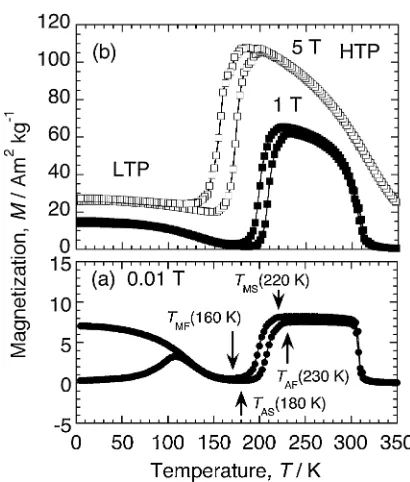
Figure 1 shows the temperature dependence of the
mag-netization at®0H=0.01 T (a), 1 T and 5 T (b). From the data
for ®0H=0.01 T, the Curie temperatureTCwas determined
to be 310 K, and the martensitic transformation starting
temperature TMS, the martensitic transformation finishing
temperature TMF, the reverse transformation starting
temper-ature TAS and the reverse transformation finishing
temper-ature TAF were determined to be 220, 160, 180 and 230 K,
respectively. It is confirmed that Mof LTP is much smaller
than that of HTP in Ni46Mn41In13. With increasing H, TMS,
TMF, TAS and TAF shift to the low temperature side, and
the width of the thermal hysteresis increases slightly. The decrease of the transformation temperatures is due to gain
of Zeeman energy by applying magnetic fields.
Figure 2 shows the magnetization (MH) curves at 150,
190 and 250 K. Here, the data were measured after zero-field
heating from 100 K. For the data of 150 K (LTP) and 250 K
(HTP), any anomaly on the MH curves did not observed
for ®0H¯5 T. At 190 K (TAS<T<TAF), a magnetic fi
eld-induced phase transition (metamagnetic transition) between LTP and HTP was observed with a large magnetic hysteresis. Figure 3 shows the experimental XRD patterns of
Ni46Mn41In13 for 20°¯2ª¯80° at 293 K (HTP) and 75 K
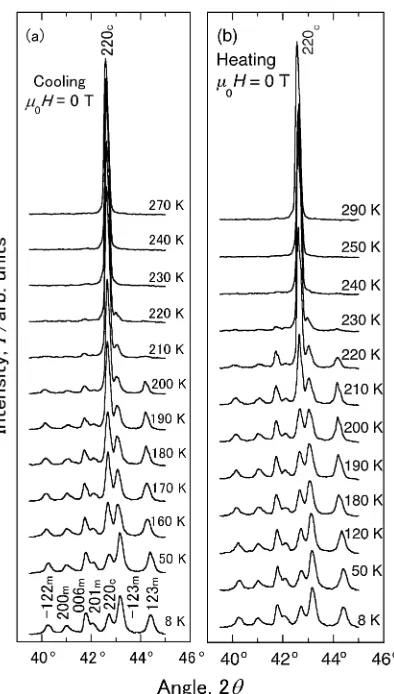
(LTP) in a zero magnetic field. The XRD patterns of
Ni46Mn41In13 for 39.5°¯2ª¯45° at several temperatures
for cooling (a) and heating (b) processes in a zero field are
shown in Fig. 4. In Figs. 3 and 4, hklc denotes the Miller
indices for theL21cubic structure. Because superlattice peaks
(111cand 200c) were observed for 20°¯2ª¯30° at 293 K,
we confirmed that HTP has the L21 structure. The lattice
parameter ac was estimated to be 0.600 nm at 293 K. The
XRD pattern of LTP was complicated and quite different
from that of Ni50Mn36Sn14 with 4O structure.12,14) The
obtained XRD patterns of LTP of Ni46Mn41In13 cannot be
represented using any orthorhombic structural models. On
the other hand, some monoclinic models (2M, 6M, 10M
and 14M) have been proposed to a LTP phase of Heusler
alloys.1824) Among them, the monoclinic six-layered
(6M)21,23) structure represented well the obtained XRD
patterns of LTP. In Figs. 3 and 4, hklm denotes the Miller
indices for the 6M structure. As shown in these figures,
observed reflection peaks at the temperature below TMFcan
be indexed using the model combining the 6M and L21
structures. From our calculation, we estimated that 60% of
the 6M phase and 40% of the residual L21 phase exist at
low temperatures below TMF. As shown in Fig. 2, the
Fig. 1 Temperature dependence of the magnetization of Ni46Mn41In13for
magneticfields of®0H=0.01 (a), 1 and 5 T (b).
Fig. 2 Magnetization curves of Ni46Mn41In13at 150, 190 and 250 K.
Fig. 3 X-ray powder diffraction patterns of Ni46Mn41In13at 293 and 75 K
in a zero magneticfield.hklcandhklmdenote the Miller indices for the
cubic L21-type and monoclinic 6M structures, respectively. The inset
[image:2.595.65.270.65.306.2] [image:2.595.322.529.69.222.2] [image:2.595.324.527.262.581.2]ferromagnetic component was negligibly small in the MH
curves at T¯190 K. That is, the residual L21 phase was
negligibly small for the bulk sample at low temperature. Therefore, the observed residual phase for the XRD pattern is probably due to partial distortion in the used powder at low
temperature. The lattice parameters for the 6M structure at
75 K were estimated to be am=0.441 nm, bm=0.557 nm,
cm=1.30 nm,¡m=90.0°,¢m=94.0° and£m=90.0°.
The Bragg peaks of the L21 structure are only seen at
temperatures above 230 K for cooling, as shown in Fig. 4(a).
With decreasingTfrom 220 K, the peaks of the 6Mstructure
appear and develop, and the intensity of the peaks of the
L21 structure becomes smaller. As shown in Fig. 4(b), with
increasingT, the peak intensity of the 6M structure becomes
small at temperatures above 220 K and cannot be detected at temperatures above 240 K. That is, the martensitic trans-formation occurs in this temperature range. This result is consistent with the magnetic data (Fig. 1).
Figure 5 shows schematic views of the relationship
between the L21 (a) and 6M (b) structures. In this figure,
projection on the (010) plane of an idealL21cubic structure is
presented.22,24) When the martensitic transformation occurs
from theL21cubic structure, the crystal takes place
diffusion-less shears on successive {202} planes and anisotropic
distortion along the a-axis of the L21 structure. The 6M
-structural model basically consists of the modulated and
six-layered {202} sheets of the distorted L21 structure. It is
important to estimate the amount of the distortion of the crystal by the martensitic transformation. However, the
number of atoms included in the unit cell of the 6Mstructure
differs from that in theL21 structure. Therefore, we assume
a pseudotetragonal22,24) structure, which denotes a
face-centered tetragonal (FCT) structure in Fig. 5(b). The lattice
parameters of the FCT and 6M structures are related to
afct=bm and cfct¼pffiffiffiffiffiffiffiffiffiffiffiffiffiffiffiffiffiffiffi4am2 b2m. Here, afct and cfct are the lattice parameters of the FCT structure. The unit cell volume
Vfct (=afct2©cfct) of the FCT structure was calculated by
using these parameters in order to estimate the volume change between the LTP and HTP transition.
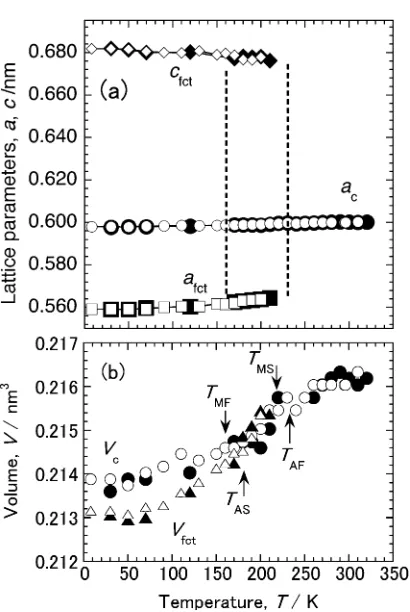
Figure 6 shows the temperature dependence of the lattice
parameters (a) and the cell volume V(b) in a zero magnetic
field. Here, the open and closed symbols indicate the data for
cooling and heating processes. In this figure, the parameters
(acandVc) and (afct,cfctandVfct) indicate the data for theL21
cubic structure and a FCT structure, respectively. The dashed
lines in thisfigure indicate thermal hysteresis considering the
peak-intensity variation of XRD results between theL21-HTP
and 6M-LTP. From the 220c diffraction line, ac of the L21
structure was estimated. On the other hand, afct and cfct of
the 6M structure were deduced from 200m, 006m and 123m
diffraction lines. By the martensitic transformation, the lattice
decreases by 5.91%along theafctaxis (parallel to one ofac),
whereas the other lattice increases by 13.1% along the cfct
axis (parallel to anotherac). With decreasingTfromTMF,afct
decreases, whereas cfct increases. The volume of the FCT
structure (Vfct) is 0.34%less than that of theL21structure (Vc).
Figure 7 shows the XRD patterns of Ni46Mn41In13at 190 K
infields up to 5 T. Here, the data were taken after zero-field
heating from 100 K. It is confirmed that the field-induced
reverse transformation occurs from the 6M toL21structures
at 190 K (TAS¯T¯TAF). In ®0H=0 T, the pattern shows
Fig. 4 X-ray powder diffraction patterns of Ni46Mn41In13 at various
temperatures for cooling (a) and heating (b) processes from 290 to 8 K under a zero magneticfield.hklcandhklmdenote the Miller indices for the
cubicL21-type structure and the six-layered monoclinic (6M) structures,
respectively.
β m
bm = afct
cm
6M cfct
Fig. 5 Schematic view of the structural relationship between theL21-type
[image:3.595.72.269.66.413.2] [image:3.595.329.519.74.285.2]two-phase coexistence consisting of the 6M and L21
structures. With increasingH, the reflection peak of the 6M
structure is suppressed, but the peak of the L21 structure is
enhanced. With decreasingHdown to zero, the intensity of
the peak of the L21 structure still remains, and the 6M
structure did not recover completely as the initial XRD pattern. This irreversible process is also reported in the previous paper for Ni50Mn36Sn14.14)
Figure 8 shows the magnetic field dependence of the
lattice parametersacfor theL21structure,afctandcfctfor the
FCT structure deduced from the 6Mstructure at 190 K. It is
confirmed that the lattice parameters of both structures are
almost independent of the magnetic field for ®0H¯5 T.
When a magneticfield is applied, the volume fraction of the
L21 and 6M phases is only varied. The difference of the
lattice parameters for both the structure is¹6.06%along the
afctaxis and+13.1%along thecfctaxis, andVfctis 0.18%less
thanVcat 190 K under®0H=4 T.
4. Conclusion
The structural properties of magnetic Heusler alloy
Ni46Mn41In13 were investigated by magnetization and X-ray
powder diffraction measurements in 4.5¯T¯350 K and in
0¯®0H¯5 T. The alloy undergoes the martensitic
trans-formation from the L21-type cubic structure with ac=
0.600 nm at 293 K to the six-layered monoclinic (6M)
structure in the temperature range of 160230 K. The lattice
parameters for the 6M structure were estimated to be am=
0.441 nm, bm=0.557 nm, cm=1.30 nm, ¡m=90.0°, ¢m=
94.0° and£m=90.0° at 75 K. In this transformation from the
L21and 6Mstructures, the cell volume contracts by 0.34%at
8 K. The magnetic field induces the reverse transformation
in Ni46Mn41In13 in the vicinity of the transition temperature.
Acknowledgments
The authors thank Mr. T. Shibagaki for experimental support. The XRD and magnetization measurements were carried out at the High Field Laboratory for Superconducting Materials, Institute for Materials Research and the Center for Low Temperature Science, Tohoku University, respectively. This work was supported in part by the KAKENHI 22360285.
Fig. 6 Temperature dependence of the lattice parameters (a) and the unit cell volume (b) for Ni46Mn41In13 under a zero magnetic field. The
parameters (acandVc) and (afct,cfctandVfct) indicate the data for theL21
-type cubic structure and the face-centered tetragonal (FCT) structure deduced from the six-layered monoclinic (6M) structure. The open and closed symbols show the data for cooling and heating processes, respectively. The dashed lines indicate the thermal hysteresis with varying fraction of monoclinic 6Mphase amongTMS,TMF,TASandTAF.
Fig. 7 X-ray powder diffraction profiles of Ni46Mn41In13in magneticfields
up to 5 T at 190 K.
Fig. 8 The lattice parameters for Ni46Mn41In13in magneticfields up to 5 T
at 190 K. The parametersac, andafctandcfctindicate the data for theL21
[image:4.595.67.272.62.368.2] [image:4.595.321.530.64.316.2] [image:4.595.329.521.360.506.2]7) P. J. Webster, K. R. A. Ziebeck, S. L. Town and M. S. Peak:Philos. Mag. B49(1984) 295310.
8) P. J. Brown, J. Crangle, T. Kanomata, M. Matsumoto, K. U. Neumann, B. Ouladdiaf and K. R. A. Ziebeck:J. Phys. Condens. Matter14(2002) 1015910171.
9) Y. Sutou, Y. Imano, N. Koeda, T. Omori, R. Kainuma, K. Ishida and K. Oikawa:Appl. Phys. Lett.85(2004) 43584360.
10) T. Krenke, E. Duman, M. Acet, E. F. Wassermann, X. Moya, L. Manosa and A. Planes:Nature Mater.4(2005) 450454.
11) T. Krenke, M. Acet, E. F. Wassermann, X. Moya, L. Manosa and A. Planes:Phys. Rev. B72(2005) 014412.
12) P. J. Brown, A. P. Gandy, K. Ishida, R. Kainuma, T. Kanomata, K. U. Neumann, K. Oikawa, B. Ouladdiaf and K. R. A. Ziebeck:J. Phys.
20) W. Ito, K. Ito, R. Y. Umetsu, R. Kainuma, K. Koyama, K. Watanabe, A. Fujita, K. Oikawa, K. Ishida and T. Kanomata:Appl. Phys. Lett.92 (2008) 021908.
21) W. Ito, M. Nagasako, R. Y. Umetsu, R. Kainuma, T. Kanomata and K. Ishida:Appl. Phys. Lett.93(2008) 232503.
22) V. V. Khovaylo, T. Kaomata, T. Tanaka, M. Nakashima, Y. Amako, R. Kainuma, R. Y. Umetsu and H. Morito: Phys. Rev. B 80 (2009) 144409.
23) R. Y. Umetsu, K. Ito, W. Ito, K. Koyama, T. Kanomata, K. Ishida and R. Kainuma:J. Alloy. Compd.509(2011) 13891393.