
MICROELEMENT CONTENT OF HERB VARIETIES ON A
FLOODPLAIN PASTURE OF UPPER TISZA RIVER
Zoltán Győri
[a]*, Péter Sipos
[a], Diána Ungai
[a]and Norbert Boros
[b]Paper was presented at the 4th International Symposium on Trace Elements in the Food Chain, Friends or Foes, 15-17 November, 2012,
Visegrád, Hungary
Keywords: microelement content, pasture, herb
In order to produce good quality products it is necessary to find out about the quality of pastures to be grazed. It is also important to know the element composition of grazed herbs and the demands of animals bred on pastures, especially where the environment may influence the feed safety conditions of plants – as in the case of floodplains. Our objective was to determine that what the element composition (Cu, Zn, Mn and Fe contents) of herbs grown on a floodplain which was subsided by a heavy metal contaminated sediment. Our results call an attention to the differences in the accumulation of herbs. Bidens tripartitus, Lotus corniculatus and Vicia cracca grown in the floodplain showed the higher amounts of Fe and Zn, but the effect of heavy metal contamination on the element contents of other examined plants cannot be proved.
* Corresponding Authors Tel: +36 (30) 983 2880 E-Mail: [email protected]
[a] Institute of Food Science, Quality Assurance and Microbiology, Faculty of Agricultural, Food Science and Environmental Management, University of Debrecen [b] Environmental and Chemical Engineering Department,
Faculty of Engineering, University of Debrecen
Introduction
At the beginning of year 2000, dams broke at two Romanian mining companies (at Baia Mare first and Baia Borsa second). The first one releasing 100 000 m3 of contaminated water with cyanide to the river Tisza via its tributary Szamos. The heavy metal content of the polluted water was several times higher than the limits for heavily contaminated surface water (Ministry for Environment, 2000).1 While the cyanide caused severe damage to organisms in the river, other heavy metals present in the water may also have been deposited in the sediments.
The second disaster sent about 20 000 tons of mud containing heavy metals into the river Tisza along with a simultaneous flood settling, forming a layer of approximately 5-10 cm in depth on the pre-existing soil (Fig. 1 and Fig. 2). As most of the affected areas were under agricultural use, and the economy of the region depends heavily on their continued productivity, it is important to study the heavy metal concentration within herbaceous plants in the floodplain.
The composition of herb varieties of a pasture is very important considering animal husbandry.2 Mineral element composition is one of its most important quality parameters.3 However, pastures are often that kinds of fields that are close to rivers and its alluvial deposits cover them yearly. The heavy metal contamination of the flood of Tisza river in the year 2001 caused considerable injuries for the
ecosystem4, and the long-term effects of the metals settled in the floodplain are not known.
Our objective was to determine the element composition (Cu, Zn, Mn and Fe contents) of herbs grown on this exhaustively examined (to 300 cm depth) soil. The results of in-depth soil analysis were presented by Győri et al.5
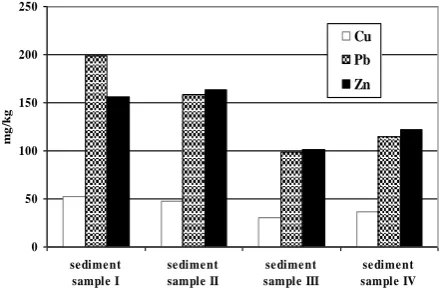
We present the sediment analysis data on the Fig. 1 and Fig. 2. The samples came from the banks of the river and the terraces of the holiday houses, at the altitudes of 112.750 mB.a.; 114.670 mB.a.; 108.940 mB.a. and 105.450 mB.a. in samples 1 to 4 respectively. For comparison this data with a chernozem soil data we can see on Fig. 3. We have to underline that in the most fertile soil Zn and Cu content was twofold lower than in floodplain soil.
Figure 1 Total Cu, Pb and Zn content of sediment samples (Tivadar, 2001)
Considering that this 300 cm depth sediment of the floodplain subsided in the last 150 years, a control plot selection was almost impossible. This is the reason we used the results of Tölgyesi6 and also Hungarian measurement7 results by Leányvár for comparison.
0 50 100 150 200 250
se dime nt sample I
se dime nt sample II
se dime nt sample III
se dime nt sample IV
m
g
/k
g
Cu
Pb
Figure 2. Lakanen-Erviö soluble Cu, Pb and Zn content of sediment samples (Tivadar, 2001)
Figure 3. Lakanen-Erviö soluble and total Cu, Pb and Zn content of chernozem soil (Látókép, 1998)8
Materials and methods
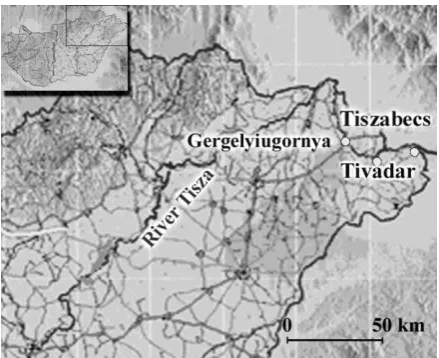
Samples were taken in a floodplain meadow of upper the Tisza River near Tivadar and Gergelyiugornya in 2001-2003. Samples of 42 herb varieties from natural flora were collected from 1x1 m plots (ten times) near the boreholes in the floodplain.
Figure 4. Sampling sites on the river Tisza, Hungary
Plant samples were dried at 60°C and grounded by Retsch SK-1 hammer mill with 1 mm sieve. The chemical analysis was carried out with analytical grade HNO3-H2O2 (E. Merck, Darmstadt, Germany) digestion by the method of Kovács et al.9,10 by PERKIN-ELMER OPTIMA 3300 DV type
ICP-Spectrometry). Ultrapure water was use to prepare the solutions (Millipore, Paris, France). The easily available element contents extracted according to the Lakanen-Erviö method.11
Table 1. Geographical data of sampling sites
Sampling site Geographical
coordinates River kilometers
Tivadar N 48 04’ 00.6” 708.7
E 22 31’ 04.8”
Gergelyugornya N 48 07’ 46.5” 683.0 E 22 19’ 39.5”
We determined the following elements: Al, B, Ba, Ca, Cd, Co, Cr, Cu, Fe, K, La, Li, Mg, Mn, Mo, Na, Ni, P, S, and Zn. Out of the 20 elements examined, Cu, Fe, Mn, and Zn are discussed in detail in the present study. We used the SPSS 17.0 for Windows and Microsoft Excel 2007 programs for statistical analysis of data. Results are mean values of two replications.
Results and discussion
Previously Tölgyesi5 analyzed seventeen varieties in 1969, so this was the base of our comparison. We found that the newly measured Mn values representing the herb samples collected at Tivadar were lower than the previous findings at Leányvár exception of Salvia nemorosa, while the Zn content of new samples were higher in the case of most of the examined herbs.
These systematic differences are taken into account for the differences in the basic of soil properties or analytical methods. The differences in Cu and Fe content were varied by herb to herb (Table 1).
Comparing our results to the previous findings, we found significant differences in several cases. Tölgyesi5 found that
Solanum dulcamara, Symphytum officinale and Taraxacum officinale accumulate Cu in high degree.
We confirmed these results and recommend that the list of Cu accumulating herbs can be complement by Salvia nemorosa and Bidens tripartitus. We found high Fe content in the case of Salvia nemorosa, Althea officinalis, Rumex acetosa and Solanum dulcamara (above 500 mg kg-1). The highest Mn contents were measured in the case of Salvia nemorosa, Althea officinalis and Equisetum arvense (in descending order). Lotus corniculatus, Salvia nemorosa and
Bidens tripartitus contained the highest concentrations of Zn.
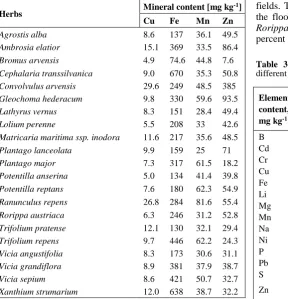
As we mentioned above we analyzed more than forty herb varieties from the floodplain of upper Tisza. The microelement contents of additional 21 herb varieties are summarized in Table 2.
The copper content in case of Convolvulus arvensis and
Ranunculus repens were more than 25 mg kg-1. These values were the maximum among the studied herb varieties. Two high iron contents (more than 600 mg kg-1) were determined in case of Cephalaria transsilvanica and Xanthium 0 2 4 6 8 10 12 14 16
se dime nt sample I
se dime nt sample II
se dime nt sample III
se dime nt sample IV m g /k g Cu Pb Zn 0 10 20 30 40 50 60 70 80
Cu Pb Zn
m
g6
kg
Lakanen-Erviő solution
Table 1 Mineral element content of different herbs Legend: L = Leányvár, 1963., T = Tivadar, 2001.
Herbs
Mineral elements mg kg-1 in dry matter
Cu Fe Mn Zn
L T L T L T L T
Althea officinalis 6.9 8.4 494 732 98 41.5 28 32.5
Bidens tripartitus 24.2 18.7 278 86.8 118 24.4 31 59.0
Cichorium intybus 12.1 11.3 209 296 35 18.5 35 44.4
Equisetum arvense 7.7 6.0 253 177 117 41 27 37.9
Galium verum 6.6 11.4 200 63.5 40 33.6 21 45.0
Lotus corniculatus 7.0 10.2 83 226 - 38.8 22 66.1
Lathyrus tuberosus 9.0 4.8 170 121 46 14.5 19 39.5
Poa pratensis 6.1 8.0 143 74 43 29.8 22 15.8
Potentilla argentea 5.4 7.12 362 171 96 38.9 22 29.6
Ranunculus acris 8.3 7.8 138 163 65 37.6 25 26
Rumex acetosa 4.7 8.7 145 572 37 26.3 25 23.1
Salvia nemorosa 9.2 17.5 369 869 56 67.1 44 61.8
Solanum dulcamara 15.4 14.8 315 509 91 33.1 20 31.7
Sonchus arvensis 15.7 10.2 754 154 49 25.6 63 55.4
Symphytum officinale 14.8 15.7 405 301 55 19.4 34 26.9
Taraxacum officinale 14.6 12.4 286 401 44 33.9 40 33.6
Vicia cracca 12.5 11.8 412 136 59 36.7 33 52.4
The manganese content of these varieties group was higher than in the recorded in previous table. Compare with the Salvia nemarosa’s manganese content we found that Plantago major, Potentilla reptans, Trifolium repens, and
Gleochoma hederacum are near 60 mg kg-1 manganese.
Table 2 Microelement content of other herbs
Herbs Mineral content [mg kg
-1]
Cu Fe Mn Zn
Agrostis alba 8.6 137 36.1 49.5
Ambrosia elatior 15.1 369 33.5 86.4
Bromus arvensis 4.9 74.6 44.8 7.6
Cephalaria transsilvanica 9.0 670 35.3 50.8
Convolvulus arvensis 29.6 249 48.5 385
Gleochoma hederacum 9.8 330 59.6 93.5
Lathyrus vernus 8.3 151 28.4 49.4
Lolium perenne 5.5 208 33 42.6
Matricaria maritima ssp. inodora 11.6 217 35.6 48.5
Plantago lanceolata 9.9 159 25 71
Plantago major 7.3 317 61.5 18.2
Potentilla anserina 5.0 134 41.4 39.8
Potentilla reptans 7.6 180 62.3 54.9
Ranunculus repens 26.8 284 81.6 55.4
Rorippa austriaca 6.3 246 31.2 52.8
Trifolium pratense 12.1 130 32.1 29.4
Trifolium repens 9.7 446 62.2 24.3
Vicia angustifolia 8.3 173 30.6 31.1
Vicia grandiflora 8.9 381 37.9 38.7
Vicia sepium 8.6 421 50.7 32.7
Xanthium strumarium 12.0 638 38.7 32.2
It seems the Ambrosia elatior, Gleochoma hederacum, and Plantago lanceolata varieties accumulate the zinc (more than 70 mg kg-1).
We also investigated the mineral content of Rorippa austriaca. This variety was the first to grow from the drying up mud layer. Four places were the origin of samples out of which two came from the floodplain and two from arable fields. The iron, sulfur and the zinc content were higher in the floodplain samples (see Table 3). The zinc content of
Rorippa austriaca was higher (50 mg/kg) with twenty percent in the floodplain samples.
Table 3. Mineral content of Rorippa austriaca samples from different sampling sites (2000)
Elements content, mg kg-1
Sampling sites
Csaroda Beregsurány Tivadar Gergely-ugornya
B 25.2 28.5 33.5 27.6
Cd <0.05 0.1 <0.05 <0.05
Cr 0.4 0.7 0.6 1.6
Cu 5.7 7.7 6.6 10.0
Fe 75.4 128 183 222
Li 0.7 0.9 0.9 0.8
Mg 1295 1837 1537 1138
Mn 20.8 28.5 22.7 23.9
Na 298 331 371 376
Ni 1.5 4.0 2.2 1.6
P 2243 2016 1834 2253
Pb <0.02 <0.02 <0.02 <0.02
S 6957 7001 8515 8638
This result demonstrates the high sulfur content of the new sediment contains sulfide and sulfate chemical form of zinc.
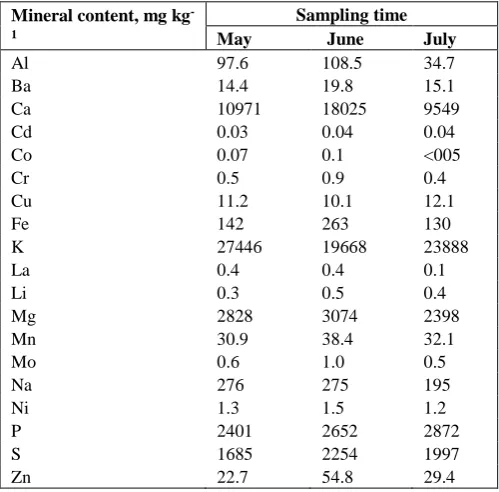
We analyzed the Trifolium pratense samples (Table 4) collected in different time to get information about the changing of mineral content time to time.
Table 4. The changing of mineral content during the vegetation period (Trifolium pratense)
Mineral content, mg kg -1
Sampling time May June July
Al 97.6 108.5 34.7
Ba 14.4 19.8 15.1
Ca 10971 18025 9549
Cd 0.03 0.04 0.04
Co 0.07 0.1 <005
Cr 0.5 0.9 0.4
Cu 11.2 10.1 12.1
Fe 142 263 130
K 27446 19668 23888
La 0.4 0.4 0.1
Li 0.3 0.5 0.4
Mg 2828 3074 2398
Mn 30.9 38.4 32.1
Mo 0.6 1.0 0.5
Na 276 275 195
Ni 1.3 1.5 1.2
P 2401 2652 2872
S 1685 2254 1997
Zn 22.7 54.8 29.4
The copper content was very stabile during the sampling period. On the other hand the iron, calcium, manganese, and zinc content were higher in June than in May or July.
Conclusions
Comparing the plant varieties element by element we found that as regards several elements it was Althea officinalis, Salvia nemorosa, Bidens tripartitus, Lotus corniculatus, Symphytum officinale, Taraxacum officinale
and Vicia cracca that accumulated high amount of studied elements.
In terms of micro-element contents we found these plants are the most valuable ones of the plant community we analyzed.
The heavy metal contamination on the studied varieties cannot be proved.
References
1Ministry for Environment of the Republic of Hungary.
Preliminary evaluation of the cyanide pollution in the rivers Szamos and Tisza. Directorate for Environmental Protection. 2000.
2Kádár, I. Gyepgazdálkodási Közl., 2004, 2, 57-65.
3Brekken, A., Steinnes, E., Sci. Total Environ., 2004, 326
(1-3), 181-195.
4Győri, Z., Alapi, K., Szilágyi, Sz. In: Natural Attenuation
of metals along the Tisza River-Floodplain-Wetlands Continuum. Eds: Adriano, D. C., Németh, T., Győri, Z. Debrecen: University of Georgia - MTA TAKI - DE ATC,
2003, 146-161.
5Győri Z., Alapi K., Prokisch, J., Németh, T., Adriano, D.,
Sipos, P. Agrochem. Soil Sci., 2010, 59(1), 117-124.
6Tölgyesi, Gy., A növények mikroelem-tartalma és ennek
mezőgazdasági vonatkozásai. Mezőgazdasági Kiadó Budapest, 1969, 198.
7Tölgyesi, Gy., Haraszti, E., Agrochem. Soil Sci., 1970.
19(4), 521–530.
8Győri Z. D.Sc. Thesis, MTA, 1999, 197.
9Kovács, B., Dániel, P., Győri Z., Loch, J., Prokisch, J.
Commun. Soil Sci. Plant Anal.,1998, 29, 2035-2054.
10Kovács, B., Győri, Z., Prokisch, J., Loch, J., Dániel, P.
Commun. Soil Sci. Plant Anal., 1996, 27, 1177-1198.
11Lakanen, E., Erviö, R. FAO Soils Bulletin, 1982, 10.
Received: 16.10.2012. Accepted: 14.11.2011.
![Synthesis and Characterization of a [Li0+xMg2 2xAl1+x(OH)6][Cl·mH2O] Solid Solution with X = 0 1 at Different Temperatures](data:image/gif;base64,R0lGODlhAQABAIAAAP///wAAACH5BAEAAAAALAAAAAABAAEAAAICRAEAOw==)