Research Article
a
September
2017
Computer Science and Software Engineering
ISSN: 2277-128X (Volume-7, Issue-9)
A Hybrid Approach for Virtual Machine Migration in Cloud
Computing Environment
Ramandeep Kaur
Abstract: A lot of research has been done in the field of cloud computing in computing domain. For its effective performance, variety of algorithms has been proposed. The role of virtualization is significant and its performance is dependent on VM Migration and allocation. More of the energy is absorbed in cloud; therefore, the utilization of numerous algorithms is required for saving energy and efficiency enhancement in the proposed work. In the proposed work, green algorithm has been considered with meta heuristic algorithms, ABC (Artificial Bee colony .Every server has to perform different or same functions. A cloud computing infrastructure can be modelled as Primary Machineas a set of physical Servers/host PM1, PM2, PM3… PMn. The resources of cloud infrastructure can be used by the virtualization technology, which allows one to create several VMs on a physical server or host and therefore, lessens the hardware amount and enhances the resource utilization. The computing resource/node in cloud is used through the virtual machine. To address this problem, data centre resources have to be managed in resource -effective manner for driving Green Cloud computing that has been proposed in this work using Virtual machine concept with ABC and Neural Network optimization algorithm. The simulations have been carried out in CLOUDSIM environment and the parameters like SLA violations, Energy consumption and VM migrations along with their comparison with existing techniques will be performed.
Keywords: Virtual machine, VM migrations, Artificial Bee Colony (ABC), artificial neural network (ANN)
I. INTRODUCTION
The concept of cloud computing is based on the basic term of reusability of information technology capabilities. Cloud computing allows several organizations and customers to use variety of applications without installing and accessing their personal records on any portable computer with web access [1]. With virtualization, cloud computing has addressed the vast client base of heterogeneous computing with same type of physical infrastructure. Resources of computer, storage resources and the different applications can dynamically provide charge as per use and later can be released if not needed. Such services are offered with an agreement i.e. SLA, which gives the desired Quality of service (QoS) to their users. In order to fully understand the capabilities of cloud computing, cloud providers need to ensure that they can adapt to their virtual machine (VM) transport to meet different buyer prerequisites while keeping customers away from the basic data centre [2]. Cloud allows multiple services to be hosted on globally shared resource pools, where resources are allocated to on-demand services [3]. It uses a virtualized environment to run the service, because there is no virtualized computing being inefficient and inflexible. But, it has some service performance degradation, and energy costs and a lot of power consumption. Most violations occur during real-time migration of virtual machines that affects SLA parameters such as availability, response time, throughput, network bandwidth, and so on.
ISSN(E): 2277-128X, ISSN(P): 2277-6451, pp. 30-35
Therefore, it is necessary to develop a new method for SLA-aware energy-efficient algorithms for resource allocation in the data centre [4].
There are three services in cloud computing, termed as, SaaS (Software as a Service), PaaS (Platform as a Service) and IaaS (Infrastructure as a Service). VM method is one of the mostly used technique in cloud computing, that is used for implementing these three services along with VM migration techniques that is used for the maintenance of virtualized cloud computing data centers [5]. Minimizing energy consumption of data center is the main research area for keeping the quality of service. For minimizing power developers has proposed green cloud computing that is based upon cloud computing and virtualization concept? This helps in decreasing power consumption. In this research work, we
focused on VM migration based on green computing. In data centers it is always a need to migrate VM for some reasons [6].
Whenever a physical machine is not able to fulfil the entire requirement of the virtual machine then there came the requirements of the migration of the VMs or the borrowing spaces from other hosts. In the same contrast, a lot of researchers have put their effort in order to minimize the SLA violation against different set of threshold values. Algorithms like Genetic; Particle Swarm Optimization have already being utilized in this scenario [7]. The aim of this research work is to optimize the selection process of the physical machine for VM migration and to crosscheck the migration using Artificial Neural Network. Artificial Neural Network is a classifier technique and used to classify the free and best suitable task for all VMs according to their optimised data that are optimised with ABC optimisation technique [8]. Artificial Neural Network classifies free and per allocated VMs and allocates the task to free VMs using their properties. In the proposed work, artificial neural network is used to make better performance of simulation. By using the Artificial Neural Network, the energy consumption rate can be reduced during the allocation process [9].
II. RELATED WORK
Zhang et al. [10] presented a cloud computing survey along with their key concepts, architecture, and implementation. The goal of this research is to understand the design challenges of cloud computing like VM migration,
energy consumption, server consolidation and data security.Buyya, Rajkumar et al [11] surveyed on energy efficient
computing and proposed an architectural for obtaining energy efficient architecture along with allocation policies. The simulation of work is done on CLOUDSIM toolkit. The proposed system save cost and improve energy efficiency under
workload condition.Z. Xiao et al. [12]presented a scheme that uses virtualization method to assign data center resources
based on demand of users and supported by green computing. A concept of skewness has been introduced to determine
the unevenness in the server.Qiang Li et.al [13] used feedback control algorithm for amanaging the VM in cloud
computing. . In this, VM machines are grouped together into shared pool then as per SLO agreement, the VM allocation
will takes place. Sarathe et al.[14] proposed a green algorithm for VM migration. The algorithm used for migration is
Ant colony optimization algorithm along with Max-min system.Max-Min ant system performed better in terms of VM
migrations, energy consumption and VM consolidation.Gouzardi et.al [15], has solved resource allocation problem
using SLA violations. Bo Li, Jianxin Li et al [16] has stated Energy aware heuristic algorithm on the basis of distributes
workload in virtual machine with minimum number of virtual machines or nodes required. Jiandun Li et al [17] has
introduced a hybrid energy-efficient scheduling algorithm for private clouds, concentrated on load balancing, Load migration on the base of state of virtual machines, count response time.
III. EXPERIMENTAL SETUP
In this research work, cloud sim toolkit is used to simulate the code. In CLOUDSIM toolkit, different VMs are initiated on the simulated host m/c (machine) on data server. It is known as an integration of libraries in NETBEANS for implementing and designing the proposed work.
ISSN(E): 2277-128X, ISSN(P): 2277-6451, pp. 30-35
IV. METHODOLOGY
The methodology is described in steps: Start and design the simulation work frame.
Firstly, we Initialize VMs and define SLA parameters for VMs After that, Initialize Hosts and define features for the Host
For each VM in the allocation table at each host, initialize ABC algorithm
To apply Artificial bee colony algorithm for selection of possible physical machine.
Step 6: Selection of appropriate machine from the output of ABC with help of Artificial neural network. Evaluate the performance metrics.
Stop.
V. SIMULATED RESULTS
This section explains the results obtained after the simulation of the proposed work. Different parameters are taken place with the validation for obtaining and comparing the results. Metrics, namely, Number of migrations, SLA violations and energy consumption has been used for the same.
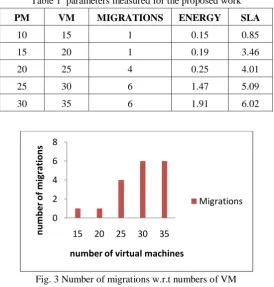
Table 1 parameters measured for the proposed work
PM VM MIGRATIONS ENERGY SLA
10 15 1 0.15 0.85
15 20 1 0.19 3.46
20 25 4 0.25 4.01
25 30 6 1.47 5.09
30 35 6 1.91 6.02
Fig. 3 Number of migrations w.r.t numbers of VM
From the figure above it is concluded that the number of migrations increases as the number of virtual machines increases.
Fig.4 SLA with respect to number of VM
In the figure 4 displays the SLA violations measured by every set of virtual machines with 5 iterations. SLA violation increases as the number of virtual machines increases.
0 2 4 6 8
15 20 25 30 35
n
u
m
b
e
r
of
m
ig
ra
ti
on
s
number of virtual machines
Migrations
0 2 4 6 8
15 20 25 30 35
SL
A
Number of virtual machines
ISSN(E): 2277-128X, ISSN(P): 2277-6451, pp. 30-35
Fig. 5 Energy consumption w.r.t numbers of VMs
When ABC algorithm along with neural network is applied to the proposed work energy consumed by the server is shown in figure above. When the number of virtual machines is less energy consumption is less but as the number of virtual machines increases energy consumption also increases.
5.1 COMPARISON OF PROPOSED WORK WITH EXISTING WORK
In this section, the parameters measured after the simulation of existing work with the proposed work have been discussed.
Table 2 comparison of number of migrations in the proposed work with existing work
NO. OF VM MIGRATIONS FOR EXISTING WORK NO. OF VM MIGRATIONS FOR
PROPOSED WORK
No. of PMs No. of VMs TVMM ACOVMM ABCVMM
10 15 7 4 1
15 20 9 6 1
20 25 11 9 4
25 30 16 13 6
30 35 19 15 6
In the table above comparison of number of migrations in the proposed work has been compared with the existing work. In the existing work different migrations have been used named as Traditional_VMmigration approach (TVMM), ACO based migration method named as (ACOVMM) along with proposed technique in which ABC along with neural have been used.
Fig. 6 Comparison of proposed with existing work
0 0.5 1 1.5 2 2.5
15 20 25 30 35
En
e
rg
y
co
n
su
m
p
ti
on
Number of virtual machines
Energy
0 2 4 6 8 10 12 14 16 18 20
15 20 25 30 35
Nu
m
er
of
m
igr
at
ion
Number of virtual machines
TVMM
ACOVMM
ISSN(E): 2277-128X, ISSN(P): 2277-6451, pp. 30-35
In the figure above, comparison of proposed work along with existing work has been displayed in the form of graph. Here blue bar line indicates the TVMM values, red bar line indicates ACOVMM values, green bar line indicates the ABCVMM values used in the proposed work, whereas green bar line indicates the number of migrations obtained for the proposed work with respect to the number of virtual machines. It has been concluded that when ABC algorithm along with neural network has been applied in the proposed work number of migrations decreased which means less SLA violations and less energy consumption.
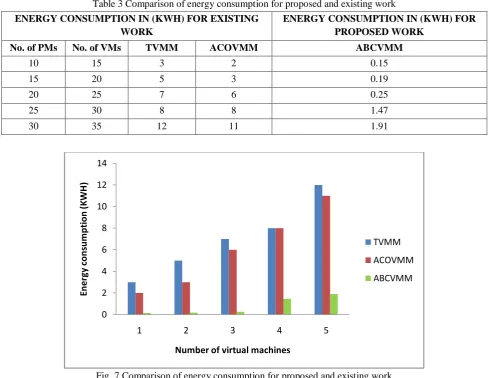
Table 3 Comparison of energy consumption for proposed and existing work ENERGY CONSUMPTION IN (KWH) FOR EXISTING
WORK
ENERGY CONSUMPTION IN (KWH) FOR PROPOSED WORK
No. of PMs No. of VMs TVMM ACOVMM ABCVMM
10 15 3 2 0.15
15 20 5 3 0.19
20 25 7 6 0.25
25 30 8 8 1.47
30 35 12 11 1.91
Fig. 7 Comparison of energy consumption for proposed and existing work
In the figure above, comparison of proposed work along with existing work has been displayed in the form of graph. Here blue bar line indicates the TVMM values, red bar line indicates ACOVMM values, green bar line indicates the MMVMM values used in the proposed work, whereas green bar line indicates the energy consumed in (KWH) for the proposed work with respect to the number of virtual machines. In the proposed work when ABC along with neural network as a classifier has been applied then the energy consumed by the server decreased and the obtained average consumed energy is 0.79 KWH whereas for MMVMM in the existing work average consumed energy is 5.2KWH.
VI. CONCLUSION
In this research work an artificial bee colony (ABC) optimization technique is proposed along with neural network for VM migrations in cloud computing.ABC algorithm is used for selecting the number of possible physical machines and the selection of appropriate machine from the output of ABC algorithm has been done by using Artificial neural network (ANN). The work is being simulated by using CLOUDSIM tool. As ABC algorithm has different alternatives, therefore, different variants are applied to VM migration problem. In this research work, Artificial Bee Colony (ABC) is applied and Performance of all these metrics has been compared with the existing work by means of energy consumption and number of migrations. From the research, it is being concluded that proposed work has performed better as compared to the existing work. The performance parameters like SLA violation, Energy consumption, and number of migrations with respect to number of virtual machines have been measured. This research has shown that with the usage of VM, Number of migrations, energy consumption and SLA violation has been reduced.
0 2 4 6 8 10 12 14
1 2 3 4 5
En
e
rg
y
co
n
su
m
p
ti
on
(
K
W
H
)
Number of virtual machines
TVMM
ACOVMM
ISSN(E): 2277-128X, ISSN(P): 2277-6451, pp. 30-35
In future to select the physical machines for VM migration different optimization algorithms like genetic algorithm along with particle swarm optimization (PSO) can be used in hybridization. The migrations can be checked by using ANN in conjunction with Fuzzy logic.
REFERENCES
[1] R. Buyya, R. Ranjan and R. N. Calheiros, “Modeling and simulation of scalable Cloud computing environments
and the CLOUDSIM toolkit: Challenges and opportunities,” 2009 International Conference on High
Performance Computing & Simulation, Leipzig, 2009, pp. 1-11.
[2] Xu, Gaochao, et al. “A novel artificial bee colony approach of live virtual machine migration policy using Bayes
theorem.” The Scientific World Journal 2013.
[3] Hashizume, Keiko, et al. “An analysis of security issues for cloud computing.” Journal of Internet Services and
Applications 4.1 (2013): 5.
[4] M. Satyanarayanan, P. Bahl, R. Caceres and N. Davies, “The Case for VM-Based Cloudlets in Mobile
Computing,” in IEEE Pervasive Computing, vol. 8, no. 4, pp. 14-23, Oct.-Dec. 2009.
[5] Voorsluys, W., Broberg, J., Venugopal, S., &Buyya, R. (2009). Cost of Virtual Machine Live Migration in
Clouds: A Performance Evaluation. CloudCom, vol.9, pp.254-265.
[6] O. Osanaiye, S. Chen, Z. Yan, R. Lu, K. K. R. Choo and M. Dlodlo, “From Cloud to Fog Computing: A Review
and a Conceptual Live VM Migration Framework,” in IEEE Access, vol. 5, no. , pp. 8284-8300, 2017.
[7] T. G. Rodrigues, K. Suto, H. Nishiyama and N. Kato, “Hybrid Method for Minimizing Service Delay in Edge
Cloud Computing Through VM Migration and Transmission Power Control,” in IEEE Transactions on
Computers, vol. 66, no. 5, pp. 810-819, May 1 2017.
[8] Y. Wen, Z. Li, S. Jin, C. Lin and Z. Liu, “Energy-Efficient Virtual Resource Dynamic Integration Method in
Cloud Computing,” in IEEE Access, vol. 5, no. , pp. 12214-12223, 2017.
[9] C. Xu, Z. Zhao, H. Wang, R. Shea and J. Liu, “Energy Efficiency of Cloud Virtual Machines: From Traffic
Pattern and CPU Affinity Perspectives,” in IEEE Systems Journal, vol. 11, no. 2, pp. 835-845, June 2017.
[10] Zhang, Qi, Lu Cheng, and RaoufBoutaba. “Cloud computing: state-of-the-art and research challenges.” Journal
of internet services and applications vol.1, 2010, pp. 7-18.
[11] Buyya, Rajkumar, Rajiv Ranjan, and Rodrigo N. Calheiros. “Intercloud: Utility-oriented federation of cloud
computing environments for scaling of application services.” International Conference on Algorithms and
Architectures for Parallel Processing. Springer, Berlin, Heidelberg, 2010.
[12] Z. Xiao, W. Song and Q. Chen, “Dynamic Resource Allocation Using Virtual Machines for Cloud Computing
Environment,” in IEEE Transactions on Parallel and Distributed Systems, vol. 24, no. 6, pp. 1107-1117, June
2013.
[13] Qiang Li, QinfenHao, Limin Xiao, and Zhoujun Li, “Adaptive Management of Virtualized Resources in Cloud
Computing Using Feedback Control,” in First International Conference on Information Science and Engineering, April 2009, pp. 99-102.
[14] Sarathe, Reena, Amit Mishra, and Shiv Kumar Sahu. “Max-Min Ant System based Approach for Intelligent VM
Migration and Consolidation for Green Cloud Computing.” International Journal of Computer
Applications vol.136, 2016.
[15] Goudarzi H., Pedram M., “Multi-dimensional SLA-based Resource Allocation for Multi-tier Cloud Computing
Systems,” in IEEE International Conference on Cloud Computing, Sep. 2011, pp. 324- 331.
[16] Bo Li, Jianxin Li, JinpengHuai, TianyuWo, Qin Li,LiangZhong (2009), “EnaCloud:AnEnegy-saving
Application Live Placement Approach for Cloud Computing Enviorments” , In IEEE International Conference on cloud Computing 2009, pp. 17-24.
[17] Jiandun Li, JunjiePeng, Wu Zhang (2011), “A Scheduling Algorithm for Private Clouds”, Journal of