The Effect of Using Fun Activities on Learning
Vocabulary at the Elementary Level
Farideh Bavi
Department of English Language Teaching, Ahvaz Branch, Islamic Azad University, Ahvaz, Iran
Abstract—The current study investigated the effect of using fun activity on learning vocabulary at the Elementary level in Ahvaz. The participants were 40 female students who were selected among 80 learners. They were studying English at an English institute. Their age was ranging from 8 to15. In order to have homogeneous groups, the learners were given an Oxford Quick Placement Test to determine their proficiency level. The teacher made test based on Hill's book given to them as the pre-test. Then they were divided into two equal groups of experimental and control groups. The experimental group received instruction and the control group was taught in the traditional way of teaching vocabulary including the uses of both groups 12 sessions of treatment, each 45 minutes with the same materials; and then they took a post-test at the end of the course. Data were analyzed through Independent and Paired samples test. Results showed that the experimental group outperformed the control one (p<0). Implications of the study suggest learners using fun activity on learning vocabulary to provide them with effective learning.
Index Terms—charades, letter scramble, chalk board acronym
I. INTRODUCTION
Vocabulary knowledge occupies a crucial position in the process of second language learning. Myriads of attempts have been made to assist learners to solve the challenges facing to vocabulary learning. However, doubts remain over their effectiveness in enhancing learners’ vocabulary comprehension and production (Song, 2011).
Using games and fun activity as an instructive device isn't something new and had a long history in dialect educating. Diversions were utilized for more redundancy in Audio lingual; they were presented in Desuggestopedia as pretend exercises or different exercises planning to lessen dialect obstructions; most exercises in TPR were amusement like ones to embed fun in classroom condition; and they observed to be convenient in Cooperative dialect educating, so as to boost the student association. This long story may demonstrate the viability of amusements (Thanh Huyen, & Thu Nga, 2003).
During the language learning process, young learners are quick to learn vocabulary, slower to learn structures. Having exposure and using words in the contexts such as fun activities (Brainstorm, charades, modified catch phrase, the dictionary game, what am I thinking of?, letter scramble, 20 object) can be a beneficial in order to fix them in their mind. Fun activities can help establishing the relationship between the words to other lexical items so that a vocabulary network is built up (Ashraf, Ghaneimotlagh & Salami, 2014).
The use of games and fun activities for vocabulary teaching and its wash-back effect well documented in various Studies that help many students to shed their embarrassment and be able to participate more actively in the meaning making process (Honarmand & Rostampour 2014). According to Derakhshan and DavoodiKhatir (2015), various methods such as using games can be used to teach and learn vocabulary. Games can assist the teachers to create social contexts in which the language is useful and meaningful. To successfully advance learning, amusements must incorporate routes for understudies to think about and clarify what is going on. Learning may not happen without time for reflection.
Instructors ought to propel understudies to exploit diversions in their learning procedure. They additionally need to screen their understudies' utilization of these vocabulary amusements to ensure that the structure and guidelines of the diversion don't take higher rank over learning. Learning vocabulary through diversions is one of the compelling and fascinating ways that can be connected in classrooms (Emirmustafaolu & Gökmen, 2015).
For instance, Donmus (2010) trusts that the estimation of instructive diversions has been expanding in dialect training since they help to make dialect instruction engaging. Likewise, these days learning vocabulary through recreations and fun exercises has increased much consideration. Whenever diversions and training are consolidated, it can be educative and instruction conditions can be engaging. The students who learned through amusements, increase inspirational dispositions and can be more persuaded while learning.
Diversions and fun exercises have dependably been a prevalent instrument in an English class keeping in mind the end goal to premium and wake up uninterested understudies additionally is a successful intends to advance youngsters' educational and mental potential in English learning has been under dialog for quite a while (Kuo, 2008). Deng (2006) expressed that "a diversion is a focused action including abilities, possibility, or continuance with respect to at least two people who play as indicated by an arrangement of guidelines, as a rule for their own particular beguilement or for spectators."(p. 3).
Taheri (2014) social association in diversion like exercises accommodates understudies different chances to help and support, let them partake in true correspondence, collaborate with each other, increment their confidence, demonstrate a more noteworthy readiness to cooperate with their companions. Truth be told, they are subliminally roused towards coordinating and counseling (talking each other and utilizing vocabulary and expressions. The understudies are occupied with the movement on the grounds that there is no should fear evaluations and instructor just screens understudies and reports the champs and failures. Understudies' endeavors in finding the right answer in a vocabulary amusement draw in them in a social collaboration. Interfacing in vocabulary amusement like exercises, understudies are expelled from anxious weights of being watched so their capacity to learn and review vocabulary things will be expanded. Toward the finish of action, understudies of the gatherings endeavor to find the obscure vocabulary things by arranging each other which consequently expands understudies' participation. Moreover, the recent findings are highly valued by constructivist theorists, who believe that social interaction is critical to learning.
Scarfo and Littleford (2008) assert that by setting up a play and fun environment, children are given the opportunity to manipulate, explore and experience with a variety of new material which enhances learning. Through play, children learn independence, knowledge and application of new vocabulary. Taking the advantages of learning vocabulary through different methods into account motivated the researcher to apply various activities, especially fun activities (i.e., Brainstorm, Charades, Modified catch phrase, the dictionary game, what am I thinking of? letter scramble, 20 object) in a new context to investigate their role applying in improving vocabulary enhancement. This study tries to illuminate the impact of applying fun activities on improving elementary students' vocabulary knowledge.
II. STATEMENT OF THE PROBLEM
In Iran, educational contexts, have strict class management and lack of fun activities that has made the classes boring and out of enjoyment because teachers don't use game, pictures, role playing, songs, in their teaching to attract students, this way of teaching is meaningless for children and so they'll lose their motivation for learning second language. This effects students' learning also in this way of teaching students don't exposed to the vocabulary for learning because of lack of time for those words to be acquired, or learn vocabulary in long lists or in isolation from a text, or by the use of traditional way such as giving synonym, definition, and opposite and giving example and use of translation and repetition, they are more learning difficulties when it comes to acquiring vocabulary. Learning vocabulary in this way makes difficulties and will lead to anxiety for some students. Through games and fun activity students interact with each other and also make students to learn by themselves and from other students in the processes of playing that reduce the fear of making mistake. Learning in this way gives the students an opportunity to challenge and exposure out of stress and anxiety for learning.
This current study tries to provide a fun atmosphere and use fun activities to teach various words to the elementary learners and attempts to investigate the role of applying fun activities in vocabulary learning.
III. OBJECTIVES OF THE STUDY
The first purpose of this study is to investigate the impact of using fun activities on vocabulary learning. Another purpose of this study is to reflect the efficacy and effectiveness of fun activities in performing the main responsibility of educational systems for learners which is paving the new ways to one’s future and ongoing development and guiding the individuals to higher stages of vocabulary learning development based on the learners needs and potential talents and in a unique way for each group of learners.
IV. RESEARCH QUESTIONS AND NULL HYPOTHESIS
This study aimed to answer the following question:
RQ. Does the use of fun activities (i.e., Chalk board Acronym, Letter scramble, charades...) affect learning vocabulary among EFL learners at the elementary level?
Based on the above question, the following null hypothesis was formed:
H0: The use of fun activities (i.e. Chalk board Acronym, Letter scramble, charades...) does not affect learning vocabulary among EFL learners at the elementary level.
V. SIGNIFICANCE OF THE STUDY
would not only contribute to the language learning process at lexical learning domain but also may eventually contribute to improving foreign language learning and teaching in our educational system and possibly worldwide.
VI. REVIEW OF THE LITERATURE
A. Theoretical Background
The meaning of diversion is a movement that you do to have a ton of fun. World recreations can make the understudies more concentration in dialect learning, since they don't feel that they are compelled to learn. Recreations can bring down uneasiness, in this way making the obtaining of information more probable (Richard-Amato, 1988). As indicated by Hansen (1994), fun exercises as one the world recreations branches are profoundly inspiring and engaging, and they can give modest understudies greater chance to express their supposition and sentiments. They additionally empower students to secure new encounters inside an outside dialect which are not generally conceivable amid an average lesson. Diversions can be media that will give numerous favorable circumstances for instructor and the understudies either.
Diversion is a normal for human instinct, thus one might say that the historical backdrop of amusement come back to the essential years of individual (Demirbilek, Yilmaz, and Tamer, 2010). In spite of the fact that there has been no certain meaning of amusement, numerous theoreticians have said that diversion is a characteristic piece of kids' life and give distinctive meanings of amusement. In addition, because of the distinctive impacts of diversions on people's improvement, specialists have given distinctive meanings of amusement (Donmus, 2010).
Wittgenstein (1953) likely was the main scholarly logician to address the meaning of the word diversion. Wittgenstein demonstrated that the components of recreations, for example, play, tenets, and rivalry, all neglect to enough characterize what amusements are. Wittgenstein stated that individuals utilize the word diversion to a scope of unique human exercises that bear to each other just what one may call family similarities. Alcorn (2003) states that diversions are a sort of game or stimulation that require cooperation, rivalry keeping in mind the end goal to accomplish certain objectives and have unique principles, it requires to have rules and certain objectives to be taken after. Piaget (1967) characterized amusement as osmosis of jolts from outside world and adjust it into the framework. Piaget remarked that recreations just have impact on youngsters' improvement. Notwithstanding, these days instructive framework have transformed, one might say that diversions might be successful on each age gather by making them fittingly amid formative period (Donmus, 2010).
Instructive diversions are exercises that give understudies the chance to control the past learning by rehashing it in a more agreeable place. Furthermore, help understudies to take in the lesson subjects and to take care of their concern by utilizing their want and excitement to play (Donmus, 2010). Csikszentmihalyi states that people, who play amusements, lose themselves amid diversion exercises and pull in the subjects of approaching occasions (Demirbilek, Yilmaz, and Tamer, 2010).
Moreover, the full of feeling channel speculation of the common approach which specified by Krashen (1980) contends that 'students with high inspiration for the most part improve the situation, and students with fearlessness and a decent mental self view have a tendency to be more fruitful' (Richards and Rodgers, 2001, p. 183). This idea is identified with utilizing recreations in showing English expanding youngsters' inspiration and certainty which give larger amounts of advancement of English learning. Jiang (2008), considered an organized survey, classroom perceptions and the flow instructor understudy connections, 360 respondents, demeanors toward utilizing amusements in learning English at a grade school were examined. Utilizing diversions as showing helps favored by sixty-eight percent of understudies.
In addition, all understudies had negative thoughts when amusements were not utilized as a part of class. At the end of the day, understudies want to lose themselves in a diversion showing condition which is very successful in raising their inspiration and enthusiasm for English dialect learning. A similar conclusion was likewise specified by Kuo's (2008) investigate. Kuo looked at two methodologies in educating, showing routinely and showing amusement, isolated understudies into the two gathering of trial (giving diversion instructing) and control gatherings (giving general educating). Results demonstrated that the test gather outflanked the control aggregate both in understudies, English oral capacity and in certainty. Along these lines, amusements not just convey enjoyable to the class, additionally convey high inspiration and certainty to the understudies (Chan and Lin, 2000; Robinson, 1960; Zheng, 2008).
They additionally include that agreeable rivalry generally engaged with amusement, and keep students intrigued, these give the inspiration to students of English to get included and took an interest in dynamic learning. "Recreations likewise enable students to recall the material in a charming and engaging way" (Uberman, 1998, p. 20). "For some kids in the vicinity of four and twelve years of age, dialect learning won't be the key motivational factor unless, amusements give this boost" (Lewis, 1999, p. 101). "Utilizing recreations encourages the understudies to unwind; and recollect things speedier and better. Also, amusements make the securing of info more probable by bringing down nervousness "(Richard-Amato, 1988, p. 147).
Recreations and fun exercises draw in the understudy thoughtfulness regarding learn English since it is fun and influence understudies to need to have analyze, find and cooperate with their condition (Lewis and Bedson, 1999).
of English as a result of the opposition between understudies. Furthermore, carry true setting into the classroom that upgrades understudies' utilization of English in an adaptable, open manner (Huyen and Nga, 2003). In synopsis, diversions and fun exercises are helpful and successful instrument that ought to be connected in vocabulary classes. The utilization of amusement in vocabulary learning is an approach to make the lessons all the more fascinating, agreeable and powerful.
Learning through recreations is valuable, important, and commendable and powerful that brings inspiration, unwinding and amusing to students in the class. The students can learn dialects on a very basic level and effectively through amusements (Alemi, 2010, Anyuegbu, 2012, Huyen and Nga, 2003, Jitmuad, 2005, Kumar and Lightner, 2007, Obee, 2002, Piaget, 1967, Simpson, 2011). Additionally, learning can be enhanced better by positive criticisms from educators or students' taking an interest in the gathering or class. These rouse them to the succeeded objective (Alemi, 2010; Kumar and Lightner, 2007). What's more, word diversions can mirror the students themselves in their classroom and educators through word amusements can evaluate their showing procedure also (Alemi, 2010).
Notwithstanding encouraging kids' inspiration and certainty, students can get vocabulary all the more rapidly and effectively by doing activities amid diversion playing (Angelova and Lekova, 1995; Atake, 2003; Deng, 2006). As indicated by Dewey's (1916) "learning by doing" by doing and by acting on the planet youngsters can learn best (Pound, 2005). At the point when youngsters touch something, they discover what the question is and how it feels; when they do some activity, they become more acquainted with its significance. By utilizing an amusement which recommends youngsters loads of chances to do, to act, and to move, kids can take in a more noteworthy amount of important vocabulary.
Shuang and Jin-xia (2015) pointed out that creating a suitable atmosphere for English teaching and learning is indispensable for children to learn English vocabulary. People have realized the significance of atmosphere and also paying more attention to use games in learning vocabulary for elementary learners, there are many aspects that have been ignored which affect the characteristics of body and mind of the children. Whether we should teach English to children has always been a hot topic and affected a lot of children, parents, and some teachers. However, there are some not suitable teaching methods that have a bad effect on the children’s physical and mental health. For example, some teachers think highly of the ability of speaking English and ignore the importance of vocabulary. Actually, we should put them in the same position, not only improving the ability of communication but also their cognitive competence. Also, teachers often think highly of how to keep words in mind rather than teach children how to learn through games in the relaxed and interesting environment. Besides, when teaching vocabulary, teachers get used to teach children how to read words and make children read again and again. However, this phenomenon is so common that affects the quality of children and their interests.
The game teaching is of great significance for children. Chen (2010), holds that games not only make children lively and arouse children’s learning interest, but also can provide help for teachers as an effective teaching method. When playing a group game, children have the chance to cooperate with others and they can have the chance to show their talent to develop communication skills and language skills in the game. The game teaching as a very crucial method plays a very momentous role in English vocabulary for children, it is the best way to stimulate their motivation and inspire their greater enthusiasm for English learning. In the process of the activity, children can improve their self-confidence through hard-working which lays a solid foundation in their language learning. Therefore, as a teacher, when using games to teach English vocabulary in kindergartens, they should take the Therefore, as a teacher, when using games to teach English vocabulary in kindergartens, they should take the characteristics of children’s mind and body into consideration and make full use of games combining with the learning vocabulary to improve children’s abilities of imagination and the interests to learn (Shuang & Jin-xia 2015).
Webb and Chang (2013) declare that the educator's way to deal with instructing, and the classroom exercises, are essential factors that influence L2 vocabulary adapting, thus, it is critical to think about methods for upgrading instructor coordinated vocabulary adapting, for example, utilizing amusements in the classroom, and to examine convictions identified with such systems. Along these lines, for most students, class time turns out to be vital for fruitful procurement of L2 vocabulary adapting, particularly when students don't have the open door for dialect use outside of the classroom (Salaheldin, 2015)
There has been numerous current exact examination in the territory of vocabulary advancement quite a bit of it including the exploration of Nation and his partners, (Nation and Chung, 2009, Nation, 2008, Nation, 2009, Nation, 2001). In light of their examination, Nation et al (2009) express that an all-around arranged vocabulary lesson in any dialect showing class ought to have the accompanying highlights:
1. It centers on the fitting level of vocabulary. 2. It gives an adjusted scope of chances for learning.
3. It screens and surveys the students' vocabulary information in valuable ways.
understudies on learning through amusements in her classes. She thinks about recreations as an approach to help understudies not just appreciate and engage with the dialect they learn, yet additionally rehearse it by chance. Amusements can influence understudies to center around the diversion and take in the dialect unknowingly. With the utilization of recreations, the instructor can make diverse settings in which understudies should utilize the dialect to impart, trade data and say their own particular conclusion (Wright, 1984).
According to Sorayaieazar (2012), most Iranian students learn vocabulary passively due to several factors, although students realize the importance of vocabulary when learning language. To start with, they think about the educator's clarification for significance or definition, elocution, spelling and syntactic capacities exhausting. For this situation, dialect students have nothing to do in a vocabulary learning area yet to tune in to their instructors. Second, understudies just consider vocabulary learning as knowing the essential importance of new words. Along these lines, they disregard every single other capacity of the words. Third, understudies typically get new vocabulary through new words in their course readings or when given by instructors amid classroom lessons. Forward, numerous Iranian students would prefer not to go out on a limb in applying what they have learnt. Understudies may perceive a word in a composed or talked frame however they will be unable to utilize that word legitimately in various settings or articulate it accurately.
Then again, conventional exercises make understudies to be engaged with an exhausting procedure of remembrance of not insignificant rundown of vocabulary, inferences, reiteration of words, interpretation, fill-in-the-clear activities, and so forth. Scrivener (2009, p. 241), states that "the not insignificant rundown of words and their interpretation appears to excite memory and notwithstanding when we can recollect the word we need, it doesn't appear to fit easily into our sentences". He trusts that the activity of taking note of down a rundown of lexical things makes no assurance that recalling will happen. In this way, from an educational perspective, there is a prerequisite for look into that help to distinguish the best possible exercises which give appropriate chances to l2 learning.
According to Schmitt (2010) a large vocabulary is needed for someone who wants to use language in a correct way. As it was mentioned, people use language for communicating, conveying, thought, and exchanging beliefs. Vocabulary learning happens when students are active in discovering ways in which words are related to experiences and to one another.
B. Experimental Background
Alem (2010) researched the part of utilizing word diversions in growing the student's vocabulary. In this manner, she utilized five word recreations (i.e., Twenty Questions, Charades, Definition Games, Passwords, and Crossword Puzzles). She chose the members haphazardly from a male/female gathering of third grade middle school understudies and furthermore arbitrarily partitioned them into two gatherings: exploratory and control. Control aggregate were shown words utilizing customary techniques; in any case, the test bunch got word diversions as a treatment toward the finish of every session. At long last, a vocabulary test was directed to the two gatherings to decide the contrasts between them. The score affirming the constructive outcome of word amusements on growing students' vocabulary.
Irandolati and Mikaili (2011) inspected the impacts of instructional diversions on encouraging of understudies' vocabulary learning. The objective of their investigation was to accomplish data about the part of the recreations in the level of vocabulary learning among understudies. The members of their investigation were 70 female understudies in the age of 12-13 years of age which were chosen from one of the Iranian elementary schools in Iran. To do this examination they utilize pre-test and post-test. by examining the pre-test and post-test they understood that utilizing recreations has the critical part in instructing vocabularies to the dialect students, they likewise found that amusement has its potential as an instructive instrument for artistic preparing and can persuade and include students particularly the peaceful and aloof ones in the entire learning process.
Efendi (2013) directed an examination on the utilization of recreations to enhance vocabulary dominance. The point of his examination was to depicting the using the diversions in enhancing vocabulary authority of the seventh grade understudies. His exploration was a sort of classroom activity look into in which the specialist goes about as the educator who drives instructing action. Keeping in mind the end goal to gather information he utilize perception agenda, field note and a test .The members of his examination were 29 understudies of seventh grade understudies. His investigation comprises of four noteworthy advances: arranging, actualizing, watching, and reflecting. The discoveries of the examination demonstrated that applying amusements with the themes vocabulary of day by day English correspondence, individuals' occupation, and individual care and appearance can enhance understudies' vocabulary dominance accomplishment.Students learn words through exposure, but are slow to learn before the age of 10 (Robbins & Ehri, 1994) and the learning of most words by young children is due to direct explanation (Biemiller, 2003).
Shahriarpour and Kafi (2014) studied the application of digital games to develop learning English vocabularies especially through video games such as L.A.Noire. This digital game is very popular among teenagers;. This paper collected data by the use of two tools, interview and observation. There are interviews with teachers and students about their observations and reactions toward playing the digital game. Finally, it is believed that digital games do increase motivation in learners toward learning, consequently, changing the direction from rote learning to meaningful learning. Using digital games is one of the factors which make the learners interested and motivated.
experimental. For the control group textbook was taught vocabulary through the traditional method while the experimental group was taught by Tic Tac Toe game and flash cards. After analyzing the test results showed that using games has an important role in teaching vocabulary to zero beginners.
VII. METHODOLOGY
A. Participants
This study was conducted on 40 female students who were selected via non-random sampling (i.e., convenience sampling) through Oxford Quick Placement Test (2001) at the elementary level (i.e., 18-29 scores) from among 60 students in Oxford English Institute Ahvaz city, Iran. The participants’ age range was between 8 to 15 years. The participants were assigned to two experimental and control groups non-randomly, each group consisting of 20 students. The researcher tries to select as homogeneous participants as possible through using the OPT. To further make sure that they were at the homogenous level of language knowledge and skills, they took a pre-test of vocabulary at the elementary level.
B. Instrumentation
1) Oxford Quick Placement Test (2001) will be used to homogenize the participants regarding their English proficiency. At last 20 elementary level students based on this test will be chosen to participate in this study. To assess vocabulary improvement, according to Hill' book steps to understanding (2010), a researcher-made vocabulary pre-test including 60 items is designed. It consists of 30 multiple-choice items and 30 true/false items was applied. The face validity and content validity of test will be proved by several teachers who have taught the given book for several semesters. The reliability coefficient of the pilot test in this research was estimated by Cronbach Alpha Formula as (α=.609). The post-test will be designed based on the modified pre-test.
2) To assess vocabulary improvement, a researcher made vocabulary test including 60 items as pretest and posttest consisting of 30 multiple-choice items and 30 true/false items was applied. The face validity and content validity of test will be proved by several teachers who have taught that given book for several semesters. It is to demonstrate the lexical improvement of participants in pre-test and post-test phases and to determine to what extent using fun activities in teaching will be effective.
Additionally, the aforementioned pre and post-test researcher-made test consisting of 60 vocabulary items including 30 multiple-choice and 30 true/false based on the follow up activities of Hill (2010) will be piloted on 10 other elementary students to make sure of its reliability. The reliability coefficient of the pilot test in this research will be estimated by Cronbach Alpha Formula as (α= .892)
C. Procedure
To collect the quantitative data, first the researcher will use an Oxford Quick Placement Test 2001 (OPT) to homogenize the participants and assigning them into two groups. Second, the researcher will use a pretest which consists of 60 items of 30 multiple-choice items and 30 true/false items. The face validity and content validity of test will be proved by several teachers who have taught that given book for several semesters. It is to demonstrate the lexical improvement of participants in pre-test and post-test phases and to determine to what extent using fun activities in teaching will have positive effect on vocabulary improvement. The treatment phase during 4 weeks (12 sessions) will be presented to experimental group and the vocabularies will be taught through fun activities including different fun activities such as (a) Chalk board Acronym, (b) Letter scramble, (c) charades. Control group will be taught through conventional vocabulary teaching methods .Finally, a post-test will be conducted to evaluate the difference between the learners’ performance from pre-test to post-test and illustrate the effect of using fun activities on vocabulary learning process. Students were instructed through Chalk board Acronym, Letter scramble and charades games. Chalk board Acronym is an ideal pedagogical tool for teaching young learners' vocabulary in this game teacher write respective words vertically, on the board and then have students come up at a time, to write a word starting with each letter of the vertical word. As far as this game is designed basically for young learners, they learn this game very quickly and so do vocabulary.
Letter scramble as another game is widely used as a learning tool. In this process of teaching vocabulary through Letter scramble, teacher took a list of words that students have recently learned and then to write a scramble version of each word on the board and then allowing students to unscramble the words on the paper the first one to finish deciphering all the words wins. Charades is another game that is used in the teaching vocabulary class. In this process, the teacher Write vocabulary words on individual index card and break the class into two teams and have one individual from each team act out the same word. The team to correctly guess the word first scores a point. After 4 weeks interval a post-test was run to check the word achievement. The aim of the post-test was further to investigate whether there was any difference in vocabulary achievement or not. Finally, the scores in the two groups were meticulously investigated to see if there was any significant relationship between their level of incidental vocabulary learning and the way they trained during sessions.
In order to determine whether the use of fun activity have any effect on learning vocabulary this study is conducted and the collected data were analyzed using different statistical procedure. In order to collecting the data and analyzing the results quantitatively, descriptive statistics and inferential statistics will be used. Through using SPSS, version 17, Paired Samples and Independent Samples t-tests are used for comparing the performance of the experimental and control groups at the pre-test and post-test.
VIII. RESULTS
The results of descriptive statistics (pre-tests) are presented in Table 1
Groups N
Mean Std. Deviation
Std. Error Mean
Experimental 20 12.1000 2.86356 .64031 Control 20 11.1500 3.21632 .71919
As it can be seen in Table 1, the number of the participants in each of the groups is 20. Initially, each participant's pre-test score obtained. Then, descriptive statistical of mean and standard deviation of each group were calculated. Results indicated that the average means for every two groups was near and the difference between the two groups was not significant. Regarding the standard deviation (SD), it was found that the SD of the experimental group was 2.86356 lower than control group. In order to find out whether the difference between the performances of the two groups was statistically significant, an Independent sample t-test was applied, and the results of the pre-test were interpreted.
TABLE 2:
INDEPENDENT SAMPLES T-TEST (PRE-TEST)
Levene's Test for Equality of Variances t-test for Equality of Means
95% Confidence Interval of the Difference
Experimental vs. Control F Sig. t Df Sig. (2-tailed) Mean Difference Std. Error Difference Lower Upper
Equal variances assumed .027 .871 .987 38 .330 .95000 .96293 -.99935 2.89935
Equal variances not assumed .987 37.498 .330 .95000 .96293 -1.00021 2.90021
Table 2 indicates the statistical analysis of Independent Sample t-test on the two groups' pre-test scores. These results showed that the difference between the means was not significant at (p<0.05) since the observed t. (.987) is less than the critical t (2.000) with df= 38, this result suggested that the groups were homogeneous before the research period at the pre-test level.
TABLE 3:
DESCRIPTIVE STATISTICS (POST-TESTS)
Groups N
Mean Std. Deviation
Std. Error Mean
Experimental 20 14.1000 2.77014 .61942 Control 20 11.9500 3.20321 .71626
Table 3 shows that the means in the two groups are different to some extent. The mean for experimental was 14.1000 and control groups were 11.9500 respectively. To describe the statistical significance of the two groups, an Independent Sample t-test was applied. The results of the statistical operations are analyzed in Table 4.
TABLE 4:
INDEPENDENT SAMPLES T-TEST (POST-TEST)
Levene's Test for Equality of Variances t-test for Equality of Means
95% Confidence Interval of the Difference
Experimental vs. Control F Sig. t df Sig. (2-tailed) Mean Difference Std. Error Difference Lower Upper
Equal variances assumed .018 .895 2.270 38 .029 2.15000 .94695 .23300 4.06700
4.06831 Equal variances not
assumed 2.270 37.226 .029 2.15000 .94695 .23169
Critical t with df 38 =2.125
TABLE 5:
DESCRIPTIVE STATISTICS (PRE VS.POST-TESTS) Groups Mean
N Std. Deviation
Std. Error Mean
Pair 1 Exp. Pre-test 12.1000 20 2.86356 .64031 Exp. Post-test 14.1000 20 2.77014 .61942 Pair 2 Control. Pre-test 11.1500 20 3.21632 .71919 Control. Post-test 11.9500 20 3.20321 .71626
Table 5 shows the results of the two groups' post-test, shows some differences in comparing to pre-test. And the means of two groups increased. It can be inferred that second groups of speech acts strategies instructions (14.1000 and 11.9500 ) shows the great difference in comparing to the pre-test groups (12.1000 and 11.1500 ). And it shows fun activity in learning had the most influence on the results of post-test. To compare the statistical significance of the two groups' mean in the pre-test and post-test, Paired sample t-test was applied and the results of the statistical operations are analyzed in Table 6.
TABLE 6:
PAIRED SAMPLES T-TEST (PRE VS.POST-TEST) Paired Differences
t df Sig.
(2-tailed) 95% Confidence Interval of
the Difference Mean Std. Deviation Std. Error Mean Lower Upper Pair 1 Exp. Pre vs. Post-test -2.0000 .56195 .12566 -2.26300 -1.73700 -15.916 19 .000 Pair 2 Control. Pre vs. Post-test -.80000 .76777 .17168 -1.15933 -.44067 -4.660 19 .000
Critical t with df 19 =2.020
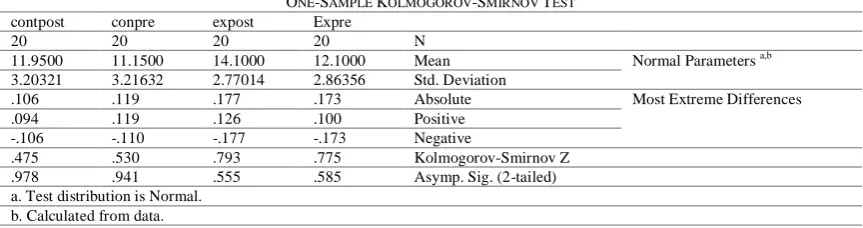
Table 6 shows the results shows that the difference between the groups is significant at (p<0.05) in Pair 1. Since the observed t (2.020) is greater than the critical t (2.020) with df = 19 and the difference between the groups is significant at (p>0.05) in Pair 2. Since the observed t (4.660) is greater than the critical t (2.020) with df =19. To calculate the normality of the test distribution, one –Sample Kolmogorov-Simirnov Test was conducted to the two groups. Data are illustrated in Table 7.
TABLE 7:
ONE-SAMPLE KOLMOGOROV-SMIRNOV TEST
Expre expost conpre contpost N 20 20 20 20
Normal Parameters a,b
Mean 12.1000 14.1000 11.1500 11.9500 Std. Deviation 2.86356 2.77014 3.21632 3.20321
Most Extreme Differences Absolute .173 .177 .119 .106 Positive .100 .126 .119 .094 Negative -.173 -.177 -.110 -.106 Kolmogorov-Smirnov Z .775 .793 .530 .475
Asymp. Sig. (2-tailed) .585
.555 .941
.978
a. Test distribution is Normal. b. Calculated from data.
Table 7 shows the test distribution is normal.
IX. DISCUSSION
This section elaborates on the results and findings presented in the previous part. To discuss the results of the research, the research question is raised again:
Tuan (2012) whose review demonstrated recreations are a focal a technique to obtaining of learning through playing. Correspondingly, Uberman (1998) who affirmed that opposition gave by diversions positively affected understudy learning since they enabled the understudies to impart and work together utilizing the objective dialect.
Graphic measurements likewise demonstrated that the mean scores of the test aggregate were more prominent than that of control gathering. In this manner, the impact of utilizing fun movement on learning vocabulary effectsly affected improving student's vocabulary at the rudimentary level. The essential inquiry in this investigation was regardless of whether the impact of utilizing fun action on learning vocabulary at the basic level. The outcomes are clear and make a solid contention for thinking about the impact of utilizing fun movement on rudimentary students. The t-test insights was utilized to break down the information gathered. There was a critical contrast between the execution of trial understudies and their partners who were not noteworthy. Future discoveries may add to a superior comprehension of the way that a few understudies advantage more from mediation programs and, along these lines, demonstrate preferred treatment results over others. With respect to the set number of members and the examination setting place for the present investigation, more research is expected to demonstrate the legitimacy and reasonability of this exploration.
The aftereffects of this examination are in accordance with Al-Shawi (2014) found that the utilization of recreations to show vocabulary has improved understudies' capacity to remember words, cooperate and function as a group and expanded their inspiration. Additionally, Tunchalearnpan's (2012) consider testing the utilization of vocabulary amusements to enhance vocabulary information on 40 school understudies, which found that understudies' maintenance of vocabulary was enhanced by utilizing recreations.
X. CONCLUSION
The results of the current study highlighted the significant role of using fun activity on learning vocabulary in improving learners’ vocabulary learning and enhancing their vocabulary achievement. Based on the results of the statistical calculations pursued during this study, the study has yielded the conclusion that the use of fun activity technique is more effective in teaching vocabulary than traditional methods at the elementary levels. The outcomes additionally demonstrated that the members in the trial assemble has given important movement and activities as opposed to retaining design. This demonstrates learning vocabulary can be upgraded through utilizing fun movement and the students can take in the vocabulary in an important setting. In this way, this examination loans trustworthiness to this conviction that fun action effectsly affects the understudies' vocabulary learning. Consequently, instructors ought to think about these exercises as a feasible option for educating vocabulary. In this way, it can be useful for educators to use them in their classes to upgrade the advantages of this system. The discoveries of this investigation show that engineers of vocabulary direction and educational programs ought to reevaluate their utilization of fun action inside their introductions. Bolstered by hypothetical perspectives, the outcomes got from this investigation demonstrated that keeping in mind the end goal to build up the capacity of vocabulary authority, educators can profit by utilizing fun action procedures and ought not to depend only on customary instructing systems. Syllabus planners can build up the capacity of abusing distinctive sorts of movement in the understudies to conquer learning lacks. This investigation gave motivation to assert that utilizing fun movement in learning vocabulary is more powerful than conventional mode to ace words; in any case, it is firmly prescribed to utilize fun action in a supplementary way keeping in mind the end goal to advance vocabulary aptitude better and all the more proficiently. Future research may likewise consider distinctive dialect bunches other than English to check whether students from other dialect gatherings may carry on comparably. Moreover, it would likewise be valuable to contemplate tests outside of Iran to decide whether a similar result applies or no.
Finally, the outcomes of the present study are influenced by the following limitations: (1) it was just one term study in the English institute term of 2016 years, (2) It was limited to Elementary students enrolled at in English institute Ahvaz city, Iran, (3) It was limited to the vocabulary learning and improvement and no other skills, (4) The study included only 40 participants; the inclusion of more participants could improve the reliability and validity of the results of the thesis, (5) The participants were all female. Taking into consideration of male could also add the reliability and validity of the findings.
REFERENCES
[1] Ahmad, R. S. (2009). Can Grammar be taught through Games? Tishreen University Journal for Research and Scientific Studies - Arts and Humanities. 31(1), 195-203
[2] Alemi, M. (2010). Educational games as a vehicle to teaching vocabulary. The Modern Journal of Applied Linguistics, 2(6), 425-438.
[3] Angelova, T. G., & Lekova, B. C. (1995). A model of early childhood foreign language education through playing motoric games. Retrieved October 22, 2009, from ERIC database. (ERIC Document Reproduction Service No. ED397957)
[4] Anyaegbu, R, Ting, W, & Li, Y. (2012). Serious game motivation in an EFL classroom in Chinese primary school. The Turkish Online Journal of Educational Technology, 17(1), 154-164.
[6] Ashrafa.H, Ghanei M. F, & Salamic, M. (2014). The Impact of Online Games on Learning English Vocabulary by Iranian (Low-intermediate) EFL Learners, Article in Procedia - Social and Behavioral Sciences 286-287.
[7] Atake, K. (2003). Using games to teach English in Japanese junior high school. Retrieved November 3, 2009, from ERIC database. (ERIC Document Reproduction Service No. ED479748).
[8] Biemiller, A.(2005). Vocabulary: Needed if more children are to read well. Journal of Reading Psychology 24(6): 3-14. [9] Chen, J. L. (2007). Using games in teaching English to preschool students. Unpublished master's thesis, National Dong Hwa
University, Haulian, Taiwan.
[10] Demirbilek, Muhammet, Ebru Yilmaz, & Suszan Tamer. (2010). Second language instructors’ perspectives about the use of educational game. Procedia Social and Behavioral Sciences.
[11] Deng, Q. H. (2006). A study of using games in primary school English teaching. Unpublished master's thesis, Northwest Normal University, Shensi province, China.
[12] Derakhshan, A & Davoodi K. E. (2015). The Effects of Using Games on English Vocabulary Learning. Journal of Applied Linguistics and Language Research, 2(3), 39-47
[13] Dewey, J. (1916). Democracy and Education: An Introduction to Philosophy of Education. Macmillan. New York: Macmillan.
[14] Dolati, R., & Mikaili, P. (2011). Effects of instructional games on facilitating of students’ vocabulary learning. Australian Journal of Basic and Applied Sciences, 5(11), 1218-1224.
[15] Donmus,V. (2010). The use of social networks in educational computer-game based foreign language learning. Social and Behavioral Sciences, 9(3),1497–1503.
[16] Efendi, E. (2013). The use of games to improve vocabulary mastery. Journal de Physique III, 1(12): 78-84.
[17] Emirmustafaolu, A, & Gökmen. D. U. (2015). The effects of picture vs. translation mediated instruction on L2 vocabulary learning. Procedia - Social and Behavioral Sciences 199 (2015) 357 – 362
[18] Ersoz, A. (2000). ‘Six Games for the EFL/ESL Classroom’. The Internet TESL Journal. 6(6), 1-6
[19] Fisher, P. J., & Blachowicz, C. L.Z. (2005). "Vocabulary instruction in a remedial setting." Reading & Writing Quarterly, 21(3), 281-300.
[20] Hansen, F. A. (1994). Testing: Social Consequences of the Examined Life. University of California Press, California [21] Hill,L, A. (2010). Steps to understanding. London: Longman.
[22] Honarmand, B., Rostampour, M., & Abdorahimzadeh, J. (2015). The Effect of Game Tic TAC Toe and Flash Cards on Zero Beginners’ Vocabulary Learning. International Journal of Educational Investigations, 2(3), 27-41.
[23] Huyen, N., Thi, T., & Nga, T. T. (2003). Learning vocabulary through games, the effectiveness of learning vocabulary through games. Asean EFL Journal. Retrieved on January, 2018 from http://www.asian-efl- journal.com/dec_03_sub.Vn.php.
[24] Krashen, S. (1989). We acquire vocabulary and spelling by reading: Additional evidence for the input hypothesis. The Modern Language Journal, 24(3), 237-270.
[25] Kumar, Rita & Lightner, Robin. (2007). Games as an Interactive Classroom Technique: Perceptions of Corporate Trainers, College Instructors and Students. International Journal of Teaching and Learning in Higher Education, 19(1), 53-63.
[26] Lee, J. M. (1996). English Games. The People Publisher, Seoul.
[27] Lewis, G., & G. Bedson. (1999). Games for Children. Oxford University Press, Oxford.
[28] Liang, D. Q. (2007). The teaching researches and practices of game in primary school (Master thesis, Guangxi Normal). [29] Nation, I. S. P. (1995). Teaching and Learning Vocabulary. Cambridge: Cambridge University Press.
[30] Nation, I. S. P. (2000). Learning Vocabulary in another Language (Cambridge Applied Linguistics). Cambridge: Cambridge University Press.
[31] Nation, I.S.P. (1990). Teaching and learning vocabulary. Massachusetts: Heinle & Heinle Publisher.
[32] Nation, P. & Chung, T (2009). Teaching and testing vocabulary. In Long, M.H & Doughty, C.J (eds.), The handbook of language teaching. Wiley- Black well publications.
[33] Obee, B. (2002). The Grammar Activity Book. Cambridge. UK: Cambridge University Press. [34] Piaget, Jean. (2001). The Moral Judgment of The Child. Oxon, GB: Routledge.
[35] Richard-Amato, P. (1988). Making It Happen: Interactions in the Second Language Classroom. Longman, New York.
[36] Richards, J. C., & Rodgers, T. S. (2001). Approaches and methods in language teaching (2nd ed). London: Cambridge University Press.
[37] Robbins, C., & Ehri, L. C. (1994). Reading storybooks to kindergartners helps them learn new vocabulary words. Journal of Educational psychology, 86(1): 54-68
[38] Shahriarpour, N. (2014). On the Effect of Playing Digital Games on Iranian Intermediate EFL Learners’ Motivation toward Learning English Vocabularies. Procedia-Social and Behavioral Sciences, 9(8): 1738-1743.
[39] Song, W. (2011). Learning vocabulary without tears: a comparative study of the jigsaw and information gap tasks in vocabulary acquisition at school (Unpublished master thesis). Kristianstad University Sweden, School of Education and Environment. Retrieved February 7, 2013.
[40] Sorayaie A. A. (2012). The Effect of Games on EFL Learners’ Vocabulary Learning Strategies. International journal of basic and applied science, 1(2), 239-243
[41] Taheri, M. (2014).The Effect of Using Language Games on Vocabulary Retention of Iranian Elementary EFL Learners.
Journal of Language Teaching and Research, 5(3), 544-549,
[42] Tunchalearnpanih, P. (2012). Using Games on Students’ Vocabulary Learning. Srinakharinwirot University (SWU), Thailand, Pp. 816- 825.
[43] Turgut, Y. & Irgin, P. (2009). Young learners’ language learning via computer games. Procedia Social and Behavioral Sciences, 1(6), 760–764.
[47] Wright, A., Betteridge, D. & Buckby, M. (1984). From 'Games for Language Learning'. Cambridge: Cambridge University Press.