AUSTRALIAN JOURNAL OF BASIC AND
APPLIED SCIENCES
ISSN:1991-8178 EISSN: 2309-8414 Journal home page: www.ajbasweb.com
Open Access Journal
Published BY AENSI Publication
© 2017 AENSI Publisher All rights reserved
This work is licensed under the Creative Commons Attribution International License (CC BY).
http://creativecommons.org/licenses/by/4.0/
To Cite This Article: Israa Sh. Ahmed, S. A. Aljunid, C. B. M. Rashidi, Layth A. Al dulaimi., Evaluation of 2-D Wavelength/Time MDW OCDMA Code via Different Detection Techniques. Aust. J. Basic & Appl. Sci., 11(1): 83-90, 2017
Evaluation of 2-D Wavelength/Time MDW OCDMA Code via Different
Detection Techniques
1Israa Sh. Ahmed, 2S. A. Aljunid, 3C. B. M. Rashidi, 4Layth A. Al dulaimi
1,4Research Student, School of Computer and Communication Engineering, University Malaysia Perlis (UniMap), Malaysia.
2Professor Dr., Dean, Research and Development Unit, School of Computer and Communication Engineering, University Malaysia Perlis
(UniMap), Malaysia.
3Senior lecturer, School of Computer and Communication Engineering, University Malaysia Perlis (UniMap), Malaysia.
Address For Correspondence:
Israa Shihab Ahmed, University Malaysia Perlis (UniMap), School of Computer and Communication Engineering, Pauh Putra, 02600 Arau, Perlis, Malaysia.
A R T I C L E I N F O A B S T R A C T Article history:
Received 18 September 2016 Accepted 1 January 2017
Available online 26 January 2017
Keywords:
Tow-Dimensional Modified Double Weight code, Direct detection technique, AND-Subtract detection, phase induced intensity noise, multiple access interference.
The major interference factor in Optical Code Multiple Access (OCDMA) is to overcome the Multiple Access Interference (MAI) noises, which induce the occurrence of Bit Error Rate (BER). The Phase Induced Intensity Noise (PIIN) is the dominant noise in the receiver, which is closely related to the MAI. In this paper, we focus on two different detection technologies Direct-detection and AND-Subtract detection. The study depends on simulation modeling and the code properties; 2-D MDW code is used in this investigation because of the unity cross-correlation. The weights of the code are k1=4,k2=2, the first represented the spectral weight, second represent the temporal
weight. OptiSystem software (Version 11.0) has been used to study the performance of the code with this two detection for four users. The BER was measured against different data rate and transmission distance over direct detection as well as AND-Subtraction detection. The 2-D MDW code shows a high performance when implemented with direct detection with high bit rate reach 2.5 Gbps even in short distance 12 Km, but, for 622 Mbps data rate the transmission range reach 60 km. And for received power, the code can gain BER = 10-9 at -25 dBm with 622 Mbps and -20
dBm at 1.25 Gbps.
INTRODUCTION
Incoherent OCDMA has been attracted the attention of most research groups until now, the system consisting of unipolar sequences in the signature code is called incoherent system (Kaur and Singh, 2015). These codes help in reducing the effect of multiple access interferences MAI to a great extent, such as double weight (DW), enhanced double weight (EDW), modified quadratic congruences (MQC) codes and modified double weight code (1-D MDW) (Aldouri, 2011). 2-D MDW code is a code with good cross-correlation help to suppress the impact of phase-induced intensity noise (PIIN) in the system and reduces the effect of MAI (Arief, 2013) because of the cross-correlation properties. Therefore, the design of code sequences and detection techniques is essential to mitigate the detrimental of MAI (Ghafouri-Shiraz and Karbassian, 2012 ).
Complementary detection with MAI mitigation but, it has a high number of optical filters at complementary decoder branch, performance limited by PIIN and must use balanced detection (Zaccarin and Kavehrad, 1993).
1 0 1 0 ) )( ( ) ( ) ( ( , ) M i N j h j g i d ijd g h a a
R
disadvantage the interfering signals should have the same frequency and power to cancel each other out (Kaur and Singh, 2015; Al-Khafaji, 2013).
Modified-AND with good PIIN and MAI mitigation and complexity design, the main disadvantages of this technique is supporting a moderate number of users compared to hundreds of Mbps data rate and using of balanced detection (Al-Khafaji, 2011).
AND is a better performance detection technology due to better MAI mitigation compared to others detections and has a low number of optical filters using AND decoder with high security (Ahmed, 2012), but still limited by PIIN and as the others using balanced detection.
Direct detection, in this technique only the required spectral chip in the optical domain is detected, other undesirable signals are removed by filtering (Othman, 2008). This detection design does not need Subtraction part technique at electric side. Thus, MAI and Phase Induced Intensity Noise (PIIN) will not occur in this detection scheme (Norazimah, 2012). Still, this method is just substantial to codes, which the spectral chips are not covered with other phantom chips of the other channel, for example, 2-D MDW code (Aldouri, 2011).
2-D MDW Code Parameters:
2-D MDW is denoted by (M x N, w, λa, λc ), Data coded by multiplication 2-D code matrix. M is a number of wavelengths, N is temporal code length, w is weight, λa and λc are auto and cross-correlation values.
Lets 2-D MDW Code constructs by multiplying tow 1-D code have the weight k1=4 and k2=2
Table 1: 2-D MDW Code construction.
h g
X
, [000011011] [011000110] [110110000]0 1 1
000000000 000000000 000000000 000011011 011000110 110110000 000011011 011000110 110110000 1
1 0
000011011 011000110 110110000 000011011 011000110 110110000 000000000 000000000 000000000
Horizontal 1-D MDW code, k1=4
Vertical 1-D MDW code, k2= 2
In 2013 (Arief, 2013) gives the Cross-correlation of 2-D MDW code:
(1)
Four characteristic matrices used (Arief, 2013):
) 0 (
A
=Y
TX
,A
(1)=Y
TX
,A
(2)=Y
X
,A
(3)=Y
TX
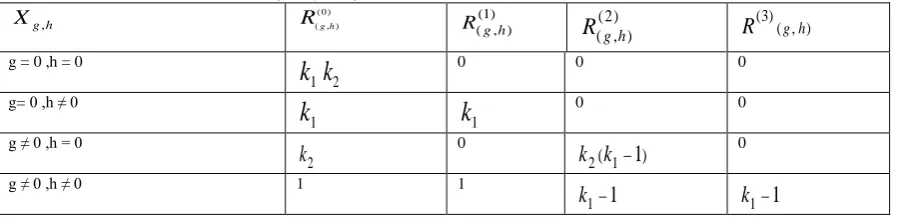
Cross-correlation table for 2-D MDW based on Equation (1) and the characteristic matrices:
Table 1: 2-D MDW cross-correlation table (Arief, 2011). h g X , ) 0 ( ) , (gh
R (1)
) , (gh
R (2)
) , (gh
R
R
(3)(g,h) g = 0 ,h = 01
k
k
2 0 0 0g= 0 ,h ≠ 0
1
k
k
1 0 0g ≠ 0 ,h = 0
2
k
0k
2(k
11
) 0g ≠ 0 ,h ≠ 0 1 1
1
1
k
k
11
Cross-correlation Equation (1) derived from Table 1 as (Arief, 2011):
otherwise
h
and
g
for
k
k
k
R
k
R
R
R
g h g h g h g h,
0
0
,
0
,
,
)
1
(
)
1
(
(
1 2The is the code where
g
(
1
,
2
,
3
,...,
M
1
)
andh
(
1
,
2
,
3
,...,
N
1
)
.
2-D W/T MDW code SNR function based on equations derivations (Arief, 2013; Ahmed, 2016)
2 2 2
2
thermal shot
PIIN r
I
I
I
I
SNR
(3)Where the average photocurrent output from the receiver is defined as Ir.
The shot noises are coming from the receiver, the average output currents of the receiver are independent of each other is represented by Ishot.
Noise power thermal noise, the variance of thermal noise power is defined as Ithermal.
Phase Induced Intensity Noise PIIN, is the result of mixing incoherent light field’s incident which causes intensity noise at PD output IPIIN.
BER can be expressed in terms of the signal-to-noise ratio (SNR) as:
(4)
Circuit Design With Detection Techniques: Direct Detection Technique:
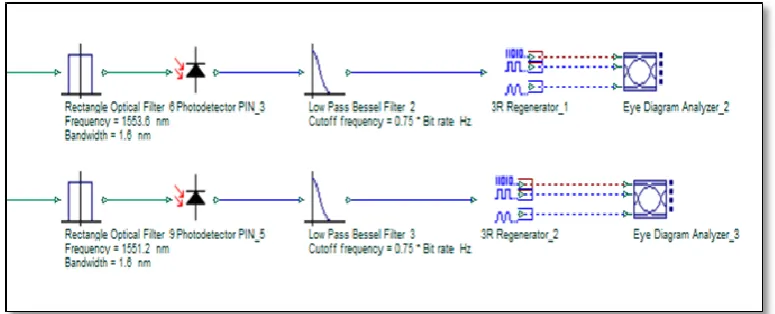
In this technique only wanted the spectral chip in the optical domain is detected, other undesirable signals are removed by filtering (Othman et al., 2008; Parikh and Paliwal, 2015). This screening design does not need Subtract detection technique at electric side. This is achievable for the simple reason that the information is assumed to be adequately irrecoverable for any of the signals that do not overlap any other signals from others user. Thus, the detector will only need to filter through the clean signals to be directly detected by the photo-detector as normal intensity modulation with the direct detection scheme. MAI and PIIN will not exist in this detection scheme (Norazimah et al., 2012; Parikh and Paliwal, 2015).
Fig. 1: Decoder with Direct Detection Technique for 2-D W/T MDW code.
AND-Subtract Detection:
And- Subtraction technique offers a significantly enhanced performance that can stand for longer transmission distance or higher data rate or a significant number of users (Rashidi et al., 2010). At the receiver side of the scheme, the approaching sign partitions into two sections, unitary to the decoder that gets a same channel construction with the encoder and the other to the decoder that has an AND-Subtract channel (Arief et al., 2013; Parikh and Paliwal, 2015).A deduction is then used to take off the overlapping data from the intended code. The MAI can be removed without the need of a compensation design (Arief, 2013).
This technique offers a better-received signal because the MAI is entirely suppressed with extra one filter in the decoder side with a high security (Ahmed et al., 2012; Parikh and Paliwal, 2015). Figure 2, observes the design of And-subtract detection technique in 2-D MDW code OCDMA.
h g
Fig. 2: AND-Subtraction Detection Method 2- D W/T MDW code in OCDMA.
Simulation Setup:
A simple diagram is for four users using the 2-D MDW code with k1=4, k2=2. The tests were carried out by 4 LED, which loaded with input power is 15.6 dBm each one slides into four frequency each frequency represent 1' in the code wavelengths sequence using WDM demultiplexer, and each chip has a spectral bandwidth of 0.8 nm. The ITU-T G.652 standard single-mode optical fiber without any amplifier was used for a different optical transmission. The attenuation and dispersion were usual at 0.2 dB/km. The dark current value was set at 5 nA, and the thermal noise factor was 1.8×10⁻²³ W/Hz for each of the photo-diodes at the detection part. The performance of the system was characterized regarding the bit-error rate (BER) and eye pattern.
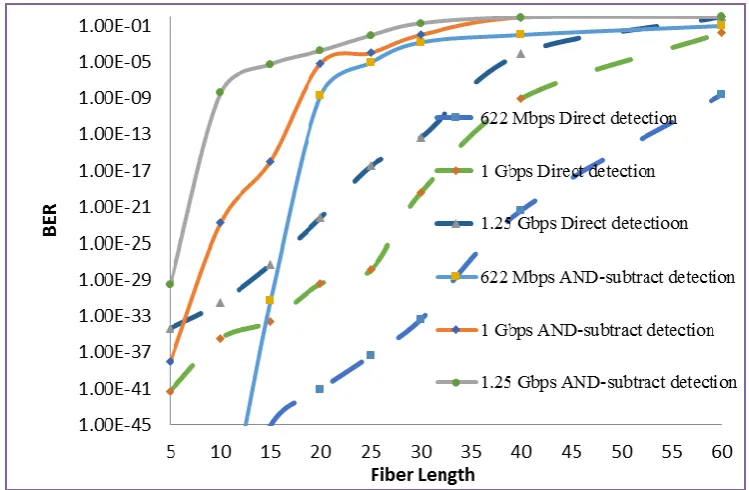
A BER curves for four users is shown in Figure 3. From the diagram, we can display the suitable detection for a bit rate of 622 Mbps is direct detections with transmission distance 60 km but, for AND-Subtraction detection, the transmission distance is 20 km at the same bit rate. While for high data rate like a bit rate of 1Gbps and 1.25 Gbps, it still shows direct detection is better that leads us by increasing the bit rate. At 1 Gbps direct detection achieved BER =10-9 at 40 km and 1.25 Gbps BER =10-9 with 19 km, it will decrease the pulse width; therefore, changing the bit rate will influence the received signals. For AND-Subtraction, detection cannot reach more than 12 km for 1 Gbps and 1.25 Gbps no more 7 km. This result is approved that direct detection is more suitable for 2-D W/T MDW code because of its properties. Thus can reach long transmission distance with high data bit rate not like AND detection.
Fig. 3: Performance of direct detection and AND-Subtraction detection technique for BER against different bit rates with various fiber length.
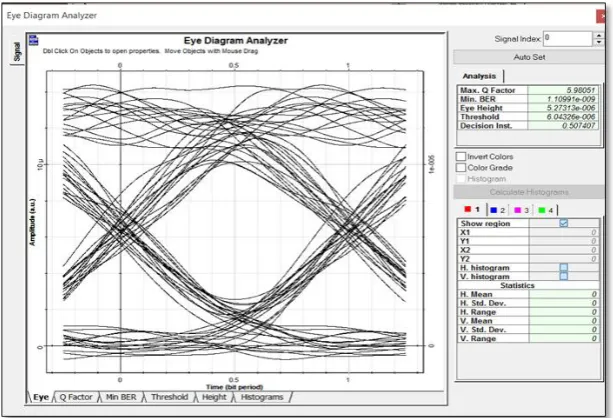
Fig. 4(a): The Eye diagram at 622 Mbps with Transmission Distance 10 km using Direct Detection.
Fig. 4(b): The Eye diagram at 622 Mbps with Transmission Distance 60 km using Direct Detection
The performance was taken with AND-Subtraction detection and the effect of varying data bit rate and different transmission distance. This graph shows the desecration of the system as the data bit rate and increases the fiber optical length that is contained in Figure 5 (a, b): AND-Subtraction detection with 662 Mbps data bit rate at different transmission distance.
Fig. 5(a): The Eye diagram at 622 Mbps with Transmission Distance 10 km.
Fig. 5(b): The Eye diagram at 622 Mbps with Transmission Distance 20 km.
Fig. 6: The Eye diagram at 1 Gbps with Transmission Distance 15 km.
Bit rate will diminish the pulse width, causing the signal to be more delicate to fiber spreading and receiver circuitry noise. Figure 7, shows the performance of spectral direct and AND-Subtraction detection method in various bit rate effected with varies received power. At bit rate 622 Mbps, the power received for direct detection for being around -25dBm though for AND-Subtraction at the same bit rate and directions, the received power is about -19 dBm. The loss power is high at AND-Subtraction detection technique and for 1 Gbps the direct detection is more suitable than AND-Subtraction. And so on, it is serene that direct detection can support higher bit rate than AND-Subtraction because of the less power loss.
Fig. 7: The performance BER versus the effective receive power of Direct and AND-Subtraction Detection method in various Bit Rates.
ConclusionL
In fact, the performance of the OCDMA system is decreasing for high bit rates. Since the effect of attenuation and dispersion in the fiber. In this investigation, we have used direct detection method, and it implemented with 2-D W/T MDW codes. For this detection scheme, the direct detection method is appropriate, in the case that we see at the performance BER to AND-Subtraction detection technique. It has been tested from
the outcome of the simulation. This because successfully reduced MAI and PIIN has been rejected. These results are approved that direct detection is more suitable for 2-D W/T MDW code because of its properties. Thus can reach long transmission distance with high data bit rate not like AND-Subtraction detection.
REFERENCES
Ahmed, I.S., S.A. Aljunid, C.B.M. Rashidi and L.A. Al dulaimi, 2016. High Performance with Avalanche Photodiode in Wavelength/Time Optical Code Division Multiple Access. Australian Journal Of Basic And Applied Sciences, 10(15): 306-314.
Ahmed, N., S.A. Aljunid, R.B. Ahmad, H.A. Fadil and M.A. Rashid, 2012. Novel OCDMA detection technique based on modified double weight code for the optical access network. Elektronika is Elektrotechnika, 18(8): 117-121.
Aldouri, M.Y., S.A. Aljunid, R.B. Ahmad and H.A. Fadhil, 2011. Bit error rate (BER) performance of return-to-zero and non-return-to-zero data signals optical code division multiple access (OCDMA) system based on AND detection scheme in fiber-to-the-home (FTTH) networks. Optica Applicata, 41(1): 173-181.
Al-Khafaji, H.M., S.A. Aljunid, A. Amphawan, H.A. Fadhil and A.M. Safar, 2013. Reducing BER of spectral-amplitude-coding optical code-division-multiple-access systems by single photodiode detection technique. Journal of the European Optical Society-Rapid Publications, 8.
Al-Khafaji, H.M., S.A. Aljunid and H.A. Fadhil, 2011. Performance enhancement of SAC-OCDMA system using modified-AND -Subtraction detection. In Computer Applications and Industrial Electronics (ICCAIE), IEEE International Conference, pp: 412-415.
Arief, A.R., S.A. Aljunid, M.S. Anuar, M.N. Junita, R.B. Ahmad and F. Ghani, 2011. Enhanced performance of new family modified double weight codes spectral amplitude coding optical CDMA system network. In Control System, Computing and Engineering (ICCSCE), IEEE International Conference, pp: 488-494.
Arief, A.R., S.A. Aljunid, M.S. Anuar, M.N. Junita and R.B. Ahmad, 2013. Cardinality enhancement of spectral/spatial modified double weight code optical code division multi-access system by PIIN suppression. Optik-International Journal for Light and Electron Optics, 126(19): 3786-3793.
Ghafouri-Shiraz, H., M.M. Karbassian, 2012. Optical CDMA networks: principles, analysis, and applications. John Wiley & Sons, pp: 38.
Kaur, A. and G. Singh, 2015. Improved Performance of SAC-OCDMA system using SPD Detection Technique. International Journal of Advanced Research in Electronics and Communication Engineering (IJARECE), 4(11): 2759-2761.
Norazimah, M.Z., H.M. Al-Khafaji, S.A. Aljunid and H. Fadhil, 2012. Performance comparison of different detection techniques in long-haul fiber SAC-OCDMA systems. In Photonics (ICP), IEEE 3rd International Conference, pp: 199-203
Othman, M., M.F.M. Rejab, R. Talib, N.A. Cholan, M.F.L. Abdullah, S.A. Aljunid and M.K. Abdullah, 2008. Comparison of detection techniques in optical CDMA access network for point to multipoint configuration. In Electronic Design, ICED International Conference, pp: 1-5.
Parikh, T., A. Paliwal, 2015. Performance Enhancement of Dynamic Cyclic Shift Code with Direct Detection and AND Subtraction Detection Technique of OCDMA. International Journal of Signal Processing, Image Processing and Pattern Recognition, 8(9): 299-306.
Rashidi, C.B.M., M.S. Anuar and S.A. Aljunid, 2010. Study of direct detection technique for zero cross-correlation code in OCDMA. Computer and Communication Engineering (ICCCE), International Conference IEEE.