Research Article
January
2018
Computer Science and Software Engineering
ISSN: 2277-128X (Volume-8, Issue-1)
Cloud Computing Security Issues and Challenges: A Review
Pankaj Gehaloach, Rohit Mahajan
Department of Computer Science and Engineering, Golden College of Engineering and Technology, Gurdaspur, Punjab, India
Abstract: With the rapid development of cloud computing, more and more data are being centralized into remote cloud server for sharing, which raises a challenge on how to keep them both private and accessible. The Research in Cloud Computing remains attractive because of crave to obtain high performance, accessibility, low cost and many other luxuries. Hence, growth of internet and virtualization technology, cloud computing gains a lot of attention in the field of computer networks. Due to these reasons to maintain secure and robust data, security in cloud computing is one of most important issue. Cloud computing is an upcoming uprising in computer science and information technology industry because of its performance, security, accessibility, low cost and many other amenities. Cloud security is a multifaceted and highly complex issue. Today security is main issue in cloud. All industry is moving toward cloud computing so security of data on cloud is essential so different security algorithm (like DES, AES, RSA etc.) has been implemented. In this paper, we compared and analyzed different security related issues and models. We also matched the challenges and security related issues of different security related algorithms plus models under different parameters such as confidentiality, integrity, authentication and authorization.
Keywords: Cloud computing; Cryptographic process; Public and Private Cloud.
I. INTRODUCTION
Cloud computing is an extension of grid computing and distributed computing, which is a software concept indeed [1], it works through variety of technologies such as software technologies, integration, management, and the use of various hardware resources. Cloud computing is realized mainly through the virtual technology [2]. The importance of Cloud Computing is continuously increasing getting a growing attention in the scientific and IT communities. Cloud computing and storage solutions provide end users and organizations with diverse capabilities for storing and processing their data in third-party data centers. Organizations use the Cloud in a variety of different service models i.e. SaaS, PaaS, and IaaS along with deployment models like Private, Public, Hybrid. Cloud computing security is a group of control-based techniques along with policies that are made to adhere to regulative compliance rules along with protection of information, data applications plus infrastructure associated with cloud computing use. For providing business or consumer IT services over the Internet Cloud Computing is a much more flexible, cost-effective plus proven delivery platform. However, cloud computing has an added level of risk because of essential services that often outsourced to a third party which further makes it harder to maintain data security, privacy and service availability.
Cloud computing is often considered the successor of grid computing. In reality, it embodies aspects of all these three major technologies. Computing clouds are deployed in large datacenters hosted by a single organization that provides services to others. Clouds are characterized by the fact of having virtually infinite capacity, being tolerant to failures, and being always on, as in the case of mainframes. In many cases, the computing nodes that form the infrastructure of computing clouds are commodity machines, as in the case of clusters. The services made available by a cloud vendor are consumed on a pay-per-use basis, and clouds fully implement the utility vision introduced by grid computing.
ISSN(E): 2277-128X, ISSN(P): 2277-6451, pp. 60-66
Figure 1: Cloud Computing
The security problems of cloud disk are not only the traditional problems but also new problems in cloud computing. [3] Described the security threats and challenges of the cloud computing with its three basic patterns (Saas, Paas, Iaas). Analyzed and summarized the threats being faced from different aspects. Cloud disk‟s weak security mainly occurs in the following aspects:
1) Transmission security: data in transmission process may be intercepted, but the data transmission is not working with the strong encryption protection measures.
2) Access control: access control authority is weak, the user data stored in the clouds without setting access authority, the user lost absolute right to monitor.
3) Data storage: user upload data after the clouds, it is likely to be distributive stored, users do not know the specific position where the data is stored. And the confidential data and non-confidential data stored is not classified, which may cause the leakage of data.
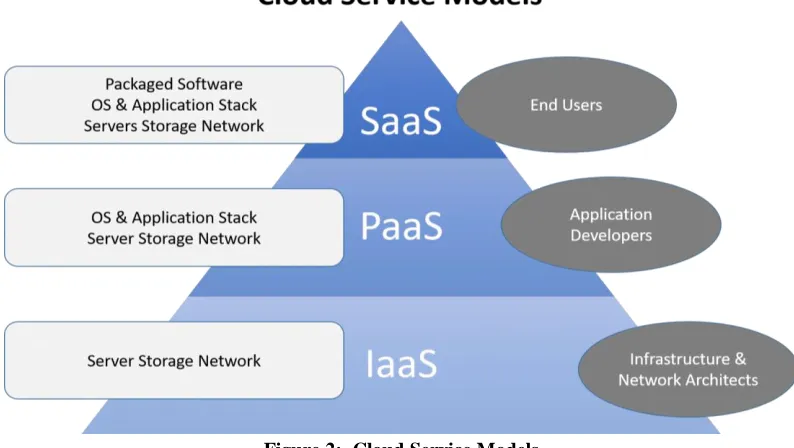
Cloud computing represents a distributing computing mechanism that by the utilize of the high speed network, data processing is moved from private PC or servers to the remote computer clusters (big data centers owned by the cloud service providers), any user has a potential super computer at hand and can access the data and get the computing capability at any time, from anywhere, you only need to pay for the resources which you have used, don‟t care about who provide the resources and in what way. The fig 2 shows the types of cloud.
Figure 2: Cloud Service Models
ISSN(E): 2277-128X, ISSN(P): 2277-6451, pp. 60-66 those services. Cloud providers use virtualization technologies combined with self-service abilities for computing resources via network infrastructure. In cloud environments, several kinds of virtual machines are hosted on the same physical server as infrastructure. In cloud, costumers must only pay for what they use and have not to pay for local resources which they need to such as storage or infrastructure.
Three major milestones have led to cloud computing: mainframe computing, cluster computing and grid computing. Mainframes: These were the first examples of large computational facilities leveraging multiple processing units. Mainframes were powerful, highly reliable computers specialized for large data movement and massive input/output (I/O) operations. They were mostly used by large organizations for bulk data processing tasks such as online transactions, enterprise resource planning, and other operations involving the processing of significant amounts of data. Clusters: Cluster computing started as a low-cost alternative to the use of mainframes and supercomputers. The technology advancement that created faster and more powerful mainframes and supercomputers eventually generated an increased availability of cheap commodity machines as a side effect. Starting in the 1980s, clusters become the standard technology for parallel and high-performance computing.
Data Security concerns with sensitivity of data stored to different types of cloud environment. This major issue is barrier to different range of people and barred them from adopting cloud. To resolve this problem related to sensitivity of data a security model based on verification of data at different security level that i.e. cloud service provider level, network intruder level, user level or third party level has been proposed. In this model, deployment standard algorithm Rivest-Shamir-Adleman(RSA) to encrypt data before sourcing it to cloud and also made the scheme for dual authentication of users.
Initially, organization store sensitive data internally protected with different security means but now days many organization started storing their data towards cloud. Still some organization lags behind in adoption of cloud due to security. Data security is most prominent issue of cloud computing. When the users upload their data to cloud then they have no direct hold over data. They only have to trust the cloud service provider for data security. When these providers are untrusted then data is unsafe. Data owner cannot trust anyone while outsourcing its data. Its main role is to protect data by themselves. On the basis of main responsibility of data owner towards data security an approach of data owner centric protection has been designed in form of model. Data is protected against third party, network intruder and cloud service provider. Re-encryption, HMAC and Identity based user authentication techniques has been used in this model. Proposed model give data owner control over its data storage at cloud and make them feel free without any fear of losing their data at cloud.
Cloud computing can effectively address the computing needs of users of versatile scales ranging from an individual to large organizations. This paper proposes a cloud computing model which effectively handles the issues related to cloud data security including confidentiality, integrity, authentication and authorization. Our model handles both external as well as internal data security threats. It makes use of a hybrid cloud architecture using both private as well as public cloud.
In this paper, we have compared different security related models and issues under different parameters i.e. Authentication, identification, encryption, indexing of data, time delay etc. The rest of this paper is Organised as Folllow: section 2 represents the related work in the field of cloud security. Section 3 represents simulation environment and the comparative study of different security models and the issues related to cloud security. Conclusion and future work are drawn in section 4.
II. RELATEDWORK
ISSN(E): 2277-128X, ISSN(P): 2277-6451, pp. 60-66 significant reductions in other areas. Despite all the hope of gaining maximum advantage from this cloud computing, it seems to have born with security and management concerns, which time to time hinders its growth. For this, lot of research work has been done to secure the data in cloud computing (primary concern) from every perspective, but everything seems to face a new challenge as soon as it is employed.
In this paper, I have made a review on my topic data security in cloud computing at different levels by reading different kinds of papers and analyzing different techniques which are being used in these papers published by authors which are discussed as follows:
Tao Jiang et al [5] investigated the collusion attack in the ongoing scheme and offered an effectual public integrity auditing scheme with secure group user revocation on the basis of vector commitment plus verifier-local revocation group signature which supports public checking and efficient user revocation.
Eman M.Mohamed et al [6] investigated the basic problem of cloud computing data security and offered the data security model of cloud computing on the basis of study of the cloud architecture. They implement the software to improve work in a data security model for cloud computing.
Mazhar Ali et al [7] formally verified the working of SeDaSC by means of high-level Petri nets, the Satisfiability Modulo Theories Library, and a Z3 solver. The results of the proposed study was elected encouraging and verified that SeDaSC has the potential to be efficiently used for secure data sharing in the cloud.
Dr. L. Arockiam et. al.[8] proposed a new cryptographic technique which is applied to address the security problem. Encrypted data is stored on storage servers while secret keys are reserved by data owner along with that access to the user is granted by issuing the corresponding data decryption keys.
Ayad F. Barsoum et. al. [9] provide a comparative analysis of the proposed MB-PMDDP scheme with a reference model obtained by extending current provable possession of dynamic single-copy schemes. The theoretical analysis was validated through experimental results on a commercial cloud platform.
Zhen Chen et al.[10] proposed the system implementation of vCNSMS and for this purpose collaborative network security prototype system used in a multi-tenant data center. They demonstrated vCNSMS with a integrated collaborative scheme and deep packet inspection with an open source UTM system. A security level based protection policy was proposed for simplification of the security rule management for vCNSMS.
Dharmendra S. Raghuwanshi et al. [11] provided solution that facilitates cloud consumers to store their sensitive data and application data objects in corresponding storage devices along with complete data privacy and security. It also provide both CSP and cloud vendors for achieving transparency in security processes of cloud.
Cindhamani.J et. al. [12] proposed an enhanced frame work for data security in cloud that provisw data security polices i.e. integrity, confidentiality and availability. The data was stored in cloud by using 128 bit encryption and RSA algorithm, then they use the trust management which audits the data instead of client.
Aws Naser Jaber1 et. al. [13] provide a complete survey of security in cloud computing
Sood et.al [14] proposed approach to ensure data security in cloud computing. In this proposed approach key generation, encryption, indexing of data, user authentication and data integrity is performed by data owner itself. Unfortunately, there will be high overhead on data owner and hence time consuming too.
III. SIMULATION ENVIRONMENT
The proposed model combines the benefits of private and public clouds. It effectively uses hash codes, symmetric encryption, user specific roles, a cryptographic process and dual verification in order to enhance the overall security of the data that is stored on the cloud. The proposed cloud security model has various aspects, each having a specific purpose and all collectively contributing in making our proposed model superior to various other proposed models. Cloud security [15] is a multifaceted and highly complex issue. The data owners‟ especially of large organizations fear possible data misuse by the cloud provider without their knowledge. This concern is a major deterrent in the path of shifting operations to the cloud. Any kind of security and privacy violation is critical and can produce dire consequences. The main stumbling block concern is data security at different levels. Client may range from an individual to big organization. Data Security at different levels concerns with two aspects: External level security and Internal Level security. External level security deals with data insecure against third party, cloud service provider or network intruder. Internal level security deals with authorized users or employee of an organization. Data Security concerns with sensitivity of data stored to different types of cloud environment. This major issue is barrier to different range of people and barred them from adopting cloud. As soon as cloud security issues are further organized and strict regulations and governance for cloud operation are in position so that more and more business owners will feel safe to opt for cloud computing.
ISSN(E): 2277-128X, ISSN(P): 2277-6451, pp. 60-66 intruder level. Data is protected against all level of threats. In proposed model data remains private during transit as well as data at rest and from untrusted parities. The goals of proposed model are to provide:
Security at User Level: Data remain secure from dishonest employee of organization or intruder.
Security at cloud service provider: Data remain private from untrusted or fake cloud provider.
Security at Third Party level: Data security against untrustworthy third party if involved data protection.
Network Intruder: Data remains secure during transit or over network form intruders.
Data Confidentiality: Data secrecy is maintained throughout the model i.e. data at rest or over network or during transit.
Data Privacy: Data Leakage is not there without authentication so data remains private.
Overhead: As model is based on owner centric approach so all the overhead will on data owner but this model has been proposed such that data owner overhead should be less.
Data Integrity: To check data tampering over the network by the network intruder during transit of data is kept main concern in model.
In order to secure data encryption is technique used in proposed model. Encryption of data is carried according sensitivity of data. The data is classified as: Type0 and Type1.
Type0 – Data is not sensitive i.e. no need to encrypt data. Data is directly uploaded to cloud without encryption. Type1 – Data is sensitive and need to encrypt data before uploading to cloud.
Type0 or Type1 depends on response of data owner. For Type1 data follow Data Encryption Mechanism.
3.1 Working of VMware Workstation
VMware Workstation offers the benefits of multiple PCs without the added expense, physical setup and maintenance. VMware Workstation runs multiple operating systems and their applications in an isolated and secure virtual machine. VMware Workstation can run many virtual machines simultaneously on a single PC. VMware Workstation maps the physical hardware resources to the virtual machine‟s resources, so each virtual machine has its own CPU, memory, disks, I/O devices and more. Each virtual machine is the full equivalent of a traditional PC. VMware Workstation installs just like a standard program on a Windows or Linux PC. VMware Workstation is recognized for its broad operating system support, rich user experience, a comprehensive feature set and high performance. VMware Workstation is designed for professionals that rely on virtual machines to get their job done.
3.2 OpenSSL
OpenSSL is based on the excellent SSLeay library developed by Eric Young and Tim Hudson. The OpenSSL toolkit is licensed under an Apache-style licence, which basically means that you are free to get and use it for commercial and non-commercial purposes subject to some simple license conditions. Secure Sockets Layer is an application-level protocol which was developed by the Netscape Corporation for the purpose of transmitting sensitive information, such as Credit Card details, via the Internet. SSL works by using a private key to encrypt data transferred over the SSL-enabled connection, thus thwarting eavesdropping of the information. The most popular use of SSL is in conjunction with web browsing (using the HTTP protocol), but many network applications can benefit from using SSL. By convention, URLs that require an SSL connection start with https: instead of http. The OpenSSL toolkit includes:
libssl.a: Implementation of SSLv2, SSLv3, TLSv1 and the required code to support both SSLv2, SSLv3 and TLSv1 in the one server and client.
libcrypto.a: General encryption and X.509 v1/v3 stuff needed by SSL/TLS but not actually logically part of it. It includes routines for the following:
ISSN(E): 2277-128X, ISSN(P): 2277-6451, pp. 60-66
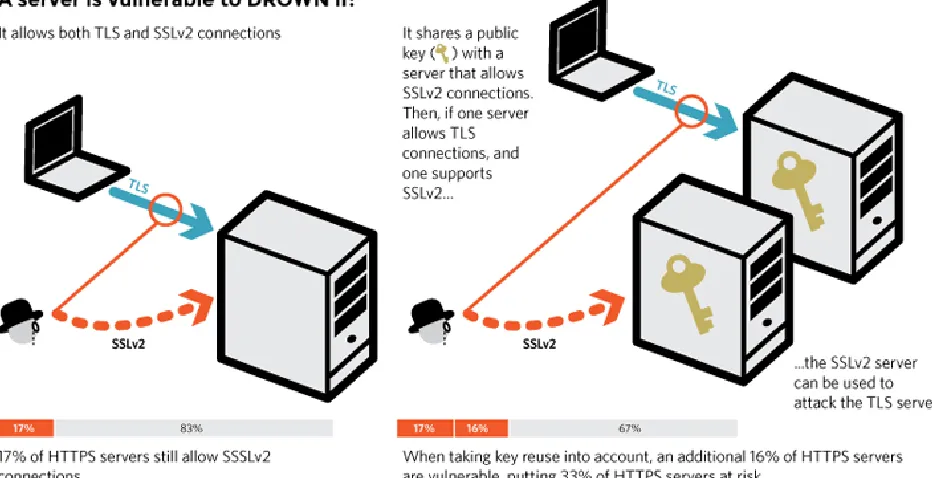
Figure 3: Open SSL Models
3.3 Comparative Study of Cloud Computing Security Models
Table 1 gives comparison of various security models and algorithms in Cloud computing. These algorithms naturally can well match the challenges and security related issues of cloud computing.
Table 1. Functionality comparison
Functions Tao Jiang
et al. [1]
Mohamed et al. [2]
Mazhar Ali et al. [3]
Arockiam et al. [4]
Zhen Chen et al. [6]
Raghuwa n et al. [7]
Li Ma et al. [10]
Complexity of Encryption
O(n) O(n) O(1) N/a N/a O(n) N/a
Identification and
authentication
Moderated High Moderated Low High High N/a
Authorization High Moderated Moderated Moderated Moderated Moderated Moderated
Encryption High High Moderated Moderated Moderated High N/a
Storage provider verification
Yes Yes No No Yes No N/a
Indexing of data
No Yes No No No No No
Overhead Moderated Low Moderated High Moderated Moderated Moderated
Time delay Yes No Yes Yes No No Yes
IV. CONCLUSION & FUTURE SCOPE
ISSN(E): 2277-128X, ISSN(P): 2277-6451, pp. 60-66 security model. It also explores the features like availability, reliability and integrity of data under different security parameters of different security techniques.
After the analysis of different security issues in different cloud security techniques, our future work will emphasize much more in security and will proposes a hybrid cloud computing technique that effectively deals with the issues related to cloud data security comprising confidentiality, integrity, authentication and authorization
REFERENCES
[1] Danan Thilakanatha, Shiping Chen,Surya Nepal, Rafael A. Calvo and Leila Alem, “A platform for secure
monitoring and sharing of generic health data in the Cloud”, Elsevier Ltd, 2013.
[2] Pardeep Sharma, Sandeep K. Sood, Sumeet Kaur, “Cloud Implementation Issues and What to Compute on
Cloud”, International Journal of Advances in Computer Networks and its Security, vol.1, no. 1, pp. 130-135,
2011.
[3] Jingwei Li, Jin Li, Zheli Liu and Chunfu Jia “Enabling efficient and secure data sharing in cloud computing”
Concurrency Computat.:Pract Exper.,John Wiley & Sons, Ltd.,2013.
[4] Jing-Jang Hwang, Hung-Kai Chuang, Yi-Chang Hsu and Chien-Hsing Wu, “A Business Model for Cloud Computing Based on a Separate Encryption and Decryption Service”, National Science Council of Taiwan Government.
[5] Tao Jiang et. al.“Public Integrity Auditing for Shared Dynamic Cloud Data with Group User Revocation” IEEE 2015
[6] Eman M.Mohamed et. Al. “Enhanced Data Security Model for Cloud Computing”, INFOS2012 - 14-16 May [7] Mazhar Ali et al “SeDaSC: Secure Data Sharing in Clouds”, IEEE SYSTEMS JOURNAL 2015
[8] Dr. L. Arockiam et. al. “Efficient Cloud Storage Confidentiality to Ensure Data Security” ICCCI -2014, Jan. 03 – 05, 2014, Coimbatore, INDIA.
[9] Ayad F. Barsoum et. al.” Provable Multicopy Dynamic Data Possession in Cloud Computing Systems”, IEEE TRANSACTIONS ON INFORMATION FORENSICS AND SECURITY, VOL. 10, NO. 3, MARCH 2015 [10] Zhen Chen et al. “Collaborative Network Security in Multi-Tenant Data Center for Cloud Computing”,
TSINGHUA SCIENCE AND TECHNOLOGY ISSNl l1007-0214l l09/10l lpp82-94, Volume 19, Number 1, February 2014
[11] Dharmendra S. Raghuwanshi et al. “MS2: Practical Data Privacy and Security Framework for Data at Rest in Cloud”, IEEE 2014
[12] Cindhamani.J et. al. “An enhanced data security and trust management enabled framework for cloud computing systems”, 5th ICCCNT – 2014
[13] Aws Naser Jaber1 et. al. “A Study in Data Security in Cloud Computing”, IC4T 2014.
[14] Sandeep K. Sood, “A Highly Secure Hybrid Security model for Data Security at Cloud ”, Submitted to Security and Communication Networks, John Wiley and Sons (Interscience), Special Issue on Trust and Security in Cloud Computing, 2012.
[15] P.Varalakshmi and Hamsavardhini Deventhiran, “Integrity Checking for CloudEnvironment Using Encryption
Algorithm”, IEEE, 2012.
[16] Eman M.Mohamed and Sherif EI-Etriby, “Randomness Testing of Modem Encryption Techniques in Cloud
Environment”, 8th International Conference on Informatics and Systems, 2012.
[17] Zhiqian Xu and Keith M. Martin, “Dynamic User Revocation and Key Refreshing for Attribute-Based
Encryption in Cloud Storage”, International Conference on Trust, Security and Privacy in Computing and