Design And Implementation Of Web Application
With Google Map Location Visualization For
Lecture Timetable In University Of Uyo
Kalu Constance1Department of Electrical/Electronic and Computer Engineering, University of Uyo, Akwa Ibom, Nigeria
Jude Ibanga2
Department of Electrical/Electronic and Computer Engineering, University of Uyo, Akwa Ibom, Nigeria
Nseabasi Peter Esien3
Department of Computer Education, University of Uyo, Akwa Ibom, Nigeria
Abstract— The paper presented a web-based lecture timetable management system for University of Uyo (UNIUYO). The web application uses Google Maps Application Programming Interface (API) to interface the timetable with Google map and thereby allows the lecture venues to be mapped and visualized online on the Google map. The study is motivated by the peculiar problems that are associated with timetable management in UNIUYO. Notably, UNIUYO has about four different campuses that are few kilometers apart from one another. Some students offer course combinations that require the students to have their lectures in different campuses of UNIUYO. Accordingly, the major focus of the timetable web application is to automate the timetable design process, eliminate or at least minimize conflicts in the timetable, provide a platform for prompt resolution of problems identified by the users and to make it easier for users to locate the lecture venues in the various campuses of university of Uyo. The Waterfall software development method is used in the web application development. The tools used for the system implementation include: Macromedia Dreamweaver and Cascaded Style Sheet (CSS), MYSQL Database Management System, PHP for the server-side scripting language and Apache for the Web server. Google Maps Application Programming Interface (API) is embedded in the system to allow communication between the application on the web-server and the remote Google geo-server. Sample lecture timetable data from the faculty of Engineering University of Uyo were used to demonstrate the application of the web-based time table management system.
Keywords — Timetable, Map Mashup, Web Application, Spatiotemporal, Software
especially, higher institutions where there are different disciplines with many courses that need to be assigned time and venue, even in the face of several constraints [1,2,3,4]. Interestingly, the emergence of Information and Communication Technology (ICT) has brought about computerized methods for preparing and publishing time tables [5,6,7,8,9,10,11]. In addition, the emergence of map mashup application has introduced another dimension to the timetable software system. It is now possible to include the spatial information about the lecture venues which can enable map-based visualization and tracking of the lecture venues [12, 13,14].
lecturer’s course allocations. It also captures the geographic coordinates of the lecture venues. The web application then uses its algorithms to schedule lectures for the courses in the available venues in such a way that the conflict in time or venues are avoided. The web application also interfaces with Google Map web server through the Google Maps Application Programming Interface (API) which enables the system to communicate between the web-server and the Google Map web server [15, 16,17,18, 19]. Eventually, the web server uses the local data captured from UNIUYO to visualize the lecture venues on Google map. It also allows users to use other Google map features to track the lecture venue in real-time.
II. THE SUMMARY OF THE PROCEDURE USED TO ADDRESS THE PROBLEMS IDENTIFIED IN THE EXISTING UNIVERSITY OF UYO TIMETABLE MANAGEMENT SYSTEM
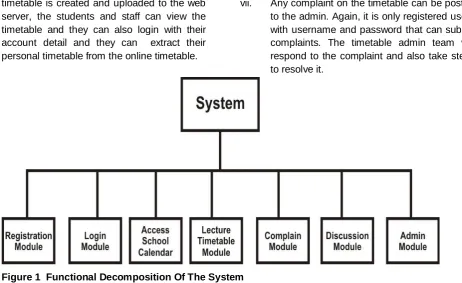
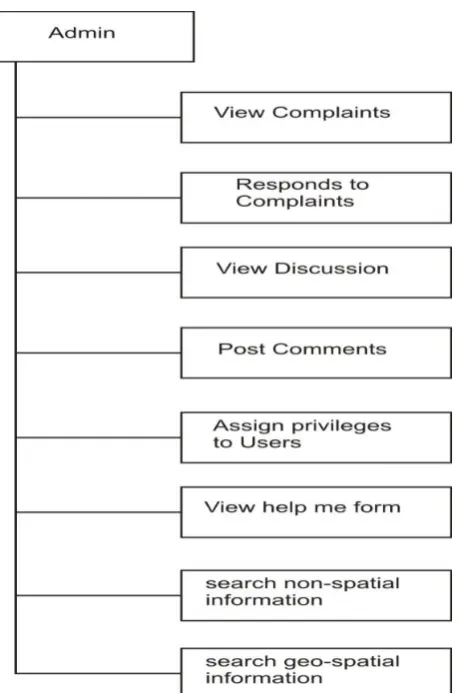
The major focus of the timetable web application is to automate the timetable design process, eliminate or at least minimize conflicts in the timetable, provide a platform for prompt resolution of problems identified by the users and to make it easier for users to locate the lecture venues in the various campuses of university of Uyo. The overall timetable web application is managed by an administrative team (admin) that has access to the admin module (Figure1). The admin manages the web application hosting plan, ensures that the users operate within their user privilege specifications, attends to the complaints posted by users and also responds to those complaints. In order to minimize conflicts in the timetable, the web application provides a centralized procedure for creating, updating and validating the timetable records. The centralized procedure is summarized as follows;
i. At the beginning of each academic session, the timetable web application admin unit updates the database with detailed information on all the courses offered in the university, the lecture venues in all the campuses and their geo-coordinates, the lecturer’s course allocation and other information like holidays and lecture free days.
ii. Since students’ course registration details for the current semester may not be ready as at the time the timetable is prepared, the previous year’s course registration details and results are used to generate the probable course registration details for the current semester. This approach may lead to few conflicts in the timetable. However, the complaint module in the web application is used to ensure that the users’ complaints are
iii. The information on the lecture venues capacity and the class size of each of the courses are updated and the lecture venue size and course class size are matched. This application will develop a table that generates a list of various lecture venues that can accommodate a given course based on the lecture venue size and course class size compatibility. The guiding principle for the allocation is that the venue size, in terms of number of people the venue can accommodate, must be greater or equal to the course class size.
iv. Next, the courses are assigned lecture venues starting from the first year courses, followed by the second year, and then up till the final year courses. In the time table, the postgraduate students are not considered since the postgraduate students have their separate venues that are different from the ones used by the undergraduate students. The reason why the allocation of time and venues start with the lower levels is that, one, some courses at the lower levels (such a General Studies, GST courses) are offered by all the students in that level. So, majority of the lecture venues will be occupied when these courses appear on the timetable. Two, some students at the higher level s have some lower level courses that they failed and which they need to re-take. So, by assigning the lower level courses first, the conflict in the timetable due to carryover courses are eliminated or minimized.
v. After the year one courses are allocated, the year two courses are allocated. When a course in year two is assigned a venue and time, the system validates the allocation with the central database. The validation checks that there is no conflict in venue, in time, in any carryover student’s time, there is sufficient time for those students and staff that will travel from one campus to the other campus to attend the class. All the information required for such decisions are stored in the centralized timetable database management system. Similar procedure is used to allocate venue and time to the courses for the other higher level courses.
web-timetable is created and uploaded to the web server, the students and staff can view the timetable and they can also login with their account detail and they can extract their personal timetable from the online timetable.
vii. Any complaint on the timetable can be posted to the admin. Again, it is only registered users with username and password that can submit complaints. The timetable admin team will respond to the complaint and also take steps to resolve it.
Figure 1 Functional Decomposition Of The System
III. SYSTEM DESIGN
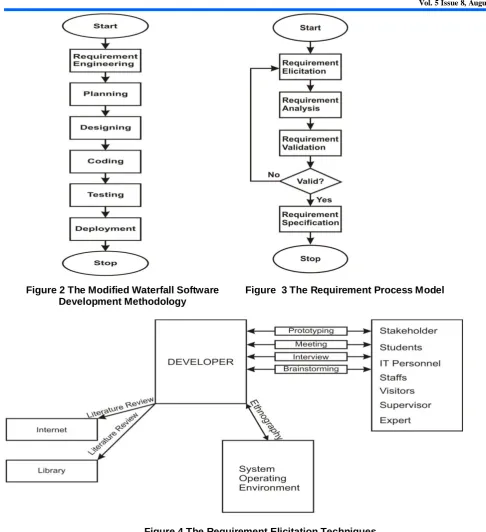
In this paper, the modified Waterfall software development methodology (Figure 2) is adopted for the development of the web-based lecture timetable management system. The activities involved in the Waterfall model include requirement engineering, planning, design, coding, testing, integration and deployment. Requirement engineering is a critical phase of the Waterfall model as such a robust requirement process model (Figure 3) is employed and it consists of the following activities: requirement elicitation, requirement analysis, requirement validation, and requirement specification. Requirement elicitation consists of actions and strategies employed by the system developers in order to understand the users’ viewpoint on the system. In this work, the requirement elicitation techniques (Figure 4) used are interview, meeting with the stakeholders, brainstorming, ethnography and the literature review.
Figure 2 The Modified Waterfall Software Development Methodology
Figure 3 The Requirement Process Model
Figure 7 Functional Decomposition of The Admin
Module Figure 8 Functional Decomposition of The Complaint Module
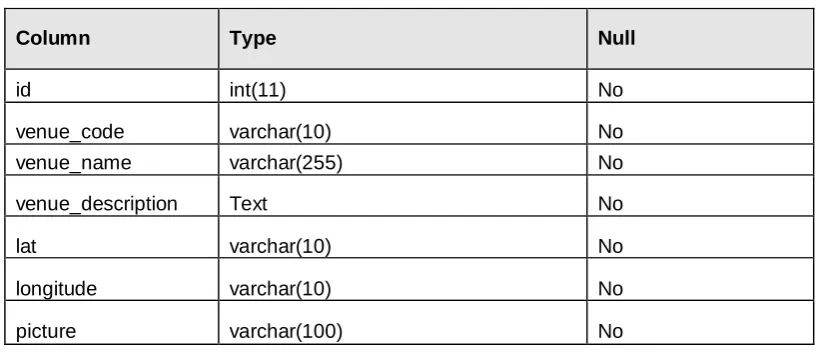
Table 1: Table structure for table: venue.
Column Type Null
id int(11) No
venue_code varchar(10) No venue_name varchar(255) No venue_description Text No lat varchar(10) No longitude varchar(10) No picture varchar(100) No
Table 2: Table structure for table: faculties .
Column Type Null
faculties_id int(100) No faculties_name varchar(255) No faculty_code varchar(30) No
Table 3: Table structure for table: departments.
Column Type Null
departments_id int(100) No departments_name varchar(255) No fac_id varchar(200) No departments_code varchar(100) No
Table 4: Table structure for table: days.
Column Type Null
id int(11) No day_code varchar(25) No day_name varchar(25) No
othernames varchar(89) No lga varchar(89) No level varchar(150) No dob varchar(25) No sex varchar(10) No course int(11) No dept varchar(150) No address Text No nationality varchar(25) No religion varchar(25) No regno varchar(25) No state varchar(25) No email varchar(89) No gsm varchar(89) No image varchar(89) No password varchar(89) No
Table 6: Table structure for table: courseofstudy.
Column Type Null
study_id int(11) No dept_id int(11) No study_name varchar(100) No duration varchar(15) No prog_id int(11) No
Table 7: Table structure for table: allocate venues.
Column Type Null
Table 8: Table structure for table: login.
Column Type Null
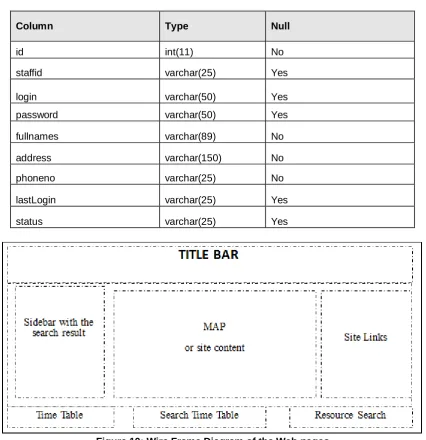
id int(11) No staffid varchar(25) Yes login varchar(50) Yes password varchar(50) Yes fullnames varchar(89) No address varchar(150) No phoneno varchar(25) No lastLogin varchar(25) Yes status varchar(25) Yes
Figure 10: Wire Frame Diagram of the Web pages
IV. SYSTEM IMPLEMENTATION
The web application is implemented using Hypertext Markup Language (HTML) and PHP (HyperText Pre-processor) server-side scripting language, MYSQL database management system, and hosted locally using WAMP server that consists of Windows operating system, Apache web server, MYSQL, and PHP. Adobe Macromedia Dream Weaver is used for the front-end design of the web application and for editing the HTML and PHP codes. Google map API is used to interface the web application to the Google map web server. Other tools used include a GPS tool which is used for generating the coordinates,
Figure 11: The UNIUYO main campus with some lecture venues in faculty of Engineering on Google map
Figure 13: The signup page for new students and login for registered students.
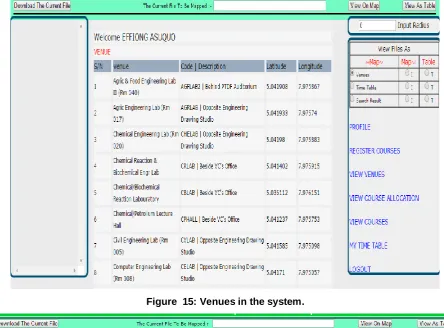
Figure 15: Venues in the system.
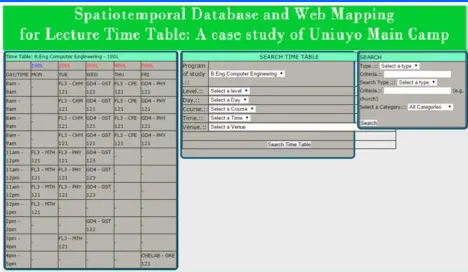
Figure 17 Search for a venue, course, level, day or time the map
Figure 18: Search results of a lecture’s venues on the map
V. CONCLUSION
The design and implementation of a web-based spatiotemporal lecture timetable system for University
REFERENCES
1. Hooshmand, S., Behshameh, M., &Hamidi, O. (2013). A tabu search algorithm with efficient diversification strategy for high school timetabling problem. arXiv preprint arXiv:1309.3285.
2. Mockus, J., &Pupeikienė, L. (2012). On multi-start algorithms for optimization of high school timetables. Informatica, 23(3), 405-425.
3. Mushi, A. R. (2011). Non-Linear Great Deluge algorithm for Tanzanian High Schools Timetabling.
International Journal of Advanced Research in Computer Science, 2(4).
4. Mohammadi, M. S., & Lucas, C. (2008, September). Cooperative co-evolution for school timetabling problem. In Cybernetic Intelligent Systems, 2008. CIS 2008. 7th IEEE International Conference on
(pp. 1-7). IEEE.
5. Imhonopi, D., Urim, U. M., Onwumah, A., &Kasumu, T. O. (2017). An appraisal of information and communication technologies as new media tools for language teaching and learning in tertiary institutions in Nigeria. IFE PsychologIA: An International Journal, 25(1), 185-209.
6. Johnson, L., Becker, S. A., Cummins, M., Estrada, V., Freeman, A., & Hall, C. (2016). NMC horizon report: 2016 higher education edition (pp. 1-50). The New Media Consortium.
7. Pucciarelli, F., & Kaplan, A. (2016). Competition and strategy in higher education: Managing complexity and uncertainty. Business Horizons,
59(3), 311-320.
8. Edewor, P., Imhonopi, D., &Urim, U. M. (2014). ICTs and sustainable development of higher education in Nigeria: Rewriting the ugly narrative.
Journal of educational and social research, 4(1), 357-363.
9. Imhonopi, D., &Urim, U. M. (2011). Maximising ICT for quality research and teaching in tertiary institutions in Nigeria. Journal of Society and Development, 1(3), 44-58.
10. Njamanze, Q. U. (2010). ICT in participatory development of teaching/learning English as a global language in Nigeria: A discourse. African Journal of Teacher Education, 1(1).
11. Ogunsola, L. A. (2005). Information and communication technologies and the effects of globalization: twenty-first century" digital slavery" for developing countries--myth or reality. Electronic
Journal of Academic and Special Librarianship, 6
(1-2), 1-10.
12. Walker, L., Cross, M., & Barnett, T. (2018). Mapping the interprofessional education landscape for students on rural clinical placements: an integrative literature review. Rural and remote health, 18(2), 1-18.
13. Kaiyan, H., & Qin, W. (2018). The development and popularisation of network platform of college sports venues in intelligent manufacturing. International Journal of Reasoning-based Intelligent Systems, 10(1), 20-25.
14. Campus, W. (2017). Campus Map. Acute Care, 1, 5.
15. Ibrahim, O. A., & Mohsen, K. J. (2014). Design and implementation an online location based services using Google maps for android mobile. International Journal of Computer Networks
and Communications Security (CNCS), 2(3),
113-118.
16. Hu, S., & Dai, T. (2013). Online Map Application Development Using Google Maps API, SQL Database, and ASP .NET. International
Journal of Information and Communication
Technology Research, 3(3).
17. Hu, S. (2012). Online Map Service Using Google Maps API and Other JavaScript Libraries: An Open Source Method. In Online Maps with APIs
and WebServices (pp. 265-278). Springer, Berlin,
Heidelberg.
18. Bildirici, I. O., &Ulugtekin, N. N. (2010, November). Web mapping with Google maps mashups: overlaying geodata. In A Special Joint Symposium of ISPRS Technical Commission IV
&AutoCarto in Conjunction with ASPRS/CaGIS (pp.
15-19).