Available online throug
ISSN 2229 – 5046
PERISTALTIC FLOW OF A COUPLE STRESS FLUID
IN AN INCLINED CHANNEL UNDER THE EFFECT OF MAGNETIC FIELD
THROUGH A POROUS MEDIUM WITH SLIP CONDITION
DR. N. G. SRIDHAR*
Assistant Professor, Govt. First Grade College, Sedam-585 222, Karnataka, India.
(Received On: 28-02-19; Revised & Accepted On: 28-03-19)
ABSTRACT
T
he present paper investigates the peristaltic motion of a couple stress fluid in a two dimensional inclined channel with the effect of magnetic field through a Porous Medium using slip condition. The effects of various physical parameters on velocity, pressure gradient and friction force have been discussed & computed numerically. The effects of various key parameters are discussed with the help of graphs.Keywords: Peristaltic transport, Couple stress fluid, Magnetic field, Porous Medium and inclined channel.
1. INTRODUCTION
Peristalsis is known to be one of the main mechanisms of transport for many physiological fluids, which is achieved by the passage of progressive waves of area contraction and expansion over flexible walls of a tube containing fluid. Various studies on peristaltic transport, experimental as well as theoretical, have been carried out by many researchers to explain peristaltic pumping in physiological systems. The study of couple stress fluid is very useful in understanding various physical problems because it possesses the mechanism to describe rheological complex fluids such as liquid crystals and human blood. By couple stress fluid, we mean a fluid whose particles sizes are taken into account, a special case of non-Newtonian fluids. Srivastava et.al, [1] peristaltic transport of a physiological fluid: part I flow in non- uniform geometry. Latham [2] investigated the fluid mechanics of peristaltic pump and science. Mekhemier [3] studied non-linear peristaltic transport a porous medium in an inclined planar channel. Srivastava and Srivastava [4] studied peristaltic transport of a non-newtonian fluid: applications to the vas deferens and small intestine. El-dabe and El-Mohandis [5] have studied magneto hydrodynamic flow of second order fluid through a porous medium on an inclined porous plane. Rathod and Asha [6] effects of magnetic field and an endoscope on peristaltic motion. Rathod and Mahadev [7] studied effect of magnetic field on ureteral peristalsis in cylindrical tube. Rathod and Pallavi [8] studied the influence of wall properties on MHD peristaltic transport of dusty fluid. Rathod and Pallavi [9] studied the effect of slip condition and heat transfer on MHD peristaltic transport through a porous medium with complaint wall. Rathod and Mahadev [10] studied slip effects and heat transfer on MHD peristaltic flow of Jeffrey fluid in an inclined channel. Rathod and Laxmi [11] investigated effects of heat transfer on the peristaltic MHD flow of a Bingham fluid through a porous medium in an inclined channel. Rathod and Laxmi [12] studied effects of heat transfer on the peristaltic MHD flow of a Bingham fluid through a porous medium in a channel. Jayarami Reddy et.al, [13] studied peristaltic flow of a Williamson fluid in an inclined planar channel under the effect of a magnetic field. Ramana Kumari and Radhakrishnamacharya [14] studied effect of slip on peristaltic transport in an inclined channel with wall effects. Reddappa et.al, [15] studied the peristaltic transport of a Jeffrey fluid in an inclined planar channel with variable viscosity under the effect of a magnetic field. Hanaa Abdulhussain and Ahmed Abdulhadi [16] studied the peristaltic transport of couple stress fluid through an inclined asymmetric and non-uniform channel with porous medium. Sridhar [17] studied effects of magnetic field with variable viscosity and an endoscope on peristaltic transport of couple stress fluids through a porous medium. Sridhar [18] studied peristaltic pumping of couple stress fluid through non - erodible porous lining tube wall with thickness of porous material using magnetic field. Sridhar [19] studied peristaltic flow of a couple stress fluid in an inclined channel under the effect of magnetic field with slip condition. Ramachandra and Usha [20] studied peristaltic Transport of Two Immiscible Viscous Fluids in a Circular Tube. Raptis and Peridikis [21] studied flow of a viscous fluid through a porous medium bounded by a vertical surface. Rathod and Sridhar [22] studied peristaltic transport of couple stress fluid in uniform and non-uniform annulus through porous medium. Rathod et.al, [23] studied peristaltic pumping of couple stress fluid through non - erodible porous lining tube wall with thickness of porous material. Rathod and Sridhar [24] studied effect of magnetic field on peristaltic transport
Corresponding Author: Dr. N. G. Sridhar*
through a Porous Medium with Slip Condition / IJMA- 10(4), April-2019.
of a couple stress fluid in a channel. Rathod and Sridhar [25] studied peristaltic flow of a couple stress fluid in an inclined channel. Rathod and Sridhar [26] studied peristaltic flow of a couple stress fluids through a porous medium in an inclined channel. Rathod and Sridhar [27] studied effects of couple stress fluid and an endoscope on peristaltic transport through a porous medium. Rathod et.al, [28] studied peristaltic flow of a couple stress fluid in an inclined channel under the effect of magnetic field.Rathod et.al, [29] studied peristaltic transport of a conducting couple stress fluid through a porous medium in a channel. Sridhar [30] studied peristaltic transport of a couple stress fluid through a porous medium in an inclined channel.
The present research aim is to investigate the interaction of peristalsis for the flow of a couple stress fluid in a two dimensional inclined channel with the effect of magnetic field through a porous medium using slip condition. The computational analysis has been carried out for drawing velocity profiles, pressure gradient and frictional force.
2. FORMULATION OF THE PROBLEM
We consider a peristaltic flow of a Couple stress fluids through two-dimensional channel of width 2a and inclined at an angle α to the horizontal symmetric with respect to its axis. The walls of the channel are assumed to be flexible. The wall deformation is
2
( , )
(
)
H x t
a bCos
π
X
ct
λ
= +
−
(1)Where ‘b’ is the amplitude of the peristaltic wave, ‘c’ is the wave velocity, ‘
λ
’ is the wave length, t is the time and X is the direction of wave propagation.The governing equations are
0
u
v
x
y
∂
+
∂
=
∂
∂
(2)2 * 4 2
1
sin
ou
u
p
u
v
u
u
B u
u
g
x
y
x
k
µ
ρ
∂
+
∂
= −
∂
+ ∇ − ∇ −
µ
η
σ
−
+
ρ
α
∂
∂
∂
(3)2 * 4 2
1
cos
ov
v
p
u
v
v
v
B v
v
g
x
y
y
k
µ
ρ
∂
+
∂
= −
∂
+ ∇ − ∇ −
µ
η
σ
−
−
ρ
α
∂
∂
∂
(4)where, 2 2 2 2 2
x
y
∂
∂
∇ =
+
∂
∂
u and v are velocity components, ‘p’ is the fluid pressure, ‘
ρ
’ is the density of the fluid, ‘µ
’ is the coefficient ofviscosity, ‘
η
*’ is the coefficient of couple stress, ‘g’ is the gravity due to acceleration, ‘α
’ angle of inclination, ‘σ
’ is electric conductivity, ‘k
1‘ is the permeability of the porous medium and ‘Β
°‘ is applied magnetic field.Introducing a wave frame (x, y) moving with velocity c away from the fixed frame (X, Y) by the transformation
, , , , ( , )
x=X −ct y=Y u=U v=V p=P X t (5)
We introduce the non-dimensional variables:
2 2
* * * * * *
2
, , , , ,
,
,
,
x y u v tc pa ga
x y u v t p
a c c c c
b
G
M
a
a
ρ
λ
δ
λ
µ λ
µ
°µ
σ φ
= = = = = =
=
=Β
=
(6)
Equation of motion and boundary conditions in dimensionless form becomes
0
u
v
x
y
∂
+
∂
=
∂
∂
(7)2 2 2 2 2 2
2 2 2
2 2 2 2 2 2 2
1
Re
u
u
v
u
p
u
u
u
u
x
y
x
x
y
x
y
x
y
δ
δ
δ
δ
γ
∂
+
∂
= −
∂
+
∂
+
∂
−
∂
+
∂
∂
+
∂
∂
∂
∂
∂
∂
∂
∂
∂
∂
2 2( )
( )
sin
M
u
K u
G
α
−
−
+
(8)2 2 2 2 2 2
3 2 2 2 2 2
2 2 2 2 2 2 2
1
Re
u
v
v
v
p
v
v
v
v
x
y
y
x
y
x
y
x
y
δ
δ δ
δ δ
δ
* 2 2
a
η
γ
µ
=
couple-stress parameter,K
2k
12a
=
porous parameter &M
2 2o 2a
σ
µ
=Β
Hartmann number.The dimensionless boundary conditions are: 2
2
2 2
0;
0
0
;
1
[2
]
n
u
u
at
y
y
y
u
u
u
k
finite at
y
h
Cos
x
y
y
φ
π
∂
=
∂
=
=
∂
∂
∂ ∂
= −
= ± = +
∂ ∂
(10) where,k
n is Knudsen number (slip parameter)Using long wavelength approximation and neglecting the wave number
δ
, one can reduce governing equations:0
p
y
∂
=
∂
(11)2 4
2 2
2 2 4
1
( )
( )
sin
p
u
u
M
u
K u
G
x
y
γ
y
α
∂
=
∂
−
∂
−
−
+
∂
∂
∂
(12)Solving the Eq. (12) with the boundary conditions (10), we get
2 2 2
1
1
. sin
(
)
p
D
u
D
G D
x
γ
K
M
α
∂
=
−
−
−
∂
+
(13)Where
2 2
2
2
y
h
D
=
−
−
β
y
The volumetric flow rate in the wave frame is defined by
5 4 3 2
2 2 2
0
1
2
sin
15
4
3
(
)
h
p
h
h
h
h
q
udy
A
GA
x
K
M
β
β
α
γ
∂
=
=
−
+
+
−
−
∂
+
∫
(14)Where,
3 2 3
6
2
2
h
h
h
A
=
−
β
−
The expression for pressure gradient from Eq. (14) is given by
5 4 3 2
2 2 2
sin
1
2
15
4
3
(
)
p
q GA
x
h
h
h
h
A
K
M
α
β
β
γ
∂
=
+
∂
−
+
+
−
+
(15)The instantaneous flux Q (x, t) in the laboratory frame is
0
( , )
(
1)
h
Q x t
=
∫
u
+
dy
= +
q
h
(16)The average flux over one period of peristaltic wane is
Q
0
1
1
T
Q
Qdt
q
T
=
∫
= +
(17)From equations (15) and (17), the pressure gradient is obtained as
5 4 3 2
2 2 2
(
1)
sin
1
2
15
4
3
(
)
p
Q
GA
x
h
h
h
h
through a Porous Medium with Slip Condition / IJMA- 10(4), April-2019.
The pressure rise (drop) over one cycle of the wave can be obtained as 1
0
dp
P
dx
dx
∆ =
∫
(19)The dimensionless frictional force F at the wall across one wavelength is given by 1
0
dp
F
h
dx
dx
=
−
∫
(20)3. RESULTS AND DISCUSSIONS
In this section we have presented the graphical results of the solutions axial velocity u, pressure rise
∆
P
, friction force F for the different values of couple stress (γ
), magnetic field (M), angle of inclination (α
), gravitational parameter (G), porous parameter (K) and slip parameter (β
). The axial velocity is shown in Figs. (1 to 6).The Variation of u with
γ
, we find that u depreciates with increase inγ
(Fig. 1). The Variation of u with magnetic field M shows that for u decreases with increasing in M (fig. 2).The Variation of u with angle of inclinationα
shows that for u increases with increasing inα
(Fig 3). The Variation of u with gravitational parameter G shows that for u increases with increasing in G (Fig 4). The Variation of u with porous parameter K shows that for u decreases with increasing in K (Fig 5). The Variation of u with slip parameterβ
shows that for u increases with increasing in G (Fig 6).Fig. 1: Effect of
γ
on u, whenφ
=0.2, x=0.1, p=-25, G= 6, M=1,β
=.1,K= 5 & α=π/4.Fig. 5: Effect of K on u, when
γ
=1, φ=.2, x=0.1, p=-.25, M =1, β =.1, G=4 & α=π/4. Fig. 6: Effect ofβ
on u, whenγ
=1, x=0.1, p=-.25, G = 6, φ=0.2, M=1, K=5 & α=π/4.The variation of pressure rise
∆
P
is shown in Figs (7 to 12) for different values ofγ
, M,α
, G, K &β
. We find thatP
∆
increases with increasing inγ
(Fig. 7). The Variation of∆
P
with M shows that for∆
P
increases with increasing in M (Fig 8).The Variation of∆
P
with angle of inclinationα
shows that for∆
P
increases with increasing inα
(Fig 9). The Variation of∆
P
with gravitational parameter G shows that for∆
P
increases with increasing in G (Fig 10). The Variation of∆
P
with porous parameter K shows that for∆
P
increases with increase in K (Fig 11). The Variation of∆
P
with slip parameterβ
shows that for∆
P
depreciates with increase inβ
(Fig 12).
Fig. 7: Effect of
γ
on∆
p
,whenφ
=0.6, G =4, α = π/4, Q = 0, β = 1, K=1 & Μ=1. Fig. 8: Effect of M on∆
p
,whenγ
=.7,φ
=0.2, G=2, α = π/4, β =.1, K=1 & Q = 0. Fig. 9: Effect ofα
on∆
p
,whenγ
=1.5,φ
=0.6, M =1, Q=0, G =20, K=1 & β = 10 Fig. 10: Effect of G on∆
p
,whenγ
=1.5,φ
=0.6,M = 10, Q=0, β = 1, K=1 & α =π/4. Fig. 11: Effect of K on∆
p
,whenγ
=1.5,φ
=0.6,M = 10, Q=0, β = 1 & α =π/4. Fig. 12: Effect ofβ
on u, whenγ
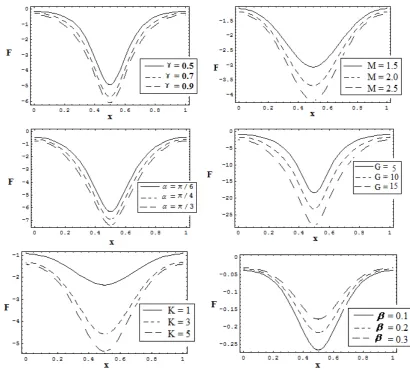
=1.5, G = 20, φ=0.2, Q=0, M=10, K=1 & α= π/4.The variation of friction force F is shown in Figs. (13 to 18) for a different values of
γ
, M,α
, G, K &β
.through a Porous Medium with Slip Condition / IJMA- 10(4), April-2019.
Fig. 13: Effect of
γ
on F, when G = 4,φ
=0.6,α = π/4, Q = 0, β = 1, K=1 & M = 1. Fig. 14: Effect of M on F, whenγ
=1,φ
= 0.2,α = π/4, Q = 0, β = .1, K=1 & G = 2. Fig. 15: Effect ofα
on F, whenγ
=1,φ
=0.6, G = 6, Q=0, β = 1, K=1 & M = 1. Fig. 16: Effect of G on F, whenγ
=1.5,φ=.6, α = π/4, Q=0, β = 1, K=1 & M = 10. Fig. 17: Effect of K on F, whenγ
=1.5,φ=.6, α= π/4, Q=0, β=1, G=2 & M=10. Fig. 18: Effect ofβ
on u, whenγ
=.1, G = 2, φ=0.2, Q=0, M = 5, K=1 & α = π/4.4 CONCLUSIONS
In this paper we presented a theoretical approach to study the peristaltic flow of a couple stress fluid in an inclined channel with the effect of a magnetic field through a Porous Medium using slip condition. The governing Equations of motion are solved analytically. Furthermore, the effect of various values of parameters on Velocity, Pressure rise and Friction force have been computed numerically and explained graphically.
We conclude the following observations:
1. The velocity u increases with increasing in gravitational parameter G, angle of inclination
α
, slip parameterβ
but, decreases with increasing in couple stress parameterγ
, porous parameter K & magnetic field M. 2. The pressure∆
P
increases with increasing in gravitational parameter G, angle of inclinationα
, couple stressparameter
γ
, porous parameter K& magnetic field M but, decreases with increasing in slip parameterβ
. 3. The friction force F decreases with increasing in gravitational parameter G, angle of inclinationα
, coupleREFERENCES
1. L.M.Srivastava and V.P.Srivastava, and S.K.Sinha, “Peristaltic Transport of a Physiological Fluid: Part I Flow in Non- Uniform Geometry”, Biorheol. 20 (1983), pp. 428-433.
2. T.W.Latham, “Fluid Motion in a Peristaltic Pump”, M.Sc.Thesis, MIT, Cambridge MA (1966).
3. Kh.S.Mekhemier, “Non Linear Peristaltic Transport a Porous Medium in an Inclined Planar Channel”, J.Porous .Media, 6(3), (2003), 5.pp. 189-201.
4. L. M. Srivastava and V. P. Srivastava, “Peristaltic transport of a non-newtonian fluid: applications to the vas deferens and small intestine,” Annals of Biomedical Engineering, vol. 13, pp. 137–153, 1985.
5. El-dabe, N.T. and El-Mohandis, S. (1995) Magneto hydrodynamic flow of second order fluid through a porous medium on an inclined porous plane, The Arabian J.for Sci. and Eng., 20, No. 3, 571-580.
6. V.P.Rathod and S.K.Asha, Effects of Magnetic Field and an Endoscope on Peristaltic Motion, Journal of Applied Mathematics,2(4),2011, pp.102-109.
7. V.P.Rathod and Mahadev: Effect of magnetic field on ureteral peristalsis in cylindrical tube, Ultra Scientist of Physical Sciences, 23, 135-142, 2011.
8. V.P.Rathod and Pallavi Kulkarni: The influence of wall properties on MHD Peristaltic transport of dusty fluid,Advances in Applied Science Research,2(3), 265-279 , 2011.
9. V.P.Rathod and Pallavi Kulkarni: The effect of slip condition and heat transfer on MHD peristaltic transport through a porous medium with complaint wall. Int.J.Applied Mathematical Sciences, 5(12), 47-63, (2011). 10. V.P.Rathod And Mahadev: Slip effects and heat transfer on MHD peristaltic flow of Jeffrey fluid in an
inclined channel.J.Chemical, Biological & Physical Sci. 2 , 1987-97 ,2012.
11. V.P.Rathod and Laxmi Devindrappa: Effects of heat transfer on the peristaltic MHD flow of a Bingham Fluid through a porous medium in an inclined channel. Mathematical sciences international research journal (This was chandighar conference they published in their own journal), 3(1), 2014.
12. V.P. Rathod and Laxmi Devindrappa: Effects of heat transfer on the peristaltic mhd flow of a bingham fluid through a porous medium in a channel, International Journal of Biomathematics, 7(6) (2014) 1450060-1450080.
13. B. Jayarami Reddy , M. V. Subba Reddy, C. Nadhamuni Reddy and P. Yogeswar Reddy-Peristaltic flow of a Williamson fluid in an inclined planar channel under the effect of a magnetic field, Advances in Applied Science Research, 2012, 3 (1):452-461.
14. A.V. Ramana Kumari and G. Radhakrishnamacharya, effect of slip on peristaltic transport in an inclined channel with wall affects, Int. J. of Appl. Math and Mech. 7 (1): 1-14, 2011.
15. B. Reddappa, M. V. Subba Reddy and S. RAmakrishana Prasad , peristaltic transport of a jeffrey fluid in an inclined planar channel with variable viscosity under the effect of a magnetic field, International Journal of Mathematical Archive, 2 (11), 2011 2285-2294.
16. Hanaa Abdulhussain, Ahmed M.Abdulhadi, peristaltic transport of couple stress fluid through an inclined asymmetric and non-uniform channel with porous medium, Int. Journal of Science and Research, Vol. 7, Issue 2, 2018, 7-16.
17. N.G.Sridhar, Effects of magnetic field with variable viscosity and an endoscope on peristaltic transport of couple stress fluids through a porous medium, International Journal of Mathematical Archive-8(7), 2017, 6-15. 18. N.G.Sridhar, Peristaltic pumping of couple stress fluid through non - erodible porous lining tube wall with thickness of porous material using magnetic field,International Journal of Advance Research, Vol. 3, Issue 7, July 2015, pp.1 -14.
19. N.G.Sridhar,Peristaltic flow of a couple stress fluid in an inclined channel under the effect of magnetic field with slip condition, Int. Jourl. of Statistics and Applied Mathematics, 2017, 2(4), 01-06.
20. R.A.Ramachandra and S.Usha, “Peristaltic Transport of Two Immiscible Viscous Fluids in a Circular Tube”, J.Fluid Mech., 298 (1995), p.271.
21. Raptis. A., Peridikis.C. (1983) Flow of a viscous fluid through a porous medium bounded by a vertical surface, Int. J. Engng. Sci., 21, No 11, 1327-1336.
22. V. P. Rathod and N. G. Sridhar, Peristaltic transport of couple stress fluid in uniform and non-uniform annulus through porous medium, international journal of mathematical archive, 3(4), 2012, page: 1561-1574.
23. V. P. Rathod, N. G. Sridhar and Mahadev. M. Peristaltic pumping of couple stress fluid through non - erodible porous lining tube wall with thickness of porous material, Advances in Applied Science Research, 2012, 3 (4):2326-2336.
24. V.P.Rathod and N.G.Sridhar, Effect of magnetic field on peristaltic transport of a couple stress fluid in a channel, Advances in Applied Science Research, 2016, 7(1), pp 134-144.
25. V.P.Rathod and N.G.Sridhar, peristaltic flow of a couple stress fluid in an inclined channel,Journal of Allied Practice Research International and Review,Vol. II, Issue VII, (2015) p.n. 25-36.
26. V.P.Rathod and N.G.Sridhar,Peristaltic flow of a couple stress fluids through a porous medium in an inclined channel, Journal of Chemical, Biological and Physical Sciences, Apr. 2015, 5(2),1760-1770.
through a Porous Medium with Slip Condition / IJMA- 10(4), April-2019.
28. V.P.Rathod, Navrang Manikrao and N.G.Sridhar, peristaltic flow of a couple stress fluid in an inclined channel under the effect of magnetic field, Advances in Applied Science Research,6(9) (2015), 101-109. 29. V.P.Rathod, Navrang Manikrao and N.G.Sridhar, peristaltic transport of a conducting couple stress fluid
through a porous medium in a channel, International Journal of Mathematical Archive-6(9), (2015), 106-113. 30. N.G.Sridhar, Peristaltic transport of a couple stress fluid through a porous medium in an inclined channel,
International Journal of Mathematical Archive-10(1), 2019.
Source of support: Nil, Conflict of interest: None Declared.